Artificial Intelligence is rapidly transforming the way businesses operate. Organizations are no longer using AI solely for chatbots, predictive analytics, or workflow automation. The next evolution is AI agents—intelligent digital workers capable of understanding context, making decisions, executing tasks, and collaborating with humans.
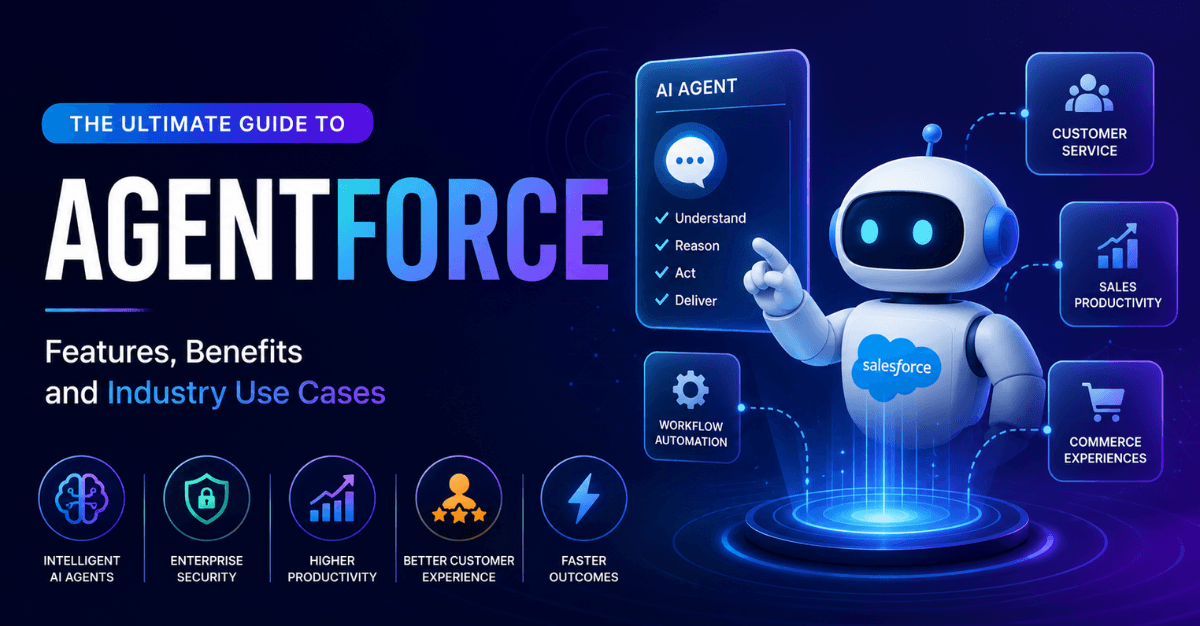
Recognizing this shift, Salesforce introduced Agentforce, a powerful AI platform designed to help organizations build and deploy autonomous AI agents across customer service, sales, marketing, commerce, and operations.
Agentforce is more than another AI assistant. It represents Salesforce’s vision of a digital workforce where AI agents work alongside employees, automate complex tasks, and deliver personalized customer experiences at scale.
In this guide, we’ll explore what Agentforce is, its core features, business benefits, industry applications, and why it is becoming one of the most important innovations in the Salesforce ecosystem.
What Is Salesforce Agentforce?
Agentforce is Salesforce’s agentic AI platform — an integrated layer across the entire Salesforce ecosystem that enables organizations to build, deploy, and manage autonomous AI agents that work alongside human teams.
In 2025, Salesforce underwent its most significant rebranding in company history, transitioning from the familiar “Cloud” naming convention to the Agentforce brand. This was not a cosmetic change — it reflected a fundamental architectural shift in how the platform operates.
Where traditional Salesforce automation (Flows, Process Builder, Apex) executes deterministic, pre-defined logic, Agentforce agents use AI reasoning to determine what action to take, when to take it, and how to handle situations that were not explicitly anticipated in the original configuration.
Read: Salesforce AI Implementation Challenges (And How to Solve Them)
Agentforce vs. Chatbots vs. Traditional Automation
| Capability | Traditional Chatbot | Rule-Based Automation | Agentforce |
|---|---|---|---|
| Handles predefined scenarios | ✅ | ✅ | ✅ |
| Reasons through new situations | ❌ | ❌ | ✅ |
| Takes multi-step actions | ❌ | ✅ (pre-defined only) | ✅ (adaptive) |
| Learns from context | ❌ | ❌ | ✅ |
| Operates across systems | ❌ | Limited | ✅ |
| Escalates intelligently to humans | Limited | ❌ | ✅ |
| Available 24/7 | ✅ | ✅ | ✅ |
The key distinction: a chatbot navigates decision trees. A rules-based automation follows a script. An Agentforce agent reasons through the situation and determines what to do — more like a junior team member than a workflow.
Why Agentforce Matters in 2026
Businesses are facing increasing pressure to improve productivity, reduce costs, and deliver exceptional customer experiences.
At the same time, employees are overwhelmed by repetitive administrative tasks that consume valuable time.
Agentforce addresses these challenges by introducing AI agents capable of handling many routine activities that traditionally required human intervention.
Organizations can use Agentforce to:
- Improve operational efficiency
- Accelerate customer service
- Increase sales productivity
- Automate workflows
- Deliver personalized experiences
- Scale without proportionally increasing headcount
As AI adoption continues to accelerate, businesses that effectively leverage AI agents will gain significant competitive advantages.
Also read: Is Agentforce Designed to Slowly Replace Einstein?
How Agentforce Works
Agentforce combines multiple Salesforce technologies into a unified AI platform.
Key components include:
Salesforce Data Cloud
Data Cloud serves as the foundation for Agentforce by providing unified customer data from multiple sources.
This allows AI agents to access real-time customer information and deliver context-aware responses.
Einstein AI
Einstein provides the intelligence behind Agentforce agents.
It powers:
- Natural language understanding
- Recommendations
- Predictions
- Content generation
- Decision support
Salesforce Platform
Agentforce integrates directly with Salesforce applications including:
- Sales Cloud
- Service Cloud
- Marketing Cloud
- Commerce Cloud
- Revenue Cloud
This allows agents to execute actions across the entire customer lifecycle.
Agent Builder
Agent Builder enables organizations to configure and customize AI agents without extensive coding.
Businesses can define:
- Agent roles
- Tasks
- Workflows
- Knowledge sources
- Permissions
This simplifies deployment and management.
Core Agentforce Features
1. Agentforce for Sales
Agentforce transforms sales operations across the entire deal cycle — from lead generation to close.
2. Agentforce for Service
Customer service is the highest-volume Agentforce deployment category in 2026 — and the one with the most immediate, measurable ROI.
Provide always-on support for customers to help with answering questions, resolving cases, managing orders, and troubleshooting issues — delivering reduced response times, always-on service, and cost savings.
3. Agentforce for Marketing
Automate communications about event information, book sessions, provide event logistics and surveys — delivering personalized marketing and a streamlined experience.
Agentforce Marketing agents handle campaign-level tasks that previously required manual effort at scale: personalizing outreach based on behavioral data, managing lead nurture sequences, segmenting audiences in real time, and surfacing attribution insights without manual report building.
4. Agentforce for Commerce
Agentforce for Commerce helps businesses manage their digital commerce business and grow sales — used by organizations in the B2B, B2C, and D2C sectors with headless commerce, composable commerce, order management, and payments.
In March 2026, Salesforce announced Intent-Aware Search, which solves a key frustration for online shoppers: the dreaded “no results” search page.
5. Agentforce in Slack
Conversational AI inside Slack allows users to query customer data or complete Salesforce tasks directly through chat, with enterprise-grade controls for privacy and governance.
Account management agents can now be found in Slack, letting teams update opportunities and research accounts without leaving the Slack interface.
6. Agentforce Builder — Low-Code Agent Creation
Agentforce Builder enables low-code agent creation with custom topics and actions. Industry-specific templates exist for financial services, healthcare, manufacturing, and retail. MuleSoft integration connects agents to external systems for cross-platform workflows.
7. Data 360 — The Intelligence Foundation
Data 360 (formerly Data Cloud) is Salesforce’s unified data platform. It ingests, harmonizes, and unifies data from any source to create comprehensive customer profiles that power AI agents and personalization across the entire Agentforce 360 ecosystem. In 2026, Data 360 has become the intelligence foundation that enables autonomous agents to make informed decisions.
8. Agentforce for Background Processing
Have Agentforce work behind the scenes to process data and perform long-running tasks to improve productivity for any department — delivering cost savings, higher productivity, and more complete data.
9. Employee Learning Agents
Build every employee customizable learning journeys that are conversational, flexible, and based on their role or persona — delivering improved learning outcomes, scalability, and global accessibility.
10. Agentforce for Identity and Security
Agentforce for Identity introduces a conversational layer to identity management, allowing administrators to streamline OAuth and External Client App setup using natural language. This streamlines integration configuration, reduces configuration errors, and aligns identity management with Salesforce’s broader shift toward AI-assisted development.
The Business Benefits of Agentforce
Increased Productivity
Employees spend significant time on repetitive administrative work.
Agentforce automates routine tasks, allowing teams to focus on strategic initiatives.
Faster Customer Service
AI agents can handle customer inquiries instantly.
This reduces wait times and improves customer satisfaction.
Improved Decision-Making
By analyzing large volumes of data, Agentforce helps employees make more informed decisions.
Reduced Operational Costs
Automation reduces manual effort and enables businesses to scale operations more efficiently.
Personalized Experiences
Because agents access customer data in real time, interactions can be highly personalized.
24/7 Availability
AI agents operate continuously, ensuring customers receive support outside traditional business hours.
Faster Sales Cycles and Higher Win Rates
Agentforce automates meeting prep by synthesizing CRM data into actionable insights. SDR agents handle lead qualification and scheduling around the clock. Sales teams spend less time on data entry and more time building relationships.
Enterprise-Grade Security and Compliance
Agentforce is built with enterprise-grade security and compliance standards to ensure data privacy and regulatory adherence. It scales effortlessly to support growing customer bases and complex workflows, making it suitable for industries such as healthcare, finance, and retail.
Faster Agent Onboarding and Training
At Wiley, seasonal agents onboarded 50% faster after Agentforce deployment. The platform’s ability to deliver contextual information and guided workflows to new team members reduces training time while improving quality from day one.
Reduced Repetitive Workload for Human Teams
Automated workflow suggestions allow the platform to recommend automation opportunities for repetitive business processes, helping organizations reduce manual work and improve operational efficiency.
Composable — Start Small, Scale Fast
Agentforce does not require a full-platform transformation to deliver value. Basic implementation requires Salesforce Admin knowledge and understanding of business workflows. Low-code tools reduce technical barriers for simple use cases.
Check out: Salesforce AI Agents – The Future of Enterprise Automation
Agentforce Use Cases Across Salesforce Clouds
Agentforce for Sales Cloud
Sales teams spend significant time on administrative activities.
Agentforce can:
- Generate opportunity summaries
- Recommend next-best actions
- Prepare meeting notes
- Forecast revenue
- Automate follow-ups
This allows sales representatives to focus more on building customer relationships.
Agentforce for Service Cloud
Customer service teams can use Agentforce to:
- Resolve common inquiries
- Route cases
- Generate responses
- Access knowledge articles
- Escalate complex issues
This improves response times and agent efficiency.
Agentforce for Marketing Cloud
Marketing teams can leverage Agentforce to:
- Create personalized content
- Build audience segments
- Optimize campaigns
- Analyze engagement data
- Recommend campaign improvements
Agentforce for Commerce Cloud
E-commerce businesses can use AI agents to:
- Recommend products
- Answer customer questions
- Assist with checkout
- Manage returns
- Improve shopping experiences
Agentforce for Revenue Cloud
Revenue operations teams can use Agentforce to:
- Generate quotes
- Apply pricing rules
- Recommend products
- Streamline quote-to-cash processes
Also check: Salesforce Service Cloud + AI – Next-Gen Customer Experience
Industry Use Cases: Agentforce Across Sectors
Healthcare
Healthcare organizations can use Agentforce to:
- Manage patient inquiries
- Schedule appointments
- Assist care coordination
- Provide personalized patient support
Financial Services
Banks and financial institutions can leverage Agentforce for:
- Customer onboarding
- Fraud detection support
- Loan processing assistance
- Account servicing
Retail and E-Commerce
Retailers can improve customer experiences through:
- Product recommendations
- Personalized promotions
- Customer support automation
- Order management
Manufacturing
Manufacturers can use Agentforce to:
- Support distributors
- Manage service requests
- Automate sales processes
- Improve supply chain visibility
Telecommunications
Telecom providers can automate:
- Customer support
- Billing inquiries
- Service provisioning
- Plan recommendations
Check: WhatsApp for Salesforce – Transform Customer Conversations Without Leaving Your CRM
How to Get Started with Agentforce
Step 1: Identify Your Highest-Impact Use Case
Start where the volume is highest and the business case is clearest. Customer service case deflection, lead qualification, and sales meeting preparation are the three use cases with the fastest ROI timeline for most organizations.
Step 2: Audit Your Data Foundation
Data 360 becomes the intelligence foundation that enables autonomous agents to make informed decisions. Before deploying agents, assess whether your Salesforce data is clean, current, and structured appropriately to support agent decisions. Agents operating on poor data produce poor outcomes.
Step 3: Build Your First Agent with Agentforce Builder
Agentforce Builder enables low-code agent creation with custom topics and actions. Industry-specific templates exist for financial services, healthcare, manufacturing, and retail. Start with a template relevant to your industry, customize it to your specific use case, and deploy to a defined user group.
Step 4: Define Human Escalation Paths
Agentforce agents perform best when their scope is clearly defined and escalation paths to human team members are explicit. Define the situations where agents should escalate, who they should escalate to, and how the handoff occurs.
Step 5: Measure, Iterate, and Expand
Establish baseline metrics before deployment (case volume, resolution time, lead qualification rate, rep time on admin tasks). Measure post-deployment performance against those baselines. Organizations report ROI in as little as two weeks — use early data to build the internal business case for expanding agent scope.
Agentforce vs. Competitors: Where It Stands
| Platform | Foundation | Key Differentiator | Best For |
|---|---|---|---|
| Salesforce Agentforce | Native Salesforce platform | Deepest CRM + data integration | Salesforce customers |
| Microsoft Copilot Agents | Microsoft 365 + Azure | Microsoft ecosystem depth | Microsoft-centric organizations |
| ServiceNow AI Agents | IT Service Management | ITSM workflow automation | IT operations |
| HubSpot AI Agents | HubSpot CRM | SMB accessibility | Small to mid-market |
| Custom LLM Deployments | Enterprise AI infrastructure | Maximum flexibility | Organizations with deep AI teams |
For organizations already on Salesforce, Agentforce has a structural advantage that no external AI agent platform can match: it operates natively on your CRM data, your customer records, your business processes, and your security framework — without the integration complexity and data duplication that cross-platform deployments require.
Best Practices for Agentforce Implementation
Start with High-Impact Use Cases
Identify processes with high volumes of repetitive work.
Define Clear Agent Responsibilities
Each agent should have specific tasks and objectives.
Maintain Human Oversight
AI agents should complement employees rather than replace critical decision-making.
Ensure Data Quality
Agent performance depends heavily on accurate and reliable data.
Monitor Performance Continuously
Track outcomes, user feedback, and business impact to optimize agent effectiveness.
The Future of Agentforce
Agentforce represents the next stage of enterprise AI.
As AI capabilities continue to evolve, future agents will become increasingly capable of:
- Complex reasoning
- Multi-agent collaboration
- Predictive decision-making
- End-to-end process automation
Organizations that invest in AI agent strategies today will be better positioned to compete in an increasingly digital economy.
Conclusion
Agentforce is transforming how businesses leverage AI within the Salesforce ecosystem.
By enabling organizations to deploy intelligent AI agents across sales, service, marketing, commerce, and revenue operations, Agentforce helps improve productivity, enhance customer experiences, and accelerate business growth.
Unlike traditional chatbots, Agentforce agents can understand context, access enterprise data, automate workflows, and execute meaningful business actions.
As businesses continue to embrace AI-driven transformation, Agentforce is poised to become a cornerstone of modern digital operations.
For organizations looking to unlock the full potential of Salesforce AI, Agentforce provides a powerful foundation for innovation, automation, and growth.
Frequently Asked Questions
Q: What is the ROI of Agentforce?
Organizations report average returns of 171% from agentic AI deployments, with U.S. enterprises hitting 192%, exceeding traditional automation by 3x. Wiley achieved 213% ROI with $230,000 in documented savings. Agentforce users report ROI in as little as two weeks.
Q: How much does Agentforce cost?
Agentforce uses a consumption-based Flex Credits model at $2 per conversation for standard interactions. Volume discounts are available, and many capabilities are included in existing Salesforce Sales Cloud and Service Cloud licenses.
Q: What is the Atlas Reasoning Engine?
The Atlas Reasoning Engine uses a Reason–Act–Observe loop for human-like decision-making. It is the AI reasoning framework that governs how Agentforce agents analyze situations, determine appropriate actions, execute those actions, and evaluate whether the goal has been achieved.
Q: Do I need to be a developer to build Agentforce agents?
Basic implementation requires Salesforce Admin knowledge and understanding of business workflows. Low-code tools reduce technical barriers for simple use cases. Advanced deployments benefit from prompt engineering skills, data strategy expertise, and familiarity with compliance requirements.
Q: Which industries use Agentforce most?
Healthcare is leading the charge with 68% already using AI agents, followed closely by financial services and retail. Every industry is finding ways to make AI agents work for them.
Q: How does Agentforce handle data security and compliance?
Agentforce contains a powerful set of low-code guardrails and security tools designed to keep data secure, prevent abuse, and reduce hallucinated and biased responses. These guardrails are on by default and are easily configurable by admins and business users.
 Bio
Bio