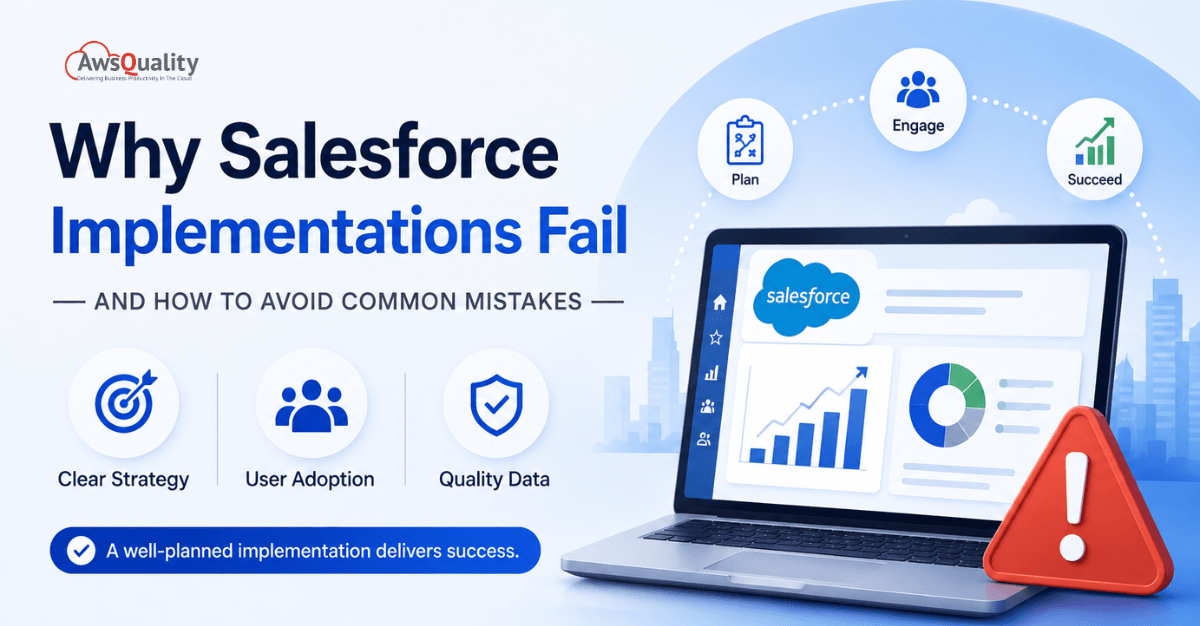
Salesforce is one of the world’s most powerful CRM platforms, helping businesses streamline sales, customer service, marketing, and operations. However, simply purchasing Salesforce doesn’t guarantee success. Many organizations invest significant time and resources into implementation, only to face low user adoption, budget overruns, missed deadlines, and disappointing business outcomes.
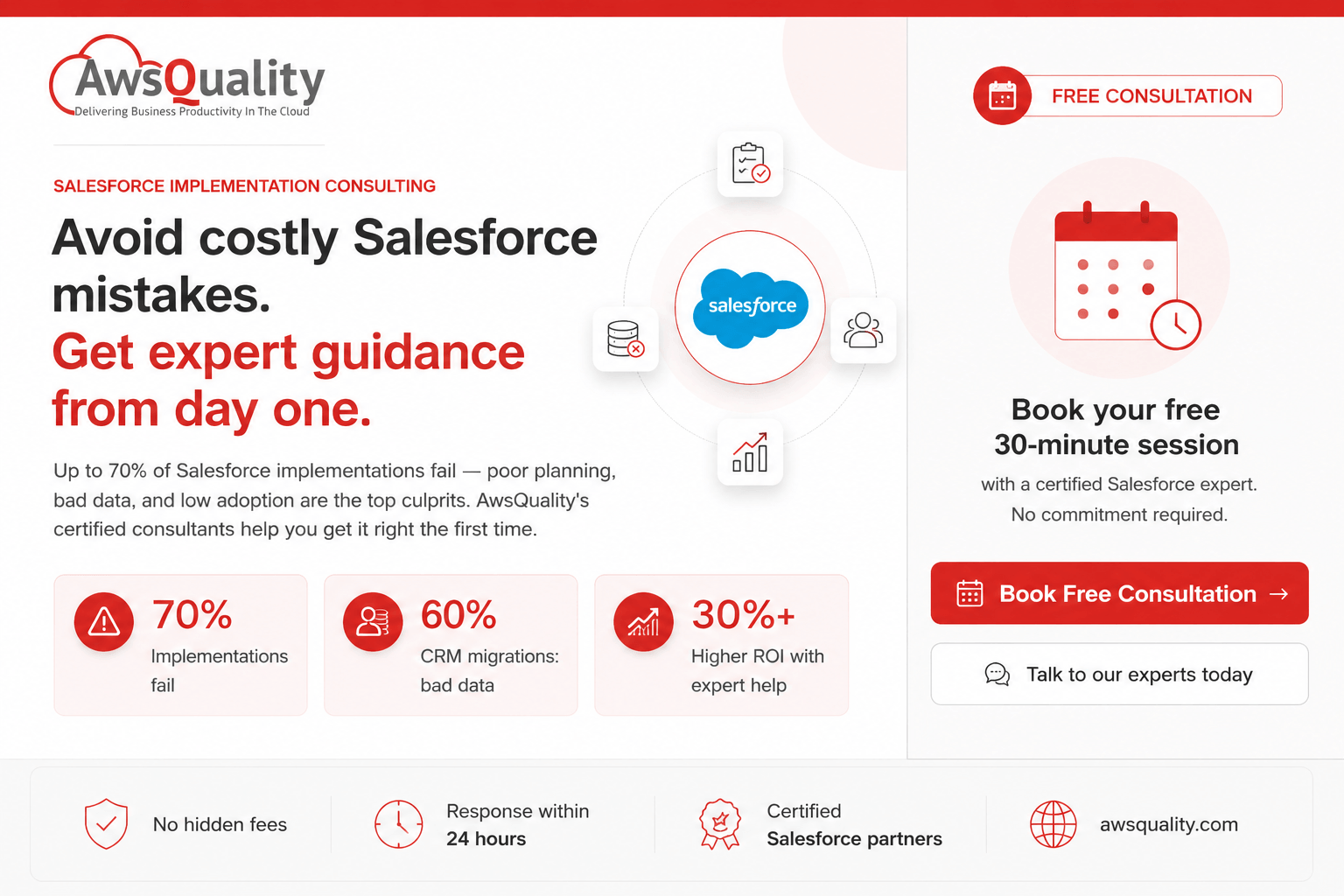
Up to 70% of Salesforce implementations fail to meet their strategic objectives. Some research puts the broader CRM failure rate as high as 90%. Companies invest six, seven, and sometimes eight-figure sums into Salesforce deployments — expecting streamlined sales pipelines, better customer insights, and measurable productivity gains — and walk away with an underused system, demoralised teams, and a budget that has quietly doubled.
The large percentage of digital transformation projects fail to achieve their intended objectives—not because of the technology itself, but because of poor planning, inadequate stakeholder involvement, and ineffective change management.
This guide breaks down every major failure point — rooted in the latest research and real-world outcomes — and gives you the exact strategies to avoid them, so your organization lands in the successful 30%.
Read: Low Salesforce Adoption? Try These 7 Fixes That Work
Why Salesforce Implementations Matter
Salesforce has evolved far beyond a traditional CRM. It now serves as a unified platform for managing customer relationships, sales, service, marketing, analytics, automation, and AI-powered business processes.
When implemented correctly, Salesforce enables organizations to:
- Improve customer experiences
- Increase sales productivity
- Automate business processes
- Deliver better reporting and analytics
- Enhance collaboration
- Support business growth
- Accelerate digital transformation
However, achieving these benefits requires much more than technical implementation.
The Hidden Cost of Failed Salesforce Implementations
Before examining why failures happen, it is worth understanding what they cost. A failed Salesforce rollout is not simply a missed deadline or a stalled project. The consequences are material and long-lasting.
When implementations go wrong, organizations typically face:
- Wasted licensing and consulting fees — often ranging from $25,000 to $500,000+ depending on scale
- Lost productivity — sales teams reverting to spreadsheets, email threads, and shadow systems
- Re-implementation costs — which research shows typically run 50% to 300% of the original project budget
- Delayed time-to-value — meaning competitive advantages remain unrealised for 12–18 additional months
- Erosion of stakeholder trust — making future technology initiatives harder to fund and approve
One documented case saw a manufacturing company select a low-cost $89,000 implementation over a $340,000 proposal — only to face a user adoption rate of just 34% against an industry standard of 85%+, a 28% decline in business process efficiency from pre-implementation levels, and an eventual re-implementation bill of $445,000. The total cost of the “cheaper” decision: $2.7 million in wasted investment and 18 months of lost productivity.
The data is clear: the cost of a failed implementation is always greater than the cost of doing it right the first time.
Also read: Top Salesforce Integrations Every Growing Business Needs
Common Reasons Salesforce Implementations Fail
1. Undefined or Vague Business Goals
The single most common starting mistake is beginning a Salesforce implementation without a clear, measurable definition of what success looks like.
Teams launch into configuration conversations — which objects to build, which fields to include, which dashboards to display — without first answering the fundamental question: what business problem are we actually solving?
The result is a Salesforce instance that is technically configured but operationally irrelevant. It may look impressive in demos but fails to reflect the actual workflows, priorities, and decision-making processes of the people who must use it every day.
What goes wrong:
- Requirements are gathered from IT rather than frontline users, creating a system optimised for data architecture rather than daily workflows
- Success metrics are never defined, making it impossible to measure ROI or identify failure early
- Scope creep accelerates because there is no agreed baseline to push back against — research shows that poorly scoped projects commonly see cost overruns of 150% to 300% above original estimates
How to avoid it:
Before any configuration begins, define your goals in specific, measurable business terms. Instead of “improve sales visibility,” write “reduce average deal cycle time from 45 days to 30 days within 6 months of go-live.” Attach every major configuration decision to one of these outcomes. If a requested feature does not map to a defined business goal, it goes in Phase 2 — not Phase 1.
2. Poor User Adoption
If undefined goals are the most common starting mistake, poor user adoption is the most common ending failure — and the reason most implementations ultimately underperform.
The CRM failure rate sits at 55% in 2025, and low user adoption is the leading cause. When users resist a new platform, data goes unentered, pipeline reporting becomes unreliable, and the entire investment produces near-zero return. Research also shows that only 50% of CRM features are actively used by employees, even in organizations that consider their implementations successful.
User adoption is not a training problem. It is a change management problem. And most organizations treat it as neither — assuming that if the system is built, users will simply come.
What goes wrong:
- Training is compressed or cut to meet budget, reducing adoption by an estimated 20% to 40%
- Salesforce is deployed in a way that forces users into generic processes that do not reflect how they actually work
- There is no visible benefit to the user — the system feels like additional data entry for management’s benefit rather than a tool that makes their job easier
- No reinforcement exists post-launch: adoption campaigns, refresher training, and usage incentives are absent
How to avoid it:
Treat adoption as a change management initiative, not a software deployment. This means:
- Involving frontline users in the requirements and configuration process — they know the pain points no one in the C-suite has ever seen
- Designing Salesforce around how people work, not how a textbook process says they should work
- Investing in role-based, workflow-specific training rather than generic system walkthroughs
- Running post-launch adoption campaigns — one consulting company saw a 50% increase in feature usage after running a structured “Quote it to Win it” campaign following initial training
- Companies that invest in continuous learning see 32% higher ROI from their Salesforce investment compared to those following a static approach
3. Weak or Absent Executive Sponsorship
A Salesforce implementation is not an IT project. It is a business transformation programme that touches sales, marketing, customer service, operations, finance, and leadership. Without active, visible commitment from senior executives, it will not succeed.
When leadership is ambivalent — approving the budget but failing to champion the initiative — the message transmitted throughout the organization is that Salesforce is optional. Middle managers deprioritize it. Users skip training. Workarounds proliferate. And within six months, the platform is a ghost town of incomplete records and abandoned pipelines.
What goes wrong:
- Executives approve the project but delegate all involvement to a project manager or IT lead
- When competing priorities arise, Salesforce training and change management are the first things cut
- Leadership does not use Salesforce themselves, undermining any expectation that frontline staff should
How to avoid it:
Secure full executive commitment before kick-off — not just budget approval, but active participation. Executives should publicly champion the initiative in company communications, attend milestone reviews, and ideally use Salesforce for their own reporting. When a CEO discusses Salesforce metrics in leadership meetings and celebrates wins attributed to better CRM data, the entire organization receives an unmistakable signal about its importance.
4. Over-Customization and Technical Debt
Salesforce is extraordinarily flexible. That flexibility is one of its greatest strengths — and one of its most dangerous temptations during implementation.
Over-Customization occurs when organizations build complex custom code, bespoke objects, and intricate Apex logic to replicate their existing processes inside Salesforce, rather than using the implementation as an opportunity to improve those processes. The result is a platform that looks familiar on day one but becomes increasingly brittle, expensive to maintain, and difficult to upgrade over time.
What goes wrong:
- Organizations try to rebuild their legacy systems inside Salesforce rather than adopting Salesforce best practices
- Custom code dependencies make each new Salesforce release a regression risk, requiring expensive re-testing and updates
- Future administrators and partners spend the majority of their time maintaining Customizations rather than driving business value
- New features — particularly AI capabilities like Agentforce — are incompatible with heavily customised orgs, blocking access to the platform’s most powerful innovations
How to avoid it:
Adopt a “configure before customise” philosophy. Use Salesforce’s standard features, flows, and Lightning components wherever possible. Reserve custom Apex code for use cases where the standard platform genuinely cannot support the requirement — not simply because a stakeholder wants to preserve a familiar workflow. Establish a governance framework that requires business justification for every Customization, and document every departure from standard configuration for future maintainability.
5. Poor Data Quality and Migration Failures
Salesforce is only as good as the data that lives inside it. And in most organizations, data is the most underestimated challenge of any CRM implementation.
Research shows that 60% of CRM migrations fail due to bad data quality. Poor data quality costs businesses in the United States approximately $3 trillion annually, according to Harvard Business Review. Migrating dirty data into a new system does not fix the data — it simply moves the problem into a more expensive container, where it immediately begins corrupting reports, misleading sales forecasts, and undermining the trust that users place in the system.
What goes wrong:
- Data cleansing is treated as a post-migration task rather than a pre-migration requirement
- Duplicate records, inconsistent field values, and incomplete historical data are carried forward wholesale into the new org
- Field mapping between legacy systems and Salesforce is done hastily, creating structural mismatches that require months of remediation
- Testing of migrated data is cut due to timeline pressure, meaning data quality issues surface in production
How to avoid it:
Begin data preparation in parallel with the configuration phase — not after it. Audit every data source, define data ownership and quality standards before migration begins, and run deduplication and standardization processes on the source data. Test migrated data in a sandbox environment against real business use cases before any production go-live. Establish ongoing data governance processes so that data quality does not degrade over time post-launch.
6. Choosing the Wrong Implementation Partner
The quality of your Salesforce implementation partner can shape the entire outcome of your project. Yet many organizations select partners based primarily on price, creating a false economy that consistently produces far greater costs down the line.
The “low-bid trap” is well-documented. Low-cost implementations frequently encounter massive scope expansion, with change orders increasing project cost 150% to 300% above original estimates. Timeline extensions create cascading business impacts. Emergency fixes and rework require premium consulting rates. And the technical debt accumulated during a rushed, under-resourced implementation takes years to address.
What goes wrong:
- Partners are selected based on hourly rate rather than Salesforce expertise, industry experience, and delivery track record
- The implementation partner lacks certified Salesforce professionals with experience in the specific Clouds (Sales Cloud, Service Cloud, Financial Services Cloud, Health Cloud) relevant to the organization’s needs
- Discovery and requirements gathering are compressed, leading to architecture decisions that don’t support actual business needs
- Post-launch support and optimization are not included in the engagement scope, leaving the organization without expertise at the moment it needs it most
How to avoid it:
Evaluate implementation partners on their Salesforce certifications, industry specialization, reference case studies, and delivery methodology — not their day rate. A certified partner delivers 30% faster fulfilment and 85%+ user adoption, consistently outperforming DIY or low-cost approaches even when their fees appear higher upfront. Ensure that post-launch hypercare support (typically 1–2 weeks of intensive go-live support) is included in the engagement scope, as this period is critical and is frequently omitted from under-resourced implementations.
7. Treating Salesforce as a Technology Project
Perhaps the most fundamental error of all is treating a Salesforce implementation as an IT initiative rather than a business transformation.
When CRM projects are owned by technology teams, they optimise for technical correctness rather than business outcomes. The system may be architecturally elegant, properly configured, and on-time and on-budget — and still fail to deliver measurable value because it was never aligned to how the business actually operates, what users actually need, or what executives actually want to measure.
Salesforce is not a software deployment. It is a new way of managing customer relationships, sales processes, marketing campaigns, and service delivery. It requires the buy-in and active participation of every function that touches customer data — which, in most organizations, means nearly everyone.
How to avoid it:
Position the Salesforce initiative as a cross-functional business programme with executive sponsorship, a dedicated business project owner (not an IT lead), and user representatives from every affected department. Define success in business outcomes — revenue, retention, cycle time, case resolution — not technical milestones. And communicate relentlessly: why the organization is moving to Salesforce, what each team’s experience will look like, and what the expected benefits are for individuals, not just for the company.
8. Neglecting Post-Launch Optimization
Many organizations treat go-live as the finish line. In reality, it is the starting line.
A Salesforce instance that is not continuously maintained, optimised, and evolved will stagnate. Adoption rates that look promising at launch will erode as users encounter friction, workarounds proliferate, and the gap between the system and actual business processes grows. Features that could dramatically improve productivity will go unused because no one is tracking usage or responding to user feedback.
What goes wrong:
- Post-launch support and optimization budget are cut after go-live, leaving the platform to manage itself
- No governance process exists for handling enhancement requests, meaning either every request gets implemented (scope creep) or nothing does (stagnation)
- Usage metrics are never tracked, so declining adoption is invisible until it reaches crisis levels
- Salesforce’s three annual release cycles introduce new features that never get evaluated or activated
How to avoid it:
Establish a Center of Excellence (CoE) — a cross-functional team responsible for Salesforce strategy, governance, adoption, and roadmap — post-launch. Set quarterly business reviews to assess adoption metrics, data quality, and feature utilization. Track the right KPIs: forecast accuracy, lead-to-opportunity conversion rates, deal cycle time, case resolution rates, and user engagement scores. Gartner research shows that organizations with strong CRM adoption see up to 30% increase in sales revenue and a 26% improvement in win rates compared to peers with low adoption — outcomes that require continuous investment, not just a successful go-live.
Check out: Salesforce Integration v/s. Migration – Which Strategy Works Best for Your Business
Best Practices for a Successful Salesforce Implementation
The organizations that consistently deliver successful Salesforce implementations share a set of common practices that translate directly into measurable business outcomes.
1. Start with business outcomes, not features.
Define what success looks like in specific, measurable terms before any configuration begins. Every decision during implementation should map back to one of these outcomes.
2. Invest in change management from day one.
Allocate at minimum 15–20% of your implementation budget to change management, training, and communications. This is not optional — it is the primary determinant of whether users will actually use the system.
3. Secure and maintain executive sponsorship.
Identify an executive sponsor who will champion the initiative publicly, attend milestone reviews, and use Salesforce themselves. When leadership is visibly committed, adoption follows.
4. Cleanse data before migration.
Treat data preparation as a parallel workstream, not an afterthought. The quality of data at go-live determines the quality of insights for years afterward.
5. Phase the rollout strategically.
Resist the pressure to build everything in Phase 1. A focused, well-executed initial rollout with strong adoption is infinitely more valuable than a bloated, complex launch that no one uses. Plan Phase 2 before Phase 1 goes live.
6. Choose the right partner.
Select your implementation partner based on certified expertise, relevant industry experience, and a proven delivery methodology. The difference between a good partner and a poor one is often measured in millions of dollars and years of technical debt.
7. Build for continuous improvement.
Plan for post-launch governance, optimization, and ongoing training from the start. A Salesforce implementation is not a project with an end date — it is a programme that evolves with your business.
How AI is Improving Salesforce Implementations
Artificial Intelligence is helping organizations accelerate Salesforce projects through:
- Intelligent data migration
- Automated workflow recommendations
- AI-powered customer insights
- Predictive analytics
- Process automation
- Agent productivity improvements
- AI-assisted customer support
With technologies like Salesforce Einstein and Agentforce, businesses can further enhance customer experiences and operational efficiency after implementation.
Also check: Is Agentforce Designed to Slowly Replace Einstein?
Why Work with Salesforce Experts?
A successful Salesforce implementation requires more than technical expertise—it requires a deep understanding of business processes, change management, integrations, and long-term optimization.
Our Salesforce Services help businesses successfully plan, implement, customize, integrate, and optimize Salesforce solutions aligned with their strategic goals.
Salesforce Implementation Success Checklist
Before starting your implementation, ensure you can answer “Yes” to these questions:
- ✅ Have we defined measurable business objectives?
- ✅ Have we documented current and future business processes?
- ✅ Is our data clean and migration-ready?
- ✅ Have we involved all key stakeholders?
- ✅ Do we have executive sponsorship?
- ✅ Have we developed a user training plan?
- ✅ Have we planned integrations with existing systems?
- ✅ Do we have a post-launch optimization strategy?
If any answer is “No,” it’s worth addressing those gaps before moving forward.
Conclusion
Salesforce implementations don’t fail because Salesforce lacks capabilities—they fail because organizations underestimate the importance of planning, stakeholder engagement, data quality, user adoption, and continuous improvement.
By aligning technology with business objectives, investing in change management, choosing the right implementation partner, and focusing on long-term optimization, businesses can maximize the value of their Salesforce investment.
The organizations that succeed with Salesforce are not those with the biggest budgets or the most complex configurations. They are the organizations that start with clear business outcomes, invest in their people as much as their platform, choose partners with genuine expertise, and commit to continuous improvement long after go-live.
Salesforce can be a transformative competitive advantage. The decision to implement it is only the beginning. How you implement it — and with whom — is everything.
Ready to implement Salesforce the right way?
Contact AwsQuality today for a free, no-obligation consultation. Our certified Salesforce experts will assess your current environment, define your success metrics, and map a clear path to implementation that delivers measurable ROI from day one.
 Bio
Bio