
The cloud computing industry has entered one of its most dynamic phases yet — and Microsoft Azure sits firmly at the center of this transformation. Launched in 2010 as a quiet challenger to Amazon Web Services, Azure has evolved into the world’s second-largest cloud platform, reshaping how enterprises think about infrastructure, artificial intelligence, and digital strategy.
For business leaders, IT decision-makers, and technology professionals, understanding where Azure stands today isn’t just useful — it’s essential. The numbers behind Azure’s growth tell a story of extraordinary momentum: revenue surging past $75 billion, AI services expanding at triple-digit rates, and an enterprise customer base that covers the vast majority of the world’s largest corporations.
This blog dives deep into the key Microsoft Azure statistics that are shaping cloud adoption nowadays — covering market share, revenue, global infrastructure, AI leadership, enterprise penetration, and the strategic forces driving Azure’s continued rise.
Why Microsoft Azure Continues to Grow
Microsoft Azure’s rapid growth is driven by its ability to meet the evolving needs of modern businesses. As organizations accelerate their digital transformation initiatives, they require a cloud platform that offers scalability, security, flexibility, and seamless integration with existing technologies. Azure delivers all of these capabilities through a comprehensive portfolio of cloud services, including computing, storage, networking, artificial intelligence (AI), data analytics, DevOps, and cybersecurity. Its strong integration with Microsoft products such as Microsoft 365, Dynamics 365, and Power Platform makes adoption easier for enterprises already invested in the Microsoft ecosystem.
Another major growth driver is Azure’s leadership in hybrid and multi-cloud environments. Many organizations prefer a combination of on-premises infrastructure and public cloud services rather than a complete cloud migration. Azure’s hybrid cloud solutions enable businesses to modernize at their own pace while maintaining compliance, security, and operational continuity. Additionally, Microsoft’s significant investments in AI, cloud infrastructure, and sustainability continue to strengthen Azure’s position as a trusted cloud platform. As businesses increasingly adopt AI-powered applications and data-driven strategies, Azure remains a preferred choice for organizations looking to innovate, optimize costs, and build scalable, future-ready digital solutions.
Read: Cloud Migration Guide – From Legacy Systems to Cloud
Key Microsoft Azure Statistics
1. Azure’s Global Market Share: The World’s Second-Largest Cloud Platform
Microsoft Azure has firmly established itself as the second-largest cloud provider globally and continues to gain market share. According to industry reports, Azure holds approximately 21–22% of the global cloud infrastructure market, behind AWS (28–29%) and ahead of Google Cloud (12–14%). Together, these three providers account for nearly 68% of global cloud spending.
Azure’s growth is particularly impressive, with cloud revenue increasing 39% year over year, significantly outpacing many competitors. This consistent momentum makes Azure an increasingly attractive choice for organizations planning long-term cloud investments.
2. Azure Revenue Continues to Surge
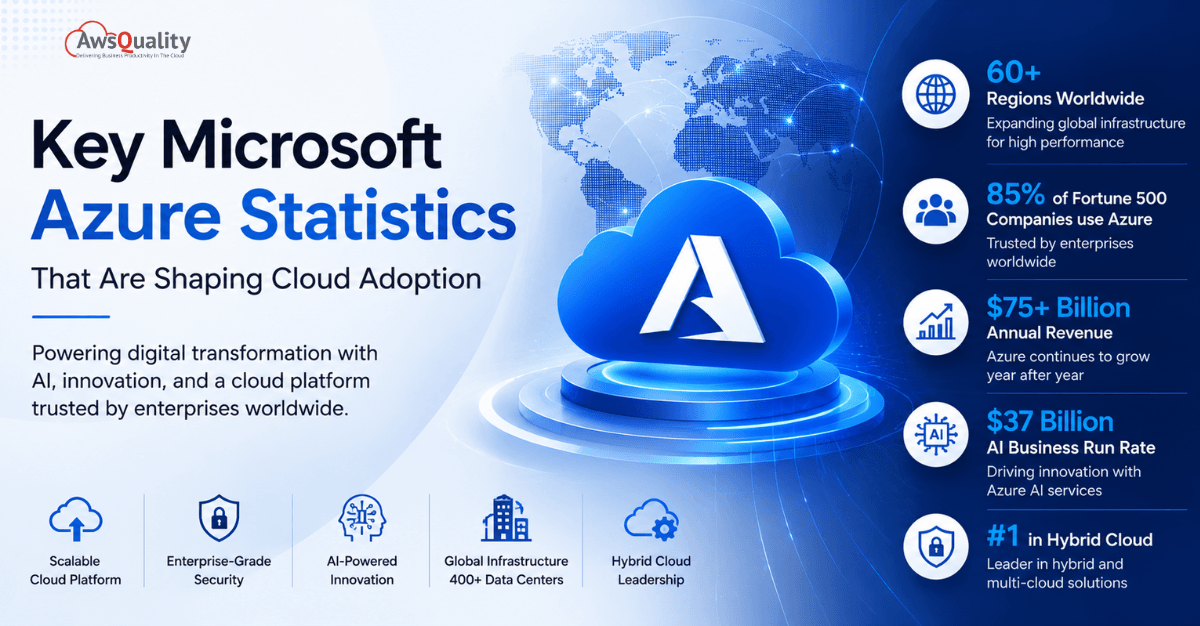
Azure has become one of Microsoft’s largest growth engines, generating over $75 billion in annual revenue. Microsoft’s broader cloud business continues to expand rapidly, driven by enterprise cloud adoption, AI services, and infrastructure investments.
Key Highlights
- Azure revenue exceeds $75 billion annually
- Azure cloud services continue to grow by nearly 40% year over year
- Microsoft is investing heavily in cloud and AI infrastructure to support future growth
These figures demonstrate Azure’s critical role in Microsoft’s long-term business strategy.
3. Strong Enterprise Adoption
Azure has earned the trust of organizations of every size, from startups to global enterprises.
Key Statistics
- 85% of Fortune 500 companies use Microsoft Azure
- 95% of Fortune 500 organizations use Microsoft Cloud services
Azure adoption continues to grow across finance, healthcare, manufacturing, retail, government, and technology sectors
Its seamless integration with Microsoft 365, Dynamics 365, and AI services makes Azure especially appealing for enterprise customers.
4. Azure AI is Driving Cloud Innovation
Artificial Intelligence has become one of Azure’s biggest growth drivers. Microsoft’s investment in OpenAI and Azure AI services has positioned Azure as a leading platform for enterprise AI.
Key Statistics
- Microsoft’s AI business has reached a $37 billion annual run rate
- Azure AI supports 60,000+ enterprise customers
- Azure AI Foundry offers access to 11,000+ AI models
As businesses increasingly adopt generative AI, Azure continues to strengthen its leadership in AI-powered cloud services.
5. Massive Global Infrastructure
Azure operates one of the world’s largest cloud infrastructures, supporting businesses across more than 70 regions with over 400 data centers.
Microsoft continues expanding its global footprint to improve:
- Performance
- Data residency
- Regulatory compliance
- AI capacity
- Disaster recovery
Its global presence helps organizations deploy applications closer to customers while meeting regional compliance requirements.
6. Hybrid & Multi-Cloud Leadership
Azure is widely recognized for its hybrid cloud capabilities, enabling organizations to seamlessly manage on-premises, edge, and cloud environments.
Key Highlights
- Most enterprises now use hybrid or multi-cloud strategies
- Azure Arc and Azure Stack simplify hybrid cloud management
- Azure’s integration with Windows Server and Microsoft Entra ID makes migration easier for enterprise customers
This flexibility has become one of Azure’s strongest competitive advantages.
7. Enterprise-Grade Security & Compliance
Security remains a key reason organizations choose Azure.
Microsoft invests heavily in cybersecurity and compliance, helping businesses protect sensitive data while meeting industry regulations.
Highlights
- Processes over 100 trillion security signals daily
- Supports 1 billion+ Microsoft Entra users
- Offers one of the industry’s largest portfolios of compliance certifications
Azure’s comprehensive security ecosystem makes it a trusted cloud platform for highly regulated industries.
8. Azure’s Growth Reflects the Future of Cloud Computing
Azure’s success mirrors the rapid expansion of the global cloud market. As organizations invest in AI, hybrid cloud, digital transformation, and application modernization, demand for cloud services continues to accelerate.
With continued innovation in AI, infrastructure, security, and enterprise services, Microsoft Azure is well positioned to remain one of the world’s leading cloud platforms for years to come.
Also read: How to Build Secure AI Systems on Cloud Platforms (Complete Guide)
What These Statistics Mean for Your Organization
The data paints a clear picture: Microsoft Azure is not a platform in steady-state — it is a rapidly evolving ecosystem where growth is accelerating, AI is becoming central, and enterprise trust is deepening. Here is what these statistics mean in practical terms:
For organizations considering cloud migration: Azure’s 85% Fortune 500 adoption rate and deep integration with Microsoft 365 make it the natural starting point for most enterprises. The sheer breadth of compliance certifications and the global infrastructure footprint reduce migration risk.
For technology decision-makers: Azure’s AI capabilities — including access to 11,000+ models through Azure AI Foundry — are no longer experimental. With 60,000+ enterprise customers already using these services, AI workloads on Azure are proven at scale.
For finance and procurement teams: Microsoft’s $627 billion commercial performance obligation signals long-duration enterprise commitment. Azure pricing models, combined with existing Microsoft licensing agreements, often deliver significant cost advantages versus building greenfield on a competing platform.
For IT security and compliance teams: Microsoft Entra’s 1 billion MAU and 100 trillion daily security signals represent a security ecosystem that no individual enterprise can replicate on its own. Leveraging Azure’s security fabric is often more effective than building in-house.
Azure’s Impact Across Industries
Financial Services
Banks and fintech companies use Azure for:
- Secure digital banking
- Fraud detection
- AI-powered analytics
- Regulatory compliance
- Risk management
Healthcare
Healthcare providers leverage Azure for:
- Electronic health records
- Medical imaging
- Telemedicine
- AI-assisted diagnostics
- Data security
Manufacturing
Manufacturers use Azure for:
- IoT monitoring
- Predictive maintenance
- Supply chain optimization
- Smart factories
- Industrial automation
Retail & E-commerce
Retailers rely on Azure to deliver:
- Personalized shopping experiences
- Inventory management
- Customer analytics
- Omnichannel commerce
- Demand forecasting
Government
Public sector organizations use Azure to improve:
- Citizen services
- Digital infrastructure
- Data security
- Compliance
- Cloud modernization
Check out: Zero Trust Security Model for Cloud and AI Applications
Challenges and Considerations
No statistical analysis would be complete without acknowledging the challenges Azure faces.
- Capacity constraints: Azure demand continues to exceed supply in key regions, meaning some customers face delays in provisioning AI infrastructure
- Market fragmentation: Azure’s market share has seen modest pressure as niche cloud players capture specific workloads
- Cost management: Cloud waste reached 29% of IaaS/PaaS budgets in 2026, with AI workloads introducing unpredictable cost patterns — organizations must invest in FinOps practices
- Competition: Google Cloud is growing rapidly (63% YoY in Q1 2026) and its Tensor Processing Units offer cost advantages for specific AI workloads
These challenges are real, but they exist within a context of extraordinary overall strength. Azure’s enterprise integration, AI leadership, and global footprint give it durable competitive moats that are difficult to dislodge.
Best Practices for Azure Adoption
Organizations planning Azure migration should:
- Define clear business objectives
- Assess existing infrastructure
- Develop a cloud migration roadmap
- Optimize cloud costs
- Implement strong security controls
- Automate deployments using DevOps
- Continuously monitor performance
- Train teams on Azure services
A strategic migration plan ensures long-term success and maximizes cloud investments.
How AwsQuality Can Help
Migrating to the cloud is about more than moving workloads—it requires the right strategy, architecture, and ongoing optimization.
At AwsQuality, our cloud experts help businesses plan, migrate, modernize, and optimize Azure environments while ensuring security, scalability, and cost efficiency. Whether you’re starting your cloud journey or optimizing an existing Azure deployment, we help you maximize the value of your cloud investment.
Conclusion
Microsoft Azure continues to shape the future of cloud computing through its enterprise-ready infrastructure, hybrid cloud capabilities, AI innovation, and global reach.
As organizations accelerate digital transformation, Azure’s comprehensive platform enables businesses to modernize operations, improve security, reduce costs, and build intelligent applications at scale.
Understanding these key Azure statistics provides valuable insight into where cloud adoption is heading—and why Azure remains one of the world’s most trusted cloud platforms.
 Bio
Bio