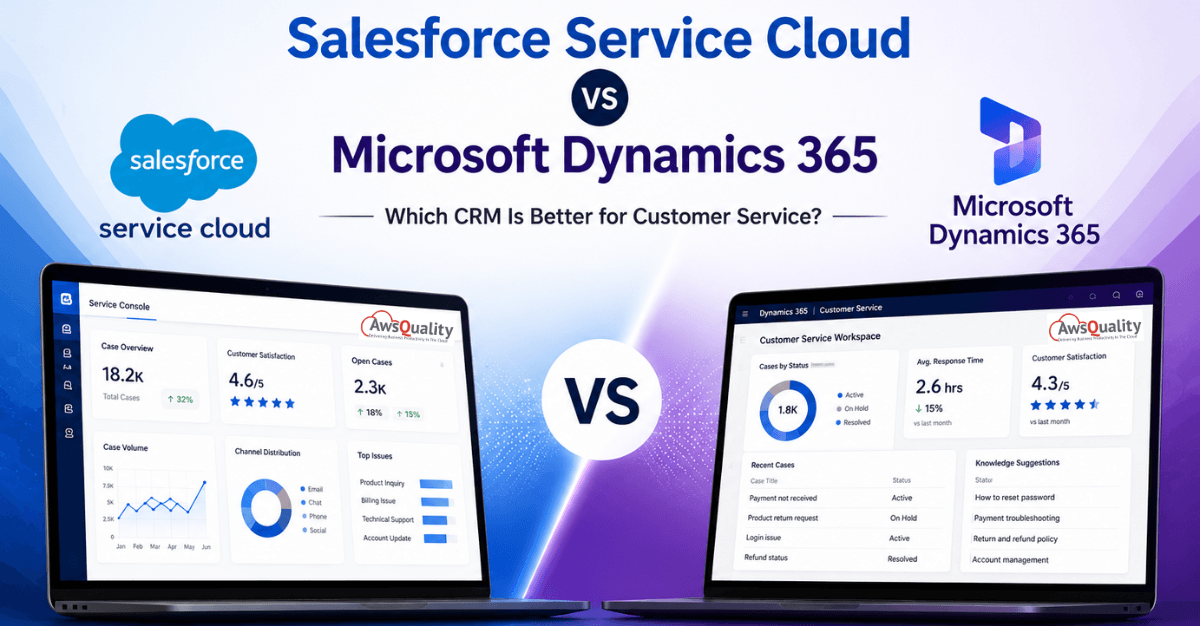
The choice between Salesforce and Dynamics 365 isn’t really about features anymore — both are feature-complete for nearly every use case. Instead, it’s about ecosystem fit, total cost of ownership, and your organization’s ability to drive adoption.
That framing matters enormously for any organization evaluating customer service platforms nowadays. Both Salesforce Service Cloud and Microsoft Dynamics 365 Customer Service are powerful, enterprise-grade solutions designed to help businesses streamline service operations — and a feature-by-feature comparison alone will not produce a clear winner, because both platforms have converged toward comprehensive functionality.
The CRM landscape has transformed dramatically as both Microsoft and Salesforce embrace autonomous AI agents, moving beyond traditional assistance to true digital labor. Both vendors are making massive R&D investments — Microsoft at $29.5 billion annually and Salesforce at $6.4 billion — ensuring continued innovation on both sides of this comparison.[Source: AlphaBold]
For organizations evaluating which platform to invest in, the right question is not “which platform has more features?” It is “which platform’s design philosophy, ecosystem, and AI strategy align with how our organization already operates?” This guide walks through every dimension of that decision — channel coverage, AI capabilities, automation, pricing, integration depth, and the practical adoption realities that determine whether either platform actually delivers on its promise.
What Each Platform Is Built For
Salesforce Service Cloud
Salesforce Service Cloud is a powerful, cloud-based customer service platform designed to help businesses deliver faster, smarter, and more personalized support. As part of the broader Salesforce Customer 360 ecosystem, it enables organizations to unify service operations across channels while leveraging AI and automation to enhance both agent productivity and customer satisfaction.
Service Cloud is built natively on the Salesforce platform — meaning it shares the same underlying data model as Sales Cloud, Marketing Cloud, Commerce Cloud, and Experience Cloud. A service agent working a customer case in Service Cloud sees the same Account and Contact record that a sales rep used to close the original deal, without any integration work required.
Microsoft Dynamics 365 Customer Service
Microsoft Dynamics 365 Customer Service is a flexible, enterprise-grade platform that empowers businesses to provide proactive and connected support experiences. Deeply integrated within the Microsoft ecosystem, it enables service teams to resolve issues efficiently by combining case management, knowledge sharing, and collaboration through familiar tools like Teams, Outlook, and Power Platform.
Dynamics 365 is part of Microsoft’s unified business-application suite, combining CRM and enterprise resource planning (ERP) capabilities. Where Service Cloud’s natural extension is into other Salesforce clouds, Dynamics 365’s natural extension is into the broader Microsoft productivity and business application stack — Power BI for analytics, Power Automate for workflow, and the rest of the Dynamics 365 finance and operations suite.
Read: Salesforce Health Check – Why Your CRM Might Be Underperforming
Salesforce Service Cloud vs Microsoft Dynamics 365: Feature Comparison
| Feature | Salesforce Service Cloud | Microsoft Dynamics 365 |
|---|---|---|
| Omnichannel Support | Excellent | Very Good |
| AI Capabilities | Einstein AI & Agentforce | Microsoft Copilot |
| Workflow Automation | Advanced Flow Automation | Power Automate |
| Self-Service Portal | Experience Cloud | Customer Portal |
| Knowledge Base | Comprehensive | Comprehensive |
| Customization | Extensive | High |
| Third-Party Integrations | 7,000+ AppExchange Apps | Strong Microsoft ecosystem |
| Scalability | Excellent | Excellent |
| Mobile Experience | Excellent | Very Good |
| Reporting & Dashboards | Advanced | Advanced |
User Experience
Salesforce Service Cloud
Salesforce provides an intuitive interface with customizable dashboards, Lightning Experience, and AI-powered recommendations that help service agents resolve issues faster.
Its unified workspace minimizes context switching and improves productivity.
Best For
- Large customer service teams
- Global support centers
- Complex service operations
Microsoft Dynamics 365
Dynamics offers a familiar interface for organizations already using Microsoft products like Outlook, Teams, and Office 365.
Users benefit from seamless collaboration across Microsoft applications.
Best For
- Microsoft-centric organizations
- Businesses heavily invested in Azure and Microsoft 365
AI Capabilities
Artificial Intelligence has become a major differentiator.
Salesforce Service Cloud
Salesforce offers powerful AI through Einstein AI and Agentforce.
Capabilities include:
- Case classification
- Automated routing
- Predictive recommendations
- AI-generated replies
- Service summaries
- Intelligent chatbots
- Customer sentiment analysis
Salesforce continues to invest heavily in generative AI for customer service.
Microsoft Dynamics 365
Microsoft integrates Copilot throughout Dynamics 365.
AI features include:
- Suggested responses
- Conversation summaries
- Knowledge recommendations
- Case resolution assistance
- Productivity enhancements
Organizations already using Microsoft Copilot benefit from a unified AI experience.
Customization & Flexibility
Every organization has unique customer service processes.
Salesforce
Salesforce excels in customization.
Businesses can configure:
- Custom objects
- Service processes
- Automation flows
- Lightning apps
- Custom dashboards
- Industry-specific solutions
The platform supports highly complex enterprise implementations.
Microsoft Dynamics
Dynamics also provides strong customization using:
- Power Apps
- Power Automate
- Azure services
- Low-code development
However, organizations often find Salesforce provides greater flexibility for large-scale CRM customization.
Omnichannel Customer Service
Customers expect support across multiple channels.
Salesforce Supports
- Phone
- Live Chat
- SMS
- Social Media
- Self-Service Portals
- Messaging Apps
Agents manage all conversations from a single workspace.
Microsoft Dynamics Supports
- Voice
- Chat
- SMS
- Social Channels
- Microsoft Teams
Its omnichannel capabilities are continually improving through Microsoft’s cloud ecosystem.
Integration Ecosystem
Salesforce
One of Salesforce’s biggest strengths is its ecosystem.
Benefits include:
- AppExchange marketplace
- ERP integrations
- Marketing platforms
- Finance systems
- eCommerce platforms
- Customer support tools
- AI applications
Thousands of certified applications reduce implementation complexity.
Microsoft Dynamics
Dynamics integrates naturally with:
- Microsoft 365
- Teams
- Outlook
- SharePoint
- Azure
- Power BI
- Power Platform
Organizations already using Microsoft technologies often benefit from tighter integration.
Reporting & Analytics
Data-driven service teams require actionable insights.
Salesforce
Salesforce provides:
- Real-time dashboards
- Custom reports
- Einstein Analytics
- Service KPIs
- Customer satisfaction tracking
- Agent productivity metrics
Microsoft
Dynamics combines:
- Power BI
- Customer Insights
- Operational reporting
- AI-driven analytics
Both platforms provide enterprise-grade reporting capabilities.
Scalability
Both solutions scale effectively.
However, Salesforce is widely recognized for supporting some of the world’s largest enterprise CRM implementations across multiple industries and regions.
Its cloud-native architecture makes expansion relatively seamless.
Pricing Considerations
Pricing depends on:
- User licenses
- AI capabilities
- Automation
- Integrations
- Support requirements
While Microsoft Dynamics may appear attractive for organizations already licensing Microsoft products, businesses should evaluate the total cost of ownership, including implementation, customization, integrations, training, and ongoing maintenance.
The right platform is not always the one with the lowest licensing cost—it is the one that delivers the greatest long-term business value.
Also read: Salesforce Sales Cloud vs Service Cloud – Key Differences and Benefits
Which Industries Benefit Most?
Salesforce Service Cloud
Ideal for:
- Financial Services
- Healthcare
- Manufacturing
- Retail
- Telecommunications
- Education
- SaaS
- Professional Services
Microsoft Dynamics 365
Well suited for:
- Government
- Manufacturing
- Distribution
- Professional Services
- Organizations standardized on Microsoft technologies
Decision Framework — Which Platform Fits Your Organization?
Choose Salesforce Service Cloud When:
You need the broadest channel and AI maturity. Salesforce wins on breadth and maturity of channel options, and has a more established, service-specific AI stack with Einstein and Agentforce.
The service needs to connect directly to sales and marketing context. The platform connects cases directly with sales and marketing data, giving agents full visibility into customer relationships beyond the immediate support interaction.
You’re not Microsoft-centric. A platform-agnostic approach works better for diverse technology stacks — if your organization runs a mixed technology environment rather than being deeply standardized on Microsoft 365.
You want mature autonomous AI agents. Agentforce represents cutting-edge digital labor capabilities that, as of 2026, lead the market in autonomous service case resolution.
You’re planning to scale across multiple Salesforce clouds. Organizations already using or planning to use Sales Cloud, Marketing Cloud, or Commerce Cloud benefit from Service Cloud’s native data model alignment with the rest of the Customer 360 ecosystem.
Choose Microsoft Dynamics 365 When:
Your organization is deeply invested in Microsoft 365. If you run Office 365, Teams, Outlook, and SharePoint extensively, Dynamics 365 offers seamless integration with tools like Outlook, Teams, and Power Platform that other platforms cannot replicate without significant integration work.
You need complex field service tightly connected to finance and operations. Dynamics 365’s combined CRM/ERP architecture gives it a structural advantage for field service operations requiring deep integration with financial and operational data.
Citizen development matters to your team. Microsoft’s Power Platform is generally more accessible for citizen developers with low-code tools, making it the better fit for organizations without dedicated technical resources.
Cost predictability with existing Microsoft licensing is a priority. If you already subscribe to Microsoft 365, Dynamics 365 often provides better value when considering storage, sandboxes, and Power Platform capabilities included in the core license.
The Decision Matrix
| Business Situation | Recommended Platform |
|---|---|
| Heavy Microsoft 365 / Teams / Outlook usage | Dynamics 365 |
| Need service connected to Sales Cloud / Marketing Cloud | Salesforce Service Cloud |
| Complex field service tied to ERP/finance | Dynamics 365 |
| Want the broadest omnichannel coverage | Salesforce Service Cloud |
| Citizen developers building customizations | Dynamics 365 |
| Need deep custom development (Apex) | Salesforce Service Cloud |
| Most mature autonomous AI agents for service | Salesforce Service Cloud (Agentforce) |
| Lowest entry-level price point | Salesforce Service Cloud |
| Best value with existing Microsoft licensing | Dynamics 365 |
| Largest third-party app marketplace | Salesforce Service Cloud (AgentExchange) |
What Implementation Quality Determines Regardless of Platform
The choice between Salesforce and Dynamics 365 isn’t really about features anymore. What actually determines whether either platform delivers value is implementation quality — and this is true regardless of which platform an organization selects.
Configuration aligned to actual agent workflows — not default settings that ignore how your specific support team actually handles cases, channels, and escalations.
Change management investment — addressing the structural adoption problem both platforms share, where agents must interrupt natural workflow to engage with the CRM consistently.
AI capability activation — both Einstein and Copilot deliver meaningfully more value when configured deliberately around specific use cases (case classification, sentiment analysis, next-best-action recommendations) rather than left at default activation.
Integration architecture — whether Service Cloud connects properly to the rest of your Salesforce ecosystem, or whether Dynamics 365 connects properly to your broader Microsoft and ERP environment, determines whether agents get the full customer context the platform is capable of delivering.
For organizations evaluating Salesforce services specifically — implementation, customization, integration, and ongoing managed support — working with a certified Salesforce consulting partner experienced in Service Cloud deployment significantly improves the odds of avoiding the adoption failure pattern that affects roughly 40% of CRM projects regardless of platform choice.
Why Partner with Salesforce Experts?
Selecting the right CRM is only part of the journey. Successful implementation, customization, integration, and ongoing optimization are equally important.
If you’re planning to modernize your customer support operations, explore our Salesforce Service Cloud Solutions to design, implement, and optimize a customer service platform tailored to your business needs.
Need broader CRM expertise? Our Salesforce Services help organizations with consulting, implementation, customization, integration, migration, and ongoing support to maximize their Salesforce investment.
Conclusion: Ecosystem Fit Over Feature Lists
The CRM landscape has transformed dramatically as both Microsoft and Salesforce embrace autonomous AI agents, moving beyond traditional assistance to true digital labor. Both platforms have evolved into comprehensive, AI-native customer service solutions capable of handling the omnichannel, high-volume support demands of 2026’s customer expectations.
Both platforms offer compelling capabilities that will transform how businesses operate in 2026 and beyond. The right choice depends on your organization’s existing technology investments, industry-specific requirements, budget considerations, and strategic vision for AI-powered operations.
If your organization runs deeply on Microsoft 365 — Teams for internal communication, Outlook for email, SharePoint for documents — Dynamics 365 Customer Service offers integration depth that is difficult to replicate. If your organization needs the broadest channel coverage, the most mature service-specific AI capabilities, and a service platform that connects natively to a broader Sales, Marketing, and Commerce ecosystem, Salesforce Service Cloud remains the stronger choice for most mid-size to large businesses investing in a future-ready customer service solution.
What matters more than the platform decision itself, in nearly every documented case, is implementation quality. Whether you choose Salesforce service cloud solutions or Dynamics 365, the organizations that succeed are those that invest in configuration aligned to real agent workflows, genuine change management, and deliberate AI activation — not those that simply select the platform with the longer feature list.
Get the implementation right, and either platform delivers the faster resolution times, the AI-powered productivity gains, and the customer satisfaction improvements that modern service organizations require. Get it wrong, and the platform with more features becomes irrelevant — because the 40% of CRM projects that fail at adoption fail regardless of which logo is on the login screen.
Frequently Asked Questions
Is Salesforce Service Cloud better than Microsoft Dynamics 365 Customer Service?
Neither is universally better — both are feature-complete for nearly every customer service use case in 2026. Salesforce Service Cloud wins on breadth and maturity of channel options and has a more established, service-specific AI stack. Dynamics 365 is more cohesive for Microsoft-centric workflows. The right choice depends on your existing technology ecosystem, customization needs, and budget structure.
Which platform has better AI capabilities for customer service?
Both platforms offer advanced AI capabilities in 2026. Salesforce focuses on autonomous AI agents through Agentforce, representing cutting-edge digital labor capabilities for case resolution and escalation. Microsoft emphasizes cross-application AI with Copilot and Work IQ, deeply embedded within productivity tools like Outlook and Teams. The better choice depends on your specific use cases and existing technology stack.
Does Dynamics 365 integrate with Salesforce?
Yes. Both platforms offer integration capabilities, and Microsoft’s Sales Development Agent specifically connects to Salesforce CRM data. Various third-party integration tools also facilitate data synchronization between the platforms for organizations running both systems during a transition or for specific departmental needs.
Why do CRM implementations fail regardless of platform?
40% of CRM projects experience adoption failure regardless of which platform is selected, with poor CRM data entry cited as the top reason. Both platforms share a structural adoption problem: they require agents to interrupt their workflow to log information consistently. Implementation quality — configuration aligned to actual agent workflows, change management investment, and proper AI activation — determines success more than the platform choice itself.
Is Salesforce Service Cloud good for small businesses?
Salesforce offers a free plan for two users and a lower base price point ($25/user/month) than Dynamics 365. However, some users mention that they find duplicate management tricky and that the basic plan can feel limiting once real-world requirements emerge. Small businesses without existing Microsoft 365 investment often find Salesforce’s standalone pricing more attractive than adding Dynamics 365 on top of separate Microsoft licensing.
 Bio
Bio