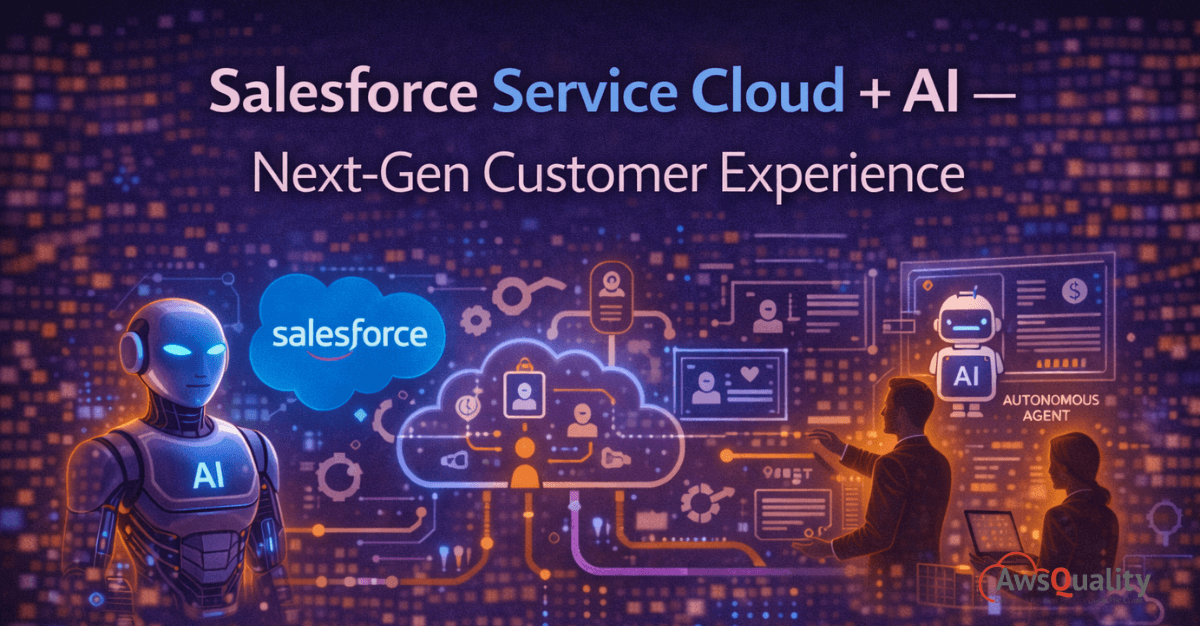
The economics and expectations of customer service are undergoing a structural shift — one that is moving faster than most organizations anticipated, and in a direction that is no longer optional to engage with.
In 2025, AI resolved 30% of all customer service cases globally. By 2027, Salesforce’s 7th State of Service Report — based on research with 6,500 service professionals — projects that figure will reach 50%. The shift from AI as a supplementary service tool to AI as the primary resolution mechanism for the majority of customer interactions is happening in production environments now, not in future-state roadmaps.
Salesforce Service Cloud, the world’s number one customer service platform for 12 consecutive years according to IDC, sits at the centre of this transformation. Combined with Agentforce — Salesforce’s autonomous AI agent platform, which surpassed $500 million in annual recurring revenue in Q3 FY2026, growing 330% year-over-year — Service Cloud has evolved from a case management system into an AI-powered customer experience platform that resolves cases, personalises interactions, predicts needs, and continuously improves from every customer engagement.
This guide covers what Salesforce Service Cloud and AI actually deliver in 2026: the specific capabilities, the documented outcomes, the implementation considerations, and the roadmap for organizations at every stage of their AI-in-service journey.
What is Salesforce Service Cloud?
Salesforce Service Cloud is a customer service platform designed to help businesses manage customer interactions, cases, knowledge, and support workflows across multiple channels.
It brings customer information and service operations into a unified environment, enabling support teams to manage conversations more efficiently.
Core capabilities include:
- Case management
- Omni-channel routing
- Knowledge management
- Service Console
- Workflow automation
- Digital customer engagement
- Service analytics
- AI-powered service capabilities
Modern Salesforce Service Cloud solutions go beyond traditional ticket management. They help organizations connect customer data, support teams, workflows, and AI to create more intelligent service experiences.
Why Customer Service is The Most Important AI Deployment Decision Nowadays
Customer experience has remained the number one priority for service leaders in both 2024 and 2025. What changed dramatically in that period was how AI is positioned relative to that priority: in one year, AI leapt from the number ten priority to the number two priority for service leaders — a shift that reflects both the maturity of available tools and the speed at which competitors are deploying them.
The pressure from customers is equally clear. 61% of customers prefer to use self-service to resolve simple issues. 89% of service professionals report that conversational AI increases self-service resolution rates. And 88% say it accelerates resolution times. The expectation of instant, accurate, always-available service — regardless of time zone, channel, or case complexity — is now a baseline customer expectation, not a differentiating capability.
The pressure from operations is just as acute. Service organizations are navigating rising case volumes, a 12% annual turnover rate among service employees, growing regulatory complexity, and budget constraints that make scaling through headcount increasingly impractical. Over 90% of organizations using AI report time and cost savings. Service teams using AI agents expect their service costs and case resolution times to decrease by an average of 20%. And service reps using AI spend 20% less time on routine cases — equivalent to approximately four hours per week per agent freed for higher-value interactions.
The combination of customer expectation, operational pressure, and AI capability maturity has produced the strategic context that every customer service leader must navigate in 2026: AI-powered service is no longer a competitive differentiator. It is the competitive baseline.
Read: Top Salesforce Integrations Every Growing Business Needs
How AI is Transforming Salesforce Service Cloud
AI in customer service is no longer limited to basic chatbots.
Within the Salesforce service ecosystem, AI can support classification, knowledge discovery, response generation, summarization, and autonomous service workflows.
Here are some of the most important applications.
1. AI-Powered Case Classification and Routing
One of the first challenges in customer support is understanding where a request should go.
Traditional systems often rely on manual categorization or predefined routing rules.
AI-powered case classification can analyze historical case data and predict relevant case field values. Classification can also support assignment and skills-based routing workflows.
For example, an incoming request mentioning a failed payment could be identified as a billing issue and routed to the appropriate team.
Business benefits include:
- Reduced manual triage
- Faster case assignment
- Improved routing accuracy
- Lower response times
- Better agent productivity
For high-volume service organizations, even small improvements in routing efficiency can have a significant operational impact.
2. Generative AI for Faster Customer Responses
Support agents spend a considerable amount of time writing responses.
Generative AI can help draft contextually relevant replies for messaging conversations and case emails. Salesforce’s Service Replies capabilities are designed to recommend or draft responses that agents can review.
Instead of writing every response from scratch, an agent can review, edit, and personalize an AI-generated draft.
The result?
AI accelerates the interaction while the human agent maintains oversight.
This can help businesses achieve:
- Faster response times
- More consistent communication
- Reduced repetitive work
- Improved agent efficiency
The goal isn’t to remove the human element from customer service. It’s to reduce the administrative work that prevents agents from focusing on customers.
3. AI-Generated Case and Conversation Summaries
Imagine a customer support case with dozens of emails, chat messages, and internal notes.
When another agent takes over, they may need several minutes just to understand what happened.
AI-generated work summaries can produce a concise summary of a conversation or case, including the issue and resolution, for agent review and editing.
This can make handoffs significantly smoother.
Agents can quickly understand:
- The customer’s issue
- Previous interactions
- Actions already taken
- Current case status
- Potential next steps
For organizations with complex customer journeys, AI-powered summarization can improve both productivity and service continuity.
4. Intelligent Knowledge Recommendations
A knowledge base is only useful when agents can quickly find the right information.
AI can analyze a customer case and recommend relevant knowledge articles based on similar historical cases.
Instead of manually searching through hundreds of articles, agents receive contextual recommendations.
This can lead to:
- Faster issue resolution
- More consistent answers
- Reduced agent training pressure
- Better knowledge utilization
AI can also assist in drafting new knowledge articles from customer conversations, subject to human review.
The knowledge base becomes a continuously improving service asset rather than a static document repository.
5. Agentforce and Autonomous Customer Service
The next major evolution is the rise of AI agents.
Salesforce Agentforce extends AI beyond simple question-and-answer interactions.
Agentforce Service Agent can support messaging conversations, process incoming cases, resolve common inquiries, and transfer complex or sensitive interactions to human service representatives.
An AI agent could potentially:
- Answer product questions
- Troubleshoot common problems
- Check order information
- Process routine requests
- Update service records
- Escalate complex cases
The key difference between traditional chatbots and AI agents is action.
Traditional chatbots typically follow predefined conversation flows.
AI agents can reason within defined instructions, access approved data, and execute authorized actions.
This creates the foundation for always-on intelligent service.
6. Personalized Customer Service at Scale
Personalization has traditionally been difficult to deliver in high-volume support environments.
An experienced agent may understand a long-term customer well. But maintaining that level of context across thousands or millions of interactions is challenging.
AI can use relevant CRM and case context to help create more personalized service responses. Salesforce also allows selected case fields and case feed information to ground certain Einstein-generated responses and summaries.
Instead of treating every support request as an isolated ticket, service teams can consider broader customer context.
This enables more relevant conversations and can reduce the frustration of customers repeatedly explaining their situation.
7. Moving from Reactive to Proactive Customer Service
Traditional customer service waits for customers to report problems.
AI creates an opportunity to identify signals earlier.
Consider a SaaS business.
If customer behavior indicates repeated product errors or unsuccessful actions, an intelligent service workflow could identify the pattern and trigger proactive assistance.
Similarly, businesses could use service and operational data to identify:
- Increasing case patterns
- Recurring customer issues
- Emerging product problems
- Potential SLA risks
- Customers requiring additional support
The future of customer experience may increasingly be about solving problems before customers need to ask for help.
Also read: 5 Ways Salesforce Can Improve Your Customer Experience
Agentforce for Service: What It Does and What It Delivers
Agentforce is the Salesforce product that has generated the most significant attention in the service context — and for good reason. It is the platform’s autonomous AI agent capability: agents that can understand customer intent, access relevant data, take action across multiple systems, and resolve cases end-to-end without human involvement.
The performance data from production deployments is compelling. Salesforce’s own help portal, running Agentforce at scale, has reported resolution rates as high as 85% without any human escalation. The company’s customer support workforce was reduced from 9,000 to approximately 5,000 employees as Agentforce absorbed routine case volume. Agentforce is currently operating at 93% accuracy — a performance level that, for many categories of routine service interaction, matches or exceeds typical human agent consistency.
As of Q4 FY2026, Salesforce had closed more than 29,000 Agentforce deals, with production accounts increasing 70% quarter-over-quarter. Every single one of Salesforce’s top 10 Q4 FY2026 customer wins included Agentforce Service as a component. The platform’s trajectory — from launch to $1.4 billion in combined Agentforce and Data 360 ARR — represents the fastest-growing product category in Salesforce history.
What Agentforce for Service does in practice:
Agentforce agents for service operate across the full resolution lifecycle. When a customer submits an inquiry through any channel — web portal, chat, email, WhatsApp, or voice — the agent reads the inquiry, identifies the customer record in Salesforce, retrieves relevant case history, account status, and interaction context from Data Cloud, and determines the appropriate resolution action.
For cases within its competency — password resets, order status queries, billing enquiries, appointment scheduling, return initiations, product information requests — the agent resolves the case autonomously, updates the relevant Salesforce records, and closes the case with a summary. For cases that require human judgment, specialist knowledge, or regulatory compliance review, the agent transfers to a human representative with a complete context summary — including what the customer asked, what the agent determined, and what information was retrieved — so the representative can continue without asking the customer to repeat themselves.
This handoff capability is one of the most practically important features in Agentforce’s service deployment. The friction of repeating context to a new agent — cited consistently as a primary driver of customer frustration — is eliminated because the AI agent preserves and transfers the full conversation context in a format the human representative can act on immediately.
The proactive capability in Agentforce 2DX extends the agent from reactive to anticipatory: agents watch for signals in customer data — delayed shipments, failed payment attempts, approaching renewal dates, elevated product usage patterns — and initiate proactive outreach before the customer contacts the company. This shift from reactive problem resolution to proactive relationship management represents the most significant change in the model of what customer service is designed to do.
Check out: What is Agentforce Labs? Salesforce’s Experimental Hub for AI Agents
Einstein AI in Service Cloud: The Embedded Intelligence Layer
Agentforce represents the most visible and autonomous AI capability in Service Cloud, but the platform’s AI architecture includes a deeper embedded intelligence layer through Einstein — Salesforce’s native AI engine that surfaces insights and suggestions throughout the agent and management experience.
Einstein Case Classification: Automatically analyses new cases at intake and classifies them by case reason, priority, and routing destination — reducing manual categorization time and improving initial routing accuracy. Classification models improve continuously as they learn from reclassification patterns by agents.
Einstein Article Recommendations: Surfaces the most relevant knowledge base articles in the agent workspace as cases are opened, based on case content analysis. Agents receive suggestions before searching, reducing the time spent finding relevant resolution content from minutes to seconds.
Einstein Reply Recommendations: Suggests response templates based on case context and successful resolution patterns from similar historical cases. Agents can accept, modify, or ignore suggestions — with acceptance or modification data feeding back into the model to improve future recommendations.
Einstein Conversation Mining: Analyses historical case conversation data at scale to identify common contact reasons, resolution patterns, emerging issues, and knowledge gaps. This analytical capability enables service managers to identify where self-service investments will have the greatest deflection impact and where knowledge base content needs to be created or updated.
Einstein Service Replies (Generative AI): Generates complete draft responses to customer inquiries using the context of the case, the customer record, and relevant knowledge base content. Agents review, edit, and send — with generative AI reducing the average time spent composing responses while improving the consistency and quality of written communication.
Einstein Work Summaries: Automatically generates case summaries and wrap-up notes at case closure, capturing what was asked, what was done, and what was resolved. This eliminates one of the most time-consuming and most frequently skipped parts of the service process — post-interaction documentation — improving both the completeness of case records and the availability of agents for subsequent interactions.
Also check: Salesforce Integration v/s. Migration – Which Strategy Works Best for Your Business
Real-World Outcomes: What Service Cloud + AI Delivers
The documented outcomes from Service Cloud and Agentforce deployments in production environments provide the most compelling evidence of what the platform combination can deliver.
Salesforce’s own deployment: After deploying Agentforce across its customer help portal, Salesforce reduced its customer support workforce from 9,000 to approximately 5,000 employees, with Agentforce handling the majority of routine support cases. Resolution rates of up to 85% without human intervention, operating at 93% accuracy, represent production performance that most service organizations would consider transformative.
Wiley: The global publishing company achieved a 213% ROI from its first Agentforce deployment, with $230,000 in documented savings. The company used Agentforce for customer service automation across its digital products portfolio.
OpenTable: George Pokorny, SVP of Global Customer Success, noted that saving just two minutes on a ten-minute call enables service representatives to focus meaningfully on customer relationship strengthening rather than administrative task completion.
Broader market results: Service teams using AI agents expect their service costs and case resolution times to decrease by an average of 20%. 87% of service decision makers report that AI helps them better serve customers. 86% of service professionals report that AI has enabled them to develop new skills — evidence that AI deployment is enabling professional elevation, not just cost reduction.
Revenue impact: Agentic AI is projected to boost upsell revenue by 15% for service organizations that deploy it — reflecting the expanded commercial capability that comes when service representatives are freed from routine case handling and able to focus on relationship-driven revenue opportunities.
Read: Salesforce Health Check – Why Your CRM Might Be Underperforming
Key AI Capabilities in the 2026 Service Cloud Platform
For organizations evaluating or planning their Service Cloud AI deployment, the following capability areas represent the most significant and most immediately deployable improvements to service delivery:
Agentforce for Service: Autonomous case resolution across digital channels. Configure the agent’s scope, set the trusted guardrails, and deploy to self-service portals, chat, email, and messaging. The agent handles in-scope cases end-to-end; out-of-scope cases escalate to human agents with full context.
Einstein Bots: Scripted and AI-hybrid bots for high-volume, predictable interaction types. Effective for simple transactional queries and information retrieval where structured conversational paths work well alongside more sophisticated Agentforce capabilities for complex scenarios.
Omni-Channel Routing: AI-powered routing that matches each case to the most appropriate available agent based on skills, language, workload, and case characteristics — replacing static skill-based routing with dynamic, real-time optimization.
Service Intelligence: The analytics and insights layer that surfaces performance trends, identifies coaching opportunities, highlights at-risk customers, and measures the impact of AI deployment against service KPIs. Includes pre-built dashboards for service managers and executive reporting on AI performance relative to human baseline.
Voice Intelligence: Real-time transcription and sentiment analysis during phone interactions, with suggestions surfaced to agents as calls progress. Post-call summaries generated automatically. Compliance monitoring across recorded interactions.
Field Service AI: Intelligent scheduling and dispatch optimization, predictive maintenance recommendations based on asset performance data, and mobile worker productivity features including AI-assisted work order completion.
Also read: What is Salesforce Revenue Cloud? The Complete Guide to Quote-to-Cash
Implementation Considerations: Building AI-Ready Service Operations
The capability of Service Cloud and Agentforce is not in question. The consistency with which organizations realise that capability depends on the quality of implementation — specifically on three areas that determine whether AI deployment succeeds or disappoints.
Data quality and unification
AI is only as good as the data it works with. Salesforce’s research finding — that companies with unified customer service channel data are 1.4 times more likely to achieve a “very successful” AI implementation — reflects a fundamental dependency. Before deploying Agentforce or any AI feature in Service Cloud, an honest audit of the data estate is essential.
Key questions: Are customer records complete and current? Is the knowledge base well-structured, regularly maintained, and tagged in a way that makes content retrievable? Are historical case records available and structured in a format that AI models can learn from? Is channel data — web, phone, email, chat — unified in a single platform or siloed across systems?
Addressing data quality issues before AI deployment is significantly less expensive than discovering them after. Every gap in data quality shows up as a gap in AI performance — and gaps in AI performance erode customer confidence in self-service faster than having no AI at all.
Governance and guardrails
AI deployment in customer service raises legitimate questions that clients and stakeholders will ask: How is customer data used by the AI model? Does it leave controlled environments? What happens when the AI produces an inaccurate response? How are compliance requirements met in regulated industries?
These are not reasons to delay AI deployment — they are reasons to design it correctly. Salesforce’s Trusted AI framework, Data Cloud’s zero-copy integration architecture, and Agentforce’s configurable guardrails provide the technical infrastructure for governed AI deployment. The organizational infrastructure — clear policies, human-in-the-loop review processes for high-risk case types, audit logging, and explainability reporting — completes the governance model.
Phased rollout and change management
The organizations achieving the strongest results from Service Cloud AI deployment share a common approach: they start with a defined, bounded use case where AI performance is most predictable, measure outcomes against defined baselines, and expand incrementally as performance is validated.
A practical rollout sequence: begin with Einstein features embedded in the agent workspace — article recommendations, reply suggestions, case summaries — which improve agent performance without requiring autonomous AI operation. Move to AI-assisted routing and classification. Deploy Agentforce to a defined self-service portal use case — password resets, order status, appointment scheduling — where the scope is clear and errors are recoverable. Expand scope based on accuracy and resolution rate data. Introduce proactive Agentforce 2DX capabilities once foundational deployment is performing reliably.
Change management for service teams requires the same care as for any significant operational change. The 86% of service professionals who report developing new skills from AI adoption reflects what good change management produces. The framing that consistently resonates: AI handles the routine interactions so that human agents can focus on the complex, high-value, relationship-driven work that is both more impactful and more professionally rewarding.
Also read: Salesforce Sales Cloud vs Service Cloud – Key Differences and Benefits
How to Implement AI in Salesforce Service Cloud
Businesses should avoid trying to automate everything at once.
A phased strategy is often more effective.
Step 1: Assess Your Current Service Operations
Identify high-volume cases, repetitive activities, resolution bottlenecks, and common customer issues.
Step 2: Improve Data and Knowledge Quality
Clean customer data and review your existing knowledge base before scaling AI use cases.
Step 3: Select High-Impact AI Use Cases
Start with clearly measurable opportunities such as case classification, summaries, knowledge recommendations, or routine self-service.
Step 4: Define AI Governance
Establish access controls, escalation rules, human review requirements, and monitoring processes.
Step 5: Integrate Service Data
Connect the systems required to give service workflows appropriate customer and operational context.
Step 6: Launch a Controlled Pilot
Test AI with a specific team, customer segment, or service process.
Step 7: Measure Business Outcomes
Track metrics such as:
- First response time
- Average handle time
- Case resolution time
- First contact resolution
- Case deflection
- Customer satisfaction
- Agent productivity
Step 8: Optimize and Scale
Use real-world performance data to improve AI workflows before expanding automation.
Check: Salesforce AI Implementation Challenges (And How to Solve Them)
AI Agents vs Human Service Agents: Who Wins?
This is the wrong question.
AI and human service agents have different strengths.
| AI Agents | Human Service Agents |
|---|---|
| 24/7 availability | Emotional intelligence |
| High-volume processing | Complex judgment |
| Fast information retrieval | Relationship building |
| Routine task automation | Sensitive conversations |
| Consistent workflows | Negotiation and empathy |
| Rapid data analysis | Contextual decision-making |
The strongest customer service model combines both.
AI handles repetitive, predictable, and data-intensive activities.
Human agents focus on complex, sensitive, and high-value customer interactions.
Salesforce’s own service research indicates teams using AI agents expect service costs and case resolution times to decline by an average of approximately 20%.
This is not simply automation.
It is a redesign of how customer service teams work.
Business Benefits of Combining Salesforce Service Cloud and AI
Faster Case Resolution
AI-assisted routing, knowledge recommendations, and response generation can reduce unnecessary manual steps.
Improved Agent Productivity
Agents spend less time searching for information, summarizing cases, and completing repetitive tasks.
24/7 Customer Support
AI agents can support common customer inquiries outside normal service hours.
Lower Service Costs
Automating high-volume routine interactions can help service teams scale without increasing headcount at the same rate as case volume.
More Consistent Customer Experiences
AI-supported workflows can help standardize responses and service processes across teams.
Better Customer Personalization
CRM context can help service teams deliver more relevant customer interactions.
Scalable Customer Service
Businesses can manage growing service demand more efficiently by combining human teams with AI-powered automation.
Read: Customizing and Branding Salesforce for a Better Customer Experience
Key Challenges Businesses Must Consider
AI-powered customer service delivers significant opportunities, but successful implementation requires more than enabling a feature.
Data Quality
AI is only as useful as the information supporting it.
Duplicate customer records, outdated knowledge articles, and incomplete case data can reduce the quality of AI outputs.
AI Governance
Businesses need clear policies defining:
- What AI agents can do
- What data AI can access
- When human approval is required
- Which interactions must be escalated
- How AI actions are monitored
Customer Trust
Customers need confidence in AI-powered experiences. Salesforce research found that 68% of customers said advances in AI make company trustworthiness even more important.
Transparency and responsible AI use should be part of the customer experience strategy.
Integration Complexity
Service Cloud may need to connect with:
- ERP platforms
- Payment systems
- E-commerce platforms
- Legacy applications
- Data warehouses
- Communication tools
Poor integration can prevent AI from accessing the context required to deliver useful outcomes.
Change Management
AI changes how service teams operate.
Agents need training not only on how to use AI but also on when to trust, verify, edit, or escalate AI-generated outputs.
Why Businesses Need the Right Salesforce Service Cloud Partner
AI implementation is not simply a technology configuration exercise.
Businesses need to align customer journeys, CRM data, service processes, integrations, security, and AI governance.
An experienced Salesforce services partner can help organizations:
- Assess Service Cloud readiness
- Identify practical AI use cases
- Configure Service Cloud workflows
- Implement automation
- Integrate enterprise systems
- Improve customer data quality
- Support AI and Agentforce initiatives
- Optimize service operations
The Future of Customer Experience Is AI-Assisted and Human-Led
AI is changing customer service.
But the future is not about removing people from customer interactions.
It is about using AI to handle repetitive work, surface the right information, accelerate decisions, and give human agents more time for conversations that require empathy and judgment.
Salesforce Service Cloud combined with AI creates an opportunity to move beyond traditional case management.
Customer service can become more proactive.
More personalized.
More scalable.
And ultimately, more valuable to both customers and businesses.
The organizations that succeed will not simply add AI to existing customer service processes.
They will redesign customer service around the strengths of both AI and human expertise.
Frequently Asked Questions
Q. What is Salesforce Service Cloud AI?
Salesforce Service Cloud uses AI capabilities to support customer service activities such as case classification, response drafting, summarization, knowledge recommendations, and AI-assisted service workflows.
Q. How does AI improve customer experience in Salesforce Service Cloud?
AI can reduce response times, personalize interactions, recommend relevant information, automate routine tasks, and help agents resolve cases more efficiently.
Q. Can Salesforce Service Cloud automate customer support?
Yes. Service Cloud supports automation across case management and routing, while Agentforce Service Agent can handle common service interactions and transfer complex or sensitive conversations to human representatives.
Q. What is Agentforce for customer service?
Agentforce is Salesforce’s AI agent platform. For service use cases, AI agents can support customers, resolve common inquiries, process cases, and perform authorized actions using relevant business data and workflows.
Q. Will AI replace customer service agents?
AI is more likely to change the role of service agents than eliminate it entirely. AI can automate routine tasks while human agents focus on complex issues, empathy, judgment, and relationship management.
Q. How can businesses implement AI in Salesforce Service Cloud?
Businesses should assess service processes, improve data quality, prioritize measurable AI use cases, define governance, run controlled pilots, and scale based on business outcomes.
Conclusion
The data is clear. The trajectory is established. And the competitive implications are already visible in the market.
AI resolved 30% of customer service cases in 2025 and is on track to resolve 50% by 2027. The organisations that will lead customer experience in 2028 and beyond are those that are deploying Salesforce Service Cloud and Agentforce correctly in 2026 — building the data foundations, the governance frameworks, and the human-AI collaboration models that make AI-powered service consistently excellent rather than inconsistently experimental.
Service Cloud with Agentforce is not a future investment in a future capability. It is the current-generation platform that is redefining what customer service organisations can deliver — in resolution speed, personalisation quality, cost efficiency, and commercial impact.
The question is not whether to engage with this transformation. The question is whether to engage with it strategically, with the right platform, the right implementation partner, and the right operational discipline to make it work at the standard your customers expect and your business requires.
Ready to build next-generation customer service with Salesforce Service Cloud and Agentforce?
AwsQuality’s certified Salesforce Service Cloud consultants help organisations design, deploy, and optimise AI-powered service operations — from initial readiness assessment through to Agentforce deployment and ongoing managed services.
 Bio
Bio