Artificial Intelligence has rapidly become a strategic priority for enterprises across industries. Organizations are investing in AI-powered customer experiences, intelligent automation, predictive analytics, generative AI, AI agents, and real-time decision-making. Yet many AI initiatives fail—not because the models are inadequate, but because the underlying data is fragmented, inconsistent, or inaccessible.
According to industry research, poor data quality costs organizations millions annually, while a significant percentage of AI projects fail to reach production due to data-related challenges. This highlights a critical reality:
AI is only as effective as the data that powers it.
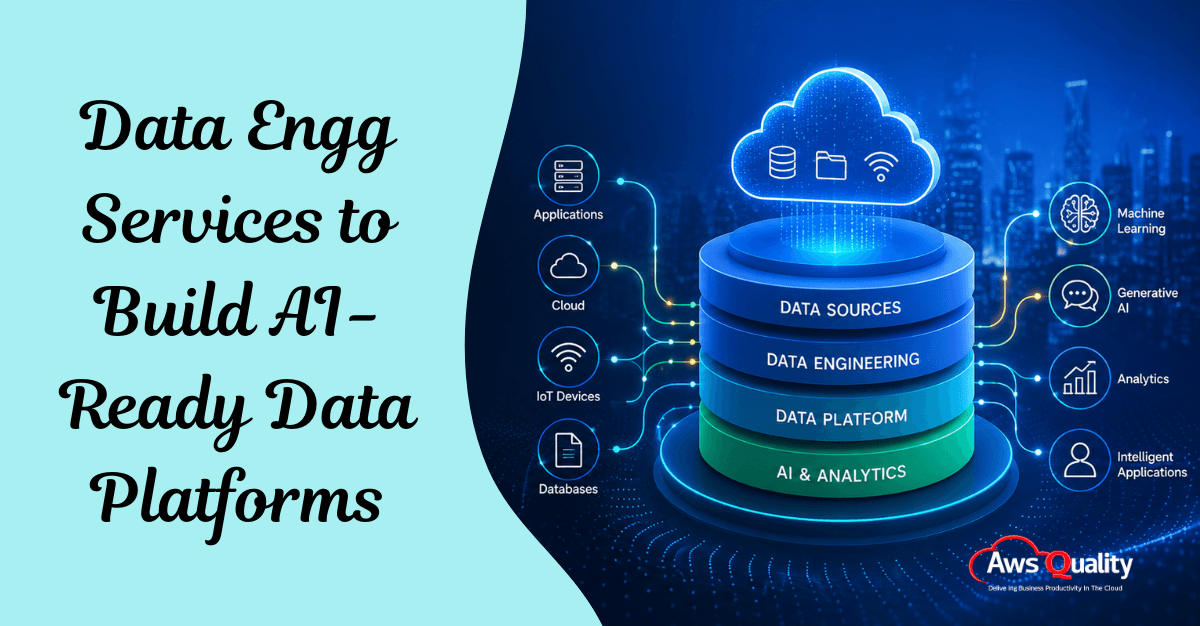
Building an AI-ready organization begins long before selecting machine learning models or deploying generative AI applications. It starts with creating a modern, scalable, and governed data platform—and that’s where data engineering services become indispensable.
In this guide, we’ll explore how data engineering services help enterprises build AI-ready data platforms, the essential components of a modern data architecture, and why investing in data engineering is the foundation of successful AI transformation.
What Are Data Engineering Services?
Data engineering services involve designing, building, managing, and optimizing the systems that collect, process, transform, store, secure, and deliver enterprise data.
Rather than focusing on analytics alone, data engineering creates the infrastructure that enables analytics, AI, business intelligence, and operational reporting.
Why AI Projects Fail Without Strong Data Engineering
Many organizations believe adopting AI starts with choosing the right model or platform.
In reality, most AI challenges originate much earlier.
Common data problems include:
- Data spread across disconnected systems
- Poor data quality
- Duplicate records
- Missing metadata
- Inconsistent business definitions
- Legacy databases
- Slow reporting pipelines
- Limited real-time capabilities
- Weak governance
- Security and compliance concerns
Without solving these issues, organizations struggle to:
- Train reliable AI models
- Generate accurate predictions
- Build AI agents
- Deliver personalized customer experiences
- Automate business workflows
- Scale AI across departments
AI readiness is fundamentally a data engineering challenge.
Why AI Projects Fail Without Strong Data Engineering
Many organizations believe adopting AI starts with choosing the right model or platform.
In reality, most AI challenges originate much earlier.
Common data problems include:
- Data spread across disconnected systems
- Poor data quality
- Duplicate records
- Missing metadata
- Inconsistent business definitions
- Legacy databases
- Slow reporting pipelines
- Limited real-time capabilities
- Weak governance
- Security and compliance concerns
Without solving these issues, organizations struggle to:
- Train reliable AI models
- Generate accurate predictions
- Build AI agents
- Deliver personalized customer experiences
- Automate business workflows
- Scale AI across departments
AI readiness is fundamentally a data engineering challenge.
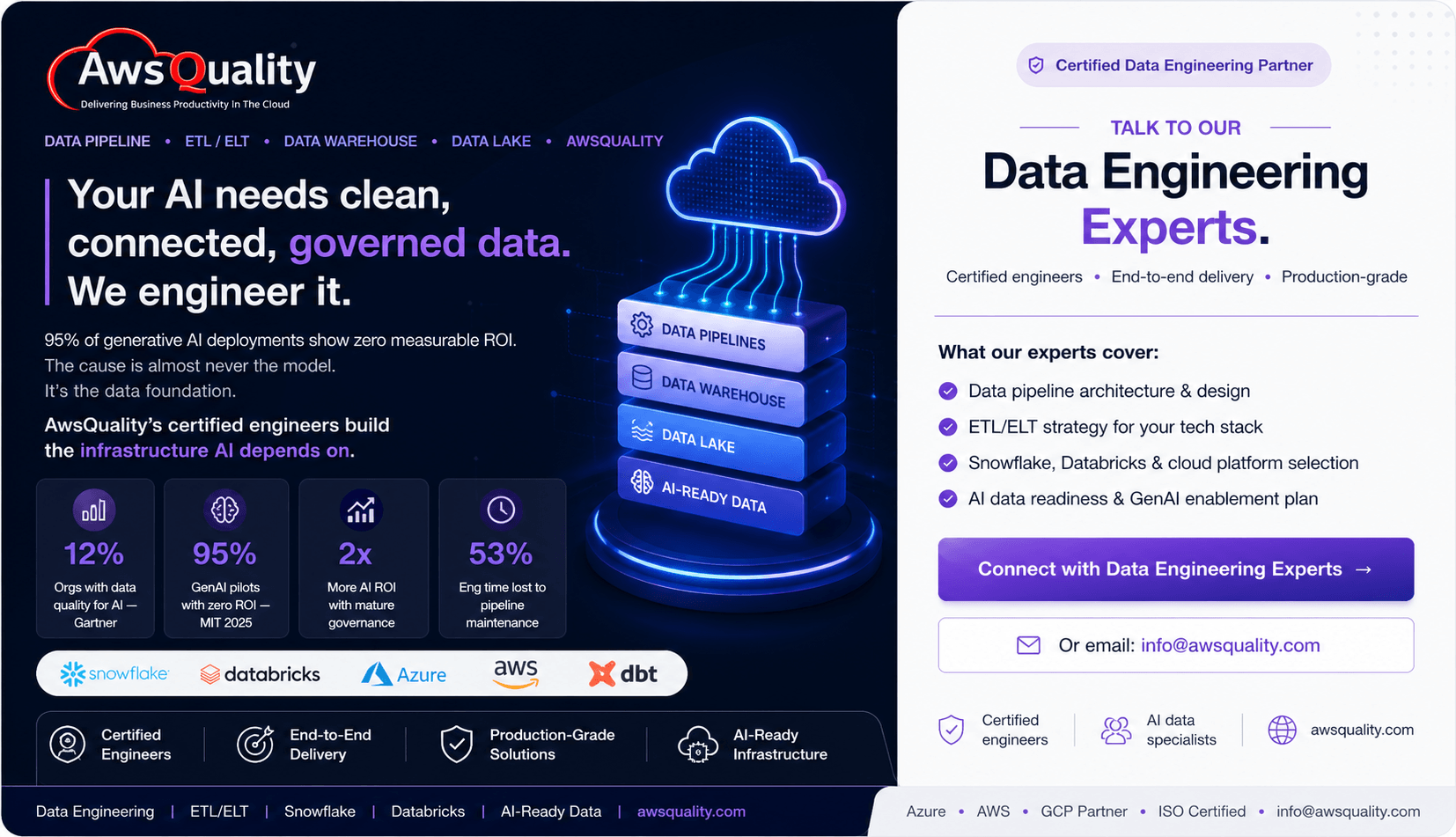
Understanding the AI Data Readiness Gap
Before examining how data engineering services solve the problem, it is essential to understand exactly what makes data AI-ready — and why most enterprise data environments fall short.
AI-ready data is not simply “clean data” in the traditional analytics sense. A dataset that produces accurate quarterly reports is not necessarily AI-ready. AI models — particularly large language models, machine learning models, and autonomous AI agents — have requirements that traditional business intelligence systems were never designed to meet.
Five criteria define AI-ready data at the enterprise level, each of which requires deliberate data engineering to achieve:
1. Freshness and Consistency
AI systems consume data at the cadence they operate — which for modern AI agents and real-time applications may be seconds or milliseconds. A customer data record that was accurate in yesterday’s batch report may be factually wrong by the time an AI agent reads it at 9:47 this morning. Zylos Research found that 60% of enterprise AI failures related to retrieval-augmented generation (RAG) trace to freshness and consistency problems rather than retrieval quality. Enterprise data environments built for periodic batch processing are structurally mismatched to this requirement.
2. Structural Accessibility
AI models need data in formats they can consume — not locked in proprietary database schemas, not requiring complex API queries to extract, and not siloed in systems that do not expose their data to external consumers. The Cloudera Data Readiness Index found that 56% of enterprise AI leaders cite siloed data as the top obstacle to AI readiness. Data that exists but cannot be accessed by the AI workload is not AI-ready data.
3. Semantic Consistency
When the same concept — a customer, a product, an order, a revenue event — is represented differently across multiple systems, AI models encounter semantic inconsistency that generates unpredictable and unreliable outputs. A customer who appears as “John Smith” in the CRM, “J. Smith” in the billing system, and “Smith, John” in the support platform is not three records of the same person from an AI agent’s perspective — they are three different people, unless data engineering has unified that identity across systems.
4. Quality at AI Scale
Traditional analytics tolerates a level of data imperfection that AI cannot. A mislabeled training example becomes a systemic bias in the model. An outdated data slice becomes a drifted model that no longer reflects current business reality. A missing field that was acceptable as a blank in a spreadsheet becomes a hallucination in a generative AI output. Informatica’s CDO Insights 2025 ranked data quality and readiness as the number one obstacle to AI success, cited by 43% of Chief Data Officers surveyed.
5. Lineage and Governance
AI systems that make or influence decisions require the ability to explain those decisions — both for internal accountability and for regulatory compliance. McKinsey estimated in late 2025 that enterprises with mature data governance programs were nearly twice as likely to achieve measurable ROI from generative AI deployments. Without lineage tracking, auditability, and governance frameworks, AI outputs cannot be trusted, defended, or scaled across regulated functions.
Each of these five criteria requires specific, deliberate data engineering work. They do not emerge automatically from deploying a cloud data platform. They are built — pipeline by pipeline, integration by integration, quality rule by quality rule — by data engineering teams applying the right architecture and the right tooling to the specific data landscape of each enterprise.
Also read: The Complete Guide to Data Engineering Services for Modern Enterprises
What Data Engineering Services Deliver for AI Readiness
Data engineering services provide the infrastructure, architecture, and ongoing capability that transforms fragmented, inconsistent enterprise data into an AI-ready foundation. The specific components they deliver map directly to the five AI data readiness criteria above.
Component 1: Unified Data Pipelines That Feed AI at the Right Cadence
The most fundamental data engineering contribution to AI readiness is the pipeline — the automated system that moves data from where it lives to where the AI system needs it, at the speed and frequency the AI requires.
Most enterprise data environments were built for batch processing: data is extracted from source systems, transformed, and loaded into analytics environments on a daily, weekly, or monthly schedule. This cadence is sufficient for dashboards and reports. It is insufficient for AI agents that need current customer context to respond accurately, for predictive models that need recent transaction data to make reliable forecasts, or for autonomous workflows that need real-time operational data to take the right action.
Data engineering services design and build pipeline architectures calibrated to AI requirements:
Batch pipelines remain appropriate for AI use cases that consume historical data — training machine learning models, generating weekly recommendation scores, or building analytical features from large historical datasets. Modern batch pipeline architectures use orchestration frameworks like Apache Airflow, dbt, and AWS Step Functions to ensure reliability, error handling, and automatic recovery when source systems change.
Near-real-time pipelines use change data capture (CDC) technology to detect and propagate changes in source systems — such as a CRM record update, a completed transaction, or a new support case — to the AI data platform within seconds or minutes of the change occurring. This eliminates the staleness problem that causes AI agents to act on outdated information.
Streaming pipelines process data as continuous event streams using Apache Kafka, Azure Event Hubs, or Amazon Kinesis — enabling AI systems that require true real-time data such as fraud detection models, real-time recommendation engines, and live customer service intelligence.
The pipeline architecture decision for each AI use case is a data engineering judgment that requires understanding both the AI system’s data consumption pattern and the source system’s data generation pattern. Getting it wrong — providing batch data to a real-time AI application, or building complex streaming infrastructure for a use case that only needs daily data — creates either AI failures or unnecessary cost.
Component 2: ETL and ELT Development for AI-Grade Data Transformation
Raw data from enterprise source systems is almost never in a format that AI can consume directly. Customer records have inconsistent naming conventions. Financial transactions use different date formats across systems. Product catalogs use different category hierarchies in different regions. CRM opportunity records are missing fields that the AI model uses to make predictions.
ETL (Extract, Transform, Load) and ELT (Extract, Load, Transform) development is the data engineering practice that addresses this gap — standardizing, cleaning, enriching, and structuring data as it moves through the pipeline.
For AI readiness specifically, ETL and ELT development delivers several critical outcomes:
Entity resolution and identity unification. Identifying that the same customer appears under different identifiers across CRM, ERP, billing, and support systems — and unifying that identity — is one of the highest-value data engineering contributions to AI performance. A customer AI agent that cannot recognize the same customer across systems cannot provide the contextually relevant, personalized service that makes AI agents commercially viable.
Feature engineering. Many AI models consume not raw data fields but derived features — calculated values that represent patterns or relationships in the underlying data. Engineering these features as reusable, version-controlled, documented data assets — part of a modern feature store — requires data engineering capability that most analytics teams do not have.
Business rule implementation. Enterprise AI systems must apply business rules — revenue recognition policies, customer segmentation criteria, product classification logic — consistently across all the data they consume. Implementing these rules in the transformation layer ensures that AI outputs reflect business definitions rather than raw system data.
Data standardization at scale. Standardizing date formats, currency representations, address formats, product identifiers, and categorical values across dozens of source systems is a data engineering project that can span months for large enterprises. It is, however, the prerequisite for AI systems that need to compare, aggregate, and reason across data from those systems.
Component 3: Data Integration That Eliminates AI Data Silos
56% of enterprise AI leaders cite siloed data as the top obstacle to AI readiness, according to the Cloudera/HBR research. Data silos exist when critical business information is locked in systems that do not share it — either because those systems lack the integration architecture to expose their data, or because the data engineering work required to connect them has not been done.
Data engineering services address silos through integration architecture that connects enterprise source systems to the AI data platform:
API-based integration connects SaaS applications — CRM platforms, marketing automation tools, e-commerce platforms, financial systems — to the data pipeline through their published APIs. Salesforce, HubSpot, NetSuite, SAP, and hundreds of other enterprise applications expose data through APIs that data engineers use to extract, transform, and load business data into unified analytical environments.
Database integration connects relational databases, data warehouses, and operational data stores to the AI platform through direct database connectivity, replication, or CDC — ensuring that transactional data from core business systems is available to AI workloads without requiring manual extraction.
Event-driven integration captures business events — a new order placed, a support case escalated, a contract signed — from the systems where they occur and propagates them to the AI platform in near-real-time, enabling AI systems that respond to business events as they happen.
For enterprises with Salesforce as their core CRM — one of the most common enterprise data engineering scenarios — the integration challenge extends to connecting Salesforce Sales Cloud, Service Cloud, Marketing Cloud, and Data Cloud with external data platforms in ways that maintain the context of the customer relationship while making that context available to AI systems operating outside the Salesforce environment.
Component 4: Data Quality Engineering for AI-Grade Accuracy
Gartner estimates that organizations lose an average of $12.9 million per year due to poor data quality. For AI systems, the cost of poor data quality is not just financial — it is operational. An AI model trained on poor-quality data produces poor-quality predictions. A generative AI system that retrieves inaccurate customer data generates inaccurate customer communications. An autonomous AI agent operating on stale pricing data makes incorrect commercial decisions.
Data quality engineering for AI requires a significantly more rigorous approach than the data quality practices sufficient for traditional business intelligence:
Automated quality validation implements validation rules directly in the data pipeline — checking completeness, accuracy, consistency, and freshness for every data element as it flows through the system. Records that fail validation are quarantined, logged, and routed for remediation before they reach the AI data platform rather than propagating downstream as corrupted inputs.
Data observability provides continuous monitoring of data quality metrics — tracking completeness rates, null rates, value distribution changes, schema drift, and volume anomalies across all pipelines and datasets. Modern data observability platforms like Monte Carlo and Great Expectations detect data quality degradation in real time, enabling engineering teams to identify and address problems before they affect AI system performance.
Deduplication at enterprise scale. Enterprise data environments accumulate duplicate records at a rate that compounds over time — particularly in CRM systems, customer databases, and product catalogs. Data engineering services implement systematic deduplication logic that identifies and resolves duplicate records, ensuring that AI systems operate on a consolidated, accurate representation of each entity.
Lineage tracking. Understanding where data came from — which source system, which transformation logic, which pipeline version — is essential for diagnosing AI quality issues and for regulatory compliance in industries where AI decision traceability is required. Data lineage is a data engineering capability that must be built deliberately rather than as an afterthought.
Component 5: Cloud Data Platform Architecture for AI Scalability
AI workloads place demands on data infrastructure that traditional on-premises data environments were not designed to handle. Machine learning model training requires access to years of historical data processed at scale. Real-time AI inference requires data retrieval at millisecond latency. Generative AI applications require the ability to combine structured business data with unstructured text, documents, and communications in a unified retrieval system.
Cloud data engineering services design and build the platform architecture that makes these demands achievable:
Data lakehouse architecture combines the flexibility of a data lake — storing structured, semi-structured, and unstructured data in open formats — with the performance and governance of a data warehouse. This architecture is the most widely adopted for enterprise AI readiness in 2026, as it provides the unified storage and compute environment that supports both traditional BI workloads and modern AI training and inference requirements. Platforms like Snowflake, Databricks Delta Lake, Google BigQuery, and Microsoft Fabric implement variations of this architecture.
Vector database integration for generative AI applications requires a specific data engineering capability that most enterprise data teams did not need before 2024 — the ability to generate, store, and retrieve vector embeddings of enterprise knowledge. Retrieval-augmented generation (RAG) systems — which give generative AI models access to enterprise-specific knowledge — depend on this infrastructure to retrieve relevant context at query time.
Feature store implementation creates a centralized repository of pre-computed, versioned, documented machine learning features — derived from the raw enterprise data through feature engineering pipelines. Feature stores eliminate the problem of different teams computing the same features differently, ensure that the same features used in model training are available at inference time, and accelerate the deployment of new AI models by making reusable features immediately available.
Multi-cloud and hybrid data integration addresses the reality that most large enterprises operate across multiple cloud environments and maintain some on-premises systems that cannot be immediately migrated. Building the connectivity between these environments — while maintaining security, governance, and performance standards — is a significant data engineering challenge that determines whether enterprise AI systems can access the full breadth of organizational data or only the portion that lives in a single cloud.
Component 6: Data Governance for Enterprise AI Trust
McKinsey’s 2025 research found that enterprises with mature data governance programs were nearly twice as likely to achieve measurable ROI from generative AI deployments. This finding reflects a principle that is increasingly well understood in data and AI leadership: governance is not a constraint on AI capability. It is the infrastructure that makes AI capability trustworthy and scalable.
Data governance for AI readiness requires engineering work across several dimensions:
Access control and data security. AI systems that access enterprise data need to operate within the same access control framework that governs human access — ensuring that AI agents can access customer data they are authorized to use, but cannot access data outside their authorization scope. Implementing this at the data engineering level — building access controls into the pipeline and platform architecture rather than relying on application-level controls — is more reliable and more auditable.
Regulatory compliance. Enterprises in regulated industries — financial services, healthcare, insurance, retail — must ensure that their AI systems comply with applicable data protection and AI accountability regulations. GDPR, CCPA, the EU AI Act, and industry-specific regulations impose requirements on how enterprise data is used for AI training, how AI decisions are explained, and how long data is retained. Data governance engineering builds the technical controls — consent management, data minimization, retention enforcement, explainability logging — that make compliance demonstrable rather than asserted.
Data stewardship workflows. Sustaining data quality and governance over time requires defined ownership and accountability for every data domain in the enterprise. Data engineering services help enterprises implement the operational processes and tooling — metadata management, data cataloging, data quality dashboards, stewardship workflows — that maintain governance standards as the data landscape evolves.
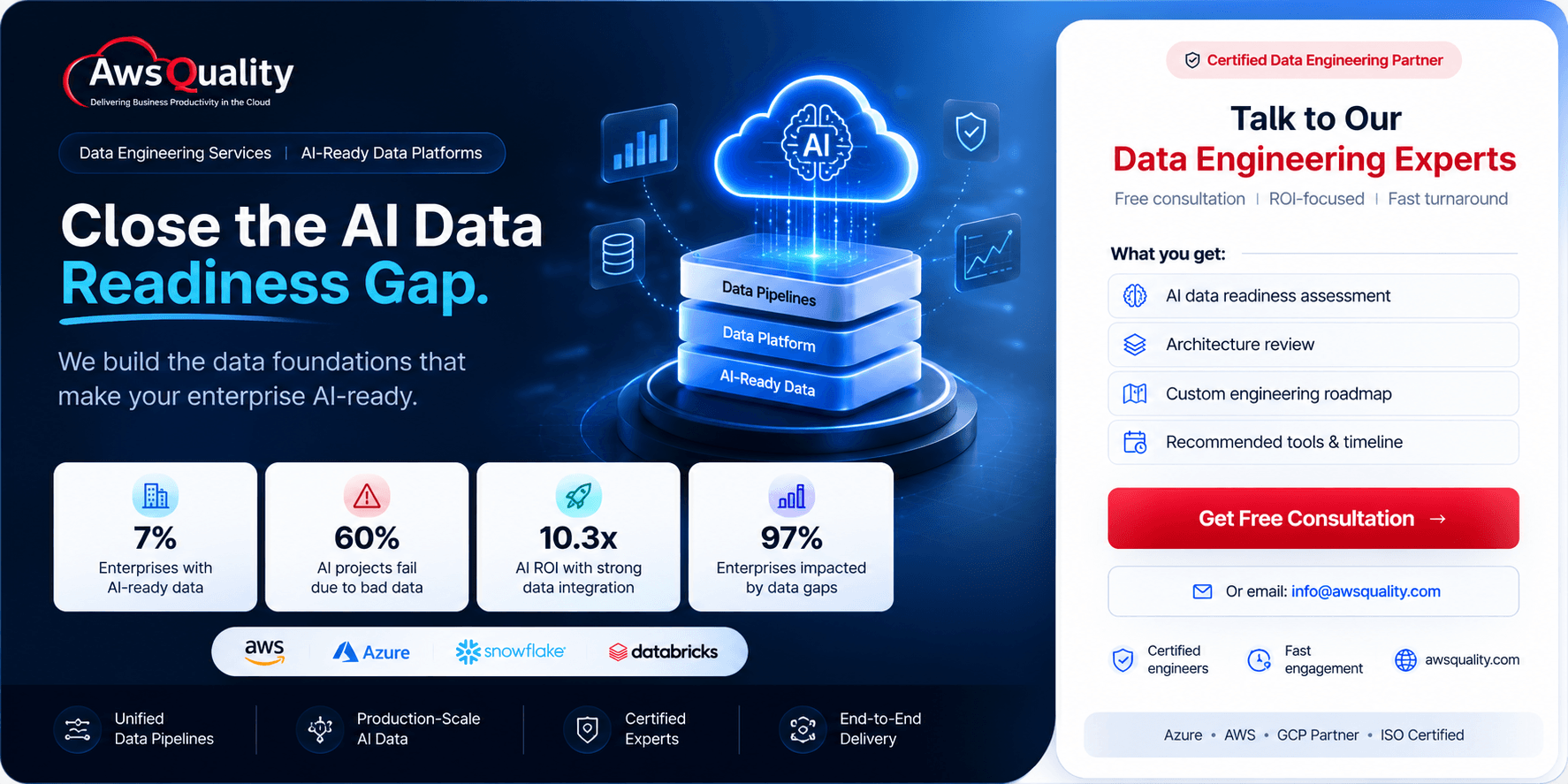
The Data Engineering Foundation for Specific AI Use Cases
The components described above combine to support the specific AI use cases that enterprises are deploying in 2026. Understanding how data engineering enables each use case clarifies why infrastructure investment is indispensable.
Customer Service AI Agents
Autonomous customer service agents — like Salesforce Agentforce, which achieved 85% case resolution without human intervention in Salesforce’s own deployment — require unified customer data from CRM, purchase history, service history, and product usage systems, refreshed in near-real-time, with consistent identity resolution across all sources. The data engineering work required to achieve this — real-time integration, identity unification, ETL standardization — is what separates AI agents that resolve cases reliably from those that escalate everything because they cannot find or trust the customer data they need.
Predictive Sales and Revenue Analytics
Machine learning models that predict deal close probability, churn risk, or revenue trajectory require extensive historical data from CRM opportunity records, activity logs, email engagement, and financial outcomes — cleaned, structured, and enriched with derived features. Data engineering services build and maintain the pipelines that collect, transform, and deliver this data in the format that the models require, and ensure that training data and inference data are consistent.
Supply Chain and Operations Optimization
AI-driven supply chain optimization requires integrating data from procurement systems, inventory management, logistics platforms, IoT sensors, and demand signals — often across dozens of supplier systems and multiple geographies. Data engineering services build the integration architecture that unifies this data, establishes the quality standards that make AI optimization outputs reliable, and delivers the near-real-time pipeline performance that operational AI requires.
Generative AI and Knowledge Management
Enterprise generative AI applications — internal knowledge assistants, document processing agents, contract analysis systems — require the ability to retrieve relevant enterprise knowledge in response to user queries. Building RAG infrastructure requires data engineering work to extract, chunk, embed, and index enterprise documents, knowledge bases, and structured data — maintaining freshness as the underlying content changes and ensuring that the retrieval system respects access control policies.
Fraud Detection and Risk Management
Real-time fraud detection AI requires streaming data pipelines that process transaction events as they occur, feature engineering pipelines that compute risk signals from historical transaction patterns, and model serving infrastructure that delivers inference results with latency measured in milliseconds. The data engineering architecture for financial services AI is among the most demanding in the enterprise landscape — and the most consequential when it fails.
Why Data Engineering is the Prerequisite — Not the Parallel Track
The most common mistake enterprises make in AI investment sequencing is treating data engineering and AI development as parallel workstreams — attempting to build the AI capability simultaneously with the data infrastructure that it requires.
This approach produces exactly the outcome described in MIT’s Project NANDA 2025 research: 95% of generative AI deployments achieve zero measurable return. The AI models are built. The pilots are run. The demos are impressive. And then the production deployment fails — because the data infrastructure that looked adequate in a controlled pilot environment cannot support the AI system under real operational conditions with real data variability and real enterprise scale.
The pattern that consistently produces measurable AI ROI is sequential, not parallel:
Phase 1: Data foundation. Assess the current data landscape. Identify the source systems, data quality gaps, integration requirements, and governance needs specific to the target AI use cases. Design and build the data pipelines, ETL processes, integrations, quality controls, and platform architecture that make the required data AI-ready. This phase takes weeks to months depending on scope.
Phase 2: Focused AI use case. With AI-ready data available, develop and validate the specific AI capability — the model, the agent, the application — against the prepared data foundation. The quality and consistency of the data means the AI development and validation cycle is faster and more reliable than it would be on unprepared data.
Phase 3: Production deployment. Deploy the AI system to production with the confidence that the data infrastructure will support it — because that infrastructure has been built, tested, and validated specifically for the requirements of this use case.
Phase 4: Capability expansion. As the data foundation matures and the AI system proves its value in production, expand both the data coverage and the AI capabilities — adding new data sources, new use cases, and new AI capabilities on the foundation that already exists.
Organizations that skip Phase 1 spend Phase 2 and Phase 3 discovering the data problems that Phase 1 would have resolved — at the worst possible time, under the worst possible pressure, with the worst possible visibility to stakeholders who are expecting results.
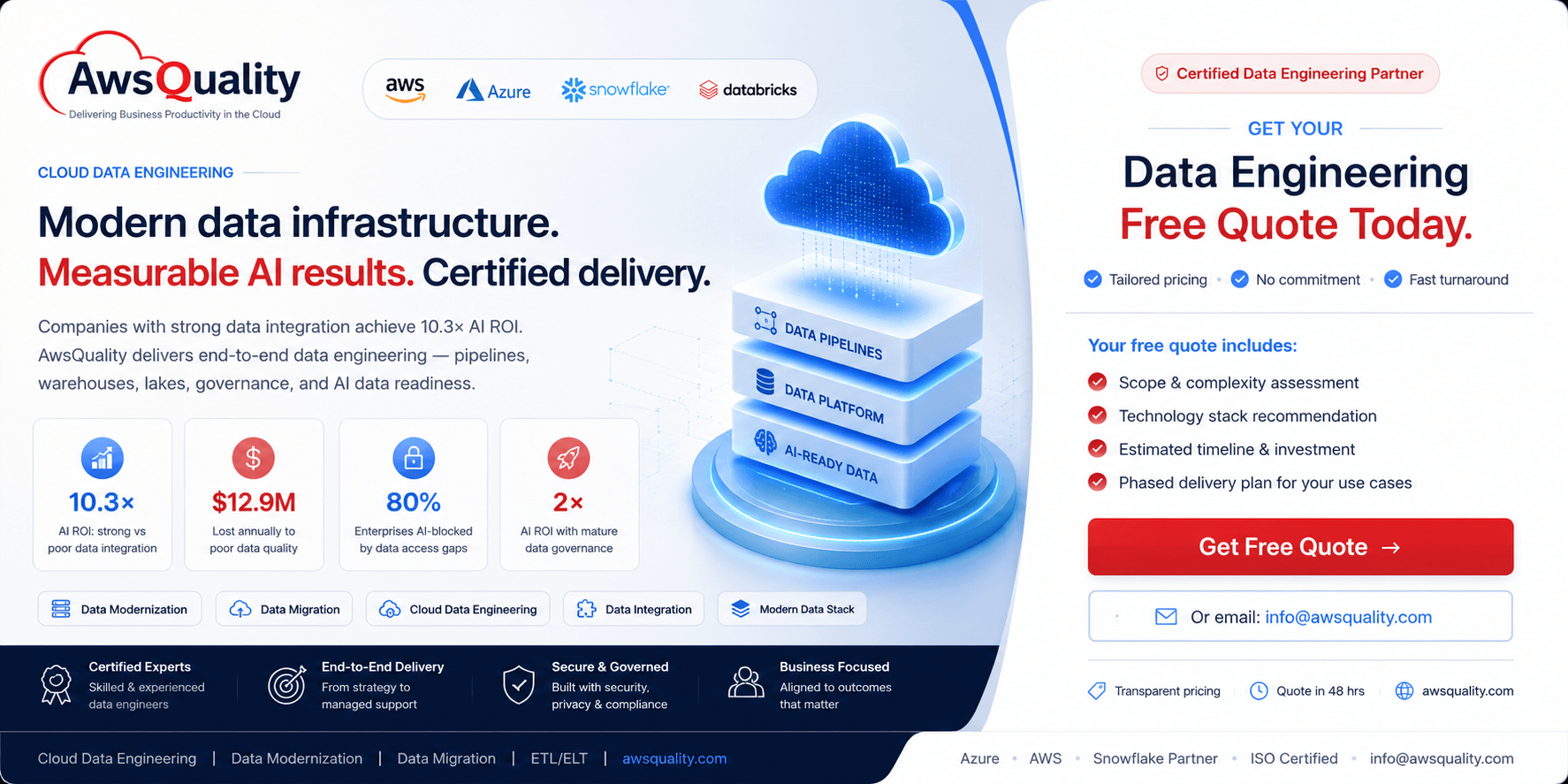
Choosing the Right Data Engineering Partner for AI Readiness
Not all data engineering services are equivalent in their ability to support enterprise AI readiness. The specific capabilities that distinguish a data engineering partner capable of building an AI-ready foundation include:
Experience across the full data lifecycle. AI data readiness is not a pipeline problem alone, or a quality problem alone, or a governance problem alone. It requires integrated capability across ingestion, transformation, quality, integration, storage, and governance. Partners that specialize in one dimension cannot build the full foundation that AI requires.
Cloud platform expertise across environments. Enterprise AI data environments are almost always multi-cloud or hybrid. A partner with deep expertise in only one cloud platform cannot address the full integration challenge that most large enterprises face.
Understanding of AI-specific data requirements. Data engineering services that were built for traditional analytics may not understand the specific requirements of AI systems — feature stores, vector databases, RAG infrastructure, real-time serving latency, model training data pipelines. The 2026 AI data engineering challenge requires both data engineering depth and AI architecture understanding.
Governance and compliance capability. For regulated enterprises, the governance dimension of AI data readiness is as important as the technical infrastructure. Partners that cannot build governance into the data architecture — not as a later addition but as a foundational capability — will create compliance exposure that limits or prevents production AI deployment.
Business Benefits of AI-Ready Data Platforms
Faster AI Deployment
Teams spend less time preparing data and more time building AI solutions.
Better Decision-Making
Executives gain access to trusted enterprise-wide insights.
Higher AI Accuracy
High-quality datasets improve model performance.
Reduced Operational Costs
Automation eliminates repetitive data management tasks.
Improved Compliance
Governed platforms simplify regulatory reporting.
Enhanced Customer Experience
Unified customer data enables personalization across channels.
Greater Scalability
Cloud-native platforms grow alongside business needs.
Industries Benefiting from Data Engineering Services
Financial Services
- Fraud detection
- Risk modeling
- Regulatory reporting
- Customer analytics
Healthcare
- Clinical analytics
- Patient insights
- Predictive diagnostics
- Operational optimization
Retail
- Demand forecasting
- Inventory optimization
- Recommendation engines
- Customer personalization
Manufacturing
- Predictive maintenance
- IoT analytics
- Supply chain visibility
- Production optimization
Telecommunications
- Network optimization
- Churn prediction
- Customer analytics
Technology Companies
- AI products
- SaaS analytics
- Usage insights
- Platform monitoring
Cloud Data Engineering and AI
Most enterprises are building AI-ready platforms in the cloud.
Benefits include:
- Elastic scalability
- Lower infrastructure costs
- Managed data services
- Integrated AI platforms
- Enhanced security
- Faster deployment
Popular cloud ecosystems include:
- AWS
- Microsoft Azure
- Google Cloud Platform
Cloud-native data engineering enables organizations to innovate without managing complex infrastructure.
Best Practices for Building AI-Ready Data Platforms
Start With Business Objectives
Technology should support measurable business outcomes.
Prioritize Data Quality
AI cannot compensate for unreliable data.
Adopt Cloud-Native Architecture
Cloud platforms offer greater scalability and flexibility.
Implement Strong Governance
Build security and compliance into the platform from day one.
Automate Data Pipelines
Reduce manual work through orchestration and automation.
Enable Self-Service Analytics
Empower business users with trusted data access.
Design for Scalability
Future-proof the architecture for AI growth.
Common Mistakes to Avoid
- ❌ Treating AI as a standalone initiative
- ❌ Ignoring data governance
- ❌ Maintaining disconnected data silos
- ❌ Relying solely on batch processing
- ❌ Delaying cloud modernization
- ❌ Underestimating metadata management
- ❌ Focusing on AI models before fixing data foundations
Why Partner With a Data Engineering Company?
Building enterprise-grade AI platforms requires expertise across architecture, cloud engineering, integration, governance, and analytics.
A specialized data engineering partner helps organizations:
- Assess current data maturity
- Design AI-ready architectures
- Build modern data pipelines
- Implement governance frameworks
- Optimize cloud data platforms
- Support AI initiatives at scale
Rather than assembling multiple disconnected solutions, experienced consultants deliver an integrated strategy aligned with business goals.
How AwsQuality Helps Enterprises Build AI-Ready Data Platforms
At AwsQuality, we help organizations transform fragmented data environments into scalable, AI-ready platforms.
Our Data Engineering Services include:
- Data strategy and consulting
- Cloud data engineering
- ETL/ELT development
- Data lake and lakehouse implementation
- Data warehouse modernization
- Real-time data streaming
- AI-ready data preparation
- Data governance and security
- Analytics platform engineering
- Ongoing platform optimization
Whether you’re modernizing legacy systems or preparing for enterprise AI adoption, our experts design data platforms that deliver measurable business value.
Final Thoughts
AI is transforming how enterprises operate, compete, and innovate.
But successful AI initiatives begin long before models are trained or applications are deployed.
They begin with trusted, scalable, and well-governed data.
Data engineering services provide the architecture, pipelines, governance, and operational foundation required to support modern AI workloads.
Organizations that invest in AI-ready data platforms today will be better positioned to:
- Accelerate innovation
- Improve decision-making
- Scale AI initiatives
- Enhance customer experiences
- Build resilient digital businesses
The future of enterprise AI isn’t built on algorithms alone.
It’s built on data engineering.
Frequently Asked Questions (FAQs)
What are data engineering services?
Data engineering services involve designing, building, and managing systems that collect, process, store, integrate, and prepare data for analytics, AI, and business intelligence.
Why is data engineering important for AI?
AI models depend on high-quality, accessible, and governed data. Data engineering ensures AI systems receive reliable data through scalable pipelines and modern architectures.
What is an AI-ready data platform?
An AI-ready data platform is a secure, scalable, and governed environment that provides clean, integrated, and real-time data for AI, machine learning, analytics, and business applications.
How do data engineering services improve business outcomes?
They enhance data quality, automate pipelines, eliminate silos, improve decision-making, reduce operational costs, and enable faster AI deployment.
 Bio
Bio