
Financial services are undergoing one of the biggest technology transformations in history. Today’s users expect more than secure transactions—they demand intelligent, personalized, and proactive financial experiences. Whether it’s mobile banking, digital wallets, investment platforms, insurance apps, or fintech solutions, Artificial Intelligence (AI) has become a fundamental component rather than an optional enhancement.
Many organizations initially integrated AI into their existing mobile applications as an additional feature. However, as AI capabilities continue to evolve, this approach is proving inadequate. Modern financial applications require an AI-first architecture, where intelligence is embedded into every layer of the application from the beginning.
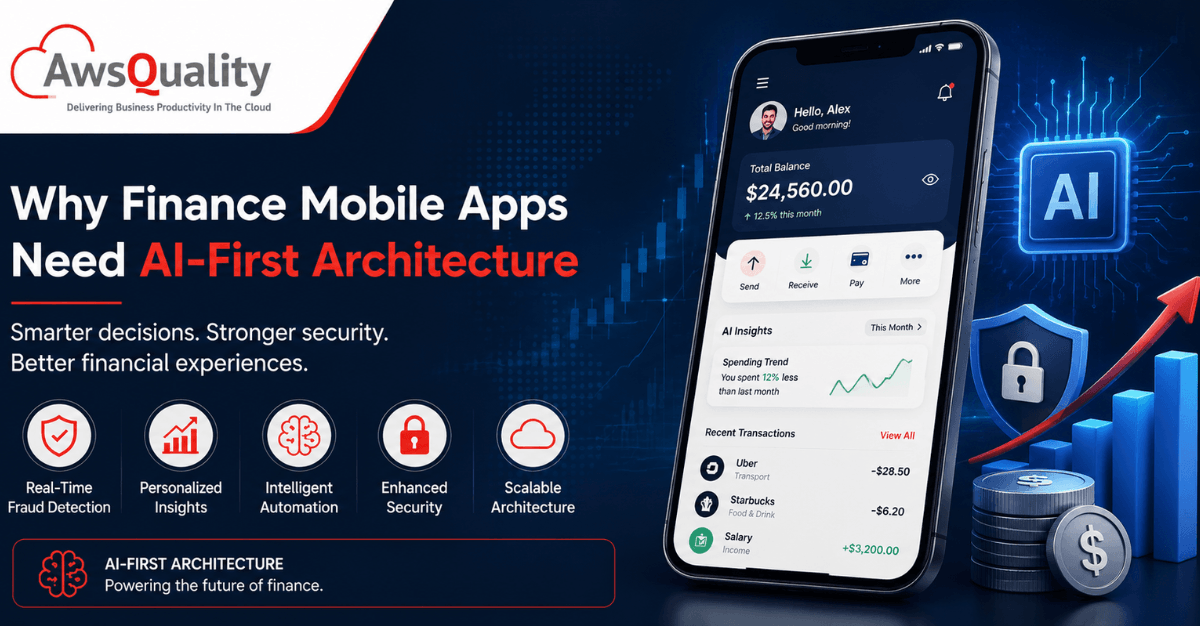
An AI-first approach enables finance apps to deliver smarter automation, real-time fraud detection, personalized financial recommendations, predictive analytics, enhanced customer support, and stronger security—all while improving scalability and user experience.
What “AI-First Architecture” Actually Means
The Difference Between AI-Enabled and AI-First
An AI-enabled finance app has AI features. A chatbot answers customer questions. A fraud model flags suspicious transactions after they occur. A recommendation engine suggests products based on periodic data exports. The AI exists, but it operates at the edges of an architecture that was designed around traditional application logic — request, process, respond, store.
An AI-first finance app is architected differently from the ground up. AI models are core dependencies in the application’s primary data flow, not optional services called when convenient. Every transaction, every user action, and every account event is processed through real-time AI inference as a structural part of how the application works — not as an enhancement layered on top.
Rethink your architecture. AI agents require infrastructure that supports traceability, real-time decisions, and autonomous escalation.
That requirement — traceability, real-time decisions, autonomous escalation — cannot be satisfied by calling an external AI API from a traditional CRUD application. It requires the application’s core architecture to be designed around streaming data, event-driven processing, and AI inference as a first-class architectural citizen.
Why “Adding AI Later” Doesn’t Work for Finance Apps
Most fintech innovation lives at the edge: UX layers, APIs, analytics. But in 2026, the core is finally catching up.
The historical pattern in fintech app development — and in mobile app development generally — has been to build the application’s core transaction processing first, then add intelligence layers (analytics, personalization, fraud scoring) on top once the core product is stable. This pattern works adequately for non-financial mobile apps, where the cost of a delayed or imperfect AI recommendation is low.
It does not work for finance mobile apps in 2026, for three structural reasons:
Latency requirements have collapsed. Instant settlement is no longer a differentiator. It’s expected. When settlement happens in real time, fraud detection, risk scoring, and compliance checks must also happen in real time — within the same transaction window, not in a subsequent batch process. An architecture where AI is a bolt-on service introduces latency that the real-time settlement expectation cannot absorb.
Regulatory requirements demand built-in explainability. Under the EU AI Act and DORA, fintechs must ensure that AI systems can justify their decisions, log their reasoning, and hand off to humans when needed. Explainability and audit trail requirements cannot be retrofitted onto an architecture where AI decisions happen in an external service with no native logging integration into the core application’s compliance and audit infrastructure.
Data freshness determines model accuracy. AI fraud and risk models depend on having access to the freshest possible transaction and behavioral data. An architecture where AI services receive data through periodic batch exports rather than real-time event streams produces models that are working with stale information — degrading the accuracy of exactly the fraud and risk decisions that matter most.
The Rise of Intelligent Financial Experiences
Consumers increasingly rely on mobile apps for managing every aspect of their finances.
They expect apps to:
- Detect fraud instantly
- Recommend smarter investment opportunities
- Predict spending patterns
- Automate savings
- Categorize expenses
- Offer personalized financial advice
- Provide instant customer support
Meeting these expectations requires intelligence embedded directly into the application’s architecture.
Read: From Idea to Launch – How Mobile App Development Services Work
Key Benefits of AI-First Architecture for Finance Apps
Real-Time Fraud Detection
Fraud prevention remains one of the most critical priorities for financial institutions.
AI continuously analyzes:
- Transaction patterns
- Device behavior
- Login activity
- Geographic anomalies
- User behavior
Instead of relying on static rules, AI identifies suspicious activities in real time.
Benefits include:
- Faster fraud detection
- Reduced financial losses
- Lower false positives
- Improved customer trust
Personalized Banking Experiences
Every customer has different financial goals.
AI analyzes customer behavior to deliver:
- Personalized savings plans
- Investment recommendations
- Loan offers
- Credit card suggestions
- Financial wellness insights
This improves engagement while increasing cross-selling opportunities.
Smarter Customer Support
AI-powered virtual assistants are transforming customer service.
Finance apps now provide:
- 24/7 support
- Account assistance
- Loan eligibility guidance
- Transaction queries
- Card management
- Complaint resolution
Natural Language Processing (NLP) enables human-like conversations while reducing operational costs.
Predictive Financial Insights
Rather than simply displaying historical transactions, AI predicts future financial behavior.
Examples include:
- Cash flow forecasting
- Spending predictions
- Budget recommendations
- Investment opportunities
- Credit risk analysis
Users receive actionable insights instead of static reports.
Enhanced Security
Financial applications process highly sensitive customer information.
AI strengthens security through:
- Behavioral biometrics
- Facial recognition
- Voice authentication
- Continuous risk scoring
- Adaptive multi-factor authentication
Security evolves dynamically based on user behavior.
AI-Powered Features Modern Finance Apps Should Include
A competitive finance app should leverage AI across multiple capabilities:
Intelligent Expense Tracking
Automatically categorize transactions and identify spending trends.
Smart Budgeting
Recommend budgets based on historical financial behavior.
Automated Savings
Predict surplus income and automate savings contributions.
Credit Scoring
Use AI models to evaluate creditworthiness using alternative data.
Robo-Advisory
Provide personalized investment strategies aligned with user goals and risk tolerance.
Fraud Prevention
Continuously monitor transactions for anomalies and suspicious activities.
Voice Banking
Enable users to perform banking tasks through secure voice interactions.
Document Verification
Use AI-powered OCR and computer vision for instant identity verification and KYC processes.
Also read: 5 Signs You’ve Found the Right Mobile Application Development Company
The Rise of Intelligent Financial Experiences
Consumers increasingly rely on mobile apps for managing every aspect of their finances.
They expect apps to:
- Detect fraud instantly
- Recommend smarter investment opportunities
- Predict spending patterns
- Automate savings
- Categorize expenses
- Offer personalized financial advice
- Provide instant customer support
Meeting these expectations requires intelligence embedded directly into the application’s architecture.
The Business Case — What AI-First Architecture Actually Delivers
Fraud Detection in Real Time
AI-powered fraud detection has reduced financial losses by up to 40%, with over 60% of financial institutions using machine learning to detect fraud in real time. Unlike traditional rule-based systems, AI analyzes transactions within milliseconds, enabling payment decisions in under 200 ms while minimizing false positives and improving customer trust.
Faster Loan Underwriting
AI has transformed loan approvals, reducing processing times from 48 hours to just 8 minutes. By automating document verification, identity checks, credit analysis, and risk assessment, AI enables instant lending decisions while routing only complex cases for human review.
Lower Operating Costs
AI-driven automation can reduce operational costs by 20–40%, with some fintechs reporting savings of up to 44%. Automating customer support, compliance, and risk assessment allows financial institutions to improve efficiency while enabling employees to focus on high-value activities.
Personalized Financial Experiences
Modern users expect more than basic banking features—they expect personalized financial guidance. AI analyzes real-time customer behavior to deliver tailored spending insights, investment recommendations, savings suggestions, and product offers, helping financial apps improve engagement, retention, and customer loyalty.
Smarter Compliance
As regulations like PSD3 and MiCA reshape the financial industry, AI helps automate KYC, AML monitoring, transaction reporting, and risk analysis. AI-first architecture enables compliance systems to access real-time customer and transaction data, reducing manual effort while improving regulatory accuracy and scalability.
Check out: How to Build a Minimal Viable Product and Secure Funding?
Key Components of AI-First Finance App Architecture
1. Event-Driven Data Architecture
AI-first finance apps rely on an event-driven architecture where every transaction, login, and user interaction generates real-time events. This enables AI to instantly detect fraud, monitor compliance, personalize experiences, and make intelligent decisions without relying on delayed batch processing.
2. API-First Integration Layer
An API-first architecture allows services such as payments, risk management, customer accounts, and AI models to operate independently. This modular approach makes it easier to update AI models, integrate third-party services, and scale applications without disrupting the entire platform.
3. Real-Time AI Inference
Financial decisions often need to happen within milliseconds. Real-time AI inference processes live transaction data to detect fraud, assess risk, and authorize payments instantly. Optimized AI models, low-latency infrastructure, and fallback mechanisms ensure speed, accuracy, and reliability.
4. Explainability & Audit Infrastructure
As financial regulations evolve, AI decisions must be transparent and auditable. Every AI-driven action—such as blocking a transaction or approving a loan—should include detailed logs, confidence scores, and model versions, enabling compliance and easier human review when required.
5. Mobile-Native AI Capabilities
Modern finance apps increasingly leverage on-device AI for biometric authentication, behavioral analysis, fraud detection, and predictive user experiences. Processing AI tasks directly on mobile devices improves security, reduces latency, and enhances user privacy.
6. Agentic AI Orchestration
The next generation of finance apps uses AI agents to automate complex workflows such as KYC verification, loan processing, customer support, and document analysis. These AI agents can make decisions, collaborate across systems, and escalate tasks to human experts whenever necessary, enabling faster and more efficient financial operations.
Industry-Specific Applications of AI-First Architecture
Digital Banking & Neobanks
Modern digital banking is driven by personalized experiences. AI-first architecture enables real-time spending insights, predictive cash flow alerts, automated savings recommendations, and intelligent financial guidance—helping banks improve customer engagement and loyalty.
Payments and Real-Time Transfer Apps
Payment apps require instant fraud detection and real-time risk analysis. AI-first architecture continuously evaluates transactions, minimizes fraud, speeds up approvals, and strengthens customer trust without compromising performance.
Lending and Underwriting Platforms
AI-first lending platforms automate document verification, identity checks, credit assessment, and fraud detection. By analyzing data in real time, they enable faster loan approvals, more accurate credit decisions, and improved customer experiences.
Wealth Management and Robo-Advisory
AI powers personalized investment strategies, portfolio rebalancing, tax optimization, and market analysis. AI-first architecture helps wealth management apps deliver intelligent financial advice based on real-time market conditions and individual investor goals.
Embedded Finance and B2B Fintech
As embedded finance continues to grow, AI-first architecture enables businesses to integrate payments, lending, compliance, and fraud protection into their platforms. This allows marketplaces and SaaS applications to offer secure, intelligent financial services without building the infrastructure from scratch.
Also check: MVP to Market – Realistic Cost, Timelines and Tech Stack for MVP App Development
Building AI-First Architecture — A Practical Roadmap for Finance App Development Teams
Step 1: Audit the Current Data Flow
Before redesigning architecture, map how data currently moves through the finance application — from user action through processing to storage and any downstream analytics or AI services. Identify every point where AI inference currently happens as an asynchronous or batch process rather than a real-time, in-flow step.
Step 2: Identify the Highest-Value AI-First Conversions
Start with low-risk domains. Tasks like KYC triage, contract parsing, and invoice matching are ideal entry points.
Not every AI capability needs to be rebuilt simultaneously. Prioritize the conversions that deliver the most immediate business value: fraud detection (direct loss prevention), underwriting speed (direct conversion and competitive advantage), and compliance automation (direct cost reduction and risk mitigation) are typically the highest-priority candidates for AI-first redesign.
Step 3: Build the Event-Driven Foundation
Move to cloud-native, real-time architecture. The event-driven data layer described in Part 3 is the foundational infrastructure investment that every subsequent AI-first capability depends on. This is typically the most significant architectural investment in the transformation — and the one that should be prioritized before building out specific AI use cases on top of it.
Step 4: Design for Explainability From the Start
Design for trust. Ensure your agents know when to pause, explain, or escalate. Build the audit logging, explanation generation, and human escalation pathways into the architecture as core requirements — not as compliance features added before a regulatory audit.
Step 5: Choose the Right Mobile App Development Partner
AI-first finance app architecture requires specific expertise: experience with real-time data architecture, familiarity with financial services compliance requirements (PSD3, DORA, regional banking regulations), and genuine depth in both backend AI infrastructure and mobile-native development — biometric authentication, offline-capable mobile architectures, and the performance optimization that finance apps require given their latency-sensitive nature.
For organizations evaluating mobile app development partners for finance applications, the evaluation should prioritize teams with demonstrated fintech app development experience — not general mobile development capability applied to a finance use case for the first time. The architectural decisions in finance mobile app development carry compliance and security implications that general consumer app development does not.
Step 6: Plan for Continuous Model Iteration
AI models in finance applications require continuous retraining as fraud patterns evolve, as regulatory requirements change, and as user behavior shifts. The architecture should be designed to support model updates and A/B testing of model versions without requiring application redeployment — treating AI models as a continuously evolving component of the system rather than a fixed feature shipped once.
Common Mistakes in AI-First Finance App Architecture
Mistake 1: Treating AI as a Microservice Bolt-On
The most common failure pattern is building the core finance application using traditional architecture, then adding an “AI service” that the application calls when needed. This produces the latency, data freshness, and explainability gaps described throughout this guide. AI-first architecture requires AI to be a foundational design consideration, not an add-on service.
Mistake 2: Underestimating Compliance Requirements
AI regulation will tighten globally, especially in the EU and U.S. Each compliance failure can result in legal penalties or reputational damage. Teams that build AI-first architecture without designing explainability and audit infrastructure from the start face expensive retrofitting when regulatory requirements catch up to their deployment.
Mistake 3: Optimizing for Accuracy Over Latency
In finance applications, a marginally more accurate fraud model that takes 2 seconds to return a prediction is often worse than a slightly less accurate model that returns a prediction in 100 milliseconds — because the transaction processing window cannot accommodate the slower model regardless of its accuracy advantage. AI-first architecture decisions must weigh latency requirements as seriously as model accuracy.
Mistake 4: Ignoring On-Device AI Opportunities
Many finance app teams default to server-side AI processing for everything, missing opportunities where on-device inference (biometric authentication, basic fraud signal detection, predictive UI) would deliver better speed, privacy, and offline resilience. Mobile-first architecture should evaluate, for each AI capability, whether on-device or server-side inference is the better fit.
Mistake 5: Building AI Infrastructure That Cannot Scale With Agentic AI
Agentic AI systems now act like virtual managers in mobile apps. Teams that build AI-first architecture around single-purpose models (one model for fraud, one for recommendations) without considering how agentic orchestration will layer on top often need significant rearchitecting when they later want to deploy AI agents that take multi-step actions across the application.
AI is no longer a feature—it is becoming the foundation of modern financial applications.
Conclusion
Organizations that continue relying on traditional mobile architectures risk falling behind customer expectations and competitive innovation.
By adopting AI-first architecture, businesses can build finance apps that are smarter, safer, more personalized, and more scalable.
From fraud detection and intelligent automation to predictive insights and personalized customer experiences, AI-first design enables financial institutions to deliver exceptional value while preparing for the future of digital finance.
The future belongs to finance apps that don’t simply process transactions—they understand, predict, and continuously improve every financial interaction.
 Bio
Bio