Data has become the foundation of modern business. Every customer interaction, financial transaction, IoT sensor, application, and business process generates valuable information that can drive smarter decisions and fuel innovation.
However, collecting data is only the first step.
Many enterprises struggle with disconnected systems, inconsistent data quality, legacy infrastructure, slow analytics, and fragmented reporting. As organizations adopt Artificial Intelligence (AI), machine learning, cloud computing, and real-time analytics, these challenges become even more significant.
This is where data engineering services play a critical role.
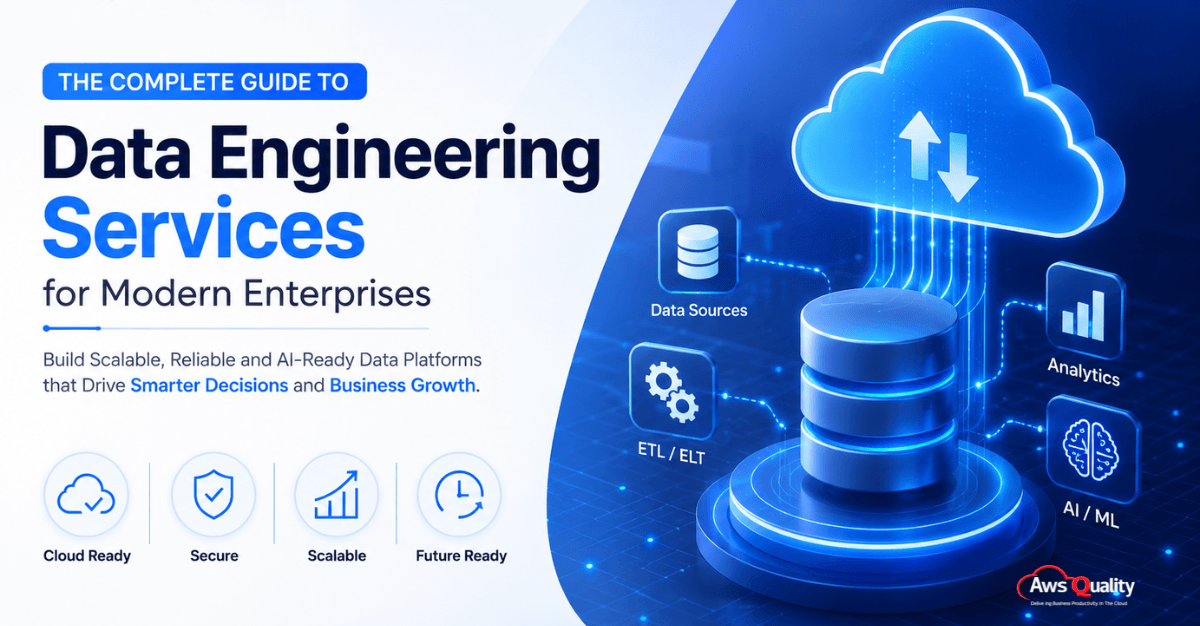
Rather than simply storing information, data engineering enables organizations to collect, integrate, transform, govern, and deliver trusted data that powers analytics, business intelligence, and AI applications.
Why Data Engineering Has Become the Enterprise Priority
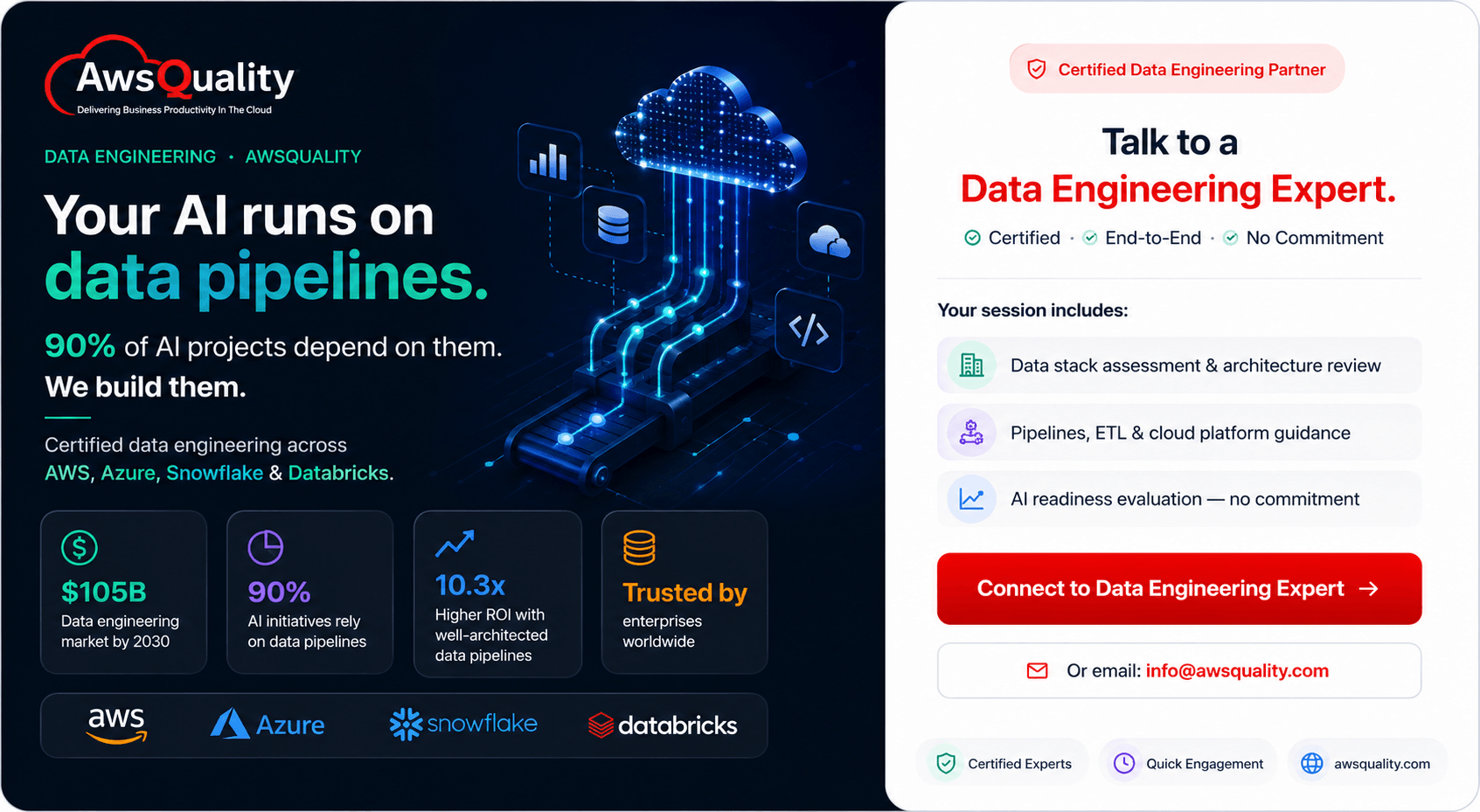
The data engineering market reached $105.40 billion in 2026. The Big Data Engineering Services segment, valued at $91.54 billion in 2025, is projected to reach $187.19 billion by 2030 — growing at a compound annual growth rate of 15.38%, according to Mordor Intelligence. More than 85% of Fortune 500 companies now operate dedicated data engineering teams. And organizations typically allocate 60 to 70% of their total data budgets to data engineering activities alone.
These numbers reflect a fundamental shift in how enterprises understand and prioritize data infrastructure. For two decades, data was treated primarily as a reporting function — a source of dashboards, spreadsheets, and periodic analysis that informed decisions made by humans. That model is being replaced, faster than most organizations anticipated, by one in which data is operational infrastructure: the raw material that powers AI systems, autonomous agents, real-time analytics, personalized customer experiences, and automated business processes.
In that new model, data engineering is not a technical support function. It is a business-critical capability — as foundational to enterprise operations as financial systems, CRM infrastructure, or cloud computing. And the enterprises that have invested in building it, or partnered with expert data engineering services providers to deliver it, are generating measurably better outcomes across every metric that matters: faster decision-making, higher AI ROI, lower operational costs, and stronger competitive positioning.
This guide covers everything a modern enterprise needs to understand about data engineering services: what they are, what they include, why they are indispensable for AI and analytics success, how to evaluate the options for building or buying the capability, and how to choose the right data engineering partner for the specific requirements of your organization.
What Is Data Engineering?
Data engineering is the discipline of designing, building, and maintaining the systems and processes that collect, store, transform, integrate, and deliver data at scale. It is the foundational technical practice that makes all downstream data activities possible — business intelligence, analytics, machine learning, AI, and data-driven automation.
A useful way to understand data engineering’s role is to think of it as the infrastructure layer of the data ecosystem. Just as physical infrastructure — roads, power grids, water systems — enables economic activity without being visible in the transactions it supports, data engineering infrastructure enables analytical and AI activity without appearing in the outputs those activities produce.
The scope of data engineering spans the full data lifecycle:
Data Ingestion — the collection of data from source systems: databases, APIs, SaaS applications, IoT devices, event streams, files, and external data providers. Ingestion may be batch-based, near-real-time, or real-time streaming depending on the latency requirements of the downstream use case.
Data Transformation — the process of converting raw, often inconsistent source data into structured, standardized, and enriched formats suitable for analytics and AI. This is where business logic is applied to data: entity resolution, deduplication, type standardization, aggregation, and feature engineering.
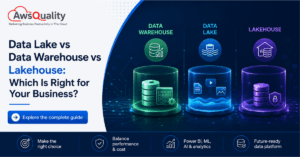
Data Storage — the design and management of the repositories where processed data is stored for analytical consumption. This includes data warehouses for structured analytical data, data lakes for raw and semi-structured data, and increasingly, data lakehouses that combine both approaches.
Data Orchestration — the scheduling, sequencing, monitoring, and error handling of data pipeline workflows. Orchestration ensures that the right data is processed in the right order, at the right time, with automatic recovery when failures occur.
Data Quality — the implementation of validation rules, monitoring systems, and remediation workflows that maintain the accuracy, completeness, consistency, and freshness of data throughout the pipeline. Data quality is the most direct determinant of the reliability of any analytics or AI system built on top of the data.
Data Governance — the policies, standards, and controls that define how data is accessed, documented, retained, secured, and used across the organization. Governance is the infrastructure of trust in enterprise data — the set of practices that allows leadership to act confidently on data-driven insights.
Data Integration — the connectivity between the disparate systems that hold enterprise data, enabling a unified view of customers, operations, finances, and products across organizational and technical boundaries.
Together, these practices constitute data engineering — and together, they are what the term “data engineering services” refers to when delivered by an external partner.
Read: How Data Engineering Services Help Enterprises Build AI-Ready Data Platforms
Why Modern Enterprises Need Data Engineering Services
The case for investing in data engineering services in 2026 is supported by data from every major research source in the field. Three specific drivers make the investment not merely beneficial but necessary:
The AI Imperative
90% of AI and machine learning projects depend directly on data engineering pipelines. Only 7% of enterprises report their data is completely ready for AI adoption (Cloudera/Harvard Business Review, March 2026). 60% of AI projects will be abandoned through 2026 due to lack of AI-ready data (Gartner). And 95% of generative AI deployments show zero measurable financial return — primarily because of data quality and infrastructure failures, not model failures (MIT Project NANDA, July 2025).
The conclusion is direct: enterprises that want to realize value from AI investment must first invest in the data engineering that makes AI workable. The data engineering layer is not a prerequisite for AI in the future. It is a prerequisite for AI in the present.
The Scale of Enterprise Data
More than 402 zettabytes of data are expected to be generated globally during the current decade. The average enterprise now manages data from dozens of source systems — CRMs, ERPs, marketing platforms, financial systems, IoT devices, customer interactions, and third-party data feeds — each generating data at volumes and velocities that were unimaginable a decade ago. 82% of organizations use real-time streaming in their pipeline architectures, reflecting the growing requirement to process data as it is generated rather than after the fact.
Managing data at this scale without dedicated data engineering infrastructure — without automated pipelines, quality monitoring, governance frameworks, and scalable storage — is not a best practice; it is an impossibility that organizations attempt at their peril.
The Cost of Getting It Wrong
Data quality issues affect nearly 30% of organizational revenue. Organizations experience an average of 67 monthly data incidents, each requiring an average of 15 hours to resolve. 30 to 40% of data pipelines fail weekly when they are not properly maintained and monitored. And Gartner estimates that poor data quality costs organizations an average of $12.9 million per year in direct financial terms.
These costs are not incurred by organizations without data. They are incurred by organizations that have data but have not invested in the engineering infrastructure to make it reliable. The financial case for data engineering services is, at its most basic, the case for replacing this cost with a deliberate investment in infrastructure that produces returns rather than incidents.
The Business Value of Data Engineering
Modern enterprises invest in data engineering because it delivers measurable business outcomes.
Better Decision-Making
Executives gain access to accurate, real-time insights instead of relying on outdated reports.
Faster Analytics
Automated pipelines reduce delays and enable near real-time reporting.
AI Readiness
High-quality, governed data significantly improves AI model performance.
Lower Operational Costs
Automation eliminates repetitive manual data preparation.
Improved Customer Experience
Unified customer data enables personalization across every touchpoint.
Regulatory Compliance
Built-in governance simplifies GDPR, HIPAA, SOC 2, and other compliance requirements.
Scalable Growth
Modern cloud architectures scale with growing business demands.
Core Components of Data Engineering Services
1. Data Architecture
Everything starts with architecture.
Data architects design how information flows across the organization.
This includes:
- Source systems
- Storage
- Processing
- Governance
- Security
- Analytics
- AI consumption
A strong architecture prevents future scalability issues.
2. Data Integration
Organizations rarely rely on a single system.
Data integration connects information across:
- Salesforce
- SAP
- Microsoft Dynamics
- Oracle
- AWS
- Azure
- Google Cloud
- Custom applications
- Third-party APIs
Integrated data provides a unified business view.
3. ETL and ELT Development
One of the most important responsibilities of data engineering is building reliable data pipelines.
ETL (Extract, Transform, Load)
Data is transformed before loading.
ELT (Extract, Load, Transform)
Data is loaded first and transformed inside modern cloud platforms.
Benefits include:
- Automated workflows
- Better performance
- Lower maintenance
- Improved consistency
4. Data Lakes
Data lakes store:
- Structured data
- Semi-structured data
- Unstructured data
Examples:
- Images
- Documents
- Videos
- IoT data
- Application logs
Data lakes provide flexibility for AI and advanced analytics.
5. Data Warehouses
Unlike data lakes, warehouses store curated business information optimized for reporting.
Common platforms include:
- Snowflake
- Amazon Redshift
- Azure Synapse
- Google BigQuery
Warehouses enable:
- Dashboards
- KPIs
- Executive reporting
- Business Intelligence
6. Lakehouse Architecture
Modern enterprises increasingly combine the flexibility of data lakes with warehouse performance.
Lakehouse platforms offer:
- Lower storage costs
- Better governance
- Faster analytics
- AI support
Popular technologies include:
- Databricks
- Apache Iceberg
- Delta Lake
7. Real-Time Data Engineering
Businesses increasingly need live insights.
Examples include:
- Fraud detection
- Inventory updates
- Customer recommendations
- Financial monitoring
- Predictive maintenance
Real-time data engineering uses streaming technologies to process information continuously.
8. Data Governance
Governance ensures data remains:
- Secure
- Accurate
- Traceable
- Compliant
- Consistent
Key governance capabilities include:
- Data cataloging
- Metadata
- Access control
- Data lineage
- Policy enforcement
9. Data Quality Engineering
Poor data quality affects every downstream system.
Data engineering services establish:
- Validation
- Cleansing
- Standardization
- Deduplication
- Monitoring
- Automated alerts
High-quality data improves trust across the organization.
10. AI Data Preparation
Generative AI and Machine Learning require properly prepared datasets.
Data engineering supports:
- Feature engineering
- Vector databases
- RAG pipelines
- Document indexing
- Knowledge repositories
- Semantic search
Without quality data, AI initiatives struggle to deliver business value.
Cloud Data Engineering
Most enterprises now build data platforms in the cloud.
Benefits include:
- Elastic scalability
- Reduced infrastructure costs
- High availability
- Built-in security
- Managed services
- AI integration
Cloud platforms commonly used include:
AWS
- Amazon S3
- Glue
- Redshift
- EMR
- Athena
Microsoft Azure
- Azure Data Factory
- Synapse Analytics
- Azure Data Lake
- Event Hubs
Google Cloud
- BigQuery
- Dataflow
- Pub/Sub
- Dataproc
How to Choose a Data Engineering Services Partner
The data engineering services market is large and fragmented, ranging from global systems integrators to specialist boutiques. Evaluating providers on the dimensions that actually determine delivery quality is essential for a decision that will shape the organization’s data capability for years.
1. Certified Technical Expertise
Data engineering is a multi-platform discipline. The right partner holds certifications from the specific platforms your architecture uses: Microsoft Azure, Amazon AWS, Google Cloud, Snowflake, Databricks, and where relevant, the Salesforce data ecosystem. Certifications are not decorative — they reflect the investment the firm has made in developing and validating technical expertise.
2. End-to-End Delivery Capability
Data engineering projects fail when expertise is narrow. A partner that excels at pipeline development but cannot address data quality, governance, or BI integration will deliver technically sound pipelines that do not produce the business outcomes the organization needs. The right partner covers the full data engineering lifecycle.
3. AI Data Readiness Experience
In 2026, every data engineering engagement has an AI dimension. A partner that does not understand the specific data requirements of machine learning feature engineering, vector database infrastructure, and real-time serving architecture cannot build the foundation that enterprise AI requires.
4. Industry Expertise
Data engineering requirements vary significantly across industries. Financial services require real-time transaction processing, fraud detection infrastructure, and regulatory compliance. Healthcare requires HIPAA-compliant data handling and clinical data pipeline expertise. Retail requires e-commerce integration, demand forecasting pipelines, and customer data platform architecture. Choose a partner with demonstrated delivery in your industry.
5. A Proof-of-Concept Approach
No data engineering requirement is identical, and no proposal can be fully validated before delivery begins. The right partner proposes a scoped proof-of-concept against your actual data, on your actual source systems, before full engagement — providing evidence of capability rather than relying entirely on past case studies.
6. Post-Delivery Support
Data engineering infrastructure requires ongoing maintenance, optimization, and extension. A partner that treats delivery as a project with a defined end date and no post-delivery engagement will leave the organization managing infrastructure it may not fully understand. Evaluate the partner’s managed services and ongoing support capability alongside their project delivery capability.
Modern Data Engineering Technologies
Common technologies include:
Storage
- Snowflake
- Databricks
- BigQuery
- Redshift
Processing
- Apache Spark
- Hadoop
- Flink
Orchestration
- Apache Airflow
- Prefect
- Dagster
Streaming
- Kafka
- Amazon Kinesis
- Azure Event Hubs
Transformation
- dbt
- Spark SQL
Governance
- Apache Atlas
- Microsoft Purview
- Collibra
How Data Engineering Supports AI
AI initiatives depend on:
- Trusted data
- Real-time access
- Metadata
- Governance
- Feature pipelines
Data engineering enables:
Machine Learning
Training datasets
Generative AI
Knowledge repositories
AI Agents
Context-aware enterprise information
Predictive Analytics
Historical and real-time data
Business Intelligence
Accurate dashboards
Also read: Why Agentic AI is the Next Big Enterprise Challenge for CTOs
A Practical Data Engineering Implementation Roadmap
For enterprises beginning or maturing their data engineering programme, the following phased roadmap provides a structured path from current state to a production-grade, AI-ready data platform.
Phase 1: Discovery and Assessment (Weeks 1–4)
Map the current data landscape comprehensively: every source system, every existing pipeline or integration, every data store, and every analytics use case. Assess data quality across critical business domains. Identify the highest-priority business use cases that data engineering should enable — the decisions that are currently made on incomplete, inconsistent, or untimely data. Produce an architecture recommendation and a prioritized implementation roadmap.
Phase 2: Foundation (Months 1–3)
Select and configure the target data platform — cloud warehouse, data lake storage, orchestration framework, and observability tooling. Build the initial pipelines for the highest-priority data domains. Implement the data quality framework. Establish the governance model: data ownership, access control, retention policies, and documentation standards.
Phase 3: Core Pipeline Delivery (Months 3–6)
Build out the pipeline portfolio progressively — adding source systems, transformation layers, and analytical datasets in priority order. Implement the integration architecture for the enterprise’s most important systems: CRM, ERP, marketing, and financial. Deploy the BI layer: data models, dashboards, and reports that deliver immediate analytical value on the new data platform.
Phase 4: AI Enablement (Months 6–12)
Build the data infrastructure specifically required for AI workloads: feature engineering pipelines, feature stores, vector database infrastructure for GenAI applications, and real-time serving infrastructure for AI agents. Deploy initial AI use cases on the prepared data foundation. Measure AI performance against the data quality baseline established in Phase 2.
Phase 5: Optimization and Scale (Month 12+)
Review pipeline performance, data quality metrics, and analytics usage patterns. Optimize warehouse and lake costs through right-sizing, lifecycle management, and usage governance. Extend the platform to additional source systems and use cases. Build the internal capability — through training, documentation, and structured knowledge transfer — to manage and extend the platform as business requirements evolve.
Data Engineering Use Cases
Financial Services
- Fraud detection
- Risk analytics
- Customer intelligence
Healthcare
- Clinical analytics
- Patient insights
- Regulatory reporting
Retail
- Personalization
- Demand forecasting
- Supply chain optimization
Manufacturing
- Predictive maintenance
- IoT analytics
- Production optimization
Telecommunications
- Network monitoring
- Customer analytics
- Churn prediction
Technology Companies
- SaaS analytics
- Usage reporting
- Product intelligence
Common Challenges Enterprises Face
Legacy Systems
Disconnected platforms create silos.
Poor Data Quality
Duplicate and inconsistent records reduce trust.
Scaling Problems
Older architectures struggle with growing data.
Governance Gaps
Lack of ownership creates compliance risks.
Skills Shortages
Experienced data engineers remain in high demand.
Best Practices for Data Engineering
Start with Business Goals
Technology should support measurable outcomes.
Build Modular Architecture
Flexible systems simplify future growth.
Automate Everything Possible
Reduce manual intervention.
Prioritize Governance
Security and compliance must be built in.
Monitor Data Quality Continuously
Prevention is better than correction.
Enable Self-Service Analytics
Empower business users responsibly.
Prepare for AI
Design infrastructure that supports future AI initiatives.
Why Choose AwsQuality for Data Engineering Services?
At AwsQuality, we help organizations transform fragmented, legacy data environments into scalable, cloud-native, AI-ready platforms.
Our capabilities include:
- Data Engineering Consulting
- Data Platform Architecture
- Cloud Data Engineering
- ETL & ELT Development
- Data Lake & Lakehouse Implementation
- Data Warehouse Modernization
- Real-Time Data Pipelines
- AI Data Preparation
- Data Governance
- Metadata Management
- Data Quality Engineering
- Managed Data Services
Whether you’re modernizing legacy infrastructure or preparing for enterprise AI adoption, our team delivers secure, scalable, and future-ready data solutions tailored to your business goals.
Frequently Asked Questions
What are Data Engineering Services?
Data Engineering Services involve designing, building, integrating, and managing data infrastructure that supports analytics, AI, reporting, and business applications.
What is a data lakehouse?
A data lakehouse combines the storage flexibility and cost efficiency of a data lake — storing raw data in open formats on cloud object storage — with the performance, ACID transactions, and governance features of a data warehouse. Platforms like Databricks Delta Lake, Apache Iceberg, and Microsoft Fabric implement the lakehouse architecture.
What is the modern data stack?
The modern data stack refers to the cloud-native toolset that has become the default architecture for enterprise data engineering since approximately 2020: a cloud data warehouse (Snowflake, Redshift, BigQuery, or Synapse) for analytical storage, dbt for in-warehouse transformation, Fivetran or Airbyte for data ingestion, Airflow or Prefect for orchestration, and a BI tool (Looker, Power BI, Tableau) for analytics consumption.
Why are Data Engineering Services important?
They improve data quality, eliminate silos, automate pipelines, enable AI, strengthen governance, and support better business decisions.
How does Data Engineering support AI?
Data engineering prepares, integrates, governs, and delivers high-quality data that AI models need to produce accurate and reliable outcomes.
Which cloud platforms are commonly used for Data Engineering?
AWS, Microsoft Azure, and Google Cloud are the most widely adopted cloud platforms for modern data engineering workloads.
What’s the difference between Data Engineering and Data Analytics?
Data engineering builds the infrastructure and pipelines that deliver trusted data, while data analytics focuses on interpreting that data to generate insights.
What is the difference between Data Engineering and Data Science?
Data engineering builds and maintains the infrastructure that stores, moves, and transforms data — the pipelines, warehouses, lakes, and integrations. Data science uses that infrastructure to analyse data, build predictive models, and generate insights. Data engineering is the foundation; without it, data scientists have no clean, reliable data to work with.
How long does a data engineering project take?
Simple data pipeline projects connecting two to three sources to a single destination can be delivered in two to four weeks. Comprehensive enterprise data platform implementations — covering multiple source systems, a cloud data warehouse, a data lake, quality frameworks, and governance — typically take three to nine months depending on scope and complexity.
What is the difference between ETL and ELT?
ETL (Extract, Transform, Load) performs data transformations before loading into the target system. ELT (Extract, Load, Transform) loads raw data first and performs transformations within the target platform using its native computer. ELT has become the preferred approach for cloud data warehouse environments because modern warehouses provide cost-efficient compute for in-database transformation.
How does data engineering enable AI and machine learning?
AI and machine learning require high-quality, well-structured, current, and consistently formatted data to produce reliable outputs. Data engineering provides this through data pipelines that collect and transform raw data, feature engineering that derives the variables ML models need, feature stores that make those variables available at training and inference time, and data quality infrastructure that ensures the accuracy and freshness of AI inputs.
How much do data engineering services cost?
Data engineering service costs vary significantly with scope, platform selection, data volume, and team configuration. AwsQuality provides transparent pricing in every engagement proposal, following a free initial assessment that allows us to scope requirements accurately. Contact our team at info@awsquality.com for a free data engineering assessment and cost estimate.
Conclusion: Data Engineering Is the Foundation for Everything That Matters
The enterprises that will lead their industries in 2030 are not the ones that invest the most in AI models or analytics tools. They are the ones that invest in the data engineering infrastructure that makes those tools work — the pipelines, integrations, warehouses, lakes, quality frameworks, and governance capabilities that transform raw, fragmented enterprise data into a reliable, accessible, AI-ready foundation.
The data engineering market reached $105.40 billion in 2026 because that investment is generating returns. Companies with strong data integration achieve 10.3 times the AI ROI of those with poor data connectivity. Enterprises with mature data governance are nearly twice as likely to achieve measurable returns from generative AI. And organizations that treat data engineering as the prerequisite for analytics and AI — rather than the afterthought — consistently outperform those that discover its necessity after an expensive failure.
 Bio
Bio