Every business leader faces the same relentless pressure: do more, with less, faster than last year. Operational costs — the salaries, tools, processes, and overhead that keep a business running — have historically been the most difficult cost category to reduce without compromising quality or capacity.
AI agents are changing that equation fundamentally.
Unlike earlier automation tools that could only follow rigid, rule-based scripts, AI agents can reason, plan, make decisions, and take autonomous action across complex multi-step workflows — with no human required in the loop for routine decisions. The result is a category of cost reduction that was simply not available to businesses before 2024.
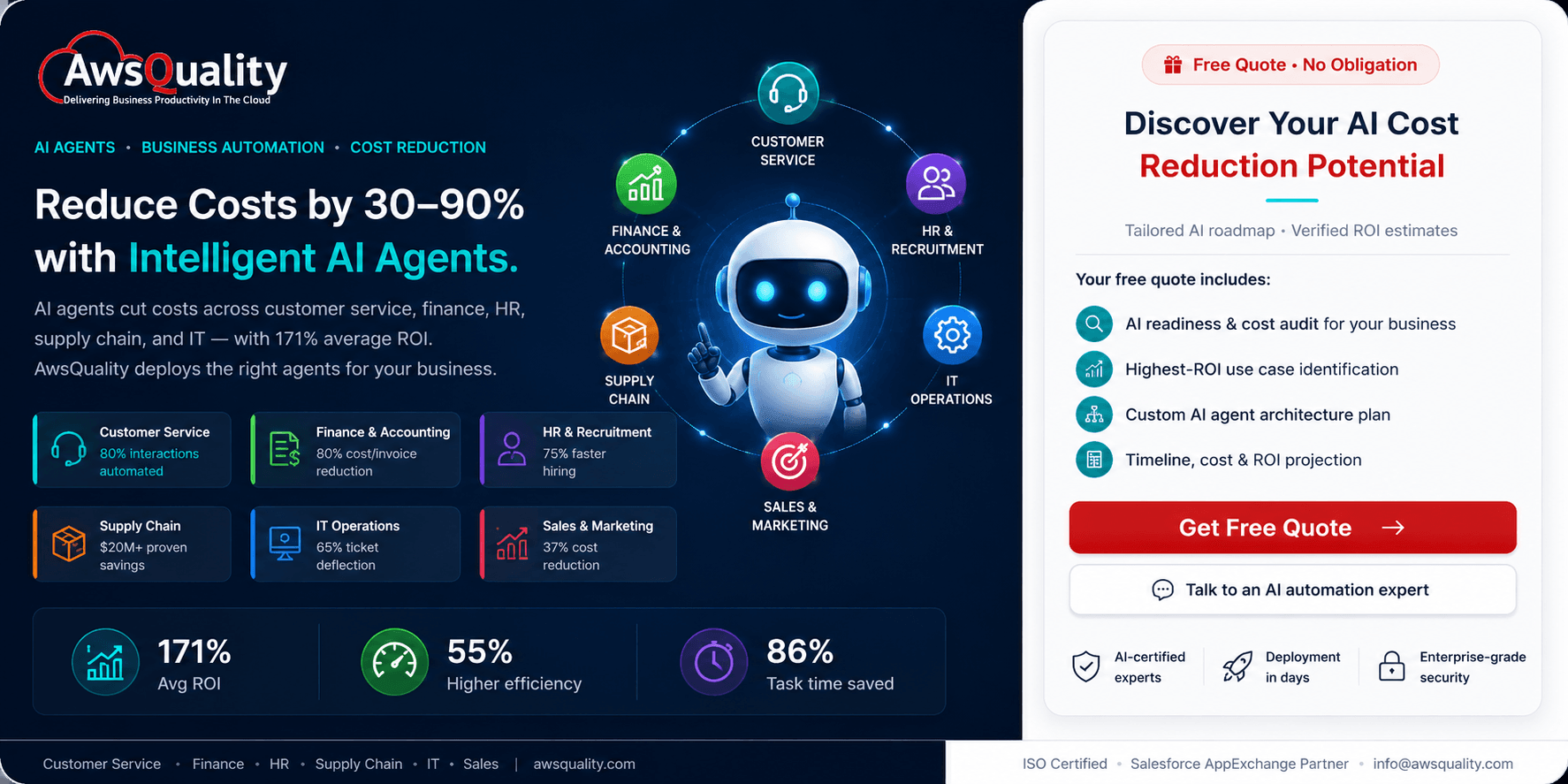
The data in 2026 is no longer theoretical. AI agents have been shown to cut manual work and operational costs by at least 30% while simultaneously increasing speed and productivity. Businesses using AI agents report 55% higher operational efficiency and 35% cost reductions. Companies report an average ROI of 171% from agentic AI deployments, with U.S. enterprises reaching 192% — roughly three times traditional automation returns.
This guide breaks down exactly where AI agents reduce costs, how much they save, which industries are seeing the most consistent returns, and what your business needs to know before deploying them.
What are AI Agents — Why are They Different?
Before examining cost reduction, it is worth being precise about what an AI agent is and why it is structurally different from conventional automation.
Traditional automation — robotic process automation (RPA), rule-based chatbots, scheduled workflows — executes predefined sequences. It is fast and consistent within its programmed boundaries, but brittle outside them. Any exception, ambiguity, or decision point outside the script requires human intervention.
AI agents are different in three critical ways. They can perceive their environment — reading emails, analyzing documents, interpreting data. They can reason — understanding context, evaluating options, applying judgment to novel situations. And they can act — taking multi-step actions across systems without waiting for human instruction.
Agentic AI reduces human task time by up to 86% in multi-step workflows, significantly boosting operational efficiency. This is not incremental improvement. It is a structural shift in what automation can accomplish.
By 2026, 40% of enterprise applications include AI agents, up from less than 5% in 2025 — and around 75% of organizations are testing or deploying AI agents. The adoption curve is steep because the ROI case is unusually strong across a wide range of business functions.
Read: How to Ensure Compliance, Security, and Transparency in AI Systems
Why Businesses are Investing in AI Agents
Organizations today face several operational challenges:
- Rising labor costs
- Increasing customer expectations
- Manual repetitive work
- Disconnected business systems
- Longer response times
- Limited scalability
- Human errors
- Talent shortages
AI agents help businesses overcome these challenges by automating knowledge work while maintaining speed, accuracy, and consistency.
Cost Reduction Areas
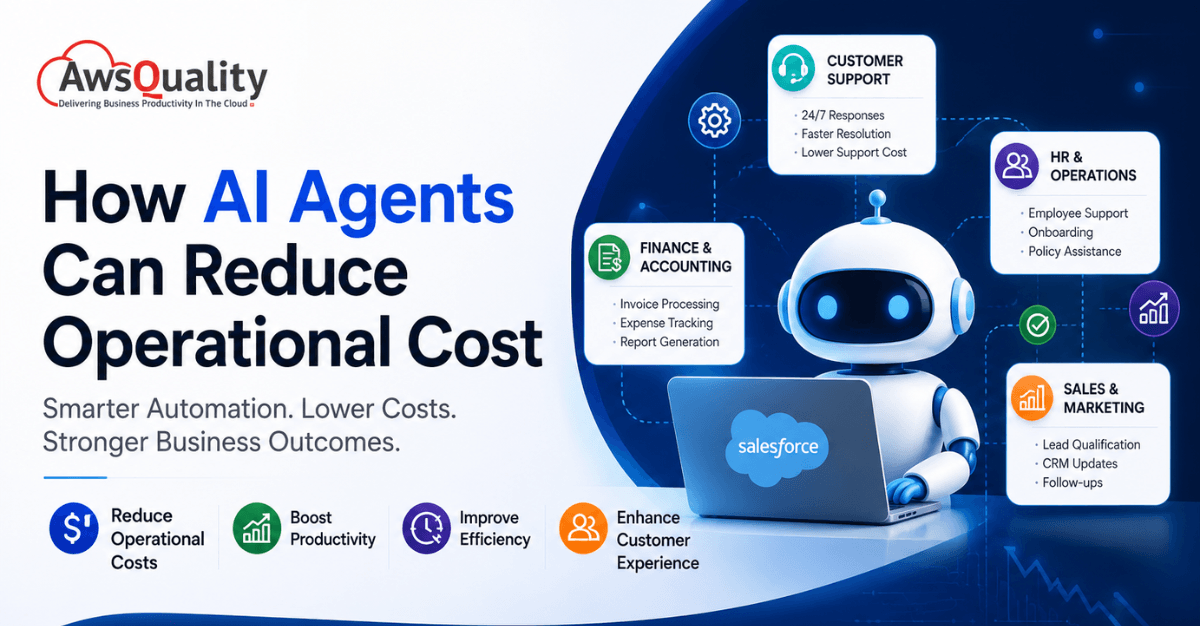
1. Customer Service and Support
Customer service is the highest-volume, most consistently documented area of AI agent cost reduction — and the deployment timelines are among the fastest.
AI agents now manage about 80% of all customer service interactions, reducing operational costs by 30%. The mechanism is straightforward: every interaction resolved autonomously by an AI agent costs a fraction of an interaction handled by a human agent.
Autonomous resolution at over 60% containment shifts thousands of interactions per day from $5–8 in assisted cost to $0.80–1.50 in automated cost. At scale, that cost differential compounds into substantial annual savings.
Real-world proof — Klarna:
Klarna’s AI customer service assistant handled roughly two-thirds of incoming support chats in its first month, equivalent to the work of 700 full-time employees. The company reported a 40% reduction in cost per transaction since Q1 2023.
Real-world proof — Financial services contact center:
A 3,000-seat financial services contact center deployed autonomous digital agents and AI-driven routing across voice and messaging channels. Over 24 months, the organization reduced annual operating costs by 18–22% while maintaining service hours and improving CSAT scores.
According to McKinsey, agentic AI can reduce time to resolution in customer service by up to 90% and cut service backlog by 30 to 50%. These figures reflect the compounding effect of AI agents operating 24/7, across multiple channels simultaneously, without fatigue, training costs, or turnover.
What AI agents handle autonomously in customer service:
- Ticket triage, categorization, and routing
- FAQ resolution and knowledge-base responses
- Order status, returns, and refund processing
- Appointment scheduling and reminders
- Multi-channel escalation with full context transfer
- Real-time sentiment detection and priority flagging
2. Finance and Accounting
Finance operations are characterized by high-volume, rule-governed processes with clear data inputs and outputs — a near-ideal environment for AI agents. The returns in this function are some of the most precisely measurable in the enterprise.
In finance and accounting, AI agents achieve a 95% automation rate in invoice processing and AP automation, with 80% cost reduction per invoice — compressing the financial close from 10 days to 3 days.
Financial institutions project a 38% increase in profitability by 2035, attributed to the integration of AI agents.
Real-world proof — JPMorgan Chase:
AI agents at JPMorgan generate investment banking presentations in 30 seconds, compared to the hours junior analysts previously spent. The system drafts M&A memos, automates trade settlement, and detects fraud in real time across 450+ active AI agent use cases in production.
Real-world proof — Insurance claim processing:
An insurance claim processing agent handling 10,000 claims per month generates $370,000 in monthly savings — $4.4 million annually — with a payback period of 2.3 months.
What AI agents handle autonomously in finance:
- Invoice receipt, coding, and approval routing
- Accounts payable and receivable reconciliation
- Expense report validation and policy compliance
- Fraud detection and anomaly flagging in real time
- Financial close coordination and reporting
- Cash flow forecasting and variance analysis
- Regulatory compliance monitoring and documentation
3. Human Resources and Recruitment
HR operations carry significant administrative overhead that consumes time without generating direct business value. Candidate screening, interview scheduling, onboarding coordination, and policy query handling are all structured, high-volume processes that AI agents can automate substantially.
HR teams using AI agents optimize the entire employee lifecycle, achieving a 75% reduction in hiring time and increased diversity in talent pools. Agents streamline recruiting by parsing resumes, matching candidates to roles, and generating bias-aware summaries for hiring managers, reducing time-to-hire and improving candidate experience.
In human resources, AI agents achieve 70% time reduction in recruitment screening and improve time-to-productivity in employee onboarding by 40%, while deflecting 60% of routine HR policy inquiries without human involvement.
Real-world proof — AMD:
AMD, a global leader in high-performance computing, deployed AI-powered HR agents with Kore.ai to transform HR support for its globally distributed workforce into an intelligent, scalable platform — providing 24/7 support at scale as the organization expanded.
What AI agents handle autonomously in HR:
- Resume screening and candidate ranking at scale
- Interview scheduling and calendar coordination
- Onboarding document collection and verification
- Routine HR policy and benefits query resolution
- Time-off requests and approvals routing
- Performance review coordination and tracking
- Compliance training assignment and completion tracking
Ready to reduce operational costs with intelligent automation? Hire AI Agent Developers from AwsQuality to build custom AI agents tailored to your business workflows.
4. Supply Chain and Logistics
Supply chain is the function where AI agents generate ROI across multiple dimensions simultaneously — cost reduction, error reduction, and resilience improvement — making it the highest-impact deployment area for manufacturing, retail, and distribution businesses.
AI-powered innovations could reduce logistics costs by 15%, optimize inventory levels by 35%, and boost service levels by 65%, according to Microsoft.
Industry research tracking mid-enterprise logistics agent deployments reports savings of 10–25% in fuel costs and 5–20% reductions in overall logistics costs for organizations moving from route-planning software to autonomous routing agents.
AI-powered predictive maintenance achieves 67% reduction in unplanned downtime across facilities, 45% decrease in overall maintenance costs, and 92% accuracy in predicting failures 30 days before they would occur.
Real-world proof — General Mills:
General Mills deployed an AI-driven supply chain optimization system that assesses 5,000+ daily shipments, producing over $20 million in supply chain savings since fiscal 2024. The system evaluates shipment routing, timing, and vendor performance autonomously, flagging exceptions for human review rather than pausing for approval on every decision.
Real-world proof — Uber Freight:
Uber Freight’s AI agent cut empty miles by 10–15%, moved $20 billion in freight, and reduced support wait times from 5 minutes to 30 seconds.
Real-world proof — SPAR Austria:
SPAR Austria, a leading food retailer with over 1,500 stores, uses AI to reduce food waste by optimizing ordering and supply chain management. The retailer developed a solution that analyzes sales data, weather, promotions, and seasonality to generate precise product forecasts.
What AI agents handle autonomously in supply chain:
- Demand forecasting and inventory replenishment
- Route optimization and carrier selection
- Supplier performance monitoring and risk detection
- Logistics exception handling and rerouting
- Predictive maintenance scheduling
- Procurement and vendor negotiation within parameters
- Returns processing and reverse logistics coordination
5. IT Operations and Help Desk
IT operations are a significant cost center in most mid-to-large enterprises, driven primarily by the volume of Level 1 support requests that require human attention for resolution. AI agents have proven highly effective at deflecting this volume while improving resolution speed.
In IT operations, Level 1 help desk automation achieves 65% ticket deflection. System monitoring with automated remediation reduces Mean Time to Resolution (MTTR) by 80%.
Enterprises using AI agents in IT operations report up to 30% reduction in incident response times, with IT departments leading adoption with over 65% already using AI agents for monitoring and automation.
What AI agents handle autonomously in IT:
- Password resets and access provisioning
- Software installation and patch management
- System health monitoring and auto-remediation
- Incident classification, triage, and routing
- Compliance audit preparation and evidence collection
- User onboarding and offboarding automation
- Security threat detection and initial response
6. Sales and Marketing Operations
Sales and marketing operations consume significant resources in lead management, campaign execution, data enrichment, and reporting — all high-volume, process-driven activities that AI agents can substantially automate.
AI voice agents have driven a 37% increase in lead conversion rates, 26% growth in test-drive appointments, and 357 successful after-sales engagements in the first two months of deployment.
Companies adopting agentic AI report an average revenue increase of 6% to 10%, while some have achieved up to 37% reductions in marketing costs through AI-driven optimization.
What AI agents handle autonomously in sales and marketing:
- Lead scoring, qualification, and routing
- Email outreach personalization and sequencing
- CRM data enrichment and record maintenance
- Campaign performance reporting and optimization
- Proposal and quotation drafting
- Follow-up scheduling and meeting coordination
- Social listening and competitive intelligence gathering
7. Healthcare Operations
Healthcare represents one of the most compelling — and consequential — AI agent cost reduction opportunities, with the combination of documentation burden, staffing pressure, and administrative overhead creating significant efficiency gaps.
AI applications in healthcare can generate up to $150 billion in annual savings for the industry by 2026, according to Accenture.
Healthcare organizations are getting a $3.20 return for every $1 invested in AI agents.
Real-world proof — AtlantiCare:
AtlantiCare, a regional healthcare system in New Jersey, deployed an AI documentation agent that listens to consultations, generates structured clinical notes, and pre-populates the relevant fields in the electronic health record. Measured outcomes included 80% provider adoption within the first months of deployment, a 42% reduction in documentation time, and 66 minutes saved per clinician per day.
What AI agents handle autonomously in healthcare:
- Clinical documentation and note generation
- Appointment scheduling and patient reminders
- Prior authorization and insurance verification
- Discharge planning coordination
- Medical coding and billing support
- Patient query handling and triage
- Regulatory compliance documentation
Also read: How AI + Cloud Drives Business Growth and Efficiency
AI Agents vs Traditional Automation
| Traditional Automation | AI Agents |
|---|---|
| Rule-based | Context-aware |
| Fixed workflows | Dynamic decision-making |
| Limited flexibility | Learns continuously |
| Single task | Multi-step workflows |
| Requires structured input | Understands natural language |
| Minimal reasoning | Advanced reasoning capabilities |
How to Prioritize Your AI Agent Investment: A Practical Framework
Not every business process is equally ready for AI agent automation. The organizations generating the strongest returns follow a disciplined prioritization approach that balances impact with implementation risk.
1. Identify high-volume, rule-governed processes
The best candidates for AI agent automation are processes that are high-volume, time-sensitive, data-rich, and rules-based. Customer service Tier-1 resolution, invoice processing, candidate screening, and IT help desk tickets all meet these criteria. The highest-ROI agentic AI deployments share three traits: the agent owned a complete decision, it ran in production rather than a pilot, and the architecture matched the risk level of the task.
2. Quantify the cost of the current process
Before selecting an AI agent use case, measure the current cost precisely — headcount, time-per-transaction, error rates, and downstream costs of errors. This baseline is what makes ROI measurement possible post-deployment.
3. Prioritize by time-to-ROI
Time-to-ROI ranges from two weeks for customer service to 12+ months for supply chain orchestration. Organizations with limited AI maturity should start with faster-return use cases — customer service, IT help desk, invoice processing — before tackling more complex multi-agent supply chain deployments.
4. Prepare data before deployment
Only 21% of enterprises fully meet AI readiness criteria, with data quality and governance identified as the primary barriers. Clean, well-structured data is the foundation of effective AI agent performance. Address data quality issues before deployment, not after.
5. Plan for governance and monitoring
Organizations typically see initial measurable savings within 6–9 months, with full cost-optimization impact realized within 18–24 months. Success depends on cross-functional alignment, clean data, and willingness to evolve business processes alongside technology.
Check out: Why Agentic AI is the Next Big Enterprise Challenge for CTOs
Common Mistakes That Undermine AI Agent ROI
The same pattern that affects CRM and ERP implementations applies to AI agents: the technology is not the problem. The implementation approach is.
1. Starting with complexity
Organizations that attempt multi-agent, cross-system orchestration as their first AI deployment frequently encounter data integration challenges, governance gaps, and change management failures that delay ROI by 12–18 months. Start with a single, well-scoped use case in production.
2. Treating AI agents as a headcount replacement announcement
AI agent deployments that are communicated as job elimination programs encounter significant user resistance that undermines adoption. The most successful deployments are positioned as tools that free people from low-value work — and are backed by genuine reskilling investment.
3. Deploying without governance
95% of organizations getting zero AI returns cite change management failures and unclear business objectives as the primary cause. Every production AI agent deployment needs defined escalation logic, human oversight triggers, and active monitoring.
4. Ignoring data quality
Top challenges in AI agent deployment include security concerns cited by 62% of practitioners, data privacy and quality issues, and lack of formal governance, with only 17% of enterprises having formal AI governance in place. Deploying AI agents on poor-quality data produces poor-quality automation.
5. Measuring inputs, not outcomes
The ROI of an AI agent deployment is measured in business outcomes — cost per transaction, resolution time, error rate, revenue influenced — not in the number of agents deployed or API calls made. Define your outcome metrics before deployment begins.
Best Practices for Implementing AI Agents
Start with High-Impact Processes
Focus on workflows that are:
- Repetitive
- Time-consuming
- High volume
- Rules-driven
These typically deliver the fastest ROI.
Integrate with Existing Systems
AI agents become more valuable when connected with:
- CRM platforms
- ERP systems
- HR software
- Helpdesk platforms
- Knowledge bases
- Document repositories
Keep Humans in the Loop
Not every decision should be fully automated.
Organizations should define clear escalation rules for:
- Compliance issues
- Financial approvals
- Legal decisions
- High-value customers
Human oversight remains essential.
Prioritize Security
AI agents often access sensitive business information.
Implement:
- Role-based access
- Encryption
- Audit logs
- Identity management
- Compliance monitoring
Security should be built into every AI deployment.
Measure Business Outcomes
Track metrics such as:
- Cost savings
- Response time
- Employee productivity
- Customer satisfaction
- Automation rate
- Error reduction
- ROI
Continuous measurement ensures long-term success.
Challenges to Consider
While AI agents offer significant benefits, businesses should address:
- Data quality
- Integration complexity
- Change management
- Employee adoption
- Governance
- Compliance requirements
- Ethical AI considerations
A well-defined AI strategy helps minimize implementation risks.
The Future of AI Agents
AI agents are rapidly evolving from task automation tools to intelligent digital teammates.
Future capabilities will include:
- Autonomous business process orchestration
- Multi-agent collaboration
- Predictive decision-making
- Advanced workflow optimization
- Personalized customer experiences
- Cross-functional enterprise automation
Organizations adopting AI agents today will be better positioned to compete in an increasingly digital economy.
How AwsQuality Can Help
Successfully implementing AI agents requires more than selecting the right technology—it requires a clear strategy, seamless integrations, and strong governance.
At AwsQuality, we help businesses design, develop, and deploy AI-powered solutions that automate workflows, improve operational efficiency, and reduce costs. From AI strategy and enterprise integrations to custom AI agent development, our experts help organizations unlock the full potential of intelligent automation.
Conclusion
AI agents are reshaping modern business operations by automating repetitive work, improving decision-making, enhancing customer experiences, and reducing operational costs across every department.
Rather than replacing employees, AI agents empower teams to focus on innovation, creativity, and high-value work while handling routine tasks with speed and accuracy.
Businesses that adopt AI agents strategically will not only reduce costs but also build more agile, scalable, and competitive organizations for the future.
Frequently Asked Questions (FAQ)
What are AI agents?
AI agents are intelligent software systems that autonomously perform tasks, make decisions, and interact with enterprise applications using AI and large language models.
How do AI agents reduce operational costs?
They automate repetitive tasks, improve employee productivity, reduce customer support workloads, minimize errors, and optimize business workflows.
Which industries benefit most from AI agents?
Healthcare, finance, retail, manufacturing, logistics, education, and professional services are among the industries seeing significant benefits.
Are AI agents secure?
Yes, when implemented with proper governance, access controls, encryption, and compliance frameworks.
Can AI agents integrate with existing business systems?
Yes. Modern AI agents can integrate with CRM, ERP, HRMS, helpdesk software, cloud platforms, and other enterprise applications through APIs.
 Bio
Bio