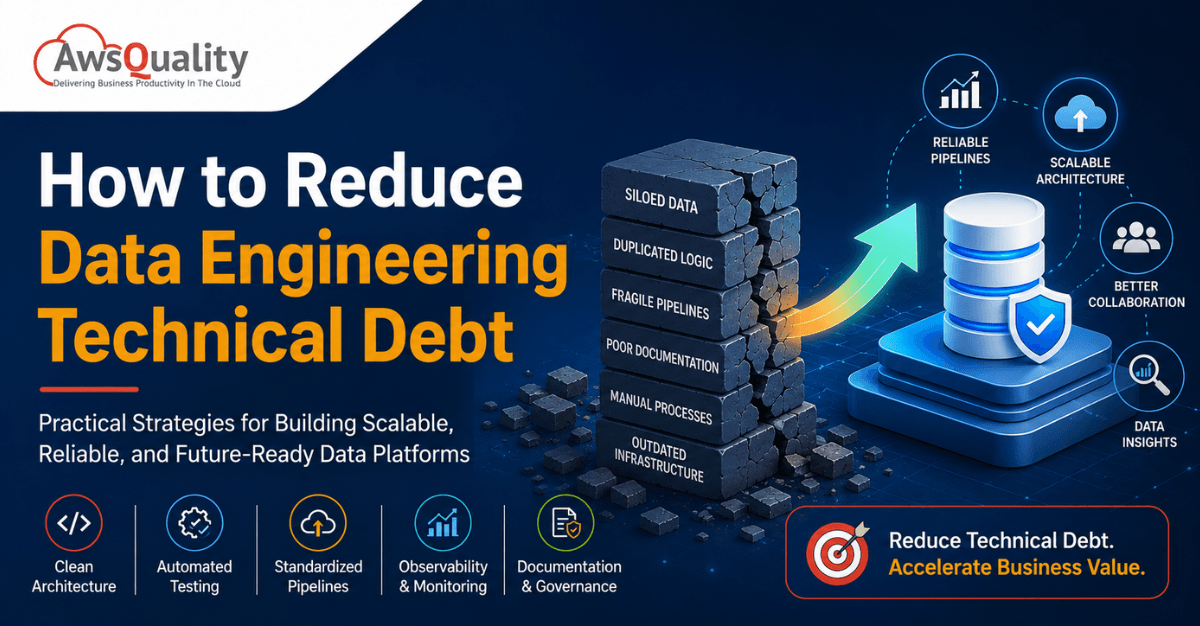
Modern businesses increasingly depend on data pipelines to power analytics, reporting, machine learning, artificial intelligence, and operational decision-making. But as data environments grow, the engineering foundation behind them can become difficult and expensive to maintain.
Quick fixes, duplicated transformations, undocumented pipelines, outdated infrastructure, fragile integrations, and inconsistent data models may solve immediate problems. Over time, however, these decisions accumulate into data engineering technical debt.
The result is familiar to many data teams: pipelines take longer to change, failures become harder to troubleshoot, engineers spend more time maintaining existing workflows, and new data initiatives become increasingly difficult to launch.
Reducing technical debt does not mean rebuilding the entire data platform from scratch. The better approach is to identify the highest-impact debt, prioritize remediation, modernize incrementally, and introduce engineering practices that prevent new debt from accumulating.
This guide explains what data engineering technical debt is, why it matters, how to identify it, and practical strategies for reducing it.
Read: How Data Engineering Services Help Enterprises Build AI-Ready Data Platforms
Key Takeaways
- Data engineering technical debt is the accumulated cost of shortcuts, outdated architecture, duplicated logic, poor documentation, and deferred improvements in a data environment.
- Technical debt can increase pipeline failures, maintenance costs, cloud spending, security risks, and time-to-market.
- Not all technical debt needs immediate remediation. Prioritize debt based on business impact, risk, frequency, and remediation effort.
- Standardization, automated testing, observability, documentation, reusable components, and CI/CD can significantly reduce future debt.
- Modernization should generally be incremental rather than a complete rewrite.
- DataOps practices help bring software engineering discipline to data pipelines through automated testing, deployment, monitoring, and collaboration.
- AI can accelerate parts of modernization, but AI-generated pipeline code still requires engineering standards, testing, review, and governance.
What is Data Engineering Technical Debt?
Technical debt, in software engineering, is the accumulated cost of shortcuts, temporary solutions, and deferred improvements that make systems harder, more expensive, and slower to change over time. Ward Cunningham, who coined the term, described it as the gap between the system as it was built and the system as it should have been built — a gap that must be paid down with interest the longer it is left unaddressed.
In data engineering, technical debt manifests across a set of specific, identifiable patterns: pipelines that work but are not understood; data models that reflect the data structures of five years ago rather than the business requirements of today; transformations that are not tested and therefore fail silently; orchestration graphs that are so entangled with dependencies that changing one pipeline requires testing twenty; documentation that was never written for logic that only the original author understood; and infrastructure that was provisioned manually, can’t be reproduced, and nobody is confident they could rebuild after a failure.
The distinctive feature of data engineering technical debt is its tendency to be invisible until it becomes a crisis. A fragile pipeline does not announce its fragility. It processes data normally until the day an upstream schema changes or a new data volume exceeds an untested threshold — and then it fails in a way that takes hours to diagnose because the failure mode was never documented and the pipeline was never tested.
CAST’s 2025 “Coding in the Red” report, which analyzed 10 billion lines of code across 47,000 applications, found that 45% of the world’s code is fragile, 32% is bloated, and 31% is too rigid to change without breaking something. Data engineering code bases are no exception — and in many cases, the pressure to ship pipelines quickly in response to business demands has made them more debt-laden than equivalent application codebases.
Why Data Engineering Technical Debt Matters
Technical debt in data platforms can remain hidden for years because the system may continue producing data even while becoming increasingly difficult to maintain.
Eventually, however, the consequences become visible.
1. Higher Maintenance Costs
Engineers spend more time fixing existing pipelines instead of developing new capabilities.
A simple schema change can require modifications across dozens of pipelines when transformation logic has been duplicated.
2. Slower Data Delivery
When pipelines are tightly coupled and poorly documented, even small changes require extensive investigation and testing.
This slows down analytics, reporting, and AI initiatives.
3. More Pipeline Failures
Fragile dependencies, hard-coded configurations, missing validation, and inadequate error handling can increase operational failures.
Reliable pipelines should be designed to handle failures while protecting data accuracy and integrity.
4. Increasing Cloud Costs
Inefficient queries, unnecessary processing, duplicated datasets, excessive data movement, and poorly optimized storage can increase infrastructure spending.
Technical debt can therefore become a financial problem as well as an engineering problem.
5. Poor Data Quality
Technical debt often affects data quality indirectly.
For example, inconsistent transformation logic can cause different teams to calculate the same business metric differently.
That undermines trust in dashboards, reports, and AI applications.
6. Security and Compliance Risks
Outdated dependencies, excessive permissions, undocumented data flows, and missing audit trails can create security and compliance challenges.
Modern data engineering principles emphasize auditability through logs, versions, and dependency tracking.
7. Difficulty Scaling AI Initiatives
AI systems depend on reliable, accessible, and well-governed data.
If the underlying data platform is fragmented or difficult to modify, preparing data for machine learning, generative AI, or AI agents becomes significantly harder.
Also read: The Complete Guide to Data Engineering Services for Modern Enterprises
How Data Engineering Technical Debt Accumulates
Technical debt does not typically result from negligence. It accumulates through understandable decisions made under real constraints — constraints that rarely include enough time to build the ideal solution.
Pressure-driven shortcuts. Business stakeholders need a new data feed by the end of the week. The data engineer hard-codes values that should be configurable, skips test coverage that should be built, and documents nothing because documentation will take an extra day. The pipeline works. The shortcuts stay.
Evolving requirements on static foundations. A data model designed for the reporting requirements of 2020 is being asked to support the AI requirements of 2026. The model cannot accommodate the new requirements cleanly — but a full redesign is expensive and disruptive — so new fields are added, workarounds are built, and the model becomes progressively harder to understand and extend.
Inadequate data engineering practices in early stages. Many organizations build their first data infrastructure when data engineering best practices are not yet a priority. The first data warehouse was built by an analyst who knew SQL. The first ETL pipelines were scripts that ran on someone’s laptop. These early systems work until they don’t — and by the time they need to be replaced, they are embedded in business processes and downstream systems that make replacement complex.
Accumulated point-to-point integrations. Rather than building a governed, reusable ingestion architecture, pipelines are built individually as each new source is added. Ten sources become twenty, each with a custom ingestion script, each with its own error handling approach (or lack thereof), each creating a new entry point for failure.
Tool and technology sprawl. As the data team grows and new tools become available, the technology stack expands organically — a mix of orchestration tools, transformation frameworks, storage formats, and query engines — without a deliberate architectural strategy. The result is a platform where each component was the right choice when adopted but the combination creates integration complexity and operational overhead.
Deferred refactoring. Engineers know which pipelines need to be rewritten. The backlog of refactoring work is visible and understood. But business demand for new pipelines consistently outpaces the capacity allocated to maintenance, and refactoring is deferred indefinitely in favor of new development.
Check out: Top Data Engineering Trends Every Business Should Know
The Eight Types of Data Engineering Technical Debt
Identifying the specific form that technical debt takes is the prerequisite for reducing it systematically. Data engineering technical debt falls into eight distinct categories, each with its own accumulation mechanism and its own reduction approach.
1. Pipeline Fragility Debt
What it is: Pipelines that process data correctly under normal conditions but fail unpredictably when upstream data changes, volumes spike, or edge cases appear. Fragile pipelines lack error handling, have no retry logic, cannot tolerate schema evolution, and have never been tested against edge case inputs.
How it manifests: A pipeline that has processed customer records reliably for two years fails silently when a source system changes a field from string to integer. Nobody notices for three days, by which point downstream reports are wrong and analytical decisions have been made on incorrect data.
The accumulation mechanism: Fragility accumulates through normal development under time pressure. Adding error handling, testing edge cases, and implementing retry logic adds time to pipeline development. Under deadline pressure, these investments are consistently deferred.
Reduction approach: Implement standard error handling patterns across all pipelines — retry with exponential backoff for transient failures, dead-letter queuing for persistent failures, and explicit failure notifications that alert the data team before downstream consumers discover the problem. Establish schema evolution handling (Avro, Protocol Buffers, or explicit schema compatibility rules) that prevents upstream changes from becoming downstream failures.
2. Testing Debt
What it is: Data pipelines that have no automated tests — no unit tests for transformation logic, no integration tests for end-to-end pipeline behavior, no data quality tests for the outputs they produce. Testing debt means that the only way to know whether a pipeline is producing correct output is to examine the output manually after the fact.
How it manifests: A refactoring of a transformation function inadvertently inverts a conditional logic. The pipeline runs successfully. The data changes subtly. Nobody notices until a business analyst questions a revenue figure six weeks later.
The accumulation mechanism: Testing data pipelines requires more than testing application code — it requires test data, test infrastructure, and testing frameworks designed for the pipeline context. This setup investment is consistently deferred in favor of shipping new pipelines.
Reduction approach: dbt (data build tool) is the most widely adopted solution to testing debt in modern data engineering. dbt’s built-in testing framework enables not-null, unique, accepted-values, and relationship-integrity tests that execute as part of every pipeline run and block downstream refreshes when they fail. Great Expectations and Soda provide more comprehensive statistical and business-rule validation at the pipeline level. The minimum viable testing standard for any data pipeline: tests that validate the key assumptions about the output — row counts within expected ranges, no nulls in required fields, referential integrity between joined datasets.
3. Documentation Debt
What it is: Transformation logic, business rules, and data lineage that exist only in the memory of the engineer who built the pipeline. When that engineer leaves or moves to a different team, the knowledge leaves with them. New engineers cannot modify the pipeline confidently because they do not understand its intent, its edge cases, or its downstream consumers.
How it manifests: A senior data engineer leaves. Their most critical pipeline produces a metric that appears in every executive dashboard. Three months later, a business requirement changes and the metric needs to be updated. Nobody on the remaining team can modify the pipeline confidently without risking breaking it in ways they cannot predict.
The accumulation mechanism: Documentation takes time that is not allocated in sprint planning and is not visible to business stakeholders. It is consistently the first item cut when pipelines are built under pressure.
Reduction approach: Documentation-as-code eliminates the documentation-as-afterthought pattern by building documentation into the code itself. dbt’s YAML-based documentation system enables description of every model, every column, and every test alongside the SQL that defines them. The dbt docs site then generates a browsable documentation portal automatically. OpenLineage, integrated with Apache Airflow and Spark, generates data lineage automatically — tracing every field from its dashboard to its source system without requiring manual documentation of that lineage. The goal is documentation that cannot fall out of sync with the code, because it is generated from the code.
4. Orchestration Debt
What it is: Workflow orchestration configurations that have grown organically into complex, brittle dependency graphs. Pipelines that should run independently are tightly coupled. Schedules are hard-coded rather than event-driven. Upstream failures cascade to downstream pipelines in ways that are difficult to diagnose. The orchestration layer has become a liability rather than an enabler.
How it manifests: A morning pipeline failure at 3 AM causes cascading failures across twelve dependent pipelines. By the time business users arrive, eight dashboards are stale, two reports have been sent with incorrect data, and the on-call engineer has spent four hours tracing the failure through a dependency graph that was never designed for maintainability.
The accumulation mechanism: Orchestration debt accumulates because pipelines are added incrementally, with each new pipeline adding dependencies to existing ones in ways that make individual sense but create collective complexity.
Reduction approach: Apache Airflow, Prefect, and Dagster all support DAG-based dependency management that makes pipeline dependencies explicit and auditable. The reduction strategy is: decouple where possible (pipelines that do not have genuine data dependencies should not have scheduling dependencies); implement explicit SLA monitoring that alerts before downstream consumers are affected rather than after; and replace implicit coupling (Pipeline B starts 30 minutes after Pipeline A) with explicit event triggers (Pipeline B starts when Pipeline A produces a completion event). Apache Airflow’s TriggerDagRunOperator and Prefect’s event-based scheduling both support this pattern.
5. Data Model Debt
What it is: Data models — warehouse schemas, dimensional models, entity structures — that were designed for the business requirements of a previous state and have been incrementally patched to accommodate new requirements without being redesigned. The model is technically functional but is increasingly difficult to query, extend, or trust.
How it manifests: A fact table originally designed for transactional sales reporting has been extended with columns for subscription billing, returns processing, and partner revenue — none of which were in the original design. Queries against the table require joining through workarounds to avoid double-counting, and every analyst has a slightly different understanding of which filters are required to produce accurate results.
The accumulation mechanism: Redesigning data models is disruptive and expensive. It requires migrating existing data, updating all downstream models and reports, and retesting a wide range of outputs. This cost consistently defers model redesign in favor of incremental patching that extends the model’s functional life but degrades its quality.
Reduction approach: Incremental model improvement through dbt’s modular transformation architecture reduces the disruption cost of model redesign by allowing models to be replaced module by module rather than all at once. The specific sequence: identify the highest-traffic models with the most downstream dependencies; document the current model’s logic, including the workarounds that consumers have been applying; design the improved model; implement it alongside the existing model with a migration period where both are maintained; transition downstream consumers; and retire the legacy model. This approach replaces the “big bang” redesign (which frequently fails) with a phased transition that maintains continuity.
6. Infrastructure Debt
What it is: Cloud data infrastructure provisioned manually through cloud provider consoles, without Infrastructure as Code (IaC) definitions that make it reproducible, auditable, and version-controlled. Clusters sized for yesterday’s workloads. Storage tiers that have never been optimized. Auto-scaling configurations that were never implemented. Costs that are growing faster than the data value they generate.
How it manifests: A Snowflake warehouse runs at its maximum size continuously because nobody configured auto-suspend. A Databricks cluster is sized for peak load and runs at 15% utilization during off-peak hours. An S3 bucket containing five years of raw data sits in the highest-cost storage tier because lifecycle policies were never configured. Monthly cloud bills are growing 20% quarter over quarter without a proportional increase in analytics output.
The accumulation mechanism: Infrastructure decisions made quickly during initial platform build become defaults that persist indefinitely. Manual provisioning cannot be tracked, audited, or reproduced — so it accumulates as configuration drift between environments and as cost inefficiency that nobody owns.
Reduction approach: Terraform is the most widely adopted IaC tool for cloud data infrastructure, supporting AWS, Azure, GCP, Snowflake, and Databricks providers. Migration to IaC should begin with the highest-cost, highest-risk infrastructure components — the compute clusters and storage buckets where configuration drift creates the most financial waste and operational risk. In Snowflake, implement auto-suspend (60 seconds for development warehouses, 120 to 300 seconds for production warehouses) and configure multi-cluster auto-scaling. In Databricks, enable cluster auto-scaling with appropriate minimum and maximum node counts. Implement S3 Intelligent-Tiering or Azure Data Lake Storage lifecycle policies that automatically move aged data to lower-cost tiers.
7. Integration Debt
What it is: Point-to-point data integrations where each source system has a custom extraction script built independently, with different error handling, different scheduling approaches, different authentication patterns, and different documentation standards. Each integration is a unique snowflake that creates a unique maintenance burden.
How it manifests: A data platform with 30 source systems has 30 custom extraction scripts in 4 different languages, scheduled through 3 different mechanisms, with error notifications going to 6 different email addresses. When a source system updates its API, the change must be identified, assessed, and addressed separately for each affected integration.
The accumulation mechanism: Integration debt accumulates because each integration is built individually at the time the source is onboarded, by whoever is available, using whatever approach is familiar. Without a standard integration architecture, diversity accumulates naturally.
Reduction approach: Standardize data ingestion through a governed ingestion layer. Fivetran, Airbyte, and Stitch provide managed connectors for hundreds of common source systems, eliminating the need to build and maintain custom extraction code for standard sources. For sources that require custom connectors, establish a standard connector pattern that all custom connectors follow — consistent authentication handling, consistent error handling, consistent retry logic, consistent logging. Singer.io provides an open-source specification for this standardization.
8. Governance and Data Quality Debt
What it is: The absence of systematic data quality standards, access controls, lineage tracking, and metadata management. Data quality is discovered by downstream consumers rather than enforced in the pipeline. Access to sensitive data is broader than required. Nobody can trace why a metric in a dashboard differs from the equivalent metric in another report.
How it manifests: A data analyst discovers that the revenue figure in the executive dashboard differs from the revenue figure in the operational report by 4%. Investigating the discrepancy requires two days of manual pipeline archaeology because no lineage tracking exists. The root cause is a different filter applied in two different transformation models that should be producing the same number.
The accumulation mechanism: Governance investment — data catalogs, lineage tracking, access controls, quality monitoring — is consistently deprioritized in favor of new pipeline delivery. The costs of absent governance accumulate gradually and become visible only when a specific incident makes the absence unmistakable.
Reduction approach: Implement data observability from the highest-impact layer first. Monte Carlo, Elementary (built on dbt), and Bigeye continuously monitor data freshness, volume, schema, and distribution — surfacing anomalies in minutes rather than days. OpenLineage provides end-to-end lineage tracking across Airflow, Spark, dbt, and visualization tools, enabling field-level traceability from dashboard to source. Databricks Unity Catalog and Snowflake’s native governance features provide row-level and column-level access control within the data platform itself.
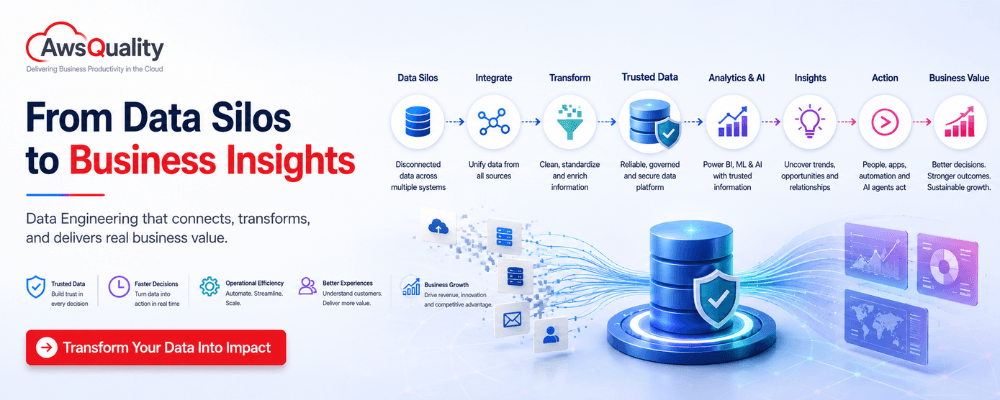
Also check: From Data Silos to Business Insights – How Data Engineering Creates Enterprise Value
How to Identify Data Engineering Technical Debt
Before reducing technical debt, organizations need to understand where it exists.
A useful assessment should examine the entire data lifecycle, from ingestion through consumption.
Step 1: Inventory Your Data Assets
Create an inventory of:
- Data sources
- Data pipelines
- Transformation jobs
- Data warehouses
- Data lakes
- Databases
- APIs
- Orchestration workflows
- BI datasets
- Machine learning datasets
- Data products
The goal is to understand what exists before deciding what should change.
Step 2: Map Dependencies
Document how systems and pipelines depend on one another.
For each pipeline, identify:
Source → Ingestion → Transformation → Storage → Consumption
This makes tightly coupled or highly fragile sections of the platform easier to identify.
Step 3: Assess Pipeline Health
Evaluate pipelines using metrics such as:
- Failure frequency
- Processing time
- Data freshness
- Recovery time
- Manual intervention
- Infrastructure cost
- Test coverage
- Number of dependencies
- Change frequency
Step 4: Identify High-Risk Components
Not every outdated pipeline requires immediate modernization.
Prioritize components that:
- Fail frequently
- Support critical business processes
- Are expensive to operate
- Contain sensitive data
- Are difficult to modify
- Have limited documentation
- Depend on unsupported technologies
Step 5: Estimate the Cost of Doing Nothing
Technical debt becomes easier to prioritize when expressed in business terms.
Ask:
How much engineering time does this problem consume every month?
Also consider:
- Infrastructure costs
- Lost productivity
- Delayed projects
- Business downtime
- Compliance exposure
- Data quality issues
A Practical Framework for Prioritizing Technical Debt
A simple scoring model can help data teams decide what to address first.
Score each debt item from 1 to 5 for:
| Factor | Question |
|---|---|
| Business impact | How important is the affected data process? |
| Frequency | How often does the problem occur? |
| Risk | Could it create security, compliance, or data-quality issues? |
| Cost | How much does it cost to operate or maintain? |
| Complexity | How difficult is the current architecture to change? |
| Remediation effort | How difficult would it be to fix? |
High-impact, high-frequency problems with manageable remediation effort should generally receive priority.
This avoids the common mistake of spending months modernizing components simply because they are old while ignoring technical debt that is actively affecting the business.
10 Ways to Reduce Data Engineering Technical Debt
1. Standardize Data Pipeline Architecture
Create standard patterns for common workloads.
For example:
- Batch ingestion
- API ingestion
- Change data capture
- Streaming
- Data validation
- Transformation
- Error handling
- Monitoring
Reusable patterns reduce the amount of custom code engineers need to create.
AWS recommends reusable blueprints and architectural guardrails to simplify pipeline deployment and improve consistency.
2. Separate Ingestion From Transformation
Avoid putting ingestion, transformation, validation, and business logic into one large workflow whenever possible.
A cleaner architecture separates:
Raw Data → Validation → Transformation → Curated Data → Consumption
This makes pipelines easier to test, troubleshoot, replay, and modify.
It also reduces the risk that a change to business logic will disrupt data ingestion.
3. Eliminate Duplicated Logic
Look for transformations that appear repeatedly across pipelines.
Instead of maintaining five different versions of the same customer normalization logic, create one reusable implementation.
This reduces maintenance effort and makes business rules more consistent.
4. Introduce Automated Data Testing
Data pipelines should be tested just like application code.
Depending on the workload, tests can validate:
- Schema
- Null values
- Uniqueness
- Referential integrity
- Accepted ranges
- Record counts
- Freshness
- Business rules
Automated testing helps detect problems before they reach downstream consumers.
5. Implement CI/CD for Data Pipelines
Manual deployment creates unnecessary operational risk.
A modern pipeline development process should include:
Code → Test → Validate → Review → Deploy → Monitor
Infrastructure-as-code and automated deployment can also make environments more reproducible. AWS specifically identifies reproducibility and infrastructure as code as important principles for modern data engineering.
6. Improve Data Observability
Monitoring should go beyond checking whether a pipeline completed successfully.
Track:
- Pipeline failures
- Data freshness
- Volume changes
- Schema changes
- Processing duration
- Data-quality anomalies
- Resource utilization
Near-real-time monitoring and logging can help teams detect and remediate data-flow issues faster.
7. Document Data Ownership and Lineage
Every critical dataset should have a clear owner.
Documentation should ideally answer:
- Where did this data originate?
- What transformations were applied?
- Who owns it?
- Who consumes it?
- How frequently is it updated?
- What happens if the source changes?
Data lineage becomes particularly important as organizations prepare data for regulated analytics and AI workloads.
8. Reduce Unnecessary Pipeline Dependencies
Every dependency increases the potential impact of change.
Review whether each dependency is genuinely necessary.
Where appropriate:
- Simplify workflows
- Separate independent processes
- Remove redundant transformations
- Reduce unnecessary data movement
- Create clearer interfaces between systems
The goal isn’t to eliminate dependencies entirely. It is to make them intentional and manageable.
9. Modernize Incrementally
A complete rewrite is often tempting.
It is also risky.
Instead of replacing the entire platform, identify high-value areas and modernize them in phases.
For example:
- Phase 1: Critical pipeline assessment
- Phase 2: Testing and observability
- Phase 3: Pipeline standardization
- Phase 4: High-risk workload modernization
- Phase 5: Legacy platform retirement
This allows the organization to improve reliability while continuing to deliver business value.
AWS recommends managing technical debt through structured modernization and optimization rather than treating debt reduction as a one-time activity.
10. Establish DataOps Practices
DataOps applies software engineering and operational practices to data management.
It can include:
- Automated testing
- Version control
- CI/CD
- Monitoring
- Deployment automation
- Collaboration
- Data-quality management
The objective is to make data pipelines more reliable, repeatable, and maintainable.
AWS describes DataOps as applying DevOps principles to data management, including automation of testing and deployment.
How AI Can Help Reduce Data Engineering Technical Debt
AI is increasingly being used to accelerate modernization activities.
For example, AI-assisted engineering can help teams:
- Explain legacy pipeline code
- Generate documentation
- Identify duplicated logic
- Suggest code refactoring
- Generate test cases
- Analyze dependencies
- Identify potential schema issues
- Assist with SQL modernization
- Accelerate migration planning
However, AI should be treated as an accelerator rather than an automatic solution.
Recent industry discussions also highlight a new concern: AI-generated pipeline code can itself create technical debt when generated logic is inconsistent, poorly tested, or difficult to reproduce.
The right approach is therefore:
AI-assisted development + engineering standards + testing + human review
rather than simply generating large volumes of pipeline code.
Data Engineering Technical Debt vs Data Platform Modernization
These concepts are related but not identical.
Technical debt reduction focuses on removing or managing the problems that make an existing environment difficult to maintain.
Data platform modernization focuses on improving the underlying architecture, technologies, processes, and capabilities.
For example, replacing an outdated ETL platform may be modernization.
Removing duplicated transformations, adding automated tests, and documenting dependencies may be technical debt reduction.
A successful modernization program should address both.
When Should You Refactor, Replace, or Retire a Pipeline?
Not every pipeline deserves the same treatment.
Refactor
Choose refactoring when:
- The technology is still appropriate.
- The business logic is valuable.
- The architecture can be improved without replacing the platform.
Replace
Consider replacement when:
- The technology is approaching end-of-life.
- Operating costs are excessive.
- The platform limits scalability.
- Modern alternatives provide significant advantages.
Retire
Retire a pipeline when:
- Nobody consumes its output.
- The data is duplicated elsewhere.
- The business process no longer exists.
- Its maintenance cost exceeds its value.
Retiring unused systems is often one of the simplest ways to reduce technical debt.
A 90-Day Data Engineering Technical Debt Reduction Plan
Organizations looking for a practical starting point can structure the first three months as follows.
Days 1–30: Assess
- Inventory pipelines and data assets
- Map dependencies
- Identify critical workloads
- Review failures and incidents
- Analyze cloud costs
- Identify outdated technologies
- Document major technical debt items
Days 31–60: Prioritize and Standardize
- Score technical debt
- Establish architectural standards
- Define reusable pipeline patterns
- Introduce data-quality tests
- Improve monitoring
- Document critical data assets
- Select priority modernization projects
Days 61–90: Modernize
- Refactor the highest-impact pipelines
- Automate testing and deployment
- Remove redundant workflows
- Improve observability
- Address critical security gaps
- Measure improvements
- Create a continuous debt-management process
At the end of 90 days, the objective shouldn’t be to eliminate all technical debt.
The objective should be to have visibility, priorities, measurable improvements, and a repeatable process for preventing new debt.
Metrics to Measure Technical Debt Reduction
To determine whether your modernization effort is working, track measurable outcomes.
Reliability
- Pipeline failure rate
- Mean time to recovery
- Successful pipeline run percentage
Performance
- Pipeline execution time
- Data freshness
- Processing latency
Engineering Productivity
- Time required to modify pipelines
- Deployment frequency
- Manual interventions
- Engineering hours spent on maintenance
Data Quality
- Data-quality failure rate
- Schema incidents
- Duplicate records
- Data reconciliation issues
Cost
- Cost per pipeline
- Compute utilization
- Storage costs
- Cost per processed dataset
Modernization
- Percentage of pipelines using standard patterns
- Percentage covered by automated testing
- Percentage deployed through CI/CD
- Number of retired legacy pipelines
These metrics turn technical debt from an abstract engineering concern into something leadership can measure and manage.
Common Mistakes When Reducing Data Engineering Technical Debt
Trying to Fix Everything at Once
Large-scale rewrites increase risk and can delay business initiatives.
Better approach: prioritize high-value debt and modernize incrementally.
Replacing Tools Without Fixing Architecture
Moving from one technology to another does not automatically eliminate technical debt.
Better approach: address architecture, processes, ownership, and standards alongside technology.
Ignoring Documentation
A modern pipeline can still become technical debt if nobody understands how it works.
Better approach: make documentation part of the engineering lifecycle.
Focusing Only on Infrastructure Costs
Cheap infrastructure doesn’t necessarily mean an efficient data platform.
Better approach: consider engineering effort, reliability, data quality, and business impact alongside infrastructure cost.
Treating AI-Generated Code as Production-Ready
AI can accelerate development but does not eliminate the need for testing and engineering review.
Better approach: subject AI-generated pipeline code to the same standards as human-written code.
How AwsQuality Can Help Reduce Data Engineering Technical Debt
Reducing data engineering technical debt requires more than introducing another tool. It requires an assessment of the existing data environment, a clear modernization roadmap, and an implementation approach that balances technical improvements with business priorities.
AwsQuality helps organizations modernize data engineering environments, improve data pipelines, strengthen data quality, and build scalable data platforms for analytics and AI initiatives.
A structured engagement can include:
- Data architecture assessment
- Data pipeline modernization
- ETL/ELT modernization
- Cloud data engineering
- Data quality and governance
- Data pipeline optimization
- Data platform modernization
- AI-ready data architecture
- Data engineering strategy and roadmap
The objective is not simply to make the technology newer.
It is to create a data platform that is easier to maintain, easier to scale, more reliable, and better prepared for future AI and analytics workloads.
Final Thoughts
Data engineering technical debt rarely appears because teams deliberately build bad systems. It usually develops gradually as organizations respond to changing requirements, tight deadlines, new data sources, and evolving technologies.
The important question isn’t whether your organization has technical debt.
It is whether that debt is visible, prioritized, and actively managed.
Start by inventorying your data environment. Identify the pipelines and systems creating the greatest business and engineering burden. Standardize where possible, automate testing and deployment, improve observability, eliminate unnecessary complexity, and modernize incrementally.
Most importantly, make technical debt management part of your ongoing data engineering practice rather than treating it as a one-time cleanup project.
A healthier data engineering foundation doesn’t just reduce maintenance.
It gives your organization a faster, more reliable path to analytics, AI, and future digital initiatives.
Frequently Asked Questions
What is data engineering technical debt?
Data engineering technical debt is the accumulated cost of shortcuts, outdated systems, duplicated logic, and deferred improvements that make data platforms harder to maintain.
What causes technical debt in data engineering?
Common causes include legacy pipelines, duplicated transformations, poor documentation, manual processes, weak testing, complex dependencies, and outdated technologies.
How can you reduce data engineering technical debt?
Start by assessing and prioritizing debt, then standardize pipelines, automate testing and deployment, improve observability, document dependencies, and modernize high-impact workloads.
Should organizations rebuild their entire data platform?
Usually not. Incremental modernization is often less risky and allows teams to improve critical areas while continuing to deliver business value.
How does DataOps help reduce technical debt?
DataOps introduces practices such as version control, automated testing, CI/CD, monitoring, and deployment automation to make data engineering more reliable and maintainable.
Can AI help reduce data engineering technical debt?
Yes. AI can assist with code analysis, documentation, testing, refactoring, and modernization. However, AI-generated changes still require testing, governance, and human review.
How often should organizations review data engineering technical debt?
Technical debt should be reviewed continuously, with a more structured assessment at least quarterly or when major architecture, technology, or business changes occur.
 Bio
Bio