Enterprise AI is entering a new phase.
For years, businesses primarily used AI as an assistant. AI could answer questions, summarize documents, generate content, analyze information, recommend actions, and help employees complete individual tasks.
That model is changing.
The next generation of enterprise AI is increasingly focused on agents that can understand business context, reason through multi-step requests, retrieve information, make decisions within defined boundaries, and take actions across enterprise systems.
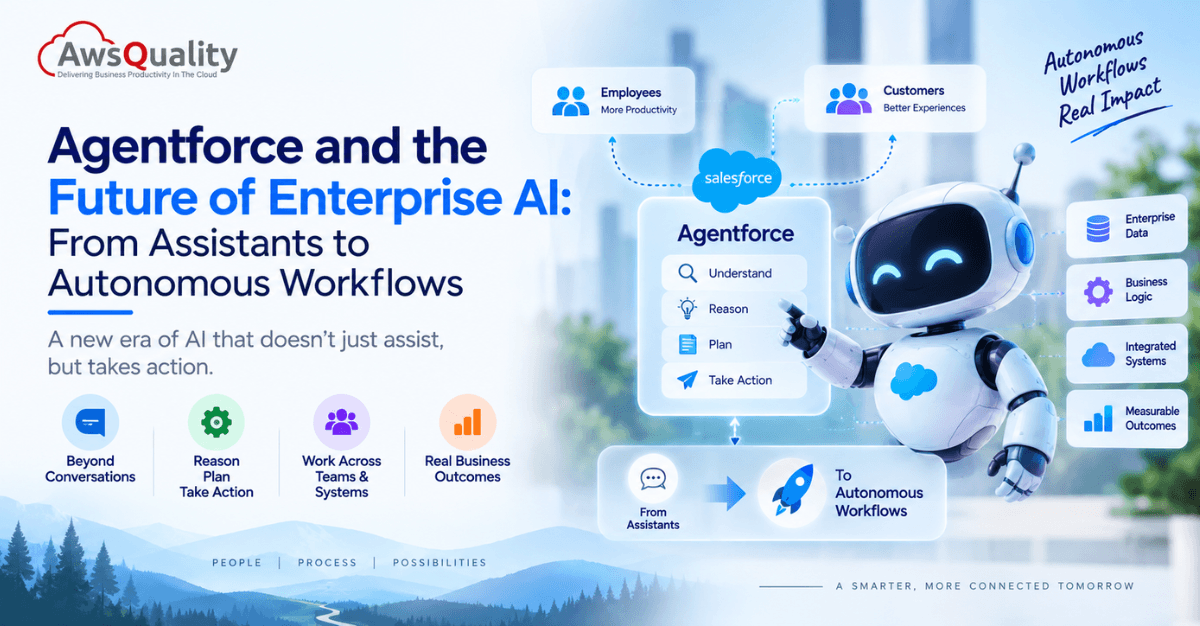
Salesforce’s Agentforce is positioned around this shift. Salesforce describes Agentforce as a platform for building and deploying autonomous AI agents that can reason through requests, retrieve business information, create plans, and execute actions. Its current platform direction also emphasizes multi-agent orchestration, enterprise data, business logic, security, and observability.
This evolution raises an important question for enterprise technology leaders:
What happens when AI stops being just a tool employees use and becomes an active participant in business workflows?
The answer involves much more than adding an AI chatbot to an existing application.
It requires organizations to rethink data architecture, application integration, identity, governance, security, workflow automation, observability, and the role of humans in business processes.
This article explores how Agentforce fits into that evolution and what the shift from AI assistants to autonomous workflows could mean for enterprise technology.
From AI Assistants to AI Agents
The first wave of enterprise generative AI focused heavily on assistance.
Employees could ask an AI system to:
- Summarize a customer record
- Draft an email
- Generate a sales proposal
- Answer questions
- Summarize meetings
- Create documentation
- Analyze information
- Generate code
- Recommend next steps
These capabilities can improve productivity, but the human generally remains responsible for executing the resulting action.
Consider a simple customer-service scenario.
Traditional AI assistant
 Customer asks a question
 ↓
 AI generates an answer
 ↓
 Employee reviews the answer
 ↓
 Employee performs the required action
The AI helps the employee, but the employee remains the primary operator.
Agentic workflow
 Customer request
 ↓
 AI agent understands intent
 ↓
 Retrieves relevant business context
 ↓
 Reasons about the request
 ↓
 Creates an action plan
 ↓
 Executes permitted actions
 ↓
 Validates the result
 ↓
 Escalates to a human when required
This is a fundamental difference.
The objective is no longer simply to generate an answer.
The objective is to complete a business outcome.
Salesforce describes Agentforce agents as capable of retrieving data, creating action plans, and executing those plans within organizational guardrails.
What is Agentforce?
Agentforce is Salesforce’s platform for building and deploying AI agents that can support employees and customers across business processes.
Salesforce positions Agentforce as a platform where agents can reason through complex requests, retrieve business information, take actions, and operate across teams and departments.
The important architectural distinction is that Agentforce is not simply an LLM interface.
An enterprise agent needs several components to operate reliably:
 USER / CUSTOMER
 ↓
 AI AGENT
 ↓
 REASONING & PLANNING
 ↓
 BUSINESS CONTEXT
 ↓
 DATA + METADATA
 ↓
 BUSINESS LOGIC / RULES
 ↓
 ACTIONS
 ↓
 ENTERPRISE APPLICATIONS
This architecture allows an agent to move from understanding a request to actually doing something with it.
The Three Eras of Enterprise AI
Understanding where enterprise AI is heading requires a clear map of where it has been. The trajectory has three distinct eras, each building on the prior while changing the fundamental operational model.
Era 1: AI as Enhancement (2020–2023)
The first enterprise AI era was defined by machine learning models embedded in existing workflows to improve specific, bounded tasks. Spam filtering, lead scoring, product recommendation, predictive maintenance, anomaly detection in financial data. AI in this era made existing processes faster and more accurate without changing who was responsible for them or how they were organized. The human was still the decision-maker and the actor; AI produced inputs to human decisions.
Era 2: AI as Assistant (2023–2025)
The large language model wave of 2023 introduced AI systems capable of natural language interaction — generating content, answering questions, summarizing documents, drafting communications. Enterprise AI in this era became conversational and generative. GitHub Copilot made developers faster. Sales reps got AI-drafted follow-up emails. Customer service agents got AI-suggested responses. Agentforce in its initial form fit here: AI that recommended, drafted, and surfaced — with the human taking the final action.
The assistant era generated real productivity improvement. But it remained fundamentally human-directed: every AI output required a human to review and act on it before anything changed in the world.
Era 3: AI as Autonomous Workflow (2025–present)
By 2026, Salesforce’s Agentforce platform had evolved beyond basic AI assistance toward autonomous, action-oriented workflows, supported by capabilities such as Agent Script, hybrid reasoning, agent health monitoring, and multi-agent orchestration. Autonomous AI does not produce outputs for humans to act on. It acts — within defined scope, with defined escalation criteria, against real business systems, producing real outcomes. A case is resolved, not summarized. A record is updated, not flagged for update. An order is processed, not routed to a human for processing. An outreach email is sent, not drafted for review.
As Salesforce articulates in its official future-of-AI predictions: “We’re going to go from task-taking conversational assistant agents to outcome-owning agents that are deeply embedded into the fabric of work. Instead of giving agents instructions, we’ll give agents goals.”
This shift — from instruction-following to goal-pursuing — is the structural change that defines Era 3. It requires a different technical architecture, a different governance model, and a different organizational relationship with AI than the assistant era.
The Atlas Reasoning Engine — How Autonomous Workflows Actually Work
The technical foundation of Agentforce’s autonomous capability is the Atlas Reasoning Engine — the AI reasoning layer that interprets goals, plans action sequences, executes them, evaluates results, and determines next steps without requiring a human to direct each stage.
Atlas does not follow a script. It implements the ReAct (Reasoning and Acting) loop: an iterative cycle in which the agent breaks a goal down into steps, takes an action, observes the result, updates its understanding of the situation, and determines the next action — continuing until the goal is achieved, the defined scope is exceeded, or an escalation criterion is triggered.
As Vectr Solutions’ July 2026 analysis captures precisely: “Unlike traditional bots that rely on rigid if-then logic, Atlas uses a ReAct loop. It breaks down goals into steps, evaluates outcomes, and determines next actions based on real-time context. Reliability is not a product of the model. It is a product of the architecture.”
This architectural distinction matters enormously for enterprise deployment. Salesforce and Anthropic have expanded their partnership through Claudeforce, with Claude available in Agentforce as a reasoning model for the Atlas Reasoning Engine. Through Amazon Bedrock, Claude can operate within the Salesforce Trust Boundary.
The five-step Atlas execution cycle:
- Receive goal: The agent receives an incoming request — a customer inquiry, a behavioral signal trigger, an event from a connected system — through Agentforce’s event or API layer.
- Context retrieval: Atlas queries Data 360 (Salesforce’s real-time unified customer data platform) for the complete context relevant to the goal: the customer’s full history, open cases, account status, recent interactions, and behavioral signals.
- Plan formation: Atlas generates an action plan — the sequence of steps required to achieve the goal within the agent’s authorized scope. Agent Script defines deterministic execution paths for high-stakes, process-consistency requirements; Atlas applies reasoning for situations requiring judgment.
- Action execution: The plan is executed against the authorized action vocabulary — Salesforce record updates, Flow triggers, API calls to connected systems through MuleSoft, communications sent through connected channels. Every action executes under the permission model of the authenticated user context.
- Evaluation and iteration: Atlas evaluates the result of each action, updates its situational assessment, and either continues toward the goal, adjusts the plan based on what it found, or escalates to a human agent with full context when the situation exceeds its defined scope.
Depending on the workflow, the agent can iterate through reasoning, action, and observation until the task is completed, the permitted scope is reached, or escalation is required.
AWUs — The Metric That Changes the AI Investment Conversation
One of the most consequential developments in enterprise AI in 2026 is not a new capability. It is a new unit of measurement.
The conventional metrics for enterprise software investment — seats licensed, monthly active users, time-in-application — measure inputs: how many people have access to a system. They do not measure what the system actually does. For AI agents that operate autonomously, these input metrics are structurally misleading: an agent that resolves 85% of customer interactions without human involvement barely appears in “active user” dashboards because no human opened the application to generate the interaction.
Salesforce’s introduction of Agentic Work Units (AWUs) addresses this directly. An AWU is a count of a discrete task that an AI agent actually completed — a case resolved, a record updated, a workflow triggered, a communication sent. It measures AI output rather than AI access.
Salesforce’s 2026 Agentic Enterprise Index reported that Agentforce agents’ AWU output was growing at a 15% compound monthly growth rate as of April 2026. Salesforce reports that Agentforce in Slack saved employees more than 500,000 hours in one year, while Service Agent handled more than 2.8 million support requests.
The practical implication for enterprise technology investment decisions is significant. AWUs shift the AI ROI conversation from “what does our AI subscription cost?” to “how much work did our AI actually do, and what was the value of that work?” This is the accountability framework that CFOs need to approve AI investment expansion — and the measurement discipline that differentiates organizations generating compounding AI returns from those generating AI overhead.
Multi-Agent Architecture — The Next Layer of Autonomous Capability
Agentforce has moved beyond single-function agents into coordinated multi-agent systems. This is not a roadmap item. It is native infrastructure in the current platform.
Salesforce’s President and CTO (C360 Platform), Muralidhar Krishnaprasad, describes the foundational requirements for multi-agent intelligence: “This transition from single agents to multi-agent intelligence requires three necessary technology foundations: multi-agent protocol for open interoperability and communication, integrated multi-agent context for a unified data foundation, and robust multi-agent governance for security and observability of all agents.”
Agentforce provides all three:
Agent-to-Agent Communication: Agents communicate to divide tasks, share context, and make collective decisions. A Service Agent that determines a case requires fulfillment action can invoke a Fulfillment Agent directly, passing the case context and the action required, without requiring a human to coordinate the handoff.
Orchestration Layer: A central orchestration system manages agent interactions, task assignments, and workflow progression. When a multi-step customer resolution requires sequential agent actions — qualification, case creation, fulfillment, notification — the orchestration layer coordinates the sequence without human coordination at each step.
Shared Memory via Data 360: Agents share context through Data 360 as the unified data foundation. An agent that gathered context about a customer in the first step of a workflow does not need to re-query for that context in the third step — it is available through the shared memory layer, maintaining coherent situational awareness across the agent network.
AgentExchange is the operational marketplace that makes multi-agent deployment practical at enterprise scale. Companies can deploy pre-built skills and actions that agents share and coordinate across workflows — with the Winter ’27 release expanding this to over 100 prebuilt skills, including the Salesforce Development plugin now live in the Claude Code marketplace.
The Agentforce Sophistication Index: Measuring Agent Complexity
Not all autonomous workflows are equally complex. Salesforce’s Agentic Enterprise Index introduces a Sophistication Index that maps AI agent actions across five progressive tiers of cognitive complexity — providing a practical framework for understanding where an organization’s Agentforce deployment sits in the maturity continuum.
Level 1 — Read: The agent retrieves and surfaces information. Looking up records, pulling customer history, querying case status. Low cognitive complexity, high volume. Foundational for all subsequent tiers.
Level 2 — Coordinate: The agent manages data movement and routing between systems. Routing cases to appropriate queues, updating records based on incoming data, triggering workflow rules. Still relatively structured, but requires conditional logic.
Level 3 — Synthesize: The agent aggregates information from multiple sources and generates a coherent output. Drafting case summaries from full conversation history, generating meeting preparation briefs from account and opportunity data, producing compliance reports from activity logs. This is where natural language generation capability delivers measurable time savings.
Level 4 — Create: The agent generates novel content or configurations based on the situation. Drafting personalized customer communications, creating task sequences for complex case types, generating data transformation logic. Requires deeper contextual reasoning.
Level 5 — Act: The agent takes consequential, system-altering actions — processing transactions, executing fulfillment operations, modifying records with downstream business impact, triggering external API calls that produce real-world effects. The highest cognitive complexity and the tier where governance architecture is most critical.
The Agentic Enterprise Index’s production data reveals an important pattern: consumer-facing industries demonstrate the most aggressive AWU output, but retail agents typically remain narrowly focused — averaging one to two actions per agent. This suggests that most current Agentforce deployments are operating primarily at Levels 1 through 3, with the highest productivity gains coming from high-volume, routine task automation rather than complex autonomous decision-making.
The maturity progression from Level 1-3 to Level 4-5 is where the most significant enterprise AI value is being unlocked — and where the governance infrastructure becomes the critical enabler rather than a separate compliance exercise.
How Businesses Can Prepare for Agentic AI
Organizations do not need to automate everything immediately.
A practical approach is to start with clearly defined use cases.
Step 1: Identify Repetitive Work
Look for processes involving:
- High transaction volume
- Repetitive decisions
- Structured data
- Clear business rules
- Measurable outcomes
Step 2: Evaluate Data Readiness
Determine whether the required information is:
- Accurate
- Accessible
- Governed
- Consistent
- Available to the agent
Step 3: Define Agent Boundaries
Specify:
- What the agent can read
- What it can write
- What actions it can execute
- What requires approval
- When it must escalate
Step 4: Integrate the Required Systems
Connect the agent to the applications and APIs required to complete its workflow.
Step 5: Test Before Expanding
Test agents against:
- Normal requests
- Ambiguous requests
- Incorrect information
- Unexpected inputs
- Security scenarios
- Failure conditions
Step 6: Monitor Production Behavior
Measure:
- Task completion
- Escalation rate
- Error rate
- User feedback
- Action accuracy
- Business outcomes
Step 7: Expand Gradually
Start with bounded workflows and expand agent autonomy as the organization gains confidence.
Agentforce is More Than an AI Assistant
The distinction between an AI assistant and an AI agent is important.
| Capability | AI Assistant | AI Agent |
|---|---|---|
| Answer questions | ✓ | ✓ |
| Generate content | ✓ | ✓ |
| Retrieve information | ✓ | ✓ |
| Understand intent | ✓ | ✓ |
| Plan multiple steps | Limited | ✓ |
| Execute actions | Limited | ✓ |
| Work across systems | Depends on integration | ✓ |
| Operate autonomously | Limited | ✓ |
| Follow business rules | Depends on implementation | ✓ |
| Escalate to humans | Possible | ✓ |
| Coordinate workflows | Limited | ✓ |
| Multi-agent orchestration | Limited | ✓ |
This does not mean every agent should be completely autonomous.
The important shift is that AI can become an active execution layer within enterprise workflows.
Salesforce Winter ’27 — Autonomous Workflows in Production
The Winter ’27 release, arriving in production environments from late September 2026, represents what Futurum’s analysis calls “the point where Salesforce’s agentic AI strategy shifts from roadmap to production.” Fifteen production-ready innovations span contact center, commerce, scheduling, and developer tooling — with early production metrics demonstrating the shift from promising pilots to measurable enterprise outcomes.
Agentic Commerce Search — 13% Conversion Lift: AI agents that handle product discovery through natural language interactions have produced a documented 13% conversion lift in early production deployments. The agent understands intent behind conversational product queries, surfaces relevant products from the catalog, handles refinement questions, and manages the path to purchase — autonomously.
Autonomous Scheduling via Agentforce Voice: AI-driven scheduling that compresses 15-minute booking calls to seconds through 24/7 autonomous scheduling. The agent handles calendar negotiation, confirms appointments, sends confirmations, and updates CRM records — with no human agent involvement for standard scheduling scenarios.
Adaptive Experiences and Dynamic Plans: Already in production with four customers including PowerSchool (550+ users), the Broader Service Rep Assistant program has surpassed 100 customers. The system adapts service flows based on the specific customer situation rather than following a fixed script.
Agent Skills and Plugins: The 100-plus prebuilt skill library in AgentExchange enables organizations to deploy proven agent capabilities without building from scratch — significantly reducing the implementation timeline for common use cases.
30+ Countries in Production: The expansion to more than 30 countries demonstrates Salesforce’s continued effort to extend Agentforce capabilities across global markets, although organizations still need to evaluate local regulatory, data residency, and compliance requirements.
Industry-Specific Autonomous Workflows
The Agentforce Sophistication Index’s industry production data reveals that different industries are deploying autonomous agents at different complexity levels — reflecting their specific operational patterns, regulatory contexts, and data environments.
Retail and Commerce: The highest AWU volumes, primarily at Levels 1-3. High-frequency, routine customer interactions (order status, return processing, product inquiries) are the dominant use case. Pandora’s AI concierge “Gemma” illustrates the peak-demand scalability advantage: agents absorb dramatic volume spikes during holiday seasons without the staffing overhead that human-based volume management requires.
Financial Services: Moving deliberately toward Levels 3-5, with regulatory compliance as the defining architectural constraint. KYC workflow automation, account opening assistance, and advisor meeting preparation are the leading use cases — all operating within the compliance documentation and audit trail requirements of FINRA and SEC frameworks. Financial Services Cloud AI Agents provide the regulated-industry governance layer that makes Level 4-5 deployment viable.
Healthcare: Level 2-4 applications in prior authorization processing, patient appointment scheduling, care coordination, and patient engagement. Health Cloud’s HIPAA-compatible architecture is the prerequisite — AI autonomy in healthcare requires the same patient data protection at rest, in transit, and in AI processing that applies to all other PHI handling.
Manufacturing: Level 3-4 applications in sales agreement management, inventory replenishment, field service dispatch optimization, and predictive maintenance workflow triggering. Manufacturing Cloud’s ERP integration layer connects Agentforce agents to the operational systems (SAP, Oracle) where manufacturing workflows actually execute.
Enterprise IT and Operations: Salesforce’s own internal deployment is the most documented example — the 2.8 million Slack interactions, 500,000 hours saved, and the internal help portal’s 75% autonomous resolution rate represent IT operations Agentforce deployment at genuine enterprise scale.
Human-AI Collaboration — The Augmented Enterprise Model
The trajectory toward autonomous AI does not eliminate human judgment from enterprise workflows. It changes where human judgment is applied.
Vivienne Wei, COO of Salesforce’s Unified Agentforce Platform, has noted that formalizing human-AI collaboration is a key driver of engineering velocity — with Salesforce’s own internal deployment achieving over 90% AI tooling adoption across six engineering clouds in three weeks.[Source]
The operational model that is emerging from the organizations generating the strongest Agentforce results is neither full autonomy nor full human direction. It is a structured division of cognitive labor:
AI handles: Volume, speed, consistency, and availability. Salesforce reports that Agentforce resolves 85% of its customer service requests without human involvement. This illustrates the potential for agentic AI to handle high-volume, repeatable service workflows while escalating more complex cases to people. The 24/7 monitoring of behavioral signals that require immediate response. The data entry, record updating, and workflow triggering that consumes human capacity without requiring human judgment.
Humans handle: Relationship judgment, exception management, escalation resolution, governance oversight, and the strategic decisions that require accountability structures AI systems cannot carry. The 15% of customer interactions where the situation is genuinely novel, where the stakes require human judgment, or where the customer specifically needs human connection.
The escalation architecture is the mechanism that makes this division work: when an Agentforce agent reaches the boundary of its defined scope, it escalates with complete context — the full conversation history, the customer’s Data 360 profile, the actions already taken, and a clear statement of why escalation was triggered. The human who receives the escalation picks up with full situational awareness, not from a blank slate.
This model — AI that autonomously handles the predictable and immediately escalates the exceptional — is what enables the contact center math to work: 85% autonomous resolution does not mean 85% of inquiries handled without any human capacity involved. It means 85% of inquiries resolved without human intervention in the resolution itself, with the remaining 15% handled by humans who are more productive because they are freed from the volume work the AI is doing.
The Governance Architecture That Makes Autonomy Safe
As agents gain access to enterprise data and the ability to take actions, governance becomes a foundational requirement for production deployment. The organizations deploying Agentforce at the sophistication levels where it generates the most significant return are those that built governance infrastructure before expanding agent scope — not after encountering problems that governance would have prevented.
Einstein Trust Layer: The security and compliance foundation that ensures Claude inference runs within the Salesforce Trust Boundary via Amazon Bedrock — AI processing does not route through external API endpoints that would create compliance exposure. All agent actions are logged with complete audit trails: the input received, the reasoning path followed, the action taken, and the result produced.
Permission-aware execution: Every agent action executes within the Salesforce permission model of the authenticated user context. Profiles, permission sets, sharing rules, and field-level security all apply to what the agent can read and write — the same controls that apply to human users, applied consistently regardless of whether a human or an AI is executing the action.
AI Control Plane (Agentforce 360): The enterprise management layer for governing AI agent behavior at the organizational level. Manages agent identity, policy enforcement across all deployed agents, and the lifecycle management that controls how agents are promoted from development to production and monitored in production.
Agent Script for deterministic compliance: For high-stakes process flows where consistency and auditability are regulatory requirements — financial onboarding, healthcare prior authorization, compliance reporting — Agent Script enforces deterministic execution paths that guarantee the same steps are followed every time, producible as evidence in audit.
Multi-agent governance: As Salesforce CTO Krishnaprasad identifies, robust multi-agent governance for “security and observability of all agents” is one of the three required foundations for multi-agent intelligence. The governance architecture must extend to cover agent-to-agent interactions — ensuring that the permission boundaries and audit trails that apply to individual agents also apply to the workflows they create together.
What Enterprise Organizations Should Do Now
The organizations generating 8× returns from Agentforce deployments share a consistent implementation philosophy that contrasts sharply with the approaches generating the 67% failure rate in Salesforce AI initiatives.[Source]
Adopt outcome-based measurement from day one. AWUs are the right metric for AI agent deployment. Before deploying any agent, define the specific outcomes it will produce: cases resolved per day, records updated per hour, tasks completed per shift. Measure against these baselines at 30 and 60 days. Organizations that cannot articulate what outcomes their AI agents produce are not managing AI investment — they are managing AI activity.
Build governance architecture before expanding agent scope. The consistent pattern in high-performing Agentforce deployments: governance first, deployment second, scale third. AI Control Plane configuration, agent scope definitions, escalation criteria, and audit trail setup should be in place before the first production interaction — not configured in response to the first production incident.
Progress up the Sophistication Index deliberately. Level 1-3 deployment — read, coordinate, synthesize — validates the data quality, integration reliability, and organizational trust required for Level 4-5 autonomy. Organizations that attempt Level 5 (autonomous consequential action) without the production validation of Level 1-3 consistently discover problems at the highest-stakes moment.
Invest in Data 360 readiness as the prerequisite for agent quality. Agentforce agents are only as effective as the data they reason over. An agent operating on incomplete, siloed, or stale CRM data produces incomplete, unreliable decisions. The Salesforce Agentic Enterprise Index’s consistent finding that the highest-performing agents draw on unified, real-time customer data reflects the return on Data 360 investment rather than only the return on Agentforce configuration.
Design for human-AI collaboration, not human replacement. The 30% to 50% faster feature delivery that Salesforce documents from formalizing human-AI pairing comes from redesigning workflows around the division of labor between AI and human judgment — not from deploying AI into unchanged processes. Workflow redesign is the organizational investment that unlocks the technology’s value.
The Future: AI as an Enterprise Execution Layer
The most significant change may not be the AI model itself.
It may be the role AI plays inside enterprise architecture.
Historically:
 APPLICATION
 ↓
 USER
 ↓
 ACTION
The emerging model is closer to:
 BUSINESS GOAL
 ↓
 AGENT
 ↓
 UNDERSTAND + REASON
 ↓
 PLAN
 ↓
 ACCESS CONTEXT
 ↓
 TAKE ACTION
 ↓
 VERIFY RESULT
 ↓
 HUMAN IF REQUIRED
In this model, AI becomes part of the enterprise execution layer.
It can sit between business intent and operational systems, translating natural-language goals into controlled actions.
That is the larger significance of Agentforce and the broader movement toward agentic enterprise architecture.
Frequently Asked Questions
What is Agentforce?
Agentforce is Salesforce’s platform for building and deploying AI agents that can answer questions, reason through requests, retrieve business information, and perform actions within configured enterprise controls.
How is Agentforce different from a traditional AI assistant?
A traditional AI assistant primarily helps users by providing information, recommendations, or generated content. Agentforce is designed to enable agents to reason, plan, and execute business actions, including multi-step workflows.
Can Agentforce automate complete business workflows?
Agentforce can support multi-step workflows by combining business context, reasoning, actions, and enterprise integrations. The extent of automation depends on the organization’s configuration, permissions, integrations, business rules, and use case.
Is Agentforce fully autonomous?
Agentforce supports autonomous behavior, but organizations can define guardrails, permissions, and human escalation paths. Not every business process should necessarily be fully autonomous.
What role does Salesforce data play in Agentforce?
Enterprise data provides the context agents need to produce relevant responses and take appropriate actions. Salesforce positions Data 360 and its broader platform as sources of unified business context for Agentforce.
Is Agentforce secure for enterprise use?
Salesforce provides security and governance capabilities around Agentforce, including the Einstein Trust Layer, access controls, data grounding, monitoring, and other guardrails. Organizations are still responsible for correctly configuring permissions, governance, integrations, and their broader security architecture.
Will AI agents replace enterprise applications?
AI agents are more likely to change how users interact with enterprise applications than simply eliminate those applications. Enterprise systems will continue to provide data, business logic, permissions, workflows, and transactional capabilities that agents can interact with.
What should businesses do before implementing Agentforce?
Organizations should evaluate their use cases, data quality, Salesforce architecture, integrations, permissions, governance requirements, security controls, testing strategy, and expected business outcomes before expanding agentic automation.
Conclusion
The future of enterprise AI is moving beyond systems that simply answer questions.
The next generation of enterprise AI is increasingly focused on understanding goals, reasoning through problems, coordinating tasks, accessing enterprise context, and executing actions.
Agentforce represents Salesforce’s approach to this transition by combining AI agents with enterprise data, metadata, business logic, workflows, integrations, security, and governance.
For organizations, the opportunity is not simply to deploy another AI chatbot.
It is to identify where AI agents can safely participate in real business processes.
The path forward is likely to be a combination of:
AI agents + enterprise data + business logic + integrations + governance + human oversight.
Businesses that approach agentic AI as an architectural transformation—not simply an AI feature—can build a stronger foundation for intelligent, connected, and increasingly automated enterprise workflows.
For Salesforce organizations, this creates an important opportunity to rethink how CRM, data, automation, integrations, and AI can work together.
Organizations exploring Agentforce need more than an AI configuration. They need a Salesforce architecture that connects data, business logic, integrations, security, and agent workflows. AwsQuality helps businesses design and implement Salesforce solutions across CRM, integrations, automation, custom applications, and AI-driven workflows.
 Bio
Bio