
Modern enterprises have more data than ever.
Customer interactions. Transaction records. Sensor outputs. Application logs. Marketing events. Financial reports. CRM updates. Social signals.
But having more data is not the same as having better answers.
The difference between an organization that extracts consistent business value from its data and one that is buried under it is rarely the volume of data they collect. It is the architecture they use to store, govern, and make that data usable.
Three architectures dominate enterprise data platform decisions in 2026: the data lake, the data warehouse, and the data lakehouse.
Each one was designed to solve a specific set of problems. Each one creates a specific set of trade-offs. And choosing the wrong one — or defaulting to the familiar one without evaluating the alternatives — is one of the most expensive architectural decisions an enterprise can make.
According to Gartner, 60% of AI projects are abandoned through 2026 due to lack of AI-ready data. Only 7% of enterprises report their data is completely ready for AI adoption. These numbers are not primarily a technology failure — they are an architecture failure.
This guide explains what each architecture actually is, where each one performs best, what trade-offs each one creates, and how to make the right decision for your specific business requirements.
Read: Cloud Data Engineering – Best Practices for Enterprise Success
Why the Architecture Decision Matters More Than the Platform
Before comparing the three options, it is worth being precise about what this decision actually determines.
The choice between a data lake, a data warehouse, and a lakehouse is not primarily a technology choice. It is an architectural pattern choice — a decision about how your organisation will structure the relationship between raw data, processed data, governance, and analytical consumption.
The platform you run the architecture on — whether that is AWS, Azure, Google Cloud, Snowflake, or Databricks — is a secondary decision. A poorly chosen architecture running on any platform will produce the same outcome: data that is expensive to maintain, difficult to trust, and increasingly unable to support the analytical and AI workloads your business needs.
The three architectures answer different versions of the fundamental question: how should an enterprise store and manage data to maximise its value over time?
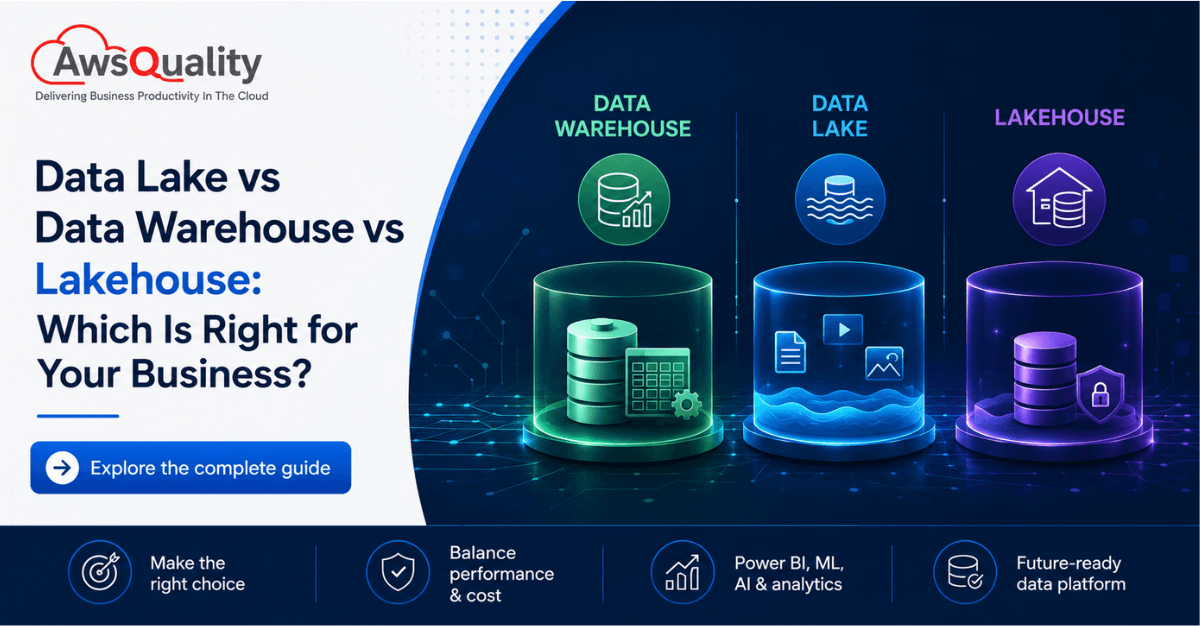
- The data warehouse answers: by structuring and governing data for reliable analytical queries.
- The data lake answers: by storing everything in its raw form for maximum flexibility.
- The lakehouse answers: by combining the flexibility of the lake with the governance and performance of the warehouse.
Understanding what problem each architecture was built to solve is the starting point for knowing which one belongs in your environment.
What is a Data Warehouse?
A data warehouse is a centralised repository that stores structured, processed, and integrated data from multiple source systems — optimised for analytical queries and business intelligence workloads.
The concept dates to the late 1980s, when Bill Inmon and Ralph Kimball independently established the architectural principles that still define enterprise data warehousing today. The modern cloud data warehouse — Snowflake, Google BigQuery, Amazon Redshift, Azure Synapse Analytics — applies the same principles to cloud-native, massively parallel processing environments.
How a data warehouse works
Data enters the warehouse through an ETL (Extract, Transform, Load) or ELT (Extract, Load, Transform) process. Source system data is extracted, validated, cleaned, transformed into a consistent format, and loaded into the warehouse in a structured schema — either a star schema (fact and dimension tables optimised for query performance) or a snowflake schema (a normalised extension of the star schema).
Business users, BI tools, and reporting applications query the warehouse through SQL, receiving fast, consistent results from data that has been pre-processed and organised for analytical consumption.
What data warehouses do well
Structured data at high performance. Warehouses are optimised for analytical SQL queries on structured data — the sales, financial, customer, and operational datasets that drive standard business intelligence and reporting.
Data quality and consistency. The ETL process enforces data quality before data enters the warehouse. Business users querying the warehouse retrieve data they can trust, because the transformation and validation process has already been applied.
Governance and access control. Warehouses provide mature role-based access control, column-level security, and audit logging — capabilities that regulated industries depend on.
BI tool integration. Every major BI platform (Power BI, Tableau, Looker, Amazon QuickSight) integrates natively with cloud data warehouses, providing the self-service analytics experience that business users expect.
Where data warehouses struggle
Unstructured and semi-structured data. Warehouses are designed for structured, schema-defined data. Storing and querying images, video, documents, JSON logs, and other unstructured formats either requires workarounds or is simply not practical.
Scale economics at very high data volumes. Traditional on-premises warehouses scaled expensively. Cloud warehouses scale more cost-effectively, but very high-volume raw data storage in a warehouse remains significantly more expensive per terabyte than object storage.
Machine learning and AI workloads. ML model training typically requires access to raw, granular data at scale — data that the warehouse transformation process may have aggregated or filtered. Warehouse schemas optimised for BI queries are often poorly suited to ML feature engineering requirements.
Schema changes. The structured schema that makes warehouses fast for queries also makes them rigid. Accommodating a new data source or a new analytical requirement often requires schema migration work that takes time and creates risk.
Platforms
Leading cloud data warehouse platforms in 2026: Snowflake, Google BigQuery, Amazon Redshift, Azure Synapse Analytics, Databricks SQL Warehouse.
Also read: From Data Silos to Business Insights: How Data Engineering Creates Enterprise Value
What is a Data Lake?
A data lake is a centralised repository that stores data in its raw, native format — structured, semi-structured, and unstructured — at any scale, using low-cost object storage.
The term was coined by James Dixon of Pentaho in 2010, in contrast to the data mart (which he described as a “store of bottled water — cleansed and packaged and structured”). The data lake, Dixon argued, was a large body of water in a more natural state — and the consumers could dive in and take what they needed.
In practice, data lakes are built on cloud object storage: Amazon S3, Azure Data Lake Storage Gen2, and Google Cloud Storage. Data is stored in its original format — CSV, JSON, Parquet, Avro, ORC, images, logs, binary files — with a schema applied only at query time (schema-on-read), rather than at storage time (schema-on-write).
How a data lake works
Data lands in the lake directly from source systems — often without transformation or validation. Ingestion pipelines may perform basic formatting or partitioning, but the core principle of the data lake is that raw data is preserved exactly as received.
Data scientists and engineers access the lake through query engines (Apache Spark, Amazon Athena, Azure Data Lake Analytics, Google Dataproc) that apply schema interpretation at query time. This flexibility means the lake can answer questions that were not anticipated when the data was first stored.
What data lakes do well
Any data type, at any scale. The data lake’s defining advantage is breadth. Structured transaction records, semi-structured JSON API responses, unstructured text documents, images, video, machine sensor output, and application logs all coexist in the same storage environment at the same low cost per terabyte.
ML and AI workloads. Data scientists working on machine learning models need access to raw, granular, diverse data at scale. The data lake provides this without the schema constraints or pre-aggregation that the warehouse imposes.
Cost-effective long-term storage. Object storage is significantly cheaper per terabyte than warehouse storage. Data that needs to be retained for compliance, historical analysis, or future use cases is cost-efficiently stored in the lake.
Schema flexibility. Because schema is applied at read time, new data sources can be added to the lake without schema migration. The lake accepts the data first; the transformation is applied when the data is consumed for a specific purpose.
Where data lakes struggle
The “data swamp” problem. Without disciplined governance, data lakes rapidly become unusable. Data lands in the lake without cataloguing, without quality validation, without clear ownership, and without documentation. After 18 months, nobody knows what is in the lake, what can be trusted, or how to find what they need. Gartner estimates that 85% of data lake projects fail to deliver their expected business value — the swamp problem is the primary reason.
No ACID transactions. Traditional data lake object storage does not support ACID (Atomicity, Consistency, Isolation, Durability) transactions. Concurrent reads and writes can produce inconsistent results. Deleting or updating specific records — required for GDPR compliance, for example — is complex and fragile.
Query performance. Ad-hoc queries against raw data in the lake are significantly slower than equivalent queries against a well-structured data warehouse. Full file scans, format overhead, and the absence of warehouse-style query optimisation all contribute to performance that is inadequate for the interactive BI use cases business users expect.
Inconsistent data quality. The schema-on-read model means data quality issues are discovered at query time — often when a data scientist is mid-analysis or when a business user receives an incorrect report. There is no quality gate at ingestion.
BI tool integration. Standard BI tools connect natively to data warehouses. Connecting them to a raw data lake requires additional transformation layers that add complexity and latency.
Platforms
Leading data lake implementations in 2026: Amazon S3 (with AWS Glue and Athena), Azure Data Lake Storage Gen2 (with Azure Synapse Analytics), Google Cloud Storage (with BigQuery external tables and Dataproc), Hadoop HDFS (declining in enterprise adoption, being replaced by cloud object storage).
What is a Data Lakehouse?
The data lakehouse is the architectural pattern that addresses the core limitations of both the warehouse and the lake — by combining open-format object storage as the data layer with ACID transaction support, schema enforcement, and warehouse-style performance applied directly at the storage level.
The term was formally introduced by Databricks in 2020, though the architectural convergence it describes had been developing for several years through open table formats (Delta Lake, Apache Iceberg, Apache Hudi) that added transactional capabilities to object storage.
The lakehouse does not require choosing between the flexibility of a lake and the governance of a warehouse. It applies warehouse-quality data management to lake-scale, lake-format data — enabling a single data platform to serve structured BI workloads, ML training workloads, and AI inference workloads from the same storage layer.
How a data lakehouse works
The lakehouse stores data in open table formats — Delta Lake, Apache Iceberg, or Apache Hudi — on cloud object storage. These formats add a transaction log layer on top of the raw file storage that enables ACID transactions, schema enforcement, time travel (querying historical versions of the data), and efficient record-level updates and deletes.
Data lands in the lake storage layer through ingestion pipelines, is transformed through ELT processes (typically dbt, Apache Spark, or the warehouse SQL engine), and is governed through a unified metadata and access control layer (Databricks Unity Catalog, Apache Polaris Catalog, or Snowflake’s native Iceberg integration). The same data is then consumed by BI tools through SQL query engines and by ML systems through Spark or Python data access libraries — from the same copy of data, without duplication.
What lakehouses do well
Unified architecture for all workloads. A single lakehouse platform serves BI and reporting, ML training, AI inference, real-time analytics, and data science exploration — without maintaining separate infrastructure for each workload type.
No data duplication. The warehouse-plus-lake model requires maintaining two copies of enterprise data: one in the lake (raw) and one in the warehouse (processed). Data must be moved between them, creating synchronisation lag, governance complexity, and storage cost. The lakehouse eliminates this duplication.
ACID transactions on open storage. Delta Lake and Apache Iceberg provide full ACID transaction support on object storage, enabling concurrent reads and writes without consistency problems, and enabling record-level updates and deletes that GDPR and similar regulations require.
Schema enforcement with flexibility. The lakehouse enforces schema for data entering the governed layers, while retaining the raw data in the storage layer for workloads that need it. Schema evolution — adding columns, changing types — is supported without the migration complexity that warehouse schema changes require.
Open formats and multi-engine access. Data stored in Parquet/Delta Lake or Parquet/Iceberg formats can be read by any engine that supports the format — Spark, Presto, Trino, DuckDB, BI tools via SQL, Python data science libraries — without format conversion or data movement.
Cost efficiency at scale. Object storage costs a fraction of proprietary warehouse storage per terabyte. The lakehouse retains this storage cost advantage while adding the governance and performance layer on top.
AI readiness. The lakehouse was designed for the AI era — with direct support for ML training data access, feature engineering pipelines, vector database integration, and the real-time data serving that AI agents require.
Where lakehouses are more complex
Higher initial setup complexity. A lakehouse requires more architectural decisions than a simple warehouse deployment — open table format selection, transaction log management, catalog configuration, and query engine integration all require expertise that a managed warehouse service abstracts.
Operational maturity requirement. The lakehouse’s unified governance only delivers its full value if the governance is implemented correctly. An ungoverned lakehouse is a data swamp on better technology.
The tooling ecosystem is still maturing. BI tool integration with lakehouse architectures, while improving rapidly, is still less seamless than native warehouse connections for some tools and some workloads.
Platforms
Leading lakehouse platforms in 2026: Databricks Lakehouse Platform (with Delta Lake and Unity Catalog), Apache Iceberg (cloud-agnostic, supported by Snowflake, AWS, Azure, GCP, Dremio), Snowflake (with native Iceberg support and Polaris Catalog), Microsoft Fabric (unifying Azure Data Lake and Synapse under a single lakehouse-aligned platform), Google BigLake (extending BigQuery governance to Cloud Storage data).
Read: Top Data Engineering Trends Every Business Should Know
Data Lake vs Data Warehouse vs Lakehouse: A Direct Comparison
| Factor | Data Warehouse | Data Lake | Lakehouse |
|---|---|---|---|
| Data types supported | Structured only | All types (structured, semi-structured, unstructured) | All types |
| Schema approach | Schema-on-write (rigid) | Schema-on-read (flexible) | Schema-on-write for governed layers, schema-on-read for raw |
| ACID transactions | Yes | No (without open table formats) | Yes |
| Query performance | High (optimised for BI) | Low to medium (varies by format and engine) | High (with optimisation) |
| Storage cost | Higher per TB | Very low per TB | Low per TB |
| BI tool integration | Native, seamless | Requires additional layers | Good and improving |
| ML/AI workload support | Limited | Strong | Strong |
| Data quality enforcement | At ingestion (ETL) | At query time (risk of swamp) | At pipeline stage (governed) |
| Governance maturity | Very mature | Requires deliberate investment | Mature and improving |
| Real-time data support | Limited | Strong | Strong |
| Record-level updates/deletes | Yes | Complex without open formats | Yes |
| Setup complexity | Low–Medium | Medium | Medium–High |
| Best for | BI, reporting, structured analytics | ML, data science, raw storage, diverse data | All workloads from a single platform |
| Primary risk | Rigidity and ML limitations | Data swamp and governance failure | Operational complexity if governance is neglected |
The Seven Questions That Lead to the Right Decision
Rather than prescribing a universal answer, the following questions produce a reliable architectural recommendation for most enterprise data platform decisions.
What are your primary workloads?
If your primary workload is structured BI and reporting — dashboards, scheduled reports, executive analytics — and you have no immediate plans for ML model training, AI systems, or diverse data types, a well-governed data warehouse is the most appropriate starting point. It is the simplest architecture for this use case and has the most mature tooling support.
If your primary workload is data science, ML model development, or AI system support — requiring access to raw, diverse, high-volume data — a data lake or lakehouse is required. A warehouse alone cannot serve these workloads adequately.
If your workloads span both categories — BI and reporting alongside ML, AI, and diverse data types — a lakehouse is the architecturally correct choice. It is the only pattern that serves both without duplication.
What data types do you need to store and analyse?
If you work exclusively with structured, relational data, a data warehouse is entirely adequate.
If you need to store and analyse semi-structured data (JSON, XML, Avro), unstructured data (text, images, video, audio), or machine-generated data (IoT sensor streams, application logs, clickstream data), a data lake or lakehouse is required.
In 2026, most enterprises that are at all serious about AI have use cases involving unstructured data — because the most valuable AI applications (document intelligence, customer conversation analysis, predictive maintenance from sensor data) operate on unstructured content. If AI is part of your data strategy, unstructured data handling is a requirement, not a future consideration.
What are your data governance and compliance requirements?
If you operate in a regulated industry — financial services, healthcare, insurance, pharmaceuticals — with strict requirements for data access control, audit trails, data lineage, and retention management, governance capability is a first-order architectural requirement.
Data warehouses have the most mature governance capabilities, built over decades. Modern lakehouses (particularly with Databricks Unity Catalog or Snowflake’s native governance) have achieved comparable governance maturity for most enterprise requirements. Data lakes without an open table format layer have the weakest native governance — the swamp problem is fundamentally a governance failure.
For regulated industries, the choice is between warehouse and lakehouse. A raw data lake without strong governance tooling is not adequate for environments where data compliance is not optional.
What are your ML and AI ambitions?
This is increasingly the decision-tipping question for most enterprises in 2026.
If your organisation has near-term plans to deploy ML models, build AI agents, implement retrieval-augmented generation (RAG) systems, or develop AI-powered products, your data architecture needs to support these workloads from the start. 90% of AI and machine learning projects depend directly on data engineering pipelines — and an architecture that cannot serve ML training and AI inference workloads will block AI adoption regardless of how good the AI ambition is.
Data warehouses alone cannot adequately serve most ML and AI workloads. Data lakes can, but the governance limitations create risk. The lakehouse is the architecture designed for the AI era, and for organisations with serious AI ambitions, it is increasingly the default recommendation.
What is your team’s current data engineering maturity?
Architectural ambition must be matched to organisational capability.
A small data team without deep data engineering experience will struggle to implement and maintain a lakehouse correctly. An ungoverned lakehouse is worse than a well-governed warehouse — it has the swamp risk of the lake with the false confidence of enterprise tooling.
If your team is early in its data engineering journey, a managed cloud data warehouse — Snowflake, BigQuery, or Amazon Redshift — provides the governance, performance, and BI integration your organisation needs now, with a clear migration path to lakehouse architecture as maturity develops.
If your team has solid data engineering experience and the organisation has the appetite for the operational investment, the lakehouse is worth building from the start — particularly if AI workloads are part of the medium-term plan.
What is your budget model?
Data warehouses have predictable cost models — compute and storage costs are relatively stable and well-understood. This predictability is valuable for organisations with fixed technology budgets.
Data lakes have very low storage costs but variable and potentially high query costs if queries are poorly optimised.
Lakehouses have low storage costs (object storage) with variable compute costs that can be controlled through query optimisation, auto-scaling, and auto-suspend policies.
For organisations with strict budget controls and primarily BI workloads, the warehouse’s cost predictability is a genuine advantage. For organisations with large data volumes and diverse workloads, the lakehouse’s storage cost efficiency typically outweighs the managed warehouse’s cost predictability over a three-to-five year horizon.
Are you building for today or for three years from now?
This is the question that most enterprise data architecture decisions fail to ask seriously.
A data warehouse built optimally for today’s BI workloads may be inadequate for the AI workloads your organisation will need in 18 months. Migrating from a warehouse-only architecture to a lakehouse after the platform is in production — with data in proprietary warehouse formats, pipelines built around warehouse semantics, and governance models implemented at the warehouse layer — is a significant undertaking.
A lakehouse built today accommodates both today’s BI requirements and tomorrow’s AI requirements without architectural rework. The incremental complexity of building the lakehouse from the start is significantly lower than the migration cost of rebuilding from a warehouse after the AI requirements crystallise.
For organisations with any meaningful AI ambition, the lakehouse is increasingly the right three-year architectural bet.
Also read: The Complete Guide to Data Engineering Services for Modern Enterprises
When Each Architecture is the Right Answer
Choose a data warehouse when:
- Your primary workloads are structured BI, reporting, and dashboards
- Your data is predominantly relational and structured
- Your team is earlier in its data engineering maturity
- You have strict governance and compliance requirements and limited engineering capacity to implement lakehouse governance
- You need the fastest path to reliable, governed analytics for business users
- Your data volumes are moderate and primarily structured
- AI and ML workloads are not in your near-term roadmap
Best suited for: Retail analytics teams, finance and accounting departments, HR analytics, mid-market companies with primarily reporting-focused data needs.
Example deployment: A mid-sized financial services company running Snowflake for customer profitability reporting, regulatory capital calculations, and executive dashboards — structured data, governed, fast, and reliable.
Choose a data lake when:
- Your primary workload is ML research, data science exploration, or AI model training on diverse data types
- You need to store very large volumes of raw data at minimum cost
- Your data includes significant unstructured or semi-structured content
- You have strong data engineering capability and can invest in governance tooling
- Speed to production is less important than data flexibility and scale
- You are building a raw data archive or compliance data store rather than a primary analytics platform
Important caveat: A raw data lake without open table formats and a governance layer is increasingly difficult to justify in 2026. The emergence of lakehouse tooling has resolved most of the raw lake’s analytical limitations at relatively low incremental cost. If you are choosing a data lake for its technical advantages, evaluate whether adding Delta Lake or Apache Iceberg on top of your object storage achieves the same benefits while avoiding the swamp risk.
Best suited for: Data science and research teams, IoT and sensor data platforms, compliance and audit data archives, organisations with very large volumes of unstructured content.
Choose a lakehouse when:
- Your workloads span both BI/reporting and ML/AI
- You want a single platform for all data workloads without duplication
- You have meaningful AI ambitions in the next 12 to 24 months
- Your data includes both structured and unstructured content
- You want open-format flexibility without compromising on governance
- Your team has solid data engineering capability and can invest in the initial setup
- You are building a new data platform from scratch and want to avoid architectural rework as requirements evolve
- Cost efficiency at large data volumes is a priority
Best suited for: Enterprise organisations with diverse analytics and AI workloads, organisations in regulated industries with both BI and ML requirements, technology companies building data products, organisations with large IoT or clickstream data volumes alongside traditional business reporting needs.
Example deployment: A retail enterprise running Databricks on Azure with Delta Lake, serving merchandising analytics through Power BI, powering demand forecasting ML models through Spark, and providing real-time inventory AI agents with current warehouse data — all from the same lakehouse platform, with Unity Catalog governing access across all workloads.
The Hybrid Reality: Most Enterprises Use a Combination
It is important to be honest about how enterprise data architecture actually works in practice.
Most large enterprises do not have a single, pure implementation of any one of these three patterns. They have a portfolio of data platforms that evolved over time — a legacy on-premises data warehouse that has been running for fifteen years, a data lake that was built three years ago to support the data science team, some data marts built for specific business units, and a growing Snowflake or Databricks environment that is becoming the strategic platform.
The decision framework above is most relevant for:
- New platform builds: organisations designing their data architecture from scratch have the clearest decision.
- Platform modernisation: organisations replacing or consolidating legacy infrastructure need to decide what they are building toward.
- Incremental expansion: organisations with an existing warehouse or lake evaluating whether to extend, supplement, or replace it.
For most enterprises with existing infrastructure, the practical question is not “which architecture should we choose” but “how do we evolve our current architecture toward the pattern that serves our next three years of requirements.”
The answer for most organisations in 2026 is some form of lakehouse — either building a new lakehouse platform, migrating existing lake and warehouse environments onto a unified lakehouse foundation, or adding open table format layers to existing object storage to achieve lakehouse capabilities without a full infrastructure replacement.
Check: Common Cloud Migration Mistakes and How to Avoid Them
Common Mistakes in Data Architecture Decisions
Choosing based on what the team already knows.
Organisations with strong Redshift experience default to Redshift. Organisations with an existing Hadoop data lake try to evolve it. Technology familiarity is a real factor in architectural decisions, but it should not override the requirements analysis. The cost of retraining a team on a new platform is almost always lower than the cost of operating the wrong architecture for five years.
Underestimating governance as a first-order requirement.
The data lake’s swamp problem is not primarily a technology problem. It is a governance problem — specifically, the absence of data cataloguing, quality validation, access control, and ownership that makes the lake navigable and trustworthy. Organisations that build data lakes without a governance programme from day one consistently regret it.
Building for today’s requirements without considering tomorrow’s.
The organisation that builds a warehouse-only platform in 2024 and then discovers an AI requirement in 2025 faces a difficult migration. Architecture decisions have multi-year consequences. The three-year question (Question 7 above) deserves more weight than it typically receives.
Treating the lakehouse as a simple upgrade.
The lakehouse is not a data warehouse with extra features, and it is not a better data lake. It is a different architectural pattern with different operational requirements, governance models, and tooling dependencies. Organisations that adopt lakehouse technology without understanding the governance and operational investment it requires often produce an ungoverned lakehouse — which has the swamp risk of the lake with additional operational complexity.
Neglecting data quality regardless of architecture.
Data quality issues affect nearly 30% of organisational revenue, according to research cited in the cloud data engineering analysis. No architecture resolves data quality problems automatically. Whether you are running a warehouse, a lake, or a lakehouse, data quality validation embedded in the ingestion and transformation pipeline is a non-negotiable investment.
The Lakehouse as the Default for New Builds
For organisations designing a new data platform, the honest recommendation is this:
Unless you have a specific, justified reason to choose a warehouse-only or lake-only architecture, the lakehouse should be your default starting point.
The reasons are practical, not theoretical.
The lakehouse eliminates the data duplication and governance fragmentation that a warehouse-plus-lake architecture requires. The open table formats that make the lakehouse work (Delta Lake, Apache Iceberg) are now mature, widely adopted, and supported across all major cloud platforms and analytics engines. The governance tooling (Unity Catalog, Snowflake Iceberg integration, Microsoft Fabric) has reached a maturity level that makes lakehouse governance achievable for enterprise data teams without extraordinary specialist expertise.
And most importantly, the AI workloads that will define the most valuable data platform use cases of the next three years — ML training, generative AI applications, AI agents, real-time decision systems — are better served by lakehouse architecture than by warehouse-only or lake-only approaches.
This does not mean the lakehouse is always right or that it is simple to implement correctly. It means that the architectural flexibility it provides, and the AI readiness it enables, make it the most defensible default for most new enterprise data platform builds in 2026.
How AwsQuality Helps You Choose and Build the Right Architecture
Choosing the right data architecture is only half the challenge.
Implementing it correctly — with the governance, pipeline engineering, quality validation, observability, and operational practices that make any architecture deliver its intended value — is where most organisations need support.
At AwsQuality, our data engineering services cover the full spectrum: from architecture assessment and platform selection through pipeline development, governance implementation, quality framework design, and ongoing managed support.
We work with organisations at every stage of data platform maturity:
- Building from scratch: helping you design the right architecture for your workloads, team capability, and three-year requirements — and implementing it to production-grade standards from the first pipeline.
- Modernising legacy infrastructure: helping you evolve from legacy on-premises data warehouses or unmanaged data lakes toward modern cloud-native or lakehouse architectures that serve your current and future workloads.
- Fixing governance failures: helping organisations whose data lakes have become data swamps establish the cataloguing, quality validation, access control, and lineage tracking that transform a liability into an asset.
- Enabling AI readiness: designing and implementing the feature engineering pipelines, vector database infrastructure, real-time data serving, and data quality standards that AI workloads require.
Ready to design your data platform architecture? Contact the AwsQuality data engineering team to discuss your requirements and get an honest architectural recommendation based on your specific workloads, team capability, and business objectives.
Conclusion
Data lake, data warehouse, and lakehouse are not competing options where one is universally better than the others.
They are architectural patterns, each designed to solve a specific set of problems, each making specific trade-offs that make them the right answer in some contexts and the wrong answer in others.
The data warehouse delivers governance, performance, and BI integration for structured analytical workloads — at the cost of flexibility for diverse data types and ML workloads.
The data lake delivers flexibility, scale, and cost efficiency for diverse data types and ML workloads — at the cost of governance, performance, and analytical reliability if not managed with discipline.
The lakehouse delivers the governance and performance of the warehouse with the flexibility, scale, and AI readiness of the lake — at the cost of higher setup complexity and a greater operational investment.
For most enterprise data platform decisions in 2026, the question is not which architecture is theoretically superior. It is which architecture correctly serves your specific workloads, your team’s capability, your governance requirements, and your three-year roadmap — and which one your organisation can actually implement and operate to its full potential.
Answer those questions honestly, and the right architecture becomes clear.
Read next: Top Data Engineering Trends Every Business Should Know
Frequently Asked Questions
What is the main difference between a data lake and a data warehouse?
A data warehouse stores structured, processed data for analytics, while a data lake stores structured, semi-structured, and unstructured data in raw form.
What is a data lakehouse and how does it differ from a data lake?
A data lakehouse adds governance, ACID transactions, schema enforcement, and better analytical performance to the flexible storage of a data lake.
Is a data lakehouse replacing the data warehouse?
Not entirely. Data warehouses remain strong for structured BI workloads, while lakehouses are increasingly used for combined BI, ML, and AI workloads. Many organizations use both.
Which data architecture is best for AI and machine learning?
A data lakehouse is generally well suited for AI and ML because it combines diverse data access, scalability, governance, and support for analytical workloads.
What is the data swamp problem and how do I avoid it?
A data swamp occurs when a data lake lacks governance, quality, ownership, and documentation. Data cataloging, quality checks, access controls, and lineage can help prevent it.
What is Apache Iceberg and why is it important?
Apache Iceberg is an open table format that adds features such as ACID transactions, schema evolution, and time travel to data stored in object storage.
Can I migrate from a data warehouse to a lakehouse?
Yes. Migration typically involves setting up the lakehouse, moving data and transformation workflows, validating results, migrating BI connections, and eventually retiring the warehouse.
How do I know if my organisation is ready for a lakehouse?
A lakehouse may be appropriate if you have BI and AI/ML workloads, need stronger data governance, want a unified platform, and have the technical expertise to manage it.
 Bio
Bio