Modern enterprises rarely suffer from a lack of data.
Customer interactions live in CRM platforms. Financial information sits in ERP systems. Marketing teams generate campaign data. Applications create logs and behavioral data. Cloud platforms, IoT devices, support systems, and third-party applications continuously add more information.
The problem is that much of this data exists in isolation.
When customer, operational, financial, and product data remain trapped in separate systems, organizations struggle to develop a unified view of their business. Analysts spend time collecting and cleaning information instead of analyzing it. Reports may present conflicting numbers. AI initiatives struggle with unreliable inputs. Decision-makers wait for insights that should be available in near real time.
This is where data engineering creates strategic value.
Data engineering provides the architecture, pipelines, integrations, quality controls, and platforms needed to transform fragmented enterprise data into accessible, reliable, analytics-ready, and AI-ready information.
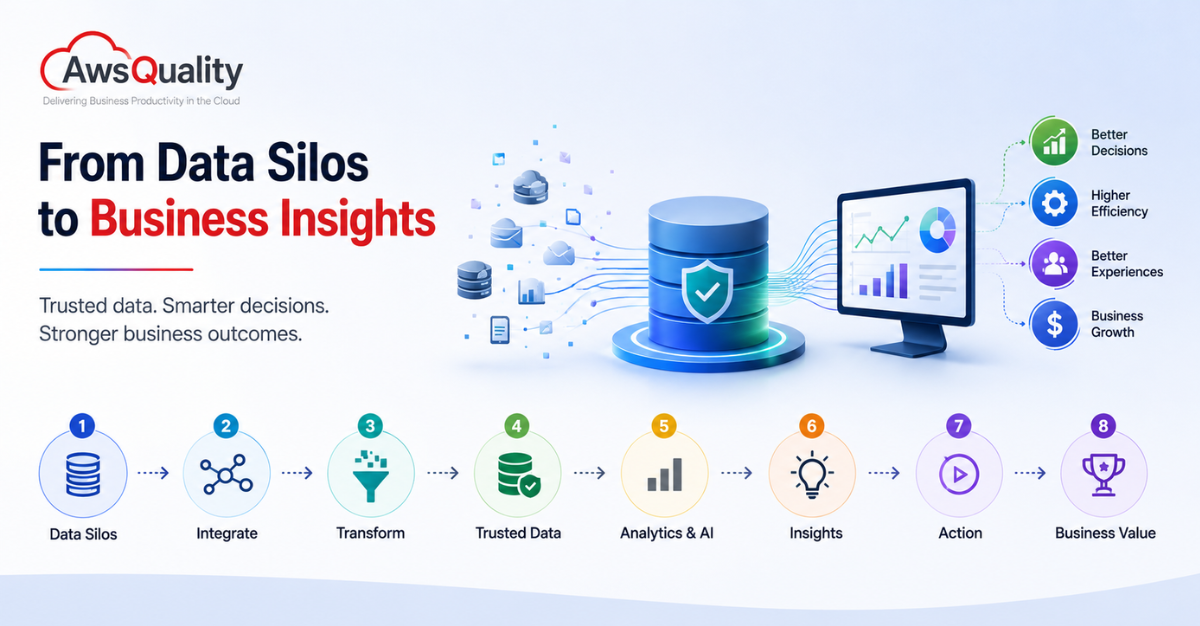
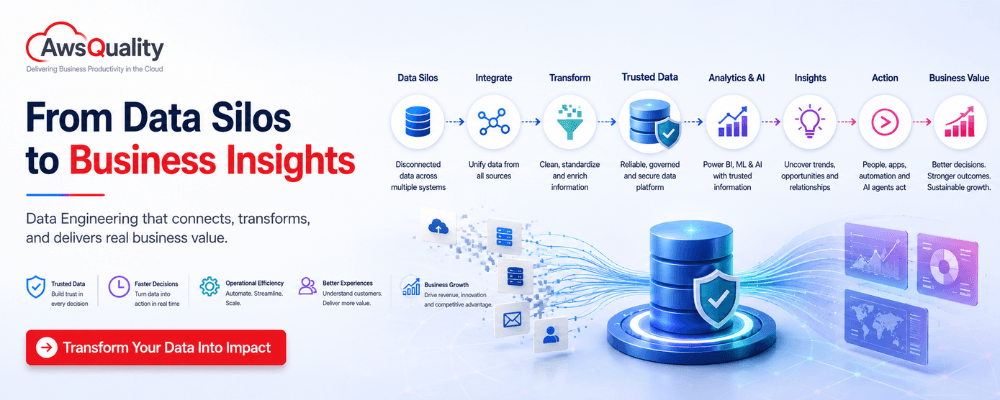
The journey can be summarized simply:
Data Silos → Integration → Transformation → Trusted Data → Analytics & AI → Business Insights → Better Decisions
For enterprises trying to become genuinely data-driven, data engineering isn’t merely an IT function. It is the foundation that turns data into business value.
Read: Top Data Engineering Trends Every Business Should Know
The $12.9 Million Problem Every Enterprise is Living With
Most enterprises are generating more data than at any point in their history. And most of them cannot use most of it.
The average enterprise technology stack now spans 897 applications, according to MuleSoft’s 2025 Connectivity Benchmark Report. Only 29% of those applications are integrated with each other. The remaining 71% operate as standalone systems — generating data that cannot be automatically shared, cannot be collectively analyzed, and cannot inform the business decisions it was produced to support.
The financial consequence of this fragmentation is quantifiable. The average mid-size enterprise loses $12.9 million annually to data silos, according to a 2025 analysis by the Data Management Association spanning 200 companies. That figure — larger than the budget of most IT modernization programs — accumulates through duplicated work, delayed decisions, missed correlations, and the organizational friction of information trapped in disconnected systems.
68% of organizations now cite data silos as their top data management concern, up 7% from the previous year, according to DATAVERSITY’s 2026 research. 81% of IT leaders report that data silos are directly hindering their digital transformation efforts (Salesforce Connectivity Report). And 97% of organizations say silos have a negative effect on performance.
These are not niche technology problems. They are the primary reason analytical investments underperform, AI initiatives stall, and leadership teams make decisions with incomplete visibility into the business they are responsible for running.
Data engineering is the discipline that addresses this problem at the architectural level — not by adding more tools to an already fragmented landscape, but by building the unified, governed, reliable data infrastructure that allows every system, team, and analytical application to work from the same trusted source of truth.
This guide examines the data silo problem in specific financial terms, explains exactly how data engineering breaks it down, and documents the five ways that data engineering investment converts into measurable enterprise value.
Also read: The Complete Guide to Data Engineering Services for Modern Enterprises
What are Data Silos and How Do They Form?
A data silo is an isolated repository of data — generated, stored, and accessible within one system, department, or team — that cannot be automatically shared with or accessed by the rest of the organization. The term captures both the technical reality (data trapped in disconnected databases and applications) and the organizational reality (information hoarded within business units as a proxy for departmental autonomy).
Data silos rarely form through deliberate choice. They emerge naturally from the way enterprises grow:
System sprawl. Every new application — a CRM, an ERP, a marketing platform, a support ticket system, a financial management tool — generates its own data in its own format. Unless actively integrated, each new system becomes a new silo.
Mergers and acquisitions. Acquired organizations bring their own systems, data models, and operational databases. Without deliberate integration, the post-acquisition enterprise operates as two parallel data environments rather than one unified one.
Departmental purchasing. When business units procure their own tools independently — without coordination with IT or data architecture — the resulting ecosystem is defined by departmental need rather than enterprise interoperability.
Historical legacy. On-premises systems built 10 to 20 years ago were not designed to integrate with the cloud platforms, SaaS applications, and real-time data streams that modern enterprises depend on. These legacy systems hold critical historical data that cannot easily be connected to the modern data stack.
Organizational culture. In organizations where data is treated as departmental property rather than enterprise asset, silos are reinforced by behavior rather than only by technology. Teams that benefit from data exclusivity resist integration.
Why Do Data Silos Develop?
Most enterprises don’t intentionally create data silos.
They emerge naturally as organizations grow.
Different departments adopt applications optimized for their individual requirements. Companies acquire other businesses with different technology stacks. Legacy platforms remain in operation. Cloud applications proliferate. Teams build independent databases and reporting systems.
Over time, the technology environment becomes fragmented.
Common causes include:
Department-Specific Applications
Sales, finance, marketing, HR, operations, and customer service may each select specialized applications.
Legacy Systems
Older applications may contain valuable business information but lack modern integration capabilities.
Mergers and Acquisitions
Acquired companies frequently bring entirely different databases, platforms, schemas, and data standards.Rapid SaaS Adoption
Modern organizations may use dozens or hundreds of cloud applications, each generating its own data.
Inconsistent Data Standards
Different departments may define the same customer, product, revenue metric, or business entity differently.
Point-to-Point Integrations
Individual integrations built without an overall data architecture can eventually create another layer of complexity.
The result is not simply a technical problem.
It can become a business problem.
Check out: How Data Engineering Services Help Enterprises Build AI-Ready Data Platforms
The Business Cost of Data Silos
Data silos create friction between the information an organization possesses and the insights it can actually use.
Slow Decision-Making
When data must be manually collected from multiple systems, reporting takes longer.
By the time decision-makers receive the information, the situation may already have changed.
Inconsistent Reporting
Different teams may calculate the same metric using different data sources or definitions.
Leadership then sees multiple versions of the truth.
Poor Customer Visibility
Sales may know one part of the customer relationship while service, marketing, and finance know others.
Without integration, no team sees the complete picture.
Duplicate Work
Analysts repeatedly extract, clean, reconcile, and transform similar datasets.
That is expensive and inefficient.
Limited Automation
Business processes are harder to automate when the necessary information is scattered across disconnected systems.
Weak AI Foundations
AI systems depend heavily on accessible, accurate, and contextually relevant information.
Fragmented data limits what enterprise AI can reliably accomplish.
In other words, data silos don’t just make reporting difficult—they can constrain analytics, automation, AI, customer experience, and growth.
What is the Role of Data Engineering?
Data engineering focuses on designing and maintaining the systems that collect, integrate, transform, store, govern, and deliver data for business use.
A modern data engineering environment can include:
- Data ingestion
- ETL and ELT pipelines
- APIs
- Streaming pipelines
- Data transformation
- Data warehouses
- Data lakes
- Lakehouse architectures
- Data quality frameworks
- Metadata management
- Orchestration
- Governance
- Monitoring
The purpose isn’t simply to move information from one database to another.
Effective data engineering services should help create a trusted data foundation that supports analytics, operational workflows, business intelligence, automation, and AI.
How Data Engineering Turns Data Silos into Business Insights
1. Connecting Disconnected Data Sources
The first challenge is integration.
Enterprise information may exist across:
CRM + ERP + SaaS + Databases + Cloud Storage + Applications + APIs + IoT + Legacy Systems
Data engineering creates pipelines and integration mechanisms that bring this information together.
Depending on business requirements, organizations may use:
- Batch ingestion
- APIs
- Change Data Capture
- Event streaming
- ETL
- ELT
- Database replication
Once information can move reliably between systems and data platforms, the organization begins breaking down data silos.
But moving data is only the first step.
2. Creating Consistent Data
Different systems often represent the same information differently.
For example, one system may record:
United States
another:
USA
and another:
US
Similar inconsistencies occur with:
- Customer names
- Product IDs
- Dates
- Addresses
- Currencies
- Categories
- Account hierarchies
Without transformation and standardization, combining datasets can produce misleading results.
Data pipelines can clean, validate, standardize, enrich, and transform information into consistent formats.
That creates a more dependable foundation for analytics.
3. Building a Centralized Data Foundation
Breaking down silos does not necessarily mean replacing every operational application.
Salesforce can remain the CRM.
An ERP can remain responsible for financial operations.
Marketing platforms can continue managing campaigns.
Instead, organizations can establish a common analytical data layer.
Depending on requirements, this might be:
Data Warehouse
Optimized for structured analytics and business intelligence.
Data Lake
Designed to store large volumes of structured, semi-structured, and unstructured information.
Lakehouse
Combines characteristics of data lakes and warehouses to support broader analytical and AI workloads.
The right architecture depends on data volume, latency requirements, analytics needs, governance, cost, and existing technology.
The objective is not centralization for its own sake.
It is to make trusted enterprise information discoverable and usable across appropriate business use cases.
4. Improving Data Quality
Connecting poor-quality data does not magically create good data.
It can simply centralize the problem.
Modern data engineering therefore requires systematic data-quality management.
Organizations should monitor dimensions such as:
Accuracy: Is the information correct?
Completeness: Are important values missing?
Consistency: Does the same information agree across systems?
Timeliness: Is the data current enough for the use case?
Validity: Does it follow expected rules and formats?
Uniqueness: Are duplicate records creating distortion?
Data-quality checks can be incorporated directly into pipelines so problems are identified before unreliable information reaches reports, applications, or AI systems.
5. Creating a Single, Trusted View of the Business
One of the biggest benefits of breaking down data silos is the ability to connect information around important business entities.
Consider a customer.
Marketing knows which campaigns the customer engaged with.
Sales knows which opportunities were created.
Commerce knows what the customer purchased.
Finance knows what was paid.
Customer service knows which issues occurred.
Product systems know how the customer uses the application.
Individually, these datasets provide partial context.
Connected, they can create a much richer customer view.
This can enable questions such as:
- Which acquisition channels produce the most valuable customers?
- Which customers are at risk of churn?
- Which product behaviors correlate with renewals?
- Which service issues affect retention?
- Which accounts have expansion potential?
That is where data engineering starts moving from technical infrastructure to strategic business capability.
6. Enabling Faster Business Intelligence
Traditional reporting environments often rely on analysts manually extracting and reconciling information.
A modern data platform can automate much of this preparation.
Data pipelines continuously move and transform information into analytics-ready datasets.
Business intelligence tools can then consume those datasets for:
- Executive dashboards
- Sales reporting
- Financial analysis
- Customer analytics
- Operational reporting
- Marketing attribution
- Product analytics
Instead of asking analysts:
“Can you collect this data and build a report?”
business teams increasingly gain access to governed information that is already prepared for analysis.
The result can be a significant reduction in time-to-insight.
7. Supporting Real-Time Decision-Making
Not every business decision can wait for yesterday’s batch report.
Some use cases require information almost immediately.
Examples include:
- Fraud detection
- Inventory availability
- Customer personalization
- Equipment monitoring
- Logistics
- Financial transactions
- Cybersecurity
- Dynamic pricing
Streaming and event-driven data architectures can process information as events occur.
Instead of:
Event → Wait → Batch Process → Report → Decision
organizations can move toward:
Event → Data Pipeline → Analysis → Decision/Action
This can fundamentally change how quickly businesses respond to changing conditions.
8. Creating the Foundation for AI
Enterprise AI has made strong data engineering even more important.
Generative AI applications and AI agents frequently need access to proprietary business information.
That information may include:
- Product documentation
- Customer records
- Transaction histories
- Policies
- Support conversations
- Contracts
- Knowledge bases
- Operational data
If this information remains fragmented, outdated, duplicated, or inaccessible, AI systems will struggle to provide reliable results.
Data engineering helps prepare information for:
- Machine learning
- Predictive analytics
- Generative AI
- Retrieval-Augmented Generation (RAG)
- Enterprise search
- Recommendation systems
- AI agents
An AI-ready data platform isn’t simply a place to store more data.
It is an environment where data is accessible, trusted, governed, contextualized, and available to AI applications in appropriate ways.
9. Enabling Better Business Automation
Automation depends on data.
Consider a sales workflow designed to automatically prioritize high-value leads.
It might need:
CRM information + Website behavior + Company information + Historical conversion data
Or a customer-retention workflow may require:
When these data sources are disconnected, automation remains limited.
Once they are integrated, businesses can build more sophisticated workflows based on a broader understanding of what is happening.
This creates an important relationship:
Data Engineering → Trusted Data → Automation → Operational Efficiency
10. Making Data Accessible Without Losing Control
Breaking down silos should not mean giving everyone unrestricted access to everything.
Enterprise data may contain:
- Personally identifiable information
- Financial records
- Employee information
- Customer data
- Intellectual property
- Regulated information
Modern data engineering must therefore work alongside governance and security.
Organizations should establish:
- Role-based access
- Data classification
- Encryption
- Lineage
- Audit logging
- Retention policies
- Data ownership
- Privacy controls
The objective is:
Right data → Right user/system → Right purpose → Right time
Accessibility and governance should evolve together.
From Raw Data to Business Value: The Data Engineering Value Chain
The business value of data engineering becomes easier to understand when viewed as a chain.
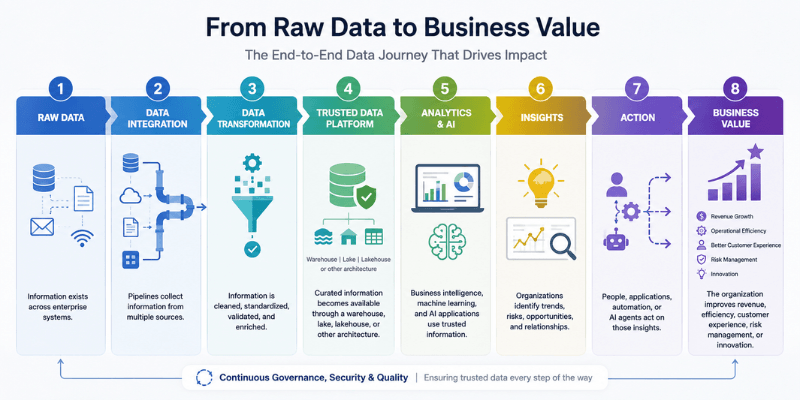
The key point is that raw data has limited value until the organization can reliably turn it into decisions and actions.
Business Outcomes Enabled by Modern Data Engineering
Better Customer Experiences
Unified customer data enables more relevant personalization and more informed service interactions.
Faster Decision-Making
Reliable data reduces the time spent collecting and reconciling information.
Improved Operational Efficiency
Automated pipelines replace repetitive manual data preparation.
More Accurate Forecasting
Integrated historical information provides a stronger foundation for predictive models.
Improved Revenue Intelligence
Businesses can better connect marketing, sales, transaction, and customer data.
AI Readiness
Well-engineered data provides the foundation needed for enterprise AI initiatives.
Greater Scalability
Modern cloud data architectures can accommodate increasing data volumes and new analytical workloads.
Measuring the Business Value of Data Engineering
Data engineering shouldn’t be measured only through technical metrics such as pipeline uptime.
Technical performance matters, but enterprises should connect it to business outcomes.
Useful measurements can include:
| Area | Example KPI |
|---|---|
| Data availability | Time required to access new datasets |
| Data quality | Percentage of records passing quality checks |
| Reporting | Time required to generate business reports |
| Productivity | Analyst hours spent preparing data |
| Reliability | Pipeline failure rate |
| Decision speed | Time from event to actionable insight |
| AI readiness | Percentage of priority data sources accessible to AI |
| Cost | Data processing/storage cost per workload |
| Customer insight | Completeness of unified customer profiles |
The strongest data engineering programs can demonstrate how improvements in the data foundation translate into improvements elsewhere in the business.
How AwsQuality Helps Businesses Unlock Enterprise Data
Building a modern data platform requires more than moving information into the cloud.
Organizations need to understand their existing data landscape, eliminate unnecessary silos, design scalable pipelines, improve data quality, and make information usable for analytics and AI.
AwsQuality’s Data Engineering Services can help organizations build and modernize data foundations across areas such as:
- Data strategy and architecture
- Data integration
- ETL/ELT pipeline development
- Cloud data engineering
- Data migration
- Data warehousing
- Data lakes and lakehouse architectures
- Data quality
- Real-time data processing
- Analytics-ready data
- AI-ready data platforms
The objective isn’t simply to centralize enterprise data.
It is to transform fragmented information into a trusted business asset that supports analytics, automation, AI, and better decision-making.
Frequently Asked Questions
What are data silos?
Data silos are isolated collections of information that cannot be easily accessed or combined with data from other departments, systems, or applications.
How does data engineering eliminate data silos?
Data engineering uses pipelines, APIs, ETL/ELT processes, streaming technologies, and modern data platforms to integrate information from different systems and transform it into consistent, usable datasets.
How does data engineering create business value?
It improves data accessibility, quality, and reliability, enabling faster analytics, better decision-making, automation, customer intelligence, and AI applications.
Why is data engineering important for AI?
AI applications require reliable and accessible information. Data engineering creates the pipelines, transformations, integrations, and platforms needed to make enterprise data usable by machine learning, generative AI, RAG systems, and AI agents.
What is an AI-ready data platform?
An AI-ready data platform provides trusted, governed, accessible, and appropriately structured enterprise information that AI applications can use securely and reliably.
What is the difference between ETL and ELT?
ETL transforms data before loading it into the destination system, while ELT generally loads raw data first and performs transformations within the destination data platform. The appropriate approach depends on architecture and workload requirements.
Can businesses eliminate every data silo?
Not every operational system needs to be replaced or physically consolidated. The goal is to make important enterprise information appropriately accessible and interoperable so business processes, analytics, and AI aren’t constrained by unnecessary isolation.
Conclusion
Enterprise data has little strategic value simply because it exists.
Value emerges when organizations can connect it, trust it, understand it, and act on it.
That is the strategic role of data engineering.
By breaking down unnecessary data silos, building reliable pipelines, improving quality, establishing scalable data platforms, and making information accessible to analytics and AI, data engineering creates the bridge between raw enterprise data and business outcomes.
The progression is straightforward:
Disconnected Data → Trusted Data → Business Insights → Intelligent Action → Enterprise Value
As analytics, automation, and AI become increasingly central to business operations, the quality of the underlying data foundation will matter even more.
Organizations that invest in modern data engineering aren’t simply improving their databases.
They’re improving their ability to understand the business, make decisions, automate operations, and build the next generation of AI-powered experiences.
 Bio
Bio