Introduction: Salesforce Comes to You
For over two decades, using Salesforce meant going to Salesforce. You logged in, navigated the interface, found the right record, and worked within the layouts and fields the platform provided. The Salesforce UI was the product.
At Dreamforce 2026, on September 15, Salesforce announced that this model has fundamentally changed.
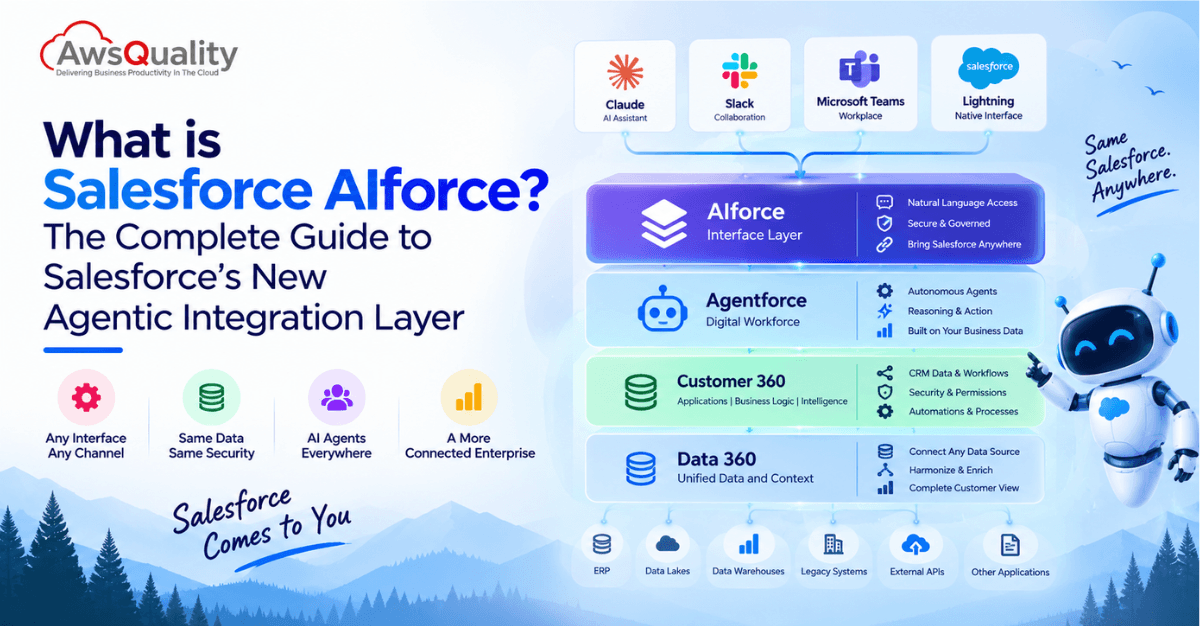
AIforce is Salesforce’s new interface layer — unveiled at Dreamforce ’26 — that brings the full power of Salesforce to wherever people and agents work. Instead of requiring users to come to Salesforce, AIforce brings Salesforce to them: in Claude, in Slack, in Microsoft Teams, in Lightning, or in any AI interface an organization chooses.
The announcement carries a direct consequence for every Salesforce customer: the data, workflows, business logic, permissions, security, and governance that organizations have spent years building inside Salesforce are no longer confined to the Salesforce application. They are now accessible from any supported AI interface, without migration, without rebuilding permissions, and without creating a new integration layer from scratch.
“AI is creating an interface revolution,” said Marc Benioff, Chair and CEO of Salesforce. “We are combining model intelligence with all the context that customers have built into Salesforce to create an intelligent, dynamic, composable system that is securely governed, built with Zero Data Retention, and designed to work with the core systems that already run your business.”
This guide covers everything Salesforce customers, administrators, developers, and architects need to understand about AIforce: what it is, how it is structured, what each component does, and what it means for organizations that have invested in the Salesforce platform.
Read: Agentforce vs Claudeforce – Features, Capabilities, Use Cases, and Differences
The Four-Layer Agentic Enterprise Architecture
To understand AIforce, the first requirement is understanding where it fits within Salesforce’s broader Agentic Enterprise architecture. AIforce is not a replacement for what Salesforce has already built — it is an additional layer on top of it.
The complete architecture has four layers, each built on the one below:
Data 360: The unified data foundation. Data 360 brings together harmonized and federated data, metadata, and memory from across the organization’s complete technology stack — not just what lives in the CRM — so that every agent and every interface has access to a complete, unified view of the customer and the business.
Customer 360: The application and semantic intelligence layer. This is where the Salesforce platform’s CRM capabilities live — the data model, the business logic, the automations, the metadata, the permissions architecture, the processes that span sales, service, marketing, commerce, and more. Everything the organization has built inside Salesforce for years resides here.
Agentforce: The digital workforce layer. Agentforce provides the ready-to-deploy AI agents and the Agent Builder for creating custom ones, all with deep understanding of the business’s functions, data, and industry because they are built directly on the Customer 360 and Data 360 layers below.
AIforce (New): The interface layer. This is what Dreamforce 2026 introduced. AIforce sits on top of the entire Salesforce stack and enables every element of that stack — all the data, logic, permissions, workflows, and agents — to be accessed from any AI interface. Not just the Salesforce UI. Anywhere.
The architectural significance is that adding a new AI interface does not require rebuilding the foundation. Every time a new interface accesses Salesforce through AIforce, it inherits the same permissions, the same security model, and the same business rules automatically. No new governance model. No migration. No duplicate data layer.
Also read: How AI Agents and Salesforce are Redefining Customer Service
Why Did Salesforce Introduce AIforce?
Traditional enterprise applications generally follow a familiar model:
User → Application UI → Business Logic → Data
For Salesforce, that has historically meant users opening Salesforce, navigating pages, dashboards, records, tabs, fields, and applications.
AI is changing that interaction model.
Users increasingly interact with software through:
- AI assistants
- Natural-language interfaces
- Collaboration platforms
- Coding agents
- Conversational applications
- Embedded AI experiences
Salesforce’s AIforce strategy is designed around this change.
Instead of requiring employees to come to Salesforce, Salesforce wants its capabilities to be available where the work is already happening. Salesforce describes AIforce as bringing its data, workflows, business logic, semantics, permissions, security, and governance to AI interfaces.
For example, a sales representative could potentially work inside Claude while accessing Salesforce information and taking Salesforce actions.
A team working in Slack could interact with Salesforce data without switching to a separate CRM tab.
A Salesforce user could work with an AI teammate directly inside Lightning.
This represents a shift from:
“Go to Salesforce to do the work.”
toward:
“Bring Salesforce capabilities to where the work happens.”
Check out: 15 Types of Salesforce Clouds and Their Features
The Three Components of AIforce
AIforce launches with three primary components, each addressing a different interface through which users can now access Salesforce:
Claudeforce — Salesforce Inside Claude
Claudeforce is the partnership between Salesforce and Anthropic, and the most prominent of the three AIforce components at launch. Its defining capability is Salesforce in Claude — bringing the full intelligence that lives inside Salesforce directly into the Claude interface.
Salesforce in Claude gives sales representatives access to their Salesforce data, workflows, and CRM capabilities through natural language conversation inside Claude, without opening the Salesforce application. It launches with 37 prebuilt sales skills covering the complete sales workflow — from prospecting and pipeline management through deal hygiene and relationship activity — delivering immediate value without configuration work on day one.
Scott White, Head of Enterprise at Anthropic, described the impact from his organization’s own production deployment: “People don’t use the UI anymore, they just talk to Claude.” More significantly: “Day-one sellers could now be almost as productive as their more experienced counterparts by using Claudeforce.” That productivity compression — from months of CRM familiarity required to near-parity on day one — is the practical value of Salesforce data and logic being accessible through a conversational AI interface.
Salesforce says Salesforce in Claude is available to customers in beta, with availability subject to applicable product, region, and customer conditions, having previously been piloted by Deloitte, GitLab, and Legora. The beta includes the 37 prebuilt sales skills.
Planned Claudeforce expansions: Skills for service, marketing, commerce, and industry-specific functions are planned. Tableau analytics integration will also be added, bringing visualization capabilities into the Claude interface.
Salesforce Development plug-in for Claude Code: For Salesforce developers specifically, the Salesforce Development plug-in for Claude Code provides more than 40 skills, access to Salesforce’s broader skills library on GitHub, and specialized sub-plugins that load dynamically and can take on development tasks autonomously. Jay Hurst, SVP of Product Management at Salesforce, demonstrated the capability: “When I’m ready, all I have to say is, ‘Claude, let’s build it.'”
The trust boundary: Salesforce has also described trust-boundary and security controls around its AIforce and Claudeforce architecture. Organizations in regulated industries should validate the applicable deployment architecture, data-processing model, contractual terms, and regional availability for their specific environment.
Also check: Why your Salesforce implementation isn’t delivering results
AIforce vs. Agentforce: What’s the Difference?
This is one of the most important questions surrounding the announcement.
Agentforce
Agentforce is Salesforce’s platform for building and deploying AI agents.
Agents can:
- Understand requests
- Reason about business context
- Access data
- Use tools
- Take actions
- Execute workflows
- Work toward business goals
Salesforce continues to position Agentforce as its digital workforce layer.
AIforce
AIforce is the interface layer.
It determines how people and agents can access Salesforce capabilities through interfaces such as Claude, Slack, and Lightning.
Therefore:
Agentforce = the digital workforce
AIforce = the interface layer
AIforce does not mean Salesforce is replacing Agentforce with Claude or Slack. Instead, Salesforce is positioning these technologies as complementary parts of its broader architecture.
AIforce vs. Agentforce – A Quick Comparison
| AIforce | Agentforce | |
|---|---|---|
| Primary role | Interface layer | Digital workforce |
| Main purpose | Bring Salesforce capabilities to where work happens | Build and deploy AI agents |
| Examples | Claude, Slack, Lightning | Sales, Service, custom agents |
| Focus | Access & interaction | Reasoning & action |
| Relationship | Provides interfaces | Provides agents |
Also check: How to Migrate to Salesforce Without Losing Your Data
What is Claudeforce?
Claudeforce brings Salesforce capabilities into Anthropic’s Claude environment.
Salesforce says Claudeforce includes a prebuilt Salesforce MCP server inside Claude, reducing the need for organizations to manually build and configure the connection. Salesforce in Claude launches with 37 prebuilt sales skills, covering use cases including prospecting and pipeline hygiene.
For developers, Salesforce also describes a Salesforce Development plug-in for Claude Code with more than 40 skills and access to a broader Salesforce skills library.
This creates an interesting development model.
Instead of:
Developer
 ↓
 Salesforce UI
 ↓
 Developer Tools
 ↓
 Manual Development
developers can increasingly interact with Salesforce development capabilities through AI-assisted development workflows.
Slackforce — Salesforce Inside Slack
Slackforce represents the evolution of Slack’s role in the Salesforce ecosystem — from a standalone messaging platform acquired by Salesforce in 2021 for approximately $27.7 billion, to a fully integrated AI-powered interface through which users can access the entire Salesforce platform.
Slackforce consists of four distinct capabilities:
Slackforce Surfaces: Live, collaborative interfaces surfaced directly within Slack, driven by real-time data from Salesforce, Slack, and connected systems. Rather than a static dashboard that reflects yesterday’s data, a Slackforce Surface is an interactive, live interface that users can filter, explore, comment on, and act on together — in real time, without leaving Slack. Users can describe what interface they need in natural language and receive it as a working, data-driven surface.
Elia Wallen, Founder and CEO of Engine, described the operational impact: “Instead of waiting on someone else’s time and expertise to turn data into a dashboard or report, anyone on our team can just describe what they need and get a real, working interface back, built from data we already have, without ever leaving the conversation.” Engine handles over 800,000 customer inquiries per year — the speed of accessing CRM context within Slack directly affects its ability to respond.
Slackbot: The personal AI assistant embedded in Slack, now powered by Salesforce through the AIforce connection. Slackbot reasons across both the conversational context of Slack (messages, threads, channel history) and the full intelligence layer of Salesforce (account data, pipeline, cases, activity). It surfaces which accounts are going quiet, understands why by reading the support cases and Slack threads behind them, reassigns an owner, creates a follow-up task, and drafts a win-back email — all from within Slack.
Slack CRM: The direct CRM capability layer inside Slack. Users can create new Salesforce accounts, log notes from recent calls, update opportunity records, and manage CRM data entirely through natural language prompts in Slack, without switching to the Salesforce application. This is not a stripped-down mobile experience — it is the full Salesforce CRM accessed from the conversation interface.
Slack Code: A multiplayer AI development environment inside Slack. Where Agentforce Vibes is an AI coding environment inside Salesforce, Slack Code makes AI development a collaborative, team-based activity in Slack. Teams can work together with an AI agent on a specific coding session or project, with all context visible to the group, code built directly in the conversation, and visual outputs previewed within Slack.
Read: Driving Salesforce User Adoption – A CXO’s Guide to Maximizing ROI
Agentforce Coworker — AI Inside Lightning
Agentforce Coworker is the Salesforce-native experience within Lightning.
Salesforce describes it as an AI teammate that can reason across accounts, activity, and history, surface insights, and take action.
It can also work with specialized Agentforce agents that organizations have already built and deployed.
This means enterprises don’t necessarily need to choose between:
AIforce OR Agentforce
The intended architecture is closer to:
AIforce + Agentforce
Agentforce provides specialized agents.
Agentforce Coworker provides a way to access those capabilities inside Lightning.
Other AIforce surfaces provide access from other work environments.
The Headless Toolkit: The Open Architecture Behind AIforce
Every AIforce component — Claudeforce, Slackforce, and Agentforce Coworker — is made possible by the Headless Toolkit, the open architecture that exposes every element of the Salesforce platform to AI agents and developers without requiring the Salesforce UI.
The Headless Toolkit is functionally a rebranding and expansion of Headless 360, previously announced at TDX 2026. Where Headless 360 created a clear separation between the Salesforce UI and the platform’s underlying capabilities, the Headless Toolkit extends that openness to AI agents as primary consumers alongside developers.
Jay Hurst, SVP of Product Management at Salesforce, described the significance at Dreamforce: “Everything you’ve invested in for the last 20+ years is instantly available to the Headless Toolkit.” The permissions, metadata, workflows, data structures, and business logic that organizations have built across decades of Salesforce investment are immediately accessible through the Headless Toolkit — to Claude, to Slack, to Microsoft Teams, to custom applications — without rebuilding or re-implementing any of it.
What the Headless Toolkit provides:
- MCPs (Model Context Protocol servers): The connectivity standard by which AI clients access Salesforce capabilities, adopted by Anthropic, OpenAI, Google DeepMind, Amazon, and Microsoft.
- APIs: Standard programmatic access to Salesforce capabilities for custom integrations.
- Plug-ins: Pre-packaged capability sets for specific use cases and interfaces.
- Skills: Reusable task-level capabilities that agents can draw on within their action vocabulary.
- Developer tools: The complete development toolkit for building on top of AIforce.
Headless Experience Layer (HXL) and HXL Playground: For developers building custom interfaces on the Headless Toolkit, the HXL provides the rendering layer, and the HXL Playground provides an environment to build and preview how end users will experience the result.
Builder Central (now in beta): Announced at Dreamforce, Builder Central allows non-developers — Product Managers, business analysts, operations leaders — to build on the HXL directly by describing what they need, without writing code. The built interface is previewed live within Builder Central and can be iterated in real time.
Agentic Identity (GA: November 2026): The identity layer that ensures every action taken by an agent or user through AIforce is tracked, traced, and monitored — and that agents receive only the subset of permissions required for their specific function. As Jay Hurst noted: while a human user may have full read, write, and delete access, an agent performing a specific task may need only a subset of that access.
Observability Centre: A monitoring and control interface that gives Salesforce administrators and builders a bird’s-eye view of all agents operating in the org — what they are doing, when, with what data — and the ability to make configuration changes in real time.
Also read: Salesforce Marketing Cloud Integration Challenges and How to Solve Them
AIforce and Enterprise Security
Security is particularly important when AI agents can access enterprise CRM data and take actions.
Salesforce says AIforce requests operate using existing permissions and business rules. The company also states that actions route back through Salesforce and that its AIforce architecture includes security and governance controls.
This is important because an AI interface should not become a shortcut around existing authorization.
A simplified model is:
AI Request
 ↓
 AIforce
 ↓
 Salesforce Permissions
 ↓
 Business Rules
 ↓
 Authorized Data / Action
 ↓
 Salesforce
The objective is to preserve the Salesforce trust boundary while enabling new interfaces
Zero Data Retention: The Trust Architecture
One of the most significant claims in the AIforce announcement is Zero Data Retention (ZDR) — the assurance that business data used with AIforce tooling is not retained by model providers and is not used to train AI models.
Marc Benioff addressed this directly at the Dreamforce main keynote: “When you’re working in Salesforce apps, and when you’re working on our platforms, your data is your data. It does not go in the models. We’ve audited it, we’ve tested it, we’ve tried it. Regardless of what you’ve heard in the media, or from other vendors, let me assure you that Salesforce products are built with zero data retention, tested over and over again by our security teams. Your data is your data. You’re not training any other model when you’re using our products.”
The ZDR claim addresses the most common enterprise concern about using commercial AI services: whether the prompts, data, and interactions submitted to the AI are being used to improve the model for other organizations. ZDR is Salesforce’s answer — business data answers the question at hand and is not retained beyond that interaction.
The full trust architecture combines ZDR with:
- Existing permission model: Every agent action executes under the permission of the authenticated user — the same Salesforce profiles, permission sets, sharing rules, and field-level security that govern human access.
- Amazon Bedrock Trust Boundary: For regulated industries, Claudeforce runs through Amazon Bedrock within Salesforce’s security perimeter, ensuring AI inference does not route through external API endpoints.
- Shared responsibility model: Salesforce provides the security and governance infrastructure; organizations are responsible for applying it correctly through their configuration choices.
- Agentic Identity: Coming GA in November 2026, providing granular agent-level permission management and full audit trails.
AIforce Architecture: A Technical View
A more complete architecture could look like this:
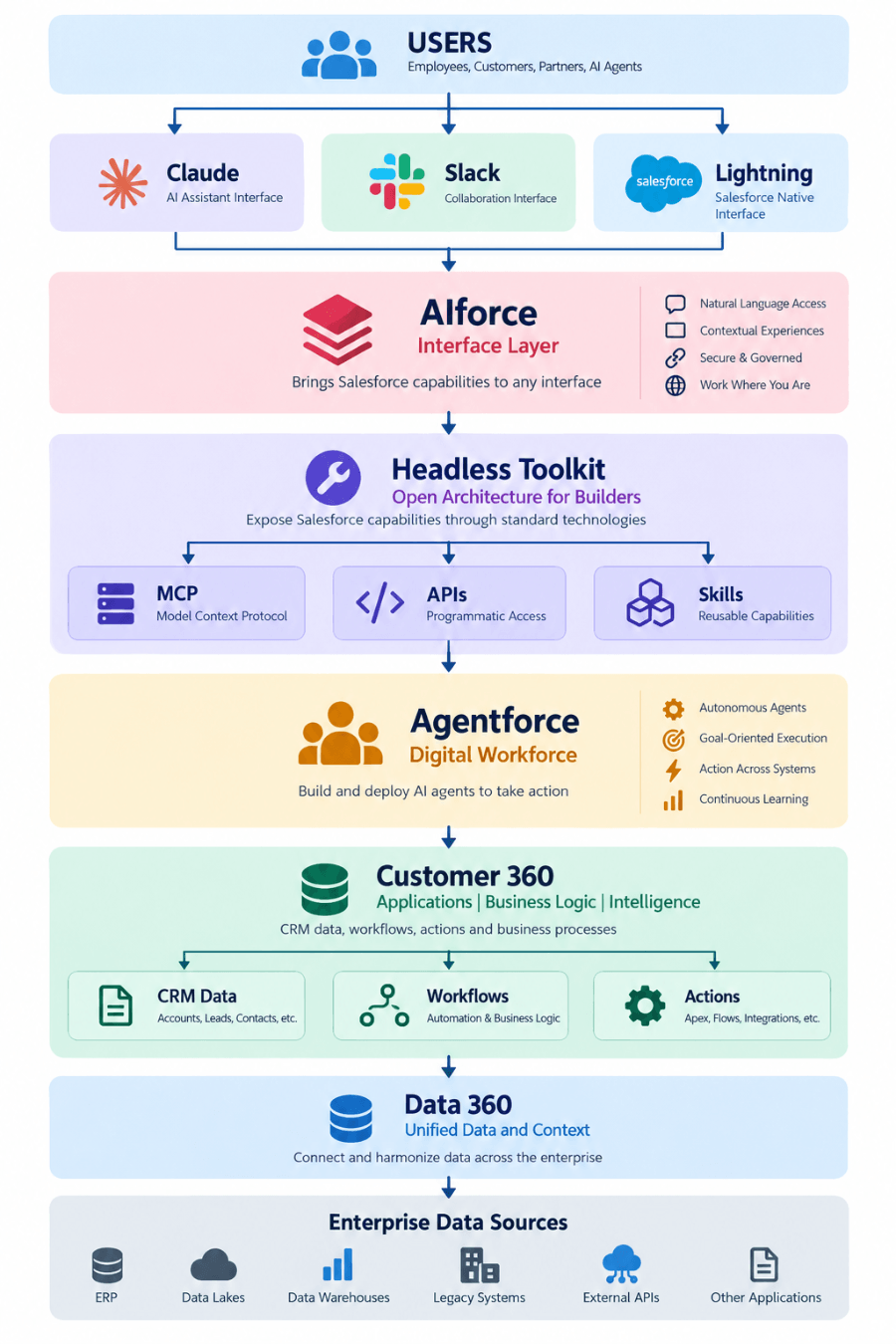
This architecture separates experience, agent reasoning, application intelligence, and data/context.
That separation can be valuable for enterprise architecture because organizations don’t necessarily need to rebuild their Salesforce foundation every time they introduce a new AI interface.
The AgentExchange Ecosystem
AIforce is not a closed system. The AgentExchange — Salesforce’s rebranded marketplace (previously the AppExchange) — is expanding to include AIforce-compatible solutions from partners that are building on the Headless Toolkit.
Partners building and distributing AIforce capabilities through AgentExchange include:
Agentic interfaces: Anthropic, Amazon Web Services, Google, Microsoft — each providing their AI client as a surface through which Salesforce capabilities can be accessed.
AI builders: Lovable and Vercel — enabling development teams to build custom interfaces on AIforce.
AI agents and tools: DocuSign, Gamma, Jasper, Ramp, and Rippling — each providing specific business function capabilities that integrate with the Salesforce platform through AIforce.
This ecosystem significantly extends what AIforce delivers out of the box. Organizations that have invested in third-party tools available through AgentExchange can connect those tools to the same Salesforce data and governance layer that powers Claudeforce, Slackforce, and Agentforce Coworker — making the investment in Salesforce’s data and logic architecture compound into new AI interfaces over time.
AIforce and the Trailblazer Community
The AIforce announcement lands in the context of Dreamforce 2026 marking the 20th anniversary of the Trailblazer community — Salesforce’s global community of administrators, developers, architects, builders, and technology leaders.
The scale of what Trailblazers have built on the Salesforce platform provides context for what AIforce makes newly accessible:
- 12 million apps built by the Trailblazer community
- 9.6 billion API calls processed every day
- 156 million lines of AI-generated code
- 151 million badges earned on Trailhead
Every one of these investments — every custom object, every Flow automation, every permission configuration, every integration, every industry-specific customization — becomes immediately available through the Headless Toolkit to Claude, to Slack, to any AI interface the organization chooses to use. The platform investment does not need to be replicated. It is exposed as-is, through AIforce.
What AIforce Means for Salesforce Customers
For organizations that have invested in the Salesforce platform, the AIforce announcement changes three fundamental things:
1. Who can access Salesforce data. Previously, accessing Salesforce data required a Salesforce user license, familiarity with the Salesforce navigation, and presence in the Salesforce application. With AIforce, any employee using Claude, Slack, or another connected interface can query Salesforce data, update records, and trigger workflows through natural language — governed by the existing permission model, without requiring Salesforce UI training.
Harry Datwani, Global Salesforce Chief Commercial Officer at Deloitte — one of the early access customers — articulated the operational consequence: “No one wants to get up and log in to another system. No one wants to click on another tab. The opportunity to meet our people where they do their work — that was the value.” Deloitte used early access to AIforce to test the tool across multiple business personas, each of which found value in bringing Salesforce context into their existing working environment.
2. How AI interfaces connect to enterprise data. Previously, connecting an AI tool to Salesforce data required custom API integrations, authentication management, data mapping, and the ongoing maintenance of those integrations as Salesforce schemas evolved. With the Headless Toolkit and AIforce, that connectivity is provided as platform infrastructure. An admin connects once; the team gets access on day one.
3. What “Salesforce investment” means. The decades of metadata, business logic, workflow automation, and permission configuration that organizations have built inside Salesforce now functions as the intelligence substrate for any AI interface that connects to AIforce. The investment compounds rather than depreciates as new AI surfaces emerge.
What AIforce Means for Salesforce Developers
AIforce could change the role of Salesforce developers in several ways.
1. More Headless Development
Developers can build experiences that don’t depend entirely on the standard Salesforce UI.
This could increase demand for:
- APIs
- MCP integrations
- Salesforce skills
- Custom interfaces
- AI agent integrations
- External application connectivity
2. More AI-Assisted Salesforce Development
The integration with Claude Code and Salesforce’s development skills introduces another dimension to AI-assisted Salesforce development.
Developers can use AI coding tools to help with tasks such as:
- Code generation
- Salesforce development
- Configuration assistance
- Debugging
- Documentation
- Testing
- Metadata-related tasks
Salesforce says its Salesforce Development plug-in for Claude Code provides more than 40 skills and access to a broader skills library.
3. More Integration Architecture
As Salesforce becomes accessible through multiple AI interfaces, architects will need to think about:
- Authentication
- Authorization
- API design
- MCP architecture
- Data access
- Agent permissions
- Error handling
- Observability
- Governance
- Integration testing
AIforce therefore doesn’t eliminate integration architecture.
In many enterprise environments, it can make integration architecture even more important.
What AIforce Means for Salesforce Administrators
Admins may increasingly need to manage AI access alongside traditional Salesforce configuration.
Areas to consider include:
Permissions
Which users and agents can access which data?
Actions
Which operations can an AI agent execute?
Business Rules
Which Salesforce processes must remain enforced?
Skills
Which capabilities should be exposed to AI interfaces?
Governance
How should AI-generated actions be monitored?
Observability
How can administrators understand what agents are doing?
Salesforce’s broader AIforce architecture emphasizes using existing permissions and business rules rather than creating a completely separate authorization model.
AIforce Use Cases for Enterprises
The potential use cases span multiple departments.
Sales
A sales representative could ask an AI interface:
“Which enterprise accounts have gone quiet this quarter?”
The system could potentially analyze CRM context, identify accounts, and surface relevant information.
Customer Service
A service employee could ask:
“Show me the history of this customer’s unresolved issues.”
The AI interface could retrieve relevant Salesforce context and connected information.
Marketing
Marketing teams could potentially query customer segments, campaign information, and related CRM context without navigating through multiple Salesforce screens.
Operations
Operations teams could use AI interfaces to access Salesforce workflows and trigger authorized actions.
Management
Executives could ask natural-language questions about pipeline, customers, service trends, or business performance.
Developers
Developers could use AI-assisted tools to work with Salesforce metadata, code, APIs, and development capabilities.
AIforce vs. Headless 360
Another source of confusion is the relationship between AIforce and Headless 360.
Salesforce had already been expanding its headless architecture before AIforce.
In August 2026, Salesforce described Headless 360 as an architecture for exposing Salesforce capabilities to authorized AI agents through MCP servers, APIs, reusable skills, and other tools.
AIforce builds on this direction.
Salesforce now refers to the Headless Toolkit as the open architecture powering AIforce experiences.
A useful way to think about the relationship is:
Headless architecture → technical foundation
AIforce → user/agent experience layer built on that foundation
Key Benefits of Salesforce AIforce
From an enterprise architecture perspective, AIforce introduces several potential
| Capability | Potential Enterprise Value |
|---|---|
| Multiple AI interfaces | Employees can access Salesforce where they already work |
| Headless architecture | Salesforce capabilities can be exposed beyond the standard UI |
| MCP support | Enables standardized AI-to-tool connectivity |
| Existing permissions | Helps preserve established access controls |
| Existing business logic | Reduces the need to recreate processes in every interface |
| Agentforce integration | Connects interface experiences with enterprise agents |
| Composable interfaces | Enables more customized experiences |
| Slack integration | Brings CRM context into collaboration workflows |
| Claude integration | Connects Salesforce context with AI-assisted work |
| Developer tooling | Expands AI-assisted Salesforce development possibilities |
What Enterprises Should Evaluate Before Adopting AIforce
AIforce is new, and enterprises should avoid treating the announcement alone as proof of production readiness for every use case.
Before implementation, technology teams should evaluate:
1. Availability
Salesforce says Salesforce in Claude is available to customers in beta, while availability can vary by product, region, and customer agreement. Salesforce also notes that pricing and packaging can change.
2. Security
Review:
- Identity
- Authentication
- Authorization
- Data access
- Agent permissions
- External interfaces
- Audit requirements
3. Data Governance
Determine:
- What data can be exposed?
- Which fields contain sensitive information?
- Which data can agents access?
- What data can agents modify?
- What actions require human approval?
4. Integration Complexity
AIforce can reduce some integration friction, but enterprise environments may still require integration work across:
- ERP
- Data warehouses
- Data lakes
- Legacy applications
- Industry systems
- External APIs
5. Agent Governancve
Organizations should establish policies for:
- Agent permissions
- Human approval
- Action limits
- Monitoring
- Testing
- Failure handling
- Auditability
6. Observability
As more AI agents begin taking actions, enterprises need visibility into:
What did the agent see?
 ↓
 What did it reason about?
 ↓
 What action did it choose?
 ↓
 What system did it modify?
 ↓
 What was the result?
AIforce adoption should therefore be considered as part of a broader enterprise AI governance strategy.
What Could AIforce Mean for Salesforce Development Services?
AIforce may create a broader development surface for Salesforce partners.
Traditional Salesforce development often focuses on:
- Apex
- LWC
- Flows
- Integrations
- Data
- CRM customization
The emerging architecture adds areas such as:
- AI agent development
- MCP integration
- Headless Salesforce
- AI interfaces
- Agent skills
- AI-assisted development
- Cross-platform workflows
- Agent governance
- AI observability
This means Salesforce development is increasingly moving beyond the traditional CRM interface.
For organizations implementing AIforce, the development challenge may not simply be:
“How do we customize Salesforce?”
It may increasingly become:
“How do we make our Salesforce business capabilities usable by humans and AI agents across the interfaces where work happens?”
A Practical AIforce Implementation Framework
Enterprises considering AIforce can approach adoption in stages.
Stage 1: Identify High-Value Workflows
Start with processes where employees frequently switch between systems.
Stage 2: Map Existing Salesforce Capabilities
Document:
- Data
- Objects
- Workflows
- Flows
- APIs
- Permissions
- Agents
Stage 3: Identify the Interface
Determine whether the workflow belongs in:
- Salesforce
- Slack
- Claude
- Another AI interface
- A custom application
Stage 4: Establish Governance
Define:
- Access controls
- Approval requirements
- Data policies
- Agent boundaries
- Monitoring
Stage 5: Build a Pilot
Start with a narrowly defined workflow.
Stage 6: Measure Results
Track:
- Time saved
- Task completion
- User adoption
- Error rates
- Agent accuracy
- Business outcomes
Stage 7: Expand
Once the architecture is validated, expand to additional workflows and departments.
Frequently Asked Questions
What is Salesforce AIforce?
AIforce is a new interface layer announced at Dreamforce 2026 that brings Salesforce data, workflows, permissions, and business logic to any AI interface — Claude, Slack, Microsoft Teams, or Lightning — without migration or rebuilding. It launches with three components: Claudeforce, Slackforce, and Agentforce Coworker.
Is AIforce the same as Agentforce?
No. Salesforce positions Agentforce as the digital workforce/agent layer, while AIforce is the interface layer that brings Salesforce capabilities to different user and AI experiences.
How is AIforce different from Agentforce?
Agentforce is the digital workforce layer — the platform for building autonomous AI agents. AIforce is the interface layer that sits above it, making the entire Salesforce stack accessible from any AI surface. They complement rather than replace each other.
What is Claudeforce?
Claudeforce brings Salesforce capabilities into Anthropic’s Claude environment. Salesforce says it includes a prebuilt Salesforce MCP server and 37 prebuilt sales skills at launch.
What is Claudeforce and what does it do?
Claudeforce is the Salesforce-Anthropic partnership that puts Salesforce inside Claude. It launches with 37 prebuilt sales skills in beta (piloted by Deloitte, GitLab, and Legora) and 40-plus developer skills for Claude Code. Service, marketing, commerce, and Tableau are planned additions.
What is Slackforce?
Slackforce brings Salesforce context, intelligence, and actions into Slack through experiences including Slackforce Surfaces, Slackbot, Slack CRM, and Slack Code.
What is Agentforce Coworker?
Agentforce Coworker is an AI teammate within the Salesforce Lightning interface that can reason across accounts, activity, and history and take actions within Salesforce’s existing permissions and business rules.
What is the Headless Toolkit?
The open architecture that exposes every element of the Salesforce platform — permissions, metadata, workflows, business logic — to AI agents and developers, without requiring the Salesforce UI. It provides MCPs, APIs, plug-ins, and skills that any compliant AI interface can use, inheriting the existing permission model automatically.
What is Zero Data Retention (ZDR)?
ZDR is Salesforce’s commitment that business data used with AIforce tools is not retained by model providers and is not used to train AI models. As Marc Benioff stated at Dreamforce: “Your data is your data. You’re not training any other model when you’re using our products.”
Does AIforce replace the Salesforce UI?
No. Salesforce continues to support Lightning while introducing additional ways to interact with Salesforce. Agentforce Coworker itself operates within Lightning, while Claudeforce and Slackforce provide additional experiences.
When was AIforce announced and what is available now?
AIforce was unveiled September 15, 2026 at Dreamforce. Agentforce Coworker is immediately available. Salesforce in Claude is in open beta. Slackforce is live for Slack users. Builder Central is in beta. Agentic Identity reaches GA in November 2026.
Does AIforce replace Agentforce?
No. Salesforce positions AIforce and Agentforce as different architectural layers. Agentforce provides the digital workforce, while AIforce provides interfaces through which users and agents can access the broader Salesforce platform.
Conclusion: A New Chapter for Salesforce Customers
AIforce is the most significant architectural expansion of the Salesforce platform since Agentforce itself — and it is the logical culmination of two years of Salesforce’s Agentic Enterprise investment.
The Salesforce platform has always derived its value from the depth of what organizations build inside it: the custom data model, the configured business logic, the automated workflows, the permission architecture, the integration ecosystem. AIforce converts that accumulated platform investment from a single-interface capability into a multi-interface foundation. The same Salesforce intelligence that drives a rep’s pipeline dashboard now drives their Claude conversation. The same business rules that govern what a Salesforce user can see now govern what an AIforce interface can access.
As one Dreamforce session frames it: until now, users had to go to Salesforce. With AIforce, Salesforce comes to them.
For Salesforce customers, the immediate opportunity is straightforward: evaluate which of your teams are working primarily in AI interfaces — Claude, Slack, Microsoft Teams — and assess where the friction of switching to Salesforce to access CRM data is creating productivity loss. Those are the use cases where AIforce delivers the most immediate value, and where the organizational return on Salesforce’s platform investment can be extended without building new infrastructure.
AwsQuality is a certified Salesforce implementation partner helping organizations understand, evaluate, and implement the full Salesforce technology stack — including AIforce, Agentforce, Claudeforce, and the Headless Toolkit. As these capabilities mature from beta to general availability, our team helps Salesforce customers design the implementation approach that makes each new layer of the Agentic Enterprise architecture deliver measurable business value.
 Bio
Bio