For years, businesses have used chatbots to answer customer questions, provide basic support, qualify leads, and reduce pressure on service teams.
Now, a new category has moved to the center of enterprise AI discussions: AI agents.
At first glance, the distinction can seem small. Both can communicate in natural language. Both may use large language models (LLMs). Both can interact with customers and employees.
But their roles are fundamentally different.
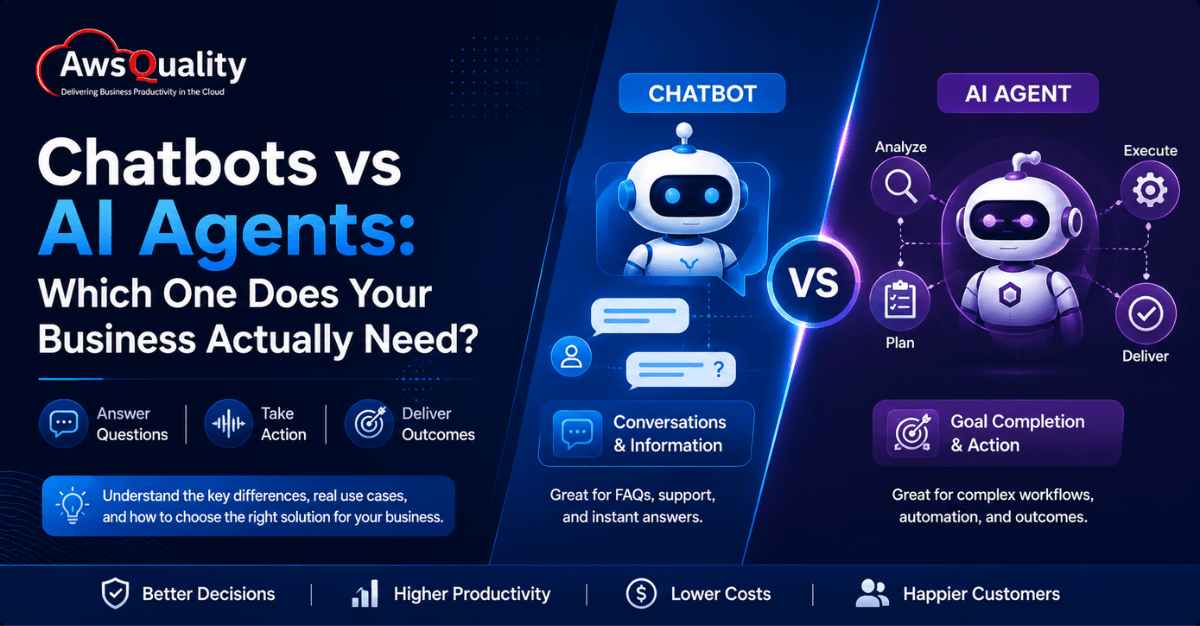
A chatbot is primarily designed to have a conversation and provide information. An AI agent can go further: it can reason about a goal, decide what steps are required, interact with connected tools and data, and take actions to move toward an outcome. Salesforce, for example, describes autonomous agents as systems capable of understanding requests and taking actions—with or without human intervention—within configured instructions and guardrails.
So the question businesses should be asking isn’t:
“Are AI agents better than chatbots?”
It is:
“Does this business problem require a conversation, an action, or an end-to-end workflow?”
That distinction can help you determine whether your organization needs a chatbot, an AI agent, or a combination of both.
Check out: How AI Agents Can Reduce Operational Costs for Businesses
The Chatbot Disappointment Most Businesses Share
If your organization deployed a chatbot between 2018 and 2024, you probably started with high expectations.
A tireless digital assistant that never sleeps, handles customer questions instantly, deflects support tickets automatically, and frees your human team for higher-value work. The vendor demo was impressive. The ROI model looked compelling. The implementation went reasonably smoothly.
Then the real numbers came in. Resolution rates that disappointed. Customers who clicked past the chat widget or immediately asked for a human. Support tickets that did not meaningfully decrease. And the gradually emerging consensus among your team that the chatbot was, at best, an FAQ page wearing a conversational interface.
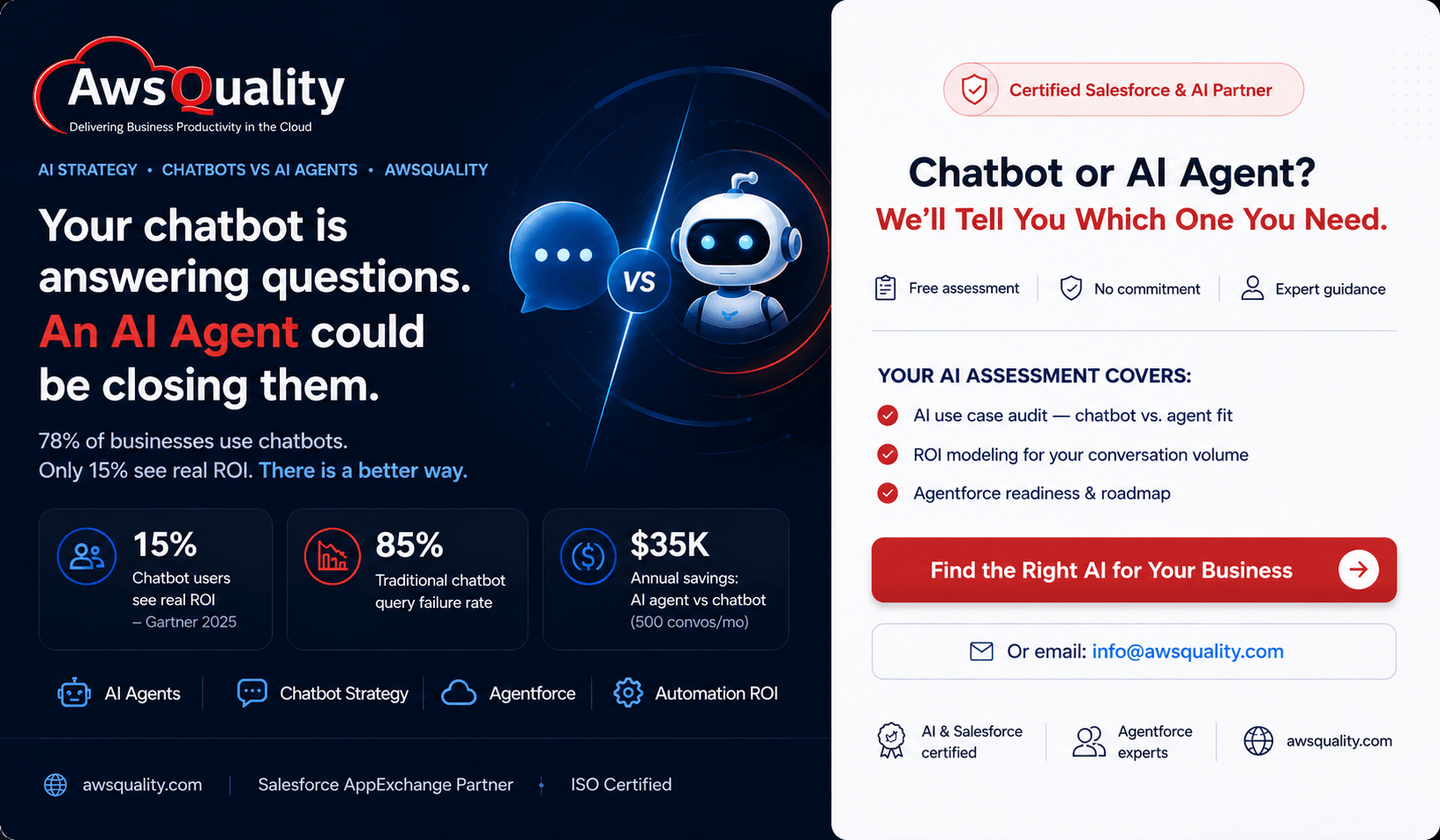
This is not a niche experience. 78% of European enterprises have implemented chatbots, yet only 15% report significant ROI, according to Gartner’s 2025 data cited by Technova Partners. The primary reason, according to that same research, is not poor implementation or inadequate training data. It is choosing the wrong tool for the job.
The arrival of AI agents has fundamentally reframed the chatbot conversation — not by improving chatbot technology incrementally, but by introducing an entirely different architectural category. Chatbots answer questions. AI agents complete work. These are not different points on the same spectrum. They are different jobs.
This guide provides a clear, evidence-based framework for understanding the difference between chatbots and AI agents, when each is the right choice, and the specific questions that determine which technology your business actually needs — before you commit to building, buying, or deploying either.
Also check: Why Agentic AI is the Next Big Enterprise Challenge for CTOs
Understanding the Three Generations of Conversational AI
The first step in understanding the chatbot vs. AI agent distinction is recognizing that “chatbot” itself is not a single technology — it is a category that has evolved through three distinct generations, each with meaningfully different capabilities.
Generation 1: Rule-Based Chatbots
The original chatbots operate on decision trees and fixed scripts. They classify user inputs into predefined categories and respond with pre-written answers. If a user’s question does not fit a recognized pattern, the bot either fails to respond helpfully or escalates to a human. Rule-based chatbots are highly predictable and inexpensive to build, but their coverage is limited to exactly the scenarios the decision tree anticipated.
Generation 2: NLP-Enhanced Chatbots
The arrival of natural language processing (NLP) enabled chatbots to interpret user intent more flexibly, without requiring exact keyword matches to trigger responses. NLP-enhanced chatbots can understand variations in how a question is phrased, handle ambiguity better than rule-based systems, and maintain context across a short conversational exchange. They are significantly more capable than rule-based chatbots for customer-facing use cases, but they remain fundamentally answer-generating systems rather than action-taking systems.
Generation 3: LLM-Enhanced Chatbots
The integration of large language models — GPT-4, Claude, Gemini, and similar — into chatbot architectures has produced the most capable generation of answer-focused systems. LLM-enhanced chatbots generate natural, contextually appropriate responses, handle a far wider range of inputs, and maintain more coherent conversations. However, they share the fundamental limitation of their predecessors: they are designed to generate text responses. They do not execute actions in external systems, do not have persistent memory across sessions without specific architecture to enable it, and do not pursue goals autonomously across multiple steps.
The AI Agent: A Different Category Entirely
An AI agent is not a better chatbot. It is a different type of system. Where chatbots are optimized for conversation — for generating the next message in a dialogue — AI agents are optimized for outcomes. They plan multi-step approaches to achieve defined goals, execute actions across connected tools and systems, maintain memory across interactions, and adapt their approach based on what they learn from the results of their actions.
As DevRev AI stated in their June 2026 analysis: “A chatbot matches your question to a pre-written FAQ answer or a knowledge-base article. An AI agent understands the context behind your question, reasons across connected systems, and takes action to resolve the issue. One column deflects. The other resolves.”
Read: Is It Possible to Make AI Development Cost-Efficient? A Complete Guide
What is an AI Chatbot?
An AI chatbot is software designed primarily to interact with users through conversational interfaces.
Traditional chatbots rely heavily on predefined rules, decision trees, keywords, and scripted responses. Modern AI chatbots can incorporate natural language processing and generative AI, allowing them to understand less structured questions and produce more natural responses.
The central interaction, however, remains conversational:
User asks → Chatbot understands → Chatbot responds
A chatbot might answer:
“What is your refund policy?”
It can retrieve the relevant information and explain the policy.
It might also:
- Answer frequently asked questions
- Provide product information
- Help users navigate a website
- Collect contact details
- Perform basic lead qualification
- Guide users through troubleshooting
- Route customers to the appropriate department
- Retrieve information from a knowledge base
Microsoft similarly characterizes chatbots as conversational tools commonly used across websites, messaging applications, and customer-service experiences.
For many straightforward use cases, that is exactly what a business needs.
Also read: Responsible and Ethical AI – How to Ensure Compliance, Security, and Transparency in AI Systems
What is an AI Agent?
An AI agent is a goal-oriented AI system capable of going beyond conversation to perform tasks or execute workflows.
Instead of simply generating an answer, an agent may determine what needs to happen next, access approved data, invoke tools or APIs, execute actions, evaluate results, and continue until the task reaches an appropriate outcome.
The interaction can therefore look more like:
Goal → Reason → Plan → Use tools/data → Take action → Evaluate → Continue or escalate
Consider a customer saying:
“My order hasn’t arrived. Can you sort this out?”
A chatbot might retrieve the tracking information and tell the customer where the shipment is.
An appropriately configured AI agent could potentially:
- Identify the customer.
- Retrieve the order.
- Check shipping status.
- Determine whether it qualifies as delayed.
- Apply relevant company policies.
- Create a replacement or initiate another approved resolution.
- Update the CRM.
- Send confirmation.
- Escalate the case if human authorization is required.
That ability to reason and act across business systems is the defining difference.
Salesforce’s Agentforce architecture illustrates this model through data, reasoning, actions, and configurable guardrails. Agents can use CRM and other connected data and invoke business processes such as flows, prompt templates, or Apex-based actions.
Chatbots vs AI Agents: Quick Comparison
| Capability | Chatbots | AI Agents |
|---|---|---|
| Primary purpose | Conversation & information | Goal completion & action |
| Interaction model | Mostly reactive | Reactive or more autonomous |
| Answers questions | Yes | Yes |
| Multi-step reasoning | Limited/varies | Core capability |
| Executes actions | Usually limited | Yes, when authorized |
| Uses business tools | Basic integrations possible | Designed for tool/API use |
| Handles complex workflows | Limited | Stronger fit |
| Autonomy | Low | Medium to potentially high |
| Context & memory | Often session-focused | Can maintain richer workflow state |
| Best suited for | FAQs, guidance, basic support | Process automation and complex tasks |
| Implementation complexity | Lower | Higher |
| Governance requirements | Moderate | Higher |
The boundary is becoming less rigid as chatbot products gain agentic capabilities. A useful practical distinction remains: chatbots optimize conversations; agents optimize outcomes.
Check: How AI + Cloud Drives Business Growth and Efficiency
The Five Architectural Differences That Actually Matter
Most chatbot vs. AI agent comparisons focus on surface-level features: response quality, integration count, pricing. These matter, but they do not reveal whether the technology will actually resolve work or merely discuss it. The five differences below are architectural — they determine what the system can fundamentally do, not just how well it does it.
1. Understanding
Chatbot: Pattern matching and intent classification. The chatbot identifies which of its known intents a user input most closely resembles and retrieves the associated response. Even LLM-enhanced chatbots primarily classify and retrieve — they match the input to the most appropriate response in their knowledge base.
AI Agent: Contextual reasoning. The AI agent understands the goal behind a request, not just its surface content. It synthesizes information from multiple sources, identifies what information is missing, determines what actions are needed to achieve the goal, and sequences those actions appropriately.
The practical difference: a chatbot asked “My order hasn’t arrived and I need it before tomorrow” retrieves the shipping delay response. An AI agent with the same query checks the order status, sees that the shipment has been delayed at a carrier hub, evaluates expedited shipping availability, identifies alternative fulfillment options, and presents the user with specific options that can actually resolve their situation before tomorrow.
2. Action
Chatbot: Read-only. Chatbots consume information and generate text. The most they can do is present options to a user or collect information that a human will act on. Even when a chatbot appears to “do” something — confirm a booking, submit a form — it is typically triggering a human-configured backend action through a narrow, predefined integration.
AI Agent: Read, write, and act. AI agents execute real actions in connected systems: creating records, updating databases, sending emails, booking appointments, initiating workflows, querying multiple APIs, generating documents, and completing multi-step processes that span several systems. The action capability is what transforms AI from an answering system into a working system.
This is the most consequential architectural difference for business outcomes. 90% of customers have to repeat information to a chatbot because it has no ability to act on context from previous interactions, according to DevRev AI’s 2026 analysis. An AI agent that has access to the customer’s account history, previous service interactions, and current order status does not need the customer to repeat anything — it already has the context it needs to act.
3. Memory
Chatbot: Session-limited or no persistent memory. Most chatbots begin each conversation with no knowledge of previous interactions. Even chatbots with session memory — maintaining context within a single conversation — lose that context when the session ends. A customer who called about a billing issue last week is a stranger to the chatbot today.
AI Agent: Persistent cross-session memory. AI agents maintain a memory architecture that preserves relevant context across interactions: customer preferences, previous issues, account history, past decisions, and the state of in-progress tasks. This persistent memory is what enables agents to build the kind of relationship context that makes assistance genuinely useful rather than repetitively introductory.
4. Reasoning
Chatbot: Linear, single-step logic. Chatbots process input and generate output in a single, direct step. Even sophisticated NLP-based chatbots do not plan a sequence of actions, evaluate alternatives, or adjust their approach based on intermediate results.
AI Agent: Multi-step reasoning and planning. AI agents decompose complex goals into sequences of actions, evaluate multiple approaches before committing, adapt their plan when intermediate steps produce unexpected results, and use tools and external data sources to inform their reasoning at each step.
Gartner predicts that by 2028, at least 15% of all daily work decisions will be made autonomously by AI agents, up from near zero today. The multi-step reasoning capability is precisely what makes agents capable of making those decisions reliably.
5. Learning and Adaptation
Chatbot: Static after deployment. The chatbot’s capability is defined by its training data and configuration. It can be updated, but it does not adapt on its own based on the outcomes of its interactions.
AI Agent: Adaptive within defined parameters. AI agents adjust their approach based on feedback from the results of their actions, learn which strategies are more effective for specific types of requests, and in more advanced implementations, surface insights from their interaction history that help human teams improve processes.
When a Chatbot is the Right Choice
Chatbots remain valuable — and more cost-effective than AI agents — for a specific category of business requirements. Deploying an AI agent for these use cases adds cost and complexity without proportional benefit.
Use a chatbot when:
The questions are predictable and the answers are fixed. FAQs, store hours, pricing, return policies, shipping rates, basic product specifications — these are high-volume, low-complexity questions with known answers. A chatbot retrieves and presents the correct answer at lower cost than an AI agent would deliver it.
The workflow is linear and does not require external system access. Directing users to the correct department, presenting a self-service menu, collecting basic information before handoff to a human, or providing step-by-step instructions for a known process — these linear workflows are well within a chatbot’s capability.
Volume is high and the cost-per-interaction needs to be minimal. When a business needs to handle thousands of identical interactions per day, chatbots provide cost-efficient scale that AI agents — which cost 3 to 10 times more per resolved task due to planning overhead and token consumption — do not justify for simple interactions.
Regulatory or governance requirements demand strictly controlled outputs. In highly regulated industries where every response must be pre-approved and auditable, rule-based chatbots provide deterministic, controllable output that LLM-based systems cannot guarantee.
Practical chatbot use cases:
- Customer service FAQs
- Password reset instructions and IT self-service
- Product catalog browsing
- Order status lookups (when the lookup is simple and the information is only displayed, not acted upon)
- Basic appointment scheduling using fixed availability slots
- Lead capture forms in conversational interface
- Website navigation assistance
Also check: Zero Trust Security Model for Cloud and AI Applications
When an AI Agent Is the Right Choice
AI agents justify their higher cost per interaction when the work they replace is genuinely complex, spans multiple systems, requires judgment, or currently requires human time that is more expensive than the agent’s operating cost.
Use an AI agent when:
Tasks span multiple systems. When completing a customer request requires accessing a CRM for account history, checking an inventory system for product availability, querying an ERP for order status, and updating a support platform with the resolution — no chatbot architecture can coordinate these steps. An AI agent does.
Decisions depend on context. When the appropriate response varies based on the customer’s account tier, purchase history, previous interactions, or the specific details of their current situation — context-dependent decision-making is an agent capability, not a chatbot capability.
Multi-step follow-up is required. When the initial request requires research before a response, or when acting on the response requires multiple sequential steps — investigate, decide, act, confirm, follow up — AI agents are the appropriate architecture.
Humans are doing copy-paste work between systems. When your team members are copying data from one system into another, running lookups in one application to answer questions in another, or executing the same multi-step process repeatedly with slight variations — these are agent-appropriate tasks where the agent’s cost is easily justified against the human time it replaces.
Scale and personalization must coexist. Personalized customer interactions at high volume require both broad access to customer context and the reasoning to use that context appropriately. Only AI agents can deliver both simultaneously.
Practical AI agent use cases:
- Complex customer support with full account context and system action capability
- Sales development: lead research, qualification, and personalized outreach
- IT helpdesk: diagnosis, system access, and resolution without human involvement
- HR tasks: leave requests, document generation, policy Q&A with policy retrieval
- E-commerce: returns initiated, refunds processed, replacements ordered — end to end
- Appointment booking with real-time calendar and resource availability checking
- Invoice and billing dispute resolution accessing financial records
- Content research and generation with external data retrieval
- Salesforce Agentforce autonomous sales and service agents
Real-World Business Use Cases
Customer Service
Chatbot
Answers FAQs, explains policies, provides basic troubleshooting, and retrieves information.
AI Agent
Investigates cases, accesses customer records, checks orders, performs approved actions, updates CRM records, and escalates exceptions.
Sales
Chatbot
Answers product questions and collects lead information.
AI Agent
Researches prospects, enriches leads, updates CRM records, qualifies opportunities, schedules meetings, and creates follow-up tasks.
IT Support
Chatbot
Provides troubleshooting instructions.
AI Agent
Diagnoses an issue, checks system status, executes approved remediation, resets access, creates or updates tickets, and escalates unresolved incidents.
Human Resources
Chatbot
Answers questions about company policies and employee benefits.
AI Agent
Coordinates onboarding tasks, provisions approved access through connected workflows, schedules orientation activities, and follows up on incomplete steps.
Finance
Chatbot
Answers questions about expense policies.
AI Agent
Could collect invoice information, validate it against predefined rules, route approvals, update systems, and flag exceptions for human review.
Higher-risk financial actions should generally have stricter permissions and approval controls.
Read: How to Build Secure AI Systems on Cloud Platforms (Complete Guide)
Chatbot vs AI Agent Decision Framework
Before investing in either technology, ask these questions:
| Question | If YES, Consider |
|---|---|
| Do users mainly need answers? | Chatbot |
| Is the workflow predictable and conversational? | Chatbot |
| Is FAQ deflection the main objective? | Chatbot |
| Must AI take actions in business systems? | AI Agent |
| Does the task require multiple steps? | AI Agent |
| Does AI need to choose among possible actions? | AI Agent |
| Does the process span multiple systems? | AI Agent |
| Are some decisions high-risk? | Agent + Human Approval |
| Do you need both conversation and execution? | Hybrid approach |
The Hybrid Model: Where Most Mature Implementations Land
The most sophisticated view of chatbots vs. AI agents in 2026 is not “which one” but “where does each fit within a unified customer engagement architecture.”
The teams delivering the highest customer satisfaction and lowest cost-per-contact in 2026 run hybrid models, according to Eesel AI’s May 2026 analysis. These models use AI to resolve 60 to 70% of interaction volume autonomously, while human agents handle the interactions that require empathy, judgment, and creative problem-solving.
A mature hybrid architecture routes by complexity and emotional intensity:
Tier 1 — Automated by chatbot: High-volume, low-complexity, predictable interactions. Zero agent involvement, minimal cost, instant response.
Tier 2 — Handled by AI agent: Moderate to high complexity, requiring system access, multi-step processing, or context-dependent decisions. No human involvement for the majority of cases; agent resolves the issue end to end.
Tier 3 — Human agent with AI assistance: High-complexity, emotionally sensitive, or high-stakes interactions where human judgment and empathy are essential. Human agents use AI tools to retrieve context, draft responses, and execute follow-up actions — but the human is in control. Human agents outperform AI by 15 to 25 percentage points in customer satisfaction for emotional complaints, escalated disputes, and sentiment recovery, according to LTVplus’s 2025 analysis.
The routing logic between tiers is determined by three variables: complexity (how many steps and systems does resolution require?), emotional intensity (how frustrated or concerned is the customer?), and business value (what is the revenue risk of a mishandled interaction?).
The Five-Question Decision Framework
Before committing to a chatbot or an AI agent implementation, the following five questions establish which technology is appropriate for the specific use case being evaluated.
1. Does the task require action in an external system, or only information retrieval?
- Information retrieval only → chatbot is sufficient
- Requires action (creating records, processing transactions, triggering workflows) → AI agent is required
2. Does the response need to vary based on the individual user’s context?
- Same answer for all users with this question type → chatbot is sufficient
- Response must reflect account history, preferences, or individual circumstances → AI agent is required
3: Does completing the task require more than two sequential steps?
- One or two steps → chatbot may be adequate
- Three or more sequential steps requiring decision at each stage → AI agent is required
4. What is the cost of a wrong answer or failed resolution?
- Low stakes, easily corrected → chatbot acceptable
- High stakes, wrong answer causes significant business or customer harm → AI agent with guardrails, or human-in-the-loop
5. What is the fully loaded cost of handling this interaction with a human?
- Low cost per interaction, low volume → chatbot ROI is sufficient
- High cost per interaction, high volume → AI agent ROI is justified even at 3–10x chatbot per-interaction cost
If three or more of these questions point toward an AI agent, the use case requires an AI agent. If three or more point toward a chatbot, the use case does not need an AI agent’s complexity and cost.
The Maturity Path: How Businesses Evolve From Chatbots to Agents
Organizations rarely move directly from no AI to full AI agent deployment. The most common — and most sustainable — maturity path follows four stages:
Stage 1: Chatbots to reduce volume.
Deploy FAQ-handling chatbots to deflect predictable, high-volume inquiries, reducing human agent workload on repetitive requests. Measure deflection rate and customer satisfaction.
Stage 2: Tool-connected bots to fetch data.
Extend chatbots with integrations that allow them to retrieve account data, order status, and similar real-time information — improving resolution rate without full agent architecture.
Stage 3: Agentic workflows to execute tasks.
Introduce AI agent capability for the highest-value, most clearly defined multi-step use cases — end-to-end returns processing, appointment booking with resource checking, IT ticket creation and routing.
Stage 4: Multi-agent systems to coordinate across domains.
Deploy multiple specialized agents coordinated by an orchestration layer — a sales agent, a support agent, and an operations agent that hand off to each other based on the nature of the customer’s need, with full context preserved across handoffs.
Salesforce’s Agentforce platform, which powers enterprise AI agent deployment across Sales Cloud, Service Cloud, and Experience Cloud, supports this full maturity path — from simple automated responses through to multi-agent orchestration with human escalation pathways.
Common Mistakes to Avoid
Businesses entering the agentic AI era should avoid several common mistakes:
Using agents for problems simple automation can solve. Not every workflow requires AI reasoning.
Giving agents too much autonomy too quickly. Begin with narrow permissions and expand based on evidence.
Ignoring data quality. Agents acting on inaccurate enterprise data can automate mistakes faster.
Skipping human escalation paths. Agents need a defined mechanism for handing ambiguous or sensitive situations to people.
Focusing on demos instead of production architecture. A compelling prototype is not the same as a reliable enterprise system.
Ignoring cost. Agentic workflows can involve multiple model calls, retrieval operations, API requests, and tool executions. Current industry discussion increasingly emphasizes measuring cost per business outcome rather than model-token cost alone.
Chatbots vs AI Agents: Which One Should You Choose?
Here’s the simplest answer.
Choose a chatbot if:
Your primary objective is to answer, guide, inform, collect, or route.
Choose an AI agent if:
Your primary objective is to reason, decide, execute, coordinate, or complete.
Choose both if:
Your customer or employee needs a conversational experience that can also complete business processes behind the scenes.
The decision shouldn’t be driven by which technology is receiving more attention.
It should be driven by what your business actually needs the AI to accomplish.
How AwsQuality Can Help
Moving from conversational AI to enterprise-grade AI agents requires more than choosing a model.
Businesses need the right combination of AI architecture, enterprise data, integrations, workflows, security controls, governance, and ongoing optimization.
AwsQuality can help organizations evaluate and implement AI solutions across their existing technology ecosystems, including Salesforce-centric environments.
Potential initiatives can include:
- AI strategy and use-case assessment
- AI agent development
- Salesforce AI and Agentforce implementation
- Enterprise system integration
- Workflow automation
- Data engineering
- Cloud infrastructure
- AI application development
- Agent testing and optimization
The objective should not be to deploy AI agents everywhere. It should be to identify where agentic automation can produce measurable business value while maintaining appropriate control and oversight.
Frequently Asked Questions
What is the main difference between a chatbot and an AI agent?
A chatbot primarily communicates with users and provides information, while an AI agent can reason about goals, use tools, and take approved actions to complete tasks or workflows.
Are AI agents replacing chatbots?
Not necessarily. Chatbots remain useful for straightforward conversational and informational use cases. AI agents are better suited to tasks requiring reasoning, actions, and workflow execution. Many businesses can benefit from combining the two.
Are AI agents more expensive than chatbots?
They can be. Agentic systems may require additional model calls, integrations, orchestration, monitoring, security, and governance. Cost should therefore be evaluated against the value of the business outcome rather than simply comparing AI usage costs.
Can an AI agent work with Salesforce?
Yes. Salesforce’s Agentforce is designed to use enterprise data, reasoning, and configured actions, including actions connected to Salesforce processes such as Flow and Apex.
Do AI agents require human oversight?
The appropriate oversight depends on the workflow and its risk. High-impact actions involving money, sensitive information, permissions, or irreversible business decisions generally warrant stronger controls and human approval.
Should a small business use AI agents?
Potentially, but only where the business case justifies the additional complexity. A small business with straightforward FAQs may get more value from a chatbot, while one with repetitive multi-system processes could benefit from a narrowly scoped AI agent.
Conclusion
The evolution from chatbots to AI agents represents a larger shift in enterprise AI:
from AI that talks about work to AI that can participate in doing the work.
Chatbots remain highly valuable for answering questions, providing guidance, collecting information, and handling structured conversations.
AI agents become valuable when businesses need AI to go beyond conversation—to reason, interact with enterprise systems, make bounded decisions, and execute multi-step workflows.
But more autonomy isn’t automatically better.
The most effective AI strategy is the one that applies the simplest technology capable of solving the business problem safely and economically.
Before deciding between a chatbot and an AI agent, ask one question:
Do we need AI to provide an answer—or deliver an outcome?
That answer will usually point you in the right direction.
 Bio
Bio