Data has become the foundation of digital transformation. As organizations embrace artificial intelligence (AI), machine learning (ML), cloud computing, and real-time analytics, traditional data architectures are no longer sufficient to meet modern business demands.
Today’s enterprises need data platforms that are scalable, secure, intelligent, and AI-ready. This shift has placed data engineering at the center of every successful digital initiative. From automating data pipelines to enabling generative AI applications, modern data engineering is evolving rapidly to help businesses unlock greater value from their data.
According to industry analysts, global enterprise data volumes are expected to continue growing exponentially over the next few years. Organizations that modernize their data infrastructure today will be better positioned to innovate, improve customer experiences, and gain a competitive edge.
Data engineering is no longer back-office infrastructure. It is one of the most strategically significant capabilities a modern enterprise can develop or partner for — and the trends reshaping it in 2026 are redefining what that capability needs to look like.
This guide covers the 12 data engineering trends with the most direct impact on how businesses collect, process, store, govern, and activate their data. For each trend, the underlying technology driver is explained, the business impact is quantified where research supports it, and the practical implication for enterprise data teams is identified.
Read: The Complete Guide to Data Engineering Services for Modern Enterprises
Why Data Engineering Matters More Than Ever
Data engineering is the backbone of every modern analytics and AI initiative. It enables organizations to collect, integrate, process, store, and govern data efficiently while ensuring reliability, scalability, and security.
Modern data engineering helps businesses:
- Build AI-ready data platforms
- Enable real-time decision-making
- Improve data quality
- Reduce operational costs
- Accelerate digital transformation
- Support advanced analytics and machine learning
- Strengthen data governance and compliance
As business requirements evolve, so do the technologies and methodologies driving data engineering.
Top Data Engineering Trends Every Business Should Know in 2026
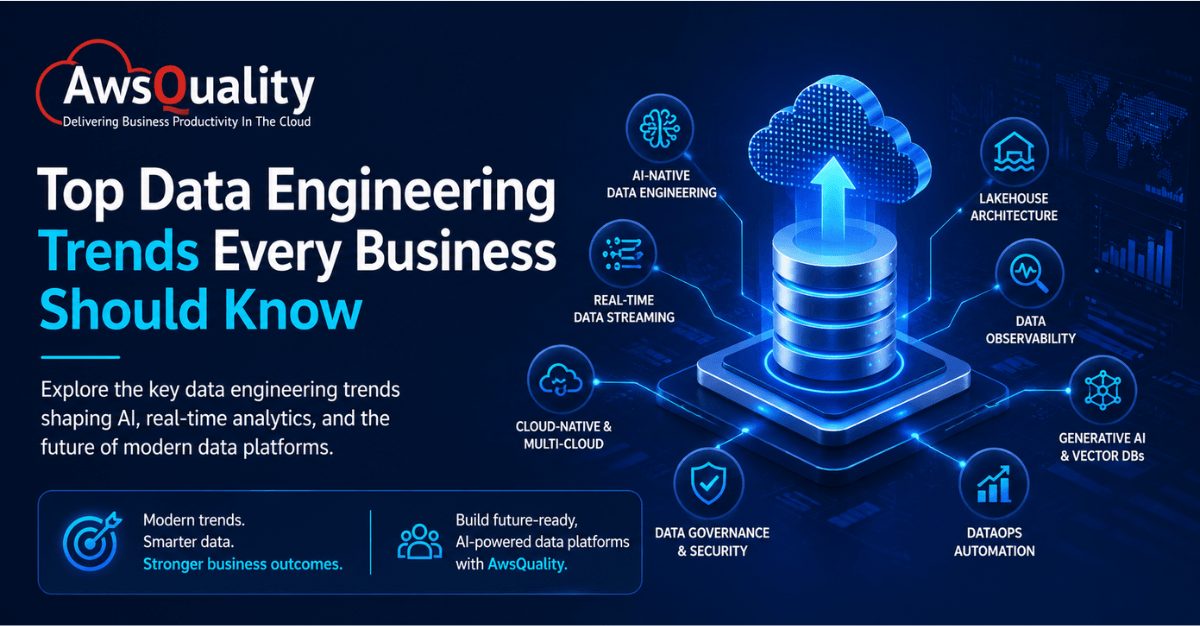
1. AI-Native Data Engineering
Artificial intelligence is transforming how data pipelines are built, monitored, and optimized.
AI-driven automation now assists with:
- Pipeline optimization
- Data quality monitoring
- Schema detection
- Metadata generation
- Anomaly detection
- Infrastructure optimization
- Intelligent workload management
Rather than replacing data engineers, AI enhances productivity by automating repetitive tasks and enabling teams to focus on higher-value initiatives.
Business Impact
- Faster development cycles
- Improved data accuracy
- Reduced operational overhead
- Better resource utilization
2. AI-Ready Data Platforms
Organizations are realizing that successful AI initiatives require more than powerful models—they require high-quality, governed, and accessible data.
Modern AI-ready platforms integrate:
- Data lakes
- Data warehouses
- Lakehouses
- Vector databases
- Feature stores
- Knowledge graphs
- Real-time pipelines
These platforms support machine learning, predictive analytics, and generative AI workloads while ensuring scalability and governance.
3. The Rise of Lakehouse Architecture
The debate between data lakes and data warehouses is giving way to a more unified approach: the lakehouse.
Lakehouse architectures combine the flexibility of data lakes with the governance and performance of data warehouses.
Benefits include:
- Unified storage
- Better analytics performance
- Lower infrastructure costs
- Support for structured and unstructured data
- Simplified data management
As businesses seek to reduce complexity, lakehouses are becoming the preferred architecture for modern data platforms.
4. Real-Time Data Processing
Batch processing is no longer sufficient for many business scenarios.
Organizations increasingly rely on real-time data for:
- Fraud detection
- Personalized customer experiences
- Dynamic pricing
- Predictive maintenance
- Supply chain visibility
- Financial monitoring
Streaming technologies enable businesses to react to events as they happen, improving agility and customer satisfaction.
5. Data Observability Becomes Essential
Organizations can no longer rely solely on monitoring infrastructure—they must also monitor data health.
Data observability provides visibility into:
- Pipeline failures
- Missing records
- Schema changes
- Data freshness
- Data accuracy
- Anomalies
By proactively identifying issues, businesses can improve trust in analytics and reduce downtime.
6. DataOps for Faster Delivery
Inspired by DevOps, DataOps brings automation, collaboration, and continuous improvement to data engineering.
DataOps practices include:
- Automated testing
- Continuous integration
- Continuous deployment
- Version control
- Monitoring
- Pipeline orchestration
Benefits include faster releases, fewer errors, and improved collaboration between engineering, analytics, and business teams.
7. Stronger Data Governance
As regulations become more stringent and AI adoption accelerates, governance is becoming a strategic priority.
Modern governance frameworks include:
- Metadata management
- Data lineage
- Role-based access control
- Data cataloging
- Compliance automation
- Data quality standards
Strong governance improves security while building trust in enterprise data.
8. Cloud-Native Data Engineering
Businesses continue migrating from legacy infrastructure to cloud-native platforms because they offer:
- Elastic scalability
- Cost optimization
- Global accessibility
- Managed services
- High availability
- Built-in security
Cloud-native data engineering enables organizations to innovate faster while reducing operational complexity.
9. Data Mesh Adoption
Traditional centralized data teams often become bottlenecks.
Data Mesh decentralizes ownership by allowing business domains to manage their own data as a product while following shared governance standards.
Benefits include:
- Faster delivery
- Greater scalability
- Improved business alignment
- Better data ownership
- Increased innovation
While not suitable for every organization, Data Mesh continues gaining momentum in large enterprises.
10. Generative AI and Large Language Models
Generative AI has fundamentally changed enterprise data strategies.
Organizations now require infrastructure that supports:
- Retrieval-Augmented Generation (RAG)
- Vector embeddings
- Semantic search
- Knowledge repositories
- Context-aware AI assistants
Data engineering plays a critical role in preparing and governing the data that powers these intelligent systems.
11. Multi-Cloud and Hybrid Data Platforms
Few organizations rely on a single cloud provider.
Modern enterprises often combine:
- AWS
- Microsoft Azure
- Google Cloud Platform
- On-premises infrastructure
Data engineering teams are designing architectures that seamlessly integrate data across hybrid and multi-cloud environments while maintaining security and governance.
12. Data Security by Design
Cybersecurity is now embedded into data engineering from the beginning rather than treated as an afterthought.
Organizations are implementing:
- Encryption at rest and in transit
- Zero Trust architectures
- Fine-grained access controls
- Automated compliance monitoring
- Continuous auditing
Secure-by-design architectures help protect sensitive business and customer information.
13. Intelligent Metadata Management
Metadata has become one of the most valuable assets in enterprise data ecosystems.
Modern metadata platforms automatically capture:
- Data lineage
- Business definitions
- Pipeline dependencies
- Data ownership
- Usage analytics
This improves discoverability, governance, and collaboration across the organization.
14. Sustainability in Data Engineering
Organizations are increasingly considering the environmental impact of data infrastructure.
Modern practices include:
- Efficient pipeline design
- Compute optimization
- Storage lifecycle management
- Cloud cost optimization
- Energy-efficient architectures
Sustainable data engineering reduces both operational costs and environmental impact.
15. Self-Service Data Platforms
Business users expect faster access to trusted data without relying on engineering teams for every request.
Self-service platforms enable:
- Interactive analytics
- Business intelligence
- Data discovery
- Governed data access
- Low-code integrations
This empowers teams to make faster, data-driven decisions while maintaining governance.
How Businesses Should Respond to These Trends
Understanding these twelve trends is necessary but not sufficient. The organizations that extract competitive advantage from them are those that translate trend awareness into architectural decisions and implementation priorities.
For organizations early in their data engineering journey: The foundational investments — data pipeline development, data warehouse or lakehouse architecture, data quality framework, and basic observability — remain the priority before any trend-specific investment. The trends in this guide accelerate value for organizations that have a working data foundation. They cannot substitute for one.
For organizations with a working data foundation: Real-time streaming, DataOps practices, and data observability deliver the most immediate and measurable return. Data Vault 2.0 and enhanced governance engineering are the priority for regulated-industry organizations. Synthetic data is the priority for organizations whose AI ambitions are constrained by data access.
For organizations with a mature data platform: Data mesh (where scale justifies it), data monetization, and advanced AI-native pipeline automation represent the frontier investments that create the widest competitive advantage when other table-stakes investments are already in place.
Across all maturity stages: Generative AI tooling in the data engineering development workflow delivers productivity improvement at any stage of data platform maturity. The investment is relatively low (tool adoption within the engineering team) and the productivity return is measurable within weeks.
How to Prepare for the Future of Data Engineering
To stay ahead of these trends, organizations should:
- Modernize legacy data architectures
- Invest in cloud-native platforms
- Prioritize data governance and quality
- Automate data pipelines
- Adopt DataOps practices
- Prepare infrastructure for AI and machine learning
- Enable real-time analytics where needed
- Develop scalable, secure, and future-ready data strategies
Why Partner with AwsQuality?
At AwsQuality, we help organizations build intelligent, scalable, and AI-ready data ecosystems that support digital transformation and long-term growth.
Our Data Engineering Services include:
- Data strategy and consulting
- Cloud data engineering
- ETL and ELT pipeline development
- Data lake and lakehouse implementation
- Real-time data processing
- AI-ready platform design
- Data governance and security
- Data modernization and migration
- Analytics and business intelligence enablement
Whether you’re beginning your modernization journey or scaling enterprise AI initiatives, our experts deliver data platforms that are secure, resilient, and built for the future.
Frequently Asked Questions
What is the biggest trend in data engineering for 2026?
AI-ready data platforms are one of the most significant trends, enabling organizations to support generative AI, machine learning, and advanced analytics through high-quality, governed, and scalable data infrastructure.
Why is data engineering important for businesses?
Data engineering is critical because 90% of AI and machine learning projects depend directly on data engineering pipelines. Only 7% of enterprises currently have data that is completely ready for AI adoption. Poor data quality affects approximately 30% of organizational revenue. Without reliable, well-governed, AI-ready data infrastructure, analytics investments produce unreliable outputs and AI deployments produce inaccurate or ungoverned results.
What is lakehouse architecture?
A lakehouse combines the scalability and flexibility of a data lake with the governance, performance, and reliability of a data warehouse, making it ideal for modern analytics and AI workloads.
How does data engineering support generative AI?
Data engineering prepares, cleans, governs, and organizes enterprise data while building pipelines, vector databases, and retrieval systems that power Retrieval-Augmented Generation (RAG) and other generative AI applications.
Why should businesses invest in modern data engineering?
Modern data engineering enables organizations to improve decision-making, accelerate AI adoption, strengthen security, reduce costs, and build scalable platforms that support future business growth.
What is DataOps and how does it differ from traditional data engineering?
DataOps applies DevOps principles — version control, automated testing, continuous integration and deployment, monitoring — to data pipeline development and operations. Traditional data engineering manages pipelines through manual processes and ad-hoc changes. DataOps treats data pipelines as software, applying the same engineering discipline that has transformed application development to the data infrastructure that applications depend on.
What is data mesh and is it right for every organization?
Data mesh is a distributed data architecture that assigns data ownership to the domain teams that generate and use the data, governed by federated standards. It is not appropriate for every organization — it solves the specific problem of centralized data teams becoming bottlenecks in large, complex organizations with many data domains. For organizations where a centralized data team can effectively serve all business units without persistent backlogs and quality inconsistencies, the data mesh model adds governance complexity without proportional benefit.
Final Thoughts
Data engineering is no longer a back-office IT function—it’s a strategic enabler of AI, analytics, and digital transformation. The trends shaping 2026 reflect a shift toward intelligent automation, cloud-native architectures, real-time processing, stronger governance, and AI-ready platforms that empower businesses to innovate faster and make better decisions.
Organizations that proactively embrace these advancements will be better equipped to harness the value of their data, respond to changing market demands, and unlock new opportunities for growth. By partnering with an experienced provider like AwsQuality, businesses can build resilient, scalable, and future-ready data ecosystems that support today’s priorities while preparing for tomorrow’s innovations.
 Bio
Bio