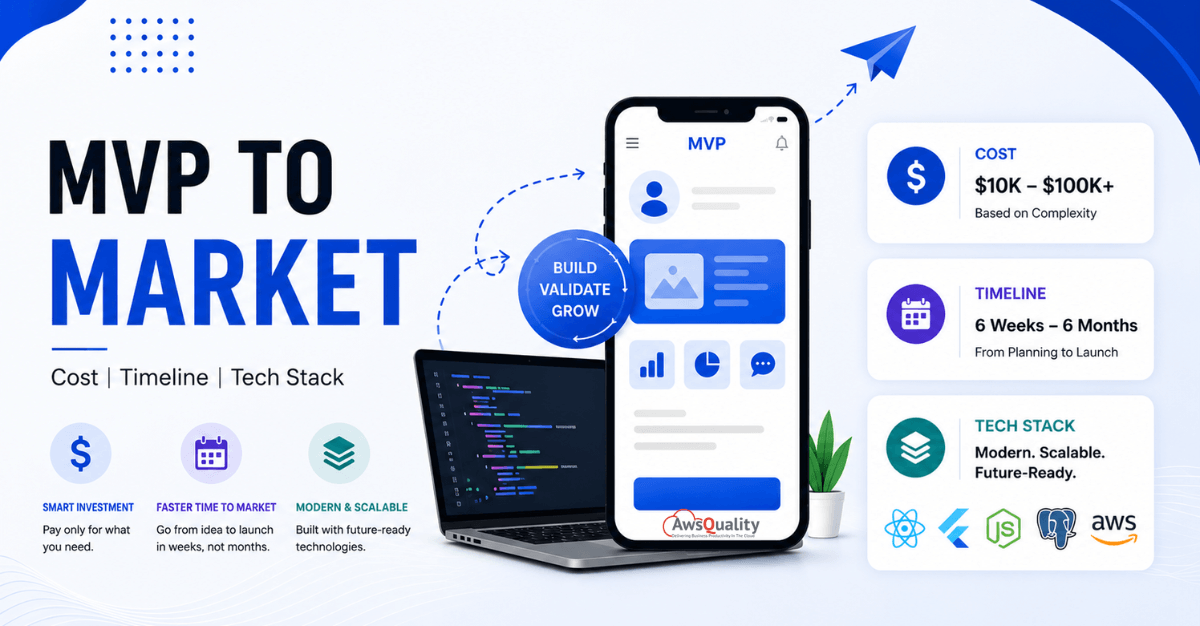
MVP (Minimum Viable Product) app development in 2026 costs between $10,000 and $150,000 for most startups, with complex AI-powered builds reaching $300,000 or more. Timelines range from 4 weeks for no-code prototypes to 24 weeks for enterprise-grade platforms. The recommended tech stack for most MVPs is Next.js + Node.js + PostgreSQL for web apps, and React Native or Flutter for mobile. According to a 2024 Startup Genome report, startups using an MVP approach have a 60% higher success rate than those launching with fully-featured products.
Building a successful digital product begins with a great idea, but turning that idea into a market-ready application requires careful planning, strategic execution, and efficient resource allocation. This is where Minimum Viable Product (MVP) development plays a crucial role.
An MVP allows startups and businesses to launch a product with essential features, validate market demand, gather user feedback, and minimize development risks before investing heavily in a full-scale solution.
However, one of the most common questions entrepreneurs ask is:
“How much does it cost to build an MVP, how long will it take, and what technology stack should I choose?”
The answer depends on multiple factors, including product complexity, feature requirements, development team structure, and business goals. This guide provides a realistic overview of MVP development costs, timelines, and recommended technology stacks to help founders make informed decisions.
Read: A Complete Guide to Build a Minimal Viable Product and Secure Funding
Why Startups Should Build an MVP First
Launching a fully-featured application without market validation often leads to wasted resources and product failure.
An MVP helps businesses:
Validate Product-Market Fit
Instead of investing months or years into development, startups can test whether users genuinely need the solution.
Reduce Development Costs
Building only essential features minimizes initial investment and allows businesses to prioritize future enhancements based on user feedback.
Faster Time to Market
A streamlined product reaches users faster, creating opportunities for early traction and revenue generation.
Attract Investors
Investors are more likely to support products that demonstrate real user engagement and market validation.
Enable Data-Driven Decisions
User behavior and feedback provide actionable insights for future product iterations.
The Smartest Investment a Founder Can Make
There is a version of your product in your head right now. It does everything. It scales to millions of users. It has every feature your customers could ever need.
And building that version will almost certainly bankrupt you — or at least waste the first year of your runway on something the market never asked for.
This is why the MVP exists.
An MVP — Minimum Viable Product — is not a corner-cut version of your vision. It is a deliberate, disciplined strategy: build the smallest product that validates your core business hypothesis with real users, collect evidence, and let that evidence guide what you build next. It is the difference between spending $500,000 on an assumption and spending $40,000 to find out whether that assumption is true.
MVP development means building the smallest possible product that proves value and uses AI to accelerate validation, automate repetitive engineering, and forecast user behavior. With global startup failure rates still high, a validated MVP is often the difference between follow-on funding and shutdown.
This guide gives you the complete picture: what an MVP truly costs, how long it realistically takes to build, which technology stack gives you the best foundation, and how to go from idea to market without burning your runway on the wrong things.
Also read: From Idea to Launch – How Mobile App Development Services Work
What is an MVP? (The Definition Has Evolved)
An MVP is not the smallest product you can build. It is the smallest product that can validate a business hypothesis with real users. Nowadays, that definition has evolved in two important ways. First, user expectations are higher. Users expect fast onboarding, smooth UI, stable performance, and trust signals like secure login and clear privacy handling. An MVP still must be lean, but it cannot feel unfinished. Second, MVP success is increasingly tied to distribution. Startups that validate faster are the ones that ship with analytics, activation loops, and content that is understandable by search engines and AI assistants.
The MVP Product Spectrum
Understanding where your product sits on this spectrum is the first step to accurate cost and timeline planning:
| Type | Description | Typical Budget | Timeline |
|---|---|---|---|
| Proof of Concept | Validates technical feasibility only | $3,000–$10,000 | 1–3 weeks |
| Prototype / Wireframe | Clickable mockup, no live backend | $5,000–$15,000 | 2–4 weeks |
| No-Code MVP | Built on Bubble, Webflow, Glide | $5,000–$20,000 | 4–6 weeks |
| Basic Custom MVP | Single core workflow, custom code | $10,000–$50,000 | 6–12 weeks |
| Standard SaaS MVP | Multi-feature, production-ready | $50,000–$150,000 | 10–20 weeks |
| Complex / AI MVP | AI features, compliance, scale | $150,000–$300,000+ | 16–28 weeks |
Part 1: The Real Cost of MVP Development in 2026
Let’s address the most common question first — and answer it honestly.
The price tag for building a Minimum Viable Product can vary widely, from $10,000 to over $150,000, leaving many entrepreneurs confused about how to budget properly. The reason for that range is not vagueness — it is scope. Two MVPs with the same feature list can cost dramatically different amounts depending on how well the scope was defined, where the development team is located, and which technology choices were made.
Cost by Complexity Tier
Simple web MVPs with one core feature loop cost $15,000 to $40,000 and take 6 to 10 weeks to build. This tier covers straightforward applications, internal dashboards, basic workflow tools, simple customer portals, lightweight reporting systems, and single-feature mobile apps. Simple MVPs typically include user authentication, one primary workflow, basic analytics, and one or two standard integrations like Stripe or SendGrid.
Mid-range SaaS platforms and marketplaces run $40,000 to $100,000 and take 10 to 16 weeks. This tier covers multi-role applications, marketplace platforms, subscription SaaS products, and apps with complex backend logic or third-party API integrations.
AI-powered MVPs are the fastest-growing category in 2026. GenAI features like RAG pipelines, chat interfaces, and AI copilots add 15–30% to budgets due to data preparation, model evaluation, and guardrails engineering.
Cost by Development Phase
Before any coding begins, you’ll need designs and interactive prototypes. Data from Startups.com shows that teams who spend at least 20% of their MVP budget on the pre-development phase are 3 times more likely to build a successful product.
| Phase | % of Total Budget | Key Deliverables |
|---|---|---|
| Discovery & Scoping | 10–15% | Requirements, user stories, architecture plan |
| UI/UX Design | 15–20% | Wireframes, prototypes, design system |
| Frontend Development | 25–30% | User interfaces, responsive design |
| Backend Development | 25–35% | APIs, databases, business logic |
| QA & Testing | 10–15% | Functional, security, performance testing |
| Deployment & DevOps | 5–10% | Hosting, CI/CD pipeline, monitoring |
| Post-Launch Buffer | 10–15% | Bug fixes, iteration, maintenance |
Cost by Team Location
Developer rates vary significantly by region and have a direct impact on your total build cost:
| Region | Hourly Rate | Quality Level | Best Use Case |
|---|---|---|---|
| USA / Canada | $100–$200/hr | Excellent | Regulated industries, premium builds |
| Western Europe | $80–$150/hr | Excellent | Compliance-heavy products |
| Eastern Europe | $40–$80/hr | Excellent | Best quality-to-cost ratio globally |
| Latin America | $30–$70/hr | Very Good | US timezone alignment |
| India / Southeast Asia | $20–$50/hr | Good–Excellent | Budget-focused MVPs |
Hidden Costs That Founders Routinely Miss
Your MVP budget does not end at the code handover. These costs are almost always underestimated:
- Cloud infrastructure — AWS, GCP, or Azure: $50–$500/month depending on traffic
- Third-party APIs — Auth, payments, notifications, maps: $100–$1,000/month
- App Store fees — Apple Developer: $99/year; Google Play: $25 one-time
- Compliance costs — HIPAA, GDPR, PCI-DSS can add $10,000–$50,000
- Post-launch maintenance — Budget 15–20% of development cost annually
- User acquisition and marketing — Often the most underestimated line item
Founder’s rule: Add 25% to any development estimate to cover integration complexity, iteration cycles, and infrastructure costs. Projects that skip this buffer almost always run over.
What Does MVP ROI Look Like?
For context, the average seed-stage startup in North America raised $3.6 million in 2025 (Crunchbase, 2025), meaning even a complex MVP at $150K represents roughly 4% of a typical seed round. The ROI math heavily favors building an MVP over a full product launch.
Part 2: Realistic MVP Timelines — Phase by Phase
Speed matters in startups. But speed without structure creates expensive rework. The minimum total MVP app development timeline is approximately 9 weeks for a basic scope. More complex builds run 16–20 weeks.
Here is what those weeks actually contain:
Phase 1: Discovery and Planning (1–3 Weeks)
This is the most consistently undervalued phase in MVP development — and the one that determines everything that follows.
Activities include: defining the core problem your product solves, writing user stories and acceptance criteria, mapping technical architecture, finalizing the MVP scope, and setting up development infrastructure.
According to a McKinsey and Oxford University study, IT projects without proper validation run an average of 45 per cent over budget and 7 per cent over time, while delivering 56 per cent less value than predicted. The antidote is a disciplined discovery phase.
Key output: A locked MVP scope document — the single most powerful tool for preventing budget overruns.
Phase 2: UI/UX Design (1–3 Weeks)
Modern users have high expectations even for an MVP. Your product must be usable and trustworthy from day one — not because it needs to look like a finished product, but because users make trust decisions in the first 60 seconds of using any application.
Activities include: information architecture, wireframing, high-fidelity UI design in Figma, building a basic design system, and testing with real users before development begins.
Key output: Approved, developer-ready design files with documented component library.
Phase 3: Core Development (3–12 Weeks)
The longest and most expensive phase. The range is wide because scope complexity varies enormously between product types.
Activities include: backend API and database development, frontend implementation, third-party integrations (payments, authentication, notifications), and mobile development if applicable.
AI acceleration note: AI-assisted development tools have compressed timelines by 40 to 60 percent for teams that know how to use them effectively, according to McKinsey. Experienced teams using GitHub Copilot, Cursor, and AI-augmented code review are shipping features meaningfully faster than teams relying on traditional methods alone.
Phase 4: Quality Assurance and Testing (1–2 Weeks)
Every hour spent on QA before launch saves multiple hours of crisis management after it. Bugs in production destroy user trust faster than any competitor can.
Activities include: functional testing, cross-browser and cross-device testing, security testing, performance and load testing, and user acceptance testing with real users.
Phase 5: Deployment and Launch (1 Week)
Activities include: setting up the production environment, configuring CI/CD pipelines, deploying to app stores if applicable (allow 1–3 days for Apple review, 1–2 days for Google Play), and establishing monitoring and alerting infrastructure.
Timeline by MVP Product Type
| MVP Type | Realistic Timeline |
|---|---|
| No-code / low-code MVP | 4–6 weeks |
| Simple single-platform web MVP | 8–12 weeks |
| Cross-platform mobile MVP | 10–16 weeks |
| SaaS with subscription and billing | 12–20 weeks |
| Two-sided marketplace | 14–20 weeks |
| AI/ML-powered MVP | 16–24 weeks |
| Healthtech / fintech with compliance | 20–32 weeks |
Part 3: The Best Tech Stack for MVP Development in 2026
Your technology choices are among the most consequential decisions you make as a founder. The wrong stack creates technical debt that costs more to fix than it saved you initially. The right stack accelerates development, makes hiring easier, and scales with your growth.
The Golden Rule of MVP Stack Selection
Evaluate technology stacks based on your team’s existing skills rather than industry hype. A proficient Django developer will ship an MVP faster than a novice TypeScript developer, regardless of theoretical framework advantages.
The 2026 Recommended MVP Stack (Web)
The recommended stack for 2026: Frontend: Next.js (React) for web, React Native or Flutter for mobile. Backend: Node.js (Express/NestJS) or Python (FastAPI). Database: PostgreSQL + Redis. Auth: Supabase Auth or Auth0. Payments: Stripe. Hosting: Vercel, AWS, or Railway. This stack balances developer productivity, performance, and scalability.
| Layer | Technology | Why It Wins in 2026 |
|---|---|---|
| Web Frontend | Next.js (React) | SSR for SEO, massive ecosystem, Vercel deployment |
| Mobile | React Native + Expo / Flutter | Cross-platform, single codebase, fast iteration |
| Backend | Node.js (NestJS) or Python (FastAPI) | JavaScript consistency or AI/ML-ready Python |
| Primary Database | PostgreSQL | Reliable, scalable, industry standard |
| Caching / Real-time | Redis | Session management, queues, real-time features |
| Authentication | Supabase Auth or Auth0 | Secure, minutes to implement, reduces dev time |
| Payments | Stripe | Gold standard for payment integration |
| File Storage | AWS S3 or Cloudflare R2 | Reliable, cheap, globally distributed |
| Frontend Hosting | Vercel | Zero-config deployment, edge functions |
| Backend Hosting | Railway, Render, or AWS | Scalable, managed, low DevOps overhead |
| Monitoring | Sentry + Datadog | Error tracking and performance monitoring |
Stack by Product Type
- Mobile app: Flutter (cross-platform) or React Native + Node.js backend + PostgreSQL.
- Fintech or high-concurrency: Go backend + React frontend + PostgreSQL + Redis + Azure or AWS compliance tier.
- Content platform: Next.js + Headless CMS (Contentful or Sanity) + API layer + Vercel.
- Pre-PMF MVP (fastest path): Ruby on Rails or Next.js + PostgreSQL + Vercel/Railway. Skip everything else until users prove value.
- AI-powered MVP: Next.js frontend + Python FastAPI backend + PostgreSQL + vector database (Pinecone or pgvector) + OpenAI or Anthropic API
- E-commerce MVP: Next.js + headless commerce backend + PostgreSQL + Stripe + Vercel
Frontend: Why Next.js Dominates in 2026
For web apps: Next.js is the clear winner — SSR for SEO, great developer experience, and excellent performance. For MVPs that depend on organic search visibility, server-side rendering is essential. Next.js provides this out of the box, along with Vercel’s zero-configuration deployment infrastructure that removes DevOps overhead for early-stage teams.
Mobile: Flutter vs React Native in 2026
Both are production-ready. Both power millions of apps. Here is how to choose between them:
Cross-platform saves 30–50% vs building two native apps. If you already use React/TypeScript for your web app, go React Native + Expo. If you’re mobile-first with no web codebase, go Flutter (46% market share).
React Native is ideal if your team already works with JavaScript and React. Flutter is better suited for apps requiring highly custom UI and pixel-perfect control across platforms. Both are mature in 2026.
React Native has fully transitioned to its “New Architecture” (Fabric and TurboModules). This shift has eliminated the “Bridge” — the old bottleneck that used to slow down communication between JavaScript and the native platform. In 2026, React Native’s performance is virtually indistinguishable from native code.
TypeScript: No Longer Optional
Over 80% of professional JavaScript projects use TypeScript in 2026. This is no longer a preference. It is the baseline expectation for production-grade startup codebases. Teams still starting new projects in plain JavaScript in 2026 are creating future maintenance debt that will cost more to address than the short-term convenience saves.
No-Code / Low-Code: A Serious Option for the Right MVP
No-code tools like FlutterFlow can ship an MVP for $5K–$15K in 2–6 weeks — Gartner says 70% of enterprise apps will use low-code by 2026.
Use no-code when:
- You need to validate a concept in days, not weeks
- Budget is under $20,000
- Your product doesn’t require complex backend logic or compliance
- You’re testing a landing page, simple workflow, or directory
Switch to custom development when:
- You operate in a regulated industry (healthcare, fintech)
- You need AI/ML capabilities beyond simple API calls
- You’re building for meaningful scale beyond a few hundred users
- You need complex backend logic or deep third-party integrations
Check out: 5 Signs You’ve Found the Right Mobile Application Development Company
Part 4: What MVP Success Actually Looks Like in 2026
Building the MVP is the beginning of the process, not the end. The real work — and the real value — comes from what happens after launch.
Define Your Metrics Before Launch
You cannot measure success without knowing what success looks like. Before your MVP goes live, establish these benchmarks:
| Metric | What It Measures | Target Benchmark |
|---|---|---|
| Activation Rate | % of users completing the core action | Varies by product (aim for 40%+) |
| Day-7 Retention | % of users returning after one week | 20–30% is strong for early-stage |
| Day-30 Retention | % of users returning after one month | 10–20% indicates real value |
| NPS Score | User satisfaction and advocacy | +30 or higher shows product resonance |
| Time to Value | How long it takes users to “get it” | Under 5 minutes is the target |
| Conversion Rate | % of users completing desired action | Depends on product and pricing |
The Post-Launch Iteration Cycle
Ship → Measure → Learn → Prioritize → Build → Ship
Week 1–2: Fix critical bugs. Respond personally to every piece of user feedback. Watch session recordings, not just analytics.
Week 3–4: Analyze behavioral data. Where do users drop off? What features do they skip entirely? What brings them back?
Month 2: Build your v1.1 backlog from real usage data — not your assumptions. Kill features nobody uses. Double down on what works.
Month 3: If traction metrics are strong, prepare your investor pitch. Validated product-market fit signals are worth more than any deck.
When Your MVP Is Ready to Scale
You are ready to move beyond MVP when you can answer “yes” to all of these:
- Do you have repeatable user acquisition — you can predict how new users will find you?
- Is your Day-30 retention strong — users are coming back?
- Have paying customers validated willingness to pay?
- Can new users understand your product’s value without hand-holding?
- Can you articulate what to build next — from data, not opinion?
Part 5: Common MVP Mistakes That Waste Money and Delay Launch
Mistake 1: Building in Stealth Too Long
The market does not care how long you spent building. Every week you delay launch is a week without real user feedback. Ship early. The goal is learning, not perfection.
Mistake 2: Feature Creep Before Validation
The MVP is a learning product. If there is no budget or time for iteration, the startup fails to capture the value of launching. Every unvalidated feature is an unplaced bet. Do not place 40 bets simultaneously.
Mistake 3: Testing With Friends Instead of Real Users
Friends want to be supportive. They will tell you the product is great even when it isn’t. Real users vote with their behavior — they either come back or they don’t. Build your beta group from strangers who match your target persona.
Mistake 4: Choosing a Stack for Prestige, Not Fit
Using the most talked-about framework on Product Hunt does not make your product better. Using the framework your team knows does. A team that knows Django will ship a better MVP faster than a team learning Go from scratch.
Mistake 5: Skipping Analytics at Launch
If you do not instrument your MVP with analytics before launch, you are flying blind. Integrate Mixpanel, PostHog, or Google Analytics 4 before your first user signs up — not as an afterthought.
Mistake 6: No Rollback Plan
Even with thorough testing, production surprises happen. Always have a rollback procedure documented and tested before go-live. Fifteen minutes of preparation can prevent hours of downtime.
Mistake 7: Over-Engineering for Non-Existent Scale
Startups that leverage existing components can reduce development costs by 40–60% while accelerating time to market, according to CB Insights research. Do not build a microservices architecture for 50 users. Build for 10x your current scale, not 1,000x.
Mistake 8: Ignoring Post-Launch Costs in the Budget
The MVP does not end at launch. Infrastructure, maintenance, iteration cycles, and user acquisition all require ongoing investment. Without budget clarity, projects often succumb to misaligned assumptions about delivery timelines, feature sets, or commercial viability.
Also check: Mobile App Development Guide – Trends, Technologies & Strategy
Part 6: MVP Development Process — Step by Step
Step 1: Validate the Problem Before Writing a Line of Code
Conduct 10–20 user interviews with your target audience. Build a landing page with a waitlist. Test demand with a mockup in Figma before committing to development. Define your one core hypothesis: “We believe [user] will [action] because [reason].”
Step 2: Define Scope with the MoSCoW Framework
Apply this filter to every proposed feature:
- Must Have: Core value proposition — the reason someone would use this product at all
- Should Have: Significantly improves experience, but can launch in v1.1
- Could Have: Nice to have, clearly deferred until post-validation
- Won’t Have: Explicitly out of scope for MVP
Build only “Must Have” features. Everything else waits for user evidence.
Step 3: Select Your Tech Stack Based on Team Skills
Refer to the stack recommendations above, but always weight your team’s existing expertise above any other factor. The fastest path to market is the stack your developers already know.
Step 4: Design for Usability, Not Perfection
Focus on: a clear onboarding flow users can complete in 60 seconds, one primary call-to-action per screen, mobile-responsive design from day one, and accessibility basics that ensure your product is usable by everyone.
Step 5: Build in Two-Week Agile Sprints
Two-week sprints create natural checkpoints for scope review, stakeholder communication, and early course correction. At the end of each sprint, you should have working software to demonstrate — not progress reports.
Step 6: Launch to a Controlled Beta Group
Launch to 50–200 real users first. Watch how they actually use the product. Let their behavior — not your assumptions — guide the next iteration.
Step 7: Measure, Learn, Iterate
Define success metrics before launch. Measure them obsessively. Kill what isn’t working. Double down on what is. The MVP process is only complete when you have enough evidence to make your next product decision from data.
Factors Affecting MVP Development Cost
Feature Scope
More features directly increase development effort and project costs.
Recommendation
Focus on:
- Core functionality
- User onboarding
- Essential workflows
Avoid feature overload during the MVP stage.
Design Complexity
Custom UI/UX design requires additional time and resources.
Cost Impact
- Basic UI: Lower cost
- Custom design system: Higher cost
- Interactive animations: Highest cost
Platform Choice
Development costs differ depending on whether you build:
Web Application
Most cost-effective option for MVP validation.
Mobile Application
Requires:
- iOS development
- Android development
Cross-Platform App
Offers significant savings by using a shared codebase.
Third-Party Integrations
Common integrations include:
- Payment gateways
- CRM systems
- Analytics tools
- Maps and geolocation
- Social logins
Each integration increases development complexity.
MVP Development Cost by Industry: Real-World Examples
| Industry | MVP Type | Cost Range | Timeline |
|---|---|---|---|
| B2B SaaS | Dashboard with billing and team management | $30,000–$80,000 | 10–16 weeks |
| E-Commerce | Marketplace with listings and Stripe payments | $25,000–$70,000 | 8–14 weeks |
| HealthTech | Patient portal with HIPAA compliance | $80,000–$200,000 | 16–28 weeks |
| FinTech | Payment app with PCI-DSS compliance | $70,000–$180,000 | 16–24 weeks |
| On-Demand | Uber-style booking and matching platform | $40,000–$100,000 | 12–20 weeks |
| EdTech | Learning platform with video and quizzes | $30,000–$80,000 | 10–18 weeks |
| AI SaaS | AI-powered tool with LLM integration | $80,000–$250,000 | 16–24 weeks |
| Mental Health | Holistic mental health app MVP ranges from | $40,000 to $120,000+, depending on features and compliance scope$40,000–$120,000 | 12–20 weeks |
Pre-Launch MVP Checklist
Before Development Starts
- Minimum 10 user interviews completed with target audience
- Core hypothesis clearly defined and documented
- MVP scope locked (must-have features only)
- Tech stack selected based on team expertise
- Budget set with 25% contingency included
- Timeline milestones agreed upon by all stakeholders
During Development
- Two-week agile sprints in place
- Analytics instrumented from day one (Mixpanel, PostHog, or GA4)
- Error monitoring configured (Sentry)
- Security basics implemented (HTTPS, authentication, input validation)
- QA test plan defined and being executed alongside development
Before Launch
- Beta user group identified (50–200 target personas)
- Onboarding flow tested with real users outside your team
- Payment integration tested end-to-end
- Monitoring, alerting, and rollback procedure documented
- Success metrics and measurement tools confirmed active
After Launch
- Responding personally to every piece of user feedback
- Weekly review of core metrics (activation, retention, NPS)
- Session recordings reviewed at least twice per week
- v1.1 backlog building from real behavioral data
- Investor narrative being updated with real traction evidence
Frequently Asked Questions
Q: How much does it cost to build an MVP in 2026?
The cost of MVP development varies widely, typically $10K–$50K for startups, and up to $150K+ for complex, AI-enabled builds. Simple single-feature products can be built for under $20,000, while regulated or AI-powered products often exceed $150,000.
Q: How long does it take to build an MVP?
The minimum total MVP app development timeline is approximately 9 weeks for a basic scope. More complex builds run 16–20 weeks. No-code MVPs can launch in 4–6 weeks. Compliance-heavy platforms in healthcare or fintech may take 6–8 months.
Q: What is the best tech stack for an MVP in 2026?
Next.js (React) for web frontend, React Native or Flutter for mobile, Node.js or Python FastAPI for backend, PostgreSQL for database, and Vercel or Railway for hosting. This stack balances developer productivity, performance, and scalability. Always choose based on your team’s existing skills above all else.
Q: Should I use no-code or custom development for my MVP?
No-code tools like FlutterFlow can ship an MVP for $5K–$15K in 2–6 weeks. Use no-code for rapid concept validation. Switch to custom development when you need compliance, AI capabilities, complex backend logic, or scale beyond a few hundred users.
Q: What is the biggest mistake founders make when building an MVP?
Building too many features before validating demand. Teams who spend at least 20% of their MVP budget on pre-development phases are 3 times more likely to build a successful product. Validate the problem before you write any code.
Q: How do I know if my MVP is successful?
Track activation rate, Day-7 and Day-30 retention, NPS, and conversion rate. VCs and corporate innovation teams now expect measurable signals — retention, engagement, early revenue — not slides. If users return and willingly pay, your MVP is working.
Q: Is React Native or Flutter better for a mobile MVP?
React Native is ideal if your team already works with JavaScript and React. Flutter is better suited for apps requiring highly custom UI and pixel-perfect control across platforms. Both are mature in 2026. The right choice depends entirely on your team’s existing skills.
Q: How can AI tools reduce MVP development costs?
AI-assisted development tools have compressed timelines by 40 to 60 percent for teams that know how to use them effectively, according to McKinsey. Tools like GitHub Copilot and Cursor reduce the time for boilerplate code, testing, and documentation — but require experienced engineers to direct them effectively.
Conclusion: Build Less, Learn More, Launch Faster
The best MVP is not the one with the most features. It is the one that answers your most important business question in the shortest possible time with the least possible investment.
According to a 2024 Startup Genome report, startups that use an MVP approach have a 60% higher success rate than those that launch with fully-featured products. The math is clear. The discipline is the hard part.
Validate your problem before you write code. Lock your scope before you start building. Choose your tech stack based on team expertise, not trends. Launch to real users faster than feels comfortable. Let their behavior — not your instincts — define what you build next.
The path from MVP to market is not a sprint. It is a series of deliberate, evidence-based decisions. Make them well, and your product will have a foundation that no amount of venture funding alone can provide: proof that someone actually wants what you built.
Start small. Ship fast. Learn faster.
 Bio
Bio