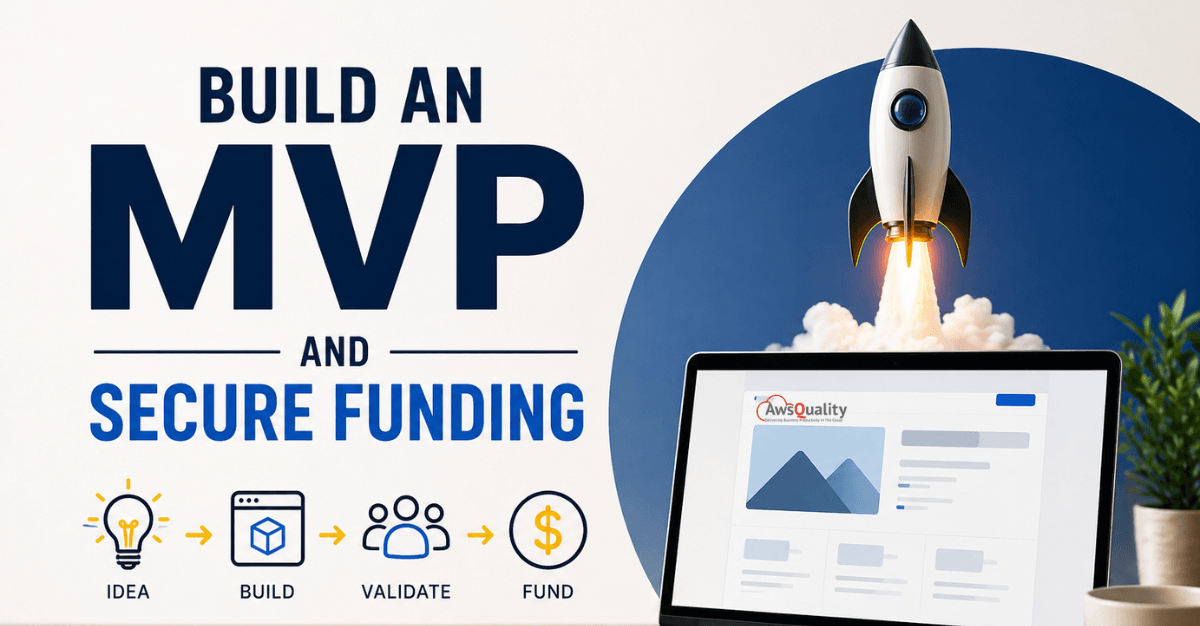
From raw idea to investor-ready product — without wasting a single dollar on the wrong thing.
Every billion-dollar company you admire — Airbnb, Dropbox, Uber, WhatsApp — started as something embarrassingly small. Airbnb was a website where strangers paid to sleep on air mattresses in someone else’s living room. Dropbox was a three-minute video. The founders were not trying to build empires. They were trying to find out whether anyone cared about their idea before they burned through their savings.
That discipline — building the smallest thing that can teach you the most — is the essence of a Minimal Viable Product. And if done well, it is also the most powerful fundraising tool you will ever create. This guide walks you through both: how to construct an MVP that works, and how to use it to unlock the capital you need to scale.
- 90% of startups fail, primarily due to lack of market need. [Source]
- 42% of those failures cite “no market need” as the top reason. [Source]
- Startups with validated traction are significantly more likely to secure funding than idea-stage startups.
What Is a Minimal Viable Product?
The term “Minimal Viable Product” was popularised by Eric Ries in The Lean Startup, but its roots go back to Steve Blank’s Customer Development methodology. An MVP is not a beta version of your final product. It is not a stripped-down, half-broken prototype. And it is certainly not an excuse to ship something sloppy.
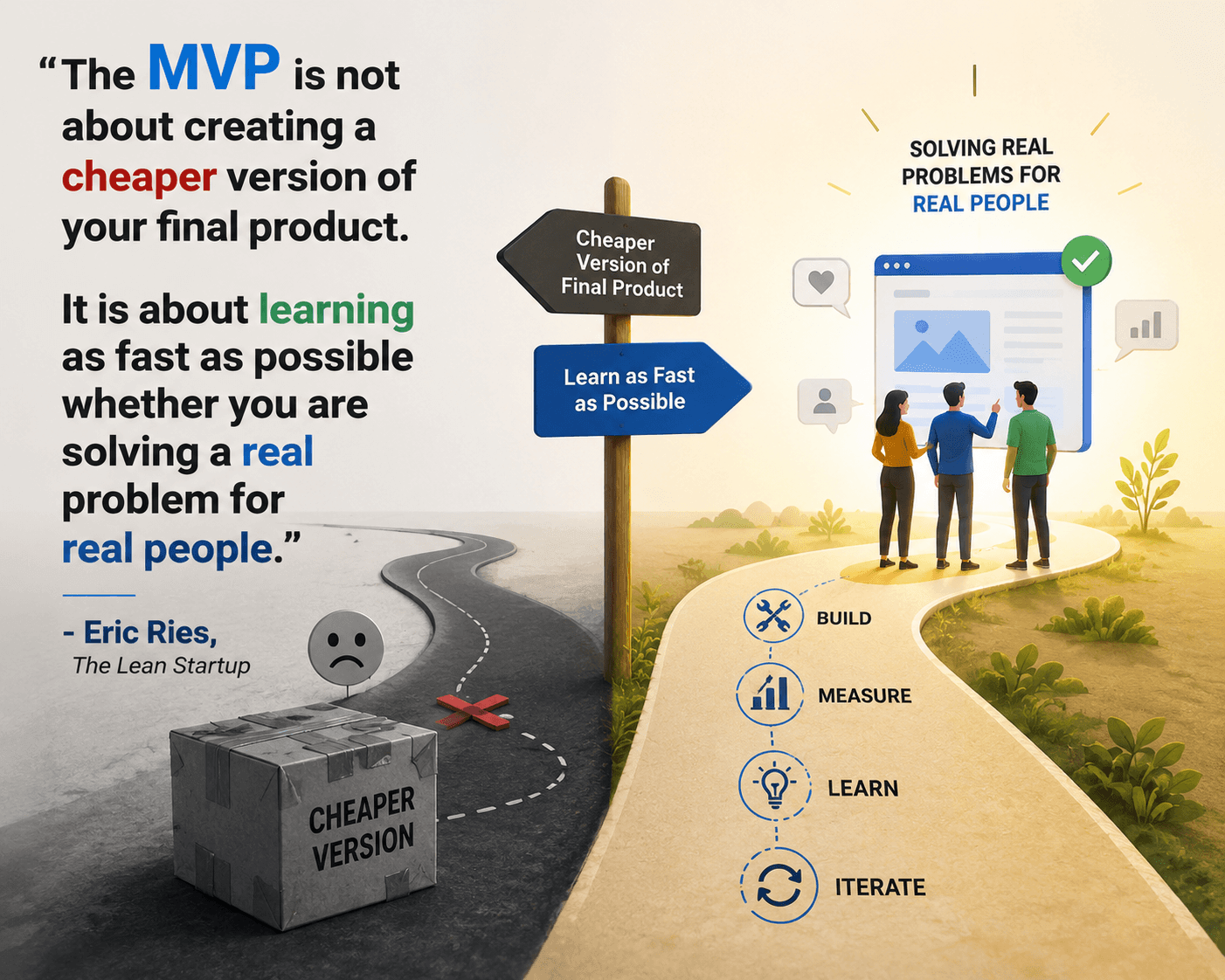
An MVP is the smallest product that allows you to collect the maximum amount of validated learning about your customers with the least effort. Every word in that definition matters. “Smallest” forces prioritisation. “Validated learning” demands evidence over assumption. “Least effort” keeps you efficient and alive long enough to iterate.
Read: 5 Signs You’ve Found the Right Mobile Application Development Company
Why Start with an MVP Instead of a Full Product?
Many founders make the mistake of building too much, too soon.
This leads to:
- High development costs
- Delayed launches
- Features users don’t need
An MVP approach helps you:
- Reduce risk
- Launch faster
- Validate product-market fit
- Attract early users
👉 Investors prefer startups that validate before scaling.
Step 1: Identify a Real Problem Worth Solving
Every successful product starts with a clear problem.
Before building anything, ask:
- What problem are you solving?
- Who is facing this problem?
- How are they solving it today?
Your MVP should focus on a specific, high-impact problem.
If the problem is unclear, the product will fail—no matter how well it is built.
Step 2: Define Your Core Value Proposition
Your value proposition explains why users should choose your product.
It should clearly answer:
👉 What makes your solution different?
👉 Why does it matter?
Keep it simple and focused.
Avoid trying to solve multiple problems at once.
Step 3: Prioritize Features (Build Only What Matters)
One of the biggest mistakes in MVP development is overbuilding.
Instead of asking:
👉 “What can we build?”
Ask:
👉 “What is the minimum we need to validate the idea?”
Focus only on:
- Core functionality
- Essential user flows
- Key value delivery
Everything else can come later.
Step 4: Choose the Right Development Approach
There are multiple ways to build an MVP:
1. No-Code / Low-Code Tools
Best for:
- Fast validation
- Non-technical founders
2. Custom Development
Best for:
- Scalable products
- Complex functionality
3. Prototype + Manual Backend
Best for:
- Testing demand before building
Choose based on:
- Budget
- Timeline
- Technical complexity
Step 5: Design for Simplicity and Usability
Your MVP does not need to be perfect—but it must be usable.
Focus on:
- Clear user flow
- Simple interface
- Fast performance
If users don’t understand how to use your product, you won’t get meaningful feedback.
Step 6: Launch Early and Collect Feedback
The real value of an MVP comes after launch.
Start with:
- A small group of users
- Early adopters
- Target audience
Collect feedback on:
- Usability
- Value
- Pain points
👉 Feedback is your roadmap for improvement.
Step 7: Measure What Matters
Instead of vanity metrics, focus on:
- User engagement
- Retention
- Conversion rates
- Customer feedback
These metrics show whether your product is solving a real problem.
Step 8: Iterate Based on Real Data
An MVP is not a one-time build.
It is a continuous process:
- Test
- Learn
- Improve
Use feedback and data to refine your product.
This is how you move toward product-market fit.
How to Use Your MVP to Secure Funding
Once you have a validated MVP, you are in a much stronger position to raise funds.
1. Show Traction, Not Just Ideas
Investors don’t fund ideas—they fund traction.
Your MVP should demonstrate:
- Active users
- Growth trends
- Engagement metrics
👉 Even small traction is better than no validation.
2. Prove Product-Market Fit
You don’t need millions of users.
But you need evidence that:
👉 People want your product
This can include:
- Positive feedback
- Repeat usage
- Early revenue
3. Build a Strong Story Around Your MVP
Your pitch should connect:
- Problem → Solution → Validation → Growth
Explain:
- Why the problem matters
- How your MVP solves it
- What results you’ve achieved
4. Highlight Scalability
Investors are looking for growth potential.
Show how your MVP can:
- Scale to more users
- Expand features
- Enter new markets
5. Choose the Right Funding Option
Depending on your stage, you can explore:
- Angel investors
- Venture capital
- Seed funding
- Bootstrapping
- Crowdfunding
Each option has different expectations.
Also read: From Idea to Launch – How Mobile App Development Services Work
4 Common Mistakes to Avoid
Many startups fail at the MVP stage due to:
Building in stealth for too long
Ideas don’t get stolen. Execution does. The longer you wait to show real users, the more your mental model of the problem diverges from reality.
Confusing features for value
Users don’t care about features. They care about outcomes. Build the outcome first, then add the features that enable it efficiently.
Skipping qualitative feedback
Analytics tell you what users do. Interviews tell you why. Both are necessary. Pure data-driven teams often optimize for the wrong thing.
Using friends and family as test users
They will be kind. You need honest. Find users from your actual target segment, even if it takes more effort to recruit them.
👉 The goal is validation—not perfection.
What Makes a Successful MVP?
A successful MVP is:
- Simple
- Focused
- User-driven
- Data-backed
It solves one problem well and evolves based on feedback.
MVP vs. Prototype vs. POC — What’s the Difference?
These three terms are often used interchangeably, but they serve entirely different purposes at different stages.
| Proof of Concept | Prototype | MVP | MMP (post-MVP) |
|---|---|---|---|
| A technical experiment to determine feasibility. Internal-facing. Never shown to customers. Answers the engineering question, not the market question. | A design artefact — clickable mockup or visual model — used to explore UX. May not function at all. Great for usability testing, not for validating demand. | A living, usable product (however small) released to real customers to generate real data about behaviour, retention, and willingness to pay. | The Minimum Marketable Product — the MVP iteration that is polished enough to be sold commercially and used as evidence in investor conversations. |
Key Insight
The most common MVP mistake is building too much. First-time founders consistently overestimate what is “minimum.” If you are not slightly embarrassed by your MVP when you launch, you have waited too long.
Types of startup funding
Not all funding is equal. Different stages of capital come with different expectations, dilution levels, and strings attached. Here’s a practical overview:
| Stage | Source | Typical range | What they want |
|---|---|---|---|
| Pre-seed | Founders, friends & family, angels | $10K – $500K | Strong team, compelling idea, early traction signals |
| Seed | Angel investors, micro-VCs, accelerators | $500K – $3M | MVP, early users, evidence of PMF (product-market fit) |
| Series A | Institutional VCs | $3M – $15M | Proven PMF, repeatable growth, clear business model |
| Grants & non-dilutive | Government, foundations | Varies widely | Sector alignment, social impact, innovation focus |
| Revenue-based | Clearco, Pipe, Capchase | $50K – $5M | Recurring revenue, healthy margins, SaaS model preferred |
Accelerators like Y Combinator, Techstars, and Antler occupy a unique position — they provide capital, credibility, and a powerful network in exchange for equity (typically 5–7%). For first-time founders without a network, an accelerator can compress years of relationship-building into three months.
Final Thoughts
Building an MVP is not just a development process—it is a strategy.
It helps you:
- Validate your idea
- Reduce risk
- Learn from users
- Attract investors
Start small. Learn fast. Improve continuously.
That’s how successful startups are built.
Frequently Asked Questions
1. What is a Minimum Viable Product (MVP)?
An MVP is the simplest version of a product that delivers core value and allows startups to validate their idea with real users.
2. How long does it take to build an MVP?
It typically takes 4 to 12 weeks, depending on complexity and development approach.
3. Can I secure funding with just an MVP?
Yes, if your MVP shows traction, user engagement, and clear problem-solution fit.
4. What is the main goal of an MVP?
The goal is to validate assumptions and gather feedback before scaling.
5. Should I build an MVP or a full product first?
You should always start with an MVP to reduce risk and validate demand.
 Bio
Bio