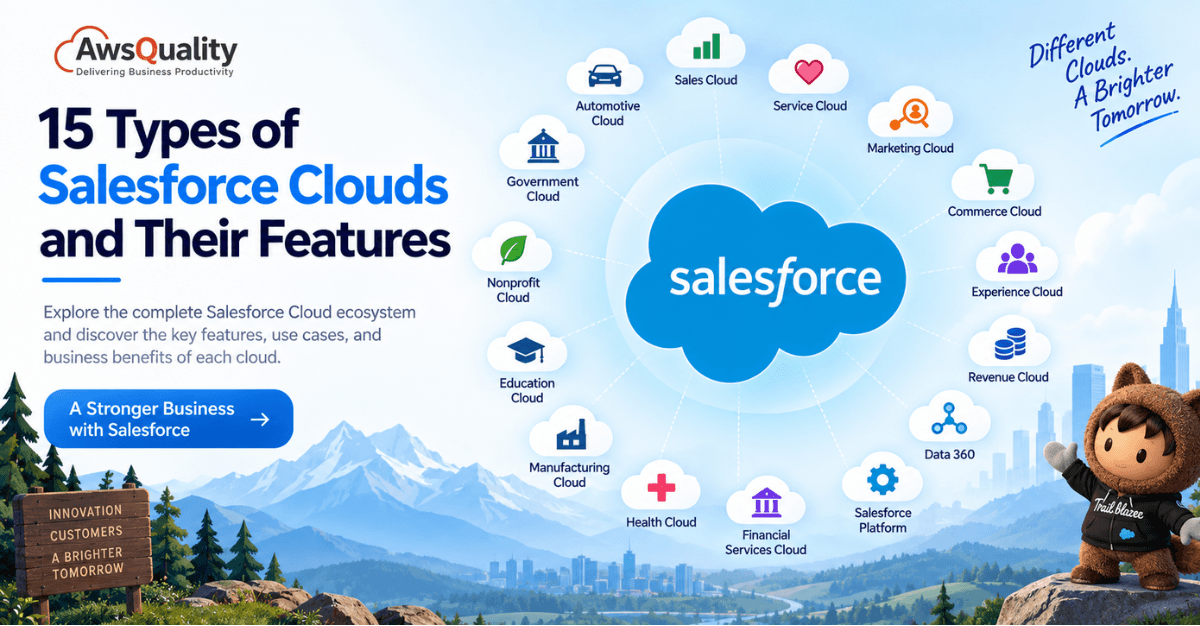
Salesforce is more than a customer relationship management (CRM) platform. Its broad portfolio includes purpose-built applications and industry solutions designed to help organizations manage sales, customer service, marketing, commerce, data, revenue operations, and industry-specific processes from a connected platform.
Salesforce “Clouds” are designed around specific business functions or industries. For example, Sales Cloud supports sales teams, Service Cloud focuses on customer service, Marketing Cloud helps organizations manage customer journeys, and Commerce Cloud supports digital commerce. Salesforce also offers specialized solutions for industries such as financial services, healthcare, manufacturing, automotive, education, nonprofit organizations, and the public sector.
In addition, Salesforce’s portfolio continues to evolve. Data Cloud was rebranded as Data 360 in October 2025, while Revenue Cloud is now being transitioned to the name Agentforce Revenue Management in Salesforce’s current documentation.
In this guide, we’ll explore 15 important Salesforce Clouds and solutions, their key features, use cases, benefits, and the types of organizations that can benefit from them.
What are Salesforce Clouds?
Salesforce Clouds are specialized Salesforce applications and industry solutions built to address particular business functions or industry requirements.
Instead of implementing separate systems for sales, customer service, marketing, commerce, and industry-specific processes, organizations can use Salesforce solutions that share a common platform and customer data foundation.
For example:
- Sales teams can use Sales Cloud to manage leads, opportunities, and accounts.
- Customer service teams can use Service Cloud to manage cases and customer interactions.
- Marketing teams can use Marketing Cloud to create personalized customer journeys.
- Commerce teams can use Commerce Cloud to manage digital buying experiences.
- Organizations can use Data 360 to unify data across systems.
- Industry organizations can adopt specialized solutions such as Financial Services Cloud, Health Cloud, or Manufacturing Cloud.
The exact products and names can change as Salesforce evolves its portfolio, so the list below focuses on major Salesforce Clouds and solutions relevant to organizations evaluating the platform in 2026.
15 Types of Salesforce Clouds and Their Features
1. Sales Cloud
What it is: Salesforce’s flagship CRM product and the most widely deployed cloud in the portfolio. Sales Cloud is purpose-built to streamline the complete sales process — from lead capture through opportunity management, forecasting, and deal closure — for B2B and B2C sales organizations of any size.
Key Features of Sales Cloud:
- Account and Contact Management: Centralized records for every company and individual in the customer relationship, with full interaction history, relationship mapping, and activity tracking.
- Lead Management and Routing: Automated lead capture from web forms, marketing campaigns, and third-party sources; rule-based routing to the right sales representative based on territory, industry, or lead score.
- Opportunity and Pipeline Management: Visual pipeline view with stage-by-stage deal tracking, close date management, and product and pricing line item management through Products and Price Books.
- Einstein Lead Scoring: AI-powered scoring that analyzes historical conversion data to rank leads by their likelihood to convert, helping sales teams prioritize the highest-value prospects.
- Sales Forecasting: Collaborative forecasting that aggregates individual opportunity projections into team and organizational revenue forecasts, with AI-powered forecast adjustments.
- Sales Analytics and Reports: Real-time dashboards covering pipeline health, rep activity, forecast accuracy, win rates, and sales cycle length.
- Agentforce for Sales: Autonomous AI agents that handle meeting preparation, pipeline review, deal health assessment, and follow-up task creation.
Best for: Sales teams of any size — from SMB inside sales to enterprise field sales organizations. The foundation of virtually every Salesforce deployment.
2. Service Cloud
What it is: Salesforce’s customer service and support platform, designed to help service teams manage cases, resolve issues efficiently, and deliver consistent service experiences across every channel — phone, email, chat, messaging apps, and self-service portals.
Key Features of Service Cloud:
- Case Management: Automated case creation from email, web, and phone; intelligent case routing based on skills, availability, and priority; SLA management with escalation rules.
- Omnichannel Routing: Intelligent queue-based routing that distributes work across chat, phone, email, messaging, and social channels based on agent capacity and skill sets.
- Knowledge Base: Searchable library of articles, solutions, and procedures that agents and customers can access to resolve issues without creating a case.
- Agentforce Service Agent: Autonomous AI agents that handle Tier-1 customer inquiries — account questions, order status, return processing — without human intervention, escalating to human agents with full context for complex situations.
- Service Analytics: Real-time dashboards tracking case volume, first-contact resolution rate, average handle time, customer satisfaction scores, and agent productivity.
- Field Service: Scheduling, dispatch, and mobile capabilities for organizations with field technicians who need offline access, real-time job updates, and inventory management.
Best for: Customer service and support organizations across industries — contact centers, field service operations, and any team managing high volumes of customer inquiries.
3. Marketing Cloud
What it is: Salesforce’s suite of digital marketing tools for planning, executing, and measuring marketing campaigns across email, mobile, social media, advertising, and web channels. The portfolio now includes Marketing Cloud Engagement (formerly ExactTarget) for B2C campaign execution and Marketing Cloud Account Engagement (formerly Pardot) for B2B marketing automation.
Key Features (Marketing Cloud Engagement — B2C):
- Email Studio: Drag-and-drop email builder with dynamic content blocks, A/B testing, send-time optimization, and deliverability management.
- Journey Builder: Visual customer journey orchestrator that triggers personalized messages across channels based on real-time customer behavior and data events.
- Mobile Studio: Push notifications, SMS marketing, and in-app messaging with behavioral triggers.
- Advertising Studio: Connect CRM data to advertising platforms (Google, Facebook, LinkedIn) for audience matching and suppression.
- Einstein AI: Predictive send time, engagement scoring, content recommendations, and subject line optimization.
Key Features (Account Engagement — B2B):
- Lead Nurture Programs: Automated drip campaigns that advance leads through the funnel based on engagement and scoring thresholds.
- Einstein Lead Scoring: AI-powered lead scoring based on demographic fit and behavioral engagement.
- B2B Marketing Analytics: Pipeline attribution, campaign ROI, and marketing influence reporting connected to Sales Cloud opportunity data.
Best for: B2C companies with large customer databases needing multi-channel personalization (Marketing Cloud Engagement); B2B companies needing lead nurturing and marketing-to-sales alignment (Account Engagement).
4. Commerce Cloud
What it is: Salesforce’s e-commerce platform for building digital storefronts across B2C and B2B commerce contexts. Commerce Cloud powers the complete digital buying experience — product discovery, cart and checkout, order management, and post-purchase customer service.
Key Features of Commerce Cloud:
- Storefront Builder: Drag-and-drop storefront design with Lightning-based components, responsive for web and mobile.
- Einstein Product Recommendations: AI-powered personalized product recommendations based on browsing history, purchase patterns, and similar customer behavior.
- Order Management: End-to-end order lifecycle management — placement, payment, fulfillment routing, return processing, and customer notifications.
- B2B Commerce: Account-based buying experiences with negotiated pricing, bulk ordering, contract price books, and approval workflows.
- Headless Commerce: API-first architecture enabling organizations to build custom storefronts using their own technology stack while leveraging Commerce Cloud’s back-end commerce logic.
- Commerce AI: Conversational shopping agents and intelligent search powered by Agentforce, enabling customers to find products through natural language queries.
Best for: B2C retailers building digital storefronts and personalized shopping experiences; B2B companies managing account-based complex buying processes.
5. Service Cloud Voice
What it is: An integrated telephony solution that embeds phone call handling directly into the Service Cloud agent console, providing real-time AI assistance during live calls. Service Cloud Voice connects Salesforce with telephony providers through Amazon Connect and partner integrations.
Key Features of Service Cloud Voice:
- Embedded Phone: Agents handle calls inside the Service Cloud console without switching between systems, with automatic screen-pop of the customer record.
- Real-Time Transcription: Live call-to-text transcription powered by Amazon Transcribe, enabling agents to read conversation context rather than taking manual notes.
- Einstein Next Best Action: AI recommendations delivered to the agent during the live call based on what the customer is saying and their CRM history.
- Call Recording and Analytics: Post-call recording, sentiment analysis, and speech analytics for coaching, quality assurance, and compliance.
- Unified Routing: Calls routed through the same Omnichannel routing engine as digital channels, providing true omnichannel capacity management.
Best for: Contact centers using Salesforce Service Cloud that want to eliminate the phone-CRM context switch and leverage AI during live customer calls.
6. Experience Cloud
What it is: Formerly known as Community Cloud, Experience Cloud is Salesforce’s platform for building branded digital portals, communities, and websites for customers, partners, and employees — powered by the same Salesforce data that backs internal business processes.
Key Features of Experience Cloud:
- Partner Portals: Branded portals for channel partners with deal registration, lead distribution, MDF management, and co-branded content libraries.
- Customer Self-Service Portals: Branded customer portals where customers can open cases, check case status, access knowledge base articles, and manage their account information.
- Employee Communities: Internal employee portals for HR self-service, policy access, announcements, and collaboration.
- LWR and Aura Sites: Lightning Web Runtime (LWR) and Aura-based site builders for high-performance branded experiences with drag-and-drop page building.
- CMS (Content Management): Native content management for publishing articles, news, and resources within portal experiences.
- Einstein Bots for Communities: AI-powered chatbots deflecting support cases directly within partner and customer portals.
Best for: Organizations with partner networks, customer bases, or employee communities that need branded self-service experiences connected to Salesforce CRM data.
7. Analytics Cloud (Tableau + CRM Analytics)
What it is: Salesforce’s analytics and business intelligence platform, now consolidated around two products: CRM Analytics (formerly Einstein Analytics / Tableau CRM) for Salesforce-native analytics embedded in the CRM context, and Tableau for broader enterprise data visualization and BI.
Key Features (CRM Analytics):
- Embedded Dashboards: Analytics dashboards that live inside Sales Cloud, Service Cloud, and other Salesforce clouds, providing contextual insights without leaving the CRM workflow.
- AI-Generated Insights: Einstein Discovery analyzes pipeline data, service cases, and other CRM objects to surface predictions and recommendations automatically.
- SAQL and Recipes: SAQL (Salesforce Analytics Query Language) and Recipe-based data preparation for building complex analytics datasets from Salesforce and external sources.
Key Features (Tableau):
- Visual Analytics: Drag-and-drop data visualization across any data source — relational databases, cloud warehouses, flat files, and Salesforce data.
- Tableau AI: Natural language querying (“How did Q3 EMEA sales compare to Q2?”), AI-powered data explanations, and intelligent visualization recommendations.
- Data Stories: AI-generated narratives that explain dashboard findings in natural language for non-technical stakeholders.
Best for: Sales and service operations teams that need analytics embedded in daily Salesforce workflows (CRM Analytics); enterprise BI teams building organization-wide analytics across diverse data sources (Tableau).
8. Data Cloud (Data 360)
What it is: Data Cloud — renamed Data 360 in late 2025 — is Salesforce’s real-time customer data platform that unifies customer data from every source (CRM, behavioral data, external databases, marketing platforms, transactional systems) into a single, queryable Customer 360 profile. It is the data foundation that makes Agentforce AI agents and personalization at scale possible.
Key Features of Data Cloud (Data 360):- Data Ingestion: Connectors for ingesting data from cloud storage, data warehouses, marketing platforms, web analytics, and streaming event sources.
- Identity Resolution: AI-powered matching that merges records from different systems representing the same individual into a unified customer profile.
- Real-Time Segmentation: Millisecond-latency audience segmentation that enables personalization decisions based on the most current customer data available.
- Calculated Insights: Derived metrics computed from unified customer data — lifetime value, churn propensity, engagement score — available across all Salesforce clouds.
- Data Sharing with Snowflake (Data Lakehouse): Zero-copy data sharing between Data Cloud and Snowflake, enabling analytics and AI workloads on Salesforce data without data movement.
- Agentforce Foundation: The data layer that Agentforce AI agents reason over — without Data Cloud, agents operate on siloed CRM data; with Data Cloud, they operate on the complete customer context.
- Data Ingestion: Connectors for ingesting data from cloud storage, data warehouses, marketing platforms, web analytics, and streaming event sources.
- Identity Resolution: AI-powered matching that merges records from different systems representing the same individual into a unified customer profile.
- Real-Time Segmentation: Millisecond-latency audience segmentation that enables personalization decisions based on the most current customer data available.
- Calculated Insights: Derived metrics computed from unified customer data — lifetime value, churn propensity, engagement score — available across all Salesforce clouds.
- Data Sharing with Snowflake (Data Lakehouse): Zero-copy data sharing between Data Cloud and Snowflake, enabling analytics and AI workloads on Salesforce data without data movement.
- Agentforce Foundation: The data layer that Agentforce AI agents reason over — without Data Cloud, agents operate on siloed CRM data; with Data Cloud, they operate on the complete customer context.
Best for: Organizations that run multiple Salesforce clouds or have significant external data sources, and need unified customer context to power AI personalization and autonomous agents.
9. Agentforce
What it is: Agentforce is Salesforce’s autonomous AI agent platform — technically a capability layer that spans all Salesforce clouds rather than a standalone cloud in the traditional sense. It enables organizations to build and deploy AI agents that reason, plan, and take autonomous actions within Salesforce workflows using the Atlas Reasoning Engine powered by Claude (Anthropic).
Key Features of Agentforce:
- Agent Builder: No-code/low-code interface for building custom AI agents by defining topics (what the agent handles), actions (what the agent can do), and instructions (how the agent should behave).
- Atlas Reasoning Engine: Multi-step plan-and-act loop that interprets incoming requests, selects appropriate actions, executes them, evaluates results, and determines next steps.
- Pre-Built Agents: Agentforce Service Agent (customer service), Agentforce Coworker (employee-facing), and Agentforce Vibes (development) available out of the box.
- Agentforce for Sales (Claudeforce): 37 prebuilt sales skills available through the Salesforce in Claude plugin (open beta September 2026).
- Agentic Work Units (AWUs): The consumption metric for Agentforce — 2.4 billion AWUs were delivered by the end of FY2026, growing 57% in a single quarter.
- Einstein Trust Layer: Security and governance architecture that keeps AI workloads within the Salesforce Trust Boundary, with comprehensive audit trails.
- Client and Household Management: Financial Services-specific data model representing households, financial accounts, financial goals, and life events rather than generic contacts and opportunities.
- Wealth Management Advisor Console: Unified view of client portfolio, held-away assets, financial plans, and recent interactions for wealth advisors.
- Insurance Console: Policy management, claims tracking, and producer management for P&C and life insurance carriers and agencies.
- Regulatory Compliance Features: Audit trails, interaction logging for FINRA and SEC compliance, and compliant communication management.
- Einstein Relationship Insights: AI-powered identification of relationship network connections and referral opportunities within existing client data.
- Financial Services Cloud AI Agents (Agentforce): KYC workflow automation, account opening assistance, and advisor meeting preparation agents.
- Patient Timeline: Unified chronological view of a patient’s care interactions — appointments, treatments, care team communications, and health events — accessible to care team members.
- Care Team Management: Coordination tools for multi-disciplinary care teams, enabling care plan assignment, task management, and communication.
- Referral Management: End-to-end referral tracking from primary care to specialist, with status tracking and communication at each step.
- Provider Data Management: Credentialing, network management, and provider relationship management for health plans and provider organizations.
- Intelligent Appointment Scheduling: AI-optimized appointment booking that considers provider availability, patient preferences, and care pathway requirements.
- Health Cloud AI Agents: Prior authorization processing, patient engagement automation, and care coordination agents.
- Sales Agreements: Structured management of long-term volume commitments and pricing agreements between manufacturers and their direct customers or distributors, with actual vs. planned quantity tracking.
- Account-Based Forecasting: Collaborative forecasting that incorporates customer-provided purchase forecasts alongside internal sales projections, creating a unified demand signal.
- Partner Relationship Management: Dealer and distributor portal capabilities through Experience Cloud integration, with deal registration, MDF management, and co-selling tools.
- Integration with ERP: Pre-built integration patterns connecting Manufacturing Cloud sales agreements with ERP production planning and order management systems.
- Manufacturing AI: Predictive maintenance insights, demand forecasting AI, and service field operation agents.
- Student Success Hub: 360-degree view of each student’s academic progress, engagement, and support interactions, enabling advisors and faculty to identify at-risk students proactively.
- Recruitment and Admissions Management: Prospect tracking, application pipeline management, scholarship management, and yield optimization for higher education admissions teams.
- Advancement and Fundraising: Alumni relationship management, major gift fundraising pipeline, campaign management, and stewardship workflows.
- Student Support Case Management: Advising, counseling, and support case management integrated with the student record.
- Program Management: Course and program enrollment tracking, academic plan management, and student milestone tracking.
- Donor Management: Comprehensive donor records with giving history, relationship tracking, household management, and major donor pipeline management.
- Donation and Grant Tracking: Management of individual donations, recurring giving programs, pledges, and grant funding from government and foundation sources.
- Program Management: Tracking program participants, service delivery, and outcome measurement for grant reporting and impact analysis.
- Fundraising Intelligence: AI-powered donor prospect identification, lapsed donor re-engagement recommendations, and ask amount optimization.
- Volunteer Management: Volunteer recruitment, scheduling, hours tracking, and engagement management.
- Case Management: Service delivery case management for nonprofits providing social services, housing assistance, or community programs.
- Emissions Tracking: Scope 1 (direct emissions), Scope 2 (purchased energy), and Scope 3 (value chain) greenhouse gas emissions tracking across facilities, fleets, and supply chains.
- Automated Reporting: Pre-built frameworks for GRI, SASB, TCFD, CDP, and SEC climate disclosure reporting, with data automatically populated from tracked emissions records.
- Energy Management: Facility-level energy consumption tracking, renewable energy certificate management, and energy reduction goal setting.
- Supplier Sustainability: Supplier carbon footprint data collection and scope 3 emissions calculation from supply chain partners.
- Science-Based Target Setting: Goal management aligned with Science Based Targets initiative (SBTi) frameworks.
- Sustainability AI: Automated emissions factor application, anomaly detection in energy data, and recommendation of emission reduction actions.
- Standard Salesforce applications
- Industry-specific solutions
- Custom Salesforce applications
- Integrations with external systems
- Data 360
- AI and Agentforce capabilities
- Sales Cloud
- Service Cloud
- Marketing Cloud
- Commerce Cloud
- Data 360
- Tableau
- MuleSoft
- Slack
- Agentforce
- Industry solutions
- Sales research
- Lead qualification
- Customer service
- Case summarization
- Marketing personalization
- Data analysis
- Product discovery
- Revenue operations
- Industry-specific workflows
Scale in 2026: 29,000+ customer deals; organizations have increased activated agents by 3× in the past year; average agent creation time reduced by 53%.
Best for: Any Salesforce customer that wants to automate high-volume, routine workflows — customer service Tier-1, employee self-service, sales process assistance — without custom AI development.
10. Financial Services Cloud
What it is: An industry-specific Salesforce cloud built for financial services firms — wealth management, retail banking, commercial banking, insurance, and mortgage — with a data model, compliance features, and workflows designed around the specific regulatory and operational requirements of the financial services industry.
Key Features of Financial Services Cloud:
Best for: Wealth management firms, retail banks, commercial banks, insurance carriers, and mortgage companies that need CRM capabilities tailored to financial services’ regulatory and relationship-management requirements.
11. Health Cloud
What it is: Salesforce’s industry cloud for healthcare and life sciences organizations, providing patient relationship management, care coordination, and clinical integration capabilities on a HIPAA-compatible architecture.
Key Features of Health Cloud:
Best for: Hospitals, health systems, health plans, specialty practices, and life sciences organizations requiring patient-centric CRM with healthcare-specific data models and HIPAA-compatible architecture.
Check out: Salesforce Sales Cloud vs Service Cloud – Key Differences and Benefits
12. Manufacturing Cloud
What it is: Salesforce’s industry cloud for discrete manufacturers, process manufacturers, and industrial companies, providing tools for managing long-term customer agreements, production planning integration, and partner and dealer management.
Key Features of Manufacturing Cloud:
Best for: Discrete manufacturers, industrial equipment companies, and process manufacturers managing complex multi-year customer agreements, channel partner networks, and integration requirements with manufacturing ERP systems.
13. Education Cloud
What it is: Salesforce’s purpose-built platform for educational institutions — universities, colleges, and K-12 school systems — designed to manage the complete student lifecycle from prospective student recruitment through alumni engagement.
Key Features of Education Cloud:
Best for: Higher education institutions (universities, community colleges) managing student recruitment, success, and alumni engagement; K-12 school systems managing enrollment and family engagement.
14. Nonprofit Cloud
What it is: Salesforce’s comprehensive platform for nonprofit organizations, built on the Nonprofit Success Pack (NPSP) foundation and expanded into a purpose-built cloud suite that addresses fundraising, program management, grant management, and volunteer coordination.
Key Features of Nonprofit Cloud:
Best for: Nonprofits of all sizes — human services organizations, advocacy groups, healthcare nonprofits, educational nonprofits, and arts organizations — that need CRM capabilities purpose-built for constituent and donor relationship management.
15. Net Zero Cloud (Sustainability Cloud)
What it is: Salesforce’s environmental data management and sustainability reporting platform, enabling organizations to track their greenhouse gas emissions, energy consumption, water usage, and waste data — and produce the ESG and sustainability disclosures that investors, regulators, and customers increasingly require.
Key Features of Net Zero Cloud:
Best for: Enterprise organizations with formal sustainability commitments, ESG disclosure requirements, or regulatory carbon reporting obligations — particularly in energy, manufacturing, financial services, and publicly traded companies subject to emerging climate disclosure requirements.
Also check: 12 Cloud Tool Strategies from Top Salesforce Consulting Companies
Salesforce Clouds vs. Salesforce Platform
It is important to distinguish between Salesforce Clouds and the Salesforce Platform.
Salesforce Clouds generally provide packaged capabilities for particular business functions or industries.
The Salesforce Platform provides the underlying environment for customization, application development, automation, integration, data management, and other capabilities.
Organizations can therefore use:
This flexibility allows businesses to start with standard functionality and customize the platform as requirements become more complex.
How to Choose the Right Salesforce Cloud
With 15 clouds in the portfolio, the selection question is one of the most common and most consequential decisions a Salesforce customer makes. The framework that produces the best selection decisions:
Start with the business problem, not the feature list. The clouds with the highest adoption rates are those selected because they address a specific, documented business problem — improving sales velocity, reducing support ticket resolution time, unifying customer data for AI — rather than because they include impressive-sounding features. Define the business outcomes the organization needs to produce before evaluating which cloud’s capabilities produce them.
License what you will actively use in year one. The most consistent source of Salesforce budget waste is licensing clouds for future use cases without activating them, or licensing capabilities that require significant process change without the change management investment to drive adoption. The total cost of a Salesforce deployment is not the license cost; it is the license cost plus implementation cost plus adoption cost plus ongoing support cost. Start lean and expand based on demonstrated value.
Prioritize the Sales Cloud + Service Cloud + Data Cloud foundation. For most organizations, this combination — Sales Cloud for revenue operations, Service Cloud for customer support, and Data Cloud to unify the customer context across both — provides the most immediate measurable return and the foundation on which industry clouds, marketing clouds, and commerce clouds build effectively.
Evaluate Agentforce for every high-volume, routine workflow. With 29,000+ deals and 2.4 billion Agentic Work Units delivered, Agentforce is a past proof-of-concept for enterprise customer service, employee self-service, and sales assistance automation. Any deployment planning that does not include an Agentforce capability assessment is missing the highest-ROI layer of the 2026 Salesforce platform.
Read: Agentforce vs Claudeforce – Features, Capabilities, Use Cases, and Differences
Benefits of Using Salesforce Clouds
Organizations can gain several benefits by adopting Salesforce’s application and industry ecosystem.
Unified Customer Data
Salesforce can bring customer information and business processes together across departments.
Process Automation
Workflow and automation capabilities can reduce repetitive manual work.
Industry-Specific Functionality
Industry solutions provide prebuilt capabilities for specialized business requirements.
Scalability
Organizations can expand their Salesforce ecosystem as their business requirements evolve.
AI Capabilities
Salesforce increasingly integrates AI and Agentforce capabilities across its application portfolio. Salesforce describes its current platform strategy as combining application capabilities, Data 360, and Agentforce to deliver AI-assisted and autonomous workflows.
Integration
Salesforce applications can integrate with external systems, allowing organizations to connect CRM information with ERP, marketing, finance, data, and other enterprise platforms.
What is the Difference Between Salesforce Clouds and Salesforce Products?
The terms Salesforce Cloud, Salesforce product, and Salesforce solution are sometimes used interchangeably, but they do not always mean exactly the same thing.
A Salesforce Cloud generally refers to a major business or industry solution, such as Sales Cloud or Health Cloud.
A Salesforce product can refer to a specific application or capability within the broader ecosystem.
For example, Salesforce’s portfolio includes:
Therefore, the Salesforce ecosystem is considerably broader than the 15 solutions discussed in this article.
The Role of AI and Agentforce Across Salesforce Clouds
AI is becoming an increasingly important layer across Salesforce’s ecosystem.
Rather than treating AI as a standalone CRM feature, Salesforce is integrating AI capabilities into business processes across sales, service, marketing, commerce, data, and industry applications.
Agentforce is Salesforce’s platform for building and using AI agents that can assist users or perform certain business workflows autonomously. Salesforce describes its current platform strategy as supporting both agent-assisted and agent-autonomous workflows.
For example, AI can help with:
The practical value of these capabilities depends heavily on the quality, accessibility, governance, and context of the underlying business data.
Frequently Asked Questions About Salesforce Clouds
How many Salesforce Clouds are there?
There is no single permanent number of Salesforce Clouds. Salesforce’s product portfolio changes over time through new products, rebranding, acquisitions, and consolidation. The 15 solutions covered here represent major Salesforce Clouds and industry solutions that organizations may encounter when evaluating the Salesforce ecosystem.
What are the main Salesforce Clouds?
The major Salesforce application areas include Sales Cloud, Service Cloud, Marketing Cloud, Commerce Cloud, Experience Cloud, Data 360, and revenue management capabilities. Salesforce also offers numerous industry-specific solutions.
Which Salesforce Cloud is best for sales?
Sales Cloud is Salesforce’s primary CRM solution for sales organizations. It provides capabilities for customer information, sales activities, opportunities, and sales automation.
Which Salesforce Cloud is used for customer service?
Service Cloud is designed for customer service and support operations, including case management, customer interactions, chat, and service processes.
What is Salesforce Data Cloud called now?
Salesforce Data Cloud was rebranded as Data 360 on October 14, 2025. Salesforce notes that the functionality remains the same during the transition, so you may still encounter “Data Cloud” in older documentation and references.
Is Revenue Cloud still called Revenue Cloud?
Salesforce’s current documentation is transitioning the name Revenue Cloud to Agentforce Revenue Management. Older documentation and existing implementations may still use the Revenue Cloud name.
Can a company use multiple Salesforce Clouds?
Yes. Organizations can combine Salesforce applications and industry solutions to support different business processes. For example, a company could use Sales Cloud for sales, Service Cloud for customer support, Marketing Cloud for engagement, Commerce Cloud for digital commerce, and Data 360 to unify data.
Which Salesforce Cloud is best for healthcare?
Health Cloud is Salesforce’s industry-focused solution for healthcare and life sciences organizations. It supports areas such as patient and member engagement, care management, referrals, and healthcare-specific processes.
Which Salesforce Cloud is best for financial services?
Financial Services Cloud is designed for banking, wealth management, insurance, and related financial services organizations.
Conclusion: The Right Cloud for the Right Business Problem
Salesforce’s 15-cloud portfolio is its greatest strength and its most common source of confusion. The breadth of purpose-built solutions for sales, service, marketing, commerce, data, AI, and seven industry verticals means that virtually any organization can find Salesforce capabilities directly relevant to its requirements. The challenge is navigating that breadth to identify the specific combination of clouds that addresses specific business problems at a cost structure the organization can justify.
The organizations that generate the most value from Salesforce — and IDC’s projection of $724 billion in customer value by 2026 reflects what that generation looks like at scale — are those that started with a clear answer to a clear business problem, selected the cloud or clouds designed to address it, invested in adoption alongside technology, and expanded into additional clouds as the initial deployment demonstrated measurable return.
AwsQuality is a certified Salesforce implementation partner with expertise across the Salesforce cloud portfolio — Sales Cloud, Service Cloud, Data Cloud, Agentforce, Financial Services Cloud, Health Cloud, and the full range of platform and integration capabilities. Whether you are evaluating your first Salesforce deployment, optimizing an existing implementation, or planning an Agentforce AI agent strategy, our certified team brings the implementation depth and platform breadth to match your requirements to the right Salesforce cloud combination.
 Bio
Bio