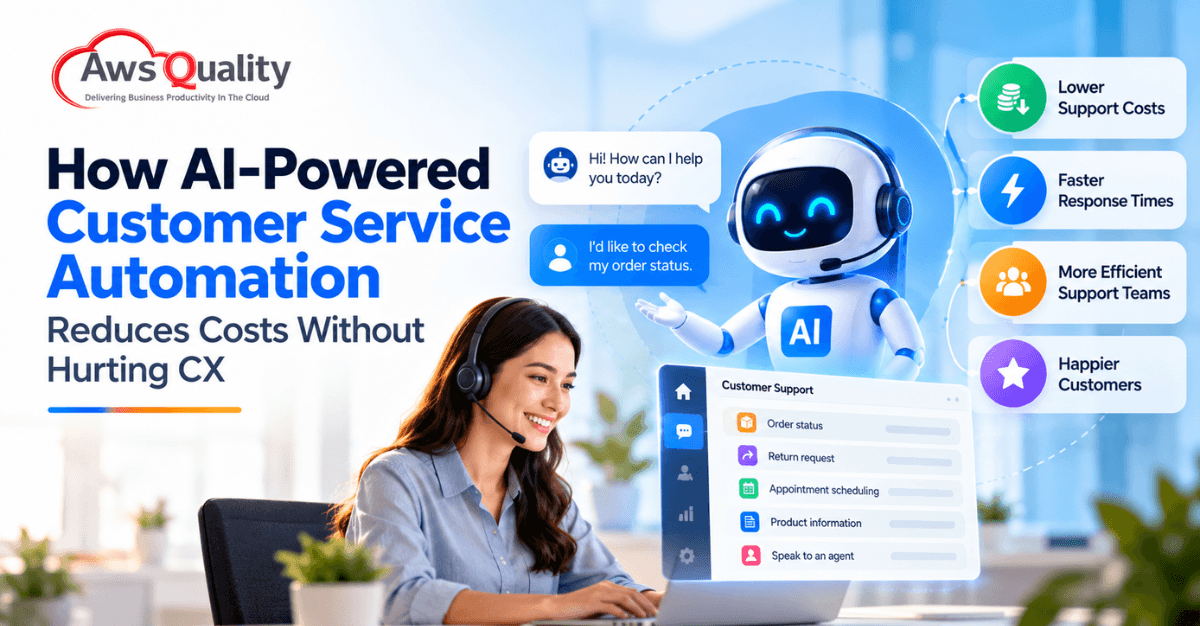
Customer service teams are under constant pressure to do two things at the same time: reduce operating costs and deliver better customer experiences.
That can be difficult when support volumes are growing, customers expect faster responses, and service teams need to work across chat, email, voice, social media, and other channels.
AI-powered customer service automation offers a way to address both challenges. By automating repetitive requests, assisting human agents, improving routing, and making customer information easier to access, businesses can reduce the cost of servicing customers without turning support into a frustrating self-service maze.
The key, however, is not to automate everything.
The most effective approach is to automate the right interactions and keep humans involved when customers need judgment, empathy, or specialized assistance.
Modern AI customer service platforms can now answer questions, retrieve information, perform defined actions, assist human agents, and escalate conversations when necessary. AWS and Salesforce, for example, both describe AI-agent architectures that combine automation with human escalation and business-system integration.
Key Takeaways
- AI customer service automation can reduce cost by handling repetitive, high-volume interactions without requiring proportional increases in staffing.
- The best automation targets predictable tasks such as FAQs, order-status requests, appointment scheduling, basic troubleshooting, and routing.
- AI should augment human agents rather than eliminate human support altogether.
- Seamless escalation is essential for protecting customer experience.
- Connecting AI to trusted business data and systems is more important than simply adding a chatbot.
- Businesses should measure both cost efficiency and CX outcomes, including resolution rate, customer satisfaction, escalation rate, response time, and cost per interaction.
- A phased implementation allows organizations to prove value before expanding automation.
What Is AI-Powered Customer Service Automation?
AI-powered customer service automation uses artificial intelligence to handle or assist with customer support activities that traditionally require manual effort.
Depending on the implementation, AI can:
- Answer frequently asked questions
- Understand customer intent
- Retrieve account or order information
- Recommend relevant knowledge articles
- Summarize customer conversations
- Draft agent responses
- Route requests to the appropriate team
- Schedule appointments
- Perform predefined service actions
- Assist human agents during live conversations
- Detect when a customer needs human assistance
- Transfer conversations to human agents with relevant context
- Give irrelevant answers
- Repeat the same response
- Force customers through rigid menus
- Fail to understand follow-up questions
- Make customers repeat information
- Hide the option to speak with a human
- Provide incorrect information
- Prevent customers from reaching the right department
- High-volume, routine tier-one inquiries with known, accurate answers
- 24/7 coverage for common questions outside business hours
- Initial intake and routing for all inbound contacts
- Post-interaction documentation and CRM updates
- Proactive notifications and outreach
- QA monitoring across all interactions
- Real-time information retrieval to support human agents mid-interaction
- Complex inquiries requiring judgment, nuance, or policy exceptions
- Emotionally charged interactions where empathy is the primary need
- High-value customer relationships where the personal dimension matters
- Escalations from AI interactions where resolution was not reached
- Cases involving legal, compliance, or sensitive personal circumstances
- Real-time suggestions
- Knowledge retrieval
- Summaries
- Recommended responses
- Next-best actions
- Customer intent
- Product
- Issue type
- Priority
- Customer segment
- Agent expertise
- Language
- Sentiment
- Cost per interaction
- Cost per resolved case
- Agent hours saved
- Automation rate
- Average handle time
- After-contact work time
- Staffing requirements
- Escalation costs
- Customer satisfaction (CSAT)
- Net Promoter Score (NPS)
- First-contact resolution
- Resolution rate
- Customer effort
- Response time
- Repeat contact rate
- Abandonment rate
- AI resolution rate
- Escalation rate
- Fallback rate
- Answer accuracy
- Hallucination/error rate
- Knowledge-grounding quality
- Tool/action success rate
- Human override rate
- AI and LLM capabilities
- Customer and business data
- CRM integration
- APIs and backend systems
- Knowledge bases
- Workflow automation
- Cloud infrastructure
- Security controls
- Human escalation
- Monitoring and analytics
- This is broader than a traditional rule-based chatbot.
Modern AI agents can understand natural-language requests, interact with business systems, and complete multi-step tasks within defined boundaries. AWS, for example, describes AI agents that can answer questions, take actions, and escalate to human agents when necessary.
Salesforce similarly describes customer service AI agents that can understand customer requests, retrieve information, and take specified actions while operating within defined guardrails.
The Cost Math: What AI Actually Changes
Understanding where the savings come from makes the implementation decisions clearer.
The per-interaction cost comparison is dramatic. Gartner reports a median cost of $1.84 per self-service contact compared with $13.50 for assisted channels. This illustrates why shifting appropriate, routine interactions toward self-service can have a significant economic impact. AI-native platforms operate at $1 to $3 per resolution. Human agents run $6 to $8 per interaction at baseline; complex escalated interactions are higher. Freshworks data shows cost per customer interaction dropping 68% — from $4.60 to $1.45 — after AI implementation across its customer base.
Volume deflection multiplies the savings. McKinsey reports that AI deployments reduce total interaction volume by 40–50%. When AI handles routine tier-one inquiries — order status, password resets, account information, standard FAQs — those interactions never reach the agent queue. Fewer interactions reaching agents means either fewer agents needed, or agents spending more time on higher-value work that actually requires their expertise.
What to realistically expect: The potential savings vary considerably by industry, contact volume, use case, and level of automation. McKinsey has documented customer-service transformations that reduced service interactions by 40–50% and lowered cost-to-serve by more than 20%. However, these results should be treated as examples rather than universal benchmarks. Actual savings depend on the processes automated, AI operating costs, integration effort, and the quality of the underlying customer-service workflows.
5 Ways AI Reduces Customer Service Costs Without Hurting CX
The businesses striking the right balance generate savings through five specific capabilities. Each one, implemented correctly, either improves the customer experience or maintains it rather than degrading it.
1. Instant Resolution of Tier-One Inquiries — 24/7, Without Wait Time The most frequent customer service interactions are often the most straightforward: “Where is my order?”, “How do I reset my password?”, “What are your return policy terms?”, “Can you update my billing address?” These questions have known answers. They require information — delivered accurately, quickly, and at any hour.
AI handles these interactions in seconds at 2 AM without a queue. The customer gets an answer in 30 seconds instead of waiting 8 minutes on hold until business hours. For this category of inquiry, the AI resolution is both cheaper for the business and genuinely better for the customer — faster, available around the clock, and consistent.
What makes this work without hurting CX: The AI must know its limits. An AI system that confidently gives wrong answers is far more damaging to customer trust than one that says “I’m not finding the right answer — let me connect you with someone who can help.” Define the boundary of AI-eligible inquiries carefully and do not stretch it past the point where accuracy can be maintained. Scope matters more than scale.
2. Agent Assist: Making Every Human Agent More Effective
Not every interaction can or should be fully automated. But AI can still significantly reduce the cost of human-handled interactions through Agent Assist tools that work alongside agents rather than replacing them.
When a human agent opens an interaction, Agent Assist surfaces the customer’s full history across all previous touchpoints, suggested responses based on similar past cases that resolved successfully, the most relevant knowledge base articles for the specific issue, sentiment analysis indicating whether the customer is frustrated or patient, and automated after-interaction documentation so agents do not spend time on post-call notes.
The result is faster resolution with less effort per interaction — and better outcomes for customers. According to Master of Code Global, its Zipify Agent Assist deployment achieved 65% faster response times, 2× faster ticket closure, and 30% lower operating costs. Each agent recovers approximately 6.4 hours per week through AI assistance — time redirected to more complex, relationship-intensive customer work.
This is the capability that most directly addresses the CX concern. The human is in the interaction. The customer relationship is maintained. The interaction is simply faster, better-informed, and less expensive to deliver.
3. Intelligent Routing That Gets Customers to the Right Place Faster
One of the most consistent sources of customer frustration — and one of the least-discussed drivers of support cost — is incorrect routing. A customer calls with a billing dispute and reaches technical support. A customer emails a complex question and lands in the general inquiry queue. The customer re-explains their issue when transferred. The agent who initially took the case writes handoff notes. Resolution takes twice as long as it should.
AI-powered intelligent routing analyzes the customer’s inquiry before routing occurs — reading the content of a chat message, analyzing the topic of an email, understanding the intent behind a voice query — and routes to the agent whose specific skills match that inquiry. It also factors in queue depth, agent availability, and customer history: a customer who has contacted three times about the same unresolved issue gets different routing priority than a first-time inquiry.
The CX benefit is immediate: customers reach someone who can actually help them, without transfers and without re-explaining. The cost benefit follows: first-contact resolution rates improve and total time per resolution decreases. Improving first-contact resolution can reduce repeat contacts and lower the cost of resolving customer issues.
4. Proactive Service That Prevents Issues Before They Become Contacts
Most customer service is reactive — the customer has a problem, contacts the company, and the company responds. Each reactive contact costs money and erodes satisfaction. AI makes a genuinely different model possible: identifying problems before customers contact the company, and reaching out proactively.
Examples of proactive AI-powered service:
A customer’s package has been delayed. Rather than waiting for the customer to call, the system sends an automated update with the new expected delivery date and a proactive message before the customer even knows there is a problem. A customer’s account shows a pattern indicating they are not using a feature they are paying for. An AI-triggered message offers a short tutorial or a plan better suited to their usage. A customer’s billing information is about to expire. An AI message reaches them two weeks before the card expires rather than after a payment fails and their service interrupts.
Proactive service reduces inbound contact volume — which reduces cost — while making customers feel attended to rather than chased.
5. Continuous Quality Assurance at Scale
Traditional QA in customer service reviews a sample of interactions — typically 2–5% — because human reviewers cannot process every conversation. The remaining 95%+ of interactions occur without any quality review, which means errors, policy violations, and inconsistent messaging can persist for weeks before they surface.
AI-powered QA can analyze a much larger share of interactions than traditional manual sampling, potentially covering 100% of conversations when the underlying channels and systems support it. It flags conversations where sentiment is deteriorating, where resolution took significantly longer than average, where policy was communicated incorrectly, or where the customer used language suggesting they are considering leaving. These flags enable supervisors to intervene in live interactions when needed and identify coaching opportunities for individual agents.
Better QA produces better interactions — which improves customer satisfaction and reduces the repeat contacts that come from unresolved issues. The cost reduction comes from identifying and fixing quality problems faster, rather than letting them compound into customer churn.
Why Cost Reduction Alone Can Damage Customer Experience
There is a major difference between automation that removes friction and automation that removes access to help.
A poorly designed customer-service bot may:
These problems can make a company appear less helpful even if the automation reduces the number of interactions reaching human agents.
Recent industry guidance increasingly emphasizes context, natural conversation, human escalation, and orchestration rather than simply increasing chatbot containment. IBM, for example, notes that rigid automation can create repeated questions and dead ends that undermine customer confidence.
The goal should therefore be lower service cost per resolved interaction—not simply fewer human interactions.
The Human-AI Partnership: Where the Balance Lives
The operational model that consistently generates both cost savings and CX improvement follows the same underlying principle: match the interaction type to the resource best suited to handle it.
AI handles well:
Humans handle better:
The transition between them must be seamless. When AI escalates to a human agent, the agent receives the full conversation history, the customer’s account context, and the AI’s assessment of what has already been attempted. The customer does not need to repeat themselves. The handoff should feel seamless to the customer, with the relevant conversation history and context passed to the human agent. The experience feels continuous.
AI handles what it can → humans handle what requires human judgment
A useful framework is:
| Customer interaction | Recommended approach |
|---|---|
| FAQ or basic information | AI self-service |
| Order/status lookup | AI automation |
| Password reset | AI automation |
| Appointment scheduling | AI automation |
| Basic troubleshooting | AI + knowledge base |
| Account-specific request | AI with authenticated system access |
| Complex technical problem | AI-assisted human |
| Billing dispute | Human review with AI assistance |
| Sensitive complaint | Human agent |
| High-value customer issue | Human-led with AI assistance |
| Safety, legal, or emotionally sensitive issue | Human-led |
This model allows organizations to capture automation benefits without forcing every customer into an AI-only experience.
AI Customer Service Use Cases
AI-powered automation can support many areas of customer service.
AI Chatbots and Virtual Agents
AI can provide 24/7 support for routine questions and guided workflows.
Unlike traditional rule-based bots, modern AI agents can understand natural-language questions and maintain context across a conversation.
Intelligent Email Automation
AI can classify incoming emails, identify intent, retrieve relevant information, draft responses, and route complex requests to the appropriate team.
For example, a single email containing refund, baggage, and loyalty questions can potentially be separated into multiple intents and routed through the appropriate workflows.
Recent Salesforce customer-service deployments demonstrate how agentic systems can orchestrate multi-intent email workflows and backend actions.
Voice AI
AI-powered voice systems can handle common customer requests without requiring customers to navigate traditional IVR menus.
They can understand natural-language requests, retrieve information, complete supported actions, and escalate to a human when required.
Agent Assist
AI can work alongside customer-service representatives by providing:
This is particularly valuable for complex support environments where human involvement remains essential.
Intelligent Routing
AI can classify incoming requests and route them based on:
Better routing can reduce unnecessary transfers and help customers reach the right resource faster.
Self-Service Troubleshooting
AI can guide customers through troubleshooting procedures for products, software, devices, and services.
If the issue cannot be resolved through self-service, the AI can escalate the conversation with the troubleshooting history attached.
AI in Salesforce Customer Service: What Is Available Now
For organizations running Salesforce Service Cloud, the AI capabilities available in 2026 are significant — and more tightly integrated with existing service workflows than any previous generation of customer service AI.
Agentforce for Service deploys AI agents that handle customer inquiries autonomously across chat, email, and messaging channels. Salesforce reports that Agentforce can autonomously handle customer-service interactions across supported channels, with escalation to human agents when required.
Einstein for Service provides Agent Assist capabilities within the Service Console: AI-generated reply suggestions, case summaries that give agents instant context on complex issues, next-best-action recommendations, and automated case classification and routing. Each of these reduces the time and cognitive load per interaction while keeping the human in control.
Service Intelligence provides real-time analytics across all service interactions — CSAT trends, resolution time, deflection rates, escalation patterns — that give service leaders the visibility to identify where the human-AI balance needs adjustment.
For organizations that are not yet on Salesforce Service Cloud, these same principles apply across other major service platforms — the underlying human-AI partnership model transfers regardless of the specific tools.
How to Measure Whether AI Automation Is Actually Working
Reducing customer-service costs is only one part of the equation.
A successful AI implementation should measure both operational efficiency and customer experience.
Cost Metrics
Consider tracking:
Customer Experience Metrics
Track:
AI Quality Metrics
Also measure:
AWS identifies metrics such as containment, first response time, and customer satisfaction as useful measures for evaluating automated customer-service solutions.
A Simple Way to Think About AI Customer Service ROI
A useful way to think about the economics is:
Business value = Cost Savings + Productivity Gains + CX/Retention Value − AI Operating and Implementation Costs
This is more useful than measuring automation percentage alone.
For example, an organization might achieve a high automation rate but still have poor ROI if customers frequently repeat contacts or abandon the automated channel.
Common Mistakes That Actually Hurt CX
Understanding what goes wrong is as important as understanding what works.
Automating interactions that should not be automated. Complaint escalations, complex billing disputes, service failures with significant customer impact, and interactions where the customer has already escalated once — these require human judgment. An AI response to an already-frustrated customer amplifies the frustration. Use AI to prepare the human who handles these interactions, not to replace them.
Building without a clear escalation path. An AI system that loops customers through repeated attempts at resolution without a clear, easy option to reach a human is the most reliable way to damage trust. Make escalation fast, visible, and well-signaled at every point in the AI interaction.
Deploying before the knowledge base is ready. AI quality is directly proportional to the quality of the knowledge it draws from. An AI system trained on incomplete, outdated, or inconsistent information produces incomplete, outdated, and inconsistent answers. Build and validate the knowledge base before deploying the AI that uses it.
Optimizing for deflection, not resolution. The goal is not preventing customers from reaching the company. It is resolving customer problems at lower cost. These are not the same thing. An AI that deflects contacts without resolving the underlying issue delays the cost of the interaction — the customer calls back, emails again, or quietly churns. Track resolution rates, not just deflection rates.
Ignoring customer feedback on the AI experience. The organizations generating the strongest AI customer service results treat deployment as a continuous process. They collect feedback on AI interactions, identify where customers are expressing frustration or requesting human escalation, and improve the AI’s scope and accuracy over time. A static deployment is a degrading deployment.
Implementation Approach: Getting Started Without Creating CX Risk
Start with a volume-impact analysis. Before selecting a platform, analyze your inbound contact data. What are the ten most common inquiry types by volume? What percentage of total contact volume do they represent? Which ones have clear, consistent answers? This identifies where AI reduces volume without creating CX risk — high-volume, low-complexity inquiries where resolution is both accurate and faster than a human queue.
Implement Agent Assist before fully autonomous AI. Agent Assist is lower risk and delivers immediate value: agents are more productive, interactions are faster, and customer experience improves. It also builds your team’s experience working with AI tools before the higher-stakes decision of which interaction types to fully automate.
Define escalation criteria explicitly. Before going live with any autonomous AI interaction, document the specific conditions under which the AI transfers to a human — by intent (certain inquiry types always transfer), by sentiment (escalation when customer frustration exceeds a defined threshold), by history (customers with open complaints transfer automatically), and by resolution path (transfer with context after three unsuccessful resolution attempts).
Measure resolution quality, not just deflection rate. Track first-contact resolution for AI-handled interactions. Track repeat contact rate within 7 days of AI resolution. Track CSAT for AI-handled versus human-handled interactions. These metrics tell you whether AI is resolving customer issues or simply delaying them.
AI Customer Service Automation vs. Traditional Chatbots
It is useful to distinguish modern AI customer service automation from older chatbot approaches.
| Traditional Chatbot | AI-Powered Customer Service |
|---|---|
| Often follows predefined flows | Understands natural-language requests |
| Limited conversation context | Can maintain conversational context |
| Primarily answers predefined questions | Can retrieve information and perform defined actions |
| Often requires exact wording | Can interpret variations in language |
| Limited system integration | Can connect to business systems and tools |
| Basic escalation | Context-aware human handoff |
| Can combine AI with workflows and business rules |
The distinction is becoming increasingly important as AI agents move beyond simple question answering toward task completion and system orchestration.
How AwsQuality Can Help Businesses Build AI-Powered Customer Service Solutions
Implementing AI customer service is not simply a matter of adding a chatbot.
A successful solution requires the right combination of:
AwsQuality works across AI, Salesforce, cloud, data engineering, DevOps, web, and application development, making it possible to approach customer-service automation as a broader technology and business workflow rather than an isolated AI feature.
For organizations evaluating AI-powered customer service, the focus should be on identifying the right processes to automate, connecting AI to reliable business data, designing safe workflows, and measuring both operational and customer outcomes.
Frequently Asked Questions
How does AI reduce customer service costs?
AI reduces customer service costs by automating repetitive interactions, reducing agent handle time, assisting representatives, improving routing, reducing after-contact work, and helping teams handle higher volumes without proportionally increasing staffing.
Can AI customer service improve customer experience?
Yes. When implemented correctly, AI can provide faster responses, 24/7 availability, personalized information, self-service, and quicker resolution of routine requests. However, poor automation can have the opposite effect, so human escalation and accurate information are essential.
Will AI replace customer service agents?
AI is more effective when used to augment human agents rather than replace them completely. AI can handle repetitive tasks and assist with information retrieval, while human agents handle complex, sensitive, emotional, or high-value interactions.
What customer service tasks should be automated first?
Start with high-volume, low-complexity, predictable tasks such as FAQs, order tracking, appointment scheduling, password resets, and basic troubleshooting.
How can businesses prevent AI from giving incorrect answers?
Use trusted knowledge sources, retrieval-based architectures where appropriate, clear instructions, guardrails, testing, monitoring, confidence thresholds, and human escalation. High-impact actions should also use deterministic business rules or approval workflows.
How does AI improve agent productivity?
AI can summarize conversations, retrieve knowledge, suggest responses, identify customer intent, recommend next steps, automate documentation, and surface relevant customer information.
What is AI agentic customer service?
Agentic customer service uses AI agents that can understand customer requests, reason across multiple steps, interact with business systems or tools, and complete defined tasks while operating within established permissions and guardrails.
How should businesses measure AI customer service success?
Measure both financial and CX outcomes. Important metrics include cost per interaction, automation or containment rate, resolution rate, first-contact resolution, average handle time, response time, CSAT, escalation rate, repeat contacts, and AI accuracy.
Conclusion
AI-powered customer service automation can reduce costs without hurting customer experience—but only when automation is designed around the customer rather than around automation itself.
The most effective strategy is to let AI handle high-volume, repetitive, predictable work, while giving human agents the information and tools they need to handle complex situations.
The winning model is not AI versus humans.
It is AI for speed and scale, humans for judgment and empathy.
Businesses that combine reliable customer data, intelligent automation, clear business rules, strong guardrails, and seamless human escalation can reduce service costs while creating faster, more consistent, and more personalized customer experiences.
For organizations considering AI customer service automation, the best place to start is not with the question, “How much can we automate?”
It is:
“Which customer interactions can we make faster, easier, and more effective with AI—without making the customer work harder?”
 Bio