Artificial intelligence is moving beyond standalone chatbots and copilots. Enterprises increasingly want AI systems that can understand business context, reason across data, execute workflows, and take governed actions.
That shift is particularly visible in the Salesforce ecosystem.
Salesforce has positioned Agentforce as its platform for building and deploying AI agents that can reason, interact with enterprise data, and execute business actions. At the same time, Salesforce and Anthropic announced Claudeforce in August 2026, bringing Claude’s reasoning capabilities together with Salesforce data, workflows, business logic, actions, and governance.
This creates an important question for organizations evaluating enterprise AI:
Is Claudeforce a competitor to Agentforce, or are the two becoming complementary parts of the same AI strategy?
The answer is more nuanced than a conventional product comparison.
In this guide, we’ll compare Agentforce vs Claudeforce across features, capabilities, architecture, use cases, integrations, governance, and enterprise considerations—and explain which approach may make more sense for different business scenarios.
Agentforce and Claudeforce Are Not Competitors
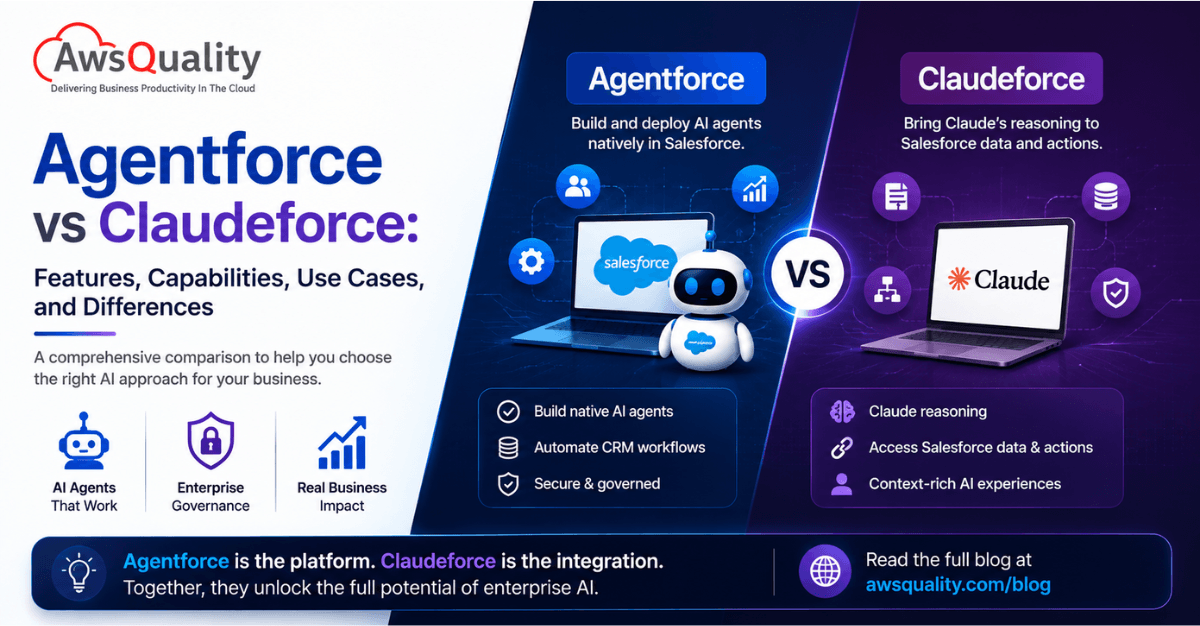
The most important thing to understand before any feature comparison is this: Agentforce and Claudeforce are not competing products. They are complementary components of a single AI strategy that Salesforce is building with Anthropic.
Claude is deeply integrated across Agentforce, serving as a reasoning model for the Atlas Reasoning Engine, powering Agentforce Vibes and Agentforce Coworker by default, and available as a model option in Agent Builder. Claudeforce did not introduce Claude to Salesforce’s ecosystem. It formalized and expanded a relationship that was already operational.
Claudeforce runs in two directions simultaneously:
- Claude moves deeper into Salesforce
- Salesforce moves into Claude
— becoming a default or deeply integrated model across several Agentforce and Slack experiences.
— embedding Salesforce data, workflows, and business logic inside the Claude interface through a new plugin.
Agentforce and Claudeforce solve related but distinct problems. Understanding which problem your organization needs to solve determines which capability, or which combination, applies.
Don’t Forget Classic Salesforce Automation
Agentforce and Claudeforce are not the only options for Salesforce automation. Traditional Salesforce automation—including Flows, Triggers, and other deterministic business logic—remains an important part of enterprise architecture.
Not every workflow needs AI.
For processes that are highly repeatable, deterministic, and governed by clearly defined rules, traditional automation can often provide more predictable execution and easier testing and auditing.
A practical Salesforce automation strategy may therefore combine three approaches:
| Requirement | Best-fit approach |
|---|---|
| Deterministic, rule-based processes | Salesforce Flows / Triggers |
| AI-driven, adaptive workflows and autonomous actions | Agentforce |
| Claude-first knowledge work using Salesforce context | Claudeforce |
| Complex enterprise environments | Combination of all three |
The goal should not be to replace existing automation with AI simply because AI is available. Instead, organizations should determine whether a workflow requires deterministic automation, AI-driven reasoning, or a combination of both.
For regulated or high-impact processes, enterprises should pay particular attention to predictability, permissions, human oversight, auditability, and business-rule enforcement before introducing agentic behavior.
Quick Answer: Agentforce vs Claudeforce
Agentforce is Salesforce’s enterprise AI agent platform. Claudeforce is a Salesforce–Anthropic partnership that connects Claude’s reasoning capabilities with Salesforce’s enterprise data, workflows, business rules, actions, and governance.
Agentforce is primarily the agent-building and execution environment inside the Salesforce ecosystem. Claudeforce extends Claude into Salesforce workflows and brings Salesforce capabilities into Claude. Salesforce also makes Claude available inside Agentforce as a reasoning model.
| Area | Agentforce | Claudeforce |
|---|---|---|
| Primary role | Enterprise AI agent platform | Salesforce + Anthropic integration |
| Core AI | Supports multiple AI models | Claude |
| Enterprise data | Salesforce data and connected sources | Salesforce data accessible through Claude |
| Business workflows | Native Salesforce actions and workflows | Salesforce workflows and actions through the integration |
| AI agents | Build and deploy agents | Claude-powered agentic experiences |
| Main environment | Salesforce ecosystem | Claude + Salesforce ecosystem |
| CRM automation | Strong | Strong |
| Claude reasoning | Available through supported models | Core to the experience |
| Governance | Salesforce trust and governance framework | Salesforce governance combined with Claude |
| Best fit | Building Salesforce-native agents | Bringing Claude reasoning into Salesforce-driven work |
The key takeaway is simple:
Agentforce is primarily the enterprise agent platform, while Claudeforce is the broader Salesforce–Anthropic partnership and integration strategy connecting Claude with Salesforce capabilities.
What is Agentforce?
Agentforce is Salesforce’s platform for building, deploying, and governing autonomous AI agents that operate inside the Salesforce ecosystem. It is the answer to the question: how do we put AI agents to work inside the CRM, with the governance controls that enterprise software requires?
How Agentforce Works
Agentforce agents are built inside Salesforce using the Agent Builder interface. Each agent is defined by:
Topics — the categories of requests the agent is authorized to handle. A customer service agent might have topics covering return processing, account inquiries, and shipping status. An agent that receives a request outside its defined topics escalates to a human rather than attempting to handle it.
Actions — the specific capabilities the agent can use to handle each topic. Actions include querying Salesforce records, updating case fields, triggering Salesforce Flow workflows, sending emails, and calling external APIs through MuleSoft. An action is a specific, governed capability, not a general “do anything” instruction.
The Atlas Reasoning Engine — the reasoning layer that can use Claude as a supported reasoning model — interprets the incoming request, selects the appropriate action, executes it, evaluates the result, and determines what to do next.
Instructions — the prompt that defines the agent’s persona, its boundaries, and its escalation criteria.
Check out: Why your Salesforce implementation isn’t delivering results
What Claude Does Inside Agentforce
Since late 2025, Claude has been deeply embedded across Agentforce’s primary surfaces:
| Agentforce Surface | Claude’s Role |
|---|---|
| Atlas Reasoning Engine | Available as a reasoning model powering agent plan-and-act loops |
| Agentforce Vibes | Default model in the Vibes IDE for agent testing |
| Agentforce Coworker | Default model powering the internal employee-facing agent |
| Agent Builder | Selectable model option when configuring new agents |
Claude is deployed within Agentforce through Amazon Bedrock inside the Salesforce Trust Boundary. This means inference workloads — the actual AI processing — remain within Salesforce’s security perimeter rather than making a round trip to an external API endpoint. For organizations in financial services, healthcare, life sciences, and public sector, this is the security detail that enables regulated-industry deployment.
Agentforce Adoption and Customer Results in 2026
Agentforce has moved beyond early experimentation into large-scale enterprise adoption. In Salesforce’s FY2026 results, the company reported more than 29,000 Agentforce deals since launch, up 50% quarter over quarter. Salesforce also reported more than 2.4 billion Agentic Work Units (AWUs) delivered across Agentforce and Slack, with AWUs growing 57% quarter over quarter. An AWU measures a discrete task executed by an AI agent in production, such as resolving a customer case, updating a record, or triggering an automated workflow.
Customer deployments also provide examples of measurable business impact. Salesforce reports that Wiley achieved 40% higher case resolution after implementing Agentforce Service Agent. Engine resolves 50% of chat inquiries with Agentforce, while OpenTable reports 73% case resolution within three weeks of launching its restaurant agent.
Where Agentforce Lives
Agentforce agents live inside Salesforce. They operate on Salesforce data, governed by Salesforce permissions, and their execution stays within the Salesforce platform. A customer service agent built in Agentforce handles customer inquiries that arrive through Salesforce Service Cloud — not through a general-purpose AI interface.
This is Agentforce’s core architectural characteristic: it is Salesforce-native. The agents it builds are designed to be deployed inside the Salesforce environment, embedded in customer service workflows, sales processes, and employee-facing tools that run on the CRM platform.
Also check: Driving Salesforce User Adoption – A CXO’s Guide to Maximizing ROI
What is Claudeforce?
Claudeforce is the expanded strategic partnership between Salesforce and Anthropic, announced August 26, 2026. It is not a single product. It is an umbrella name covering three distinct workstreams, each at a different maturity level, addressing different personas, and carrying different risk profiles for organizations evaluating adoption.
Understanding Claudeforce requires keeping these three workstreams separate because they are genuinely different things:
Workstream 1: Claude in Salesforce (Deepened Integration — Already Live)
The first workstream formalizes and deepens Claude’s role inside Agentforce. This is the least-new part of the Claudeforce announcement: Claude was already the default reasoning model across Atlas, Agentforce Vibes, and Agentforce Coworker before August 26. Claudeforce makes this placement official, permanent, and expanded.
Additionally, Salesforce is making Claude Code and Claude Enterprise available to all Salesforce developers and knowledge workers as the organization’s preferred AI assistant and productivity tools. Claude is the first LLM provider described as fully integrated within the Salesforce Trust Boundary.
What this means practically: If you are already running Agentforce with Claude models, nothing about your existing setup changes. Claudeforce formalizes the relationship and adds commitments to deepen the integration. Model optionality is preserved — Agent Builder’s model picker still works, and Agentforce supports Google Gemini 3.5 Flash as a native model option alongside Claude variants.
Workstream 2: Salesforce in Claude (The Headline New Product — Pilot/Beta)
This is the genuinely new capability and the product that gave Claudeforce its name. Salesforce in Claude is a plugin that brings Salesforce data, workflows, and business logic directly into the Claude interface — allowing knowledge workers to interact with Salesforce’s capabilities without opening the Salesforce application.
The plugin launches with 37 prebuilt sales skills engineered specifically for revenue team workflows:
- Meeting prep — assembles relevant account data, recent activity, open opportunities, and relationship history before a sales call
- Deal health review — surfaces signals from opportunity data, engagement history, and pipeline stage to assess deal risk and momentum
- Pipeline review — provides a consolidated view of pipeline status, coverage, and at-risk deals
The specific design decision that distinguishes Salesforce in Claude from simply connecting Claude to Salesforce via an MCP server is the skill architecture. Apex Hours’ technical analysis explains this distinction clearly: “A raw MCP connection gives Claude a pile of operations and hopes it picks well. A skill encodes task-specific guidance — which of two overlapping fields to trust, what ‘deal health’ means in your pipeline. That’s the difference between a pipeline review that’s consistent across your team and one that varies by who typed the prompt.”
The governance model addresses the problem that limited earlier MCP-based integrations: one admin connects the org once, and every user gets access scoped to their own Salesforce permissions. No per-user MCP configuration. Profiles, permission sets, and sharing rules all hold — if a rep cannot see a record in Salesforce, Claude cannot see it for them either.
Availability: Select pilot customers as of August 26, 2026. Open beta planned for September 2026. Additional prebuilt skills beyond the 37 sales skills, covering business functions outside revenue teams, are expected in late 2026. No pricing has been publicly announced.
Workstream 3: Claude in Slack (Rolling Out)
Claude becomes the default model for Slack, powering the Slackbot, Claude Tag, and Slack Code. Salesforce’s internal results provide the most concrete data point in the entire Claudeforce announcement: 83% of Salesforce’s workforce uses the Claude-powered Slackbot, driving 8.1 million hours of annualized productivity gains, with Slackbot user growth up more than 150% quarter over quarter. Slackbot revenue is now counted inside Agentforce ARR.
Read: How to Migrate to Salesforce Without Losing Your Data
Use Cases: When to Use Agentforce, When to Use Claudeforce, When to Use Both
Agentforce Use Cases
Customer service automation. An Agentforce Service Agent handles incoming customer inquiries — return requests, account questions, shipping status — autonomously through Service Cloud. The agent reads the customer’s CRM record, executes the resolution (processing the return, updating the case, sending confirmation), and escalates to a human only when the situation falls outside its defined scope.
Employee self-service. Agentforce Coworker handles internal employee requests — HR policy questions, IT support triage, expense reimbursement status — directing employees to self-service resolution rather than routing every query to a human service team.
Sales workflow automation. Agentforce agents deployed in Sales Cloud automatically update CRM records based on email activity, generate post-call summaries, classify leads based on engagement signals, and route high-priority opportunities to the appropriate team members.
Regulated industry deployment. Claude inside Agentforce, running through Amazon Bedrock within the Salesforce Trust Boundary, is the architecture Salesforce recommends for financial services, healthcare, and government customers who cannot route inference workloads through external API endpoints.
Claudeforce / Salesforce in Claude Use Cases
Pre-meeting sales preparation. A sales rep starting their day opens Claude, and the Salesforce in Claude plugin surfaces their accounts, open opportunities, and recent activity — assembling the meeting prep that previously required navigating multiple Salesforce objects manually.
Deal health assessment. A sales manager asks Claude to review a key deal and receives an analysis drawn from live Salesforce opportunity data, engagement history, and pipeline signals — without opening Salesforce Reports.
Pipeline review without the dashboard. An executive asks Claude for a consolidated pipeline review across their team. Claude queries Salesforce through the plugin and returns a structured analysis, with the option to take governed actions (updating a forecast category, reassigning an opportunity) directly from the Claude conversation.
Cross-application knowledge work. A senior seller is composing a proposal in Claude. The plugin gives Claude access to the account history, previous contract details, and competitive intelligence in Salesforce — so the proposal is grounded in actual relationship context, not generic templates.
When to Use Both
The most complete AI strategy for a Salesforce-invested organization is not either/or — it is both, for different personas and different task types.
Agentforce handles the volume, the automation, and the customer-facing and employee-facing agent deployments that need to be governed, scalable, and embedded in production workflows.
Claudeforce handles the knowledge worker productivity layer — the sales reps, executives, and analysts who primarily work in Claude and need Salesforce to be accessible from that interface rather than requiring them to open the CRM.
The same Salesforce data and governance layer powers both. A record updated by an Agentforce agent is immediately visible to a Salesforce in Claude query. The two runtimes are connected by the same permission model, the same data layer, and in the future, Agentforce agents accessible as actions from Salesforce in Claude.
Also read: Top Salesforce Integrations Every Growing Business Needs
Agentforce vs Claudeforce for Sales Teams
This is one of the most interesting areas of overlap.
Agentforce
Best when the organization wants to build a Salesforce-native AI sales agent.
Claudeforce
Potentially attractive when sellers already use Claude extensively and want Salesforce information and actions available within that workflow.
For example:
“Review my pipeline and identify the five opportunities most likely to slip this quarter.”
Claude can reason over relevant Salesforce context.
The user could then ask:
“Prepare an action plan for each opportunity.”
And potentially:
“Update the opportunity records with the next steps.”
The key advantage is that the user does not necessarily need to think in terms of navigating Salesforce screens.
Agentforce vs Claudeforce for Customer Service
For customer service, Agentforce may have a more obvious fit because it is designed around Salesforce’s CRM and service ecosystem.
Organizations can build agents around:
- Cases
- Accounts
- Contacts
- Knowledge
- Service workflows
- Escalations
- Business rules
Claudeforce can still contribute by bringing Claude’s reasoning capabilities into Salesforce-driven workflows.
Therefore, a company might use:
Agentforce + Claude
rather than choosing one or the other.
Agentforce vs Claudeforce for Enterprise Knowledge Work
This is where Claudeforce can become particularly compelling.
Many employees don’t live inside Salesforce all day.
Salespeople may work across:
- Claude
- Slack
- Salesforce
- Documents
- Analytics
- Collaboration tools
Claudeforce is designed around the idea that AI should be available where work happens rather than forcing employees to constantly switch interfaces.
Salesforce describes Slack as a workspace where humans and agents can work together, with Claude integrated into Slack experiences.
This points toward a broader enterprise AI architecture:
- Salesforce = trusted business system
- Claude = reasoning and intelligence
- Slack = collaboration layer
- Agents = execution layer
Key Technical Differences: Architecture
Agentforce architecture: User request → Agentforce agent (Atlas Reasoning Engine, powered by Claude) → Salesforce tools and data → Salesforce record updates → Response delivered inside Salesforce
The entire workflow runs inside Salesforce. The user interface is Salesforce — the agent is deployed in Service Cloud, Sales Cloud, or an employee-facing portal.
Claudeforce (Salesforce in Claude) architecture: User prompt in Claude → Salesforce in Claude plugin (AIforce + MCP) → Hosted MCP Server (Discover → Describe → Dispatch) → Salesforce records and workflows → Response delivered inside Claude
The interface is Claude. Salesforce is the data and action layer accessed through the MCP connection. The user never opens Salesforce directly — Claude surfaces the data and takes the actions on their behalf, governed by their own Salesforce permissions.
What connects them: The Model Context Protocol (MCP) is the bridge. AIforce’s MCP servers are model-agnostic — they expose Salesforce capabilities to Claude today, but could expose them to any MCP-compliant AI client. Salesforce’s Summer ’26 release demonstrated this by adding Google Gemini 3.5 Flash as a native Agentforce model option. The architecture is designed to be multi-model, even as Claude is today’s preferred partner.
Agentforce vs Claudeforce: Which Is Better?
There is no universal winner—and in many cases, the choice isn’t between Agentforce and Claudeforce at all. Traditional Salesforce automation may be the better fit for deterministic workflows, while Agentforce and Claudeforce address different forms of AI-driven work.
The right choice depends on the business problem.
| Business Requirement | Better Fit |
|---|---|
| Deterministic, repeatable CRM automation | Flows / Triggers |
| Build Salesforce-native AI agents | Agentforce |
| Create customer service agents | Agentforce |
| Build CRM automation | Agentforce |
| Use multiple AI models | Agentforce |
| Use Claude as a reasoning model | Both |
| Bring Salesforce into Claude | Claudeforce |
| Claude-first knowledge work | Claudeforce |
| Sales workflows inside Claude | Claudeforce |
| Salesforce-native governance and actions | Agentforce |
| Combine Claude + Salesforce | Claudeforce / Agentforce |
| Enterprise hybrid AI strategy | Potentially both |
| Users primarily work in Salesforce | Agentforce |
| Users primarily work in Claude | Claudeforce |
| Users work across Salesforce, Claude, and Slack | Hybrid approach |
Agentforce vs Claudeforce vs Claude: a mini comparison
| Agentforce | Claudeforce | Claude | |
|---|---|---|---|
| What it is | AI agent platform | Salesforce–Anthropic partnership/integration | AI model/AI platform |
| Primary strength | Enterprise agents | Salesforce + Claude integration | Reasoning and AI assistance |
| Salesforce-native | Yes | Connected | Not inherently |
| Salesforce data | Native | Connected through integration | Via integrations |
| Agent building | Yes | Through integrated capabilities | Yes, depending on Claude capabilities |
| Best for | Salesforce-native automation | Claude + Salesforce workflows | General enterprise AI/knowledge work |
When Should a Business Choose Agentforce?
Agentforce may be the stronger choice when:
- Salesforce is your central business platform.
- You want to build custom AI agents.
- Customer service automation is a priority.
- Sales automation is a priority.
- You need agents to execute Salesforce actions.
- You want to use different AI models.
- Your teams already work primarily inside Salesforce.
- You want a Salesforce-native agent development environment.
In these situations, Agentforce can serve as the foundation for an enterprise agent strategy.
Read: Low Salesforce Adoption? Try These 7 Fixes That Work
When Should a Business Consider Claudeforce?
Claudeforce may be particularly interesting when:
- Employees already rely heavily on Claude.
- Your organization wants Claude’s reasoning capabilities connected to CRM context.
- Sales teams want to work with Salesforce data from within Claude.
- You want AI to operate across Salesforce and other knowledge sources.
- You want to reduce application switching.
- You want Salesforce business rules to remain part of AI-driven workflows.
Salesforce says Salesforce in Claude is currently available to select pilot customers, with open beta planned for September 2026.
Because the Claudeforce ecosystem is still evolving, enterprises should evaluate the capabilities available for their specific region, edition, use case, and deployment model rather than assuming every announced capability is generally available.
Agentforce vs Claudeforce: Security and Governance
Security and governance are critical considerations when deploying AI agents in an enterprise environment. The question is not only what an AI system can understand, but also what data it can access, what actions it can take, and what controls govern those actions.
What Data Can the AI Access?
Organizations should define access at the user, agent, application, and data levels. AI agents should only have access to the information required to perform their assigned tasks, following the organization’s existing permissions and access policies.
What Can the AI Change?
There is an important difference between retrieving information and modifying business data. Reading a Salesforce record may carry limited risk, while updating an opportunity, changing a case, or triggering a workflow can have direct business consequences. Agent actions should therefore be scoped to clearly defined and authorized capabilities.
Which Actions Require Human Approval?
Not every AI-generated action should be fully autonomous. High-impact activities—particularly those involving financial, customer, legal, or operational consequences—may require human review or approval before execution.
Are Business Rules Enforced?
AI agents should operate within established business rules rather than bypassing them. Salesforce-connected actions should respect the organization’s permissions, workflows, validation requirements, and other applicable controls.
Where Is Data Processed?
Enterprises should understand how and where AI inference and data processing occur. Key considerations include model hosting, data residency, data retention, logging, privacy requirements, and contractual controls. Salesforce states that Claude can be deployed through Amazon Bedrock within the Salesforce Trust Boundary, an important consideration for organizations with stringent data-security requirements.
Can AI Actions Be Audited?
Enterprise AI systems should provide sufficient visibility into important agent activity. Organizations should be able to determine what the agent accessed, what actions it took, and when those actions occurred so that significant AI-driven activity can be reviewed and investigated when necessary.
Security Considerations for Agentforce and Claudeforce
Both Agentforce and Claudeforce are designed to connect AI capabilities with enterprise data and workflows, but organizations should evaluate the specific architecture and data flows used for each deployment. Claudeforce’s Salesforce integration is designed to preserve Salesforce permissions and business rules when Claude interacts with Salesforce capabilities.
For example, Salesforce says that users interacting with Salesforce through the Salesforce in Claude plugin continue to be governed by their existing Salesforce permissions. If a user cannot access a Salesforce record, Claude cannot access that record on the user’s behalf.
Ultimately, enterprises should not evaluate Agentforce or Claudeforce based solely on the capabilities of the underlying AI model. Security, permissions, data access, action controls, auditability, privacy, and governance should be evaluated as part of the complete AI architecture.
Before moving either solution into production, organizations should conduct a security, privacy, compliance, and architecture assessment based on their specific data, industry requirements, workflows, and deployment model.
Availability and Timeline (Updated September 2026)
| Component | Status |
|---|---|
| Agentforce | Generally available — 29,000+ deals, production deployments across industries |
| Claude in Atlas Reasoning Engine / Agent Builder | Available — deployed since late 2025 |
| Claude in Agentforce Vibes / Coworker | Default model — live now |
| Salesforce in Claude plugin (37 sales skills) | Select pilot customers — open beta September 2026 |
| Claude Tag (Slack + Salesforce connection) | Public beta — rolling out |
| AIforce Hosted MCP Server | Beta since July 2026 (API version 67.0+ required) |
| Additional prebuilt skills beyond sales | Late 2026 |
| Claude Code and Claude Enterprise for Salesforce devs | Salesforce’s preferred AI assistant — announced, availability details in progress |
| Claude as Slack default (Slackbot, Slack Code) | Rolling out — 83% internal Salesforce adoption |
* Availability and product capabilities can change. Verify current availability, pricing, and regional eligibility with Salesforce before making purchasing decisions.
Organizations running pilots alongside major Salesforce releases should coordinate testing and deployment schedules to isolate changes and reduce troubleshooting complexity.
Also read: Why Salesforce implementations fail — and how to avoid common mistakes
Agentforce vs Claudeforce: What Does This Mean for Salesforce Customers?
For existing Salesforce customers, the emergence of Claudeforce could signal a broader change in how enterprise software is used.
Traditionally:
User → Application UI → Data → Workflow → Action
Increasingly:
User → AI → Business Context → Reasoning → Action
The interface may become less important because the AI can retrieve information and execute workflows on behalf of the user.
Salesforce itself describes this shift as moving toward software that powers interfaces rather than requiring users to manually navigate static interfaces.
For businesses, this could mean that the future Salesforce strategy isn’t simply about improving CRM screens.
It is about making CRM data and business logic accessible to intelligent agents.
Common Mistakes When Evaluating Agentforce and Claudeforce
Mistake 1: Treating Them as Simple Competitors
The current relationship is more interconnected than a traditional platform comparison.
Mistake 2: Focusing Only on Model Intelligence
The best reasoning model cannot compensate for poor data quality, missing business context, or weak workflow integration.
Mistake 3: Ignoring Data Governance
Giving an AI agent access to enterprise data without carefully defined permissions creates unnecessary risk.
Mistake 4: Automating Before Understanding the Workflow
Organizations should redesign the process before simply inserting an AI agent into it.
Mistake 5: Measuring AI Adoption Instead of Business Impact
The number of prompts or conversations is not necessarily a meaningful business metric.
Measure outcomes.
The Future of Agentforce and Claudeforce
The distinction between AI model, AI agent, enterprise application, and user interface is likely to become increasingly blurred.
Instead of asking:
“Which application should employees use?”
businesses may increasingly ask:
“Which agent can safely complete this task?”
That could lead to architectures in which:
- Claude provides reasoning.
- Agentforce provides agent orchestration.
- Salesforce provides trusted business data.
- Slack provides collaboration.
- APIs and MCP provide connectivity.
- Enterprise governance controls actions.
The August 2026 Salesforce–Anthropic announcement points strongly in this direction, with both companies integrating their technologies across Salesforce, Claude, and Slack.
Planning an Agentforce or Salesforce AI Strategy?
AwsQuality can help you evaluate your Salesforce AI requirements, design an enterprise-ready Agentforce architecture, integrate AI with your business systems, and build governed workflows that deliver measurable business value. Explore our Salesforce Services →
Frequently Asked Questions
Is Claudeforce the same as Agentforce?
No. Agentforce is Salesforce’s enterprise AI agent platform, while Claudeforce refers to the expanded Salesforce–Anthropic integration that connects Claude with Salesforce data, workflows, business logic, actions, and governance.
Is Claude available in Agentforce?
Yes. Salesforce currently supports Anthropic Claude models within Agentforce, including Claude models hosted through Amazon Bedrock.
Is Claudeforce a replacement for Agentforce?
Not necessarily. The two are increasingly complementary. Claudeforce brings Salesforce capabilities into Claude, while Claude can also operate as a model within Agentforce.
Which is better for Salesforce CRM automation?
Agentforce is generally the more natural starting point for Salesforce-native CRM automation because it is designed specifically for building and executing Salesforce-connected agents.
Which is better for sales teams using Claude?
Claudeforce can be particularly attractive for teams that want to work with Salesforce context and sales workflows directly from Claude.
Can enterprises use Agentforce and Claude together?
Yes. Salesforce supports Claude as an available model option within Agentforce, while Claudeforce provides deeper integration between Claude and Salesforce.
Is Claudeforce available to everyone?
Not yet in every form. Salesforce says Salesforce in Claude is available to select pilot customers and is expected to enter open beta in September 2026.
What should enterprises evaluate before deploying either solution?
Evaluate business use cases, data access, integrations, AI model performance, security, governance, permissions, action controls, deployment architecture, cost, and measurable business outcomes.
Final Verdict: Agentforce vs Claudeforce
The most important conclusion is that Agentforce vs Claudeforce is not a conventional winner-takes-all comparison.
Agentforce is fundamentally a platform for building and deploying enterprise AI agents within the Salesforce ecosystem.
Claudeforce represents a deeper Salesforce–Anthropic integration designed to bring Claude’s reasoning together with Salesforce’s data, workflows, business logic, actions, and governance.
And because Claude is also available within Agentforce, organizations can increasingly combine the two rather than choosing only one.
For businesses, the better strategy is to begin with the workflow and desired business outcome:
What should the AI understand?
What data does it need?
What decisions should it make?
What actions should it take?
What controls must govern those actions?
Once those questions are answered, the choice between Agentforce, Claudeforce, Claude, or a hybrid architecture becomes much clearer.
The future of enterprise AI may not be about choosing between Salesforce and Anthropic.
It may be about combining trusted enterprise systems with increasingly capable reasoning models to create AI agents that can understand, decide, and act—safely.
 Bio
Bio