The Title Is Not Hyperbole
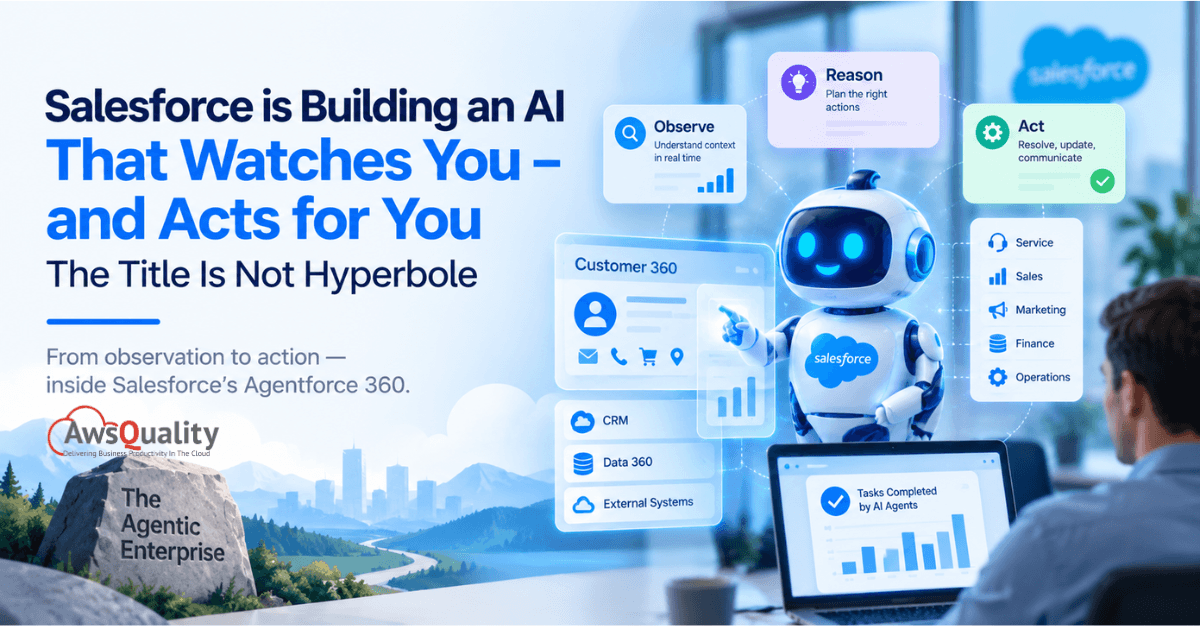
Salesforce is building AI that can observe relevant business activity, understand context, and act on it.
It resolves service cases. It updates CRM records. It sends follow-up emails. It triggers fulfillment workflows. It escalates to a human agent when the situation exceeds what it is authorized to handle — but only then. For the 85% of interactions it can fully resolve, the human never gets involved.
This is Salesforce Agentforce 360, which reached general availability on February 23, 2026, as part of the Spring ’26 release. It is deployed across 124 countries. Salesforce introduced Agentic Work Units (AWUs) as a measure of tasks accomplished by AI agents and reported 2.4 billion AWUs delivered across Agentforce and Slack by Q4 FY2026. Salesforce has named the strategy it is building around this technology “The Agentic Enterprise” — a vision of business operations in which AI agents handle the routine, the high-volume, and the time-sensitive, while humans focus on the work that genuinely requires human judgment.
This article is not an alarm. It is an explanation — of what Salesforce’s autonomous AI actually observes, how it reasons, what it acts on, and how the governance architecture is designed to prevent the failure modes that 67% of enterprise AI initiatives fall into when organizations skip the implementation fundamentals.
The headline was designed to make you read. The content that follows is designed to help you decide.
Read: How AI Agents and Salesforce are Redefining Customer Service
What “Watches You” Actually Means
The word “watches” is accurate but incomplete without context. Salesforce Agentforce does not monitor employees or surveil customers in a covert sense. It observes structured enterprise data — the CRM data, service case records, behavioral event streams, and interaction logs that enterprises have always collected — and it reasons over that data in real time rather than waiting for a human to review it.
The observation layer that makes Agentforce operate is built on three interconnected capabilities:
Data 360 (formerly Data Cloud): The real-time customer data platform that unifies customer data from every source — CRM records, behavioral signals from website and app interactions, purchase and service history, marketing engagement, and external data enrichment — into a single Customer 360 profile that is continuously updated. Agentforce agents do not reason over static CRM snapshots. They reason over the living, real-time representation of each customer relationship, updated as events occur.
Atlas Reasoning Engine: The reasoning layer behind Agentforce. Salesforce supports Claude as a reasoning model for Atlas, with Claude available through Amazon Bedrock within the Salesforce Trust Boundary. Atlas does not follow a script. It plans — assessing what the situation requires and executing the appropriate action sequence from the tools and flows available to the agent.
Agentforce Agent Script: Introduced in Spring ’26, Agent Script is a scripting language that defines explicit if/then workflows for situations where the sequence and outcomes must be consistent and predictable rather than reasoning-determined. Early adopters report the shift from agents that “usually do the right thing” to agents that “always hit the target outcome” when high-stakes process consistency is required.
The combination of these three layers is what makes Agentforce agents capable of genuinely contextual, adaptive responses — not chatbot pattern-matching but multi-step reasoning over the actual state of a business relationship.
Also read: Agentforce vs Claudeforce – Features, Capabilities, Use Cases, and Differences
What “Acts for You” Actually Means
The actions that Agentforce agents take are defined at configuration time by Salesforce administrators and developers using Agent Builder. An agent cannot take actions it has not been explicitly authorized to take. The authorization model is the same Salesforce permission model that governs human user access — if an agent’s scope does not include authorization to update a customer record, process a refund, or trigger a fulfillment workflow, it cannot do those things regardless of what the Atlas reasoning layer concludes.
Within its authorized scope, however, the agent acts autonomously:
Service resolution without human involvement.
Salesforce says Agentforce resolves about 85% of its customer service requests without human intervention. When human escalation is required, the agent can transfer relevant context so the human can continue without starting over. For a contact center handling 10,000 customer interactions per day, this means 8,500 interactions fully handled — order status inquiries, account questions, return processing, password resets, policy clarifications, troubleshooting — without a human agent involved. The 500 cases that require human escalation receive the customer conversation summary, the relevant CRM context, and the actions already taken pre-loaded for the human agent to continue.
CRM record updates without manual data entry.
Agentforce agents can update Salesforce records — closing activities, logging interaction summaries, updating opportunity stages, creating follow-up tasks, modifying account fields — based on what they observe in customer interactions. A sales call handled by Agentforce produces a structured call summary and updated CRM record automatically; a service interaction produces an updated case with resolution steps documented.
Proactive outreach based on behavioral signals.
Agents configured for proactive engagement monitor customer behavioral signals — a price drop on a browsed product, a subscription approaching renewal, a service contract expiring, a customer whose engagement signals suggest churn risk — and initiate outreach before the customer contacts the company. This is the “watches you” capability translated into customer value: the AI detects a relevant signal from the Data 360 layer and acts on it without waiting for a human to review the CRM and decide.
Cross-system action execution.
Through MuleSoft integrations and AIforce’s MCP (Model Context Protocol) architecture, Agentforce agents can execute actions across connected systems — querying an ERP for inventory status, triggering a fulfillment order, updating a billing record, creating a support ticket in an external system — within a single customer interaction, without requiring a human to coordinate across applications.
Agents on any surface: Agents can read, write, and act across your CRM from any surface, whether that’s Slack, ChatGPT, or anywhere else your team is already working.
Key Capabilities Expanding Salesforce’s Agentforce Platform
Agentforce 360’s Spring ’26 release expanded the original Agentforce platform with four components that change the scope of what autonomous enterprise AI can do in the Salesforce ecosystem:
1. Agentforce Control Plane (AI Control Plane)
The enterprise management layer for governing AI agent behavior at the organizational level. The AI Control Plane manages agent identity (who the agent is, what credentials it operates under), policy enforcement (what rules govern agent behavior across all deployed agents), and lifecycle management (how agent versions are promoted from development to production, monitored in production, and retired). For regulated-industry deployments — financial services, healthcare, government — the AI Control Plane is the governance infrastructure that makes AI compliance auditable.
2. Agent Script
The scripting language that allows builders to define deterministic if/then logic for high-stakes process flows where consistency is more important than flexibility. Agents using Agent Script do not reason about whether to follow the script — they execute it. This creates a predictable, auditable execution path for processes like financial onboarding, claims processing, and regulated customer interactions where the exact sequence of steps must be documentable.
3. Multi-Agent Orchestration
The capability for multiple Agentforce agents to coordinate on complex, multi-step workflows without requiring human coordination at each system handoff. A customer service agent can invoke a fulfillment agent, which invokes an inventory agent, which triggers a notification agent — executing a complete end-to-end resolution across the supply chain within the context of a single customer interaction.
4. Expanded Claudeforce Integration
Claude, Anthropic’s AI model, is deployed within Agentforce through Amazon Bedrock inside the Salesforce Trust Boundary — the first LLM provider described as fully integrated within this boundary. The Claudeforce partnership, announced August 26, 2026, expands this integration with open beta access to Salesforce in Claude, enabling sales professionals to access Salesforce data and take CRM actions from inside the Claude interface through 37 prebuilt sales skills.
Check out: Why your Salesforce implementation isn’t delivering results
The Governance Architecture: What Prevents This from Going Wrong
Enterprise security professionals framing the challenge are direct about the stakes: we are moving past the era of simple chatbot interfaces into a world of autonomous agents that can read, write, and execute code across our most sensitive data environments. The question is no longer whether these agents are useful, but whether they can be trusted.
That shift — from proving capability to proving trustworthiness — defines where the enterprise AI conversation has landed in 2026. Trust. Oversight. Governance. The responsible way to deploy autonomous systems. After a year of real production deployments, Salesforce’s own positioning has recalibrated from pure autonomy toward human-centered governance: the acknowledgment that agentic AI earns its place in enterprise operations through verifiable controls, not through impressive demos. The following governance architecture is the mechanism that makes that verification possible.
The governance architecture Salesforce has built around Agentforce:
Einstein Trust Layer: The security and compliance foundation that governs how AI workloads run inside the Salesforce platform. Salesforce’s Trust Boundary is designed to provide security and governance controls around AI workloads, with supported models and configurations running within Salesforce’s governed architecture. For example, Salesforce says Claude is available through Amazon Bedrock within the Salesforce Trust Boundary. For organizations in healthcare, financial services, and government that cannot route AI inference outside their compliance perimeter, this architecture is the prerequisite for responsible AI deployment.
Permission-aware execution: Every agent action executes within the Salesforce permission model. Profiles, permission sets, field-level security, and record sharing rules all apply to what the agent can read and write — the same controls that apply to human users. An agent operating on a customer’s account cannot access fields the assigned user profile does not have access to.
Topic and action scope: Agent Builder requires explicit definition of the topics an agent is authorized to handle and the specific actions it can take. An agent configured for customer service case resolution cannot autonomously modify opportunity stages or approve discounts — unless those capabilities are explicitly included in its configuration.
Comprehensive audit trails: Agent sessions can be traced across reasoning-engine executions, inputs, outputs, actions, errors, and final responses, giving administrators visibility into how an agent behaved. For compliance functions and incident investigation, this trail is the evidence that AI behavior was within authorized parameters.
Human-in-the-loop escalation: Agents have defined escalation criteria — the conditions under which they transfer to a human rather than attempting autonomous resolution. When escalation occurs, the human receives the complete conversation context, the customer’s CRM record, and the actions the agent already took — enabling the human to pick up without starting over.
The Business Case: What Agentforce is Actually Producing
The production results from early adopters provide the most reliable signal of what Agentforce delivers when implemented correctly:
Wiley: 213% ROI from the Agentforce implementation, with 40%-plus improvement in case resolution and 50% faster onboarding for seasonal agents who joined with AI assistance.[Source]
Engine (B2B travel platform): 50% of customer cases now handled autonomously, 15% reduction in average handle time across 800,000-plus annual inquiries.[Source]
OpenTable: 73% case resolution rate with Agentforce, grounded on 1,500 knowledge articles.[Source]
Salesforce internal operations: More than 1 million internal conversations annually with a 75% resolution rate without human escalation, 65% faster response time for 90% of users. [Source]
The ROI benchmark from third-party research: industry average ROI of 171% for enterprise Agentforce deployments, with top-quartile implementations reaching 8× returns, according to CRMxAI’s June 2026 analysis. [Source]
Against these results, the failure context is important: Only 33% of Salesforce AI initiatives are meeting their ROI targets. This isn’t a failure of the technology — it’s a reality of organizational transformation. AI implementation requires more than deploying agents. It requires rethinking workflows that were designed for human execution, identifying which tasks should be fully automated vs. human-assisted.[Source]
The 67% failure rate does not reflect Agentforce’s capability. It reflects the gap between deploying agents and doing the organizational work that makes agents effective — workflow redesign, data quality investment, governance framework construction, and the change management that determines whether employees collaborate with AI or route around it.
What “Watches You” Gets Right — and What the Conversation Misses
The provocative framing of AI that “watches you” captures something real: Agentforce genuinely monitors more organizational activity, more continuously, and at more granular detail than any previous enterprise software system. Every customer interaction, every CRM record change, every behavioral signal is potentially observable by AI agents configured to act on those signals.
This creates a category of organizational capability — proactive service, real-time personalization, autonomous routine task completion — that was simply not available at this speed and scale before Agentforce.
It also creates a category of organizational responsibility that requires explicit attention:
Data scope and minimization. Agents should be configured to observe only the data they need to perform their authorized functions — not the entire Data 360 profile of every customer for agents whose scope is limited to a specific service function.
Transparency to customers. Customers interacting with Agentforce agents through service portals or chat interfaces should know they are interacting with AI. Salesforce’s Einstein Trust Layer includes the disclosure mechanisms that EU AI Act transparency requirements and equivalent standards demand.
Employee awareness and agency. Employees whose workflows are being monitored and augmented by AI agents — sales reps whose call summaries are being automatically generated, service agents whose cases are being pre-analyzed — benefit from clear communication about what the AI is observing, what it is doing with those observations, and where human judgment remains primary.
Governance before scale. The organizations generating 8× returns from Agentforce deployments built their governance infrastructure — AI Control Plane configuration, agent scope definitions, audit trail setup, escalation criteria — before expanding agent coverage. The organizations contributing to the 67% that are not meeting ROI targets overwhelmingly deployed first and governed later.
Also check: How to Migrate to Salesforce Without Losing Your Data
What the Agentic Enterprise Shift Means for Your Implementation
The Agentic Enterprise is not a product announcement. It is a framework for thinking about what enterprise operations look like when AI agents handle routine, high-volume, and time-sensitive work — and humans focus on the judgment, relationship, and exception work that genuinely requires human involvement.
Building toward that model is harder than deploying any individual Agentforce agent. IBM’s State of Salesforce 2025-26 data makes this concrete: 33% of Salesforce AI initiatives are meeting their ROI targets. The 67% that are not are not failing because Agentforce does not work. They are failing because building an agentic enterprise requires more than turning agents on.
What it actually requires:
Workflow redesign. Most enterprise workflows were designed for human execution — with manual handoffs, approval gates, and information-gathering steps that assume a human is doing each one. Deploying an AI agent into an unchanged workflow often produces marginal improvement. Redesigning the workflow around what an AI agent can do autonomously — and what a human genuinely needs to own — produces the structural efficiency gains the case studies document.
Data readiness. Agentforce agents reason over the data they can access. An agent operating on incomplete, siloed, or stale CRM data produces incomplete and stale reasoning. Data 360 is the investment that gives agents a complete customer context — but only if the data pipelines feeding it are reliable and the customer profiles it produces are accurate. Data readiness is not a prerequisite to mention in a kickoff deck; it is the variable that most directly determines production agent quality.
Governance before scale. The organizations generating 8× returns from Agentforce built their governance infrastructure — AI Control Plane configuration, agent scope definitions, audit trail setup, escalation criteria — before expanding agent coverage. The organizations contributing to the 67% failure rate overwhelmingly deployed first and governed later.
Change management alongside technology. Employees whose workflows are being augmented by AI agents — sales reps whose call summaries are being auto-generated, service agents whose cases are being pre-analyzed — perform better with clear communication about what the AI is observing, what it does with those observations, and where human judgment remains primary. Adoption without change management produces the workarounds and parallel processes that undermine the efficiency gains the technology creates.
The Agentic Enterprise is not a destination an organization arrives at through a single Agentforce deployment. It is a direction — one that compounds in value as data quality improves, as governance matures, as workflows are progressively redesigned, and as the organization develops institutional knowledge about which agent configurations produce reliable outcomes in which contexts.
Read: Driving Salesforce User Adoption – A CXO’s Guide to Maximizing ROI
Why Salesforce Wants AI to Observe Context
An AI model can be intelligent and still be ineffective if it lacks context.
Imagine an employee asks:
“Should I contact this customer?”
A generic AI model might have very little information to work with.
An enterprise agent could potentially have access to authorized context such as:
- Account information
- Opportunity stage
- Customer history
- Previous communications
- Open cases
- Recent activity
- Product information
- Business policies
- Sales processes
- User permissions
Salesforce’s Agentforce architecture uses CRM data, Data 360 data, real-time insights, and retrieval capabilities to provide agents with business context.
The result is a shift from:
AI that knows general information
to:
AI that understands the organization’s operating context.
That is much more valuable for enterprise workflows.
What an AI Agent Could Observe
An ambient enterprise agent doesn’t necessarily need to “watch everything.”
The better architectural approach is to define what information and events are relevant to the agent’s mission.
Depending on the implementation, relevant signals could include:
User activity
- Page being viewed
- Records being edited
- Workflow stage
- Actions being performed
- Tasks being completed
Customer activity
- Customer interactions
- Case activity
- Opportunity changes
- Recent communications
- Purchase behavior
Business context
- Policies
- Approval rules
- Pricing rules
- Workflow requirements
- Customer eligibility
Enterprise data
- CRM records
- Data 360 information
- Knowledge articles
- Documents
- External data sources
Salesforce’s architecture documentation describes agents using CRM data, Data 360 components, real-time insights, and RAG-based retrieval to understand enterprise context.
The objective is not simply to collect more information.
It is to collect the right information at the right moment.
What Could Salesforce’s Ambient AI Actually Do?
The potential applications span almost every department.
Sales
An ambient sales agent could recognize that a salesperson is working on a high-value opportunity and surface:
- Account insights
- Competitive information
- Open service issues
- Relevant customer history
- Suggested next steps
- Follow-up recommendations
It could potentially prepare or execute authorized tasks.
Customer Service
Imagine a support representative handling a difficult customer interaction.
An ambient agent could monitor the relevant interaction context and:
- Retrieve knowledge
- Identify applicable policies
- Surface customer history
- Recommend responses
- Identify escalation conditions
- Create follow-up tasks
Salesforce already describes agent architectures that can monitor conversations and retrieve information in real time.
Marketing
Marketing teams could use agentic systems to:
- Analyze campaign performance
- Identify segments
- Recommend actions
- Prepare campaign content
- Coordinate customer journeys
- Trigger approved workflows
The important difference is that AI moves from content generation toward workflow execution.
Commerce
Salesforce is also expanding agentic capabilities across commerce.
Its July 2026 announcement described Shopper Agent, Buyer Agent, and Merchant Agent as generally available, with integrations planned across experiences including ChatGPT, Google Search, and Gemini.
This points toward a future where AI does more than help shoppers find products.
Agents can increasingly participate in the commerce process itself.
Employee Operations
Internal employees could potentially have agents that help with:
- HR processes
- Procurement
- Finance operations
- IT support
- Approvals
- Data management
- Administrative work
Salesforce’s September 2026 job-ready Agentforce portfolio explicitly extends into employee experience and back-office work.
Also read: Salesforce Marketing Cloud Integration Challenges and How to Solve Them
Salesforce is Also Moving Toward Long-Horizon AI
Perhaps the most important recent development is that Salesforce is no longer positioning agents only as systems that complete one interaction.
On September 11, 2026, Salesforce announced a new Agentforce runtime designed to let agents pursue goals across days and weeks, rather than simply completing a single conversation or task.
Consider a sales example.
Instead of:
“Write an email to this prospect.”
The objective becomes:
“Help me recover my at-risk opportunities before the end of the quarter.”
An agent could break that objective into smaller tasks, determine the necessary tools and context, work through the plan, and operate within defined guardrails and approval requirements. Salesforce gives this type of long-horizon goal pursuit as an example for its new Agentforce capabilities.
This is a major conceptual shift.
The AI isn’t simply responding to a prompt.
It is working toward an outcome.
AI Skills: Teaching the Agent How Your Best Employees Work
Another interesting part of Salesforce’s latest Agentforce direction is the concept of AI Skills.
Salesforce says Agentforce Coworker will allow employees to teach an agent how to complete a task once and then scale that knowledge across the workforce and interfaces; Salesforce lists this capability as a pilot with general availability planned for October 2026.
This creates an interesting enterprise model:
Expert employee
 ↓
 Demonstrates process
 ↓
 AI learns the workflow
 ↓
 Organization standardizes the skill
 ↓
 Agent performs the process repeatedly
This could potentially turn tacit employee knowledge into reusable digital capabilities.
For enterprises, that has implications for:
- Knowledge transfer
- Employee onboarding
- Process standardization
- Productivity
- Operational scalability
But it also raises important questions about whether the AI has learned the right process and whether the process itself should be automated.
Multi-Agent Orchestration Changes the Equation
Complex enterprise work rarely belongs to one department.
A customer problem might involve:
Sales → Service → Finance → Operations
A single AI agent may not have the right expertise or permissions for every stage.
Salesforce’s September 2026 announcement describes Multi-Agent Orchestration as a capability that routes work across specialized agents so they can operate as a coordinated team when a job crosses roles, systems, or stages.
That introduces another layer:
AI agents are not just acting for employees. They can increasingly coordinate with other AI agents.
For example:
Customer Request
 ↓
 Service Agent
 ↓
 Account Agent
 ↓
 Finance Agent
 ↓
 Order Agent
 ↓
 Human Approval
 ↓
 Action Completed
The challenge is no longer simply building a smart agent.
It becomes designing an agentic operating model.
But “Watching” Creates a Serious Governance Problem
The more context an AI can observe, the more powerful it becomes.
It also becomes more sensitive.
Organizations need to answer questions such as:
- What can the agent observe?
- Why can it observe that information?
- What data can it access?
- What actions can it execute?
- Which actions require approval?
- How are decisions logged?
- How can employees override the agent?
- How long is activity retained?
- Who can audit the agent?
- What happens when the agent makes a mistake?
Salesforce’s trusted-agent guidance emphasizes grounding, defined instructions, business policies, and actions, while its Agentforce documentation describes guardrails around what agents can do.
These controls cannot be treated as optional features.
They need to be part of the architecture.
Human Approval Still Matters
Not every action should be autonomous.
A useful enterprise framework is:
Low-risk action
Agent can act automatically
Examples:
- Create a task
- Summarize a record
- Retrieve information
- Draft an internal note
Medium-risk action
Agent recommends; human approves
Examples:
- Send a sensitive customer communication
- Change a customer status
- Apply a discretionary discount
High-risk action
Human must remain in control
Examples:
- Financial transfers
- Legal commitments
- Employment decisions
- Sensitive data changes
- High-impact customer decisions
The appropriate boundary depends on the business process, risk level, regulations, and organizational policies.
Check: How to Choose the Best Salesforce Implementation Partners
Salesforce’s AI Needs an Identity and Permission Model
An AI that can act is fundamentally different from an AI that can only generate text.
If an agent can:
- Update records
- Send communications
- Create orders
- Change data
- Access customer information
- Invoke APIs
then identity becomes central.
Salesforce’s Agentforce guidance specifically distinguishes public and private actions and emphasizes verifying the identity of users before an agent performs private actions on their behalf. It also recommends least-privilege access.
The architectural principle is straightforward:
An agent should never have more authority than it needs to complete its job.
Observability Becomes Essential
Traditional application monitoring asks:
Did the application work?
Agentic systems require additional questions:
Why did the agent make that decision?
Which information did it use?
Which action did it call?
Why did it fail?
Where did the workflow deviate?
Salesforce provides Agentforce session tracing that captures agent interactions from beginning to end, including reasoning-engine executions, actions, inputs and outputs, errors, and final responses.
Salesforce also provides Agentforce Observability capabilities for analyzing agent performance, usage, quality, trust, cost, and ROI.
For enterprise deployments, this is not merely a debugging convenience.
It is part of AI governance.
The New Enterprise AI Development Lifecycle
Agentic applications require a different development lifecycle from conventional software.
A simplified model is:
1. Define
What job should the agent perform?
2. Map
What process does the job involve?
3. Ground
What data and knowledge does the agent need?
4. Authorize
What actions can the agent perform?
5. Guardrail
Which actions require approval?
6. Test
Does the agent behave correctly across realistic scenarios?
7. Deploy
Release it to a controlled environment.
8. Observe
Monitor real-world behavior.
9. Improve
Use production evidence to refine the agent.
Salesforce’s developer guidance describes a production workflow based around observing real sessions, reproducing failures, and improving the agent based on what actually happened.
That means AI development increasingly resembles an ongoing engineering discipline rather than a one-time model deployment.
What Could Go Wrong?
The promise is significant, but so are the risks.
1. The Agent Misinterprets Intent
An agent may infer the wrong objective from a user’s behavior.
2. The Agent Takes the Wrong Action
A technically valid action can still be a business mistake.
3. Too Much Access
An agent with excessive permissions creates unnecessary security risk.
4. Poor Data Quality
Bad customer or business data can produce bad decisions.
5. Automation Bias
Employees may trust AI recommendations simply because the system appears confident.
6. Hidden Workflow Changes
An agent may alter processes in ways that employees do not immediately understand.
7. Lack of Explainability
If employees cannot understand why an agent acted, troubleshooting and accountability become difficult.
8. Excessive Surveillance
This is perhaps the biggest issue raised by the phrase “AI that watches you.”
There is a major difference between:
AI observing relevant workflow context to help an employee
and
AI monitoring employees for generalized behavioral surveillance.
Organizations need a clear boundary.
Also check: Salesforce Service Cloud vs Microsoft Dynamics 365
“Observability” Is Not the Same as Employee Surveillance
This distinction deserves special attention.
An enterprise agent may need to observe:
- The current record
- Workflow state
- Relevant customer data
- The action being performed
- A conversation or call
- The business process
That does not automatically mean the organization should capture every aspect of an employee’s behavior.
A responsible implementation should establish:
Purpose limitation
Only collect information necessary for the agent’s defined purpose.
Data minimization
Avoid unnecessary monitoring.
Transparency
Employees should understand what the system observes and why.
Access controls
Only authorized systems and users should access agent data.
Retention policies
Do not retain sensitive interaction data indefinitely without a legitimate purpose.
Human oversight
Employees need mechanisms to challenge, override, or escalate AI decisions.
How Headless Architecture Changes Salesforce Development
For Salesforce developers, this trend may be more important than the AI model itself.
Traditional development often asks:
How do we build this functionality into the Salesforce application?
The agentic model increasingly asks:
How do we expose this business capability safely so an authorized agent can use it?
That means developers need to think about:
- APIs
- MCP
- Actions
- Skills
- Metadata
- Permissions
- Identity
- Business logic
- Governance
- Observability
- Agent orchestration
Salesforce’s expanded Headless 360 strategy is explicitly designed around making enterprise capabilities available to authorized AI agents without rebuilding integrations for every new AI experience.
This could significantly change the role of Salesforce architecture teams.
What This Means for Salesforce Developers
Developers should expect agent development to become increasingly integrated with traditional Salesforce engineering.
Important areas include:
Apex
Business logic must remain reliable when invoked by agents.
APIs
Enterprise functionality needs secure interfaces.
Lightning Web Components
User interfaces may increasingly coexist with agent-driven interactions.
Flow
Automations may become callable building blocks for agents.
Data 360
Customer and enterprise context becomes increasingly important.
MCP
AI agents need standardized ways to discover and use enterprise capabilities.
Testing
Agent behavior requires scenario-based testing in addition to conventional code testing.
Observability
Developers need visibility into agent decisions, actions, failures, and outcomes.
What This Means for Salesforce Architects
Architects need to think beyond application boundaries.
A future enterprise architecture could look like:
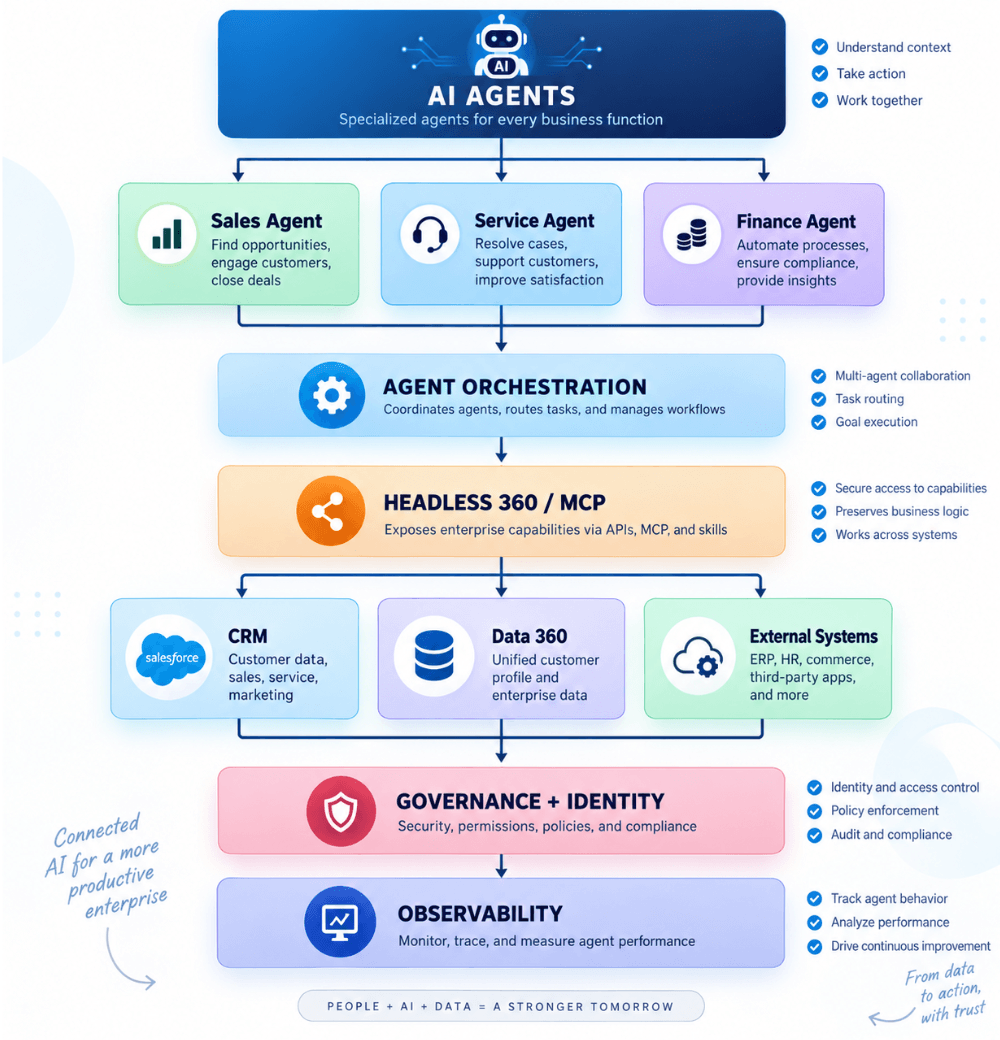
The architect’s job becomes deciding:
- What agents should exist?
- What should each agent know?
- What should each agent be allowed to do?
- How should agents communicate?
- Where should humans approve actions?
- What data should agents access?
- How should agent behavior be monitored?
Salesforce is Moving From Applications Toward Capabilities
This may be the deepest architectural implication.
Historically, Salesforce has been an application platform.
Employees log in.
They navigate objects.
They update records.
They run workflows.
They use applications.
The agentic model changes the interaction layer.
Instead of humans navigating every application themselves, agents can increasingly interact with enterprise capabilities through APIs, actions, MCP, skills, and other interfaces.
Salesforce’s Headless 360 strategy explicitly positions Salesforce capabilities as reusable building blocks that authorized AI agents can discover and use.
That suggests a future where the Salesforce UI remains important, but it is no longer necessarily the only way work gets done.
The Biggest Change May Not Be AI
It may be the interface to enterprise software.
For decades:
Human → Application → Database
Then:
Human → AI → Application
Now the trajectory is increasingly:
Human + AI Agents → Enterprise Capabilities → Data + Systems
The application becomes less visible.
The capability becomes more important.
For developers, this means building reusable, governed business capabilities.
For architects, it means designing systems that agents can safely operate.
For CIOs, it means thinking about AI as an operational layer rather than simply a productivity tool.
Also check: Low Salesforce Adoption? Try These 7 Fixes That Work
What Businesses Should Do Now
Organizations should not start by deploying an AI agent everywhere.
Start with the workflow.
Step 1: Identify High-Value Processes
Look for processes that are:
- Repetitive
- Time-consuming
- Data-rich
- Rule-driven
- Measurable
- Low-to-medium risk
Step 2: Map the Process
Document:
- Inputs
- Decisions
- Actions
- Exceptions
- Approvals
- Systems involved
- Human responsibilities
Step 3: Determine What the Agent Needs to Observe
Ask:
- What context does the agent genuinely need?
- Do not automatically provide access to everything.
Step 4: Define the Agent’s Authority
Create explicit boundaries.
For example:
| Action | Agent Authority |
|---|---|
| Read customer information | Allowed |
| Create internal task | Automatic |
| Draft email | Automatic |
| Send customer email | Approval required |
| Change pricing | Approval required |
| Delete customer record | Prohibited |
Step 5: Establish Governance
Define:
- Identity
- Permissions
- Audit logging
- Data access
- Human approval
- Escalation
- Retention
- Monitoring
Step 6: Test Before Production
Test realistic scenarios, including:
- Correct behavior
- Ambiguous instructions
- Missing data
- Incorrect data
- Unauthorized requests
- Edge cases
- Failure scenarios
Step 7: Monitor Continuously
Measure:
- Task completion
- Error rate
- Escalation rate
- Human override rate
- Cost
- Latency
- Customer outcomes
- Business impact
Salesforce’s Agentforce Observability and session-tracing capabilities are designed to provide visibility into agent behavior and performance after deployment.
The Business Question Is Not “Can AI Do This?”
That is becoming the wrong question.
The better questions are:
- Should AI do this?
- What should AI be allowed to do?
- What should remain human?
- What information does AI need?
- What happens if AI is wrong?
- Can we audit every important action?
- Can we measure the business outcome?
Those questions matter much more than whether an AI model can technically perform a task.
Salesforce’s Agentic Direction in 2026
Salesforce’s latest developments show that the company’s strategy is moving beyond conversational AI.
Several pieces are converging:
Agentforce
Autonomous agents that can reason and act.
Ambient agents
Agents that can observe relevant workflow context and provide assistance or take action.
Headless 360
Enterprise capabilities exposed for authorized agents through APIs, MCP, and other interfaces.
Data 360
Unified enterprise context that can ground agents.
Long-horizon agents
Agents that can pursue objectives over days and weeks.
Multi-agent orchestration
Specialized agents working together across roles and processes.
AI Skills
A direction toward teaching agents how experienced employees perform tasks.
Observability
Tracing and monitoring to understand how agents behave in production.
Individually, these are product capabilities.
Together, they point toward something bigger:
Salesforce is trying to turn AI from an assistant sitting beside enterprise applications into an operational layer that can participate in the work itself.
Final Takeaway
Salesforce is not simply building an AI that watches you. It is building toward a world where AI can understand the context of your work, anticipate what may be needed, and take authorized action on your behalf.
The distinction is important.
The future is not necessarily:
“AI watches employees.”
It is closer to:
“AI understands the workflow and becomes an active participant in it.”
That could fundamentally change how employees interact with Salesforce.
Instead of opening records, searching for information, navigating applications, and manually executing every step, employees could increasingly define goals while agents handle parts of the execution.
But the more autonomous AI becomes, the more important identity, permissions, governance, observability, data quality, testing, and human oversight become.
The companies that benefit most will not necessarily be the ones deploying the most agents.
They will be the ones that understand where agents should act, where humans should remain in control, and how to build the architecture that connects the two safely.
Salesforce’s latest Agentforce and Headless 360 developments suggest that this transition is already underway.
And for Salesforce customers, developers, architects, and CIOs, the question is no longer simply:
“What can AI generate?”
It is increasingly:
“What work should we allow AI to do?”
Frequently Asked Questions
Is Salesforce really building AI that watches users?
Salesforce’s architecture documentation describes an ambient agent pattern that can observe a user’s actions directly within the Salesforce UI, understand workflow context, and provide just-in-time assistance or offer to perform actions.
The term “watches” should not be interpreted as unrestricted employee surveillance. The intended architecture is contextual, authorized, and governed.
What is an ambient AI agent?
An ambient AI agent is an agent designed to operate within the context of a user’s workflow rather than waiting for every action to be explicitly requested. Salesforce describes ambient agents that can observe relevant user activity, detect intent, retrieve context, and provide assistance or perform authorized actions.
How is Agentforce different from a traditional AI chatbot?
A traditional chatbot primarily responds to user prompts. Agentforce is designed to support autonomous task execution, business interactions, and actions based on configured use cases, business data, and guardrails.
What is Headless 360?
Headless 360 is Salesforce’s strategy for exposing enterprise capabilities beyond traditional application interfaces so authorized AI agents and other experiences can discover and use them through mechanisms including APIs and MCP. Salesforce says the approach preserves existing identity, permissions, workflows, business logic, and governance.
Can Salesforce AI act on behalf of employees?
Yes, depending on the agent type, use case, configuration, permissions, and guardrails. Salesforce documents agents that can act on behalf of users or customers and emphasizes authorization and security controls for private actions.
Will Salesforce agents replace employees?
Salesforce positions Agentforce as a way to augment human workers with digital labor rather than simply replacing people. The practical impact will depend on the specific workflow, level of automation, governance, and organization.
What is long-horizon AI in Agentforce?
Salesforce’s September 2026 Agentforce announcement describes a new runtime that allows agents to pursue goals across days and weeks rather than limiting them to a single interaction or task.
Why is observability important for AI agents?
Agent observability helps organizations understand what agents are doing in production, investigate failures, measure performance, and identify areas for improvement. Salesforce provides Agentforce session tracing and observability capabilities for this purpose.
 Bio
Bio