
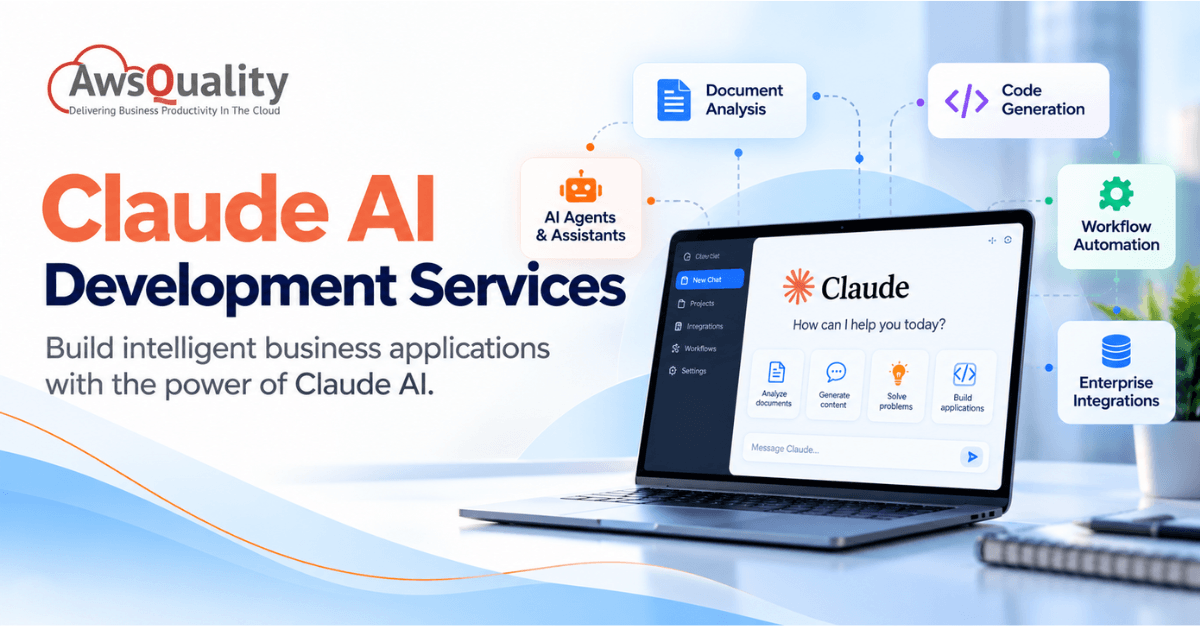
Claude AI Development Services to Build Intelligent Business Applications
Build smarter applications, automate complex workflows, and make business information more accessible with custom Claude AI development services from AwsQuality. We help businesses explore practical AI use cases, integrate Anthropic’s Claude models into existing systems, and develop AI-powered applications aligned with their business objectives.
Whether you want to build an AI assistant, connect Claude to your business applications, develop an intelligent agent, or introduce Claude Code into your software development workflow, our team can help you plan the right approach and turn your requirements into a practical solution.
Have a Claude AI project in mind? Let’s discuss your requirements, technology environment, and goals.
Claude AI Development Services for Business Applications
Claude is a family of AI models developed by Anthropic. Businesses can use Claude through APIs and supported cloud platforms to introduce language understanding, document analysis, coding assistance, and tool-enabled workflows into their applications.
However, using an AI model in a real business environment involves more than connecting an API. The solution must fit existing processes, handle relevant data correctly, manage errors, protect access, and produce outputs that can be evaluated against business requirements.
AwsQuality provides Claude AI development services focused on the complete application workflow—from identifying an appropriate use case to integrating, testing, and improving the solution.
Our development approach can support organizations looking to:
- Build custom applications powered by Claude.
- Integrate Claude into existing web applications and enterprise systems.
- Automate selected knowledge-intensive and repetitive tasks.
- Develop AI assistants that work with approved business information.
- Use retrieval-augmented generation (RAG) to ground responses in relevant documents.
- Connect Claude to external tools and APIs through controlled tool-use workflows.
- Explore Claude Code for software development, maintenance, and engineering workflows.
- Improve the reliability, security, usability, and cost efficiency of AI-enabled applications.
The scope and implementation approach depend on your business requirements, data, infrastructure, and the Claude capabilities available through your chosen platform.
Our Claude Development Services
We develop Claude-powered solutions around specific business needs rather than applying the same AI implementation to every problem.
1. Claude AI Consulting and Use-Case Assessment
Not every business process needs AI, and not every AI use case needs a complex agent or a custom application. A clear assessment helps identify where Claude may provide practical value and what is required to implement it responsibly.
Our Claude AI consulting and assessment work can include:
- Reviewing business goals and current workflows.
- Identifying potential use cases for language-model capabilities.
- Assessing available data sources and integration requirements.
- Evaluating technical feasibility and implementation dependencies.
- Defining success metrics and evaluation criteria.
- Planning a proof of concept or phased implementation.
Example: A company receives large volumes of customer inquiries. Before building an AI support assistant, the team can assess the most common requests, identify which questions can be answered from approved documentation, and determine when a request should be routed to a human representative.
The result is a more focused implementation plan with defined objectives and realistic boundaries.
2. Claude AI Application Development
Our Claude AI application development services help businesses incorporate AI capabilities into new or existing digital products.
Depending on the use case, an application may use Claude to interpret natural-language requests, summarize information, extract structured data, draft responses, classify content, or assist users with multi-step tasks.
We can help with:
- Custom AI-powered web applications.
- Intelligent internal business tools.
- AI-enabled customer and employee portals.
- Document processing and analysis applications.
- Conversational interfaces and virtual assistants.
- AI features within existing products.
- Backend services that connect Claude to business data and APIs.
We consider the complete application experience, including user inputs, output presentation, permissions, error handling, and human review where appropriate.
Example: A professional services company wants an internal application that summarizes project documents and helps employees locate relevant information. A Claude-powered solution can retrieve approved source material, generate concise summaries, and provide links or references to supporting documents when the implementation supports them.
3. Claude API Integration Services
Claude API integration allows applications to send requests to Claude and use its responses within business workflows. The integration can support tasks such as content generation, information extraction, classification, conversational experiences, and structured outputs.
AwsQuality can help assess and implement Claude API integrations based on your existing application architecture.
Our integration work may include:
- API configuration and backend integration.
- Authentication and secure credential management.
- Request and response handling.
- Prompt design and version management.
- Structured output processing and validation.
- Rate-limit and error handling.
- Logging, monitoring, and usage tracking.
- Integration with approved third-party APIs and enterprise systems.
Claude can also be accessed through supported cloud platforms, including Amazon Bedrock and Google Cloud, with platform-specific differences in availability, authentication, features, and billing. The right integration path depends on your existing infrastructure and requirements.
Example: A CRM application can use Claude to summarize account notes, draft follow-up messages, or organize customer feedback. The implementation must define which records Claude can access, how the output is reviewed, and whether generated content is saved automatically or requires user approval.
4. Claude AI Agent Development
Some business tasks involve several connected steps rather than a single request and response. For these use cases, a Claude-powered agent workflow may help interpret a task, select from approved tools, gather information, and carry out defined operations.
Our Claude AI agent development services can support use cases such as:
- Internal knowledge assistants.
- Customer support workflow assistants.
- Research and information-gathering tools.
- Document processing workflows.
- Business process assistance.
- Tool-enabled applications connected to internal APIs.
- Multi-step workflows with defined review and approval points.
Agent architecture should be selected carefully. A straightforward workflow with explicit steps may be more reliable and easier to maintain than a highly autonomous system.
When tool use is appropriate, we can help define available actions, permissions, validation rules, failure handling, and escalation paths. Actions that could affect customers, finances, production systems, or sensitive records should have suitable safeguards and approval controls.
Example: An internal operations assistant could retrieve information from approved systems, prepare a report, and present the results to an employee for review before any consequential action is taken.
5. Retrieval-Augmented Generation (RAG) With Claude
Claude can generate useful responses from the information provided to it. For business applications that need to answer questions using large or frequently updated knowledge sources, retrieval-augmented generation can help supply relevant context at the time of a request.
A RAG solution typically retrieves relevant content from an approved data source and provides it to the model as context for generating an answer.
Our RAG development work can include:
- Assessing documents and knowledge sources.
- Designing document ingestion and retrieval workflows.
- Preparing and organizing content for search.
- Integrating suitable search or vector database technologies.
- Connecting retrieved information to Claude.
- Evaluating retrieval relevance and answer quality.
- Implementing source references where supported.
- Applying access controls to retrieved content.
Example: A company has product manuals, support documentation, internal policies, and technical guides spread across multiple repositories. A Claude-powered knowledge assistant can retrieve relevant passages and use them to answer employee questions, subject to the permissions and retrieval rules established for the application.
RAG does not automatically guarantee factual answers. Retrieval quality, document freshness, access controls, evaluation, and appropriate fallback behavior all influence the final result.
6. Claude Code Development Services
Claude Code is Anthropic’s agentic coding tool that helps developers work with codebases, inspect files, make changes, and run development tasks through supported workflows.
Our Claude Code development services can support businesses that want to use AI-assisted engineering for new development, existing application improvements, maintenance, or selected software delivery tasks.
Potential areas of work include:
- Building and improving web applications.
- Updating existing application code.
- Refactoring and maintaining software.
- Assisting with debugging and code analysis.
- Generating or improving tests.
- Reviewing code changes and technical documentation.
- Automating suitable development tasks.
- Supporting repository-based engineering workflows.
AI-generated code still requires engineering judgment. Code changes should be reviewed, tested, and validated against project requirements before release.
For business-critical applications, we recommend appropriate version control, restricted permissions, automated checks, staging environments, and human approval for production changes.
Example: A business has an established web application and a backlog of maintenance tasks. Claude Code can assist developers with understanding relevant code, preparing targeted changes, and running checks, while engineers remain responsible for reviewing the changes and approving releases.
7. Claude Integration With Enterprise Systems
AI becomes more useful when it fits into the tools and processes employees already use. Enterprise integration can connect Claude-powered functionality with approved business applications, APIs, and information sources.
Depending on your environment, integration opportunities may include:
- Customer relationship management (CRM) platforms.
- Enterprise resource planning (ERP) systems.
- Internal databases and knowledge repositories.
- Customer support platforms.
- Document management systems.
- Project management applications.
- Reporting and analytics tools.
- Existing web and mobile applications.
For Salesforce environments, potential use cases include summarizing customer interactions, assisting with case classification, drafting communications, and helping employees retrieve relevant account information. The specific implementation depends on Salesforce configuration, available APIs, data permissions, and business rules.
We assess integration requirements before selecting an architecture. This helps account for data mapping, authentication, access controls, error handling, monitoring, and the impact on existing workflows.
8. Prompt Engineering and Claude Output Evaluation
The quality of an AI application depends partly on how instructions, context, and expected outputs are designed. Prompt engineering can help make model behavior more consistent, but prompts alone are not a substitute for application-level validation.
Our work can include:
- Defining clear task instructions and output formats.
- Organizing complex prompts with appropriate structure.
- Developing representative examples.
- Testing prompts against real-world scenarios.
- Evaluating output quality and consistency.
- Identifying common failure cases.
- Creating regression tests for prompt changes.
- Improving validation and fallback behavior.
Example: A document-processing application may need to extract specific fields from invoices or contracts. Evaluation can measure whether the application identifies the required fields correctly, handles missing information appropriately, and flags uncertain results for review.
We focus on testing against defined requirements rather than assuming that a prompt will work equally well across every input.
9. Claude AI Testing, Deployment, and Optimization
An AI application needs more than a successful demonstration. Before it becomes part of an operational workflow, the team should evaluate its behavior, performance, integration reliability, and cost.
Our development and optimization work can include:
- Functional and integration testing.
- Evaluation of model outputs against defined criteria.
- Testing of edge cases and ambiguous requests.
- Latency and throughput assessment.
- Usage and cost monitoring.
- Error handling and fallback planning.
- Deployment support and environment configuration.
- Post-release issue resolution and improvement planning.
Where appropriate, we can help compare model options, refine prompts, reduce unnecessary context, and use simpler processing paths for tasks that do not require more complex model capabilities.
The objective is to develop an AI solution that meets its intended requirements and can be maintained as business needs evolve.
What can You Build With Anthropic Claude?
Claude can support a range of language, analysis, coding, and tool-enabled application use cases. The best implementation depends on the problem, the available information, and the level of automation required.
AI-Powered Customer Support Assistants
Build assistants that help customers or support teams find relevant information, summarize cases, draft responses, and route requests according to defined rules.
Document Intelligence Solutions
Develop applications that summarize lengthy documents, extract selected information, classify content, compare document versions, or help employees locate relevant passages.
Enterprise Knowledge Assistants
Connect Claude to approved internal knowledge sources so employees can ask questions in natural language and retrieve relevant information without manually searching multiple repositories.
AI-Enabled CRM Workflows
Introduce assistance for customer summaries, case triage, communication drafting, and information retrieval within existing CRM processes.
Business Process Automation
Use Claude to interpret unstructured information, prepare recommendations, classify requests, or support selected steps in a larger workflow. Keep deterministic business rules and high-impact decisions under appropriate controls.
Software Development Assistance
Use Claude Code to support code analysis, maintenance, testing, documentation, and development tasks within a controlled engineering process.
Research and Reporting Assistants
Build tools that organize source material, summarize information, compare findings, and prepare structured reports for human review.
AI-Powered Content Workflows
Support content classification, drafting, summarization, rewriting, and structured content preparation with defined editorial standards and review processes.
These examples illustrate possible use cases, not guaranteed outcomes. Each project should be assessed for feasibility, data requirements, expected benefits, and implementation risks.
Our Claude AI Development Process
We follow a structured development approach to connect business objectives with implementation decisions and measurable acceptance criteria.
Step 1: Discovery and Requirement Analysis
We start by understanding the problem you want to solve, the people who will use the solution, and the systems involved.
This stage can cover business goals, current workflows, target users, data sources, integration requirements, constraints, and success measures.
Outcome: An initial understanding of the use case, scope, dependencies, and evaluation criteria.
Step 2: Feasibility and Solution Planning
We assess whether Claude is appropriate for the use case and identify the most practical implementation approach.
This may involve comparing direct API integration with a cloud-platform option, determining whether RAG or tool use is necessary, and identifying where conventional software logic should handle the task instead.
Outcome: A proposed solution approach, key technical decisions, and an initial implementation plan.
Step 3: Architecture and Experience Design
We define how the application will interact with Claude, business systems, users, and data sources.
Depending on the project, this stage may cover application architecture, API interactions, retrieval design, access permissions, workflow controls, user experience, and error handling.
Outcome: An agreed design and implementation scope.
Step 4: Development and Integration
The team builds the agreed functionality and connects it to the required applications, data sources, or development workflows.
We implement prompts, API calls, business logic, validation, and relevant supporting components according to the project requirements.
Outcome: A working implementation ready for testing.
Step 5: Testing and Validation
We evaluate the application against the agreed requirements and representative scenarios. This can include functional testing, integration checks, output-quality evaluation, failure handling, and performance assessment.
Issues identified during testing are addressed according to the agreed scope and acceptance criteria.
Outcome: A tested solution with documented limitations and outstanding items, where applicable.
Step 6: Deployment and Knowledge Transfer
We support deployment according to the agreed environment and release process. We can also provide relevant technical documentation and knowledge transfer so your team understands how the solution works and how it should be maintained.
Outcome: A deployed or deployment-ready solution with the agreed handover materials.
Step 7: Ongoing Improvement
After release, the solution may require updates as requirements, data, usage patterns, or available model capabilities change.
Where included in the engagement, ongoing work can cover issue resolution, evaluation updates, prompt refinement, performance monitoring, and further enhancements.
Outcome: A clear approach to maintaining and improving the solution over time.
Why Choose AwsQuality for Claude Development Services?
Selecting an AI development company involves more than comparing technology lists. The team should understand the business problem, integrate the solution into your existing environment, and establish a practical way to evaluate its performance.
AwsQuality brings a technology services perspective to Claude development projects.
Business-Driven Implementation
We begin with your requirements and desired outcomes. The goal is to identify a suitable technical approach rather than introduce AI where it does not add meaningful value.
Integration With Existing Technology
Claude-powered functionality often needs to work with existing applications, databases, APIs, and business processes. We consider these relationships as part of solution planning and development.
Focus on Application Quality
A working prototype is only one part of a successful implementation. Testing, error handling, validation, access controls, and maintainability should be considered according to the use case.
Flexible Project Scope
Depending on your requirements, the engagement may focus on a specific integration, an AI proof of concept, a new application, an existing system enhancement, or a broader development initiative.
Collaboration With Internal Teams
We can work with relevant stakeholders to clarify requirements, review technical decisions, and align implementation with existing engineering and business processes.
Maintainability and Knowledge Transfer
We aim to make the solution understandable and maintainable by documenting relevant design decisions, integration details, and operational considerations within the agreed project scope.
The precise team composition, deliverables, timelines, and support arrangements should be confirmed during project discovery.
Our Claude Development Services for Different Industries
Claude-powered applications can support different workflows across industries. The use cases below are examples of where language-model capabilities may be relevant; they are not claims of completed client projects.
Financial Services
Potential applications include document summarization, internal knowledge retrieval, customer service assistance, and support for selected compliance workflows. Financial decisions and regulated processes require suitable validation, oversight, and controls.
Healthcare and Life Sciences
Potential use cases include administrative document processing, internal knowledge assistants, and summarization of approved information. Clinical applications require appropriate clinical oversight, privacy protections, and compliance review.
Retail and E-Commerce
Claude can support product information workflows, customer inquiry assistance, content preparation, and analysis of customer feedback.
Technology and SaaS
Software companies may use Claude for in-product assistants, technical documentation search, support workflows, code analysis, and selected development tasks.
Manufacturing and Logistics
Potential applications include searching technical manuals, summarizing maintenance records, classifying operational reports, and helping employees locate relevant procedures.
Professional and Business Services
Teams may explore document analysis, knowledge retrieval, report preparation, proposal assistance, and workflow support.
For every industry, the solution should be designed around the actual task, the quality of available data, the consequences of errors, and the relevant legal or organizational requirements.
Technology and Integration Considerations
The technology stack for a Claude-powered solution depends on its architecture, infrastructure, and business requirements. We assess the components needed for the particular project rather than prescribing one stack for every use case.
Claude and Model Access
Applications can connect to Claude through the Anthropic API or supported cloud platforms, depending on the required capabilities and infrastructure. Model selection should consider task performance, latency, cost, availability, and evaluation results.
Application Development
Depending on the existing environment, the solution may involve web applications, backend services, APIs, databases, and integration components built with suitable programming languages and frameworks.
Retrieval and Knowledge Sources
For applications that answer questions using business documents, the architecture may include document processing, search, embeddings, vector databases, or other retrieval technologies.
Tool Use and Workflow Orchestration
Where Claude needs to interact with external systems, the application can expose defined tools or functions with appropriate permissions and validation. More complex workflows may require orchestration, state management, and explicit approval steps.
Cloud and Deployment
Deployment choices depend on the organization’s existing cloud environment, identity and access requirements, monitoring needs, and operational policies.
Security and Governance
Security considerations can include secret management, access controls, data minimization, prompt-injection defenses, output validation, audit logging, and human review. The required controls depend on the sensitivity and impact of the application.
Security, Reliability, and Responsible Claude AI Development
Business applications need to be designed for their actual operating environment. A fluent model response does not automatically mean the answer is correct, authorized, or appropriate to act on.
Our implementation approach should account for relevant safeguards, including:
- Access control: Limit the data and actions available to the application according to the user’s permissions.
- Data protection: Identify what information is sent to the model and apply appropriate handling requirements.
- Output validation: Check generated responses against expected formats, business rules, or other requirements.
- Human oversight: Require review or approval for consequential actions when appropriate.
- Monitoring and evaluation: Track relevant errors, quality measures, usage, and cost.
- Failure handling: Define what happens when a model response is incomplete, unavailable, or fails validation.
Prompt-injection defenses: Assess how untrusted input or retrieved content could influence the system’s behavior.
Security and compliance requirements vary by deployment method, contractual terms, industry, and use case. They should be assessed against the actual architecture rather than assumed from the choice of model alone.
What You Receive at Project Close
Every AwsQuality Claude AI development engagement includes:
- Fully documented Claude integration or agent system with operational runbooks
- Versioned prompt library with decision rationale and eval history
- Architecture decision record covering every major design choice
- Evaluation dataset with baseline performance metrics across key task types
- Anthropic API cost model with optimization recommendations and projected scaling costs
- Security review documentation and data flow mapping
- Knowledge transfer sessions with your internal team
- 30-day post-launch support window with bug fixing and performance monitoring
Frequently Asked Questions
What are Claude AI development services?
Claude AI development services involve designing, building, integrating, and improving applications that use Anthropic’s Claude models. They can include Claude API integration, AI application development, conversational assistants, RAG solutions, tool-enabled agents, workflow automation, testing, and deployment support.
What is the difference between Claude development services and Claude Code development services?
Claude development services generally focus on building applications that use Claude as an AI model—for example, a customer support assistant or document analysis application.
Claude Code development services focus on using Anthropic’s Claude Code tool to assist with software engineering tasks, such as understanding codebases, making code changes, writing tests, and maintaining applications. Both can contribute to a software project, but they address different needs.
Can AwsQuality integrate Claude into existing business applications?
The integration approach depends on the application, available APIs, data permissions, infrastructure, and project requirements. Potential use cases include connecting Claude-powered functionality to CRM platforms, internal tools, document repositories, and web applications. Requirements should be assessed before confirming scope and feasibility.
Can Claude be integrated with Salesforce?
Claude-powered functionality can be connected to Salesforce through an appropriate integration architecture, subject to available APIs, permissions, security requirements, and the intended workflow. Possible use cases include customer-record summarization, case classification, communication drafting, and retrieval of relevant business information.
Can Claude AI be used to build custom AI agents?
Yes. Claude’s tool-use capabilities can support applications that call defined functions or interact with external tools. The application must implement the necessary execution logic, permissions, validation, and failure handling. The appropriate level of autonomy depends on the task and its potential impact.
What is retrieval-augmented generation (RAG), and why is it useful with Claude?
RAG is an approach that retrieves relevant information from an external knowledge source and provides it to a language model as context for generating a response. It can help Claude-powered applications answer questions using company documents or other approved information. Results depend on retrieval quality, source freshness, access controls, and evaluation.
Can Claude Code be used to build or maintain existing software?
Claude Code can assist with code exploration, editing, and other development tasks. Existing software projects still require appropriate engineering review, testing, version control, and release safeguards. The scope of work depends on the codebase, requirements, and development environment.
How much do Claude AI development services cost?
The cost depends on the project scope, integration complexity, data preparation requirements, application architecture, security needs, testing, and ongoing support expectations. Model usage and infrastructure may also create separate operating costs. AwsQuality can assess the requirements and define an appropriate scope before providing a project estimate.
How long does it take to develop a Claude-powered application?
The timeline depends on the use case, required integrations, data readiness, acceptance criteria, and deployment environment. A narrowly scoped proof of concept will generally require a different level of effort from a production application with enterprise integrations and extensive validation. A realistic timeline should be established after discovery.
How do you evaluate the quality of a Claude-powered application?
Evaluation should be based on the application’s intended purpose. Depending on the use case, this can include task accuracy, completeness, output consistency, retrieval relevance, latency, cost, failure rates, and adherence to business rules. Representative test cases and human review may be necessary before release.
Is AwsQuality an official Anthropic partner?
AwsQuality provides independent technology development services and can help businesses explore Claude-powered applications based on their requirements. AwsQuality is not currently an official Anthropic partner. Any future partnership status should be confirmed before making changes to this statement.
Build Your Next AI Solution With Claude
Whether you want to integrate Claude into an existing application, build a custom AI assistant, automate a business workflow, or explore Claude Code for software development, the first step is to define the problem and evaluate the most suitable approach.
AwsQuality can discuss your goals, current technology environment, integration needs, and expected outcomes to help determine the appropriate scope for your Claude development project.
Ready to explore Claude AI development services?
Contact AwsQuality to discuss your requirements and the next steps for your project.