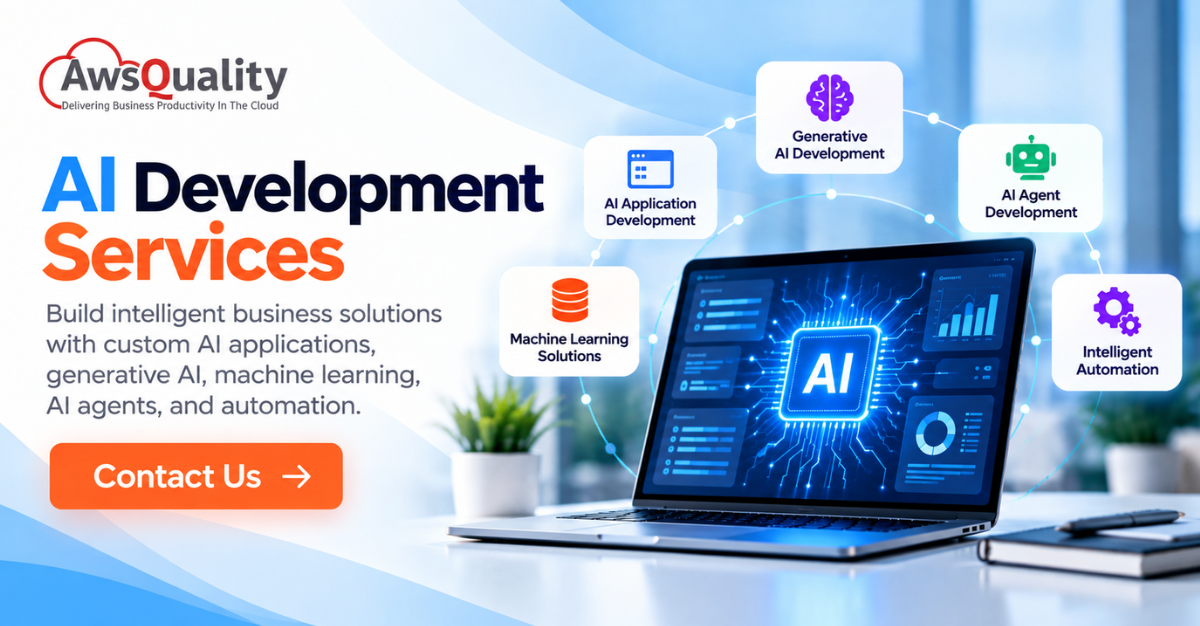
AI Development Services to Build Intelligent Business Solutions
Turn your business ideas into practical AI solutions with AwsQuality. We provide AI development services to help businesses build intelligent applications, automate workflows, improve decision-making, and make better use of their data. From AI-powered applications and generative AI solutions to custom machine learning models and intelligent automation, we develop solutions around your business goals, users, and existing technology.
Our artificial intelligence development services cover the journey from identifying the right use case to designing, developing, integrating, testing, and deploying AI solutions. Whether you want to add AI capabilities to an existing application or build a custom AI product from the ground up, our team helps you evaluate the options and develop a solution designed for real-world use.
Have an AI use case in mind? Let’s discuss your requirements and identify a practical path from idea to implementation.
Custom AI Development Services for Your Business
Every business has different processes, data, customers, and technology requirements. A generic AI tool may be enough for some tasks, but other use cases require a solution designed around specific workflows, business rules, and system integrations.
Our custom AI development services help businesses address these requirements through purpose-built applications, AI models, automation workflows, and integrations. We focus on selecting the right approach for the problem instead of adding AI where it does not provide meaningful value.
AI Application Development
Build AI-powered applications that help users work with information, complete tasks, and make decisions more efficiently. Our AI application development services cover the design and development of applications that incorporate intelligent capabilities into business and customer-facing experiences.
We can help develop AI applications that support document analysis, personalized recommendations, intelligent search, content processing, conversational interfaces, and other business-specific use cases.
What we can build:
- Custom AI-powered web and mobile applications
- Intelligent business applications and internal tools
- AI features for existing software products
- AI-powered search and recommendation systems
- Applications that use large language models and machine learning
- AI-enabled customer and employee experiences
Generative AI Development
Use generative AI to make business information easier to access, automate content-related workflows, and create more natural interactions with software.
Our generative AI development services help businesses incorporate large language models (LLMs) into applications and workflows. Depending on the use case, this can include AI assistants, document question-answering systems, enterprise knowledge search, content processing, and conversational applications.
We evaluate the requirements, available data, expected output quality, and integration needs to determine the right architecture and model approach.
Our generative AI capabilities include:
- LLM-powered applications and AI assistants
- Retrieval-augmented generation (RAG) solutions
- AI chatbots and conversational interfaces
- Enterprise knowledge management and search
- Document summarization and information extraction
- LLM API integration and workflow automation
- Model evaluation and output-quality improvement
AI Agent Development
AI agents can help coordinate multi-step tasks by interpreting inputs, using approved tools, retrieving information, and carrying out defined actions within a workflow. They can be useful when a process requires more than answering a question or generating text.
Our AI agent development services focus on business use cases where an agent can work with APIs, enterprise data, and existing applications to assist with tasks such as information retrieval, support operations, document workflows, and internal process coordination.
We design agents with defined permissions, clear task boundaries, error handling, and human approval where needed. This helps businesses adopt agent-based automation without giving an AI system unrestricted access to business operations.
Potential applications include:
- Internal employee support agents
- Customer service assistance
- Research and information retrieval
- Document processing workflows
- Multi-step business process automation
- AI assistants connected to enterprise systems
Machine Learning Development
Machine learning helps software identify patterns in data and use them to make predictions, classifications, recommendations, or other data-driven outputs.
Our machine learning development services help businesses explore and build models around specific business problems. We assess the available data, define the intended outcome, select an appropriate modeling approach, and evaluate performance against relevant metrics.
Machine learning use cases include:
- Demand and sales forecasting
- Customer churn prediction
- Recommendation engines
- Fraud and anomaly detection
- Customer segmentation
- Predictive maintenance
- Risk scoring and decision support
The right solution depends on the quality of the available data, the complexity of the problem, and the accuracy required for business use.
AI Chatbot Development
Give customers and employees a more efficient way to find information and complete routine tasks with AI-powered conversational applications.
Our AI chatbot development services can support customer support, product inquiries, internal knowledge access, lead qualification, and service-related questions. Depending on your requirements, a chatbot can use predefined business rules, natural language processing, a large language model, or a combination of approaches.
We can also connect chatbot experiences to approved knowledge sources and business systems so responses can be grounded in relevant information rather than relying only on a model’s general knowledge.
AI Integration Services
AI creates more business value when it works with the systems and information your teams already use.
Our AI integration services help connect AI capabilities with existing applications, databases, APIs, cloud services, and business workflows. This can include integrating an AI model into an existing product, connecting an AI assistant to an internal knowledge source, or adding intelligent automation to a business process.
Integration possibilities include:
- AI APIs and third-party model services
- Salesforce and other CRM platforms
- Enterprise applications and internal tools
- Databases and data platforms
- Web and mobile applications
- Cloud infrastructure and business workflows
Integration requirements depend on the existing architecture, data access, security controls, and the capabilities of each connected system.
AI Proof of Concept and Prototype Development
Before investing in a full AI implementation, it is useful to test whether the proposed approach can solve the intended problem.
Our AI proof of concept (PoC) and prototype development services help validate technical feasibility and business assumptions using a limited, clearly defined scope. We establish evaluation criteria, test the solution against representative data, identify limitations, and use the findings to inform the next steps.
A PoC can help you understand whether to proceed with full development, refine the use case, explore a different model, or consider an existing commercial tool.
AI Model Evaluation, Deployment, and Optimization
An AI solution needs more than a successful initial demonstration. It must continue to perform as expected under real usage conditions.
We help prepare AI solutions for deployment by testing functionality, evaluating output quality, checking integration behavior, and considering latency, security, and operating costs. Depending on the project, ongoing work may include performance monitoring, prompt refinement, model evaluation, version management, and updates as requirements or data change.
The objective is to make AI applications easier to operate, maintain, and improve over time.
Salesforce AI Integration
AwsQuality carries deep Salesforce platform expertise alongside AI development capabilities — a combination that is genuinely rare in the market. We integrate AI capabilities directly into Salesforce workflows through MuleSoft, Agentforce, Einstein AI, Data Cloud, and custom Apex integrations.
This means AI agents that operate inside Sales Cloud opportunity workflows, document intelligence tools that process contracts within Service Cloud cases, and AI-powered analytics embedded in Tableau dashboards — all with Salesforce’s native security model intact.
Our AI Development Capabilities
Artificial intelligence includes several technologies, each suited to different types of problems. We help businesses select and combine the capabilities that fit their objectives.
Generative AI and Large Language Models
Create applications that generate, summarize, classify, and interpret text or other supported content. Common uses include document assistants, knowledge search, conversational interfaces, and content-processing workflows.
Natural Language Processing (NLP)
Build systems that process and analyze human language. Depending on the use case, these systems can classify text, extract information, analyze sentiment, identify topics, and support language-based search.
Predictive Analytics
Use historical and current data to estimate future outcomes, identify patterns, and support business planning. Examples include demand forecasting, customer churn analysis, and operational risk prediction.
Computer Vision
Develop solutions that analyze images or video for tasks such as object detection, visual inspection, image classification, and document image processing.
Intelligent Process Automation
Combine AI with business rules, APIs, and workflow orchestration to reduce repetitive work, route tasks, extract information, and support decisions that previously required manual processing.
Retrieval-Augmented Generation (RAG)
Connect language models to relevant external or internal information sources so applications can retrieve context before generating a response. RAG is particularly useful for knowledge assistants, document question answering, and enterprise search.
AI-Powered Recommendations
Use user behavior, product information, or historical interactions to recommend relevant content, products, services, or next actions. The appropriate approach depends on the available data and the business objective.
AI Solutions We Develop
We build AI-powered capabilities around specific business requirements rather than offering the same implementation for every organization.
- AI knowledge assistants: Help employees find answers across approved company documents and knowledge sources.
- Intelligent document processing: Extract, classify, summarize, and route information from business documents.
- AI customer support solutions: Assist users with common questions and help support teams access relevant information.
- Predictive analytics applications: Turn business data into forecasts, risk indicators, and decision-support insights.
- AI-powered search: Help users find relevant information across large collections of documents or records.
- Recommendation systems: Deliver personalized suggestions based on relevant customer, product, or usage data.
- AI workflow automation: Combine model outputs, business rules, and system integrations to streamline repeatable processes.
- AI-enabled business applications: Add intelligent capabilities to existing software or develop a new application around a validated use case.
The best solution depends on your business problem, data readiness, existing systems, and the level of automation that is appropriate.
Benefits of AI Development Services for Businesses
AI is most useful when it addresses a clearly defined problem. A well-designed implementation can help businesses improve how work gets done, how information is used, and how decisions are supported.
Reduce Repetitive Manual Work
AI can assist with tasks such as document classification, information extraction, summarization, and routine inquiry handling. Automating suitable tasks can free employees to focus on work that requires judgment, creativity, and human interaction.
Improve Access to Business Information
AI-powered search and knowledge assistants can help employees locate relevant information across approved sources. This can reduce the effort involved in searching documents and navigating disconnected information systems.
Support Better-Informed Decisions
Predictive models and analytics applications can help identify trends, estimate outcomes, and surface patterns that may be difficult to detect manually. Human expertise remains important when interpreting results and making consequential decisions.
Deliver More Relevant Customer Experiences
AI-powered recommendations and conversational applications can help businesses tailor interactions to customer needs, preferences, and context when suitable data is available.
Extend Existing Applications
AI integration can add intelligent capabilities to existing software without necessarily requiring a complete system replacement. The feasibility and scope depend on the architecture and integration options available.
Build a Foundation for Future Innovation
A focused AI implementation can help businesses learn which use cases create value, what data and infrastructure are needed, and how AI can be introduced responsibly into additional workflows.
Actual results vary by use case, data quality, implementation, adoption, and the way outcomes are measured. We recommend defining success metrics before development begins.
Our AI Development Process
Our AI development process is designed to move from a business problem to a solution that can be evaluated, integrated, and maintained.
Step 1: Discovery and Requirement Analysis
We begin by understanding your business goals, current workflows, target users, existing systems, and the problem you want AI to solve.
Outcome: A clearly defined use case, initial scope, requirements, and potential success metrics.
Step 2: AI Feasibility and Data Assessment
We evaluate whether AI is an appropriate approach and review the availability, quality, accessibility, and sensitivity of the data involved. We also identify integration requirements, constraints, and potential risks.
Outcome: A feasibility assessment, data requirements, and recommended next steps.
Step 3: Solution Architecture and Technology Selection
We define the solution architecture and evaluate suitable models, APIs, frameworks, infrastructure, and integration methods. We consider accuracy, latency, scalability, maintainability, security, and operating cost.
Outcome: A proposed architecture, technology approach, and implementation plan.
Step 4: Proof of Concept or Prototype
When appropriate, we develop a focused prototype to test the most important assumptions. We evaluate its outputs against defined criteria and use feedback to refine the approach.
Outcome: Evidence of feasibility, identified limitations, and a clearer understanding of production requirements.
Step 5: AI Application Development
We develop the application, model-related components, interfaces, data connections, and workflow logic required for the agreed scope.
Outcome: A working solution ready for testing and validation.
Step 6: Testing and Validation
We test application behavior, integration reliability, output quality, edge cases, error handling, and relevant security requirements. AI-specific evaluations may include factual accuracy, relevance, consistency, and resistance to inappropriate inputs.
Outcome: A validated solution with identified limitations and release-readiness findings.
Step 7: Deployment and Integration
We prepare the solution for the selected environment and connect it to the relevant systems and workflows. Deployment arrangements depend on your infrastructure, access requirements, and operational constraints.
Outcome: A deployed AI solution prepared for intended use.
Step 8: Monitoring and Continuous Improvement
After deployment, we can help evaluate performance, monitor costs, address issues, refine prompts or workflows, and reassess the solution as data and business requirements change.
Outcome: A practical plan for maintaining and improving the solution over time.
Our Approach to Secure and Responsible AI Development
AI applications may process sensitive business information, interact with customers, or influence operational decisions. Security and responsible use should therefore be considered from the beginning of development.
Our project approach can address the following areas, based on the solution’s requirements:
- Data access controls: Restrict access to information according to defined roles and permissions.
- Privacy considerations: Identify sensitive data and determine how it should be handled, retained, or excluded.
- Grounded responses: Where appropriate, connect generative AI applications to approved information sources and evaluate whether outputs are supported by those sources.
- Human oversight: Keep human review or approval in workflows where automated actions or incorrect outputs could have significant consequences.
- Testing and evaluation: Test outputs, edge cases, failure behavior, and potential misuse scenarios.
- Monitoring and maintenance: Review application behavior and update the solution when requirements, data, or model behavior change.
- Cost and performance management: Evaluate usage, latency, and infrastructure requirements to support sustainable operation.
Security controls, regulatory obligations, and deployment options vary by project. We define the relevant requirements during discovery rather than assuming that one set of controls fits every AI application.
Industries That Can Benefit from AI Development
AI can support different business objectives across industries. The most suitable opportunities depend on the processes, information, and systems available within each organization.
Healthcare
Potential applications include administrative document processing, knowledge retrieval, operational forecasting, and workflow assistance. Clinical applications require appropriate validation, privacy safeguards, and qualified human oversight.
Financial Services
AI can assist with document analysis, fraud and anomaly detection, customer support, risk analysis, and forecasting. Sensitive decisions require appropriate controls, validation, and human accountability.
Retail and E-commerce
Use cases include product recommendations, customer service automation, demand forecasting, inventory insights, and personalized shopping experiences.
Manufacturing
AI can support visual quality inspection, predictive maintenance, production planning, and analysis of operational data.
Logistics and Supply Chain
Potential applications include demand forecasting, shipment information processing, route-planning support, inventory analysis, and workflow automation.
Technology and SaaS
Software companies can incorporate AI assistants, intelligent search, automated document processing, recommendation features, and AI-powered capabilities into existing products.
Professional and Business Services
AI can help with document review, knowledge management, research assistance, information extraction, and repeatable administrative workflows.
These examples are potential use cases, not claims of prior industry-specific delivery. We would evaluate each opportunity against your actual requirements and constraints.
Why Choose AwsQuality for AI Development Services?
Choosing an AI development partner involves more than selecting a model or building a chatbot. The solution needs to fit your business processes, connect with your systems, and be practical to maintain.
AwsQuality brings a technology services perspective to AI development, with services spanning AI, Salesforce, ServiceNow, cloud, DevOps, data engineering, mobile, and web development.
We Build for Production, Not for Demos
There is a meaningful difference between an AI proof of concept and a production AI system. AwsQuality’s development practice is organized around production requirements from the beginning of every engagement: latency budgets, cost per inference, error handling, observability, and integration with existing authentication and data infrastructure. Teams we work with don’t get demos that can’t scale — they get systems that run.
Deep Integration Capability
AI becomes genuinely useful when it’s connected to real business systems — not when it’s isolated in a standalone tool. AwsQuality’s combination of AI development expertise and deep Salesforce platform knowledge gives us the ability to embed AI in the systems your teams actually use, rather than adding another tool to the stack that requires a context switch to use.
Model-Agnostic Architecture
We don’t build for one model provider. We design AI architectures with flexibility in mind, allowing businesses to evaluate different model providers as their requirements evolve. Where technically feasible, this approach can make it easier to adopt newer models or switch providers without rebuilding the entire application.
Evaluation-First Development
Every AI system AwsQuality delivers is accompanied by an evaluation framework — specific, measurable criteria that define what “working correctly” means for that system. This isn’t documentation after the fact; it’s how we develop. Evaluation runs are part of every sprint, and production deployment is gated on evaluation benchmarks passing.
Governance Built In, Not Added On
Governance, guardrails, access controls, and audit logging are part of the system architecture, not afterthoughts. For regulated industries, we document data handling, model behavior specifications, and human review workflows in a form that satisfies compliance requirements. For all clients, we implement the controls that prevent AI systems from becoming operational liabilities.
Engagement Models
AwsQuality works with enterprises in four engagement structures, depending on where you are in your AI journey:
AI Strategy and Architecture Consulting
A time-boxed engagement (typically four to six weeks) that produces a prioritized AI use case roadmap, architecture recommendations, data readiness assessment, and total cost of ownership modeling. The right first step for organizations evaluating AI investment without an existing internal AI capability.
Fixed-Scope Project Delivery
A defined project with agreed deliverables, milestones, and evaluation criteria. Used for discrete AI applications — a specific agent, a RAG knowledge system, an LLM integration — where the scope is well-understood and delivery timeline and budget are defined.
Dedicated AI Engineering Team
A full-time embedded AI engineering team — lead architect, AI engineers, QA, and project manager — working on your AI program on a quarterly retainer basis. Used by organizations building multiple AI systems in parallel or requiring ongoing AI development capacity alongside an internal team.
Staff Augmentation
Individual AI engineers, prompt engineers, MLOps specialists, or solution architects embedded in your existing engineering team. Used by organizations that have internal AI leadership but need specific skills or additional capacity.
Looking to develop an AI-powered application for your business? Share your use case with AwsQuality to discuss the requirements, possible approaches, and next steps.
Frequently Asked Questions
What are AI development services?
AI development services involve designing, building, integrating, testing, and maintaining software that uses artificial intelligence to solve business problems. These services can include AI application development, machine learning, generative AI, AI agents, chatbots, predictive analytics, and intelligent automation.
What is the difference between AI development services and artificial intelligence development services?
The terms AI development services and artificial intelligence development services generally refer to the same category of work. Both cover the development and integration of software that uses AI technologies. The scope can range from adding an AI feature to an existing application to building a custom AI-powered product.
What are custom AI development services?
Custom AI development services involve building AI solutions around a business’s specific requirements, workflows, data, and technology environment. Examples include internal knowledge assistants, predictive models, document-processing systems, AI agents, and custom AI applications integrated with existing software.
What are AI application development services?
AI application development services focus on building software applications that incorporate AI capabilities. These may include web or mobile applications, conversational assistants, intelligent search tools, recommendation systems, document analysis applications, and business workflow tools.
How do I know whether my business needs a custom AI solution?
A custom solution may be appropriate when existing tools cannot meet your requirements, when the application must work with specialized business data, or when AI needs to integrate with specific systems and workflows. If a standard tool already solves the problem effectively, purchasing or configuring that tool may be more practical than building from scratch.
Can AI be integrated into our existing software?
Yes. AI can often be added to existing software through APIs, model services, application components, and workflow integrations. The available options depend on the current architecture, data access, security requirements, and the capabilities of the software being integrated.
How long does AI application development take?
The timeline depends on the scope, data readiness, integration complexity, evaluation requirements, and deployment environment. A narrowly scoped prototype may take considerably less time than a production application involving multiple systems, sensitive data, or complex AI workflows. A realistic timeline can be established after requirements and feasibility are assessed.
How much do AI development services cost?
AI development costs depend on the type of solution, project scope, model or API usage, data preparation, integrations, security requirements, and ongoing support needs. A small proof of concept will generally require a different level of investment than a production-grade enterprise application. AwsQuality can discuss the scope and requirements to help define an appropriate project estimate.
Which technologies are used for AI development?
The technology stack depends on the application. AI solutions may use machine learning frameworks, large language model APIs, retrieval systems, data pipelines, cloud services, databases, application frameworks, and integration APIs. Technology selection should reflect the use case, performance requirements, security needs, and long-term maintainability.
How do you evaluate whether an AI solution is successful?
Success should be measured against the business objective defined at the start. Depending on the use case, relevant measures may include task completion time, output accuracy, retrieval relevance, automation rate, user adoption, cost per task, or reduction in manual effort. These metrics help determine whether the solution is delivering the intended value.
Can you help us validate an AI idea before full development?
A proof of concept or prototype can help test feasibility before a larger investment. The process typically involves defining the use case, choosing evaluation criteria, testing a limited implementation, and documenting the results and limitations. The findings can guide the decision to proceed, revise the approach, or consider alternatives.
Let’s Build an AI Solution That Fits Your Business
You do not need to begin with a fully defined AI product. You need a business problem worth solving and a clear way to evaluate the result.
AwsQuality can help you explore your use case, assess technical requirements, and plan an AI solution that fits your applications, data, and workflows.