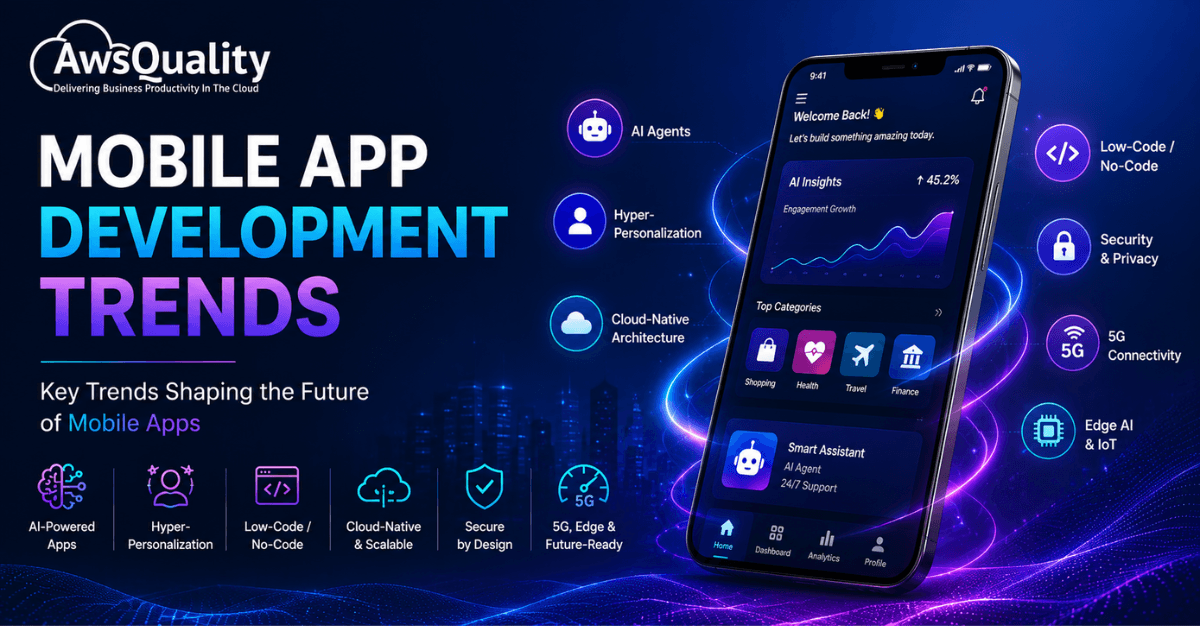
Mobile app development is evolving faster than ever. Artificial Intelligence (AI), 5G, cloud-native architecture, IoT, and hyper-personalization are transforming how businesses build digital products and engage customers.
Today’s users expect more than just functional apps. They want fast, secure, intelligent, and personalized experiences across every device. Businesses that fail to keep pace with these expectations risk losing customers to competitors that embrace innovation.
Whether you’re planning a new mobile application or modernizing an existing one, understanding the latest mobile app development trends is essential for long-term success.
In this guide, we’ll explore the most important mobile app development trends shaping the future and how businesses can leverage them to gain a competitive advantage.
Why Mobile App Development Trends Matter
6.3 billion people — 78% of the global population — now use smartphone apps regularly. The mobile app market was valued at $330 billion in 2025 and is projected to reach $1.23 trillion by 2035 at a 21.55% compound annual growth rate. The enterprise mobile app development segment alone stood at $193.9 billion in 2025.
But here is what I find more telling than the market size figures: 90% of all mobile usage happens inside apps. Just 10% is on the mobile web. For businesses that have not yet made mobile a central strategic priority — not a secondary channel, not an afterthought, but a primary one — that ratio is the most important context available.
Mobile applications have become the primary touchpoint between businesses and customers.
Modern apps help organizations:
- Improve customer engagement
- Increase operational efficiency
- Strengthen brand loyalty
- Generate new revenue streams
- Automate business processes
- Deliver personalized experiences
Keeping up with emerging technologies ensures your application remains relevant, scalable, and competitive.
Read: From Idea to Launch – How Mobile App Development Services Work
1. AI Integration Has Shifted from Differentiator to Entry Requirement
Instead of adding AI as a feature later, businesses are designing AI-first mobile applications where intelligence is built into the core architecture.
Two years ago, having AI features in a mobile app was a competitive differentiator. In 2026, it is closer to a baseline expectation.
63% of mobile app developers now integrate AI features into their apps. 70% of mobile apps use AI capabilities to improve the user experience. Apps mentioning AI in their descriptions generated 7.5 billion downloads in the first half of 2025 alone — roughly 10% of all downloads in that period. And the AI mobile apps market grew 74% in a single year, from $2.94 billion in 2024 to $5.13 billion in 2025.
The business case for AI in mobile is not about the technology — it is about the outcomes. AI-driven personalization increases app engagement by 40 to 60%. Generative AI tools reduce development time by up to 50%. AI-powered travel recommendations increase in-app bookings by 32%. Streaming apps with AI-driven content suggestions see 35% higher user retention.
The most impactful AI integrations in 2026 are not the most visible ones. They are the recommendation engines that surface the right product at the right moment, the predictive text that understands a user’s communication patterns, the anomaly detection that identifies fraud before it completes, and the personalised content sequencing that keeps users inside the app longer than any manually curated experience could.
For businesses evaluating their mobile app strategy, the question is no longer whether to integrate AI. It is which AI capabilities to prioritise, how to implement them responsibly, and how to measure their impact on the outcomes that matter — retention, conversion, lifetime value.
2. AI Agents Are Changing Mobile Experiences
AI agents represent the next evolution beyond traditional chatbots.
Unlike rule-based automation, AI agents can:
- Handle customer queries
- Schedule appointments
- Process documents
- Complete transactions
- Automate workflows
- Assist employees
Businesses across finance, healthcare, retail, and logistics are increasingly integrating AI agents into mobile applications to reduce operational costs and improve customer satisfaction.
3. Hyper-Personalization Using AI
Users no longer expect one-size-fits-all applications.
AI enables businesses to personalize:
- Home screens
- Product recommendations
- Notifications
- Offers
- Content
- Search results
Hyper-personalization increases engagement, retention, and customer loyalty while creating better digital experiences.
Also read: 5 Signs You’ve Found the Right Mobile Application Development Company
4. Low-Code and No-Code Are Democratising App Development — and Compressing Timelines
Gartner projects that by the end of 2026, low-code development tools will account for 75% of new application development — up from 40% in 2021. Forrester reports that 87% of enterprise developers already use these platforms. The low-code market is growing from $37.39 billion in 2025 to a projected $264.40 billion by 2032 at a 32.2% CAGR.
What this means practically for business leaders is significant. The historical barrier of needing specialist developer resources for every iteration of a mobile product is collapsing. Teams can now prototype, test, and deploy functional mobile applications at a fraction of the previous cost and timeline. The competitive implication is that the businesses that understand how to use low-code tools strategically — for the right use cases, with the right governance — can move faster than those still treating every mobile project as a full bespoke development cycle.
I want to be precise about where low-code has genuine application and where it has limits. For straightforward business applications, internal tools, MVP development, and rapid prototyping, low-code platforms now deliver production-quality output. For complex, data-intensive, or highly differentiated consumer products, bespoke development with modern frameworks remains the right approach. The skill is in matching the tool to the requirement — and in recognising that the low-code tier of the market has matured dramatically in the past 18 months.
5. Cross-Platform Development Continues to Grow
Frameworks like Flutter and React Native allow businesses to build Android and iOS applications using a single codebase.
Benefits include:
- Faster development
- Lower costs
- Easier maintenance
- Faster time-to-market
For startups and enterprises alike, cross-platform development provides an excellent balance between cost and performance.
Check out: How to Build a Minimal Viable Product and Secure Funding? – The Complete Guide
6. Edge AI and On-Device Processing Are Reshaping Privacy and Performance
One of the most strategically significant technical shifts in mobile in 2026 is the movement of AI processing from cloud to device. Edge AI — where machine learning models run directly on the device rather than sending data to remote servers — is transitioning from experimental to mainstream.
The drivers are clear: users increasingly expect apps to work offline or in low-connectivity environments, demand that their data stays on their device rather than being transmitted to servers, and expect near-instantaneous response times that cloud round-trips cannot always deliver. Regulatory pressure across the EU, UK, and increasingly the US reinforces these expectations with legal force.
Android 16’s introduction of AI-powered on-device notification summarization is a visible signal of where the major platforms are heading. Apple’s continued expansion of on-device ML capabilities through the Neural Engine reflects the same direction. The practical implication for businesses building mobile products is that the architecture decision about where AI processing happens — on device, at the edge, or in the cloud — is now a privacy, performance, and regulatory decision as much as a technical one.
Businesses building mobile apps with AI features in 2026 need to evaluate which capabilities can and should run on-device, and architect accordingly. Getting this wrong creates both regulatory exposure and user experience disadvantages relative to competitors who get it right.
7. The Super-App Strategy Is Moving Westward
The super-app model — a single application that serves as the primary digital interface for multiple life functions: messaging, payments, shopping, services, food delivery, transport — has dominated mobile in Asian markets for over a decade. WeChat’s ecosystem of 1.3 billion users, and Grab’s multi-service platform across Southeast Asia, represent what is possible when a single app becomes the default access point for daily life.
What is happening in 2026 is that the strategic logic of the super-app is arriving in Western markets, driven by a combination of factors: user fatigue with managing multiple apps, regulatory pressure on data fragmentation, and the technical maturity of platforms that can deliver reliable multi-service experiences.
Businesses with strong mobile user bases are increasingly evaluating whether their app can become a platform for adjacent services — whether through native development, third-party integration, or marketplace models. The question I encourage leaders to ask is not “should we build a super-app?” but rather “which adjacent services could our existing users genuinely benefit from accessing through a single, trusted interface?” The answer to that question defines the boundary of the opportunity.
Check out: MVP to Market – Realistic Cost, Timelines and Tech Stack for MVP App Development
8. AR and VR Are Expanding Well Beyond Gaming
The association of augmented and virtual reality primarily with gaming is increasingly outdated. In 2026, AR and VR are generating measurable commercial returns across retail, healthcare, real estate, manufacturing, and education — and the numbers reflect the expanding scope.
The AR/VR market is expected to reach $31.61 billion by 2026 and surge to $231.36 billion by 2031. The wearable technology market — which provides the hardware context for many AR experiences — is projected to grow by nearly $100 billion between 2025 and 2029.
The business use cases that are generating ROI in 2026 are practical rather than immersive. Retail AR that allows customers to visualise furniture in their home before purchasing reduces return rates by 20 to 30%. Manufacturing AR that overlays assembly instructions on the physical workspace reduces error rates and training time. Healthcare AR that supports surgical planning and procedural guidance improves both accuracy and training outcomes. Real estate virtual tours that deliver photorealistic walkthroughs close sales at higher rates.
For businesses in these sectors, the question is not whether AR delivers value — it demonstrably does, in documented production deployments. The question is which use case delivers the clearest ROI for your specific context, and how to execute it without the complexity overhead that earlier-generation AR development required.
9. Enhanced Mobile App Security
Cybersecurity remains one of the biggest priorities in mobile app development.
Businesses are implementing:
- Biometric authentication
- Multi-factor authentication (MFA)
- End-to-end encryption
- Secure APIs
- AI-powered fraud detection
- Zero Trust security
Security is no longer optional—it’s essential for protecting customer trust and meeting regulatory requirements.
Also check: Why Finance Mobile Apps Need AI-First Architecture
10. 5G-Powered Mobile Experiences
The global rollout of 5G enables developers to build faster and more immersive applications.
Benefits include:
- Low latency
- Real-time collaboration
- HD streaming
- AR and VR experiences
- Better IoT connectivity
Industries such as healthcare, gaming, logistics, and retail are already benefiting from 5G-enabled mobile solutions.
11. Progressive Web Apps (PWAs)
Progressive Web Apps continue to gain popularity because they combine the best features of websites and native applications.
Advantages include:
- Offline functionality
- Faster loading
- Lower development costs
- Easy deployment
- Cross-platform compatibility
For many businesses, PWAs offer a cost-effective alternative to native applications.
12. IoT-Enabled Mobile Applications
The Internet of Things (IoT) is expanding rapidly.
Mobile applications now control and monitor:
- Smart homes
- Wearable devices
- Industrial equipment
- Healthcare devices
- Connected vehicles
IoT integration enables businesses to collect real-time data and automate operations more effectively.
13. Low-Code Development for Faster Innovation
Low-code platforms help organizations rapidly build internal applications and prototypes.
Benefits include:
- Reduced development time
- Faster testing
- Lower costs
- Increased business agility
While enterprise-grade applications still require custom development, low-code platforms accelerate innovation for many use cases.
14. Voice Search and Conversational Interfaces
Voice-enabled interactions are becoming increasingly common.
Businesses are integrating:
- Voice search
- AI voice assistants
- Conversational AI
- Speech recognition
These capabilities improve accessibility and create more natural user experiences.
15. Sustainable and Efficient Mobile Applications
Businesses are increasingly optimizing mobile applications for:
- Battery efficiency
- Reduced resource consumption
- Faster loading
- Green cloud infrastructure
Sustainable software not only improves user satisfaction but also reduces infrastructure costs.
16. Subscription Models Are Dominating Monetization
The shift away from paid downloads and toward subscription-based monetization is now largely complete. In-app purchases and subscriptions account for over 94% of total mobile market value. Consumer subscription spending reached $66.8 billion in 2024 and continues to grow. The average US smartphone user now subscribes to five to seven app subscriptions simultaneously.
This matters for businesses for several reasons. First, subscription models fundamentally change the relationship between the app and the user — from a transactional one-time exchange to an ongoing value delivery relationship that must justify renewal at every billing cycle. Apps that retain users through genuine ongoing value consistently outperform those that rely on inertia for subscription renewal.
Second, subscription models create a financial predictability and compounding growth dynamic that alternative monetization approaches cannot match. Monthly recurring revenue is more forecastable than advertising revenue and more sustainable than one-time purchase models in a market where paid app downloads are in structural decline.
Third, and most importantly from a product strategy perspective: subscription models create a direct feedback loop between product quality and business performance. When users pay monthly, the decision to continue or cancel is made regularly and deliberately. This creates accountability for product teams that advertising-based models do not.
For businesses evaluating their mobile monetization approach, the question is not whether subscription models work — they demonstrably do. The question is what ongoing value proposition justifies the subscription, and how to design the product to deliver that value consistently.
Best Practices for Businesses
Before investing in a mobile application, ask:
- Does this feature solve a real customer problem?
- Will it improve user experience?
- Can the application scale?
- Is security built into the architecture?
- Can AI create measurable business value?
- Will the app integrate with existing business systems?
Technology should always support business objectives.
Choosing the Right Mobile App Development Partner
Selecting the right development partner is just as important as selecting the right technology.
Look for a company with expertise in:
- Android development
- iOS development
- Cross-platform development
- AI integration
- Cloud-native architecture
- UI/UX design
- DevOps
- Mobile app security
- API integrations
An experienced development team can help you build an application that delivers long-term business value.
Why Choose AwsQuality for Mobile App Development?
At AwsQuality, we help businesses build secure, scalable, and future-ready mobile applications tailored to their unique goals.
Our mobile app development services include:
- Android App Development
- iOS App Development
- Cross-Platform App Development
- Flutter & React Native Development
- AI-Powered Mobile Apps
- Custom Mobile Application Development
- Enterprise Mobility Solutions
- UI/UX Design
- Cloud Integration
- API Development & Integration
- Mobile App Modernization
- Ongoing Support & Maintenance
Whether you’re building a customer-facing application, an enterprise mobility solution, or an AI-powered digital product, our team helps transform ideas into high-performing mobile experiences.
Final Thoughts
The future of mobile app development is being shaped by AI, cloud computing, 5G, cybersecurity, and intelligent automation.
Businesses that embrace these innovations today will be better positioned to improve customer experiences, streamline operations, and drive sustainable growth.
Rather than chasing every new technology, focus on the trends that align with your business objectives and create measurable value.
The right mobile application is no longer just a digital product—it’s a strategic business asset.
Frequently Asked Questions
1. What are the latest mobile app development trends?
Some of the biggest trends include AI-powered apps, AI agents, cross-platform development, cloud-native architecture, 5G, IoT integration, enhanced security, and Progressive Web Apps (PWAs).
2. Why is AI important in mobile app development?
AI enables personalization, automation, predictive analytics, intelligent search, and improved customer engagement, making applications smarter and more efficient.
3. Should businesses choose native or cross-platform app development?
It depends on your goals. Native development offers maximum performance, while cross-platform development reduces cost and accelerates time-to-market.
4. Why is mobile app security important?
Strong security protects user data, prevents cyber threats, ensures regulatory compliance, and builds customer trust.
5. How do I choose the right mobile app development company?
Look for expertise in custom app development, AI integration, cloud technologies, UI/UX design, security, and ongoing support.
 Bio
Bio