
Cloud Infrastructure Requirements for Generative AI Applications
 Mohammad Usman 26 min read
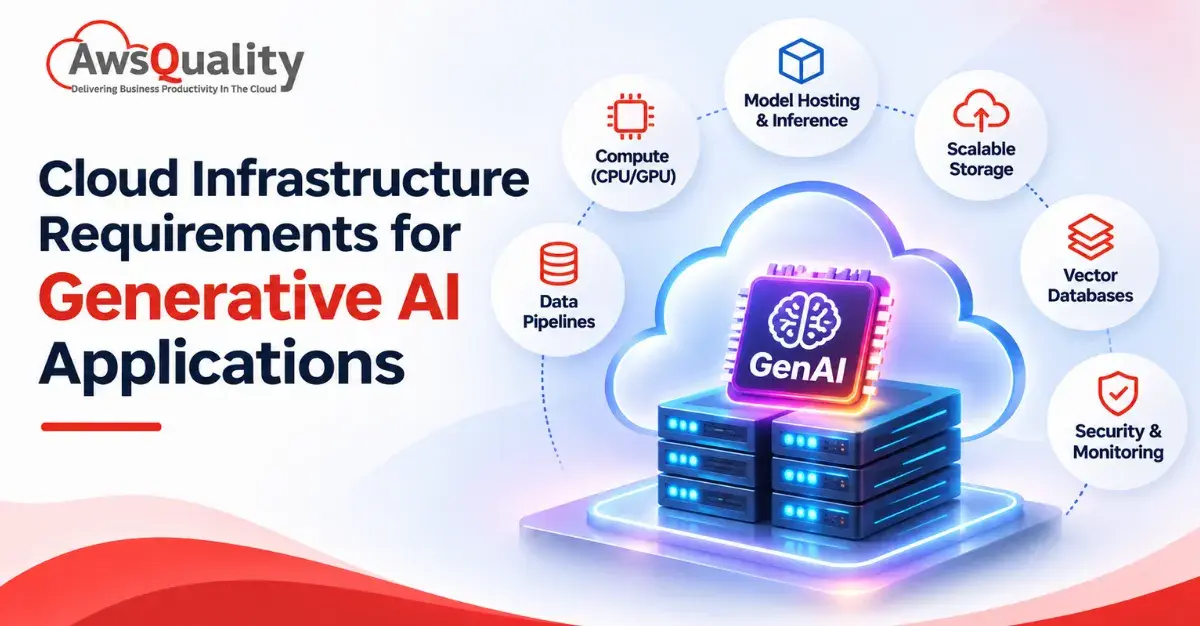
Generative AI is changing how businesses develop software, automate workflows, interact with customers, and use enterprise data. From AI-powered chatbots and virtual assistants to document processing systems and intelligent business applications, organizations are finding new ways to apply large language models (LLMs) and other generative AI technologies.
However, building a generative AI application involves more than selecting a model and connecting it to a user interface. Behind every reliable AI application is a cloud infrastructure capable of handling data processing, model inference, application workloads, security, and changing user demand.
A cloud environment designed for traditional web applications may not automatically meet the requirements of generative AI workloads. AI applications can require specialized computing resources, high-performance storage, scalable networking, vector databases, model-serving environments, and continuous monitoring.
So, what cloud infrastructure do businesses need to build and deploy generative AI applications successfully?
This guide explores the essential infrastructure components, cloud architecture considerations, security requirements, scalability strategies, and cost optimization practices businesses should consider when planning a generative AI deployment.
What is Cloud Infrastructure for Generative AI?
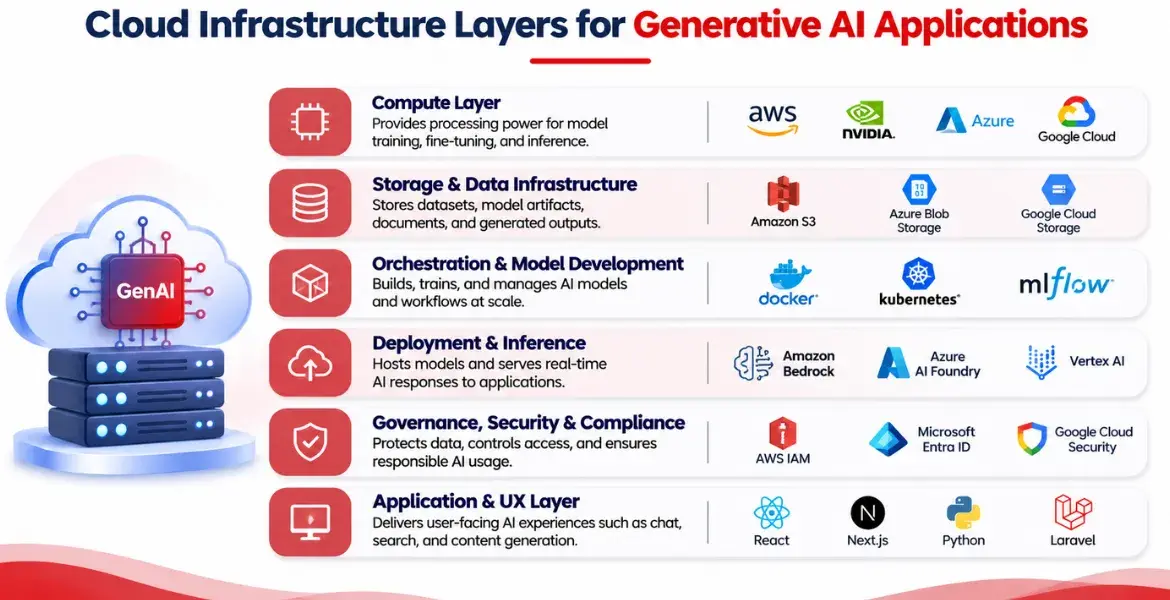
Cloud infrastructure for generative AI refers to the computing, storage, networking, database, security, and deployment resources required to develop, host, and operate AI-powered applications.
Unlike conventional applications that primarily process predefined business logic and database queries, generative AI applications interact with machine learning models to generate text, images, code, summaries, recommendations, and other outputs.
These workloads introduce additional infrastructure requirements, including:
- High-performance computing: CPUs and GPUs to support model training, fine-tuning, and inference workloads.
- Scalable storage: Storage systems for datasets, documents, model files, embeddings, and generated content.
- Model-serving infrastructure: Environments that make AI models accessible to applications through APIs or dedicated endpoints.
- Data processing pipelines: Systems that prepare, clean, transform, and organize data for AI applications.
- Vector databases: Storage and retrieval systems that help applications find semantically relevant information.
- Secure networking: Network configurations that protect communication between users, applications, databases, and AI services.
- Monitoring and orchestration: Tools to track application performance, model usage, infrastructure health, and operational costs.
The exact infrastructure depends on the application. A business using a hosted foundation model through an API may need relatively modest application infrastructure. An organization training or hosting its own large language model will have substantially different compute, storage, and operational requirements.
Read: 12 Artificial Intelligence (AI) Solutions Every CTO Should Explore
Why Do Generative AI Applications Need Specialized Cloud Infrastructure?
Generative AI applications introduce workloads that can behave differently from traditional enterprise applications. Their infrastructure must support both conventional application operations and AI-specific processing.
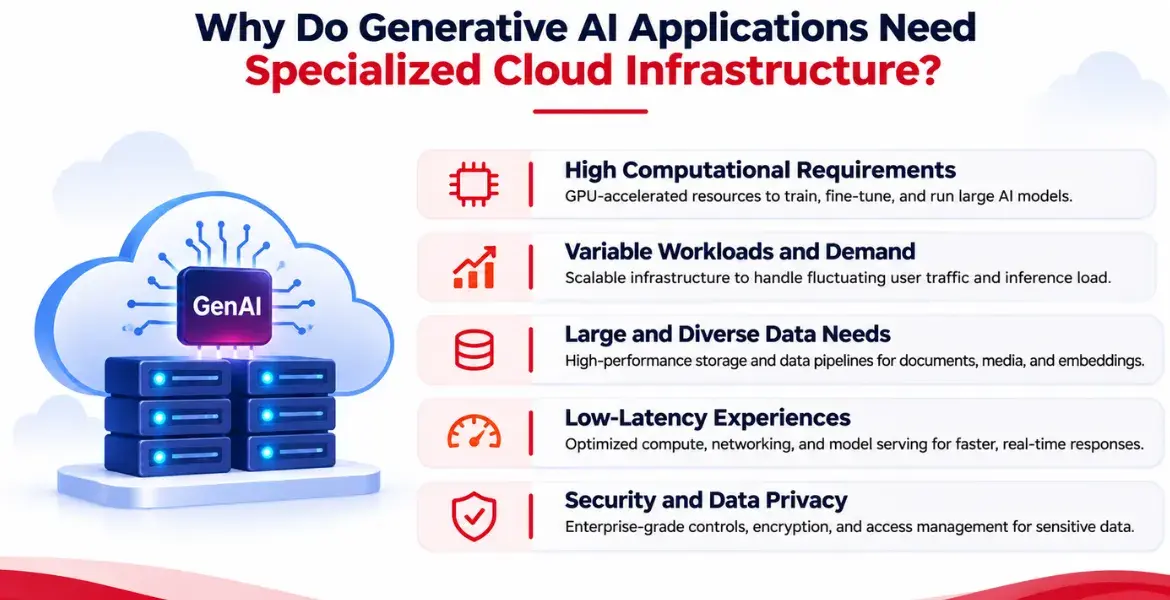
Here are some of the main reasons businesses need to plan their cloud environments carefully.
1. High Computational Requirements
Training, fine-tuning, and running AI models can require significant computing resources. Large language models, image-generation models, and multimodal systems may need GPU-accelerated computing to process workloads efficiently.
Even when businesses use externally hosted models, their applications still need computing resources to handle user requests, process documents, retrieve information, and manage application workflows.
2. Variable Workloads and User Demand
AI application traffic can fluctuate significantly. A customer-facing chatbot, for example, may receive a large number of simultaneous requests during business hours or marketing campaigns.
Infrastructure should be capable of scaling application services, inference capacity, and supporting components according to workload demand.
3. Large and Diverse Data Requirements
Generative AI applications often work with documents, databases, images, audio, and other data sources. They may need to process and store this information before passing relevant context to an AI model.
This requires suitable storage systems, data pipelines, and database architectures.
4. Low-Latency User Experiences
Users expect AI applications to respond within a reasonable amount of time. Delays can occur during document retrieval, model inference, network communication, or application processing.
Cloud infrastructure must be designed to reduce unnecessary processing delays and manage requests efficiently.
5. Security and Data Privacy
Generative AI applications may process customer information, internal documents, financial records, and other sensitive business data.
Organizations need appropriate identity management, encryption, network isolation, access controls, and monitoring to protect information throughout the AI application lifecycle.
Also read: How AI-powered customer service automation reduces costs without hurting CX
Key Cloud Infrastructure Requirements for Generative AI Applications
A production-ready generative AI environment typically consists of multiple interconnected infrastructure components. Each component supports a different part of the application lifecycle.
1. High-Performance Compute Infrastructure
Compute infrastructure provides the processing power required to run AI applications and models.
The choice of computing resources depends on whether the organization is consuming a hosted model, running its own model, or training and fine-tuning models.
CPU-based computing
CPUs are suitable for many general application workloads, including:
- Hosting frontend and backend services.
- Processing user requests.
- Running application business logic.
- Managing APIs and integrations.
- Performing data preparation and lightweight processing.
- Coordinating AI workflows.
GPU-accelerated computing
Graphics Processing Units (GPUs) are designed to perform large numbers of parallel computations. They are commonly used for AI workloads such as model training, fine-tuning, and inference.
GPU infrastructure may be required when organizations:
- Train models using large datasets.
- Fine-tune existing foundation models.
- Host open-source large language models.
- Run image, video, or other compute-intensive generative models.
- Need greater control over model deployment and inference performance.
The GPU requirements depend on model architecture, model size, precision, available memory, input and output sequence lengths, batch size, and concurrency.
Choosing the right compute model
Not every generative AI application requires dedicated GPU infrastructure. Businesses using managed model APIs can often avoid provisioning and maintaining their own model-serving GPUs.
A practical approach is to begin with the simplest compute model that meets application requirements and introduce dedicated accelerated infrastructure when performance, customization, data control, or cost considerations justify it.
2. Scalable Cloud Storage
Generative AI applications work with different types of information, including structured data, unstructured documents, model files, embeddings, and generated outputs.
A suitable storage architecture helps applications access this information efficiently while supporting growth.
Common storage requirements include:
Object storage
Object storage is useful for storing large volumes of unstructured data, such as:
- PDFs, Word documents, and spreadsheets.
- Images, audio, and video files.
- Training and evaluation datasets.
- Model artifacts and checkpoints.
- Application-generated content.
- Document collections used in retrieval-augmented generation.
Cloud object storage services include Amazon S3, Azure Blob Storage, and Google Cloud Storage.
Block storage
Block storage provides persistent storage volumes for virtual machines and other compute workloads. It can be used for operating systems, application data, temporary processing, and workloads that require predictable storage performance.
File storage
Managed file storage can support applications and AI workloads that need shared file-system access, including distributed processing environments.
Storage planning considerations
When designing storage for generative AI applications, businesses should consider:
- Data volume and expected growth.
- Storage performance and access frequency.
- Backup and recovery requirements.
- Data retention policies.
- Encryption and access permissions.
- Data location and compliance requirements.
- Data lifecycle and archival strategies.
The objective is not simply to store large amounts of data. It is to make the right information available to the appropriate application components securely and efficiently.
3. High-Performance Networking
Networking connects the different components of a generative AI environment, including application services, model endpoints, databases, storage systems, and external users.
Poor network design can increase response times, restrict data movement, and create security vulnerabilities.
Important networking components include:
Virtual Private Cloud (VPC) or Virtual Network (VNet)
A VPC or VNet provides an isolated network environment for deploying cloud resources. Organizations can use subnets, routing rules, and network security controls to separate application components.
Load balancing
Load balancers distribute incoming traffic across multiple application instances or services. This helps manage concurrent requests and prevents individual components from becoming overloaded.
Private connectivity
Private endpoints and private network connections can help applications communicate with supported cloud services without exposing service traffic directly to the public internet.
Content Delivery Networks (CDNs)
CDNs distribute static content, such as application assets and images, closer to users. They can improve the delivery of frontend resources, although they do not directly eliminate model inference latency.
Network monitoring
Network monitoring helps identify connectivity problems, unusual traffic patterns, latency, and potential bottlenecks between infrastructure components.
For generative AI applications, networking should be planned around security, data transfer requirements, user locations, and the placement of model-serving infrastructure.
4. Model Hosting and Inference Infrastructure
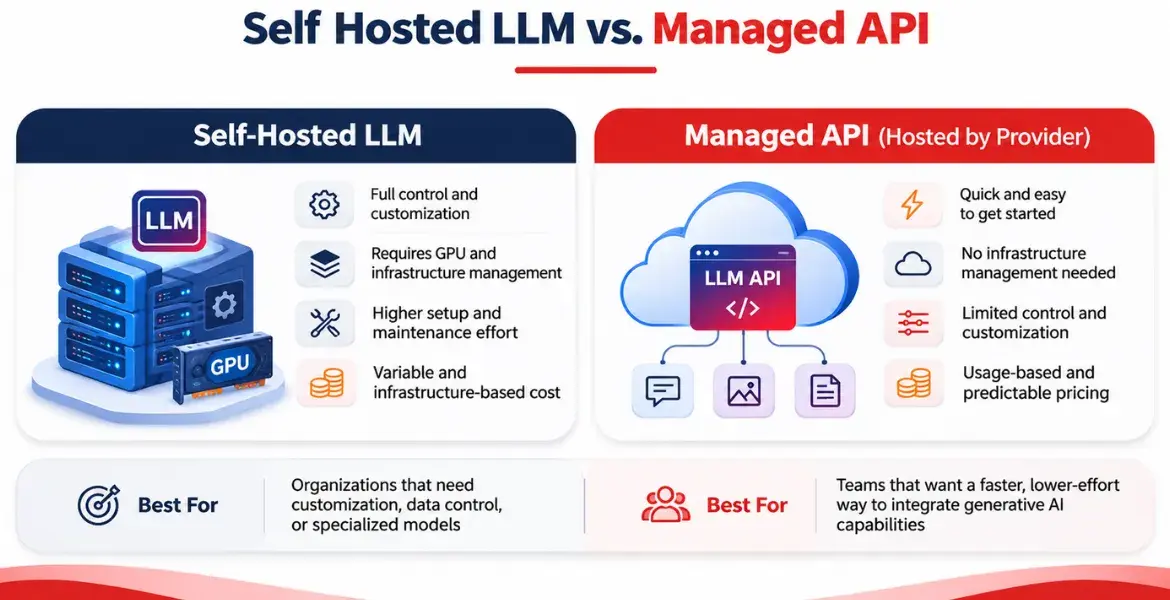
Model hosting provides the environment through which an application accesses a generative AI model.
Inference is the process of using a trained model to generate an output from an input, such as answering a question, summarizing a document, or generating code.
Businesses generally have three deployment options.
Managed model APIs
Organizations can access foundation models through managed AI services and APIs. The cloud provider or model provider manages much of the underlying model infrastructure.
This approach is useful when businesses want to develop AI applications without operating their own model-serving environment.
Examples include Amazon Bedrock, Azure AI Foundry model services, and Google Cloud’s Gemini and Vertex AI offerings.
Self-hosted models
Organizations can deploy open-source or custom models on their own cloud infrastructure. This provides greater control over model configuration, deployment, and serving environments, but also increases infrastructure and operational responsibilities.
Self-hosting may require:
- GPU-enabled compute instances.
- Model-serving frameworks.
- Containerized deployment environments.
- Model artifact storage.
- Autoscaling and load balancing.
- Performance and resource monitoring.
Hybrid model deployment
A hybrid approach combines managed model services with self-hosted models. Businesses can select different deployment approaches according to model requirements, data sensitivity, latency, customization, and cost.
Important inference considerations
A model-serving environment should be evaluated against:
- Requests per second.
- Number of concurrent users.
- Input and output token lengths.
- Time to first token.
- Total response latency.
- Throughput.
- Model availability.
- Cost per request or generated output.
These metrics help organizations determine whether their inference infrastructure can support actual production workloads.
5. Database and Vector Storage Infrastructure
Generative AI applications often need access to both conventional business data and semantically searchable information.
This is especially important for applications built using Retrieval-Augmented Generation (RAG).
Traditional databases
Relational and NoSQL databases can store application information, user profiles, transaction records, conversation history, and business data.
Examples include:
- PostgreSQL.
- MySQL.
- Microsoft SQL Server.
- MongoDB.
- Amazon DynamoDB.
Vector databases
Vector databases store numerical representations of information called embeddings. These embeddings help applications retrieve content based on semantic similarity rather than relying only on exact keyword matches.
For example, a user might ask, “How can I reset my account password?” A semantic search system may retrieve a document titled “Account Recovery Instructions” even if the document does not contain the exact words used in the question.
Common vector storage options include:
- Pinecone.
- Weaviate.
- Milvus.
- Amazon OpenSearch Service.
- PostgreSQL with the pgvector extension.
- Managed vector search services offered by cloud providers.
How vector storage supports RAG
A typical RAG workflow includes:
- Collecting relevant business documents and data.
- Extracting and preparing the content.
- Dividing documents into smaller, searchable sections called chunks.
- Generating embeddings for the content.
- Storing the embeddings and associated metadata.
- Retrieving relevant information when a user submits a query.
- Providing the retrieved context to a generative AI model.
- Returning a response based on the model’s generated output.
This approach allows businesses to connect generative AI applications with their own information without necessarily training a foundation model from scratch.
Check out: Responsible AI Implementation: Governance, Compliance, and Data Integrity Explained
6. Data Processing and Integration Infrastructure
Generative AI applications are only as useful as the information they can access and process.
Organizations often need to connect AI applications with enterprise systems, internal databases, cloud storage, CRM platforms, ERP applications, and external APIs.
A data processing infrastructure helps move information from these sources into the AI application environment.
Important components include:
Data ingestion pipelines
Collect information from databases, applications, documents, APIs, and other sources.
Data transformation
Clean, normalize, validate, and structure data before it is used by the AI application.
Embedding generation
Convert relevant text or other supported content into vector representations for semantic search.
Workflow orchestration
Coordinate data ingestion, document processing, embedding generation, indexing, and scheduled updates.
Integration services
Connect AI applications with existing enterprise platforms and business workflows.
For example, a company building an AI-powered customer support assistant may need to connect its application with CRM records, product documentation, support tickets, and knowledge bases. The infrastructure should support secure access to these systems while maintaining the appropriate data permissions.
7. Containerization and Orchestration
Generative AI applications may consist of multiple services, including frontend applications, backend APIs, document processors, retrieval services, model gateways, and monitoring components.
Containerization helps package these services with their application dependencies so they can be deployed consistently across environments.
Docker
Docker can package application services into containers, making development, testing, and deployment more consistent.
Kubernetes
Kubernetes can orchestrate containerized applications by managing deployment, service discovery, scaling, and workload scheduling.
Managed container platforms
Cloud providers also offer managed container and serverless platforms that reduce the operational effort involved in deploying application services.
The right choice depends on application complexity, workload characteristics, scaling requirements, and the level of infrastructure control needed.
For smaller applications, a managed application platform may be sufficient. Larger systems with multiple interconnected services may benefit from container orchestration.
8. Security and Identity Management
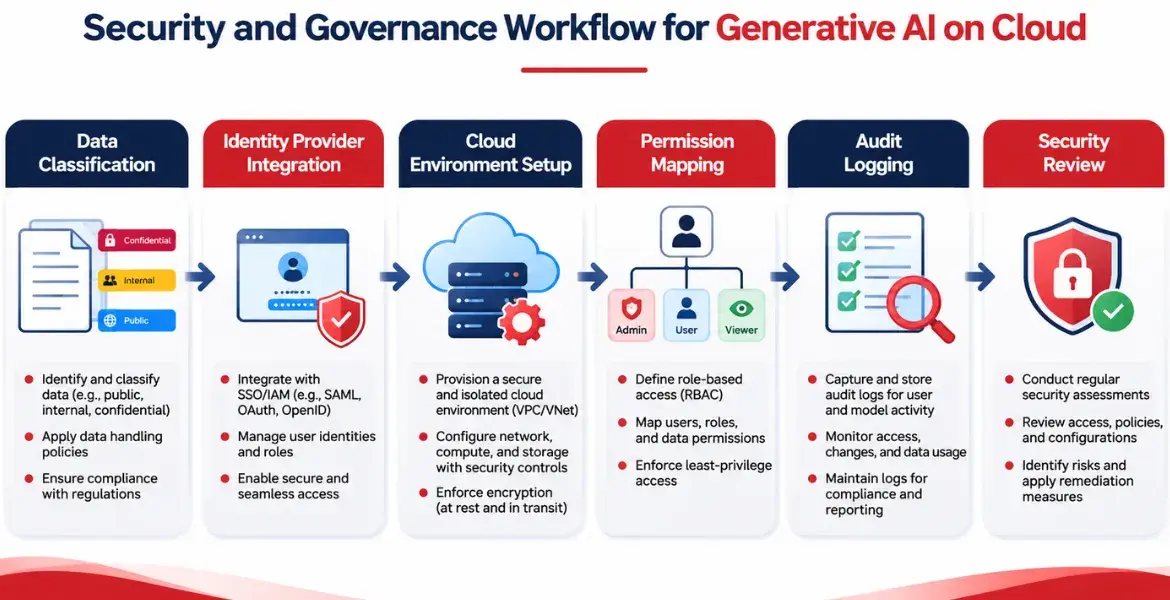
Security is a fundamental requirement for any production generative AI application, particularly when it processes enterprise or customer information.
AI infrastructure needs to protect not only application databases and cloud resources but also user prompts, retrieved documents, conversation history, model interactions, and generated outputs.
Important security controls include:
Identity and access management (IAM)
Use role-based permissions and least-privilege access to ensure users and services can access only the resources they need.
Encryption
Encrypt sensitive information in transit and at rest. Organizations may also need customer-managed encryption keys depending on their security and regulatory requirements.
Network isolation
Use private subnets, security groups, network policies, and private service endpoints where appropriate to restrict unnecessary network exposure.
Secrets management
Store API keys, database credentials, and other sensitive configuration values in managed secrets services rather than embedding them in application code.
Data access controls
Ensure retrieval systems respect the permissions associated with source documents and business records. A user should not receive information they are not authorized to access simply because an AI model can retrieve it.
AI-specific protections
Generative AI applications also require safeguards against prompt injection, sensitive information disclosure, unsafe outputs, and misuse of connected tools or APIs.
Organizations should implement appropriate input validation, output controls, content filtering, application-level authorization, and human review for sensitive workflows.
Security should be considered across the complete application lifecycle rather than added only after development is complete.
9. Monitoring, Logging, and Observability
A generative AI application can experience problems at different layers. The application may be running correctly while the model endpoint is slow, the vector database is unavailable, or the data retrieval process is returning irrelevant information.
Monitoring must therefore cover both traditional infrastructure metrics and AI-specific performance indicators.
Infrastructure monitoring
Track:
CPU and GPU utilization.
- Memory consumption.
- Storage capacity and performance.
- Network traffic and latency.
- Application instance health.
- Database availability.
- Container and service status.
Application monitoring
Monitor:
- API response times.
- Request volume.
- Error rates.
- User activity.
- Authentication failures.
- Service availability.
AI-specific monitoring
Track:
- Input and output token consumption.
- Model response latency.
- Time to first token.
- Model errors and timeouts.
- Retrieval relevance.
- Inference costs.
- Prompt and response quality.
- Safety and policy violations.
Logging and distributed tracing can help teams understand how a request moves through different application components and identify the source of delays or failures.
Organizations should also apply appropriate privacy controls to logs so sensitive prompts, documents, and generated content are not unnecessarily exposed.
Also check: How AI Agents and Salesforce are Redefining Customer Service
How to Choose the Right Cloud Deployment Model for Generative AI
There is no single cloud deployment model that works for every generative AI application. The right approach depends on the organization’s technical requirements, security needs, budget, and expected workload.
Three common deployment approaches are worth considering.
1. Public Cloud
Public cloud infrastructure provides access to scalable compute, storage, databases, networking, and managed AI services.
It is useful for businesses that want to build and scale generative AI applications without investing in physical infrastructure.
Common platforms include:
- Amazon Web Services (AWS).
- Microsoft Azure.
- Google Cloud Platform (GCP).
Public cloud services can help organizations access managed model APIs, GPU-enabled computing, object storage, vector search, and application hosting.
2. Private Cloud
A private cloud provides a dedicated cloud environment for an organization. It may be hosted in the organization’s own data center or through a third-party provider.
This model may be appropriate when businesses require greater control over infrastructure, network boundaries, data management, or deployment configurations.
However, private cloud environments may require more infrastructure management and specialized operational expertise.
3. Hybrid Cloud
Hybrid cloud combines public cloud services with private cloud or on-premises infrastructure.
For example, an organization may keep sensitive enterprise data within a controlled environment while using managed cloud AI services for selected application workloads.
This model can support specific data residency, integration, and operational requirements, but it requires careful planning around networking, identity, security, and data movement.
Reference Architecture for a Cloud-Based Generative AI Application
A typical generative AI application can be organized into several interconnected layers.
Consider an enterprise AI assistant that answers employee questions using internal company documents.
The architecture may include:
1. User Interface Layer
Employees access the AI assistant through a web application, mobile application, or internal portal.
2. Application and API Layer
The backend application authenticates users, validates requests, applies business logic, and communicates with other services.
3. Data Ingestion Layer
Enterprise documents are collected from approved sources, processed, and prepared for retrieval.
4. Embedding and Vector Storage Layer
Documents are converted into embeddings and stored in a vector database with relevant metadata.
5. Retrieval Layer
When a user submits a question, the retrieval service searches for relevant information while applying the required access permissions.
6. Model Inference Layer
The retrieved information is combined with the user’s question and sent to a selected generative AI model.
7. Response and Security Layer
The generated response is checked against application policies and returned to the user. Logging and monitoring services track the request and application performance.
8. Cloud Infrastructure Layer
Compute, storage, networking, IAM, encryption, backups, and monitoring support the complete application.
A simplified request flow looks like this:
User → Web or Mobile Application → Backend API → Authentication and Authorization → Retrieval Service → Vector Database → Model Endpoint → Response Processing → User
The document ingestion flow runs alongside the request flow:
Enterprise Data Sources → Data Ingestion → Document Processing → Chunking and Embeddings → Vector Database
This separation helps organizations manage data preparation and user-facing inference independently.
Example: Cloud Infrastructure for an AI-Powered Enterprise Knowledge Assistant
Consider a business that wants to build an AI-powered knowledge assistant for employees.
The application should answer questions using internal policies, product documentation, training materials, and business procedures.
A suitable infrastructure might include:
| Infrastructure component | Purpose |
|---|---|
| Web application | Provides the employee-facing interface |
| Backend application | Manages requests, business logic, and integrations |
| Managed AI model API | Generates responses to employee questions |
| Object storage | Stores documents and source files |
| Document processing service | Extracts and prepares document content |
| Embedding model | Converts document content into embeddings |
| Vector database | Stores and retrieves semantically relevant information |
| Relational database | Stores application configuration and user-related record |
| IAM and identity provider | Controls user authentication and authorization |
| Monitoring platform | Tracks application performance, errors, and usage |
When an employee asks a question, the application first verifies the user’s identity and permissions. The retrieval service searches the approved knowledge sources and identifies relevant content. The application then provides the retrieved context to the selected model, which generates a response.
The infrastructure must ensure that employees can only retrieve information they are authorized to access.
This example demonstrates why a generative AI application needs more than a model endpoint. It requires a coordinated infrastructure for application hosting, data processing, retrieval, security, and monitoring.
Read: Chatbots vs AI Agents – Which One Does Your Business Actually Need?
Best Practices for Building Scalable Cloud Infrastructure for Generative AI
Selecting the right cloud services is only one part of infrastructure planning. Organizations also need to design their environments so they can evolve as AI workloads grow.
Here are some practical best practices.
1. Start with the Application Requirements
Define the intended use case before selecting infrastructure.
Consider whether the application needs text generation, image generation, document processing, conversational AI, RAG, or AI agents.
Also evaluate expected users, concurrent requests, data sensitivity, response-time expectations, and integration requirements.
These factors influence compute, storage, networking, and model deployment decisions.
2. Separate Application and Model Workloads
Keep application services separate from model-serving infrastructure where practical.
This allows teams to scale backend services and inference resources independently.
For example, an application may experience an increase in user logins without a corresponding increase in model requests. Independent scaling helps avoid allocating unnecessary resources to every component.
3. Use Managed Services Where Appropriate
Managed cloud services can reduce the operational effort involved in maintaining infrastructure.
Businesses can use managed model APIs, databases, object storage, container platforms, and monitoring services instead of managing every component themselves.
However, managed services should still be evaluated for cost, service limits, data handling, availability, and integration requirements.
4. Design for Independent Scaling
Different components of a generative AI application have different resource requirements.
For example:
- Frontend services may scale according to user traffic.
- Backend APIs may scale according to incoming requests.
- Document processing workers may scale according to ingestion queues.
- Vector databases may scale according to retrieval traffic and index size.
- Model-serving infrastructure may scale according to concurrent inference demand.
Independent scaling helps allocate resources more efficiently.
5. Implement Strong Data Governance
Establish policies for data classification, access permissions, retention, encryption, and deletion.
Ensure that the retrieval layer respects source-system permissions and that sensitive information is not exposed through prompts, logs, or generated responses.
6. Automate Infrastructure Provisioning and Deployment
Infrastructure as Code (IaC) tools such as Terraform can help teams define and provision cloud resources consistently.
CI/CD pipelines can automate application testing, infrastructure validation, and deployment.
For AI applications, deployment processes should also account for model versions, prompt configurations, embedding changes, and evaluation results.
7. Monitor Performance and Quality Together
Traditional infrastructure monitoring does not tell the complete story of an AI application’s performance.
Track infrastructure health alongside model latency, token usage, retrieval quality, response quality, and user feedback.
This helps teams distinguish between infrastructure problems and AI application issues.
8. Build for Reliability and Recovery
Use health checks, backups, redundant components, retry mechanisms, and recovery procedures based on the application’s availability requirements.
For critical applications, consider multi-zone or multi-region deployment where justified by business needs.
Also test recovery procedures rather than assuming that configured backups will always be sufficient.
9. Establish Cost Controls Early
Monitor compute utilization, GPU usage, model API consumption, storage growth, and network transfer.
Set usage limits and alerts, evaluate model alternatives, and optimize retrieval and prompt design to reduce unnecessary processing.
Cost optimization should be part of the architecture from the beginning rather than an activity reserved for after deployment.
Also read: How AI Agents and Salesforce are Redefining Customer Service
Cloud Infrastructure Cost Considerations for Generative AI
Generative AI infrastructure costs can vary considerably depending on the model, deployment approach, application traffic, and data requirements.
Some of the main cost areas include:
Compute costs:
Virtual machines, containers, CPUs, GPUs, and other processing resources.
Model inference costs:
Charges associated with using managed model APIs or hosting models on dedicated infrastructure.
Storage costs:
Object storage, databases, vector indexes, backups, and model artifacts.
Networking costs:
Data transfer, private connectivity, load balancing, and content delivery.
Data processing costs:
Document extraction, transformation, embedding generation, and indexing.
Monitoring and operational costs:
Logging, metrics, tracing, security services, and infrastructure management.
Practical ways to optimize infrastructure costs
- Use managed model APIs when self-hosting is not justified.
- Select models according to task complexity instead of using the most expensive model for every request.
- Use smaller or optimized models for simpler workloads where quality requirements permit.
- Apply caching to suitable repeated requests and frequently accessed information.
- Optimize document chunking and retrieval to avoid sending unnecessary context to the model.
- Scale compute resources according to demand.
- Shut down unused development and testing resources.
- Review GPU utilization and avoid keeping expensive resources idle.
- Set budgets, alerts, and usage quotas for cloud and model services.
- Monitor cost per request or completed business task, not just total cloud spending.
For example, a customer support assistant may use a smaller model for classifying queries and a more capable model for complex responses. This approach can reduce unnecessary inference costs while maintaining the required response quality.
The most effective cost optimization strategy is to measure application performance and cost together, then adjust the architecture according to actual usage.
Read: Why Platform Engineering Outperforms Traditional Cloud Delivery
Common Cloud Infrastructure Challenges in Generative AI Projects
Even with a well-planned architecture, organizations may encounter challenges when moving generative AI applications into production.
Underestimating GPU and Memory Requirements
Choosing compute resources without testing the actual model and workload can lead to poor performance or deployment failures.
How to address it:
Benchmark the selected model using realistic input sizes, output lengths, and concurrency levels before finalizing the infrastructure.
Poor Data Quality
Incomplete, outdated, duplicated, or inconsistent data can reduce retrieval relevance and affect generated responses.
How to address it:
Establish data preparation, validation, metadata management, and indexing processes before connecting enterprise information to the AI application.
Uncontrolled Infrastructure Costs
Unoptimized inference workloads, excessive model usage, idle GPUs, and inefficient retrieval can increase operating expenses.
How to address it:
Introduce cost monitoring, usage quotas, model selection policies, and resource scaling from the beginning.
Security and Access Control Gaps
AI applications may unintentionally expose sensitive information if retrieval systems do not enforce source-level permissions.
How to address it:
Implement identity-aware retrieval, least-privilege access, encryption, secure network configurations, and appropriate AI safety controls.
Difficulties Scaling Production Workloads
A prototype may perform well with a few users but struggle when concurrent requests increase.
How to address it:
Load-test the complete application, scale individual components independently, and establish performance thresholds before production deployment.
AwsQuality’s Approach to GenAI Infrastructure
AwsQuality brings cloud architecture and AI platform expertise together to help organizations design, build, and optimize cloud infrastructure for generative AI applications. The AwsQuality GenAI infrastructure engagement covers:
Infrastructure assessment:
A current-state audit of cloud configuration, existing ML tooling, data pipeline architecture, and security posture — producing a gap analysis against production GenAI requirements.
Architecture design:
End-to-end reference architecture design covering compute selection, networking configuration, storage systems, vector database selection, MLOps platform configuration, and security controls — tailored to the organization’s specific use cases, model choices, and budget targets.
Implementation:
Terraform or CloudFormation infrastructure-as-code deployment of the designed architecture, with CI/CD pipelines for model deployment and infrastructure lifecycle management.
Cost optimization:
FinOps engineering including spot instance training pipelines, inference right-sizing, reserved capacity planning, and cost attribution dashboards.
Ongoing optimization:
As models, traffic, and use cases evolve, AwsQuality provides continuous infrastructure optimization to maintain performance and cost efficiency at scale.
Conclusion
Cloud infrastructure plays a critical role in the performance, scalability, security, and cost efficiency of generative AI applications. From GPU-accelerated computing and model hosting to vector databases, data pipelines, networking, and monitoring, every component contributes to a reliable AI environment.
However, businesses do not need to build the most complex infrastructure from the beginning. The right approach is to start with the application’s requirements, select suitable managed or self-hosted services, establish appropriate security controls, and scale resources as usage grows.
With a well-designed cloud foundation, organizations can move beyond generative AI experiments and build production-ready applications that support real business workflows.
AwsQuality helps businesses bring together cloud, AI, data engineering, and DevOps capabilities to support their digital transformation initiatives. If you’re planning to build or scale a generative AI application, the right infrastructure strategy is a practical place to start.
FAQs
Frequently Asked Questions
What cloud infrastructure is required for generative AI applications?
Generative AI applications typically require compute resources, scalable storage, networking, databases, model hosting or API access, data processing pipelines, security controls, and monitoring. Applications that use RAG may also require embedding generation and vector storage infrastructure.
Do generative AI applications require GPUs?
No. Applications that use managed foundation models through APIs may not need their own GPU infrastructure. GPUs are generally required when organizations train, fine-tune, or self-host models that need accelerated computing.
Which cloud platform is best for generative AI applications?
AWS, Microsoft Azure, and Google Cloud offer services for developing and deploying generative AI applications. The right platform depends on the organization’s existing infrastructure, preferred models, security requirements, integration needs, workload characteristics, and budget.
What is the role of a vector database in generative AI?
A vector database stores embeddings, which are numerical representations of information. It enables semantic search by finding content that is conceptually similar to a user’s query. Vector databases are commonly used in RAG applications to retrieve relevant business information for generative AI models.
What is the difference between AI model training and inference?
Training is the process of teaching a model patterns using data. Fine-tuning further adapts an existing model for a particular task or domain. Inference occurs when a trained model processes an input and generates an output. These workloads can have different compute and infrastructure requirements.
How can businesses scale generative AI applications?
Businesses can use autoscaling, load balancing, managed model endpoints, distributed application services, optimized retrieval systems, and independent scaling for different infrastructure components. Load testing and performance monitoring help determine the appropriate scaling configuration.
How can cloud infrastructure costs be reduced for generative AI?
Costs can be managed through appropriate model selection, optimized GPU utilization, autoscaling, caching, efficient retrieval, storage lifecycle policies, and monitoring of model API usage. Organizations should also review idle resources and establish budgets and usage alerts.
Is cloud infrastructure security different for generative AI applications?
Generative AI applications require conventional cloud security controls, such as identity management, encryption, network isolation, and monitoring. They also introduce additional considerations, including prompt injection, sensitive information exposure, unsafe model outputs, and unauthorized access to retrieved enterprise data.
What is RAG, and does it require additional cloud infrastructure?
Retrieval-Augmented Generation (RAG) connects a generative AI model to external information sources. A typical RAG implementation requires data ingestion, document processing, embedding generation, vector storage, retrieval services, and model inference infrastructure. The exact components depend on the selected architecture and cloud platform.
Should businesses use managed AI services or host their own models?
Managed AI services can simplify deployment and reduce infrastructure management. Self-hosting can provide greater control over model configuration and serving, but it requires more responsibility for compute, scaling, security, and maintenance. The best approach depends on performance, customization, privacy, cost, and operational requirements.
Cloud
Related Articles
How to Optimize AWS Costs Without Sacrificing Performance
Cloud adoption gives businesses the ability to scale infrastructure quickly, launch applications globally, and respond to changing workloads without maintaining traditional data…
Cloud ROI: How to Measure the Business Value of Cloud Investments
Most organizations know their cloud bill to the dollar. Far fewer know whether their cloud investment is actually paying off. This is…
Cloud Data Engineering: Best Practices for Enterprise Success
Introduction: Why Cloud Data Engineering Is the Enterprise Capability That Cannot Be Improvised The global data engineering market is projected to reach…