
How to Choose The Right ServiceNow Development Company for Your Business
 Mohammad Usman 24 min read
ServiceNow has become an important platform for organizations looking to streamline IT operations, automate business workflows, improve service delivery, and connect enterprise systems. From IT Service Management (ITSM) and IT Operations Management (ITOM) to HR Service Delivery (HRSD), Customer Service Management (CSM), and custom application development, the platform supports a wide range of business requirements.
However, getting the most value from ServiceNow requires more than purchasing licenses and configuring a few workflows. Businesses need the right implementation strategy, platform architecture, integrations, customizations, and ongoing support. This is where choosing the right ServiceNow development company becomes important.
A capable development partner can help you translate business requirements into practical ServiceNow solutions, avoid unnecessary customization, integrate existing applications, and build workflows that can scale as your organization grows. The wrong partner, on the other hand, may introduce technical complexity, increase implementation costs, and make future upgrades more difficult.
So, how do you choose the right ServiceNow development company for your business?
This guide explains the key factors to evaluate, questions to ask potential partners, common selection mistakes to avoid, and how to identify a company that aligns with your technical requirements and business goals.
What Does a ServiceNow Development Company Do?
A ServiceNow development company helps organizations implement, customize, integrate, and maintain solutions built on the ServiceNow platform. Depending on its expertise and service offerings, the company may support the entire project lifecycle, from initial consulting and requirements analysis to development, deployment, and ongoing optimization.
Typical services include:
- ServiceNow consulting: Understanding business requirements, evaluating existing processes, and recommending an appropriate platform strategy.
- ServiceNow implementation: Configuring and deploying ServiceNow applications and modules to support business operations.
- Custom application development: Building applications, workflows, forms, and business logic to address requirements that standard platform capabilities do not fully cover.
- ServiceNow integration: Connecting ServiceNow with CRM, ERP, HR, monitoring, identity management, and other enterprise applications.
- Workflow automation: Automating repetitive tasks, approvals, notifications, and cross-department processes.
- Platform customization: Configuring forms, dashboards, business rules, scripts, and user experiences.
- Data migration: Moving relevant records and business data from legacy systems into ServiceNow.
- Maintenance and support: Managing platform updates, resolving issues, improving performance, and supporting users.
Not every provider offers all these services. Before evaluating companies, identify the capabilities your project actually requires.
Read: How to Choose the Right ServiceNow Consulting Company
The ServiceNow Partner Ecosystem: Understanding What You Are Buying
ServiceNow operates a formal partner ecosystem through its ServiceNow Partner Program, which categorizes partners into tiers based on their technical certifications, customer success metrics, revenue, and geographic coverage. Understanding this tiering helps buyers filter the market efficiently.
ServiceNow Elite Partners represent the highest tier of the program. These organizations have demonstrated consistent delivery excellence, maintain large teams of certified professionals, and have direct access to ServiceNow’s product roadmap and early-access programs. Elite partners include the global system integrators and large regional specialty firms with demonstrated track records across dozens or hundreds of implementations.
ServiceNow Premier Partners occupy the mid-tier — companies that have achieved a substantial number of certifications and customer success references, but may be more geographically concentrated or focused on specific industries or modules.
ServiceNow Registered Partners form the base tier — newer entrants or smaller firms that have met minimum certification requirements but have not yet accumulated the reference portfolio of Elite or Premier partners.
Tier alone, however, is not a sufficient selection criterion. Many Registered or Premier Partners deliver exceptional results for clients that are not a fit for a large Elite firm’s model. The right question is not “what is their tier?” but rather “are they the right fit for our specific project, industry, and scale?”
Why Choosing the Right ServiceNow Development Partner Matters
ServiceNow often becomes a central part of an organization’s operational environment. It may connect multiple departments, applications, users, and business processes. Decisions made during implementation can therefore affect the platform’s usability, scalability, security, and long-term maintenance.
Here are some reasons why selecting the right development partner matters.
1. Better Alignment With Business Goals
A good development partner looks beyond the technical requirements and understands the business problem you are trying to solve.
For example, a company implementing ITSM may want to reduce manual ticket handling, improve incident resolution, and establish consistent service processes. Another organization may want to automate employee onboarding through HR workflows.
The implementation approach should reflect these objectives rather than simply reproduce existing processes in a new platform.
2. Reduced Implementation Complexity
ServiceNow offers extensive configuration and development capabilities. Without a clear implementation strategy, organizations can end up with unnecessary customizations, complicated workflows, and difficult-to-maintain configurations.
An experienced team can help determine when to use standard platform capabilities, when configuration is appropriate, and when custom development is genuinely necessary.
3. More Effective System Integration
Most enterprises already use multiple business applications. ServiceNow may need to exchange information with Salesforce, SAP, Microsoft applications, HR platforms, identity systems, and other enterprise tools.
A development partner with relevant integration experience can help design reliable data flows and reduce disconnected processes.
4. Scalability and Long-Term Maintainability
Your initial ServiceNow requirements may change as your organization grows. New departments, users, applications, and workflows may need to be added.
A well-designed solution should support future expansion without requiring extensive redevelopment.
5. Ongoing Platform Optimization
ServiceNow is not necessarily a one-time implementation project. Organizations may need regular updates, performance improvements, workflow enhancements, security reviews, and user support.
The right partner can provide a structured approach to ongoing platform management and improvement.
10 Factors to Consider When Choosing a ServiceNow Development Company
10 Factors to Consider When Choosing a ServiceNow Development Company
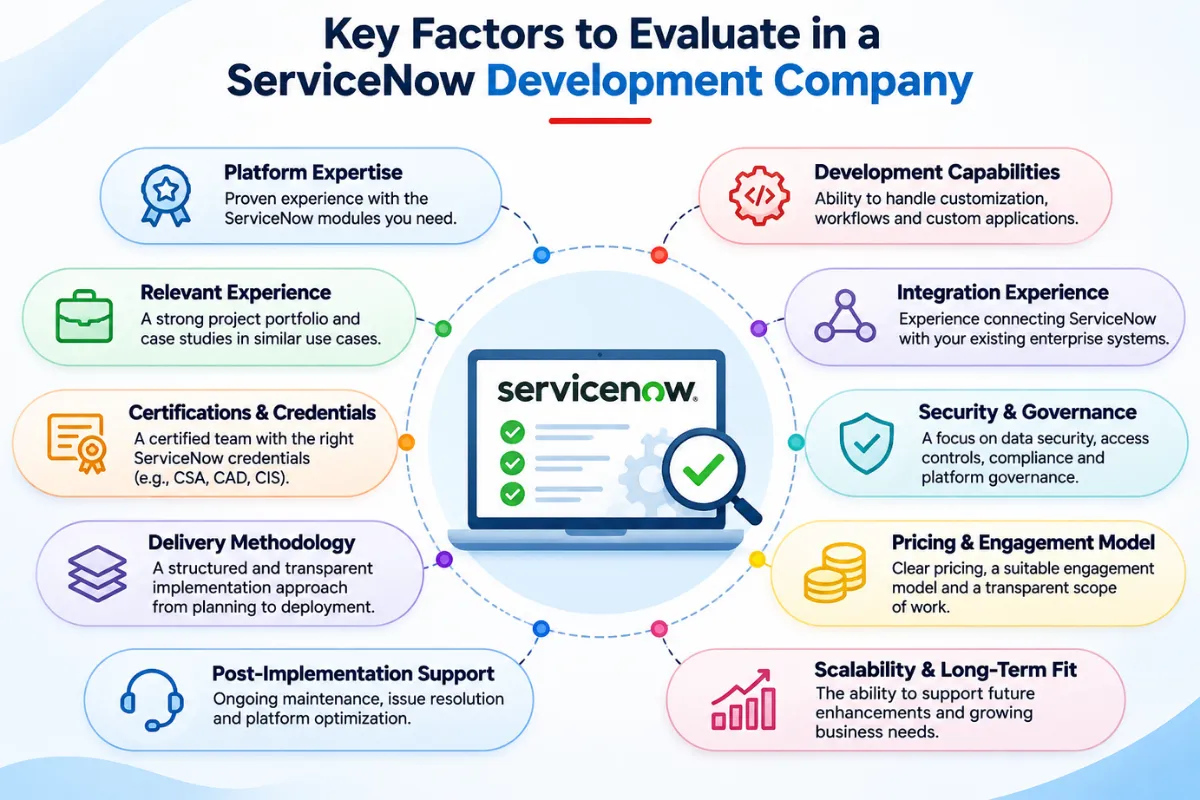
Selecting a ServiceNow development company should involve more than comparing proposals or hourly rates. Evaluate each provider based on its technical capabilities, project experience, delivery approach, communication, and ability to support your long-term requirements.
1. Evaluate ServiceNow Platform Expertise
Start by understanding the company’s actual ServiceNow experience.
ServiceNow is a broad platform with multiple products, applications, and technical capabilities. A company with experience in basic configuration may not necessarily have the expertise required for complex integrations, custom applications, or enterprise-wide implementations.
Review whether the company has experience with the ServiceNow capabilities relevant to your project, such as:
- IT Service Management (ITSM)
- IT Operations Management (ITOM)
- IT Asset Management (ITAM)
- Customer Service Management (CSM)
- HR Service Delivery (HRSD)
- Strategic Portfolio Management (SPM)
- ServiceNow App Engine
- ServiceNow Integration Hub
- Service Portal and user experience development
- Workflow automation and platform customization
You do not need a partner that specializes in every ServiceNow product. You need a team with demonstrated expertise in the modules and technical capabilities your business intends to use.
What to ask: Which ServiceNow modules and capabilities have you implemented or customized in projects similar to ours?
2. Check Relevant Project Experience and Case Studies
Past project experience can help you understand whether a company can handle your requirements.
Ask potential partners to share case studies, project summaries, or examples of work involving similar business challenges. Look beyond the project name and examine what the team actually delivered.
Evaluate the following:
- What business problem did the project address?
- Which ServiceNow modules were involved?
- Was custom development required?
- Did the project involve third-party integrations?
- How were data migration and testing handled?
- What challenges did the team encounter?
- What measurable outcomes were achieved, if available?
For example, if your organization wants to automate IT service workflows across multiple departments, a provider with relevant ITSM implementation experience may be more suitable than one whose experience is limited to basic ServiceNow configuration.
Practical tip: Ask for project references or a detailed walkthrough of a comparable implementation. A provider should be able to explain its contribution without disclosing confidential client information.
3. Verify Certifications and Partner Credentials
ServiceNow certifications can provide useful evidence of an individual’s platform knowledge. They are particularly relevant when evaluating the professionals who will work on your project.
Depending on the requirements, look for relevant credentials in areas such as:
- ServiceNow Certified System Administrator (CSA)
- ServiceNow Certified Application Developer (CAD)
- ServiceNow Certified Implementation Specialist (CIS)
- Other current role-based or product-specific ServiceNow credentials
Certifications should be evaluated alongside practical project experience. A certification alone does not guarantee that a developer can design and deliver a complex enterprise solution.
You should also verify any partner designation or official ServiceNow partnership claimed by a company. Ask for its current partner status and confirm the details through ServiceNow’s official channels where possible.
What to ask: Which certified professionals will be assigned to our project, and what experience do they have with similar implementations?
4. Assess Custom Development and Integration Capabilities
Many ServiceNow projects involve requirements that extend beyond standard platform configuration.
Your business may need custom applications, specialized workflows, external API connections, data synchronization, or integrations with existing enterprise systems.
Evaluate whether the company can handle:
- Custom application development on the ServiceNow platform
- Business rules, client scripts, and server-side scripting
- REST and SOAP API integrations
- Integration Hub and relevant integration approaches
- Data imports, transformations, and migration
- Custom workflows and approval processes
- Role-based access and application security
- Reporting and dashboard customization
For example, consider an organization that uses Salesforce for customer relationship management and ServiceNow for IT service operations. An integration between the platforms may help teams share relevant information and reduce manual data entry.
The provider should be able to explain the proposed integration architecture, data ownership, error handling, security controls, and monitoring approach.
What to ask: Have you integrated ServiceNow with applications similar to the ones in our technology environment?
5. Understand the Company’s Development and Delivery Process
A reliable development partner should follow a structured process rather than starting development immediately after receiving a project brief.
A typical ServiceNow development engagement may include the following stages:
- Discovery and requirement analysis: Understand business objectives, existing processes, technical constraints, and user expectations.
- Solution planning: Define the implementation scope, architecture, platform capabilities, integrations, and delivery milestones.
- Configuration and development: Configure ServiceNow applications, build workflows, and develop custom components where required.
- Integration and data migration: Connect external systems and migrate relevant data.
- Testing and validation: Perform functional, integration, security, regression, and user acceptance testing as appropriate.
- Deployment: Prepare the production environment, deploy approved changes, and validate the release.
- Training and handover: Provide documentation, user guidance, and knowledge transfer.
- Post-launch support: Monitor the solution, resolve issues, and plan improvements.
Ask the company how it manages requirements, development environments, version control, testing, change approvals, and production releases.
A transparent delivery process makes it easier to track progress, manage risks, and maintain accountability.
6. Evaluate Security, Governance, and Compliance Practices
ServiceNow implementations may handle sensitive employee information, customer records, operational data, and business-critical workflows. Security should therefore be considered from the beginning of the project.
Evaluate whether the development company understands and follows appropriate security practices, including:
- Role-based access control
- User authentication and authorization
- Secure API authentication
- Data access restrictions
- Audit trails and activity logging
- Secure development and testing practices
- Data migration controls
- Environment and release management
- Appropriate handling of sensitive information
If your organization operates in a regulated industry, such as healthcare or financial services, also discuss applicable compliance requirements and how responsibilities will be divided between your organization, the implementation partner, and relevant technology providers.
Avoid accepting broad statements such as “we follow industry-standard security.” Ask for specific processes, documentation, and evidence relevant to your project.
7. Compare Engagement Models and Team Availability
Different businesses require different levels of development support. Some need a partner to manage an entire implementation, while others already have an internal ServiceNow team and need additional technical resources.
Common engagement models include:
| Engagement model | How it works | Suitable for |
|---|---|---|
| Project-based development | The provider delivers an agreed scope with defined milestones and deliverables. | Organizations with clearly defined project requirements. |
| Dedicated development team | A team works on an ongoing basis and supports development priorities. | Businesses with continuous development and enhancement needs. |
| Staff augmentation | Individual developers or specialists join the existing team. | Organizations that need additional skills or temporary capacity. |
| Consulting and advisory | Specialists provide guidance on architecture, implementation, optimization, or platform strategy | Businesses that need expertise before or during implementation. |
| Managed support | The provider handles agreed maintenance, support, and operational activities. | Organizations that need ongoing platform assistance. |
Before choosing an engagement model, consider your project scope, internal technical capabilities, expected duration, budget, and need for long-term support.
Also clarify who will be assigned to the project, whether resources will be dedicated, how replacements are handled, and how knowledge transfer will work.
8. Review Communication and Project Management Practices
Even a technically capable team can struggle to deliver a project if communication and coordination are poor.
During the evaluation process, understand how the company will keep your stakeholders informed and manage day-to-day collaboration.
Look for:
- A clearly identified project manager or delivery lead
- Regular status meetings and progress reports
- Defined communication channels
- Documented requirements and decisions
- Transparent issue and risk tracking
- Clear escalation procedures
- Agreed review and approval cycles
- Access to project documentation
For organizations working with offshore or distributed teams, also consider time-zone overlap, meeting availability, responsiveness, and written communication quality.
What to ask: How frequently will we receive project updates, and who will be our primary point of contact?
9. Compare Pricing, Contracts, and Total Cost of Ownership
Cost is an important factor, but the lowest proposal is not always the most economical choice.
A ServiceNow project may involve consulting, development, licensing, integrations, data migration, testing, training, deployment, and ongoing support. A proposal that covers only initial development may not reflect the full cost of ownership.
When comparing estimates, review:
- Scope of work and deliverables
- Number and experience of assigned resources
- Estimated project duration
- Pricing model and billing frequency
- ServiceNow licensing considerations
- Third-party integration costs
- Data migration and testing effort
- Training and documentation
- Post-launch support
- Change request and additional work charges
Ask each company to explain its assumptions and exclusions. Make sure the proposal clearly defines what is included and what may incur additional charges.
A transparent pricing structure helps prevent misunderstandings and makes it easier to compare proposals fairly.
10. Check Post-Implementation Support and Scalability
Your relationship with a ServiceNow development company should not necessarily end when the platform goes live.
As business needs evolve, you may require new workflows, additional integrations, application enhancements, platform updates, and performance improvements.
Before signing an agreement, understand the provider’s post-implementation support model.
Ask about:
- Support availability and working hours
- Incident response and resolution targets
- Maintenance and platform update assistance
- Enhancement and customization services
- Documentation and knowledge transfer
- Resource availability for future projects
- Support escalation procedures
- Service-level agreements (SLAs), where applicable
A company that can support your platform beyond the initial implementation may help maintain continuity and reduce the effort involved in engaging new providers later.
ServiceNow Development Company Evaluation Checklist
Use this checklist to compare potential providers before making a final decision.
| Evaluation area | What to verify |
|---|---|
| Platform expertise | Experience with the ServiceNow modules and capabilities required for your project. |
| Project portfolio | Relevant case studies, implementation examples, and references. |
| Certifications | Current, relevant credentials of the professionals assigned to the project. |
| Partner status | Verification of any claimed official ServiceNow partner designation. |
| Development capabilities | Custom applications, scripting, workflows, and platform configuration. |
| Integration experience | Experience connecting ServiceNow with your existing enterprise applications. |
| Security practices | Access controls, secure integrations, data handling, and governance. |
| Delivery methodology | Requirements, planning, development, testing, deployment, and documentation. |
| Communication | Project reporting, stakeholder coordination, and escalation processes. |
| Pricing transparency | Clear estimates, deliverables, assumptions, and additional costs. |
| Support model | Maintenance, issue resolution, upgrades, and ongoing enhancements. |
| Scalability | Ability to support future requirements and changing workloads. |
You can use a simple scoring system to compare providers. For example, assign each criterion a score from 1 to 5, where 1 means the provider does not meet the requirement and 5 means it demonstrates strong, relevant capabilities.
Give higher importance to criteria that directly affect your project. For a complex integration project, integration architecture and technical experience may carry more weight than general company size.
Questions to Ask Before Hiring a ServiceNow Development Company
Before finalizing a provider, arrange a discovery call and ask questions that reveal its technical approach, project experience, and delivery capabilities.
Questions About Experience
- How many years of experience does your team have working with ServiceNow?
- Which ServiceNow modules and products have you worked with?
- Have you completed projects similar to ours?
- Can you share relevant case studies or client references?
- Which certifications do the professionals assigned to our project hold?
Questions About Technical Capabilities
- Can you handle custom ServiceNow application development?
- What is your experience with REST and SOAP API integrations?
- How do you approach data migration from legacy systems?
- How do you manage platform security and access controls?
- How do you prevent unnecessary customization?
Questions About Project Delivery
- What development methodology do you follow?
- How do you estimate timelines and project costs?
- What testing processes do you follow before deployment?
- How will you manage scope changes and unexpected requirements?
- What documentation and knowledge transfer will you provide?
Questions About Support and Engagement
The answers should help you assess not only what the company can build but also how it will work with your team throughout the engagement.
Common Mistakes to Avoid When Selecting a ServiceNow Development Company
Choosing a development partner based on incomplete information can create problems later. Here are some common mistakes businesses should avoid.
1. Choosing a Provider Based Only on Price
A low-cost proposal may appear attractive, but it may not include essential activities such as testing, documentation, deployment support, or post-launch maintenance.
Compare the complete scope and expected value rather than focusing only on the quoted price.
2. Assuming Certifications Guarantee Delivery Quality
Certifications indicate that an individual has met certain knowledge requirements. They do not automatically demonstrate experience in complex projects or the ability to manage business-critical implementations.
Evaluate certifications alongside practical experience, project examples, and technical discussions.
3. Ignoring Integration Requirements
A ServiceNow solution that does not connect properly with your existing systems may create data silos and additional manual work.
Identify integration requirements early and verify that the provider can address them.
4. Overlooking Security and Governance
Security should not be treated as a final checklist item. Discuss access controls, data handling, integration security, and governance during the planning stage.
5. Not Defining Project Scope Clearly
Unclear requirements can lead to missed expectations, delays, and additional costs.
Document the project’s objectives, expected functionality, deliverables, assumptions, and acceptance criteria before development begins.
6. Ignoring Post-Launch Requirements
A successful launch does not mean the platform will never need further attention.
Discuss ongoing support, maintenance, platform updates, and future enhancements before signing the contract.
7. Failing to Check References
A company’s website and sales presentation may not provide enough information to evaluate its delivery quality.
Where possible, speak with previous clients or request references from projects with comparable requirements.
How Much Does It Cost to Hire a ServiceNow Development Company?
The cost of hiring a ServiceNow development company depends on the project’s scope, complexity, required expertise, integrations, engagement model, and support expectations.
There is no single price that applies to every ServiceNow project. A basic configuration engagement will generally require a different level of effort from a complex enterprise implementation involving custom applications, multiple integrations, and data migration.
Several factors influence the overall cost:
| Cost factor | How it affects the project |
|---|---|
| Project scope | More modules, workflows, and business requirements generally require more effort. |
| Custom development | Specialized applications, scripts, and functionality add development and testing work. |
| Integrations | Each external system may require API development, data mapping, security, and validation. |
| Data migration | Data volume, quality, transformation, and legacy system complexity influence effort. |
| Team expertise | Specialized consultants and experienced developers may have different rates. |
| Engagement model | Project-based, dedicated team, staff augmentation, and managed services have different pricing structures. |
| Timeline | Compressed timelines or additional resource requirements can affect cost. |
| Ongoing support | Maintenance, monitoring, enhancements, and support agreements add recurring costs. |
How to Get an Accurate ServiceNow Development Estimate
To receive a realistic estimate, prepare a project brief that includes:
- Your business objectives and expected outcomes
- ServiceNow modules or capabilities you want to implement
- Existing systems that need integration
- Required custom applications and workflows
- Data migration requirements
- Expected users and departments
- Preferred engagement model
- Project timeline and support expectations
Ask potential providers to break down their estimates by phase, resource type, deliverable, and assumption. This will help you understand where the budget will be spent and compare proposals more effectively.
Also distinguish between development services and ServiceNow subscription or licensing costs. Licensing requirements should be evaluated separately with the appropriate ServiceNow representatives or authorized channels.
In-House ServiceNow Team vs. ServiceNow Development Company: Which Is Better?
Businesses often consider whether to build an internal ServiceNow team or work with an external development company. The right choice depends on project complexity, internal capabilities, budget, and long-term platform requirements.
| Factor | In-house ServiceNow team | External ServiceNow development company |
|---|---|---|
| Hiring | Requires recruiting and onboarding employees. | Provides access to external professionals through an engagement. |
| Expertise | Depends on the skills available within the organization. | May offer access to different specialists and technical capabilities. |
| Cost structure | Includes salaries, benefits, training, and infrastructure. | Depends on the contract and engagement model. |
| Flexibility | Team size may be harder to adjust quickly. | Resource levels may be adjusted based on the agreement. |
| Business knowledge | Employees develop deep familiarity with internal processes. | The provider needs time and collaboration to understand the business. |
| Long-term ownership | Internal team retains direct operational knowledge. | Requires clear documentation and knowledge transfer. |
| Best suited for | Organizations with continuous internal platform requirements and established technical teams. | Organizations needing specialized skills, implementation support, or additional development capacity |
When Should You Choose an In-House Team?
An in-house team may be appropriate when:
- ServiceNow is central to daily business operations.
- Your organization has continuous development and support requirements.
- You want direct control over platform resources and priorities.
- You have the budget and time to recruit and retain specialized professionals.
When Should You Hire an External Development Company?
An external partner may be a better option when:
- You are implementing ServiceNow for the first time.
- Your internal team lacks specific technical expertise.
- You need support for a defined implementation or integration project.
- You need additional development capacity.
- You want access to specialized resources without building a larger permanent team.
Some organizations also use a hybrid model. Their internal teams manage platform ownership and business priorities, while an external development partner provides specialized implementation, integration, or development support.
What Does a Typical ServiceNow Development Engagement Look Like?
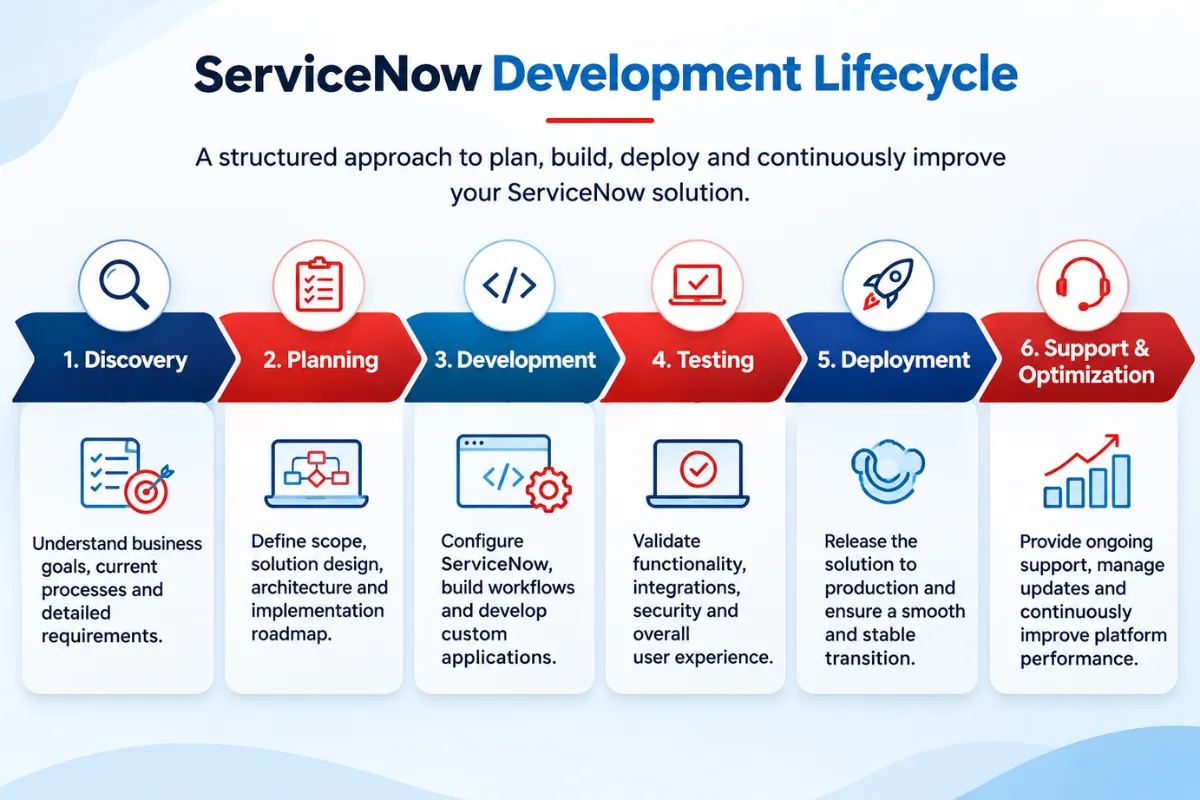
Understanding the engagement process can help you prepare for collaboration with a development partner.
Although the exact process varies by project, a typical engagement may follow these stages:
Step 1: Initial Discovery
The development company learns about your business, current technology environment, challenges, and objectives.
Step 2: Requirements and Scope Definition
Both teams identify required features, workflows, integrations, data requirements, and expected deliverables.
Step 3: Solution Design
The provider proposes an architecture and implementation approach, including which ServiceNow capabilities should be configured and where custom development may be needed.
Step 4: Development and Configuration
Developers configure applications, create workflows, build integrations, and implement approved custom functionality.
Step 5: Testing and Validation
The solution is tested against functional and technical requirements. Business users may participate in user acceptance testing before release.
Step 6: Deployment and Knowledge Transfer
Approved changes are deployed, relevant documentation is shared, and users or administrators receive the necessary guidance.
Step 7: Support and Continuous Improvement
The provider helps address issues, maintain the solution, and implement future enhancements according to the agreed support model.
Clear ownership at every stage helps keep the project organized and reduces the risk of missed expectations.
How AwsQuality Can Support Your ServiceNow Development Requirements
Choosing a technology partner is about finding a team that understands both your business objectives and the technical work required to achieve them.
AwsQuality provides technology consulting and development services across enterprise platforms and digital solutions, including Salesforce, ServiceNow, AI, cloud, DevOps, data engineering, mobile, and web development.
For organizations evaluating ServiceNow development support, the important starting point is understanding the specific business requirements, existing systems, and desired outcomes. The right solution may involve platform configuration, workflow development, custom applications, integrations, or ongoing enhancements.
A structured discovery process can help identify the appropriate scope, technical requirements, and delivery approach before development begins.
If you are planning a ServiceNow project or evaluating development support, connect with AwsQuality to discuss your requirements.
Final Thoughts
Choosing the right ServiceNow development company is an important decision that can influence the success, maintainability, and long-term value of your platform investment.
Rather than selecting a provider based only on pricing or company size, evaluate its relevant ServiceNow expertise, project experience, development and integration capabilities, security practices, delivery methodology, and post-implementation support.
Define your requirements before approaching vendors, ask detailed questions during discovery calls, review comparable project examples, and compare proposals based on scope and expected outcomes.
The right partner should be able to understand your business challenges, recommend a practical solution, communicate transparently, and support your organization as its needs evolve.
With a well-planned implementation and the right development team, ServiceNow can become a valuable foundation for connected workflows, more efficient operations, and better service delivery.
FAQs
Frequently Asked Questions
How do I choose the right ServiceNow development company?
Start by identifying your business and technical requirements. Then evaluate companies based on their ServiceNow expertise, relevant project experience, certifications, custom development capabilities, integration experience, security practices, pricing transparency, and ongoing support. Request case studies and discuss your requirements with the actual team that would handle the project.
What services does a ServiceNow development company provide?
A ServiceNow development company may provide consulting, implementation, custom application development, platform configuration, workflow automation, system integration, data migration, testing, deployment, maintenance, and technical support. The exact services vary by provider.
What certifications should ServiceNow developers have?
Relevant credentials may include ServiceNow Certified System Administrator (CSA), Certified Application Developer (CAD), and Certified Implementation Specialist (CIS). The most appropriate certification depends on the person’s responsibilities and the ServiceNow products involved in the project. Always verify current certification names and requirements through ServiceNow.
How much does ServiceNow development cost?
ServiceNow development costs depend on project scope, complexity, required modules, custom development, integrations, data migration, resource expertise, and ongoing support. Request a detailed estimate based on your requirements rather than relying on a generic price.
How long does a ServiceNow implementation take?
The timeline depends on the number of modules, workflow complexity, integration requirements, data migration, testing, and organizational readiness. A limited configuration project may take considerably less time than a multi-department enterprise implementation. A discovery and planning phase helps establish a realistic timeline.
Should I hire a ServiceNow consultant or a developer?
A ServiceNow consultant typically focuses on requirements, process analysis, solution design, and implementation guidance. A developer focuses more on configuration, scripting, integrations, and custom application development. Complex projects may require both roles to work together.
Can a ServiceNow development company integrate ServiceNow with Salesforce?
Yes. ServiceNow can be integrated with Salesforce using suitable APIs and integration approaches. The integration may support use cases such as sharing customer information, synchronizing relevant records, or connecting service workflows. The appropriate design depends on data ownership, business requirements, security, and the systems involved.
What is the difference between ServiceNow implementation and customization?
Implementation involves setting up and deploying ServiceNow capabilities to support business requirements. Customization involves modifying or extending the platform through configuration or development to address specific needs. A good implementation strategy uses standard platform functionality where practical and introduces customization only when it provides clear business value.
Do I need ongoing ServiceNow support after implementation?
Ongoing support is useful for organizations that need help with issue resolution, platform maintenance, enhancements, updates, integrations, and user support. The level of support required depends on the complexity of the implementation and the organization’s internal capabilities.
Is it better to hire a dedicated ServiceNow development team or work on a project basis?
A project-based engagement is often suitable when requirements and deliverables are clearly defined. A dedicated team may be more appropriate when you have continuous development needs, an evolving backlog, or multiple initiatives. The decision should be based on your workload, budget, and expected engagement duration.
ServiceNow
Related Articles
How to Choose the Right ServiceNow Consulting Company: A Complete Guide
Choosing the right ServiceNow consulting company can make a significant difference in how effectively your business implements and manages the ServiceNow platform.…