Planning Your 2027 Salesforce Roadmap? 10 Priorities CIOs Should Consider
 Mohammad Usman 21 min read
Salesforce has evolved far beyond its traditional role as a customer relationship management (CRM) platform. Today, organizations use it to manage customer interactions, automate business processes, connect enterprise applications, analyze data, and introduce AI-powered capabilities across different departments.
As businesses prepare for 2027, the challenge for Chief Information Officers (CIOs) is no longer simply deciding which Salesforce products or features to adopt. It is determining how the platform can support broader business objectives, improve operational efficiency, strengthen customer experiences, and deliver measurable returns on technology investments.
Artificial intelligence is adding another dimension to this challenge. With Agentforce, Data 360, advanced automation, and an increasingly connected enterprise ecosystem, Salesforce is creating opportunities for businesses to rethink how employees, applications, data, and AI agents work together.
However, adopting new capabilities without a clear strategy can introduce unnecessary complexity, increase costs, and create governance challenges. Organizations need a structured approach that balances innovation with security, scalability, integration, and long-term maintainability.
A well-planned 2027 Salesforce roadmap should focus on business outcomes, AI readiness, connected data, platform modernization, automation, security, and measurable ROI.
Read: Salesforce DevSecOps Best Practices for Secure Development and Deployment
In this guide, we explore 10 priorities CIOs and IT leaders should consider when developing their Salesforce strategy for 2027.
Why Should Businesses Revisit Their Salesforce Roadmap for 2027?
A Salesforce roadmap should evolve as business requirements, customer expectations, technology capabilities, and operational priorities change.
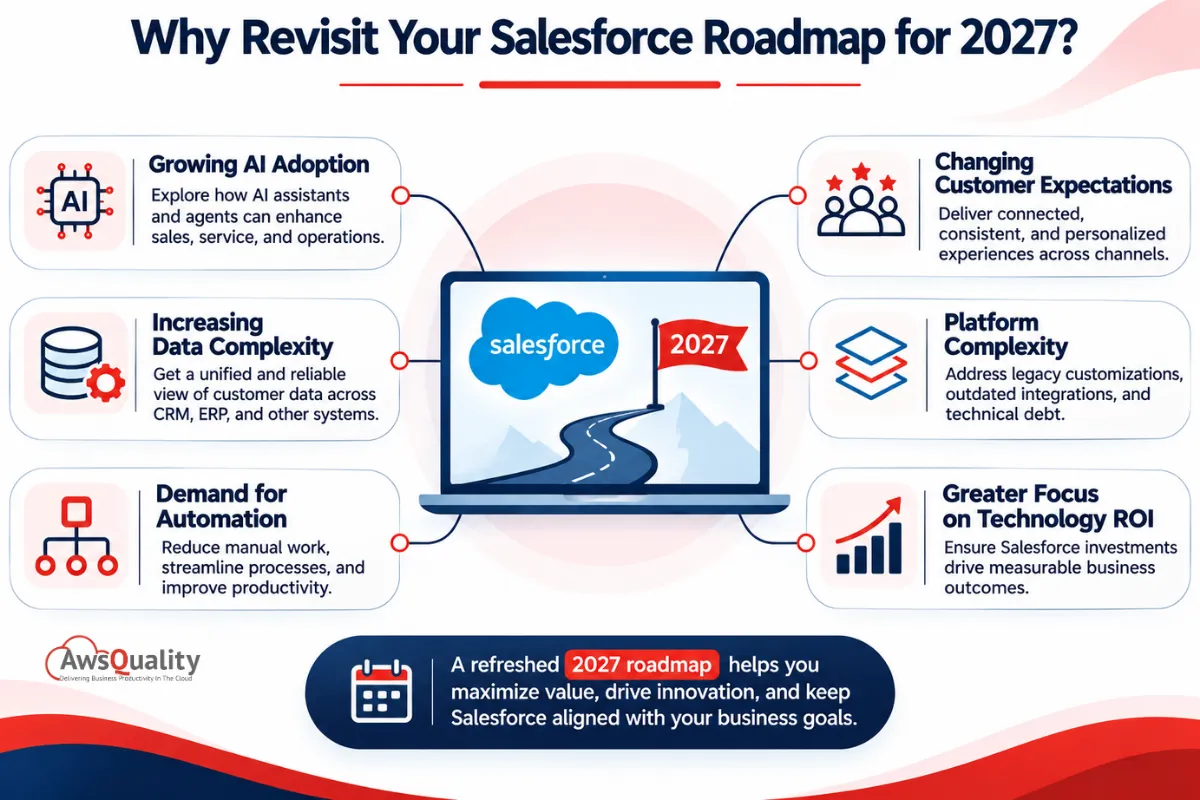
An implementation that worked effectively a few years ago may no longer support an organization’s current requirements. Growing data volumes, disconnected applications, complex customizations, increasing licensing costs, and changing security expectations can gradually reduce the platform’s effectiveness.
At the same time, new capabilities create opportunities to improve how businesses operate.
Here are some reasons organizations should reassess their Salesforce strategy:
- Growing AI adoption: Businesses are exploring how AI assistants and autonomous agents can support customer service, sales, and internal operations.
- Increasing data complexity: Organizations need reliable access to customer information across CRM, ERP, marketing, finance, and other enterprise systems.
- Demand for automation: Manual processes and repetitive tasks can slow down operations and affect employee productivity.
- Changing customer expectations: Customers increasingly expect connected, consistent, and personalized experiences across communication channels.
- Platform complexity: Legacy customizations, outdated integrations, and technical debt can make Salesforce environments difficult to maintain.
- Greater focus on technology ROI: CIOs must demonstrate how technology investments contribute to measurable business improvements.
Salesforce’s Winter ’27 release and architectural guidance also highlight areas such as agentic architecture, governance, security, capacity planning, and observability. These developments make it particularly important to evaluate platform architecture rather than simply adopt new features.
Also read: 12 Cloud Tool Strategies from Top Salesforce Consulting Companies
The following 10 priorities provide a practical starting point.
10 Salesforce Roadmap Priorities CIOs Should Consider for 2027
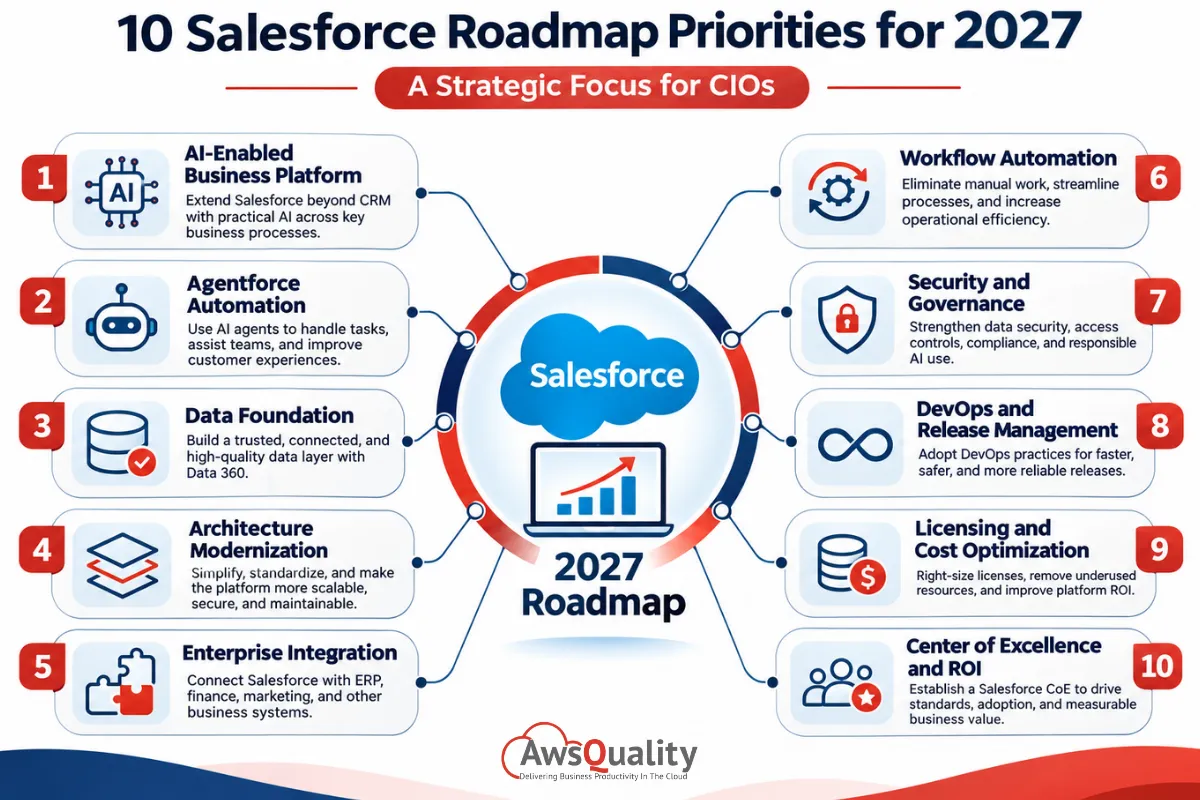
1. Move from Traditional CRM to an AI-Enabled Business Platform
One of the biggest strategic considerations for 2027 is how Salesforce can support AI-enabled business operations.
Traditionally, Salesforce has helped organizations manage customer relationships, sales activities, service requests, marketing interactions, and business workflows. AI introduces opportunities to make these processes more intelligent and responsive.
For example, businesses can explore AI capabilities to:
- Summarize customer interactions and service histories.
- Assist sales representatives with account research and preparation.
- Recommend relevant next steps based on customer information.
- Support service teams with suggested responses and knowledge retrieval.
- Automate selected repetitive tasks.
- Help employees find relevant business information more efficiently.
CIOs should evaluate where AI can improve existing workflows instead of introducing AI simply because it is a new technology.
The objective should be to identify business processes where AI can reduce manual effort, improve response times, support better decisions, or enhance customer experiences.
What CIOs should prioritize:
- Identify repetitive and information-intensive business processes.
- Evaluate existing Salesforce AI capabilities against business requirements.
- Define measurable outcomes for each AI initiative.
- Establish human oversight for important business decisions.
- Assess data availability, access permissions, and security requirements.
The transition toward an AI-enabled Salesforce environment should be gradual, beginning with clearly defined use cases and expanding as the organization gains experience.
2. Evaluate Salesforce Agentforce for Business Automation
Agentforce is an important consideration for organizations planning their Salesforce strategy in 2027.
Unlike traditional automation, which generally follows predefined rules and workflows, AI agents can use contextual information and configured tools to support more flexible task execution within defined boundaries.
For example, a business could explore Agentforce use cases such as:
Customer service: An agent could help customers find answers to common questions, retrieve relevant information, or initiate eligible service processes.
Sales operations: Agents could assist sales teams with account research, lead qualification, and preparation for customer interactions.
Internal support: Employees could use agents to locate company information, understand internal procedures, or initiate approved workflows.
Service operations: Agents could help classify incoming requests, retrieve relevant knowledge articles, and support service representatives.
However, not every business process should be automated through an AI agent. Processes involving sensitive information, financial approvals, legal decisions, or significant business consequences may require additional controls and human review.
Before investing in Agentforce, CIOs should evaluate:
- Whether the use case solves a clearly defined business problem.
- Whether the required information is available and reliable.
- What actions an agent is permitted to perform.
- When human approval or escalation is required.
- How agent performance, accuracy, and usage costs will be monitored.
- Whether the organization has the skills and governance processes needed to maintain agents.
Salesforce’s architectural guidance emphasizes planning agent composition, tool access, data grounding, and governance before scaling agent deployments. These decisions are easier to address during architecture design than after agents enter production.
The takeaway: Start with a small number of high-value use cases, validate their business impact, and expand based on actual results.
3. Build a Strong Data Foundation for Salesforce AI
AI initiatives are only as effective as the information supporting them.
If customer records are incomplete, inconsistent, duplicated, or distributed across disconnected systems, AI-generated recommendations and automated actions may be unreliable.
This makes data readiness one of the most important priorities in a 2027 Salesforce roadmap.
Many enterprises maintain customer information across multiple platforms, including:
- Salesforce CRM
- Enterprise Resource Planning (ERP) systems
- Marketing automation platforms
- Customer support applications
- Data warehouses and data lakes
- Billing and financial systems
- External business applications
When these systems operate independently, employees may not have access to a complete customer view. AI applications can face similar limitations when relevant information is unavailable or poorly structured.
Salesforce Data 360 (formerly Data Cloud) is part of the broader Salesforce data strategy. Depending on the organization’s architecture and requirements, it can help connect, unify, and activate data across different sources.
However, adopting a data platform alone does not solve every data-quality problem. Organizations also need clear data ownership, governance, integration standards, and quality controls.
What CIOs should prioritize:
- Assess the quality and completeness of existing Salesforce records.
- Identify duplicate records and inconsistent data structures.
- Map important data sources across the organization.
- Define data ownership and access responsibilities.
- Establish data-quality monitoring and improvement processes.
- Evaluate Data 360 and other integration approaches based on actual requirements.
A strong data foundation supports more than AI. It also improves reporting, customer segmentation, personalization, operational visibility, and business decision-making.
4. Modernize Salesforce Architecture and Reduce Technical Debt
As Salesforce environments evolve, organizations often accumulate technical debt.
This can happen when businesses introduce custom functionality to solve immediate requirements without considering long-term architecture, maintainability, or scalability.
Over time, these decisions can create:
- Unnecessary custom objects and fields.
- Duplicate automation and business logic.
- Complex Apex code and triggers.
- Outdated Visualforce implementations.
- Redundant integrations.
- Poorly documented customizations.
- Difficult deployment and maintenance processes.
Technical debt can slow down future development and increase the effort required to introduce new capabilities.
For example, an organization planning to implement Agentforce may discover that its existing data model, automation, and integrations are too fragmented to support the intended use cases efficiently.
This is why modernization should be a continuous part of Salesforce roadmap planning.
What CIOs should prioritize:
- Conduct a Salesforce architecture assessment.
- Review custom code, workflows, and automation.
- Identify redundant functionality and outdated components.
- Evaluate whether existing customizations can be replaced with standard Salesforce capabilities.
- Improve data models and application architecture.
- Document integrations, dependencies, and technical decisions.
Modernization does not necessarily mean rebuilding the entire Salesforce environment. In many cases, targeted improvements to architecture, automation, and integrations can deliver meaningful benefits without disrupting existing operations.
5. Strengthen Salesforce Integration Across Enterprise Systems
Salesforce rarely operates as a standalone business application in large organizations.
It typically needs to exchange information with ERP systems, accounting software, marketing platforms, e-commerce applications, data warehouses, customer support systems, and other enterprise tools.
When these systems are not properly connected, employees may need to switch between applications or manually transfer information. This creates additional work, increases the possibility of errors, and limits operational visibility.
For example, consider a company that uses Salesforce to manage customer relationships and a separate ERP platform to manage orders and inventory.
Without an effective integration strategy, sales representatives may not have real-time visibility into order status, product availability, or billing information.
A well-designed integration architecture can help connect these systems and make relevant information available where employees need it.
Salesforce integration priorities for 2027 should include:
- Connecting CRM with ERP and financial applications.
- Integrating customer support and marketing platforms.
- Establishing reliable API-based communication.
- Reducing unnecessary manual data transfers.
- Improving synchronization between connected systems.
- Implementing monitoring and error-handling mechanisms.
- Reviewing integration security and authentication methods.
Organizations should also evaluate whether existing point-to-point integrations are becoming difficult to manage. Depending on the environment, an integration platform or API-led architecture may provide a more scalable approach.
The goal is not to connect every application to Salesforce. It is to create reliable data flows that support important business processes.
Learn more about Salesforce integration services and how a structured integration strategy can help businesses connect their enterprise applications.
6. Expand Automation While Keeping Business Processes Maintainable
Automation remains an important part of Salesforce optimization.
Many organizations still depend on manual activities such as assigning records, updating customer information, sending notifications, routing service requests, and managing approval processes.
These tasks may appear small individually, but they can consume significant employee time when repeated across large teams.
Salesforce provides automation capabilities such as Flow, approval processes, and Apex-based development to support different business requirements.
For example:
- Sales leads can be assigned based on predefined criteria.
- Service requests can be routed to appropriate teams.
- Approval requests can follow configured business rules.
- Customer records can be updated when specific events occur.
- Employees can receive notifications when important actions are required.
However, adding more automation does not automatically make an organization more efficient.
Poorly designed automation can create duplicate actions, conflicting rules, difficult troubleshooting, and unexpected system behavior.
CIOs should therefore focus on automation quality, not just automation volume.
Recommended priorities:
- Identify processes with repetitive manual activities.
- Evaluate whether Salesforce Flow can handle the requirement.
- Use Apex when more complex development logic is necessary.
- Remove duplicate or outdated automation.
- Document dependencies between automated processes.
- Test automation before deploying changes.
- Monitor performance and exceptions after deployment.
A well-maintained automation strategy helps organizations improve productivity without making Salesforce increasingly difficult to manage.
7. Make Salesforce Security, Privacy, and Governance a Strategic Priority
As Salesforce environments become more connected and AI capabilities expand, security and governance need to be considered from the beginning of every initiative.
Organizations must protect customer information while ensuring that employees, integrations, applications, and AI agents only access the information and functionality they are authorized to use.
A security strategy should address several areas:
Identity and access management: Review user roles, profiles, permission sets, authentication methods, and access policies.
Data protection: Apply appropriate controls to sensitive customer and business information.
Integration security: Review API access, connected applications, authentication, and credential management.
AI governance: Define what agents can access, which actions they can perform, and when human approval is required.
Auditability: Maintain appropriate logs and monitoring processes to understand system activity and investigate unusual behavior.
Compliance: Evaluate applicable regulatory and industry requirements based on the organization’s operating locations and business activities.
CIOs should also establish clear governance responsibilities. IT, security, business operations, compliance, and data teams should understand their roles in approving and managing Salesforce changes.
Salesforce’s Winter ’27 architectural guidance highlights security enforcement, agent governance, and observability as important areas for enterprise architecture reviews.
What CIOs should prioritize:
- Conduct regular Salesforce security assessments.
- Review excessive user and application permissions.
- Establish policies for AI agent access and actions.
- Monitor integrations and connected applications.
- Document security responsibilities.
- Include security and compliance checks in development and deployment processes.
Security should not be treated as a final checkpoint before launch. It should be part of the entire Salesforce development and operational lifecycle.
8. Improve Salesforce DevOps and Release Management
As Salesforce environments become more customized and integrated, managing changes safely becomes increasingly important.
Organizations that rely heavily on manual deployments may experience inconsistent releases, configuration errors, deployment delays, and difficulty rolling back problematic changes.
Salesforce DevOps introduces a more structured approach to managing development, testing, and deployment activities.
A mature Salesforce DevOps process may include:
- Version control for metadata and source code.
- Dedicated development and testing environments.
- Automated testing.
- Continuous integration and continuous delivery (CI/CD).
- Deployment validation.
- Release approvals.
- Monitoring and rollback procedures.
For example, when a development team introduces a new Apex class or modifies an existing Flow, the change can be reviewed, tested, and validated before being deployed to production.
This helps reduce deployment risks and improves collaboration between developers, administrators, and release managers.
CIOs should consider the following improvements:
- Establish a consistent source-control strategy.
- Standardize development and deployment processes.
- Introduce automated testing wherever practical.
- Reduce dependency on manual production changes.
- Improve release documentation and approval workflows.
- Track deployment failures and release-related incidents.
Salesforce DevOps should also support the organization’s wider software delivery strategy. Aligning Salesforce releases with broader enterprise development practices can improve coordination across connected applications.
For organizations with frequent releases or complex customizations, DevOps modernization can become an important part of the 2027 Salesforce roadmap.
9. Optimize Salesforce Licensing, Usage, and Total Cost of Ownership
Salesforce can deliver significant business value, but maintaining an enterprise CRM environment also involves ongoing costs.
These may include licenses, add-on products, integrations, custom development, infrastructure-related services, administration, maintenance, and support.
As organizations introduce new capabilities, it becomes important to understand whether existing investments are being used effectively.
A cost optimization exercise should go beyond simply reducing the number of licenses.
CIOs should evaluate the overall cost of ownership and the business value generated by the platform.
Areas worth reviewing include:
- Inactive or underutilized user licenses.
- License types assigned to users who do not need all available functionality.
- Duplicate applications and overlapping tools.
- Unnecessary custom development and maintenance.
- Integration and data-management costs.
- Usage of optional Salesforce products and add-ons.
- Support and administration effort.
- Opportunities to simplify existing architecture.
Organizations should also evaluate the costs associated with AI adoption. Agent usage, data requirements, implementation effort, monitoring, and ongoing maintenance should be included in the business case.
A practical approach is to review Salesforce costs alongside utilization and business outcomes.
For example, if a department has invested in a Salesforce capability but employees rarely use it, the organization should investigate whether the issue is related to training, process design, usability, or an unnecessary investment.
The objective is to ensure that every major Salesforce investment has a clear business purpose.
10. Establish a Salesforce Center of Excellence and Measure Business Outcomes
A Salesforce roadmap should not be managed as a collection of disconnected IT projects.
As organizations introduce new applications, integrations, automation, and AI capabilities, they need a consistent way to prioritize initiatives, manage standards, and measure results.
A Salesforce Center of Excellence (CoE) can provide this structure.
A CoE typically brings together representatives from IT, business operations, development, security, data management, and other relevant teams.
Its responsibilities may include:
- Defining Salesforce architecture and development standards.
- Reviewing and prioritizing new requirements.
- Establishing governance policies.
- Coordinating platform improvements.
- Managing technical debt.
- Supporting user adoption and training.
- Monitoring business value and platform performance.
A CoE can be especially useful when multiple departments use Salesforce or when an organization is expanding into AI-driven workflows.
However, governance should not create unnecessary bureaucracy. Its purpose is to establish clear ownership and consistent decision-making while allowing teams to deliver improvements efficiently.
CIOs should define measurable KPIs for Salesforce initiatives, such as:
| Business area | Possible KPI |
|---|---|
| Sales productivity | Time spent on administrative tasks |
| Lead management | Lead response time |
| Customer service | First response time and resolution time |
| Automation | Reduction in manual processing effort |
| Data quality | Duplicate and incomplete record rates |
| Platform performance | Deployment success and incident rates |
| AI adoption | Agent task completion and escalation rates |
| Cost optimization | License utilization and total platform cost |
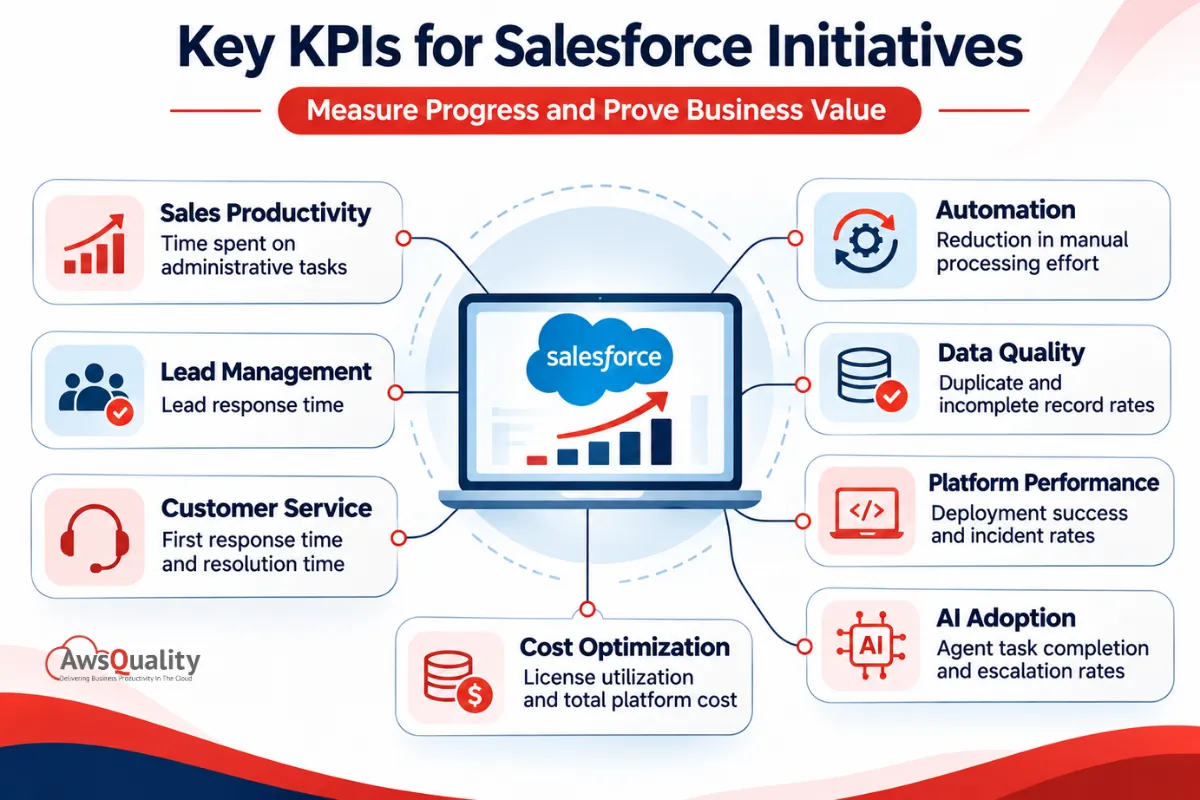
The right KPIs will depend on the organization’s goals, existing baseline, and Salesforce use cases.
A successful Salesforce roadmap should demonstrate not only what the organization has implemented but also what has improved as a result.
A Practical 2027 Salesforce Roadmap: Where Should CIOs Start?
Identifying priorities is only the first step. Organizations also need a realistic implementation sequence.
Not every initiative needs to happen simultaneously. A phased roadmap helps businesses establish foundational capabilities before introducing more complex changes.
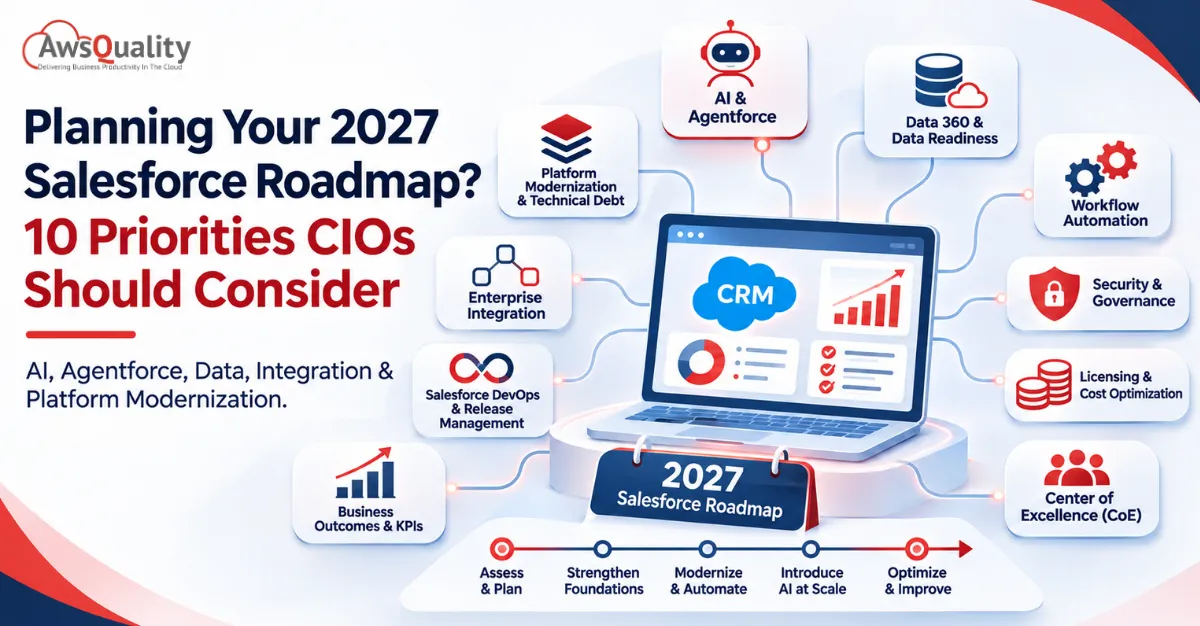
Here is an illustrative roadmap that organizations can adapt to their business requirements.
| Phase | Key focus areas | Recommended activities |
|---|---|---|
| Phase 1: Assess and Plan | Strategy, architecture, costs, and governance | Review the current Salesforce environment, identify technical debt, evaluate business priorities, and establish KPIs. |
| Phase 2: Strengthen Foundations | Data, integration, and security | Improve data quality, review access controls, modernize critical integrations, and document architecture standards. |
| Phase 3: Modernize and Automate | Customization, automation, and DevOps | Simplify workflows, improve development practices, introduce testing automation, and optimize deployment processes. |
| Phase 4: Introduce AI at Scale | Agentforce and AI governance | Pilot high-value AI use cases, establish agent controls, monitor performance, and expand successful implementations. |
| Phase 5: Optimize and Improve | ROI, adoption, and continuous improvement | Review KPIs, assess user adoption, optimize costs, and update the roadmap based on business results |
This is a planning framework, not a fixed implementation schedule. The duration and sequence of each phase will depend on the organization’s existing Salesforce architecture, available resources, regulatory requirements, and business priorities.
For example, a company with poor data quality may need to address data governance before deploying AI agents. Another organization with a stable Salesforce environment may be ready to pilot an AI use case earlier.
The most effective roadmap is the one that reflects the organization’s actual readiness.
Common Mistakes to Avoid When Planning a Salesforce Roadmap
Even well-funded Salesforce initiatives can struggle when organizations focus on technology adoption without addressing underlying business and operational requirements.
Here are some common mistakes CIOs should avoid.
1. Adopting AI Without a Clear Business Use Case
Implementing Agentforce or other AI capabilities without identifying the problem they are expected to solve can lead to low adoption and unnecessary costs.
Start with a business process, define the expected outcome, and then evaluate the technology.
2. Ignoring Data Quality
AI, analytics, and automation depend on reliable information. Poor data quality can reduce the effectiveness of even well-designed solutions.
Make data quality and governance ongoing responsibilities.
3. Adding More Customization Than Necessary
Custom development can address specific business requirements, but excessive customization may increase maintenance effort and make future upgrades more complicated.
Evaluate standard Salesforce capabilities before building custom solutions.
4. Treating Integration as an Afterthought
Disconnected enterprise applications can limit the value of Salesforce investments.
Include integration architecture and data flows in the early stages of roadmap planning.
5. Overlooking User Adoption
A technically successful implementation may still fail to deliver value if employees do not understand or use the new capabilities.
Include training, communication, and change management in the roadmap.
6. Measuring Implementation Instead of Business Impact
Counting completed features, deployments, or automation workflows does not necessarily demonstrate business value.
Track improvements in productivity, customer experience, operational efficiency, data quality, and cost.
How Can a Salesforce Consulting Partner Help Execute Your 2027 Roadmap?
Developing a Salesforce roadmap requires more than understanding the platform. Organizations must evaluate their existing architecture, business processes, integration requirements, data maturity, security controls, and long-term technology objectives.
A Salesforce consulting and development partner can help bridge the gap between strategic planning and technical execution.
Depending on the organization’s requirements, support may include:
- Salesforce architecture assessment and roadmap planning.
- Salesforce implementation and customization.
- Salesforce integration with enterprise applications.
- AI and Agentforce solution development.
- Data management and platform modernization.
- Workflow automation.
- Salesforce DevOps and release management.
- Security reviews and ongoing optimization.
An experienced partner can also help organizations evaluate build-versus-buy decisions, identify implementation risks, and prioritize initiatives based on business value.
At AwsQuality, we help businesses address Salesforce development, customization, integration, and optimization requirements. Our broader technology capabilities also include AI, cloud, DevOps, and data engineering services.
Whether your organization is planning a new Salesforce initiative or looking to improve an existing environment, the right technical approach should align with your business goals and long-term technology strategy.
Explore our Salesforce services or learn more about our Salesforce integration capabilities.
Final Thoughts
Planning a Salesforce roadmap for 2027 is an opportunity for CIOs to move beyond routine CRM maintenance and build a more connected, intelligent, and adaptable business platform.
AI and Agentforce adoption, data readiness, integration, modernization, automation, security, and cost optimization should be considered together rather than treated as independent initiatives.
However, adopting every new Salesforce capability is not the objective. The priority is to identify where technology can solve real business problems and create measurable value.
Organizations that establish a strong foundation, prioritize initiatives carefully, and continuously evaluate results will be better positioned to evolve their Salesforce environments as business needs change.
Planning your Salesforce strategy for 2027? Connect with AwsQuality to explore how Salesforce development, integration, AI, and modernization can support your business objectives.
FAQs
Frequently Asked Questions
What should be included in a 2027 Salesforce roadmap?
A 2027 Salesforce roadmap should cover business objectives, platform architecture, AI adoption, Agentforce, data readiness, integrations, automation, security, DevOps, cost optimization, and user adoption. It should also define implementation priorities, ownership, timelines, and measurable KPIs.
Why should CIOs update their Salesforce strategy for 2027?
CIOs should reassess their Salesforce strategy to address changing business requirements, growing AI adoption, increasing data complexity, integration challenges, security expectations, and platform costs. A structured roadmap helps ensure Salesforce investments remain aligned with business priorities.
How will Agentforce influence Salesforce strategies in 2027?
Agentforce gives organizations opportunities to introduce AI agents into selected business workflows, including customer service, sales operations, and internal support. Its successful adoption requires suitable data, clearly defined permissions, human oversight, testing, and ongoing monitoring.
Is Salesforce Data 360 necessary for AI implementation?
Not every AI project requires Salesforce Data 360. The right data architecture depends on the organization’s existing systems, data sources, integration requirements, and use cases. Businesses should assess their data environment before deciding whether Data 360 or another approach is appropriate.
How can businesses reduce Salesforce technical debt?
Businesses can reduce Salesforce technical debt by reviewing custom code, simplifying automation, removing redundant functionality, improving documentation, modernizing outdated components, and following consistent development and deployment practices.
How important is Salesforce integration in 2027?
Salesforce integration is important because organizations rely on multiple applications to manage customer information and business operations. Connecting these systems can improve data availability, reduce manual work, and support more consistent workflows.
How can CIOs measure the ROI of Salesforce investments?
CIOs can measure Salesforce ROI by tracking improvements in sales productivity, customer service efficiency, lead response times, automation, data quality, user adoption, and operational costs. Each initiative should have defined KPIs and a baseline for comparison.
What is a Salesforce Center of Excellence?
A Salesforce Center of Excellence is a cross-functional team or governance structure that establishes platform standards, manages priorities, supports adoption, oversees architecture, and monitors business outcomes. It helps organizations maintain consistency as Salesforce usage expands.
How often should a Salesforce roadmap be reviewed?
A Salesforce roadmap should be reviewed regularly, with quarterly reviews being a practical starting point for many organizations. Major business changes, platform releases, security requirements, and new technology opportunities may also require updates between scheduled reviews.
Should businesses hire a Salesforce consulting partner for roadmap execution?
A Salesforce consulting partner can help assess the existing environment, recommend architecture improvements, develop integrations, implement custom solutions, and support modernization. Businesses should select a partner based on relevant experience, technical capabilities, delivery processes, and understanding of their requirements.
Salesforce
Related Articles
Salesforce Shopify Integration: Connecting Customer Data, Orders, and Inventory
A successful eCommerce business depends on more than an attractive online store. It needs accurate customer information, reliable order processing, up-to-date inventory,…
15 Salesforce Consulting Partner Tips: Guide to Smart Integration
Salesforce has become an important part of how businesses manage customer relationships, streamline operations, and make data-driven decisions. However, its real business…
Salesforce DevSecOps Best Practices for Secure Development and Deployment
Salesforce has become an essential platform for managing customer relationships, automating business processes, and connecting enterprise applications. As businesses expand their Salesforce…