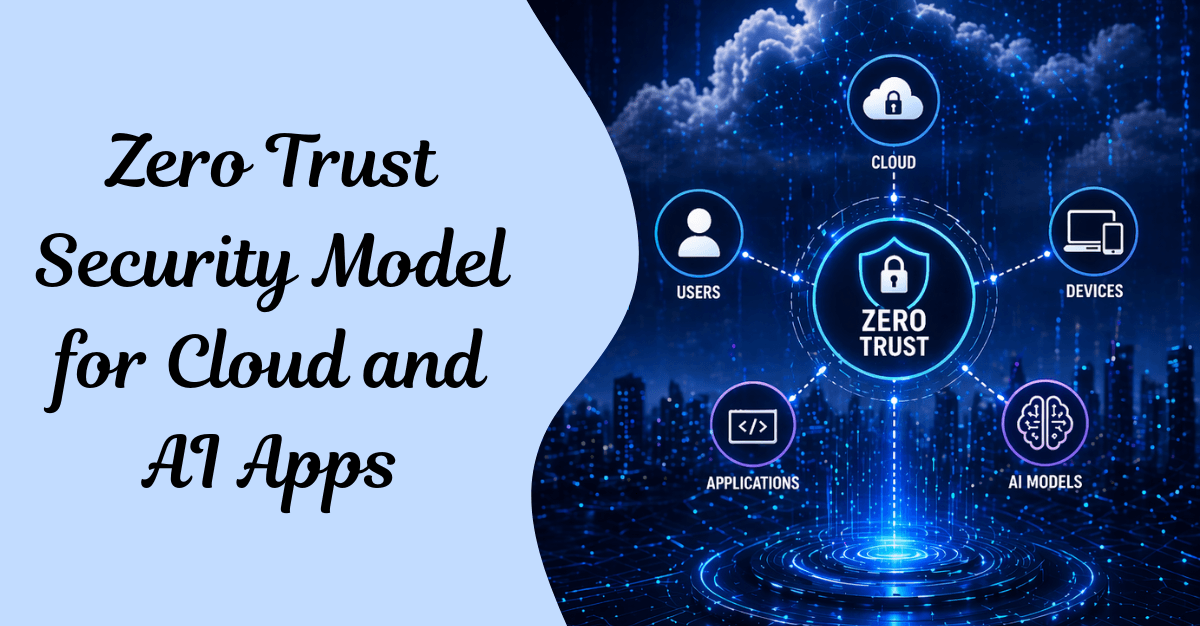
In today’s digital landscape, organizations are rapidly adopting cloud platforms and artificial intelligence to drive innovation, improve efficiency, and scale operations. However, this shift has also expanded the attack surface significantly. Traditional security models—built around the idea of a trusted internal network—are no longer sufficient. This is where the Zero Trust Security Model comes into play.
Zero Trust is not just a technology or a product; it is a modern security philosophy based on a simple but powerful principle: “Never trust, always verify.” Every user, device, application, and request must be continuously validated before access is granted, regardless of whether it originates inside or outside the organization.
Understanding the Zero Trust Model
The Zero Trust model assumes that threats can exist both outside and inside the network. Instead of granting broad access after a one-time authentication, Zero Trust enforces strict identity verification and access control at every stage.
In traditional security architectures, once a user is inside the network perimeter, they often gain access to multiple systems. This creates significant risk, especially in cloud environments where users access resources from various locations and devices. Zero Trust eliminates this implicit trust by ensuring that every request is authenticated, authorized, and encrypted.
For cloud and AI-driven systems, where data flows across multiple services, APIs, and environments, this continuous verification becomes critical. It ensures that sensitive data and models remain protected even if one layer of security is compromised.
Why Zero Trust is Essential for Cloud and AI
Cloud computing has transformed how organizations store and process data. Applications are no longer confined to a single data center; they are distributed across multiple regions, platforms, and services. At the same time, AI systems rely heavily on large datasets, APIs, and automated decision-making processes.
This combination introduces several challenges. Data is constantly moving, users are accessing systems remotely, and AI models are interacting with various external and internal sources. Traditional perimeter-based security cannot effectively manage this complexity.
Zero Trust addresses these challenges by providing a framework that secures access at every level. It ensures that only authorized users and systems can interact with cloud resources and AI models. It also minimizes the impact of potential breaches by limiting access to only what is necessary.
Another critical factor is compliance. With increasing regulations around data privacy and security, organizations must demonstrate strong access controls and monitoring. Zero Trust helps meet these requirements by providing detailed visibility and control over who accesses what, when, and how.
Core Principles of Zero Trust
At the heart of Zero Trust are a few key principles that guide its implementation. The first is continuous verification. Instead of relying on a single authentication event, the system constantly evaluates user behavior, device health, and contextual signals to determine whether access should be maintained.
The second principle is least privilege access. Users and systems are granted only the permissions they need to perform their tasks—nothing more. This reduces the risk of unauthorized access and limits the damage in case of a breach.
Another important principle is assume breach. Zero Trust operates under the assumption that attackers may already be present in the environment. This mindset encourages organizations to design systems that can detect and respond to threats quickly, rather than relying solely on prevention.
Finally, micro-segmentation plays a crucial role. Instead of a flat network where resources are widely accessible, Zero Trust divides the environment into smaller segments. Each segment has its own access controls, making it harder for attackers to move laterally within the system.
Applying Zero Trust to Cloud Environments
In cloud environments, Zero Trust focuses on securing identities, workloads, and data. Identity becomes the primary security perimeter. Strong authentication mechanisms such as multi-factor authentication (MFA) and identity federation are essential components.
Access to cloud resources is controlled through policies that consider multiple factors, including user role, location, device type, and risk level. For example, a user accessing sensitive data from an unknown device or location may be required to undergo additional verification.
Workload security is another critical aspect. Cloud applications often consist of multiple services communicating with each other through APIs. Zero Trust ensures that each service authenticates and authorizes every request, preventing unauthorized interactions.
Data protection is equally important. Encryption should be applied both at rest and in transit. Additionally, organizations should implement data classification and monitoring to track how data is accessed and used across the cloud environment.
Securing AI Applications with Zero Trust
AI applications introduce unique security challenges. They rely on large volumes of data, complex models, and automated processes. Protecting these components requires a tailored approach within the Zero Trust framework.
One of the primary concerns is data integrity. AI models are only as good as the data they are trained on. If attackers manipulate training data, they can influence the model’s behavior. Zero Trust ensures that only trusted sources can provide data and that all data interactions are validated.
Another challenge is model access control. AI models often expose APIs for inference and integration. Without proper security, these APIs can become entry points for attackers. Zero Trust enforces strict authentication and authorization for every API request, ensuring that only legitimate users and systems can interact with the model.
Monitoring is also critical. AI systems can behave unpredictably, and anomalies may indicate security issues. Continuous monitoring and logging help detect unusual patterns, such as unexpected data inputs or abnormal model outputs.
Furthermore, Zero Trust can help secure the AI development lifecycle. From data collection and model training to deployment and maintenance, every stage should include access controls, validation checks, and auditing mechanisms.
Key Technologies Supporting Zero Trust
Implementing Zero Trust requires a combination of technologies and practices. Identity and access management (IAM) systems play a central role by managing user identities and enforcing authentication policies.
Multi-factor authentication adds an extra layer of security by requiring users to provide multiple forms of verification. This significantly reduces the risk of unauthorized access due to compromised credentials.
Endpoint security solutions ensure that devices accessing the system meet security standards. This includes checking for updated software, secure configurations, and absence of malware.
Network security tools, such as software-defined perimeters and secure access service edge (SASE), help control access to resources based on identity rather than location. These tools enable secure connections regardless of where users or applications are located.
Finally, advanced monitoring and analytics provide visibility into system activity. By analyzing logs and behavioral data, organizations can detect and respond to threats in real time.
Challenges in Implementing Zero Trust
While the benefits of Zero Trust are clear, implementing it is not without challenges. One of the biggest obstacles is the complexity of modern IT environments. Integrating Zero Trust across multiple cloud platforms, legacy systems, and AI applications requires careful planning and coordination.
Another challenge is user experience. Strict security controls can sometimes create friction for users. Organizations must strike a balance between security and usability by implementing intelligent policies that adapt to context and risk.
Cost and resource requirements can also be significant. Implementing Zero Trust often involves investing in new technologies, training staff, and redesigning existing systems. However, these costs should be viewed in the context of the potential impact of security breaches.
Best Practices for Adopting Zero Trust
A successful Zero Trust implementation starts with a clear understanding of the organization’s assets, users, and data flows. This helps identify critical resources and prioritize security efforts.
Organizations should begin by strengthening identity management, as it forms the foundation of Zero Trust. Implementing MFA and enforcing strong authentication policies are essential first steps.
Next, access controls should be refined to follow the principle of least privilege. Regular audits can help ensure that permissions remain appropriate as roles and requirements change.
Micro-segmentation should be introduced gradually, starting with the most sensitive systems. This reduces risk while allowing teams to adapt to the new model.
Continuous monitoring and improvement are also crucial. Zero Trust is not a one-time project but an ongoing process that evolves with the threat landscape and business needs.
The Future of Security
As cloud computing and AI continue to evolve, the importance of Zero Trust will only grow. Organizations are moving toward distributed architectures, remote work environments, and automated systems—all of which require a more dynamic and resilient approach to security.
Zero Trust provides a framework that aligns with these trends. By focusing on identity, context, and continuous verification, it enables organizations to protect their assets without relying on outdated assumptions about trust.
For businesses investing in cloud and AI, adopting Zero Trust is not just a security decision—it is a strategic one. It ensures that innovation can continue without compromising the integrity, confidentiality, and availability of critical systems.
Conclusion
The Zero Trust Security Model represents a fundamental shift in how organizations approach cybersecurity. In a world where boundaries are blurred and threats are constantly evolving, trusting nothing by default is the safest approach.
For cloud and AI applications, where complexity and risk go hand in hand, Zero Trust offers a practical and effective way to secure systems and data. By implementing its principles and leveraging the right technologies, organizations can build a strong security foundation that supports growth, innovation, and resilience in the digital age.
Frequently Asked Questions
1. What is the Zero Trust Security Model?
Zero Trust is a cybersecurity approach that assumes no user or system is trusted by default. Every access request must be verified continuously, regardless of whether it comes from inside or outside the network.
2. Why is Zero Trust important for cloud environments?
Zero Trust is crucial for cloud environments because users and data are distributed across multiple locations. It ensures secure access by verifying identity, device, and context before granting permissions.
3. How does Zero Trust improve AI application security?
Zero Trust protects AI systems by controlling access to data, models, and APIs. It ensures that only authorized users and systems can interact with AI components, reducing risks like data poisoning and unauthorized access.
4. What are the core principles of Zero Trust?
The main principles include continuous verification, least privilege access, micro-segmentation, and assuming breach. These help minimize risks and limit unauthorized access.
5. What is least privilege access in Zero Trust?
Least privilege access means users and systems are given only the minimum permissions needed to perform their tasks, reducing the risk of misuse or data breaches.
6. Can Zero Trust prevent cyberattacks completely?
No security model can prevent all attacks, but Zero Trust significantly reduces the risk by limiting access and detecting threats early.
7. How do you implement Zero Trust in cloud applications?
Implementation involves strong identity management, multi-factor authentication, access controls, micro-segmentation, and continuous monitoring of user activity.
8. What challenges are faced when adopting Zero Trust?
Common challenges include integration complexity, cost, user experience issues, and adapting legacy systems to modern security frameworks.
9. Is Zero Trust suitable for small businesses?
Yes, Zero Trust can benefit businesses of all sizes by improving security and protecting sensitive data, especially in cloud-based environments.
10. What technologies support Zero Trust security?
Key technologies include identity and access management (IAM), multi-factor authentication (MFA), endpoint security, encryption, and real-time monitoring tools.
 Bio
Bio