Modern businesses rely on a growing ecosystem of technology providers to support operations, customer experiences, cybersecurity, cloud infrastructure, software development, data management, and digital transformation initiatives.
Over time, many organizations accumulate dozens of vendors across different departments. While each vendor may have been selected to solve a specific problem, the result is often a fragmented technology landscape that becomes increasingly difficult to manage.
Multiple contracts, overlapping tools, disconnected systems, inconsistent support experiences, and rising operational costs can quickly create complexity that slows innovation rather than enabling it.
This is why many organizations are turning to IT vendor consolidation.
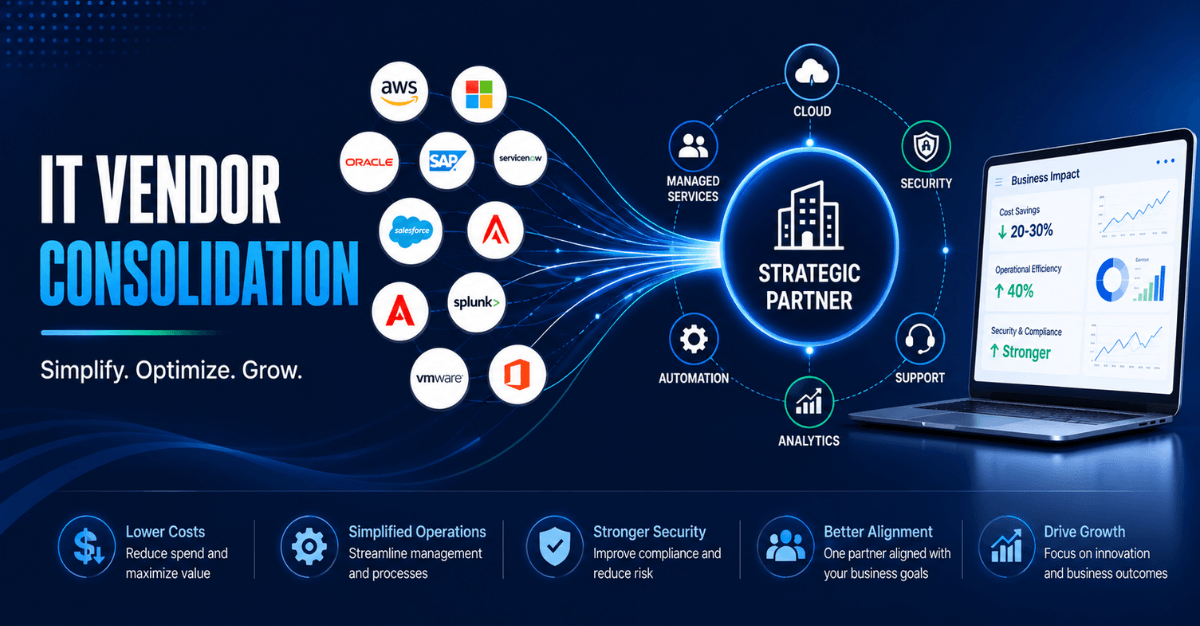
Vendor consolidation involves reducing the number of technology providers and strategically partnering with a smaller group of trusted vendors capable of delivering multiple services and solutions.
The goal is not simply to cut the vendor list. It is to improve operational efficiency, reduce costs, strengthen security, simplify management, and create better business outcomes.
In this guide, we’ll explore what IT vendor consolidation is, why organizations are adopting it, its benefits, challenges, best practices, and how businesses can execute a successful consolidation strategy.
What is IT Vendor Consolidation?
Vendor consolidation is the process of reducing the number of external suppliers you rely on for products, services, or technologies. Instead of juggling contracts with dozens of vendors, organizations focus on fewer, strategically selected partners who can deliver a broader range of needs. For organizations, this promotes a simpler, more efficient, and scalable way of doing things.
Vendor consolidation is distinct from vendor elimination. Elimination removes a vendor and the capability it provided. Consolidation reallocates that capability to an existing partner with broader scope — typically at better commercial terms, with tighter integration, and with clearer accountability.
The strategic logic is straightforward: by reallocating spend to your most trusted, high-performing partners and retiring those that duplicate services or underdeliver, consolidation turns a fragmented supply base into a focused, value-generating ecosystem.
The Vendor Sprawl Anatomy
Vendor sprawl typically develops through predictable patterns:
Organic growth: Each business unit or team acquires tools independently to solve immediate problems, without central visibility into what already exists.
Acquisition accumulation: M&A activity brings inherited vendor contracts and technology stacks that never get rationalized. Reuters reported a rise in global M&A activity in 2025, with technology deals taking a significant share. As portfolios expand through acquisition, categories converge, and roadmaps shift.
Shadow procurement: Teams purchase SaaS tools on company credit cards without IT involvement, creating a vendor population that procurement never contracted and security never assessed.
Contract inertia: Vendor contracts renew automatically because nobody has the time to evaluate alternatives, creating a compounding population of legacy relationships.
The result: currently, only 29% of systems are fully integrated across enterprises. The other 71% are operating in varying degrees of fragmentation — siloed data, duplicated capabilities, and integration debt that grows with every new system added.
Also read: Generative AI in business – where it creates real value and where it falls short
The Business Case: What Vendor Consolidation Actually Delivers
Cost Reduction
The most immediate and quantifiable benefit of IT vendor consolidation is direct cost savings.
Consolidation can reduce costs by eliminating redundancy, improving efficiency, and reducing maintenance overhead, often by 15% to 25% or more. Consolidation also leads to a 70% reduction in maintenance overhead.
These savings come from three sources:
License rationalization: Retired licenses from vendors providing capabilities already covered by remaining partners represent immediate, recurring savings. When two vendors each provide 60% of a needed capability with 40% overlap, consolidating to the better of the two eliminates the entire cost of the inferior one.
Volume-based negotiation: A primary benefit of vendor consolidation is increased negotiation power, as pooling higher purchase volumes with fewer vendors typically leads to significant volume discounts and better contract terms. The vendor receiving 80% of your category spend has a fundamentally different relationship to price negotiation than the vendor receiving 8%.
Administrative savings: Implementing vendor consolidation drastically reduces administrative overhead by streamlining the number of invoices, contracts, and performance reviews the procurement and finance teams must manage. For organizations managing 50+ vendor relationships, the administrative cost of that management — contract review, invoice processing, performance monitoring, renewal management — represents a significant operational overhead that consolidation eliminates.
ROI — Measurably Better in Consolidated Environments
Organizations see a 4x ROI in consolidated environments compared to fragmented ones. Integration timelines improve by 25% to 50%.
The mechanism behind the 4x figure: consolidated environments reduce the friction cost of every initiative that touches technology. Integration projects that require weeks of compatibility work in fragmented environments complete in days when the target systems share a common vendor ecosystem. Security reviews that require separate assessments of dozens of vendors complete faster when the vendor population is smaller and better understood. These friction reductions compound across the organization’s entire technology portfolio.
Security and Compliance Improvement
Fragmented vendor environments are harder to secure than consolidated ones — not because any individual tool is less secure, but because security posture is an emergent property of the whole environment.
When vendors have been assessed, contracts include data processing agreements, access is governed through a unified IAM approach, and the total number of external parties with data access is manageable, security posture improves. When the vendor population is large, fragmented, and partially undiscovered (shadow procurement), the attack surface is impossible to defend systematically.
Key benefits include improved compliance and simplified processes — because compliance is a function of documentation, control, and monitoring that becomes more tractable as the vendor population shrinks.
Strategic Focus for IT Teams
Consolidation gives your internal teams the gift of focus. Instead of wasting hours juggling various platforms, renewing contracts, and troubleshooting multi-system compatibility issues, your IT team can redirect that effort toward higher-value work.
The opportunity cost of vendor sprawl management is one of its most significant but least-quantified costs. Every hour an IT team member spends navigating a fragmented vendor landscape is an hour not spent on strategic initiatives — digital transformation, security improvements, developer experience investments, or innovation projects
The Seven Business Outcomes of Effective Vendor Consolidation
1. Simplified Contract and Compliance Management
Managing dozens of vendor contracts means dozens of renewal dates, dozens of compliance assessments, dozens of data processing agreements, and dozens of performance review cycles. Consolidation compresses this into a manageable portfolio where each relationship receives the attention it deserves and nothing slips through the gaps.
In 2026, organizations are establishing formal AI governance frameworks and vendor contracts increasingly include AI-specific clauses addressing explainability, risk reporting, and ethical use. Managing these new contractual requirements is straightforwardly easier with a smaller vendor population.
2. Unified Data and Reduced Integration Complexity
Every vendor relationship in a fragmented technology estate is a potential data silo. Data that should flow between systems for analytics, reporting, or operational efficiency instead requires custom integrations — each of which has development cost, maintenance overhead, and failure risk.
Consolidation to vendors with native platform integration reduces this complexity structurally. When your CRM, marketing automation, and customer service platform share a common data model (as they do when they are all Salesforce products, for example), the integration complexity of a fragmented multi-vendor approach disappears. Consolidation improves data quality by eliminating system silos and synchronization issues. Strategic implications include simplified IT architecture enabling greater agility and lower risk.
3. Improved Vendor Performance Accountability
Applying SLA penalties improves vendor performance. Best practices suggest SLA penalties should be 5% to 10% of monthly fees to ensure compliance.
In a fragmented vendor environment, accountability is diluted. When a service failure can be attributed to any of twelve vendors interacting in complex ways, pinpointing responsibility — and enforcing contractual remedies — is difficult.
In a consolidated environment, accountability is clear. The vendor managing your infrastructure owns the outcome. The vendor managing your service desk owns the resolution times. Performance governance becomes tractable when the vendor population is small enough to actively manage.
4. Stronger Strategic Partnerships
Customers want a guide who can sit alongside their team, go line by line through contracts and subscriptions, and talk plainly about which parts of the environment still support the plan for the next few years. The focus moves away from product comparison and toward helping the business set priorities and understand where cost, risk, and value sit.
This is the qualitative shift that consolidation enables — from transactional vendor management to genuine strategic partnership. A vendor receiving 15% of your technology spend has a reason to invest in understanding your business, bringing you roadmap previews, escalating issues before they become incidents, and contributing to your technology strategy.
5. Faster Technology Adoption and Deployment
Integration timelines improve by 25% to 50% in consolidated environments. When new capabilities come from vendors already integrated into your environment, deployment is faster. The compliance assessment is faster because you have already assessed the vendor. The integration work is faster because the connectors already exist. The security review is faster because the data handling is already understood.
The operational agility that consolidation creates compounds with every subsequent technology initiative.
6. Resilience Through Deliberate Relationship Management
A counterintuitive benefit of consolidation: it can improve resilience when done thoughtfully. Fragmented vendor environments appear resilient because no single vendor is critical — but in practice, the failure of any vendor in a tightly coupled fragmented environment causes cascading failures that are harder to manage than the failure of a well-understood strategic partner.
While consolidation provides clear benefits, it also introduces new risks. Address them head-on by avoiding overreliance on a single vendor by maintaining contingency relationships or diversified sourcing options, and planning phased transitions to minimize operational disruption.
Consolidation done well means choosing partners for their resilience as much as their capabilities — and maintaining deliberate contingency options for the most critical relationships.
7. Outcome-Based Vendor Relationships
Traditional time-and-materials contracts are losing relevance. Businesses now demand contracts that reflect measurable business outcomes, not just effort or activity. This shift benefits both parties. Clients gain clarity on value delivery, while vendors are incentivized to innovate and optimize performance rather than maximize billable hours.
Consolidation to fewer, deeper partnerships creates the conditions for outcome-based contracting — where the vendor’s compensation is tied to the business results they deliver, not the activities they perform. This alignment of incentives is only achievable when the relationship is significant enough for both parties to invest in the governance infrastructure it requires.
Check out: Transform Your Business with AwsQuality Technologies
Key Benefits of IT Vendor Consolidation
Reduced Costs
One of the most immediate benefits of vendor consolidation is cost savings.
Organizations can reduce expenses through:
- Volume discounts
- Bundled service agreements
- Lower administrative costs
- Reduced licensing overlap
Consolidation often improves purchasing power and contract negotiation leverage.
Simplified Vendor Management
Managing fewer vendors means:
- Fewer contracts
- Fewer invoices
- Fewer support contacts
- Simplified procurement
This allows IT leaders to focus more on strategic initiatives rather than vendor administration.
Improved Operational Efficiency
Consolidated vendors often provide integrated solutions.
This leads to:
- Better workflows
- Reduced system complexity
- Improved interoperability
- Faster issue resolution
Teams spend less time navigating disconnected systems.
Stronger Security and Compliance
Security becomes easier to manage when fewer vendors are involved.
Organizations can standardize:
- Security policies
- Compliance requirements
- Access controls
- Risk assessments
This reduces potential vulnerabilities across the technology ecosystem.
Better Strategic Alignment
A smaller group of trusted partners often develops a deeper understanding of business objectives.
This enables vendors to provide:
- Strategic guidance
- Proactive recommendations
- Long-term technology planning
Instead of acting as suppliers, they become business partners.
Faster Support and Issue Resolution
When fewer vendors are involved, accountability improves.
Support teams gain greater visibility into systems and dependencies.
As a result:
- Problems are resolved faster
- Escalations decrease
- Service quality improves
Business Areas That Benefit Most from Vendor Consolidation
Cloud Infrastructure
Organizations frequently work with multiple cloud providers, monitoring tools, and infrastructure vendors.
Consolidation can simplify:
- Cloud management
- Cost optimization
- Security governance
Managed IT Services
Many businesses combine networking, support, cybersecurity, and infrastructure management under a single managed services provider.
Software Development and QA
Consolidating development, testing, and support services with a strategic technology partner improves coordination and delivery speed.
Salesforce and CRM Services
Instead of using separate providers for implementation, customization, integration, and support, organizations often achieve better outcomes through a single Salesforce consulting partner.
Cybersecurity
Vendor consolidation helps create unified security strategies and reduces gaps between tools and providers.
Common Challenges of Vendor Consolidation
While vendor consolidation offers significant benefits, it must be approached strategically.
Over-Reliance on a Single Vendor
Consolidating too aggressively may increase dependency on one provider.
Organizations should balance consolidation with risk management.
Migration Complexity
Transitioning services between vendors requires careful planning.
Potential challenges include:
- Data migration
- System integrations
- User training
- Service continuity
Contract Limitations
Existing vendor agreements may include:
- Long-term commitments
- Early termination fees
- Renewal obligations
These factors should be evaluated before consolidation efforts begin.
Change Management
Employees and stakeholders may need to adapt to new tools, processes, and support structures.
Clear communication is essential.
Signs Your Organization Has Too Many IT Vendors
You may benefit from vendor consolidation if:
- Multiple tools perform similar functions
- Vendor costs continue increasing
- IT teams struggle with vendor management
- Integration challenges are common
- Support responsibilities are unclear
- Security audits involve dozens of providers
- Procurement processes are becoming complex
These are often indicators of vendor sprawl.
Measuring Vendor Consolidation Success
The ROI of vendor consolidation should be measured before and after, with specific metrics tracked across multiple dimensions:
| Metric | Baseline Measurement | Target Post-Consolidation |
|---|---|---|
| Total vendor count | Count all active vendors | 20%+ reduction |
| Annual technology spend | Total license and service cost | 15–25% reduction |
| Vendor management hours | Hours per month on vendor admin | 50%+ reduction |
| Number of active contracts | All contracts under management | 20%+ reduction |
| Integration points | All active system integrations | Reduction and simplification |
| Security assessment coverage | % of vendors with current assessments | 100% of strategic vendors |
| SLA compliance rate | Vendor performance against commitments | Improvement across strategic partners |
| Integration timeline | Average days to integrate new capability | 25–50% improvement |
Common Vendor Consolidation Mistakes
1. Consolidating on Price Alone
The vendor offering the lowest price for the broadest scope is not always the right consolidation partner. Quality, integration capability, support responsiveness, and strategic alignment matter as much as commercial terms. Consolidating to a vendor that is cheaper but less capable creates a different kind of fragmentation — capability gaps that accumulate into shadow procurement as teams find alternatives.
2. Moving Too Fast
The 67% failure rate is largely driven by programs that prioritized speed over stability. Exiting a vendor before its replacement capability is proven, running transitions with insufficient resources, or failing to validate migrated data integrity — these are execution gaps that fast-moving programs are most prone to.
3. Under-Communicating with Affected Teams
Vendor consolidation changes the tools and workflows of the people using them. Teams that are not engaged in the consolidation process — that have their preferred tools removed without explanation or transition support — resist the change in ways that undermine adoption and erode the value the consolidation was designed to deliver.
4. Not Capturing Baseline Metrics Before Consolidation
Without baseline measurements, consolidation benefits cannot be demonstrated. The cost savings, overhead reductions, and performance improvements that consolidation delivers become assertions rather than evidence — which limits the organizational credibility of the program and the likelihood of investment in subsequent phases.
5. Treating Consolidation as a One-Time Project
Vendor sprawl is a natural tendency of technology-intensive organizations. Without the governance mechanisms to prevent recurrence, the landscape that consolidation rationalized will fragment again within two to three years. Consolidation programs that do not include a governance phase to sustain their outcomes deliver temporary benefits at permanent cost.
How to Build an IT Vendor Consolidation Strategy
Step 1: Inventory Current Vendors
Create a comprehensive list of:
- Vendors
- Services provided
- Contract details
- Costs
- Business owners
This establishes a baseline.
Step 2: Identify Redundancies
Look for overlapping solutions and duplicate functionality.
Examples include:
- Multiple project management tools
- Several monitoring platforms
- Redundant security solutions
Step 3: Evaluate Vendor Performance
Assess:
- Service quality
- Responsiveness
- Strategic value
- Cost effectiveness
Step 4: Prioritize Strategic Partners
Identify vendors capable of supporting multiple business needs.
Consider:
- Technical expertise
- Scalability
- Industry knowledge
- Long-term partnership potential
Step 5: Develop a Transition Plan
Create a roadmap that addresses:
- Migration timelines
- Risk mitigation
- Training requirements
- Success metrics
Best Practices for Successful Vendor Consolidation
Focus on Business Outcomes
Consolidation should support:
- Efficiency
- Cost optimization
- Security
- Innovation
Not simply vendor reduction.
Maintain Competitive Oversight
Even with fewer vendors, continue reviewing performance regularly.
Establish Governance Processes
Create standards for:
- Vendor selection
- Performance monitoring
- Contract management
Prioritize Strategic Relationships
Choose partners that align with your long-term goals.
Measure Results
Track metrics such as:
- Cost savings
- Support response times
- Security improvements
- Operational efficiency
The Future of IT Vendor Consolidation
As organizations continue adopting:
- Cloud computing
- Artificial Intelligence
- Automation
- Managed services
- Digital transformation initiatives
Vendor ecosystems will become even more complex.
Businesses increasingly prefer strategic technology partners capable of delivering end-to-end solutions rather than managing dozens of specialized providers.
Future consolidation efforts will likely focus on:
- Platform standardization
- AI-powered vendor management
- Unified service delivery
- Outcome-based partnerships
Organizations that simplify their vendor ecosystems will be better positioned to scale efficiently and adapt to changing market conditions.
The 2026 Context: Why Consolidation Is Accelerating Now
Three converging factors make vendor consolidation more urgent in 2026 than at any previous point:
AI governance requirements
IT leaders in 2026 are focusing on AI governance, outcome-based contracts, third-party risk, cybersecurity, and long-term vendor strategy. Managing AI governance across a fragmented vendor population — each with different AI capabilities, different data handling practices, and different explainability standards — is operationally unmanageable. Consolidation to vendors with mature AI governance reduces this overhead.
CFO pressure on technology spending
The partners who can go line by line through contracts and subscriptions, and talk plainly about which parts of the environment still support the plan for the next few years, are the ones who will stay in the room as supplier lists get shorter. The pressure from finance to demonstrate ROI on technology spending is intensifying — and fragmented vendor relationships make that demonstration difficult.
Platform consolidation in the market
Major technology vendors are expanding their platform scope — through product development, acquisition, and partnership — making it increasingly possible to cover more capabilities through fewer relationships. The market itself is consolidating, giving buyers more options for genuine multi-capability partnerships with fewer vendors.
Conclusion: Fewer Partners, Deeper Relationships, Better Outcomes
The technology vendor landscape of 2026 rewards the organizations that have the discipline to manage fewer relationships with more depth — not those that have the most tools or the most suppliers.
Organizations see a 4x ROI in consolidated environments compared to fragmented ones. The cost savings, administrative reduction, security improvement, and strategic partnership depth that consolidation delivers are not marginal gains — they are competitive infrastructure that compounds over time.
The 67% failure rate is a warning, not a deterrent. It points directly to the execution discipline that separates successful consolidation programs from failed ones: complete discovery before strategy, validated capabilities before exits, phased transitions before decommissions, and governance mechanisms before the program closes.
The partners who can sit alongside their clients’ teams, go line by line through contracts and subscriptions, and talk plainly about which parts of the environment still support the plan for the next few years will keep their position even as customer supplier lists get shorter. The same logic applies in reverse: the organizations that do this work rigorously — understanding exactly what they have, what it costs, what it delivers, and what they could have with fewer, better partners — will make technology a competitive advantage rather than a management burden.
Fewer vendors is not a constraint. It is a strategy.
 Bio
Bio