Artificial intelligence is moving from experimentation into everyday business operations. Organizations are using AI for customer service, fraud detection, forecasting, marketing personalization, employee productivity, software development, healthcare workflows, financial decisions, and increasingly autonomous business processes.
But deploying an AI model successfully is not the same as deploying AI responsibly.
A responsible AI implementation requires organizations to answer three fundamental questions:
- How will we govern AI across its lifecycle?
- How will we meet applicable legal, regulatory, privacy, and security requirements?
- How will we ensure the data and outputs used by AI remain accurate, reliable, secure, and fit for purpose?
These questions are becoming increasingly important as AI systems gain more access to enterprise data and business processes. NIST’s AI Risk Management Framework (AI RMF), for example, provides a voluntary framework for organizations to manage AI risks and promote trustworthy AI across design, development, deployment, use, and evaluation. Its core functions are Govern, Map, Measure, and Manage.
At the same time, regulatory requirements are evolving. The EU AI Act uses a risk-based approach and introduces requirements around areas such as risk management, data quality, documentation, traceability, human oversight, transparency, accuracy, cybersecurity, and robustness for applicable systems.
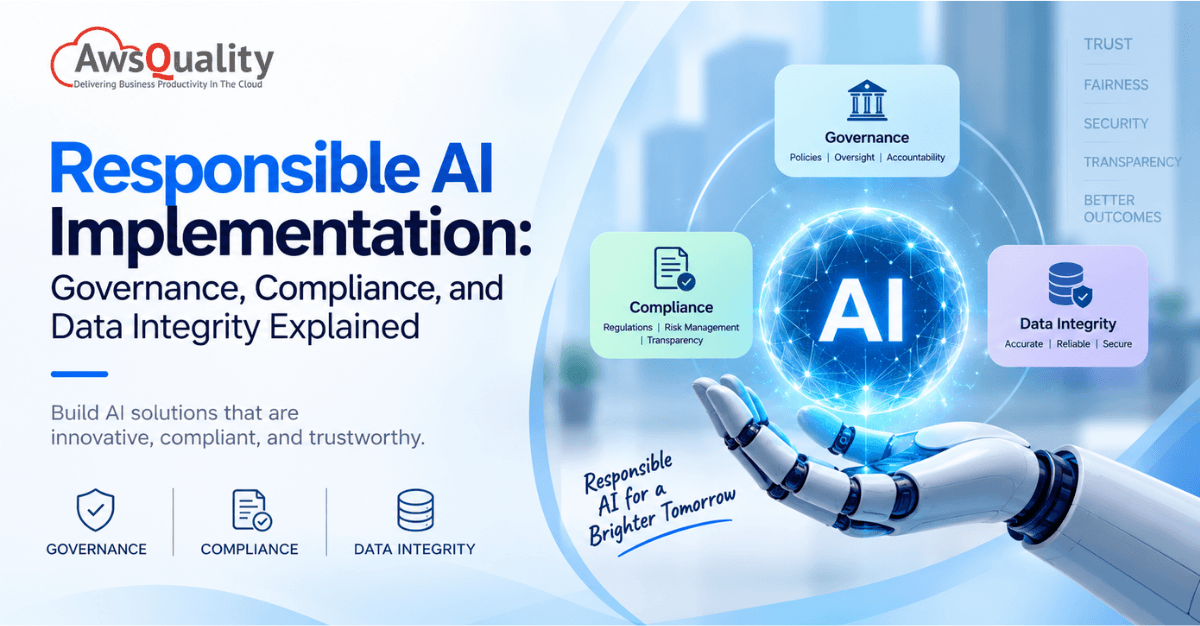
This guide explains how businesses can build a practical responsible AI program centered on AI governance, compliance, and data integrity.
Read: How AI Agents Can Reduce Operational Costs for Businesses
What is Responsible AI?
Responsible AI is the practice of designing, developing, deploying, and operating AI systems in a way that manages risks, protects people and organizations, meets applicable requirements, and supports trustworthy business outcomes.
Responsible AI goes beyond model accuracy.
An AI system can produce highly accurate predictions and still create significant problems if:
- It uses unauthorized personal data.
- Its training data contains serious quality issues.
- Its decisions cannot be explained or audited.
- Users do not know when they are interacting with AI.
- Access controls are poorly configured.
- A third-party model provider changes its behavior without adequate monitoring.
- The organization has no process for handling AI incidents.
- Employees use unapproved AI tools with confidential information.
- The system produces biased or unreliable results in production.
Responsible AI therefore needs to be treated as an organizational capability, not simply a feature added to an AI application.
Responsible AI vs. Traditional AI Development
Traditional AI development often focuses on:
Data → Model → Testing → Deployment → Monitoring
Responsible AI expands that lifecycle:
Business purpose → Risk assessment → Data governance → Model development → Evaluation → Security → Compliance → Human oversight → Deployment → Monitoring → Incident management → Continuous improvement
This broader lifecycle is consistent with the NIST approach, which emphasizes managing trustworthiness considerations throughout AI system design, development, deployment, use, and evaluation.
Also read: Why Agentic AI is the Next Big Enterprise Challenge for CTOs
Why Responsible AI is No Longer Optional in 2026
The shift from voluntary guidance to enforceable obligation happened between 2024 and 2026 faster than most enterprise technology leaders anticipated.
The regulatory escalation: The EU AI Act’s phased implementation reached its most consequential stage in August 2026. Bans on prohibited AI practices took effect in February 2025. Obligations for general-purpose AI models became effective in August 2025. Transparency duties and rules for high-risk AI systems — those used in employment, credit, healthcare, education, and law enforcement contexts — became fully applicable in August 2026. This sequence means that organizations deploying AI in high-risk contexts without documented conformity assessments, technical documentation, human oversight mechanisms, and incident logging are now in violation of enforceable law, not just advisory guidelines.
The board-level escalation: AI governance has climbed the organizational hierarchy with unusual speed. The NACD’s 2025 Public Company Board Practices and Oversight Survey found that more than 62% of directors now set aside full-board agenda time for AI. The share of organizations where CEOs directly own AI governance oversight has grown, though only 28% have reached this standard. AI-specific governance roles grew 17% year-over-year according to Stanford HAI — and the CAIO (Chief AI Officer) role jumped from 26% adoption to 76% in a single year, according to IBM, making 2027 the year boards begin holding these leaders accountable for measurable governance outcomes rather than just program existence.
The market incentive: Procurement teams now routinely request governance evidence before vendor selection, according to Solytics Partners’ July 2026 enterprise AI governance guide. Gartner projects AI governance platform spending to more than double from $492 million in 2026 to over $1 billion by 2030, as AI regulation reaches 75% of the world’s economies. The organizations that establish governance infrastructure now position themselves as trusted AI partners for enterprise customers and regulated industry relationships; those that do not face compounding compliance debt as regulations proliferate.
The 63% vs 13% differential that Protiviti and BoardProspects document — the proportion of high-AI-ROI organizations versus low-ROI ones that discuss AI at every board meeting — is the most direct evidence that governance investment and AI return are positively correlated, not in tension.
Why Responsible AI Matters for Enterprises
AI systems increasingly influence decisions, recommendations, customer interactions, and operational workflows.
A poorly governed AI system can therefore create risks across several dimensions.
Business risk
Incorrect AI outputs can lead to poor decisions, operational disruption, financial losses, or reputational damage.
Data risk
AI systems can expose sensitive information or produce unreliable results when underlying data is incomplete, inaccurate, outdated, or improperly governed.
Security risk
AI applications introduce additional attack surfaces, including prompt injection, data leakage, insecure integrations, compromised models, and unauthorized access.
Compliance risk
Organizations may need to satisfy privacy, industry-specific, employment, consumer protection, AI-specific, and contractual requirements depending on the use case and geography.
Trust risk
Customers, employees, regulators, and business stakeholders need confidence that AI systems are being used appropriately.
The result is an important shift in mindset:
Responsible AI should be designed into the AI lifecycle—not added after deployment.
Check out: Is It Possible to Make AI Development Cost-Efficient?
The Three Foundations of Responsible AI
A practical enterprise responsible AI strategy can be organized around three interconnected foundations:
| Foundation | Primary Question | Key Capabilities |
|---|---|---|
| AI Governance | Who is accountable for AI decisions and risks? | Policies, ownership, risk classification, oversight |
| AI Compliance | Are we meeting applicable legal and regulatory requirements? | Privacy, documentation, transparency, audits |
| Data Integrity | Can we trust the data powering AI? | Quality, lineage, provenance, validation, security |
These foundations reinforce one another.
For example, governance defines who owns data quality. Compliance may require documentation and traceability. Data integrity controls provide the evidence that the AI system is operating on reliable information.
What is AI Governance?
AI governance is the framework of policies, roles, processes, controls, and oversight mechanisms used to manage AI throughout its lifecycle.
Effective AI governance answers questions such as:
- Which AI systems does the organization use?
- Who owns each system?
- What business purpose does each system serve?
- What risks does it introduce?
- What data does it use?
- Which vendors and models are involved?
- What decisions can the AI make?
- When is human approval required?
- How is performance monitored?
- What happens when the system fails?
- How are changes approved?
NIST describes governance as a cross-cutting function that should inform and be integrated throughout AI risk management rather than treated as a one-time activity.
Key Components of an AI Governance Framework
1. AI Inventory
Organizations should maintain an inventory of AI systems, including internally developed models, third-party APIs, SaaS AI features, generative AI tools, AI agents, and embedded AI capabilities.
A useful AI inventory can capture:
- System name
- Business owner
- Technical owner
- Purpose
- Model/provider
- Data sources
- Users
- Risk classification
- Geographic scope
- Regulatory considerations
- Human oversight requirements
- Performance metrics
- Last review date
Without an inventory, organizations cannot effectively govern systems they do not know they are using.
2. AI Ownership and Accountability
Every production AI system should have clearly defined ownership.
For example:
- Business owner: accountable for the business purpose and outcomes.
- Technical owner: responsible for implementation, reliability, and technical controls.
- Data owner: responsible for data access, quality, and governance.
- Security team: evaluates security threats and controls.
- Legal/compliance: assesses applicable obligations.
- Risk management: evaluates broader organizational risks.
Clear ownership prevents the common situation where everyone is involved in an AI project but nobody is accountable for the outcome.
3. AI Risk Classification
Not every AI application presents the same level of risk.
A marketing content assistant is generally different from an AI system that influences employment, credit, healthcare, insurance, or other consequential decisions.
Organizations can establish internal risk tiers such as:
- Low risk: productivity and internal assistance
- Moderate risk: customer-facing recommendations or automated content
- High risk: systems influencing significant business or individual decisions
- Critical risk: systems with potentially severe safety, financial, legal, or societal consequences
Risk classification should determine the level of testing, human oversight, documentation, monitoring, and approval required.
AI Compliance: What Organizations Need to Consider
AI compliance does not come from a single universal law.
Requirements depend on factors such as:
- Industry
- Geography
- Type of AI system
- Data involved
- Intended use
- Individuals affected
- Organization size
- Contractual requirements
- Regulatory environment
For that reason, responsible AI compliance should begin with a use-case and regulatory assessment, rather than assuming that one framework covers every requirement.
The EU AI Act
The EU AI Act is one of the most significant AI regulatory frameworks globally. It follows a risk-based model covering unacceptable, high-risk, transparency, and minimal/no-risk categories.
As of 2026, the AI Act’s broader application timeline is already underway. The Act became generally applicable on August 2, 2026, with specific provisions following different timelines. Certain high-risk AI rules are scheduled for later application, including December 2, 2027 for specified high-risk use cases and August 2, 2028 for certain AI systems embedded in regulated products.
For applicable high-risk AI systems, the framework addresses areas including:
- Risk management
- Data quality
- Documentation
- Traceability
- Human oversight
- Accuracy
- Cybersecurity
- Robustness
The EU’s transparency requirements under Article 50 also began applying on August 2, 2026. These include requirements concerning certain AI interactions and AI-generated or manipulated content.
Organizations operating in or serving the EU should therefore assess which AI systems fall within the regulation and which obligations apply to them.
U.S. AI Governance
The U.S. regulatory environment is more fragmented, with federal guidance, state requirements, sector-specific obligations, contractual requirements, and existing laws potentially affecting AI use.
For example, the Office of Management and Budget’s 2025 memorandum on federal AI use establishes governance and safeguards for Executive Branch agencies, including responsibilities around AI adoption, privacy, civil rights, and oversight. This memorandum applies to federal agencies rather than serving as a blanket compliance framework for all private-sector companies.
For businesses, responsible AI compliance should therefore be mapped to the specific jurisdictions and industries in which the organization operates.
Also check: How Data Engineering Services Help Enterprises Build AI-Ready Data Platforms
Data Integrity: The Foundation of Responsible AI
One of the most overlooked aspects of responsible AI is data integrity.
An AI system cannot consistently produce trustworthy results from unreliable data.
Data integrity means maintaining the accuracy, completeness, consistency, validity, timeliness, provenance, and security of data throughout its lifecycle.
This becomes especially important when AI systems consume data from multiple enterprise sources.
For example, an enterprise AI assistant may rely on:
- CRM records
- ERP systems
- Customer databases
- Data warehouses
- Documents
- APIs
- Data lakes
- Transaction systems
- Knowledge bases
- Vector databases
- Real-time event streams
If these sources contain conflicting or outdated information, the AI system can produce misleading results even if the underlying model performs well.
Six Pillars of AI Data Integrity
1. Data Accuracy
Data should correctly represent the underlying business reality.
Examples include:
- Correct customer information
- Accurate transaction values
- Valid product information
- Correct timestamps
- Reliable financial records
Automated validation rules can identify invalid or anomalous records before they reach AI systems.
2. Data Completeness
Missing data can create blind spots.
Organizations should identify critical fields and establish completeness thresholds.
For example:
Customer profile completeness ≥ 98%
can become a measurable data quality objective for a critical dataset.
3. Data Consistency
The same business concept should have consistent definitions across systems.
Consider “active customer.”
If Salesforce defines an active customer one way while an analytics warehouse uses another definition, an AI model may receive conflicting signals.
Data governance should therefore establish common definitions through:
- Business glossaries
- Data contracts
- Standard schemas
- Master data management
- Metadata management
4. Data Timeliness
AI applications increasingly require current information.
A customer service agent using yesterday’s account status may produce a poor response.
Real-time and near-real-time applications therefore require monitoring for:
- Data freshness
- Pipeline latency
- Processing delays
- Event delivery failures
5. Data Lineage and Provenance
Organizations should be able to answer:
Where did this data come from?
and:
What happened to it before it reached the AI system?
Data lineage connects source systems to transformations, storage layers, models, and downstream applications.
This can support:
- Troubleshooting
- Auditing
- Compliance
- Impact analysis
- Model investigations
- Data quality management
6. Data Security
Data integrity also depends on preventing unauthorized modification or access.
Controls can include:
- Role-based access control
- Least-privilege access
- Encryption
- Environment separation
- Audit logging
- Data masking
- Tokenization
- Secure APIs
- Data loss prevention
Responsible AI and Generative AI
Generative AI introduces additional considerations because users can interact with models through natural language and because outputs may be generated dynamically.
Organizations should consider risks such as:
- Hallucinations
- Prompt injection
- Sensitive data disclosure
- Unauthorized data retrieval
- Copyright concerns
- Inaccurate outputs
- Model drift
- Inconsistent responses
- Excessive model permissions
- Inappropriate autonomous actions
NIST’s Generative AI Profile was created as a companion to the AI RMF specifically to help organizations identify and manage risks associated with generative AI across the AI lifecycle.
For enterprise generative AI, responsible implementation should therefore combine model controls with strong data, application, identity, and governance controls.
Responsible AI for AI Agents
AI agents raise the governance requirements even further.
A conventional AI assistant may generate an answer.
An AI agent may:
- Retrieve customer information
- Update CRM records
- Create tickets
- Send messages
- Trigger workflows
- Make recommendations
- Call APIs
- Execute transactions
This means organizations must govern not only what the model says, but also what the AI system is allowed to do.
A responsible AI agent architecture should define:
Identity → Permissions → Tools → Actions → Approval thresholds → Monitoring → Audit trail
For high-impact actions, organizations should consider human approval or additional verification.
For example:
AI can recommend a refund → human approves → system executes.
This can be safer than:
AI independently issues refunds.
The appropriate level of autonomy should depend on the risk of the action.
Also check: How AI Agents and Salesforce are Redefining Customer Service
Human Oversight Is Still Important
Responsible AI does not mean humans must manually review every AI output.
Instead, organizations should determine where human oversight creates the most value.
Human review may be particularly important when:
- Decisions affect individuals significantly.
- Data quality is uncertain.
- AI confidence is low.
- The action is irreversible.
- Financial impact is significant.
- Regulatory requirements apply.
- The AI system behaves unexpectedly.
- A customer disputes an AI-generated decision.
The EU AI Act, for applicable high-risk systems, specifically includes human oversight among its requirements.
A practical approach is to establish risk-based human-in-the-loop controls rather than treating every AI interaction identically.
AI Testing and Evaluation
Responsible AI requires continuous evaluation.
Testing should happen before deployment and continue after deployment because models, data, prompts, users, integrations, and business conditions can change.
Organizations should evaluate areas such as:
Accuracy
Does the system produce correct results?
Reliability
Does it behave consistently under similar conditions?
Safety
Can users manipulate the system into unsafe behavior?
Security
Can attackers extract sensitive information or bypass controls?
Fairness
Does the system produce materially different outcomes across relevant groups?
Privacy
Does the system expose or infer information that should remain protected?
Explainability
Can stakeholders understand why important outputs were generated?
Robustness
Does the system remain reliable when inputs change or unusual conditions occur?
Cost and performance
Are latency, compute, token usage, and infrastructure costs within acceptable thresholds?
NIST’s AI RMF organizes risk management around Govern, Map, Measure, and Manage, providing a useful structure for making evaluation a continuous process rather than a one-time certification exercise.
AI Monitoring in Production
Responsible AI doesn’t end when a system goes live.
Organizations should continuously monitor:
- Model performance
- Data quality
- Data drift
- Model drift
- Output quality
- Hallucination rates
- Safety violations
- Security events
- Latency
- Cost
- User feedback
- Human overrides
- Failed actions
- System availability
For AI agents, monitoring should additionally capture:
- Tools invoked
- Actions attempted
- Actions approved
- Actions rejected
- Data accessed
- API calls
- Escalations
- Human interventions
This creates an operational record that can help teams investigate unexpected behavior.
Third-Party AI Vendor Governance
Many organizations don’t build their AI models from scratch.
They use:
- Foundation model APIs
- Cloud AI services
- AI SaaS applications
- Embedded enterprise AI features
- External data providers
- AI development platforms
This creates third-party risk.
Before adopting an AI provider, organizations should evaluate:
Data handling
- What data is sent to the provider?
- Is customer data used for model training?
- Where is data processed?
- How long is it retained?
Security
- What authentication mechanisms are supported?
- How is data encrypted?
- What certifications and controls are available?
Model governance
- How are models updated?
- How are changes communicated?
- Can customers select or pin model versions?
Compliance
- Which regulatory requirements does the provider support?
- What documentation is available?
- Are audit reports or compliance artifacts available?
Business continuity
- What happens if the provider changes pricing, availability, functionality, or terms?
Third-party AI systems should be treated as part of the organization’s overall AI risk environment.
NIST’s AI RMF also recognizes third-party entities—including providers, developers, vendors, and evaluators—as relevant AI actors whose technologies and risk tolerances may differ from those of the deploying organization.
Read: Chatbots vs AI Agents – Which One Does Your Business Actually Need?
How to Build a Responsible AI Implementation Framework
Organizations can build a practical responsible AI program using the following lifecycle.
Step 1: Define the Business Purpose
Start with the business problem.
Document:
- Intended use
- Expected outcomes
- Users
- Affected stakeholders
- Decisions influenced by AI
- Expected benefits
- Potential harms
Avoid deploying AI simply because a technology is available.
Step 2: Identify and Classify Risks
Evaluate:
- Data sensitivity
- Business impact
- Regulatory exposure
- Security threats
- Potential discrimination
- Human impact
- Financial consequences
- Level of autonomy
Assign an appropriate risk tier.
Step 3: Inventory Data Sources
Document every important data source used by the AI system.
Capture:
- Source
- Owner
- Purpose
- Data type
- Sensitivity
- Location
- Refresh frequency
- Transformation history
- Access permissions
Step 4: Establish Data Quality Controls
Define measurable quality expectations.
Examples include:
- Completeness
- Accuracy
- Freshness
- Validity
- Uniqueness
- Consistency
Automate validation wherever practical.
Step 5: Establish Governance Ownership
Assign clear accountability across:
- Business
- Data
- Engineering
- Security
- Legal/compliance
- Risk
- AI operations
Step 6: Evaluate the Model and System
Test the complete AI application—not just the model.
Evaluate:
- Model behavior
- Prompts
- Retrieval
- Tools
- Integrations
- Permissions
- Outputs
- Edge cases
- Security
- Human escalation
Step 7: Document the System
Maintain documentation covering:
- Business purpose
- Architecture
- Data sources
- Model/provider
- Evaluation results
- Known limitations
- Risk classification
- Security controls
- Human oversight
- Monitoring
- Incident procedures
Step 8: Deploy With Guardrails
Use appropriate controls such as:
- Role-based access
- Least privilege
- Input validation
- Output filtering
- Human approval
- Rate limits
- Action boundaries
- Audit logging
Step 9: Monitor Continuously
Track data, model, system, security, and business performance.
Create thresholds that trigger investigation or escalation.
Step 10: Review and Improve
Responsible AI is an ongoing process.
Reassess the system when:
- The model changes
- Data sources change
- Business use changes
- New regulations apply
- New vulnerabilities emerge
- AI capabilities expand
- System autonomy increases
Responsible AI Implementation Checklist
Before putting an enterprise AI system into production, ask:
- Do we have a documented business purpose?
- Have we identified the system owner?
- Have we classified the AI risk?
- Do we know what data the system uses?
- Is the data accurate and complete enough for the intended purpose?
- Can we trace important data back to its sources?
- Are access controls appropriate?
- Have we evaluated security and privacy risks?
- Have we tested the model and complete AI workflow?
- Do we understand known limitations?
- Is human oversight required?
- Are important actions logged?
- Can we detect failures and abnormal behavior?
- Have applicable legal and regulatory requirements been assessed?
- Have third-party AI vendors been evaluated?
- Do we have an incident response process?
- Are AI systems monitored after deployment?
- Do we periodically reassess risk?
If several answers are “no,” the organization may not yet have the controls needed for responsible production AI.
Common Responsible AI Mistakes
1. Treating AI governance as a legal-only function
Responsible AI requires collaboration between business, engineering, data, security, legal, compliance, and risk teams.
2. Focusing only on model accuracy
Accuracy is important, but it does not address privacy, security, explainability, data integrity, or operational risk.
3. Ignoring data quality
A sophisticated model cannot compensate for fundamentally unreliable enterprise data.
4. Governing only internally developed models
Third-party AI services and embedded AI features can introduce significant risks too.
5. Waiting until production
Governance and risk controls should be designed before deployment rather than added after an incident.
6. Giving AI excessive permissions
AI agents should have only the permissions and tools required for their intended tasks.
7. Forgetting about monitoring
AI behavior can change as models, data, prompts, and user behavior change.
8. Creating policies without operational controls
A policy saying “protect sensitive data” is not enough. Organizations need technical mechanisms that enforce the policy.
Responsible AI vs. AI Compliance: What’s the Difference?
These concepts are related but not identical.
AI compliance focuses on meeting applicable legal, regulatory, contractual, and organizational requirements.
Responsible AI is broader. It includes compliance but also addresses trustworthiness, risk management, safety, reliability, security, human oversight, transparency, and business accountability.
A company can technically satisfy a specific compliance requirement while still having weaknesses in areas such as model reliability or operational monitoring.
The stronger approach is to treat compliance as one component of a broader responsible AI program.
How Data Engineering Supports Responsible AI
Responsible AI depends heavily on the data foundation underneath the AI system.
Data engineering can support responsible AI through:
- Reliable ingestion pipelines
- Data validation
- Data transformation
- Metadata management
- Data lineage
- Data quality monitoring
- Master data management
- Access controls
- Auditability
- Real-time data processing
- Data observability
- Secure data integration
This is particularly important for enterprise AI systems that combine information from CRM, ERP, data warehouses, applications, APIs, documents, and operational systems.
A strong data engineering foundation helps organizations answer an essential question:
Can we trust the data that our AI system is using to make or support decisions?
NIST is also developing work around data governance and management, reflecting the growing importance of connecting data governance with privacy and risk management.
Responsible AI and the Future of Enterprise AI
Responsible AI will become increasingly important as organizations move from AI assistants toward more autonomous systems.
The progression is significant:
AI generates content → AI recommends actions → AI executes workflows → AI agents coordinate multiple systems
As autonomy increases, governance requirements also increase.
An AI that drafts an email creates a different risk profile from an AI agent that can send the email, modify a CRM record, issue a refund, or execute a financial transaction.
Organizations should therefore align autonomy with risk.
The higher the potential impact of an AI action, the stronger the requirements should be for permissions, validation, monitoring, logging, and human oversight.
Final Takeaway: Responsible AI Is an Operating Model, Not a Checkbox
Responsible AI implementation is not about slowing down innovation.
It is about creating the controls that allow organizations to scale AI with greater confidence.
The strongest enterprise AI strategies connect:
AI governance + compliance + data integrity + security + evaluation + human oversight + continuous monitoring
NIST’s AI RMF provides one useful voluntary framework for structuring these activities through Govern, Map, Measure, and Manage.
Regulatory frameworks such as the EU AI Act are also making risk management, data quality, documentation, transparency, human oversight, and cybersecurity increasingly important for applicable AI systems.
For businesses, the objective should not be simply to ask:
“Can we deploy this AI system?”
A better question is:
“Can we deploy, operate, monitor, and govern this AI system responsibly at scale?”
That shift—from AI experimentation to AI accountability—is what can turn responsible AI from a compliance exercise into a long-term competitive capability.
Frequently Asked Questions About Responsible AI
What is responsible AI implementation?
Responsible AI implementation is the process of designing, deploying, and operating AI systems with appropriate governance, risk management, security, compliance, data quality, transparency, human oversight, and continuous monitoring.
Why is data integrity important for responsible AI?
AI systems depend on data for training, retrieval, analysis, and decision-making. Inaccurate, incomplete, inconsistent, outdated, or poorly governed data can lead to unreliable AI outputs and business decisions.
What are the main pillars of responsible AI?
Common pillars include AI governance, data integrity, privacy, security, fairness, transparency, explainability, human oversight, model evaluation, compliance, and continuous monitoring.
How does AI governance work?
AI governance establishes the policies, roles, responsibilities, risk classifications, approval processes, monitoring requirements, and accountability structures used to manage AI systems throughout their lifecycle.
Is responsible AI the same as AI compliance?
No. Compliance focuses on applicable legal, regulatory, contractual, and organizational requirements. Responsible AI is broader and includes compliance alongside trustworthiness, safety, security, reliability, transparency, human oversight, and risk management.
How can companies improve AI data integrity?
Companies can improve AI data integrity through data validation, standardized definitions, metadata management, lineage, provenance tracking, access controls, data quality monitoring, automated testing, and strong data governance.
Does every AI system need human oversight?
Not necessarily to the same degree. Human oversight should be proportionate to the risk and impact of the AI system. Higher-impact or higher-risk systems generally require stronger human review and intervention mechanisms.
What is the NIST AI Risk Management Framework?
The NIST AI RMF is a voluntary framework designed to help organizations manage AI risks and promote trustworthy AI. Its core functions are Govern, Map, Measure, and Manage.
What does the EU AI Act mean for businesses?
The EU AI Act establishes a risk-based regulatory framework for AI. Depending on the system and role of the organization, requirements can address areas such as risk management, data quality, documentation, transparency, human oversight, accuracy, cybersecurity, and robustness. Different provisions apply on different timelines.
How should businesses start a responsible AI program?
Start by creating an AI inventory, identifying business owners, classifying AI use cases by risk, mapping data sources, assessing applicable requirements, establishing data quality and security controls, testing AI systems, implementing monitoring, and defining incident-response and human-oversight processes.
 Bio
Bio