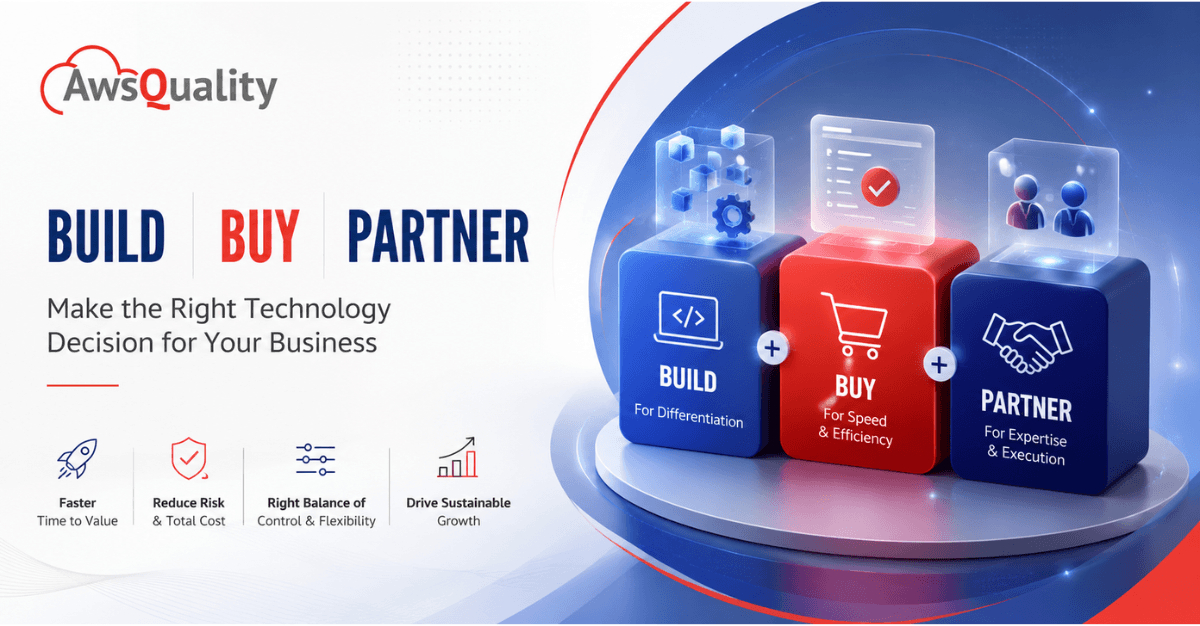
Every business eventually faces a technology decision that looks deceptively simple:
Should we build it ourselves, buy an existing solution, or partner with an external technology provider?
The answer is rarely as straightforward as choosing the cheapest option.
A solution that is inexpensive to buy may require extensive customization. A system that seems strategically important to build may consume months of engineering capacity. And a capable technology partner may provide the right balance of expertise, speed, flexibility, and cost—but only if the engagement is structured correctly.
The better question isn’t:
“Should we build, buy, or partner?”
It’s:
“Which approach gives our business the best combination of business value, speed, control, scalability, risk, and total cost of ownership?”
Modern cloud platforms have also made the decision more nuanced. Organizations can combine commercial software, cloud services, custom development, APIs, open-source components, and external expertise rather than choosing one approach for everything. AWS, for example, describes this evolution as moving beyond a simple build-versus-buy decision toward more tailored approaches using existing technology building blocks.
The build vs buy vs partner decision is not about which option is best in the abstract. It is about which option is correct for this specific requirement, in this specific organization, at this specific moment — evaluated against the right criteria before the decision is made.
This guide explains how business and technology leaders can evaluate build vs. buy vs. partner and make a technology investment decision based on business priorities rather than technology hype.
Read: IT vendor consolidation – when fewer technology partners means better business outcomes
What Does Build vs. Buy vs. Partner Mean?
Before applying a decision framework, it is worth being specific about what each option actually means — because imprecise definitions produce imprecise decisions.
Build means developing a technology solution internally, using the organization’s own engineering team. The organization owns the code, controls the roadmap, bears the full cost of development and maintenance, and retains the results as proprietary intellectual property. Build is appropriate when the technology being created is itself a competitive differentiator — when the way the software works is something no competitor should be able to purchase access to.
Buy means purchasing or subscribing to an existing software solution from a vendor. The organization pays for access to a proven, maintained product rather than bearing the cost of creating and maintaining it. Buy is appropriate when the problem being solved is generic — when the requirement looks essentially the same across the industry and no competitive advantage comes from solving it uniquely.
Partner means engaging an external technology partner — a consulting firm, a system integrator, a specialized development provider — to build or implement a solution that the organization then owns or operates. This is not the same as buying a SaaS product. It means a contractual relationship with a specialist who brings engineering capacity, domain expertise, methodology, and platform knowledge that the organization does not maintain internally. Partner is appropriate when the solution needs to be proprietary or highly customized, but sustaining an internal engineering team to build and maintain it is not realistic or economically justified.
A fourth model — the hybrid — combines elements of all three and is increasingly the most appropriate answer for complex enterprise technology decisions. A business might buy a CRM platform, partner with a specialist to customize and integrate it, and build proprietary analytics on top of it. Understanding which components deserve which treatment is the discipline the framework develops.
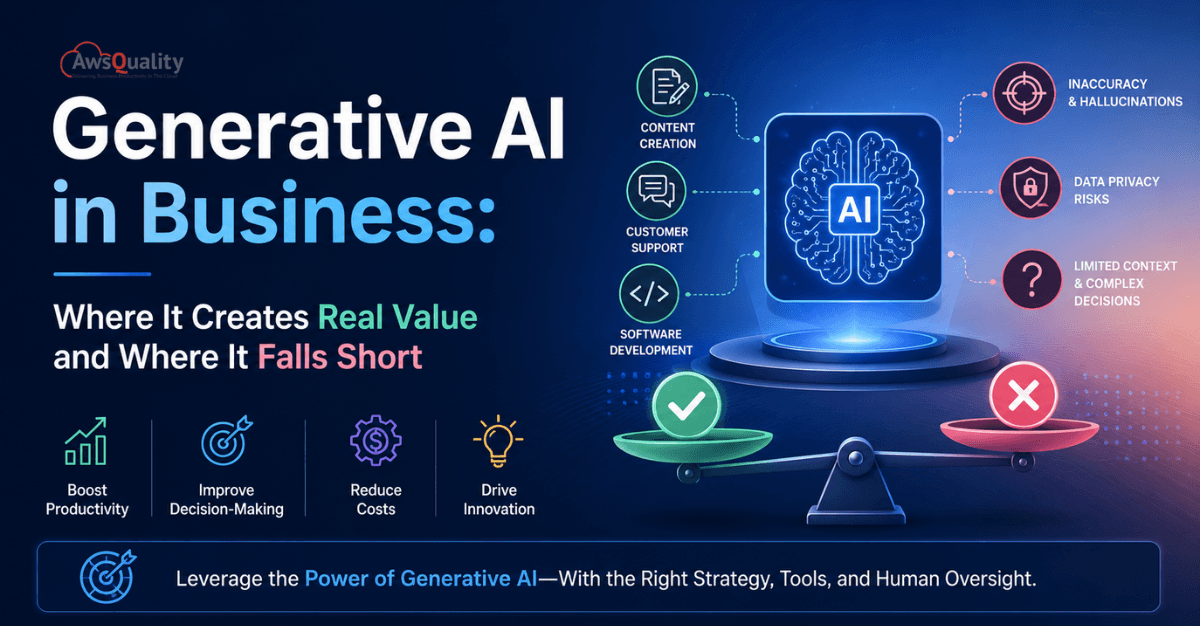
Also read: Generative AI in business: where it creates real value and where it falls short
When to Build: The Case for Internal Development
Building technology in-house is the right decision in a narrow but important set of circumstances. The temptation to overbroad this category — to treat “we want control” or “we have some developers” as sufficient justification — is where the 33% success rate of internal builds originates.
Build when technology is your core competitive differentiator.
The McKinsey build vs buy framework makes this the primary diagnostic: if the technology being created forms the core intellectual property of the business, or provides a competitive advantage that would be diluted or lost if a competitor could purchase the same tool, then building is the correct approach. A fintech company whose underwriting algorithm is its primary competitive advantage builds that algorithm. A logistics company whose route optimization is its differentiation builds that capability. Buying an off-the-shelf solution that a competitor can license for the same price eliminates the advantage the technology was supposed to create.
Build when no adequate off-the-shelf solution exists.
For highly specialized requirements — workflows that are genuinely unique to the organization’s industry, scale, or operating model — the market may simply not offer a viable alternative. If the closest available product would require such extensive modification that the vendor’s support becomes meaningless, building is more practical than trying to make a bought solution fit.
Build when integration requirements make off-the-shelf solutions impractical.
Some organizations operate on legacy systems or proprietary data models that make vendor solutions difficult to integrate effectively. When the integration cost of a bought solution approaches or exceeds the cost of building, the analysis shifts.
The honest build checklist.
Before committing to a build decision, the organization should be able to confirm: it has or can sustainably hire the engineering team required; it has a realistic timeline that accounts for the full development lifecycle, not the initial build; it has a maintenance and support plan for the system after launch; it has considered the ongoing cost of keeping the system current as requirements evolve; and it is confident the technology being built is genuinely differentiated rather than generic infrastructure dressed up as strategy.
When to Buy: The Case for Off-the-Shelf Solutions
Buying established software is the right decision in the majority of business technology requirements — specifically in every domain where the requirement is generic, the market solution is mature, and no competitive advantage comes from solving the problem uniquely.
Buy when the problem looks like everyone else’s.
CRM, ERP, HR management, accounting, email marketing, project management, customer support ticketing — these are capabilities that every organization of a given type and size needs, in essentially the same form. The market has already invested billions in solving these problems well. Rebuilding a general-purpose CRM from scratch to avoid a Salesforce license cost is almost never the right economic decision, and almost never produces a better result.
Buy when speed to market is the primary constraint.
Deploying an existing, proven solution in weeks rather than building a custom solution over months or years is often the decisive factor for organizations in competitive, fast-moving markets. The business value of having a working solution in two months rather than twelve frequently outweighs the customization advantages of a build.
Buy when the vendor’s ongoing investment in the product provides durable value.
Major enterprise software vendors invest hundreds of millions of dollars annually in product development, security, compliance, and capability expansion. A Salesforce customer gets the benefit of that investment automatically. An organization that builds a custom CRM is responsible for providing its own equivalent investment indefinitely.
The total cost of ownership calculation.
The most common mistake in a buy decision is comparing the vendor’s license cost to the perceived cost of building, without accounting for the full TCO of either option. The true cost of buying includes: license or subscription fees, implementation and configuration costs, integration development, user training, customization work, and ongoing support. The true cost of building includes: development costs (which almost always exceed initial estimates), infrastructure, security, ongoing maintenance, feature development, and the organizational cost of talent retention for the team that builds it. Evaluated on full TCO over a three-to-five year horizon, buying is almost always cheaper for non-differentiating capabilities — which is why the SaaS market has grown to its current scale.
The vendor lock-in question.
The legitimate concern about buying is dependency on a vendor whose pricing, strategy, or viability may change. This concern is valid but frequently overstated. The relevant question is not whether vendor lock-in exists — it always does to some degree — but whether the switching cost is acceptable relative to the value the solution provides and the alternatives available. For mature, widely adopted platforms with large partner ecosystems and robust data export capabilities, vendor lock-in risk is manageable. For niche vendors with limited market presence, it requires careful evaluation.
When to Partner: The Case for External Build Partnerships
Partnering is the correct decision when the requirement sits between building and buying: the solution needs to be proprietary or highly customized, but sustaining an internal engineering team to deliver it is not economically viable or organizationally practical.
Feature23’s 2026 analysis identifies the partner model’s core value precisely: the partner takes on the talent problem, the methodology, and the senior engineering bench, while the organization still owns the result. The tradeoff is cost — US technology partner firms charge $100 to $300 per hour according to Clutch’s 2026 data, and meaningful custom builds typically run six to seven figures. That cost changes character when compared to the full cost of running an internal team for the same period, or to the real cost of buying the wrong platform and replacing it within eighteen months.
Partner when the software must be proprietary but an internal team is not realistic.
Mid-market organizations that need custom software but cannot sustain the senior engineering team required to build it well are the ideal partner model customers. The partner provides the engineering capacity for the project and beyond; the organization provides the domain knowledge, the requirements, and retains ownership of the result.
Partner when specialized expertise is the key variable.
Salesforce implementation and customization, cloud migration architecture, data engineering platform builds, AI model deployment, and complex enterprise integrations all require expertise that most organizations do not maintain internally at the required depth. A partner who has executed the same class of project dozens of times brings accumulated pattern recognition that reduces risk and timeline, and produces better outcomes than an internal team approaching the same problem for the first time.
Partner when implementation risk needs to be shared.
A technology partner with relevant experience has seen the failure modes before and has developed the methodologies to prevent them. They bring structured project governance, quality assurance processes, and the accumulated lessons from previous engagements that reduce the probability of expensive mistakes.
Partner when you need speed and customization simultaneously.
Building in-house provides customization but not speed. Buying provides speed but not customization. Partnering with a specialist who has platform expertise and pre-built frameworks can provide both — faster deployment than a full internal build, deeper customization than an out-of-the-box product.
Evaluating a technology partner.
The partner’s decision carries its own risk. The selection criteria that differentiate high-performing partnerships from expensive disappointments: demonstrated experience in the specific technology domain and industry; client references from engagements of comparable scope and complexity; a defined methodology and project governance model; clarity on what the organization will own at completion; and a post-project support model that addresses the maintenance and evolution question.
The Hybrid Approach: Combining All Three
In practice, most mature enterprise technology decisions are not cleanly one option or another. The most strategically sophisticated approach is the hybrid model — buying the platform, partnering for implementation and customization, and potentially building proprietary extensions that represent genuine competitive differentiation.
Consider a business implementing a CRM and customer service platform. The core CRM platform (Salesforce, HubSpot, Dynamics 365) is bought — it is generic infrastructure that no competitive advantage comes from rebuilding. Implementation, configuration, custom workflow development, and integration with proprietary back-end systems is partnered — because the expertise required for production-quality Salesforce development is specialized, and maintaining a full-time internal Salesforce development team may not be justified by ongoing workload. Proprietary analytics built on top of the CRM data — if the analysis methodology is genuinely differentiating — might be built, by the internal team or the partner, to ensure it remains proprietary.
This hybrid model is the most common pattern in successful enterprise technology deployments. The skill is in correctly categorizing each component: what is generic infrastructure (buy), what is specialized implementation (partner), and what is genuine competitive intellectual property (build). Organizations that misclassify components — trying to build what should be bought, or buying what needs to be customized — generate the regret statistics that Gartner and Zylo document.
The Decision Framework: Seven Questions That Lead to the Right Answer
Applied sequentially, the following questions produce a reliable decision for most technology requirements.
Question 1: Is this technology a source of competitive differentiation?
If yes — if the way this technology works is something competitors should not be able to purchase access to — build or build with partner involvement. If no — if this is generic infrastructure that the entire industry needs in essentially the same form — buy.
Question 2: Does an adequate off-the-shelf solution exist?
If yes — evaluate it seriously against the buy criteria. If no — build or partner.
Question 3: Do we have (or can we sustainably hire) the internal engineering talent to build and maintain this?
If yes — build is viable. If no — buy or partner.Question 4: How quickly do we need this to be operational?
If immediately or within weeks — buy provides the fastest path. If months are acceptable and customization is critical — partner. If timeline is secondary to proprietary ownership — build.
Question 5: What is the true total cost of ownership over three to five years for each option?
Model all three: full build cost (development + maintenance + talent + infrastructure); full buy cost (license + implementation + integration + ongoing fees); full partner cost (engagement + ownership transfer + ongoing evolution). The comparison on full TCO over the relevant horizon often produces a different answer than comparing only initial costs.Question 6: What is the cost of the wrong decision?
Some technology decisions are easily reversible. A SaaS subscription can be cancelled. An integration can be rebuilt. Others are not. An ERP implementation that fails two years in is extremely expensive to reverse. The higher the cost of a wrong decision, the more rigorously the framework should be applied and the more strongly a partner with relevant experience should be considered.
Question 7: Who will own, maintain, and evolve this after it goes live?
The production support question kills more technology projects than any other single factor. A built system without a maintenance team degrades into a legacy liability. A bought system without internal ownership of configuration and administration becomes a vendor dependency. A partnered implementation without a defined post-project support model leaves the organization dependent on the partner indefinitely. The answer to this question must be determined before the primary decision is made, not after.
Check out: The Businesses That Will Thrive in the Next Decade Will Think Differently About Technology
Build vs. Buy vs. Partner: A Practical Comparison
| Factor | Build | Buy | Partner |
|---|---|---|---|
| Initial development effort | High | Low–Medium | Medium |
| Time to value | Usually longer | Usually faster | Often faster than building internally |
| Customization | Very high | Limited–Medium | High |
| Internal expertise required | High | Medium | Lower |
| Control | High | Lower | Medium–High |
| Ongoing responsibility | High | Lower | Shared |
| Vendor dependency | Low | High | Medium |
| Scalability | Your responsibility | Vendor-dependent | Shared |
| Best for | Differentiation | Commodity capabilities | Expertise & execution |
| IP ownership | Usually high | Vendor-owned | Depends on agreement |
| Maintenance burden | High | Lower | Shared/contractual |
Common Mistakes That Make the Wrong Decision Expensive
Treating build as the default for anything strategic.
The association between building technology and owning strategy is intuitively appealing and frequently wrong. Strategy requires competitive differentiation. Most business technology — even for technology companies — is infrastructure, not differentiation. Building infrastructure that could be bought is expensive and distracting.
Comparing vendor license cost to zero rather than to full build cost.
A $50,000 annual SaaS license looks expensive compared to “we’ll build it ourselves” — until the full cost of building includes development, infrastructure, security, maintenance, and the engineering team required to keep it current. The comparison must be on equivalent scope over equivalent timeframes.
Ignoring the talent problem.
Building requires hiring and retaining the engineering talent to build it well and maintain it afterward. In 2026, senior engineering talent is expensive and competitive. Organizations that underestimate the talent cost — or overestimate their ability to hire and retain it — consistently overspend and underdeliver on build decisions.
Choosing a technology partner based on price rather than expertise.
The lowest-cost partner is rarely the highest-value partner. The relevant measure is the cost of a successful outcome, not the hourly rate. A partner who has executed the same class of project ten times and charges $200 per hour produces better outcomes faster than a partner charging $80 per hour who is learning the methodology on the organization’s project.
Failing to plan the post-launch state.
The launch of a technology solution is not the end of the investment — it is the beginning of the maintenance and evolution phase that will consume resources indefinitely. Every technology decision should include an explicit plan for who owns the system after launch, what the ongoing investment looks like, and when the first major revision will be required.
Making the decision once rather than revisiting it.
The correct build vs buy vs partner answer at the time of the initial decision may become incorrect as the organization grows, as the market matures, or as requirements evolve. A custom-built system that was the right answer for a 50-person organization may need to be replaced with a mature enterprise platform when the organization reaches 500 people. Building a replacement for a bought system that has grown into a competitive differentiator may become justified at scale. Revisiting the decision periodically is as important as making it correctly the first time.
Also check: Disaster Recovery and Business Continuity Planning Explained
How the Decision Applies to Salesforce and Cloud Technology
For organizations evaluating technology decisions in the Salesforce and cloud ecosystem — the context in which AwsQuality’s clients most frequently face this decision — the framework maps directly to three common patterns.
CRM and Salesforce implementations: Buy the platform, partner for implementation.
Salesforce is a mature, best-in-class CRM platform that no competitive advantage comes from rebuilding. The buy decision is typically correct. Implementation, customization, workflow development, and integration — the work that makes the platform reflect the organization’s specific processes — is consistently best delivered by a certified implementation partner with deep Salesforce expertise. The combination produces faster deployment, lower implementation risk, and better adoption than either an internal build or an attempt to implement without specialist guidance.
Cloud infrastructure: Buy with architectural guidance.
AWS, Azure, and Google Cloud provide infrastructure capability that no organization should attempt to replicate internally. The buy decision is straightforward. The complexity is in how the infrastructure is architected, governed, and optimized — which is where partner involvement provides disproportionate value. The cost of poorly architected cloud infrastructure accumulates quickly; the cost of a well-architected engagement that prevents it is almost always recovered within the first year of operation.
Custom development on platform: Partner.
When the requirement is proprietary capability built on top of Salesforce or cloud infrastructure — custom objects, specialized automation, AI-powered features, complex integrations — the partner model combines the stability of the bought platform with the customization of a build. The organization gets proprietary functionality without the talent problem of maintaining an internal development team for what may be intermittent custom development needs.
A Better Way to Think About Technology Investment
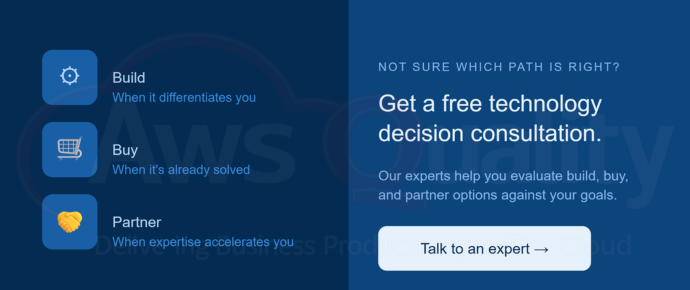
Instead of categorizing every technology decision as build or buy, think about your business capabilities.
Divide them into three categories:
Core Differentiators
Capabilities that make your company unique.
Build or heavily customize.
Essential but Non-Differentiating Capabilities
Capabilities every business needs.
Buy or consume as a service.
Specialized or Temporary Capabilities
Capabilities requiring expertise or capacity you don’t want to maintain permanently.
Partner.
This simple framework can make technology decisions much clearer.
Questions to Ask Before Making the Decision
Before approving a major technology initiative, leadership should ask:
- What business problem are we solving?
- Is this capability strategically differentiating?
- Does a mature solution already exist?
- How much customization do we actually need?
- What is the five-year total cost of ownership?
- How quickly do we need the solution?
- Do we have the internal expertise?
- Do we have enough engineering capacity?
- What are the security and compliance requirements?
- How difficult would it be to change vendors later?
- What happens if our requirements change?
- Could a partner accelerate implementation?
- Which parts should we build, buy, and outsource?
- How will we measure whether the investment succeeded?
These questions move the conversation away from technology preference and toward business value.
How AI Is Changing Build vs. Buy Decisions
Artificial intelligence is making the decision even more interesting.
AI coding assistants, cloud AI services, APIs, open-source models, managed platforms, and agent frameworks have lowered some barriers to building sophisticated capabilities.
At the same time, enterprise software vendors are embedding AI into their products.
This creates a new spectrum:
Buy AI capability → Configure AI → Partner to customize AI → Build proprietary AI capability
The right choice depends on whether AI is a differentiator for your business.
For example, a company may not need to build its own generic productivity assistant.
But it may benefit from building proprietary AI capabilities around its unique customer data, workflows, intellectual property, or domain expertise.
The principle remains the same:
Build where differentiation matters. Buy where it doesn’t. Partner where expertise or execution is the constraint.
Final Thoughts
There is no universal answer to build vs. buy vs. partner.
The right decision depends on what your business is trying to accomplish.
Build when you need differentiation and control.
Buy when a mature solution already solves the problem.
Partner when specialized expertise, implementation capacity, or speed is the biggest constraint.
And don’t be afraid to combine all three.
The strongest technology strategies don’t try to build everything.
They don’t blindly buy everything either.
They deliberately decide where the business should own capability, where it should leverage existing technology, and where external expertise can create faster or better outcomes.
Ultimately, technology isn’t the objective.
Business value is.
The right question isn’t:
“What technology should we choose?”
It’s:
“What approach gives us the best path to solving this problem, creating value, and remaining competitive over the long term?”
That is the decision that matters.
A practical rule to remember:
Build what differentiates you. Buy what is already solved. Partner where expertise and execution can accelerate you.
And when the answer isn’t obvious, don’t force a binary decision.
Build what matters. Buy what doesn’t. Partner for the gaps.
Frequently Asked Questions
What is the build vs buy vs partner decision?
It determines whether a business should build technology internally, buy an existing solution, or work with an external technology partner.
When should a business build its own software?
Build when the technology is a key competitive differentiator, existing solutions don’t meet your needs, and you have the expertise to maintain it.
What are the risks of building software in-house?
Key risks include talent dependency, cost and timeline overruns, ongoing maintenance, and the opportunity cost of using internal engineering resources.
Why do so many software purchases fail to deliver ROI?
Common reasons include poor requirements, inadequate implementation, low adoption, unclear ownership, and underestimating the total cost of ownership.
What should you look for in a technology partner?
Look for relevant expertise, industry experience, a clear delivery methodology, strong references, transparent IP ownership, and reliable post-project support.
How does total cost of ownership factor into the build vs buy decision?
TCO should include development or licensing, implementation, integration, maintenance, support, training, and ongoing administration over three to five years.
 Bio
Bio