Introduction: Why Cloud Data Engineering Is the Enterprise Capability That Cannot Be Improvised
The global data engineering market is projected to reach $105.40 billion in 2026. 94% of enterprises now use cloud services, according to a 2026 cloud engineering trends analysis. 78% of organizations have unified their data platforms under centralized teams, treating data infrastructure as a product as critical as the business systems it supports. And 90% of AI and machine learning projects depend directly on data engineering pipelines.
The opportunity is clear. The challenge is equally clear: 30 to 40% of data pipelines experience failures every week. Data quality issues affect nearly 30% of organizational revenue. Organizations experience an average of 67 monthly data incidents, each requiring approximately 15 hours to resolve. And the enterprises investing most heavily in cloud data engineering are not automatically the ones generating the highest return on that investment — because the quality of the engineering practices applied to cloud platforms determines outcomes far more than the platform itself.
Cloud data engineering is not a technology decision. It is a discipline — a set of practices applied consistently to the architecture, pipelines, data quality, governance, security, cost management, and operational processes that together constitute a functioning enterprise data platform. The difference between a cloud data platform that accelerates AI and analytics and one that accumulates technical debt is almost never the cloud provider. It is the engineering practices applied to the cloud infrastructure.
This guide covers the 20 best practices that define enterprise cloud data engineering success in 2026 — organized across six capability pillars — with the practical rationale for each, and the implementation approach that translates each practice from principle to production.
Read: The Complete Guide to Data Engineering Services for Modern Enterprises
What is Cloud Data Engineering?
Cloud data engineering is the process of designing, building, managing, and optimizing data pipelines and architectures using cloud platforms such as AWS, Microsoft Azure, and Google Cloud Platform (GCP).
It involves collecting data from multiple sources, transforming it into usable formats, and delivering it to data warehouses, data lakes, or lakehouse architectures for analytics and AI workloads.
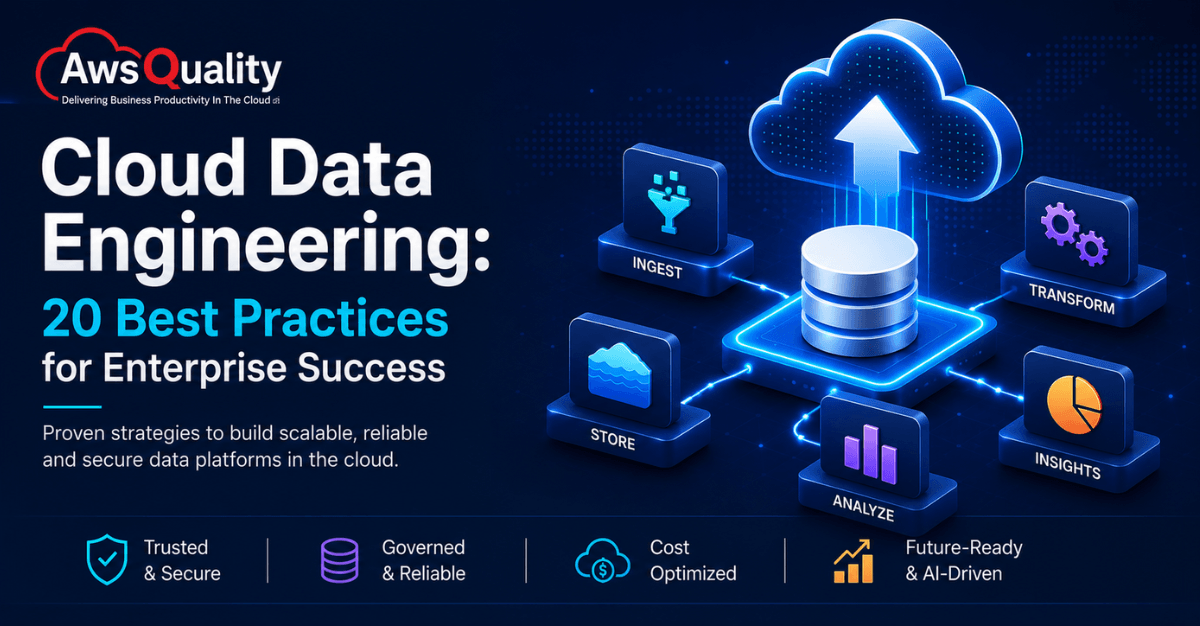
A modern cloud data engineering ecosystem typically includes:
- Data ingestion
- ETL/ELT pipelines
- Data lakes
- Data warehouses
- Real-time data streaming
- Data orchestration
- Data quality monitoring
- Metadata management
- Data governance
- Security and compliance
Also read: How Data Engineering Services Help Enterprises Build AI-Ready Data Platforms
Core Components of a Modern Cloud Data Platform
A successful cloud data engineering architecture includes several interconnected components.
Data Sources
Organizations collect data from:
- CRM systems
- ERP platforms
- SaaS applications
- Mobile apps
- IoT devices
- APIs
- Databases
- Web applications
Data Ingestion
Modern ingestion tools collect both batch and streaming data while ensuring reliability and scalability.
Examples include:
- Apache Kafka
- AWS Kinesis
- Azure Event Hubs
- Google Pub/Sub
Data Storage
Depending on business requirements, organizations may use:
- Cloud Data Lakes
- Data Warehouses
- Lakehouse Architecture
- Object Storage
Data Transformation
ETL and ELT pipelines clean, enrich, and standardize raw data before analysis.
Common tools include:
- Apache Spark
- dbt
- AWS Glue
- Azure Data Factory
- Google Dataflow
Analytics Layer
Business users access trusted data through:
- Power BI
- Tableau
- Looker
- Amazon QuickSight
AI & Machine Learning
Modern cloud platforms provide seamless integration with machine learning services for generative AI applications and predictive analytics.
The Cloud Data Engineering Landscape in 2026
Before examining specific practices, understanding the platform landscape that enterprise data engineering operates on in 2026 provides essential context for the architectural decisions that the best practices below address.
Amazon Web Services (AWS) maintains the largest cloud market share globally at approximately 30%, with the deepest catalog of managed data services: AWS Glue for serverless ETL, Amazon Redshift for cloud-native data warehousing, Amazon S3 for data lake object storage, Amazon Kinesis for real-time streaming, and Amazon MWAA for managed Apache Airflow orchestration. AWS is the natural choice for enterprises already invested in the AWS ecosystem and for those prioritizing the broadest service breadth.
Microsoft Azure holds approximately 20% of global cloud market share and provides the strongest integration with enterprise Microsoft infrastructure: Azure Data Factory for cloud ETL and orchestration, Azure Synapse Analytics for unified analytics across data warehouse and data lake, Azure Data Lake Storage Gen2 for hierarchical object storage, Azure Databricks for Apache Spark-based data engineering and ML, and Microsoft Fabric as the newest unified data and AI platform integrating all Azure data services under a single governance model.
Google Cloud Platform (GCP) holds approximately 13% of market share with distinctive strengths in serverless analytics and ML integration: BigQuery as a fully serverless data warehouse with built-in ML capabilities via BigQuery ML, Dataflow for fully managed Apache Beam-based batch and streaming processing, Dataproc for managed Spark and Hadoop clusters, and Vertex AI for integrated MLOps and generative AI workflows.
Snowflake has become the dominant cloud-agnostic data warehouse, operating across all three major cloud providers and offering compute-storage separation that enables independent scaling, native Apache Iceberg support for open-format data lake integration, Snowpark for Python-based data engineering within the warehouse, and Snowflake’s Data Clean Room capabilities for privacy-preserving data collaboration.
Databricks provides the reference implementation of the data lakehouse architecture — unifying data engineering, analytics, and machine learning on Delta Lake with Unity Catalog for enterprise governance, MLflow for model tracking, and the Intelligence Platform capabilities announced at DAIS 2025 that position Databricks as an end-to-end AI and data platform.
The most important architectural insight about this landscape: 92% of enterprises have adopted multi-cloud strategies. The cloud data engineering best practices that follow apply across all platforms — they are engineering principles, not platform-specific configurations.
Cloud Data Engineering Best Practices
1. Adopt Lakehouse Architecture as the Default Enterprise Pattern
The separate data lake (raw storage, flexible schema) and data warehouse (structured, governed analytics) model that dominated enterprise data architecture for the previous decade creates compounding problems at scale: duplicate data copies with independent update cycles that drift from each other; separate governance frameworks that enforce inconsistent standards; and separate compute environments that require engineers to manage data movement between them.
The data lakehouse architecture resolves this by combining open-format object storage (S3, ADLS Gen2, Google Cloud Storage) as the foundation with the performance, ACID transactions, and governance of a data warehouse applied at the storage layer through open table formats (Delta Lake, Apache Iceberg, Apache Hudi). A single copy of data serves both the analytics workloads that warehouses were designed for and the ML training and AI inference workloads that data lakes made possible.
For enterprise cloud data engineering in 2026, the lakehouse should be the default starting point for any new data platform design. The incremental complexity of maintaining the lakehouse architecture is significantly lower than the ongoing cost of maintaining separate lake and warehouse environments, and the unified governance model that the lakehouse enables is increasingly required by the regulatory environment.
Implementation: Select an open table format (Delta Lake for Databricks-centric environments, Apache Iceberg for cloud-agnostic environments, Hudi for streaming-heavy architectures) and implement it from the first data pipeline rather than retrofitting it after the platform is in production. The migration cost from a traditional lake-warehouse split to a lakehouse architecture after the platform is already at scale is substantially higher than building on the lakehouse model from the start.
2. Design for Multi-Cloud Portability from Day One
Cloud data engineering decisions made in year one become increasingly expensive to reverse in years two and three. Proprietary format dependencies, vendor-specific service integrations, and cloud-specific tooling choices that accumulate during initial platform build create lock-in that limits future flexibility.
92% of enterprises currently operate across multiple cloud environments. Designing for portability does not mean avoiding proprietary cloud services — it means making deliberate decisions about which proprietary services provide sufficient value to justify the lock-in they create, and using open-format or cloud-agnostic components where portability provides more value than native cloud integration would.
Implementation: Build on open table formats (Apache Iceberg in particular has gained the strongest multi-cloud adoption in 2026). Use Apache Airflow for orchestration rather than cloud-proprietary workflow tools where cross-cloud workflow management is required. Adopt dbt for transformation logic that runs identically across Snowflake, BigQuery, Redshift, and Databricks. For storage, use the leading cloud object storage platform (S3, ADLS Gen2, or GCS) with the understanding that object storage migration, while possible, is costly at scale.
3. Implement Zone-Based Data Architecture
A zone-based storage architecture — where data is organized into explicitly defined zones with clear data quality standards, access patterns, and processing states for each zone — is the structural foundation of a maintainable enterprise data platform.
The standard three-zone model distinguishes: the Raw Zone (data landed exactly as received from source systems, with no transformation, serving as the immutable source of record for all data received); the Curated or Conformed Zone (data validated, standardized, and enriched, serving as the governed single source of truth for enterprise analytics); and the Serving or Consumption Zone (data modeled specifically for consumption by analytics tools, ML systems, or business applications, optimized for the access patterns of each consumer).
Implementation: Enforce zone boundaries through naming conventions, storage account or bucket separation, access controls that restrict who can write to each zone, and data quality standards that gate promotion from raw to curated. The zone architecture provides clarity about what any given dataset represents, simplifies data lineage tracking across the platform, and enables cost optimization through lifecycle policies applied at the zone level.
4. Modular Pipeline Architecture for Reusability and Maintainability
Monolithic data pipelines — single jobs that extract from source, transform through multiple steps, and load to the destination — are the architecture that makes data platforms brittle. When a monolithic pipeline fails, diagnosing the failure requires understanding the entire pipeline. When requirements change, modifying the pipeline risks breaking unrelated functionality. And when similar logic is needed for a different source or destination, the entire pipeline is reimplemented rather than components being reused.
Modular pipeline architecture decomposes data pipelines into small, single-responsibility components — extraction jobs, individual transformation steps, quality validation rules, loading functions — that can be combined, reused, tested independently, and replaced without affecting the components they connect to. 78% of organizations have unified their data platforms under centralized teams specifically to enable this kind of systematic reusability.
Implementation: Design each pipeline component to have a single, well-defined responsibility. Use Apache Airflow or Prefect DAGs to compose pipeline components through dependency declarations rather than embedding orchestration within the pipeline code. Version controls all pipeline components individually. Implement integration tests that validate component contracts at pipeline boundaries.
5. Choose the Right Processing Pattern for Each Use Case
The processing pattern selection — batch, micro-batch, near-real-time, or streaming — should be driven by the latency requirement of the downstream use case, not by a default preference for any particular pattern.
82% of organizations now use real-time streaming in their pipeline architectures. But streaming architectures are significantly more complex to build, operate, and debug than batch architectures. Adopting streaming universally — for use cases where daily batch processing would meet all requirements — creates operational overhead without analytical benefit.
The decision framework: if the downstream use case genuinely requires data within seconds (real-time fraud detection, live inventory management, AI agents that need current operational data), streaming is required. If the downstream use case requires data within minutes (operational dashboards, near-real-time marketing segmentation), micro-batch with short intervals is appropriate and significantly simpler than true streaming. If the downstream use case requires data within hours (daily reporting, model training, operational reconciliation), batch processing is correct and should not be replaced with streaming for its own sake.
Implementation: Document the latency requirement for each downstream use case before selecting a processing pattern. Build streaming infrastructure where the use case requires it: Apache Kafka or cloud-native event streaming (Amazon Kinesis, Azure Event Hubs) for event ingestion, Apache Flink for stateful stream processing, Delta Lake or Apache Iceberg for streaming writes to the lakehouse. Default to batch for use cases that do not require streaming — the operational simplicity difference is substantial.
6. Implement Change Data Capture for Source System Integration
Change Data Capture (CDC) is the integration pattern that detects and propagates changes in source operational databases — inserts, updates, and deletes — to the data platform in near-real-time, without requiring full table extracts that place significant load on source systems.
For enterprises integrating data from high-volume transactional systems — CRM platforms, ERP systems, e-commerce databases, payment processing systems — CDC provides the freshness and efficiency that polling-based or full-extract-based integration cannot. CDC captures only changed records since the last extraction, reducing source system load; propagates changes with low latency; and maintains the full change history that is needed for time-series analysis and audit trail requirements.
Implementation: Debezium is the leading open-source CDC framework for relational databases, supporting MySQL, PostgreSQL, SQL Server, Oracle, and MongoDB. Cloud-managed CDC services include Amazon DMS for AWS-native environments and Azure Database Migration Service. For Salesforce integration specifically — a common enterprise CDC source — MuleSoft, the Salesforce native CDC API, and Fivetran’s Salesforce connector provide different latency and coverage tradeoffs depending on the CRM data synchronization requirement.
7. Enforce Infrastructure as Code for All Data Infrastructure
Data infrastructure managed through cloud provider consoles — point-and-click configuration of data warehouse clusters, storage buckets, orchestration environments, and access policies — cannot be reliably reproduced, version-controlled, audited, or replicated across environments. The result is environment drift: the production environment gradually diverges from staging because console changes are not tracked, and debugging production issues becomes archaeology through resource configurations that nobody documented.
Infrastructure as Code (IaC) applies the same engineering discipline to data infrastructure provisioning that version control applies to application code. Every data infrastructure component — storage, compute, networking, access policies, pipeline configurations — is defined in code that is version-controlled, reviewed, and deployed through automated processes.
Implementation: Terraform is the most widely adopted IaC tool for cloud data infrastructure, supporting AWS, Azure, GCP, Snowflake, and Databricks providers. For Azure-centric environments, Azure Bicep or Azure Resource Manager templates provide native integration with Azure DevOps. For Snowflake-specific infrastructure (warehouses, databases, schemas, roles, and network policies), the Snowflake Terraform provider covers the full provisioning lifecycle. Store all IaC in the same Git repository as the data pipeline code, and deploy through CI/CD pipelines that apply the same review and testing standards to infrastructure changes as to code changes.
8. Build Automated Orchestration with Dependency Management
Data pipelines have dependencies: a transformation job cannot run before the extraction job that provides its input completes. A dimension table load cannot run before the staging table it reads from is validated. A downstream analytics model cannot be refreshed before the upstream data mart that feeds it is current. Managing these dependencies manually — through cron schedules, manual triggering, or optimistic assumptions about job completion timing — is one of the most consistent sources of pipeline failures.
Workflow orchestration tools — Apache Airflow, Prefect, Dagster, and their cloud-managed equivalents — manage dependency resolution, execution ordering, failure handling, retry logic, and monitoring through declarative workflow definitions. When a pipeline step fails, the orchestrator knows which downstream steps to hold until the failure is resolved, and triggers alerts to the appropriate team.
Implementation: Apache Airflow, available as a managed service on all major cloud providers (Amazon MWAA, Google Cloud Composer, Astronomer), is the most widely adopted orchestration solution in enterprise cloud data engineering. Define pipeline dependencies as directed acyclic graphs (DAGs) in code. Implement standard operators for common pipeline patterns — extraction, quality validation, transformation, loading, notification — that can be reused across different pipeline implementations. Configure SLA monitoring that alerts when pipelines have not completed within their expected runtime, enabling proactive intervention before downstream consumers are affected.
9. Embed Data Quality Validation in the Pipeline — Not After It
The most expensive data quality problem is the one discovered by a business analyst in a dashboard three days after the underlying data error occurred. By that point, reports have been distributed, decisions have been made on incorrect data, and the remediation requires not only fixing the pipeline but also correcting the downstream impact of the data error.
Data quality validation embedded in the pipeline prevents this outcome by checking data quality as data flows through each pipeline stage and halting or routing to remediation when quality thresholds are not met. Data that fails validation is quarantined before it reaches the serving layer — not discovered after it has been used.
Implementation: dbt’s built-in testing framework provides SQL-based quality tests (not-null, unique, accepted values, relationship integrity) that execute as part of the dbt run, blocking downstream model refreshes when quality tests fail. Great Expectations provides a more comprehensive quality validation framework with statistical distribution tests, custom expectation definitions, and integration with Airflow for pipeline-embedded validation. Soda provides similar capability with a cloud-native, configuration-as-code quality rule management interface. Implement quality tests at the raw-to-curated promotion boundary at minimum — where data moves from the immutable raw zone to the governed curated zone — so that only validated data enters the analytical serving layer.
10. Implement Data Observability as a Production Standard
Data observability — the ability to understand the health, freshness, completeness, and accuracy of data flowing through the pipeline at any point in time — is the practice that reduces the 67 average monthly data incidents and the 15-hour average resolution time that organizations without observability consistently experience.
50% of organizations with distributed data architectures are expected to adopt sophisticated observability platforms in 2026, up from under 20% in 2024. The organizations that have adopted observability report dramatically faster incident detection — catching anomalies in minutes rather than discovering them from downstream consumer complaints — and significantly lower mean time to resolution when incidents do occur.
Implementation: Monte Carlo is the leading third-party data observability platform, monitoring data freshness, volume, schema, distribution, and lineage across cloud data platforms including Snowflake, BigQuery, Databricks, and Redshift. Platform-native observability is available through Databricks’s data quality monitoring and Snowflake’s data quality metrics features introduced in 2025. For teams using dbt, Elementary provides observability on top of dbt test results. Implement observability at the serving layer first — the datasets that business users and AI systems consume directly — then expand coverage to upstream pipeline stages. Configure alerting that notifies the data engineering team of anomalies within minutes, not hours.
11. Implement Column-Level Data Lineage
Data lineage — the ability to trace any field in any report, dashboard, or AI output back to its original source, through every transformation step, with full version history — is the governance capability that enables root cause analysis, regulatory compliance, and trusted data culture.
Without lineage, diagnosing why a revenue figure in a board report differs from the equivalent figure in an operational dashboard requires manual investigation through pipeline code, transformation logic, and source system schemas. With lineage, the same investigation takes minutes: trace the field from the dashboard to the dbt model that produces it, through the intermediate transformation layers, to the source system field that originated it.
Implementation: dbt generates lineage automatically for all models within its transformation graph, making inter-model dependencies visible and navigable through the dbt docs site. For end-to-end lineage that spans from source systems through ingestion pipelines, dbt transformation, and BI layer consumption, OpenLineage (the open standard for lineage metadata) integrates with Airflow, Spark, dbt, and visualization tools to produce a unified lineage graph across the full pipeline. Atlan and DataHub provide enterprise data catalog interfaces that expose OpenLineage data alongside other metadata for integrated governance management.
Check: Why Platform Engineering Outperforms Traditional Cloud Delivery
12. Implement Cloud FinOps from the First Pipeline
Cloud data platform costs are variable by nature — usage-based pricing means that growing data volumes, additional queries, and new pipelines translate directly into growing bills. Without cost governance embedded from the start, cloud data platform costs consistently escalate faster than the business value they deliver, and the first time leadership scrutinizes the data platform budget, the engineering team cannot explain where the money went.
Finance teams are increasingly collaborating with data teams to ensure that data engineering initiatives yield adequate returns, according to Versich’s 2026 CTO data engineering analysis. The FinOps discipline — applying financial accountability to cloud resource consumption — is becoming as standard a practice in data engineering as version control or automated testing.
Implementation: Implement resource tagging from the first deployment: every compute resource, pipeline, database, and storage bucket should be tagged to a business unit, a project, and a cost center. Configure cloud cost dashboards that make consumption visible to the data engineering team in real time, not at month-end. Set up cost anomaly alerts that notify the team when daily or weekly spend deviates significantly from baseline, before the end-of-month billing cycle surfaces the problem.
13. Configure Auto-Scaling and Auto-Suspend Policies
Static compute allocation — warehouses that run continuously at a fixed size regardless of workload — is the most consistent source of unnecessary data platform cost in Snowflake, Databricks, and cloud-native warehouse environments. An eight-node Snowflake warehouse running 24 hours a day while the workload it supports runs only during business hours is generating approximately 16 hours of daily waste.
Auto-scaling and auto-suspend policies eliminate this waste by adjusting compute allocation to match actual workload demand: suspending warehouses during idle periods, resuming them automatically when queries arrive, and scaling cluster size up or down based on concurrent workload requirements.
Implementation: In Snowflake, configure auto-suspend (60 seconds for development warehouses, 120 to 300 seconds for production warehouses that need faster resume after brief idle periods) and auto-scale (multi-cluster warehouse configuration that adds compute nodes during high concurrency and removes them during low concurrency). In Databricks, configure cluster autoscaling with appropriate minimum and maximum worker node counts, and enable cluster auto-termination for interactive clusters used by data analysts. In Amazon Redshift, use Redshift Serverless or configure concurrency scaling to handle variable query loads without maintaining a fixed cluster size.
14. Implement Storage Lifecycle Management
Object storage — S3, ADLS Gen2, GCS — is cheap but not free, and enterprise data platforms that retain all data at all times in the highest-performance storage tier generate significant and growing storage costs as data volumes accumulate.
Storage lifecycle policies automatically transition data between storage tiers — hot (highest-performance, highest-cost), warm (moderate performance, lower cost), and cold or archive (minimal access, lowest cost) — based on the age and access frequency of the data. Data that was created six months ago and has not been accessed since does not need to reside in the same storage tier as data created yesterday.
Implementation: AWS S3 Intelligent-Tiering automatically moves data between hot and cold tiers based on access patterns without requiring manual lifecycle rule configuration. Azure Data Lake Storage lifecycle management policies define rules that transition blobs to Cool or Archive tiers based on age and last-modified date. For both platforms, implement lifecycle rules that align with the data retention requirements of each data zone: raw zone data may need to be retained for seven to ten years for compliance but accessed only during investigations; serving zone data is accessed frequently but may have shorter retention requirements.
15. Optimize Query Performance to Reduce Compute Cost
In usage-based cloud data warehouse environments, query optimization has a direct financial consequence that it does not have in on-premises environments with fixed compute. An inefficient query that scans ten times more data than necessary consumes ten times the compute — and generates ten times the cost. At the query volumes of enterprise analytical workloads, the cumulative cost difference between well-optimized and poorly-optimized query patterns is material.
Implementation: In Snowflake, configure clustering keys on frequently filtered large tables to enable micro-partition pruning that reduces the data scanned per query. Enable result caching for repeated identical queries on slowly-changing datasets. In BigQuery, use partitioned and clustered tables to eliminate full table scans; query partitioned columns in WHERE clauses to ensure partition pruning engages. In Databricks, maintain Delta Lake table statistics through regular ANALYZE operations that enable the query optimizer to skip irrelevant files. Across all platforms, implement a query monitoring process that regularly identifies the highest-cost queries in the environment and evaluates whether query structure, table design, or materialization strategy changes would reduce their cost.
16. Implement Role-Based Access Control at the Data Platform Layer
Access control for enterprise data should be enforced at the data platform layer — within the cloud data warehouse or data lake — not only at the application layer above it. Application-layer access control protects data from unauthorized access through the application; it does not protect data from unauthorized access by someone with direct database or storage access.
Platform-layer role-based access control (RBAC) ensures that every data consumer — human analysts, BI tools, ML systems, AI agents, operational applications — can access only the data they are authorized to access, regardless of how they access it. A user who has been granted access to Customer summary data but not to Customer personally identifiable information cannot access PII through any path in the platform.
Implementation: Databricks Unity Catalog provides the most comprehensive unified governance layer in the current market — applying row-level and column-level access control across all data in a Databricks environment through a single governance model. Snowflake’s native RBAC system with row access policies and column masking policies provides similar capability within the Snowflake environment. In AWS Lake Formation, data permissions are applied at the column, row, and cell level for data stored in S3 and accessed through AWS Glue and Amazon Athena. Implement governance from the first dataset in the platform rather than adding it after the data is already in production.
17. Encrypt All Data in Transit and At Rest
Encryption is the foundational security control for cloud data platforms — protecting against data exposure from unauthorized access to cloud storage, network interception, and platform breaches. All major cloud providers provide encryption at rest and in transit as default capabilities, but enterprise environments require explicit verification and configuration that encryption standards meet regulatory requirements.
Implementation: For data at rest, verify that the encryption key management model matches organizational requirements: cloud-managed keys (the default on all major platforms) provide encryption with operational simplicity; customer-managed keys (AWS KMS, Azure Key Vault, GCP Cloud KMS) provide encryption with customer control over key lifecycle and the ability to revoke access by destroying the key. For data in transit, enforce TLS 1.2 or higher for all connections between data platform components, and disable older protocol versions that may be supported but should not be active in production environments. For environments with the highest sensitivity requirements, evaluate platform-native confidential computing options that encrypt data in use.
18. Enforce Data Governance Policies in Code, Not Documents
Data governance policies that exist only as documentation — “our governance policy requires that PII fields are masked before exposure to analysts” — are not enforced. They are aspirational. The only governance that is reliably applied in a production data environment is governance enforced by the platform itself.
Code-enforced governance translates policy into platform controls: data masking rules that automatically mask sensitive fields for users without the appropriate role; retention policies that automatically delete or archive data at the end of its retention period; data classification tags that automatically apply access restrictions to fields classified as sensitive; and quality rules that automatically quarantine data that does not meet defined standards.
Implementation: Implement data classification as a tagging standard applied to all tables and columns in the data catalog. Map classification tags to access control policies in the governance layer (Unity Catalog, Snowflake data masking, AWS Lake Formation). Implement dbt governance tests that validate that sensitive fields are appropriately masked in serving-layer models. Automate retention policy enforcement through platform lifecycle features or scheduled cleanup jobs, with audit logging that records each retention action for compliance evidence.
19. Treat Data Pipelines as Production Software
The engineering disciplines applied to application software — version control, automated testing, peer review, continuous deployment, monitoring and alerting, incident management — are the same disciplines that distinguish reliable data pipelines from fragile ones. Data pipelines that are managed as ad-hoc scripts, deployed manually, and debugged through log inspection when they fail are exactly as reliable as their operational practices suggest they should be.
DataOps applies DevOps engineering practices to data pipeline development and operations. The practical implementation: all pipeline code is stored in version control (Git) with the same branching, review, and merge process applied to application code. Automated tests validate pipeline logic, data quality, and integration contracts at each commit. Changes are deployed through CI/CD pipelines that require test passage before promotion to production. Production pipeline health is monitored continuously with alerting that surfaces problems before they affect downstream consumers.
Implementation: Configure a CI/CD pipeline (GitHub Actions, GitLab CI, Azure DevOps, or Jenkins) that triggers on every pull request targeting the main branch: running dbt tests for all affected models, validating Airflow DAG structure and dependencies, executing unit tests for any custom Python or Scala pipeline logic, and blocking merge when any check fails. Require peer review for all changes to production pipelines. Deploy to production through an automated process that applies the same infrastructure-as-code deployment run that is used in staging — eliminating manual production changes that create drift between environments.
20. Build for AI Readiness from the First Architecture Decision
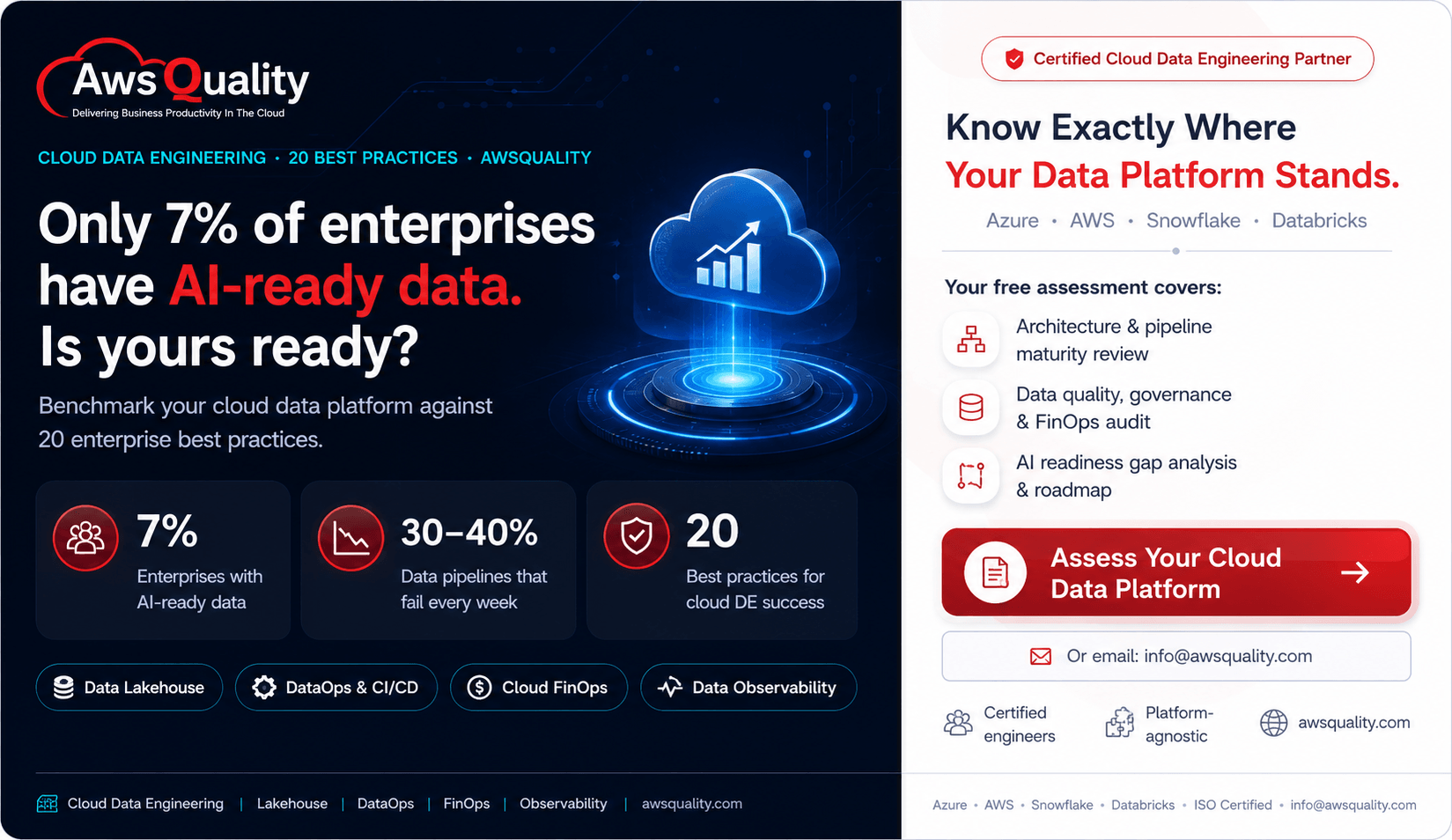
In 2026, every enterprise cloud data platform is being evaluated — explicitly or implicitly — by whether it can support the AI and machine learning workloads that are central to business strategy. Only 7% of enterprises currently have data that is completely ready for AI adoption. The cloud data platforms being built today will be the AI data foundations of the next three to five years. Building AI readiness retrospectively — after a data platform is already in production — is significantly more expensive than building it in from the first architecture decision.
The specific infrastructure components that AI readiness requires, beyond the standard cloud data engineering capabilities: feature engineering pipelines that compute and serve ML model features with the versioning and consistency that ML training and inference require; a feature store that makes computed features available at training time and inference time without recomputation; vector database infrastructure (Pinecone, Weaviate, pgvector, Databricks Vector Search) for generative AI applications using retrieval-augmented generation; real-time data serving infrastructure that provides AI agents with current operational data at the latency their decision-making requires; and data quality standards applied specifically to the fields that AI models consume, enforced in the pipeline rather than assumed at inference time.
Implementation: Include AI use case requirements in the initial architecture review for any new data platform build — not as a separate AI phase to be addressed later. Design the lakehouse storage layer with ML training data access patterns in mind, not only BI workload patterns. Implement feature engineering capability alongside standard transformation pipelines from the beginning. Choose governance tools (Unity Catalog, Snowflake governance) that provide the access control and lineage visibility required for AI systems to operate within data governance boundaries.
Common Challenges in Cloud Data Engineering
While cloud data engineering offers significant advantages, enterprises often encounter several challenges.
Data Silos
Departments using separate systems can create fragmented data.
Solution: Implement centralized data lakes or lakehouses.
Integration Complexity
Organizations often manage hundreds of applications.
Solution: Use API-first integrations and modern data connectors.
Governance at Scale
Large enterprises must manage thousands of datasets.
Solution: Adopt automated governance and metadata management.
Rising Cloud Costs
Poorly optimized workloads can increase expenses.
Solution: Continuously monitor resource usage and optimize storage and compute.
Skills Gap
Cloud data engineering requires expertise in architecture, cloud services, DevOps, and analytics.
Solution: Partner with experienced cloud data engineering specialists.
Emerging Trends in Cloud Data Engineering
Cloud data engineering continues to evolve rapidly.
Key trends include:
- AI-powered data engineering
- Lakehouse architecture adoption
- Data mesh implementation
- Data observability platforms
- Real-time analytics
- Serverless data pipelines
- Multi-cloud strategies
- Low-code data integration
- Metadata-driven automation
- Vector databases for AI applications
Organizations that embrace these innovations will be better positioned to scale their data operations and support next-generation AI initiatives.
Also check: Zero Trust Security Model for Cloud and AI Applications
Building Your Cloud Data Engineering Roadmap
The 20 best practices in this guide represent the current standard of enterprise cloud data engineering excellence. Not all of them are appropriate starting points for every organization at every stage of data platform maturity.
A practical sequencing framework by maturity stage:
For organizations establishing their first cloud data platform:
Prioritize architecture (lakehouse model, zone structure), basic pipeline engineering (modular design, orchestration), and data quality (embedded validation). Defer multi-cloud portability, advanced observability, and FinOps optimization until the platform is stable and the usage patterns are understood.
For organizations modernizing a legacy data platform:
Prioritize CDC implementation (to eliminate full-extract-based integration from legacy systems), IaC adoption (to make the new platform reproducible and auditable in ways the legacy platform was not), and governance enforcement (to establish the access control and lineage tracking that the legacy platform could not provide). Cost optimization and AI readiness are the follow-on priorities once the modernized platform is operating reliably.
For organizations with a working modern data platform preparing for AI
Prioritize AI readiness infrastructure (feature stores, vector databases, real-time serving), advanced data observability (to ensure AI input data quality meets the higher standard AI requires), and column-level lineage (to enable the audit trail that AI governance requires). The FinOps and security practices should be fully in place before AI workloads scale to significant consumption levels.
Why Choose AwsQuality for Cloud Data Engineering?
At AwsQuality, we help organizations design and implement cloud-native data engineering solutions that enable faster insights, stronger governance, and AI-ready architectures.
Our cloud data engineering services include:
- Cloud data platform strategy
- Data pipeline development
- ETL/ELT modernization
- Data lake and lakehouse implementation
- Cloud migration
- Data warehouse optimization
- Real-time data engineering
- Data governance and security
- AI-ready data platform development
- Performance optimization and managed support
With expertise across AWS, Azure, Google Cloud, and modern data technologies, our team delivers scalable solutions tailored to your business objectives.
Frequently Asked Questions
What is cloud data engineering?
Cloud data engineering involves building and managing data pipelines, storage systems, and analytics platforms using cloud technologies to support business intelligence, AI, and data-driven decision-making.
What are the benefits of cloud data engineering?
Key benefits include scalability, reduced infrastructure costs, faster analytics, improved data quality, enhanced security, and support for AI and machine learning initiatives.
Which cloud platforms are commonly used for data engineering?
The most widely used platforms include Amazon Web Services (AWS), Microsoft Azure, and Google Cloud Platform (GCP), each offering a rich ecosystem of managed data services.
What is the difference between ETL and ELT?
ETL transforms data before loading it into a destination, while ELT loads raw data first and performs transformations within the cloud data warehouse, making it more suitable for modern, scalable analytics.
Why is data governance important in cloud environments?
Data governance ensures that enterprise data remains accurate, secure, compliant, and accessible, helping organizations maintain trust in their analytics while meeting regulatory requirements.
Conclusion
Cloud data engineering has become a strategic capability for organizations seeking to unlock the full value of their data. By following best practices—such as building cloud-native architectures, automating pipelines, ensuring data quality, strengthening governance, and designing AI-ready platforms—enterprises can create a scalable foundation for innovation and growth.
As businesses continue to adopt advanced analytics, machine learning, and generative AI, the demand for modern cloud data engineering will only increase. Investing in the right architecture, tools, and expertise today enables organizations to respond faster to market changes, improve operational efficiency, and make confident, data-driven decisions.
Whether you’re modernizing legacy infrastructure or building a new cloud-first data ecosystem, AwsQuality provides the expertise to help you architect secure, high-performance, and future-ready cloud data platforms that drive long-term enterprise success.
 Bio
Bio