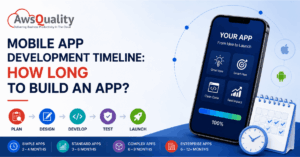

Introduction: Why Mobile App Development Deserves a Strategic Approach
There are now more than 9 million apps across the Apple App Store and Google Play Store.
Most of them fail.
Not because the underlying technology was wrong, or because the development team was poor, or because the market for the problem the app was solving did not exist. They fail because the organizations that built them treated mobile app development as a technical project rather than a strategic one.
They chose a technology before validating the use case. They built features before understanding the user. They prioritized speed to launch over correctness of design. They deployed without a plan for what happens after the app is live.
The mobile app market is unforgiving precisely because the barrier to building an app has fallen dramatically. The global mobile app market was valued at $330 billion in 2025 and is projected to reach $1.23 trillion by 2035. More than 90% of all mobile usage happens inside apps. Smartphone apps are now used by 6.3 billion people — 78% of the global population.
The opportunity is real. So is the risk of building the wrong thing in the wrong way.
This guide covers everything businesses and technology leaders need to know about mobile app development in 2026 — from the foundational decisions that determine whether an app succeeds before a single line of code is written, through technology selection, the development process, cost structures, quality assurance, launch strategy, and long-term maintenance. It is written for the people responsible for making the decisions, not just the people executing them.
Read: Mobile App Development Trends Businesses Can’t Ignore
What is Mobile App Development?
Mobile app development is the process of designing, building, testing, deploying, and maintaining applications for mobile devices such as smartphones and tablets.
Depending on the business requirements, an application may be developed specifically for iOS or Android, built using a cross-platform framework, or delivered through a progressive web application (PWA).
Modern mobile app development typically involves:
- Product strategy and market research
- UI/UX design
- Frontend development
- Backend development
- APIs and integrations
- Database architecture
- Cloud infrastructure
- Security
- Testing and quality assurance
- App Store and Google Play deployment
- Analytics and monitoring
- Ongoing maintenance and optimization
The objective isn’t simply to launch an application.
The objective is to build a mobile product that users want to use and that delivers measurable business value.
What Mobile App Development Actually Involves
Mobile app development is the end-to-end process of designing, building, testing, deploying, and maintaining software applications that run on mobile devices — smartphones and tablets running iOS and Android, and increasingly on wearables, connected TVs, and other mobile-connected devices.
The word “development” is often used as shorthand for the coding phase. That is a significant underestimation of what the process actually involves.
A mobile app development engagement that is scoped and executed correctly includes:
- Business requirement analysis and use case validation
- User research and persona definition
- Competitive analysis and market positioning
- Technical architecture design
- UI/UX design and prototyping
- Frontend and backend development
- API development and third-party integration
- Security implementation
- Testing and quality assurance across devices and OS versions
- App Store submission and deployment
- Post-launch monitoring and analytics
- Ongoing maintenance, updates, and feature development
Skipping or compressing any of these stages does not save time or money. It defers the cost to later in the project — usually to the most expensive possible point, which is after the app is in the hands of users.
The Business Case: Why Mobile Apps Matter More Than Ever
Before evaluating what to build or how to build it, the foundational question is whether a mobile app is the right solution for the business problem at hand. That question deserves an honest answer — and the honest answer for most businesses that interact with customers or manage field operations is yes.
Customer engagement at the primary touchpoint
Mobile is where customers spend their time. Apps that deliver genuine utility — that solve a real problem, reduce friction in a common task, or provide access to something the customer values — capture engagement that websites and other digital channels increasingly cannot.
The data is consistent on this point: mobile apps generate significantly higher engagement rates than mobile web, with sessions that are 3 to 4 times longer on average. Push notifications — exclusive to native and hybrid apps, unavailable on mobile web — increase user retention by 50 to 60% when used with appropriate frequency and relevance.
Revenue generation and monetization
Mobile apps generate revenue through subscription models, in-app purchases, transactional commerce, service delivery, advertising, and lead generation. In-app purchases and subscriptions now account for over 94% of total mobile market value. Consumer subscription spending on mobile reached $66.8 billion in 2024. For businesses with a recurring revenue model or a high-frequency transaction use case, a well-designed mobile app is a primary revenue channel.
Operational efficiency and enterprise mobility
The case for mobile apps is not limited to customer-facing products. Enterprise mobile applications — field service management, warehouse operations, sales force enablement, remote inspection tools, internal communications platforms — consistently deliver significant operational efficiency gains. Field service engineers with mobile access to real-time job information, asset history, and digital forms complete more jobs per day, with fewer errors, and with higher first-time fix rates than those working from paper or desktop-only systems.
Data and insight generation
Every interaction inside a mobile app is a measurable signal. Purchase patterns, navigation flows, feature usage, session duration, conversion rates, drop-off points, and engagement frequency are all visible in analytics data that a well-instrumented mobile app provides. This data is the foundation for the product iteration process that separates apps that grow from apps that stagnate.
Also read: Why Finance Mobile Apps Need AI-First Architecture
Types of Mobile Applications: Choosing the Right Approach
The first technical decision in any mobile app project is the type of app to build. This choice affects development cost, time to market, performance characteristics, access to device capabilities, and long-term maintenance burden. It is a consequential decision and one that is frequently made on the basis of inadequate information.
Native apps
Native apps are built specifically for a single platform — Swift or Objective-C for iOS, Kotlin or Java for Android — using each platform’s native development environment, UI components, and APIs.
What native apps do well: Native apps deliver the highest possible performance on their target platform. They have direct, unrestricted access to all device hardware and OS capabilities — camera, biometrics, GPS, NFC, Bluetooth, ARKit/ARCore, background processing, and notification systems. They integrate seamlessly with platform conventions that users are already familiar with, and they meet App Store and Play Store quality standards with the fewest friction points.
When native is the right choice: When performance is the primary requirement — high-frequency trading apps, real-time gaming, AR/VR experiences, video processing applications. When deep integration with device hardware is essential — health monitoring apps that need continuous background access to sensors, payment apps that require biometric authentication at the hardware level, camera-intensive applications. When the user experience must be indistinguishable from the platform’s own apps — which is a reasonable requirement for consumer apps competing in a category where the incumbents are native.
The trade-off: Native development requires separate codebases, separate development teams (or a team with both iOS and Android expertise), and separate maintenance cycles. Development and ongoing maintenance costs are approximately 40 to 60% higher than equivalent cross-platform approaches. For organizations with limited development budgets or small teams, this trade-off is significant.
Cross-platform apps
Cross-platform apps are built using frameworks that compile to native code or run within a native wrapper on both iOS and Android from a single shared codebase. The two dominant frameworks in 2026 are Flutter (Google’s Dart-based UI toolkit) and React Native (Meta’s JavaScript-based framework).
Flutter compiles to native ARM code for both platforms, rendering its own UI elements using the Skia graphics engine rather than wrapping native platform components. This produces high-performance, visually consistent experiences across platforms. Flutter is the more performant option for graphically rich or animation-heavy applications, and its widget ecosystem has matured significantly since its introduction.
React Native uses JavaScript and React components that map to native platform UI elements. It benefits from the largest developer ecosystem of any cross-platform framework, the most extensive third-party library support, and the closest integration with web development practices for teams with JavaScript expertise.
What cross-platform apps do well: A single codebase serves both iOS and Android, reducing development cost by 30 to 50% compared to parallel native builds. Updates and bug fixes are deployed once and apply to both platforms. Time to market is significantly shorter. For the vast majority of business mobile applications — CRM tools, e-commerce apps, content platforms, service booking apps, enterprise productivity tools — the performance difference between cross-platform and native is imperceptible to end users.
When cross-platform is the right choice: For most new mobile product initiatives where the use case does not require deep native platform integration. For businesses that need to be live on both iOS and Android without the budget for two native development tracks. For MVP development where speed to market and cost efficiency are the primary constraints. For internal enterprise tools where performance is less critical than feature completeness and maintainability.
The honest caveat: Cross-platform frameworks have historically been weaker on performance-intensive use cases, complex animations, and some native device integrations. In 2026, Flutter in particular has closed most of these gaps for mainstream use cases — but for applications at the extreme end of performance requirements, native remains the stronger technical choice.
Progressive Web Apps (PWAs)
Progressive Web Apps are web applications built with modern web technologies — HTML, CSS, JavaScript — that deliver app-like experiences through the mobile browser, including offline capability, push notifications on supported platforms, and home screen installation.
What PWAs do well: PWAs require no App Store installation and no App Store approval process. They are maintained as a single codebase that serves all platforms. Updates are deployed instantly to all users without requiring an app update. Development cost is significantly lower than native or cross-platform approaches, particularly for organizations with existing web development teams.
When PWAs are the right choice: When the use case is primarily content consumption rather than feature-intensive interaction. When the target audience has limited device storage or restricted app installation permissions (common in enterprise environments). When App Store distribution costs — the 15 to 30% commission on in-app purchases — are a significant business concern. When rapid, frequent content updates are the primary technical requirement.
The limitations: PWAs cannot access all device hardware. Background processing, Bluetooth, NFC, some biometric integrations, and advanced camera features remain either unavailable or significantly limited compared to native or cross-platform apps. Push notification support, while improving, is still inconsistent across browsers and iOS versions. For use cases that require these capabilities, PWAs are not the appropriate technical approach.
Hybrid apps
Hybrid apps use web technologies (HTML, CSS, JavaScript) wrapped in a native container using frameworks like Apache Cordova or Ionic. They are distinct from cross-platform frameworks like Flutter and React Native, which compile to or render through native code.
In 2026, the hybrid app model has largely been superseded by cross-platform frameworks for new development. For organizations maintaining existing hybrid codebases, migration to React Native or Flutter is typically worth evaluating if the development cadence is high enough to justify the migration cost.
Read: 5 Signs You’ve Found the Right Mobile Application Development Company
Native vs. Cross-Platform vs. PWA
| Factor | Native | Cross-Platform | PWA |
|---|---|---|---|
| Performance | Excellent | Very good | Good |
| Platform access | Excellent | High | More limited |
| Code reuse | Low | High | High |
| Development speed | Moderate | High | High |
| Development cost | Higher | Moderate | Lower in many cases |
| Best for | Performance-intensive apps | Multi-platform products | Web-first experiences |
| App Store presence | Yes | Yes | Not necessarily |
| Device integration | Excellent | High | Limited compared with native |
There is no universally best approach.
The right choice depends on the application’s functionality, target audience, budget, timeline, performance requirements, and long-term roadmap.
The Mobile App Development Process: Stage by Stage
A mobile app development process that is properly scoped and sequenced consistently produces better outcomes than one that skips stages in pursuit of speed. The stages that are most commonly compressed — discovery, design, and testing — are consistently the ones where compression creates the most expensive problems.
Stage 1: Discovery and validation
Discovery is the stage that determines whether the app should be built at all, in what form, for whom, and against which competitors. It is the stage most frequently shortchanged, and the one whose absence is most frequently cited in post-mortem analyses of app failures.
What discovery involves:
- User research: Defining the specific user segments the app will serve, conducting interviews or surveys to understand their current workflows, pain points, and decision-making, and validating that the app’s proposed value proposition addresses a genuine and prioritized need. The most common app development mistake is building for the user the product team imagines rather than the user who actually exists.
- Competitive analysis: Mapping the existing landscape of apps addressing the same or adjacent needs. Understanding what established players do well, where they fall short, and what white space exists that a new app could credibly occupy. Launching into a market without understanding the competitive context produces apps that are redundant at best.
- Market and demand validation: Confirming that a sufficient audience exists for the proposed app and that the audience’s current behaviour — what they do today in the absence of the app — confirms the demand hypothesis.
- Technical feasibility assessment: Identifying any technical constraints, regulatory requirements, or integration dependencies that would materially affect the app’s architecture or development timeline. Discovering these constraints in discovery is inexpensive. Discovering them in development is not.
Output: A validated use case, defined user personas, a competitive positioning statement, and a clear product scope that describes what the first version of the app will and will not do.
Stage 2: Strategy, scope, and planning
With a validated use case and defined user, the strategy stage translates the discovery findings into a development plan.
What planning involves:
- Feature prioritization: Defining the Minimum Viable Product — the smallest set of features that delivers genuine value to the target user and allows the team to gather real-world feedback. MV P scope decisions are the most important product decisions made in this stage. Almost every development project suffers from scope creep, and almost all scope creep originates from inadequate MV P definition.
- Technical architecture design: Selecting the technology stack, defining the system architecture (client-server, API design, data model), identifying integration requirements, and documenting the security and compliance architecture. Architecture decisions made here propagate through every subsequent stage of development.
- Monetization and business model definition: How the app generates revenue — subscription, freemium, transactional, advertising-supported, or enterprise licensing — is a product design decision as much as a business model decision. The monetization model affects the user experience, the data model, the analytics requirements, and the onboarding flow.
- Timeline and resource planning: A realistic development timeline, based on the defined scope and the technical architecture, with explicit milestones and defined resource requirements.
Output: A product brief, a technical architecture document, a development roadmap, and a project plan with resource and timeline commitments.
Stage 3: UI/UX design
User experience design is where the product strategy becomes a tangible user interface. It is the most misunderstood stage in mobile development and the one most likely to be under-resourced.
The evidence on the relationship between design quality and app success is unambiguous. Apps with strong UX design have 70% higher user retention than apps with poor design. 88% of users never return to an app after a single bad experience. The cost of fixing a usability problem in design is approximately 100 times lower than fixing it in production.
What UX design involves:
- Information architecture: How the app’s content and features are structured and how users navigate between them. Information architecture problems — the app is confusing to navigate, key features are hard to find, the mental model the app imposes does not match the user’s expectations — are the primary driver of abandonment.
- Wireframing: Low-fidelity representations of each screen and interaction flow that allow the team to evaluate the product structure without investing in visual design.
- Interactive prototyping: Higher-fidelity clickable prototypes that allow user testing before development begins. The single most cost-effective investment in any mobile app project is user testing on a prototype — finding and fixing design problems before they are coded is dramatically cheaper than finding and fixing them after.
- Visual design: The visual language of the app — typography, colour system, iconography, component design — aligned with platform conventions (Apple’s Human Interface Guidelines for iOS, Material Design for Android) and the brand identity.
- Accessibility design: Designing for users with visual, motor, or cognitive impairments is both a legal requirement in many jurisdictions and a quality indicator that correlates with overall design excellence.
Output: A complete design system, interactive prototype, and design specifications ready for developer handoff.
Stage 4: Development
Development is the stage that produces the actual software. In a well-run mobile development project, it is the stage with the least uncertainty — because the discovery, planning, and design stages have resolved the ambiguities that would otherwise surface during coding.
Frontend development implements the UI from the design specifications, builds the navigation and interaction logic, and integrates the frontend with the backend API. For native development, this involves Swift for iOS and Kotlin for Android. For cross-platform, this involves Flutter or React Native.
Backend development builds the server-side infrastructure: the API layer that the mobile frontend communicates with, the business logic, the data models, the authentication and authorization system, the integration with third-party services, and the data storage infrastructure.
API development defines and implements the contract between the frontend and backend. Well-designed APIs — following REST or GraphQL conventions, with clear versioning, authentication, rate limiting, and error handling — are the primary determinant of how maintainable the app will be over its lifetime.
Security implementation is not a post-development checklist item. Security architecture is defined in Stage 2 and implemented throughout development. Key security requirements for production mobile apps include encrypted data storage on device, encrypted data in transit (TLS 1.3), secure authentication (OAuth 2.0, biometric authentication), protection against common mobile vulnerabilities (OWASP Mobile Top 10), and where applicable, compliance with regulatory security standards (PCI DSS for payment processing, HIPAA for health data, GDPR for EU user data).
Development practices that determine project outcomes: Version control (Git with pull request review), automated testing (unit tests, integration tests, UI tests), continuous integration (automated builds and test execution on every commit), code review (every change reviewed by at least one other developer), and environment separation (development, staging, and production environments with explicit promotion criteria).
Stage 5: Testing and quality assurance
Testing is the stage that determines whether the app is ready to put in front of users. It is consistently underestimated in both time and importance, and consistently regretted when compressed.
Functional testing verifies that each feature works as specified. It is the baseline of any QA process and the minimum that should be performed before any app reaches production.
Compatibility testing verifies that the app functions correctly across the range of devices, screen sizes, OS versions, and network conditions that represent the target user base. The fragmentation of the Android ecosystem — hundreds of device models across a range of OS versions — makes compatibility testing particularly important for Android apps. A representative device test matrix should include the devices used by at least 90% of the target audience.
Performance testing verifies that the app meets response time, memory usage, battery consumption, and network efficiency requirements. Performance problems — slow loading, excessive battery drain, high data consumption — are among the most common reasons for negative reviews and uninstallation.
Security testing identifies vulnerabilities in the app’s authentication, data storage, network communication, and third-party integrations before they are discovered by users or malicious actors. Mobile security testing should follow the OWASP Mobile Application Security Verification Standard.
User acceptance testing (UAT) involves real users evaluating the app against the original use case requirements. UAT frequently surfaces usability issues that functional testing misses because the testers are not approaching the app from the perspective of genuine unfamiliarity with the product.
Beta testing exposes the app to a controlled group of real users in a real-world environment before full launch. TestFlight (iOS) and Google Play Internal Testing provide managed beta distribution channels. Beta feedback is the most valuable external data available before launch.
Stage 6: App Store submission and deployment
App Store and Google Play Store submission requires preparation that is distinct from the development process itself and that frequently takes longer than development teams expect.
Apple App Store review takes 24 to 48 hours for most submissions, but apps that trigger manual review — those with in-app purchases, those using certain APIs, those in regulated categories — can take significantly longer. App Store rejection is common: approximately 40% of initial submissions are rejected for policy violations, metadata issues, or guideline violations. Building buffer time into the launch plan for rejection and resubmission is not pessimism — it is realism.
Google Play Store review has become more stringent since 2024. Play Protect requirements, content rating requirements, and the API requirements that accompany target API level updates each have compliance requirements that must be verified before submission.
Pre-submission requirements: Privacy policy (legally required by both stores), app screenshots and preview videos (the primary conversion driver on the App Store listing page), App Store Optimization (ASO) — keyword-optimized title, subtitle, and description — and ratings and review strategy.
Stage 7: Post-launch: maintenance, monitoring, and growth
The launch of a mobile app is not the end of the development investment. It is the beginning of the maintenance and evolution phase that will consume resources for as long as the app is in operation.
Performance monitoring should be active from the day of launch. Tools like Firebase Crashlytics, Sentry, and Datadog provide real-time visibility into crash rates, ANRs (Application Not Responding events), and performance metrics. The acceptable crash-free session rate for a production app is 99.5% or above. Below 99%, user reviews and uninstallation rates increase measurably.
Analytics and product iteration — the cycle of measuring user behaviour, identifying where users drop off or disengage, forming hypotheses about why, designing experiments to test those hypotheses, and implementing the winning changes — is the process that determines whether an app grows or stagnates after launch. This process requires a clear analytics implementation (Firebase Analytics, Amplitude, or Mixpanel), defined KPIs, and a product team with both the authority and the cadence to iterate rapidly.
OS update compatibility — both Apple and Google release annual major OS updates that require testing and frequently require code changes to maintain compatibility and access to new APIs. Building a testing and release process that accommodates annual OS updates before they reach the majority of the user base is an operational requirement.
Security patching — mobile apps are targets for security vulnerabilities. A patching process that can respond to critical security vulnerabilities within days, not weeks, is an operational requirement for any app handling sensitive user data.
How to Make a Mobile App Scalable
Scalability should be considered before the application becomes successful.
Key considerations include:
Backend Scalability
Use infrastructure capable of scaling as demand increases.
Database Optimization
Design schemas, indexes, queries, and caching strategies appropriately.
API Performance
Reduce unnecessary requests and optimize backend communication.
Caching
Caching can reduce repeated backend requests and improve responsiveness.
Asynchronous Processing
Long-running operations can often be handled asynchronously rather than blocking user interactions.
CDN and Asset Optimization
Images, videos, and other static resources should be optimized and delivered efficiently.
How AI Can Improve Mobile App Development
AI isn’t only changing the applications businesses build. It is also changing how applications are developed.
Development teams can use AI-assisted tools for activities such as:
- Code generation
- Code review
- Test generation
- Documentation
- Debugging assistance
- Requirements analysis
- UI prototyping
However, AI-generated code still requires engineering review, testing, security validation, and appropriate governance.
The objective should be to increase developer productivity without reducing engineering quality.
How Much Does Mobile App Development Cost?
There is no single price for developing a mobile application.
Cost depends on factors such as:
- Number of platforms
- Application complexity
- Number of features
- UI/UX requirements
- Backend complexity
- API integrations
- AI functionality
- Security requirements
- Third-party services
- Development team location and model
- Testing requirements
- Post-launch support
A simple application may require weeks of development, while a complex enterprise application can take several months or longer.
Instead of asking only:
“How much does an app cost?“
businesses should evaluate:
“What product do we need, what business problem will it solve, and what level of investment is justified by the expected value?“
Current Mobile App Development Trends
Mobile development is increasingly influenced by AI, cloud computing, connected devices, and changing user expectations.
Here are some of the most important trends businesses should consider.
1. AI-Powered Mobile Applications
AI is becoming a core application capability rather than a standalone feature.
Mobile applications can use AI for:
- Personalized recommendations
- Conversational assistants
- Search
- Content generation
- Predictive analytics
- Image recognition
- Voice interfaces
- Intelligent notifications
- Customer support
For example, an e-commerce application could use AI to recommend products based on customer behavior.
A financial application could provide an AI assistant that helps users understand transactions.
A healthcare application could provide intelligent information and personalized reminders, subject to appropriate clinical and regulatory requirements.
The strategic shift
The question is no longer simply:
“Should we add AI to our mobile app?”
Instead, businesses should ask:
“Where can AI improve the user journey or create a measurable business outcome?”
2. AI Agents in Mobile Applications
The next step beyond conventional AI features is the integration of AI agents.
Instead of simply responding to a question, an agent can potentially:
- Understand a user’s request
- Determine the required actions
- Access approved data or systems
- Execute tasks
- Return the result to the user
For example, instead of a customer simply asking an app:
“Where is my order?”
an AI-powered experience could potentially handle a broader request such as:
“My order hasn’t arrived. Check the status and tell me what I should do.”
The agent could retrieve the order status, evaluate available information, and guide the customer through the appropriate next step.
For enterprise applications, however, AI agents require careful attention to:
- Identity
- Permissions
- Data privacy
- Security
- Human oversight
- Auditability
AI should be designed into the architecture—not simply added as a chatbot layer.
3. Personalized Mobile Experiences
Personalization is becoming increasingly important.
Applications can use behavioral and contextual data to provide:
- Personalized recommendations
- Relevant content
- Targeted offers
- Customized notifications
- Adaptive experiences
However, personalization should be balanced with privacy and transparency.
Businesses need to understand what data they collect, why they collect it, and how it is used.
4. Cloud-Native Mobile Applications
Modern mobile applications rarely operate independently.
A typical application may communicate with:
- Cloud databases
- APIs
- Authentication systems
- CRM platforms
- Payment gateways
- Analytics platforms
- AI services
- Enterprise applications
Cloud infrastructure provides the backend capabilities required to support these experiences.
Common cloud platforms include:
- AWS
- Microsoft Azure
- Google Cloud
A cloud-native architecture can help applications scale as user demand grows, provided the underlying architecture is designed appropriately.
5. IoT and Connected Mobile Experiences
Mobile applications are increasingly becoming interfaces for connected devices.
Examples include:
- Wearables
- Smart home devices
- Industrial sensors
- Connected vehicles
- Healthcare devices
A mobile application may act as the interface between the user and an IoT ecosystem.
For example:
IoT Device → Cloud Platform → API → Mobile App
This architecture allows users to monitor devices, receive alerts, and interact with connected systems.
6. Mobile Commerce
Mobile commerce continues to influence how businesses design customer experiences.
Successful mobile commerce applications often prioritize:
- Simple navigation
- Fast checkout
- Digital wallets
- Personalized recommendations
- Order tracking
- Secure payments
- Loyalty programs
The goal is to minimize friction between product discovery and purchase.
7. AR and Immersive Experiences
Augmented reality can create useful experiences in areas such as:
- Retail
- Real estate
- Education
- Manufacturing
- Healthcare
- Gaming
For example, retailers can allow customers to visualize products in their environment before purchasing.
AR should not be implemented simply because it is technically impressive.
It should solve a real user problem.
8. Low-Code and No-Code Development
Low-code and no-code platforms can accelerate development for certain applications.
They may be useful for:
- Internal business applications
- Prototypes
- Workflow applications
- Simple data-driven applications
However, businesses should evaluate limitations around:
- Custom functionality
- Scalability
- Vendor dependency
- Security
- Integration
- Long-term maintenance
Low-code is not automatically a replacement for professional software engineering.
Choosing the Right Mobile App Technology Stack
Technology decisions should follow product requirements—not the other way around.
A typical mobile application stack includes several layers.
Mobile Frontend
Common choices include:
iOS
- Swift
- SwiftUI
Android
- Kotlin
- Jetpack Compose
Cross-platform
- Flutter
- React Native
Backend
Common backend technologies include:
- Node.js
- Python
- Java
- .NET
The appropriate choice depends on the application’s requirements and the team’s expertise.
Databases
Depending on the application, teams may use:
- PostgreSQL
- MySQL
- MongoDB
- Firebase
Database selection should consider:
- Data structure
- Transaction requirements
- Scalability
- Query patterns
- Security
- Availability
APIs and Integrations
Modern applications depend heavily on APIs.
A mobile app might integrate with:
- CRM systems
- Payment gateways
- ERP platforms
- Marketing platforms
- Maps
- Authentication services
- AI platforms
- Analytics systems
A strong API architecture is therefore critical for scalability and maintainability.
Mobile App Architecture: What Should You Consider?
Architecture decisions made early can significantly affect future development.
A scalable mobile application should consider:
Separation of Concerns
Keep presentation, business logic, data access, and infrastructure responsibilities appropriately separated.
API-First Design
Define clear interfaces between the mobile application and backend systems.
Scalability
Design backend infrastructure to handle increasing users and transaction volumes.
Security
Protect data both in transit and at rest.
Observability
Monitor:
- Application crashes
- API failures
- Performance
- Infrastructure health
- User journeys
Offline and Poor-Network Support
For applications used in areas with unreliable connectivity, consider:
- Local caching
- Offline workflows
- Data synchronization
- Retry mechanisms
This can be especially important for field-service and enterprise applications.
Mobile App Development Strategy: The Decisions That Determine Success
Technology selection and development process are necessary but not sufficient conditions for mobile app success. The strategic decisions that precede and frame the technical work determine whether a technically sound app succeeds in the market.
Start with the user, not the feature list
The most reliable predictor of mobile app failure is a product built around the features the team wanted to build rather than the problems the target user needs solved. User research — conducted before any design or development begins — is the investment that most clearly separates successful apps from unsuccessful ones.
Effective user research does not require large budgets or long timelines. Five to eight qualitative interviews with representative target users, conducted before design begins, consistently surface the most important insights about the gap between what the team assumes and what the user actually needs.
Define success metrics before building
What does the app need to achieve to be considered successful? This question needs a specific, measurable answer before development begins — not a vague one.
The metrics that matter most for mobile apps, depending on the use case: daily/monthly active users, session frequency, session duration, retention rate at Day 1, Day 7, and Day 30, conversion rate (for transactional apps), average revenue per user, Net Promoter Score, and crash-free session rate.
Defining these metrics before launch, establishing baselines from comparable apps, and reviewing performance against them on a defined cadence is the discipline that produces a product that improves over time rather than one that is launched and forgotten.
Design for retention, not just acquisition
The most common failure mode in mobile app strategy is over-investing in user acquisition and under-investing in retention. Acquiring a new user typically costs 5 to 7 times more than retaining an existing one. An app that acquires users effectively but loses them quickly is running on a leaking business model.
The retention lever that has the most consistent impact across app categories is the onboarding experience. Users who successfully complete onboarding and reach the app’s core value in the first session are retained at significantly higher rates than those who do not. Designing onboarding that gets users to their first value moment as quickly and with as little friction as possible is the highest-impact product investment available in a new app.
Plan the post-launch roadmap before launch
The launch version of any mobile app is a hypothesis. It is the team’s best guess about what the target user needs, validated as well as it can be validated without real-world usage data. The post-launch roadmap — the feature and improvement plan for the first year after launch — should be designed as a framework for testing and refining that hypothesis, not as a predetermined list of features to build.
The teams that iterate most effectively are the ones that treat the post-launch analytics not as a scoreboard but as a research tool — learning from what users do, not just what they say, and designing the next iteration based on that learning.
Security and compliance are product requirements
For any app that handles user data — which is effectively every app — security and compliance are product requirements, not engineering considerations to be addressed separately. The GDPR, CCPA, HIPAA, PCI DSS, and equivalent regulations impose specific requirements on how mobile apps collect, store, process, and share user data. Apps that get these requirements wrong face fines, regulatory action, and — most damaging — loss of user trust that is difficult or impossible to rebuild.
Building security and compliance into the architecture from the beginning is significantly less expensive than retrofitting it after launch. The architecture decisions made in Stage 2 of the development process set the foundation for the app’s regulatory posture. Decisions made at that stage propagate through every subsequent stage. Getting them right at the beginning is the most cost-effective approach.
Common Mobile App Development Challenges
Businesses commonly face several challenges.
Choosing the Wrong Technology
A framework may be popular but unsuitable for a particular product.
Poor Scope Definition
Unclear requirements can result in changing timelines and budgets.
Overbuilding the First Version
Trying to launch every feature at once increases complexity and delays learning.
Weak UX
Even technically excellent applications can fail if users find them difficult to navigate.
Security Gaps
Security problems discovered late in development can be expensive to fix.
Performance Problems
Poor architecture, inefficient APIs, large assets, and database bottlenecks can create poor experiences.
Lack of Post-Launch Planning
An application requires maintenance, monitoring, updates, and continuous improvement after launch.
Common Mobile App Development Mistakes That Are Worth Avoiding
Understanding the most common reasons mobile apps fail provides an actionable framework for avoiding them.
Building without validating. The most common and most expensive mistake: spending months and significant capital building an app for a problem that, as it turns out, the target user does not experience in the way the team assumed, or that the user does not consider a priority, or for which an existing solution is already adequate. Discovery and validation before development is the most reliable antidote.
Scope creep without scope discipline. Every feature that is added to an in-progress development project adds cost, timeline, and complexity. Scope discipline — defining the MV P tightly and deferring features to subsequent releases — is one of the most valuable practices in mobile development. It is also consistently the one that faces the most internal resistance, because adding features feels like adding value even when it actually defers value by delaying the launch of a smaller but complete product.
Neglecting performance optimization. Performance is a feature. Loading time, scrolling smoothness, battery consumption, and data usage are all dimensions of user experience that users rate and review, and that drive uninstallation decisions. Performance optimization should be a continuous practice throughout development, not a final-stage activity.
Under-testing on real devices. Emulators and simulators are useful development tools. They are not substitutes for testing on real physical devices representing the actual devices used by the target audience. Device-specific rendering bugs, hardware-specific sensor issues, and carrier-specific network behaviour are all invisible in emulator testing and all visible in production.
Ignoring App Store Optimization. An app that cannot be found in the App Store or Play Store has no users regardless of its quality. ASO — keyword research, title optimization, description writing, screenshot design, and rating management — is the discipline that determines discoverability, and it is frequently an afterthought rather than a planned activity.
No post-launch plan. An app that is launched and then maintained at minimum effort will decline. The App Store is a competitive environment where user expectations are set by the best apps in any given category, and those apps release updates regularly. An app that does not release updates — that does not improve based on user feedback, does not maintain compatibility with new OS versions, does not add features that reflect evolving user needs — will lose users to apps that do.
Mobile App Development Checklist
Before starting a project, make sure you have:
- Defined the business problem
- Identified target users
- Researched competitors
- Defined the MVP
- Prioritized features
- Selected the development approach
- Defined the technology architecture
- Identified integrations
- Established security requirements
- Defined analytics and KPIs
- Created a testing strategy
- Planned deployment
- Budgeted for post-launch maintenance
- Defined a product roadmap
The Future of Mobile App Development
Mobile applications will continue to evolve as AI, cloud computing, connected devices, and new interaction models mature.
Some important areas to watch include:
AI-Native Applications
AI will increasingly become part of the core application experience rather than an optional add-on.
Agentic Experiences
Applications may increasingly allow AI agents to perform multi-step tasks on behalf of users.
Voice Interfaces
Voice can provide an alternative interaction model for certain applications and user groups.
Connected Experiences
Mobile apps will increasingly act as interfaces for IoT devices, wearables, vehicles, and other connected systems.
More Personalized Experiences
Applications will increasingly adapt content, recommendations, and workflows to individual users.
Super Apps
Some markets may continue moving toward applications that combine multiple services into a single ecosystem.
Privacy-Centered Design
As applications collect more behavioral and contextual information, privacy, security, and transparent data practices will become increasingly important.
How to Choose a Mobile App Development Partner
For most organizations, mobile app development is not a core competency — it is a strategic capability they need access to. Choosing the right development partner is therefore one of the most important decisions in the mobile app development process.
The evaluation criteria that most reliably distinguish high-performing mobile development partners from expensive disappointments:
Portfolio depth and relevance. Has the partner built apps in your category or for your use case? A portfolio of enterprise healthcare apps is relevant evidence for an enterprise healthcare project; a portfolio of consumer gaming apps is not. Relevant experience reduces the probability of the team encountering problems they have not seen before on your project.
Technical breadth. The full-stack mobile development capability required to build a production app — frontend (native or cross-platform), backend, API development, third-party integration, security, and DevOps — should be available within the engagement, not assembled from disparate specialists for each project.
Design capability. The strongest mobile development teams have in-house UI/UX design capability deeply integrated with their engineering process. Apps built by teams where design and engineering are separated — where wireframes are handed to engineers with minimal feedback loops — consistently produce worse user experiences than teams where design and engineering collaborate continuously.
Project governance and communication. How does the partner communicate progress, manage scope changes, handle blockers, and escalate issues? The answer to this question — evidenced by references from previous clients and by the specificity of the partner’s answer — is a strong predictor of the project experience.
Post-launch support. What does the partner offer after the app is live? A partner who disappears after delivery leaves the client dependent on internal resources or a new partner for the maintenance and evolution phase that consumes resources for the entire life of the app. A partner with a defined post-launch support and evolution engagement model is significantly more valuable.
References. Clients from comparable projects, willing to speak honestly about the experience, are the most reliable signal available. Request references and use them.
Why AwsQuality for Mobile App Development
AwsQuality’s mobile team has delivered iOS, Android, and cross-platform mobile applications across enterprise, healthcare, retail, fintech, and logistics — with a consistent practice of building production-grade applications that serve real user needs, not just technical specifications.
Our mobile app development services include:
- Native iOS development (Swift)
- Native Android development (Kotlin)
- Cross-platform development (Flutter, React Native)
- Progressive Web Apps
- AI-powered mobile applications
- Enterprise mobility solutions
- UI/UX design and user research
- Backend API development
- Third-party API and CRM integration (Salesforce, HubSpot, Dynamics)
- Mobile security implementation
- QA and device compatibility testing
- App Store submission and ASO
- Post-launch support, analytics, and evolution
Hire experienced mobile app developers from AwsQuality to build a mobile product that delivers genuine business value — not just a functional app, but a strategic asset.
Conclusion
Mobile app development is not a technology project with a business outcome. It is a business project that requires technology to execute.
The organizations that build mobile apps that grow, retain users, and generate measurable returns are the ones that treat every stage of the development process with the same rigour they apply to other significant business investments. They validate before they build. They design for the user they have researched, not the user they imagine. They test rigorously before they launch. They measure what matters and iterate based on what they learn.
The technology choices — which framework, which database, which cloud platform — matter. But they matter less than the strategic choices: who the app is for, what problem it solves, how it creates enough value that users keep coming back, and how the organization will evolve it after launch.
Get the strategy right and the technology will serve it. Get the technology right without the strategy and the result is a well-built app that nobody uses.
Frequently Asked Questions
What is mobile app development?
Mobile app development is the process of designing, building, testing, deploying, and maintaining applications for smartphones and tablets.
What are the main types of mobile apps?
The main approaches are native apps, cross-platform apps, and progressive web apps (PWAs).
Should I choose native or cross-platform mobile development?
Choose native when platform-specific performance and capabilities are critical. Cross-platform development can be a better option when you need to support multiple platforms efficiently.
How long does it take to develop a mobile app?
Development time depends on complexity, features, integrations, design, platforms, and testing requirements. Simple apps may take weeks, while complex applications can take several months or longer.
How much does mobile app development cost?
There is no fixed cost. The investment depends on application complexity, features, platforms, integrations, security requirements, technology choices, and ongoing support.
What technologies are used for mobile app development?
Common technologies include Swift and Kotlin for native development, Flutter and React Native for cross-platform development, and technologies such as Node.js, Python, Java, .NET, PostgreSQL, and cloud platforms for backend systems.
Can mobile apps integrate with Salesforce and other enterprise systems?
Yes. Mobile applications can integrate with Salesforce, ERP systems, payment gateways, analytics platforms, AI services, and other enterprise systems through APIs and integration services.
How can AI be used in mobile applications?
AI can support recommendations, conversational assistants, search, predictive analytics, personalization, content generation, image recognition, and intelligent workflows.
How do you secure a mobile application?
Mobile app security involves secure authentication, authorization, encryption, secure API design, protected data storage, dependency management, vulnerability testing, and ongoing security updates.
What happens after a mobile app is launched?
Post-launch activities include monitoring, bug fixes, security updates, performance optimization, OS compatibility updates, user feedback analysis, and continuous feature development.
 Bio
Bio