The United Arab Emirates has rapidly evolved into one of the world's most dynamic business hubs. From the gleaming towers of Dubai's financial district to the industrial powerhouses of Abu Dhabi, businesses across the UAE are racing to digitize operations, delight customers, and outpace the competition. In this environment, customer relationship management is no longer a luxury ? it is the backbone of sustainable growth.Salesforce, the world's leading CRM platform, sits at the center of this transformation. But deploying Salesforce is not simply a matter of flipping a switch. Maximizing its potential requires specialized expertise, localized knowledge, and continuous optimization ? precisely what a professional Salesforce development service brings to the table.
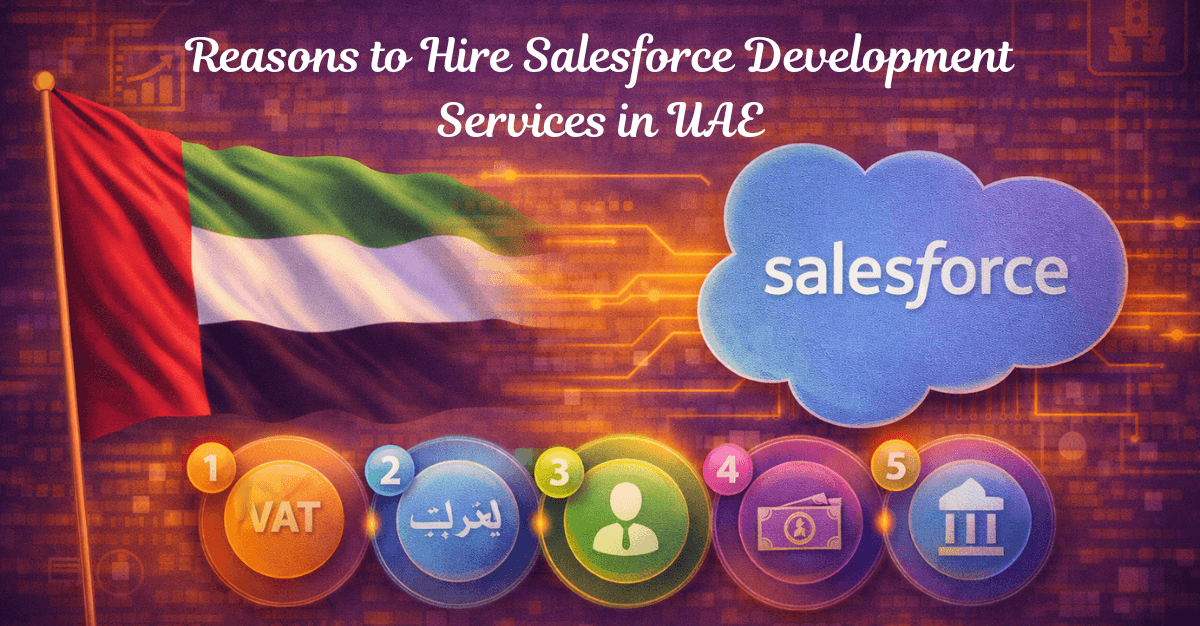
If your business is considering a CRM investment or looking to squeeze more value from an existing Salesforce environment, here are five compelling reasons why hiring a dedicated Salesforce development service in the UAE is the smartest move you can make.
Reason 1: Deep Expertise in Salesforce Customization Tailored to UAE Business Needs
Out-of-the-box Salesforce is powerful, but it is rarely a perfect fit for the nuanced operational realities of UAE businesses. Whether you are managing a multi-entity family business in Sharjah, running a fintech startup in Abu Dhabi Global Market (ADGM), or overseeing a retail chain with outlets across the seven emirates, your workflows are unique ? and your CRM should be too.
A professional Salesforce development team in the UAE does far more than configure dashboards. These specialists build custom objects, automate intricate business processes with Salesforce Flow, write Apex triggers that handle edge cases specific to your industry, and design Lightning Web Components that give your sales and service teams a seamless, intuitive experience.
Critically, locally based developers bring an understanding that offshore teams simply cannot replicate. They are familiar with UAE commercial law, VAT compliance requirements under the Federal Tax Authority, Arabic language localization needs, and the preference for relationship-driven sales cycles that characterize Gulf business culture. This contextual intelligence translates directly into a Salesforce implementation that feels purpose-built rather than generic ? saving you months of frustration and costly rework.
Read: Guide to Choosing the Right Salesforce Development Company for Your Business
Reason 2: Seamless Integration with the Regional Technology Ecosystem
No CRM operates in isolation. Your Salesforce environment needs to communicate with your ERP, your accounting software, your e-commerce platform, your logistics partners, and increasingly, your government-facing portals ? all of which may have specific regional versions or compliance requirements.
In the UAE, businesses routinely use ERP systems such as SAP, Oracle NetSuite, and Microsoft Dynamics, alongside regional payment gateways like Network International and Telr, and government integrations with entities such as the Dubai Land Department, the Ministry of Human Resources, or customs authorities at ports of entry. Connecting Salesforce with these systems requires a developer who understands both the Salesforce integration architecture (REST and SOAP APIs, MuleSoft, platform events) and the specific data formats, authentication protocols, and compliance constraints of the regional technology landscape.
A skilled UAE-based Salesforce development service will architect middleware solutions, configure AppExchange connectors, and build bespoke API integrations that allow data to flow reliably across your entire technology stack. The result is a single source of truth for your customer data ? eliminating duplicate entry, reducing human error, and giving leadership real-time visibility into business performance across departments and geographies.
Reason 3: Accelerated ROI Through Proven Industry Expertise
The UAE economy is remarkably diverse, encompassing real estate, construction, financial services, healthcare, retail, hospitality, logistics, and oil and gas ? each with its own data model, regulatory environment, and customer engagement patterns. A generalist Salesforce administrator can configure basic pipelines, but delivering genuine business transformation requires domain expertise layered on top of technical skill.
Established Salesforce development firms in the UAE have delivered projects across these verticals and bring a library of proven accelerators, templates, and best practices that dramatically shorten implementation timelines. A real estate developer in Dubai, for instance, can benefit from pre-built property management workflows, broker portal configurations, and RERA-compliant document tracking ? rather than starting from scratch. A healthcare provider can leverage Health Cloud implementations already refined through prior deployments in the region's private hospital sector.
This combination of technical depth and industry knowledge compresses your time-to-value significantly. Instead of spending the first three months discovering what your business needs, a seasoned local development partner arrives with a structured discovery methodology and immediately maps your requirements to proven solution patterns. The faster your platform goes live and the fewer post-go-live issues you encounter, the faster you see returns on your CRM investment.
Also read: Salesforce Integration Guide for Businesses and Developers
Reason 4: Ongoing Support, Optimization, and Scalability in a Fast-Changing Market
Salesforce is not a one-time project ? it is a living platform that releases three major updates per year (Spring, Summer, and Winter releases), continuously expanding its capabilities and, occasionally, deprecating features your business may depend upon. Managing these updates while keeping your customizations intact and your users productive requires continuous attention.
The UAE business environment adds an additional layer of urgency. Regulatory changes, economic diversification initiatives tied to UAE Vision 2031, rapid market expansion into new product lines or geographies, and the sheer pace of competitive pressure mean that your Salesforce configuration today may be insufficient by next quarter. Businesses that hire a dedicated Salesforce development service gain a strategic partner ? not just a one-time implementer.
This ongoing relationship delivers several tangible advantages. Your development team monitors sandbox environments before each Salesforce release to identify and resolve compatibility issues before they affect production. They conduct regular health checks to detect technical debt ? over-customized flows, inefficient SOQL queries, unused licenses ? and proactively optimize performance. When your business decides to expand into new Salesforce clouds (Marketing Cloud, Commerce Cloud, Field Service, or Revenue Cloud), your development partner already understands your data model and can execute the expansion with minimal disruption.
In a market where agility is a competitive advantage, having a responsive Salesforce team that can turn around enhancements in days rather than weeks keeps your business moving at the speed of opportunity.
Check out: Salesforce AI Agents - The Future of Enterprise Automation
Reason 5: Strategic Advantage Through AI, Analytics, and Innovation
Salesforce has invested heavily in artificial intelligence through its Einstein and Agentforce platforms, bringing predictive lead scoring, conversational AI assistants, automated case routing, and generative AI-powered content tools within reach of every Salesforce customer. For UAE businesses navigating a competitive and digitally sophisticated market, these capabilities are no longer futuristic extras ? they are becoming table stakes.
However, deploying AI effectively requires clean, well-structured data, a thoughtfully designed Salesforce architecture, and the expertise to configure and train AI models against your specific business context. A professional Salesforce development service ensures your platform is AI-ready: data quality workflows are in place, duplicate records are resolved, historical data is properly mapped, and the right AI features are activated and configured in a way that delivers meaningful, actionable insights rather than noise.
Beyond AI, Salesforce's reporting and analytics capabilities ? enhanced by Tableau and CRM Analytics ? give UAE leadership teams the dashboards they need to make confident, data-driven decisions. Revenue forecasting, pipeline health monitoring, customer lifetime value analysis, and agent performance tracking all become accessible without exporting data to spreadsheets or waiting for end-of-month reports. A skilled development team builds these analytics layers with an understanding of the KPIs that matter most in your industry and to your executive stakeholders.
Businesses that leverage Salesforce's full innovation stack ? and that have the development expertise to keep pace with new releases ? do not just manage customer relationships more efficiently. They anticipate customer needs, personalize engagement at scale, and build the kind of data-driven culture that attracts top talent, inspires investor confidence, and outperforms competitors who are still working from static spreadsheets.
Also check: How to Choose the Best Salesforce Implementation Partners
Choosing the Right Salesforce Development Partner in the UAE
Not all development services are created equal. When evaluating potential partners, look for the following:
- Salesforce certifications: Verified credentials such as Salesforce Certified Developer, Salesforce Certified Technical Architect, or industry-specific certifications signal genuine expertise rather than self-reported competency.
- A verifiable portfolio of UAE and GCC deployments: Ask for case studies and client references from projects in your industry and of similar complexity.
- A structured implementation methodology: Discovery, architecture design, iterative development, UAT, training, and go-live support should all be clearly defined and contractually scoped.
- Post-implementation support agreements: Responsive managed service options that align with your business hours and SLA requirements.
- Cultural and communication fit: Your development partner will work closely with your internal teams. Clear communication, cultural alignment, and a collaborative working style are as important as technical skill.
Conclusion
The UAE's ambitions as a global business hub are matched only by the sophistication of the technologies its enterprises are adopting. Salesforce sits at the heart of how leading UAE companies are building customer-centric operations, streamlining complex processes, and competing effectively on the world stage.
Yet the platform's power is only unlocked through expert implementation, thoughtful customization, and continuous optimization. Hiring a professional Salesforce development service in the UAE is not an overhead cost ? it is a strategic investment that delivers measurable returns in efficiency, revenue growth, customer satisfaction, and competitive agility.
Whether you are embarking on your first Salesforce deployment or looking to elevate an underperforming implementation, the right development partner will transform your CRM from a contact database into the operational engine your business needs to thrive.
Frequently asked questions
Q1: What does a Salesforce development service in the UAE include?
A Salesforce development service in the UAE includes CRM implementation, custom Apex coding, workflow automation, third-party integrations, data migration, and ongoing support. Many providers also offer industry-specific solutions tailored to UAE sectors like real estate, healthcare, and fintech, along with Arabic localization and VAT compliance configurations.
Q2: How much does it cost to hire a Salesforce developer in the UAE?
Hiring a certified Salesforce developer in the UAE typically costs between AED 250 and AED 700 per hour. Full project implementations for mid-sized businesses generally start from AED 50,000, varying based on the number of Salesforce clouds, customization depth, and integration complexity involved.
Q3: Why hire a local Salesforce development service in UAE instead of offshore?
Local UAE Salesforce developers understand regional compliance (FTA VAT), Arabic localization, Gulf business culture, and integrations with UAE-specific systems like government portals and local payment gateways. This reduces implementation risk, shortens delivery timelines, and ensures your CRM is genuinely built for the regional market.
Q4: How long does a Salesforce implementation take in the UAE?
A standard Salesforce implementation in the UAE takes 6 to 12 weeks for small-to-medium businesses. Larger enterprise projects involving multiple clouds, complex integrations, and data migration can take 4 to 9 months. Partnering with an experienced local team with proven accelerators can significantly reduce timelines.
Q5: Which UAE industries benefit most from Salesforce development services?
Real estate, financial services, healthcare, retail, hospitality, logistics, and oil and gas are among the top industries benefiting from Salesforce in the UAE. Each sector leverages Salesforce's customizable architecture for industry-specific workflows, compliance tracking, and customer engagement tailored to regional business requirements.
Q6: Is Salesforce suitable for small businesses in the UAE?
Yes, Salesforce offers scalable plans like Starter and Sales Cloud Essentials designed for smaller teams and budgets. A local UAE Salesforce development service helps SMBs configure only what they need, prioritize high-ROI features, and grow their CRM capabilities gradually without over-engineering the platform from day one.
Q7: How do UAE Salesforce developers ensure data privacy and compliance?
UAE Salesforce developers build implementations in line with the UAE Personal Data Protection Law (PDPL). This includes configuring role-based access controls, data encryption, audit trails, and data residency settings ? ensuring customer data is stored, processed, and protected in full compliance with local regulatory requirements.
 Bio
Bio