
Case study
Automated Salesforce Data Migration from Amazon S3 Using Talend
01
Project Overview
A client onboarding initiative required migrating approximately 100 GB of data files stored in Amazon Simple Storage Service (Amazon S3) into Salesforce. The objective was to simplify the onboarding process by transferring the client's existing data into Salesforce while maintaining data accuracy, consistency, and integrity.
AwsQuality designed and developed an automated ETL solution using Talend Data Integration. The solution extracted files from Amazon S3, processed and transformed the data according to Salesforce requirements, and loaded the resulting records into the appropriate Salesforce objects.
The migration framework incorporated optimized batch processing, parallel execution where appropriate, and structured error-handling mechanisms to manage large datasets efficiently and minimize manual intervention.
About the Client
The client required a structured data migration process as part of its onboarding initiative. Its existing data was stored in Amazon S3 and needed to be transferred into Salesforce to support its business operations.
The organization needed a reliable and repeatable migration approach that could handle a substantial volume of data while maintaining data integrity and accommodating future onboarding requirements.
02
The Business Challenges
Migrating approximately 100 GB of data from Amazon S3 to Salesforce involved several technical and operational considerations. The client needed an efficient migration process that could handle large files, accommodate Salesforce data requirements, and provide confidence in the accuracy of transferred records.
The key challenges included:
- Handling Large Data Volumes: Processing approximately 100 GB of source files without overwhelming available system resources or creating unnecessary operational overhead.
- Data Compatibility and Transformation: Converting source data into Salesforce-compatible structures while addressing field mapping, missing values, inconsistent formats, and data type differences.
- Salesforce API and Data-Loading Limits: Managing API and ingestion considerations while selecting an appropriate bulk-loading approach for large datasets.
- Data Integrity and Reliability: Preventing data loss and duplication while identifying failed records and enabling their reprocessing without restarting the entire migration.
- Faster Client Onboarding: Reducing manual effort and establishing a repeatable migration process that could accommodate future data volumes and additional Salesforce objects.
03
AwsQuality's Solution
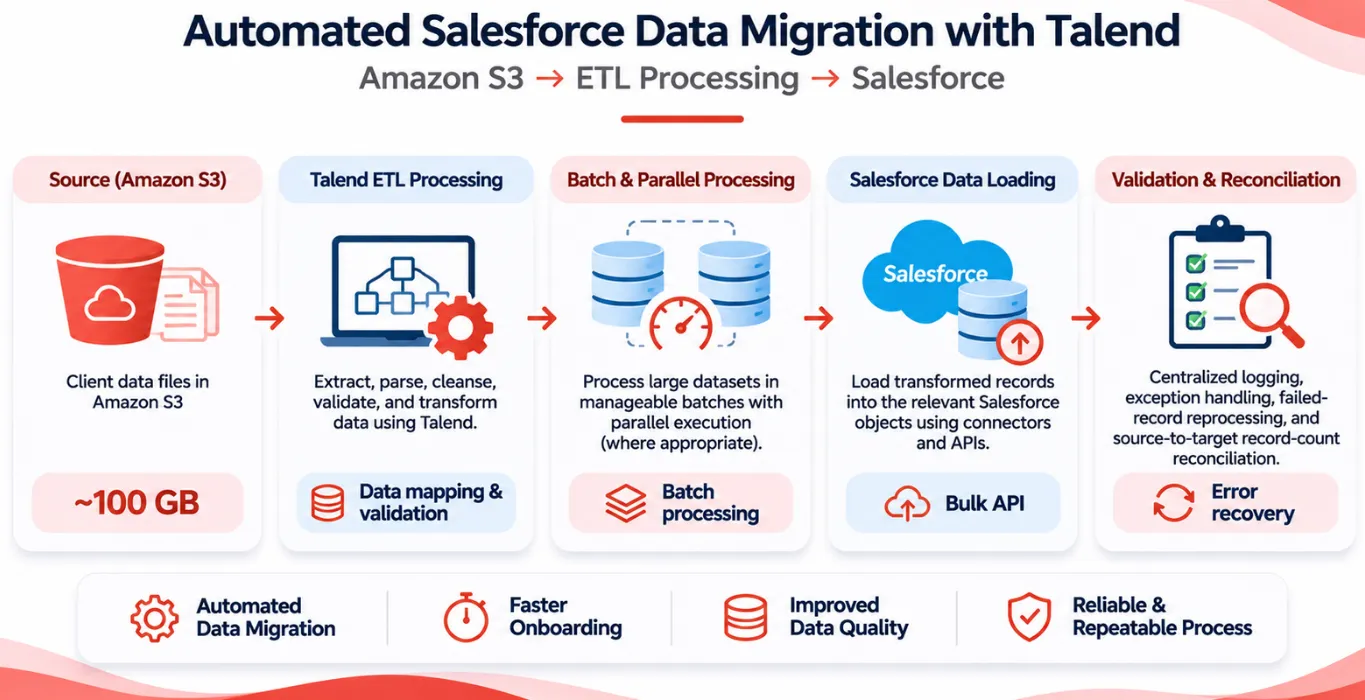
AwsQuality developed a Talend-based ETL framework to automate the migration of approximately 100 GB of data files from Amazon S3 to Salesforce. The solution was designed around five key components to support efficient data processing, controlled loading, and reliable migration management.
Amazon S3 Data Extraction
Established connectivity between Talend and Amazon S3 to retrieve source files from designated storage buckets. File-level processing was implemented to support the efficient handling of large datasets.
Data Processing and Transformation
Developed Talend jobs to parse, cleanse, validate, and transform source data. Source fields were mapped to the corresponding Salesforce objects and fields, with handling for null values, data type conversions, and formatting inconsistencies.
Optimized Batch Processing
Divided large datasets into manageable processing batches to support controlled execution. Parallel processing was configured where appropriate, alongside memory utilization optimization and batch-level tracking to monitor migration progress.
Salesforce Data Loading
Integrated Talend with Salesforce through suitable connectors and APIs to load transformed records into the relevant Salesforce objects. Salesforce Bulk API capabilities were used where supported and appropriate, with API responses captured to track successful and failed records.
Error Handling, Logging, and Reconciliation
Implemented centralized logging and exception handling to capture failed records and error details. The framework supported controlled reprocessing of failed batches and source-to-target record-count validation to help verify migration completeness.
04
Project Outcomes and Business Benefits
The Talend-based ETL framework established a structured and automated approach to migrating large volumes of data from Amazon S3 into Salesforce. The key outcomes included:
- Automated Data Migration: Established an automated pipeline for transferring approximately 100 GB of source files into Salesforce, reducing dependency on manual data processing.
- Improved Migration Efficiency: Used batch-based processing and optimized job execution to manage large datasets and support migration throughput.
- Improved Data Quality and Accuracy: Applied data validation, transformation, and reconciliation mechanisms to help maintain consistency between source files and Salesforce records.
- Reliable Error Handling and Recovery: Enabled failed-record tracking, centralized logging, troubleshooting, and selective batch reprocessing without restarting the complete migration.
- Simplified Client Onboarding: Created a reusable ETL framework to support subsequent client onboarding and data migration initiatives
- Scalable Migration Architecture: Established a flexible framework capable of accommodating additional data volumes, source files, and Salesforce objects as requirements evolve.
- Reduced Operational Complexity: Automated key extraction, transformation, loading, and monitoring activities to provide better control over the migration lifecycle.
05
Technology Stack
- Talend Data Integration
- Amazon Simple Storage Service (Amazon S3)
- Salesforce CRM
- Salesforce Bulk API
- AWS SDK / S3 Connectors
- Java
- SQL
- Talend Logging and Error Handling
06
Conclusion
By combining Talend Data Integration with Amazon S3 and Salesforce, AwsQuality developed an automated ETL framework to support the migration of approximately 100 GB of data files. The solution brought together data extraction, transformation, optimized batch processing, Salesforce integration, and structured error management to address the client's onboarding requirements.
Beyond the immediate migration, the framework established a reusable foundation for future client onboarding and Salesforce data migration initiatives. It helped transform a complex, resource-intensive process into a more controlled, automated, and scalable workflow.
Looking to Simplify Your Salesforce Data Migration?
Moving large volumes of data between platforms requires the right integration strategy, reliable data processing, and careful validation. AwsQuality helps businesses design and implement Salesforce data migration and integration solutions that support data accuracy, operational efficiency, and scalable business requirements.
Build with us
Have a similar challenge? Let’s map the solution.
Talk with our Salesforce and product team about portals, communities, integrations, and delivery that fits your roadmap.
More work
More case studies
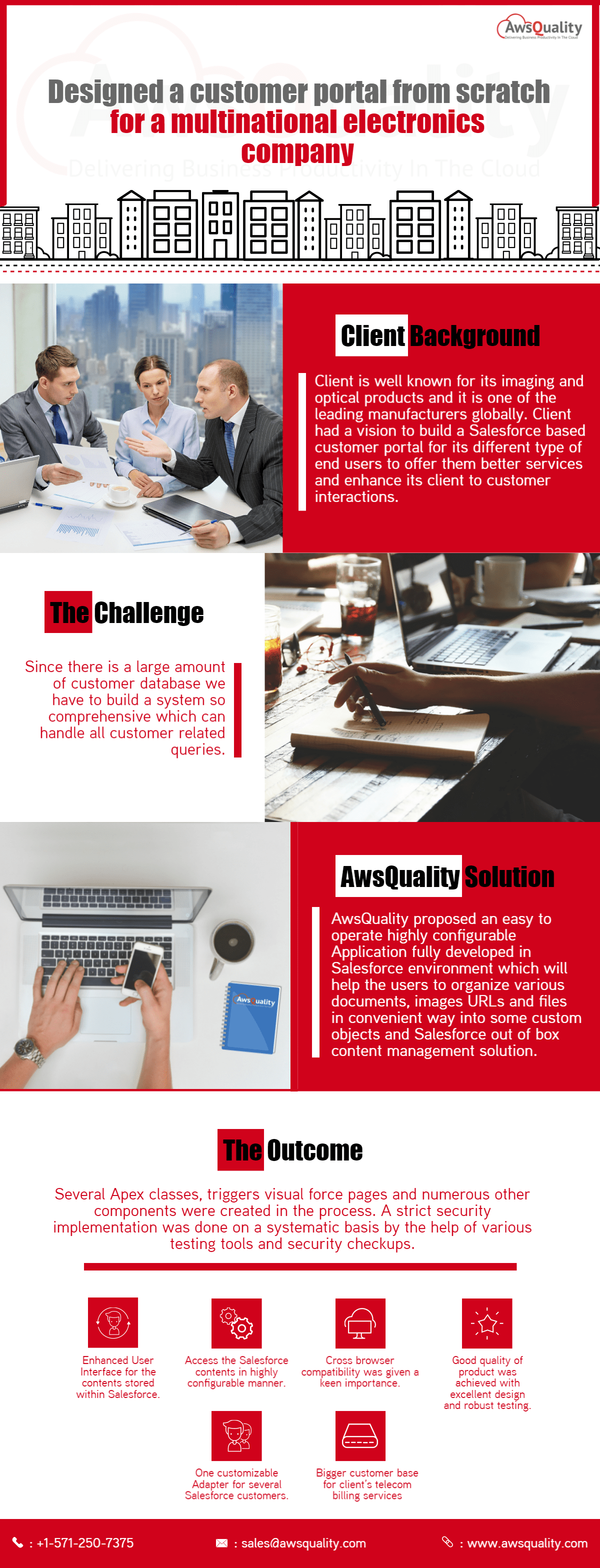 Electronics & Imaging Building a Salesforce Customer Portal (Experiance Cloud) for a Multinational Electronics Company Project Overview A multinational electronics manufacturer partnered with AwsQuality to develop a centralized, Salesforce-powered customer portal that could… Read case study
 Education Developed Salesforce Community Portal for A USA Based University Project Overview A large US-based university partnered with AwsQuality to streamline its admissions operations and improve applicant management… Read case study
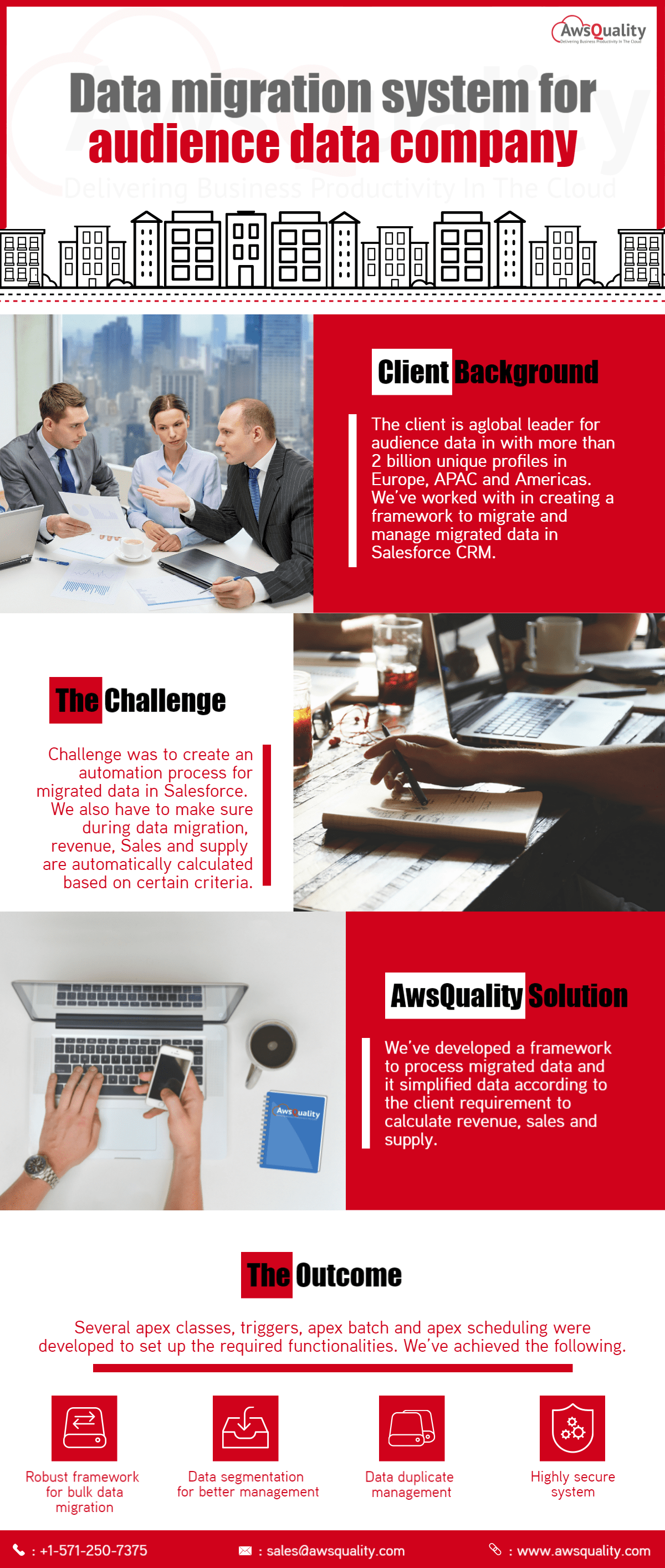 Other Developed Salesforce Data migration System for An Audience Company Client Background The client is a global leader for audience data in with more than 2 billion unique… Read case study
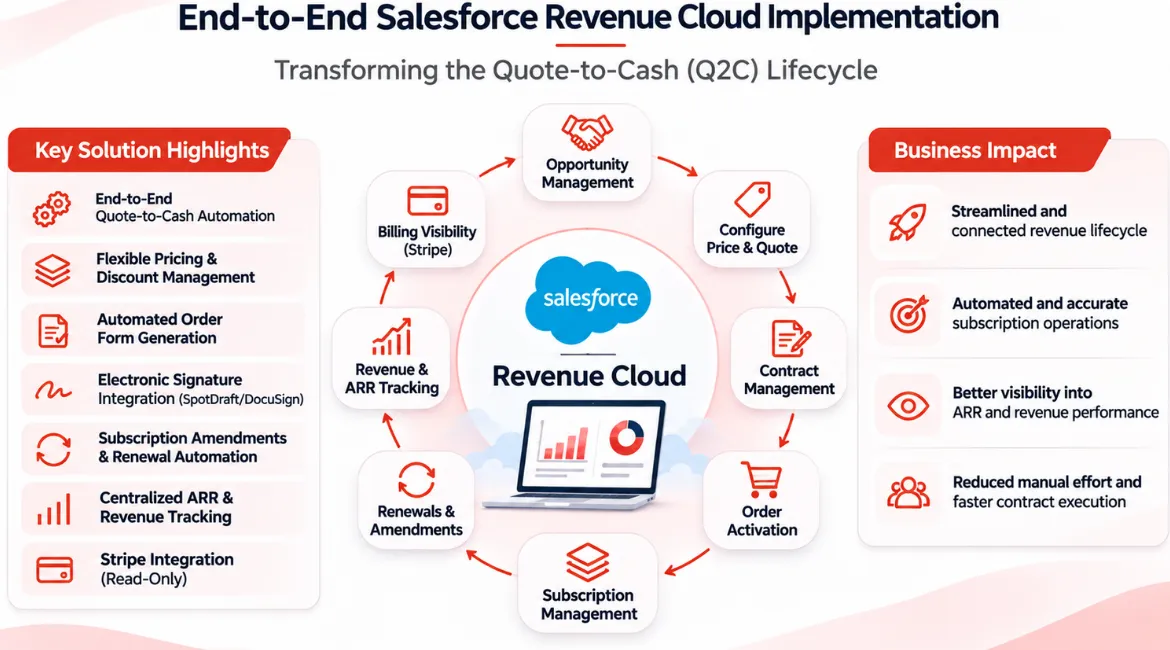 Other End-to-End Salesforce Revenue Cloud Implementation – Transforming the Quote-to-Cash Lifecycle Project Overview The client wanted to streamline its revenue management operations by bringing the entire Quote-to-Cash (Q2C) lifecycle… Read case study
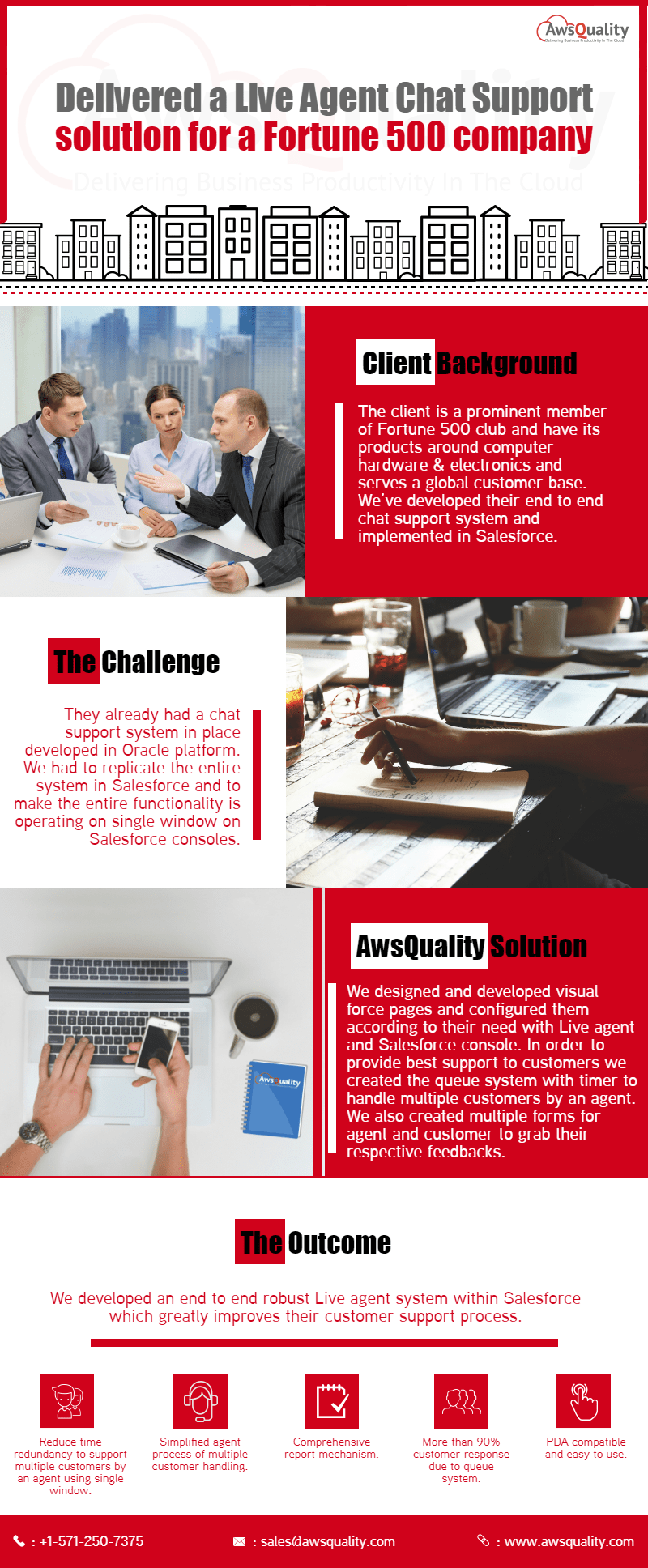 Other Implemented Salesforce Live Agent Chat Support for A Fortune 500 Company Customer Background The client is a prominent member of Fortune 500 club and have its products around computer… Read case study
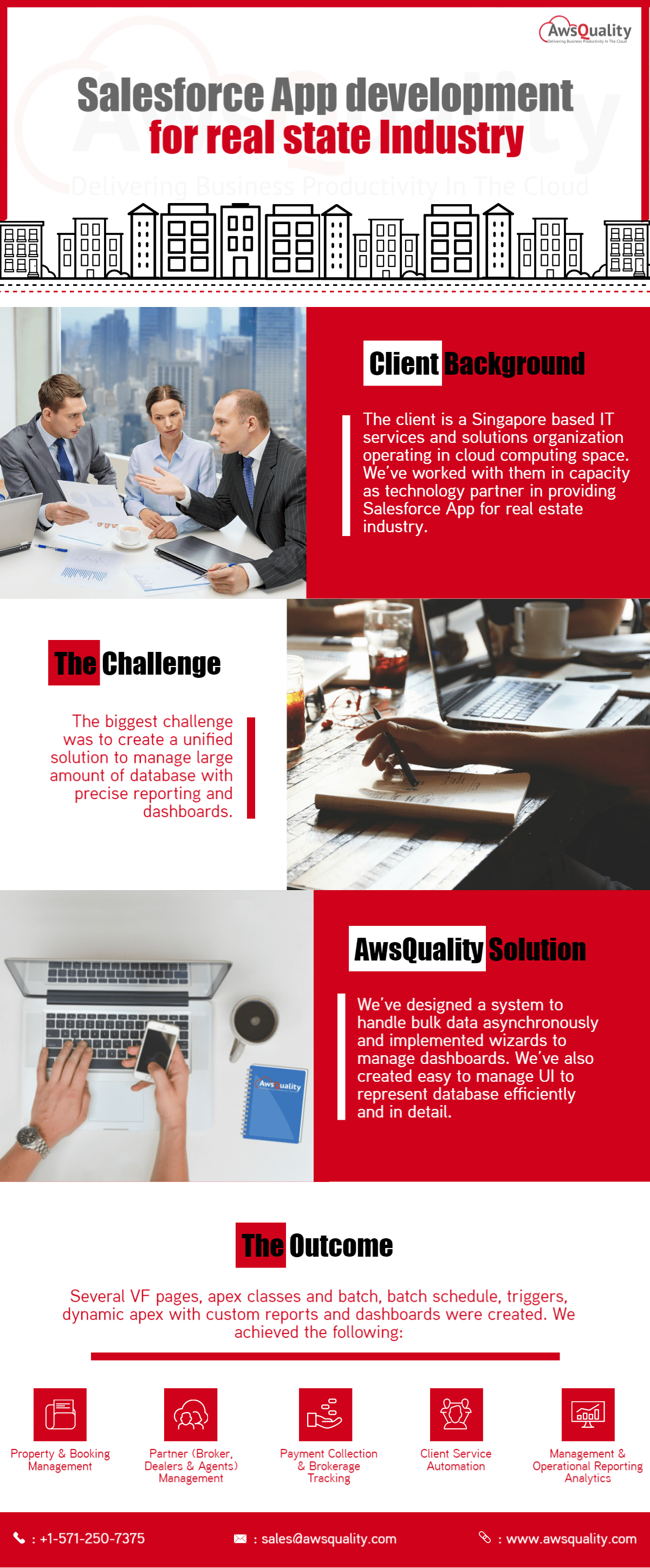 Real Estate Salesforce App Development for Real State Industry Client Background The client is a Singapore based IT services and solutions organization operating in cloud computing space.… Read case study
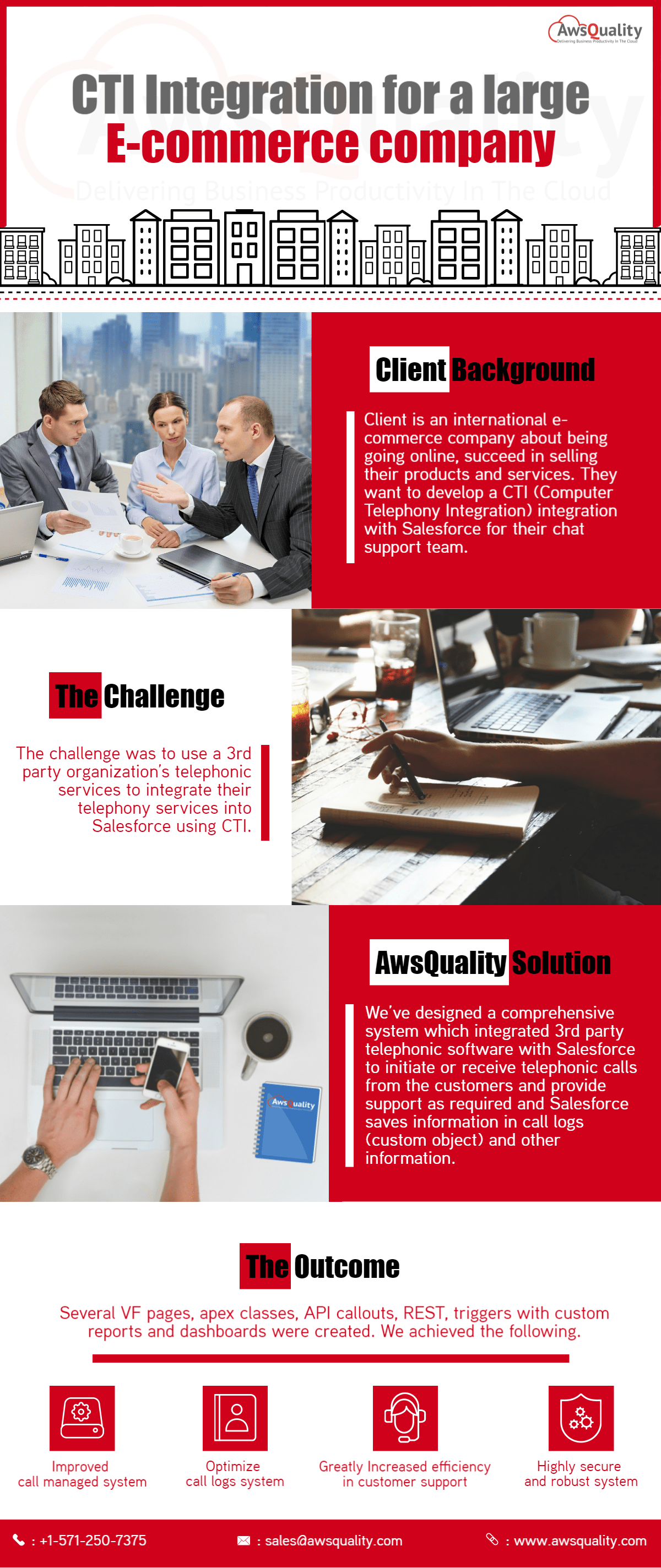 Retail & E-Commerce Salesforce CTI Integration for A large E-commerce Company Client Background Client is an international e-commerce company about being going online, succeed in selling their products and… Read case study
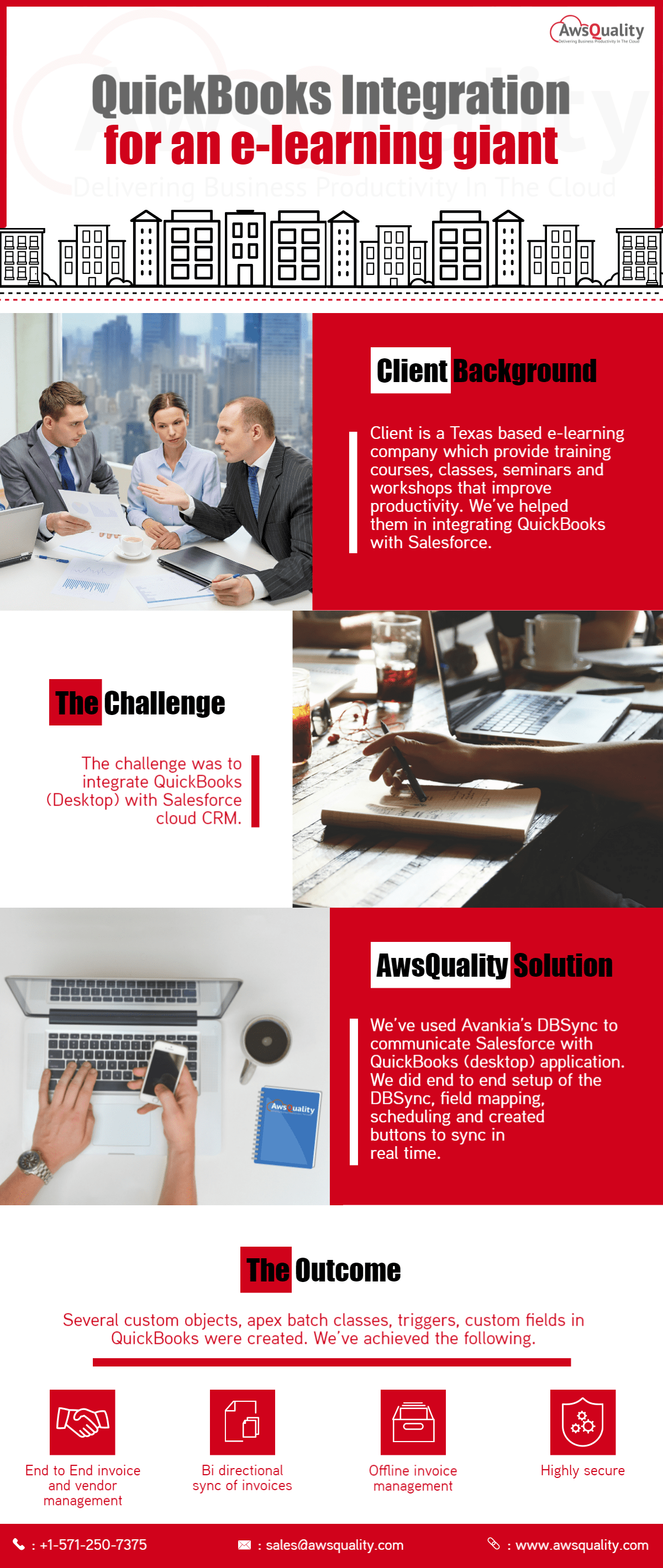 Financial Services Salesforce QuickBooks Integration for an E-learning Giant Client Background The client is a Texas based e-learning company which provide training courses, classes, seminars and workshops… Read case study
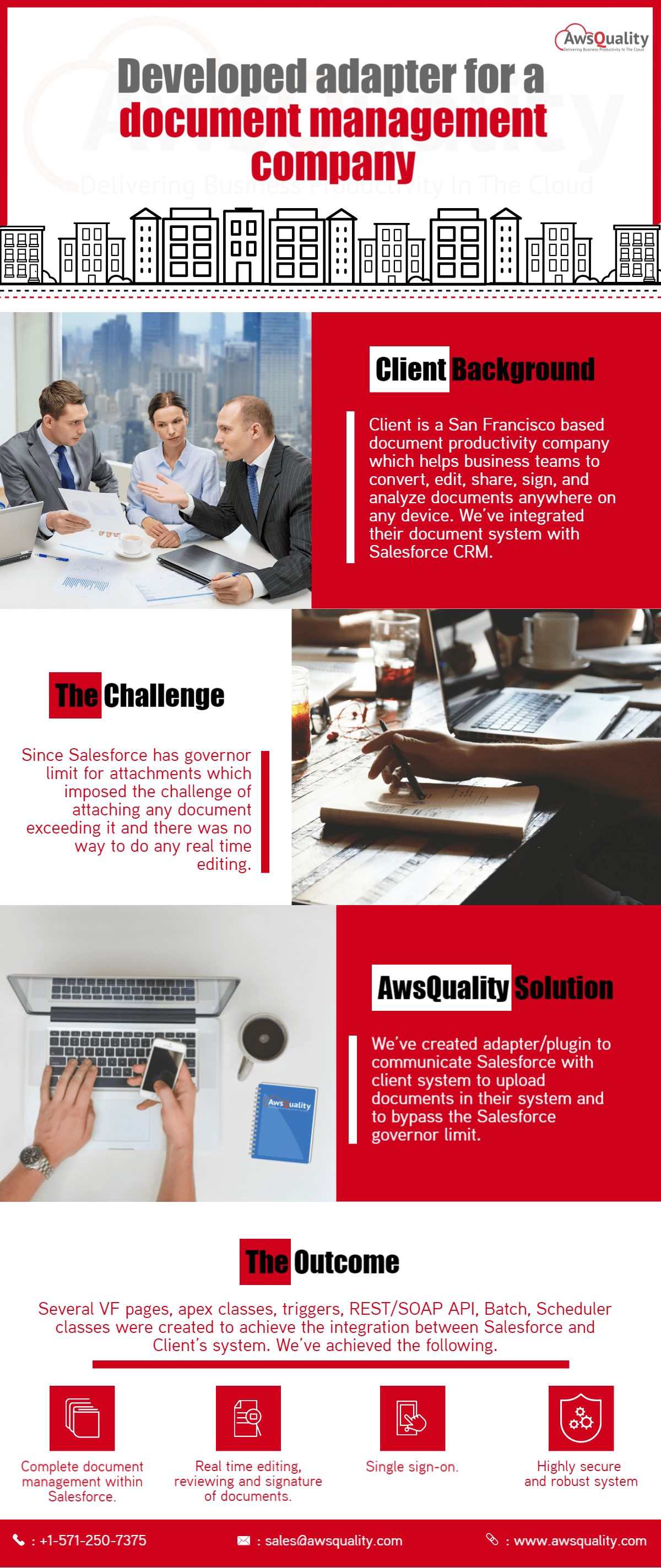 Other Salesforce Services for Document Management Company Client Background Client is a San Francisco based document productivity company which helps business teams to convert, edit,… Read case study
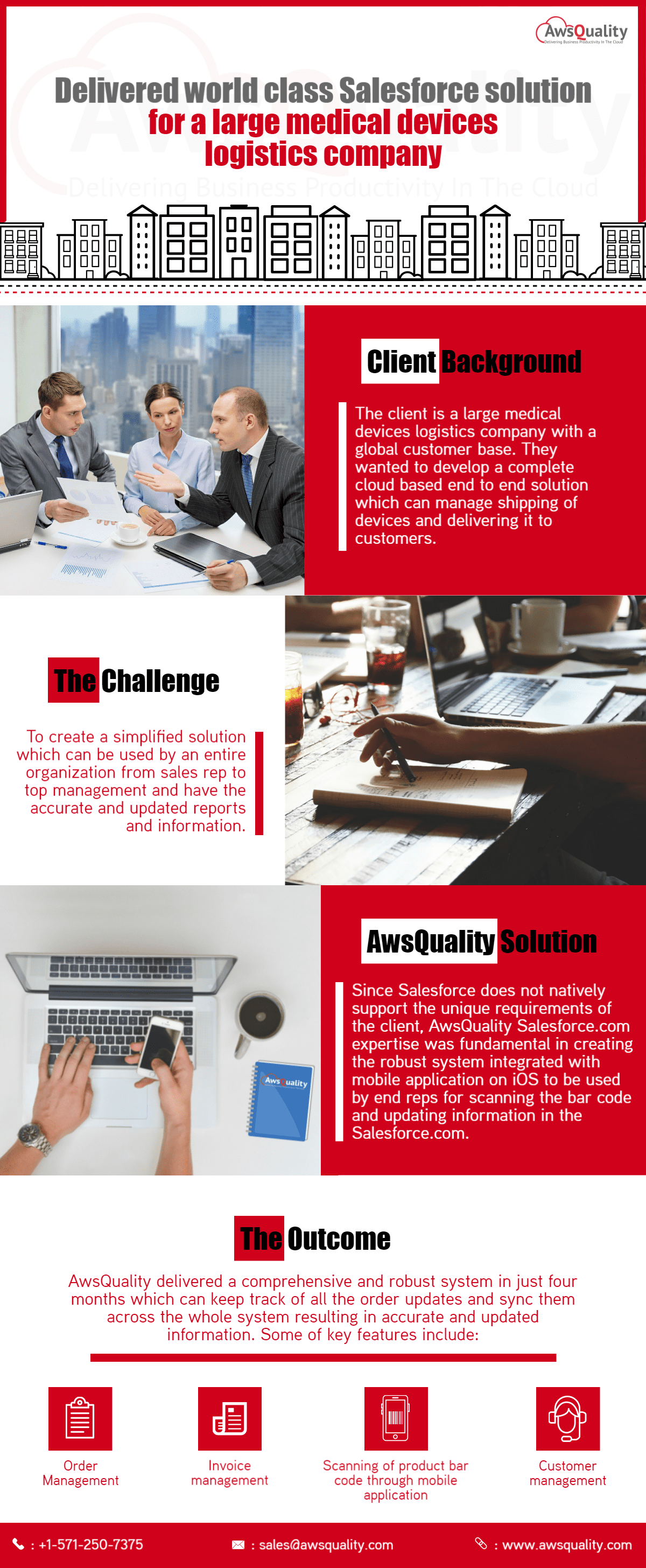 Healthcare Salesforce Solution for A Large Medical Devices Logistics Company The Background The client is a large medical devices logistics company with a global customer base. They wanted… Read case study
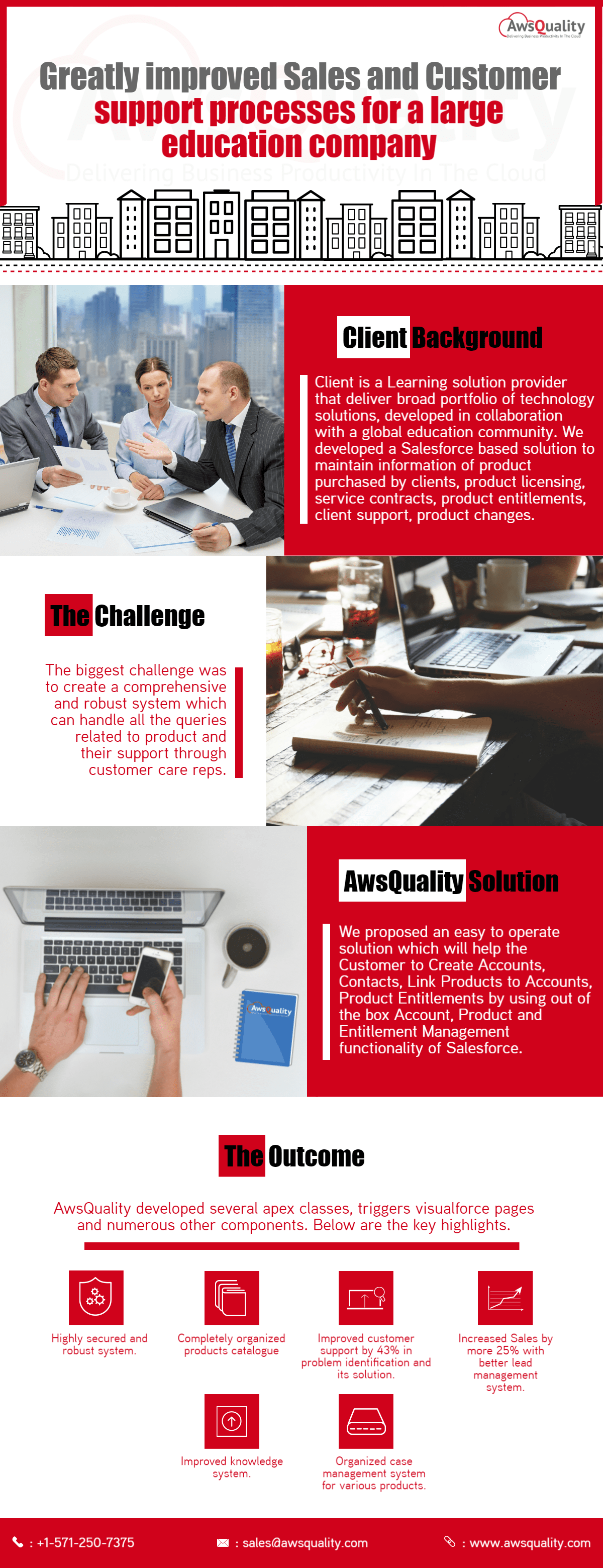 Education Salesforce Solutions for A Large Education Company Customer Background Client is a Learning solution provider that deliver broad portfolio of technology solutions, developed in collaboration… Read case study
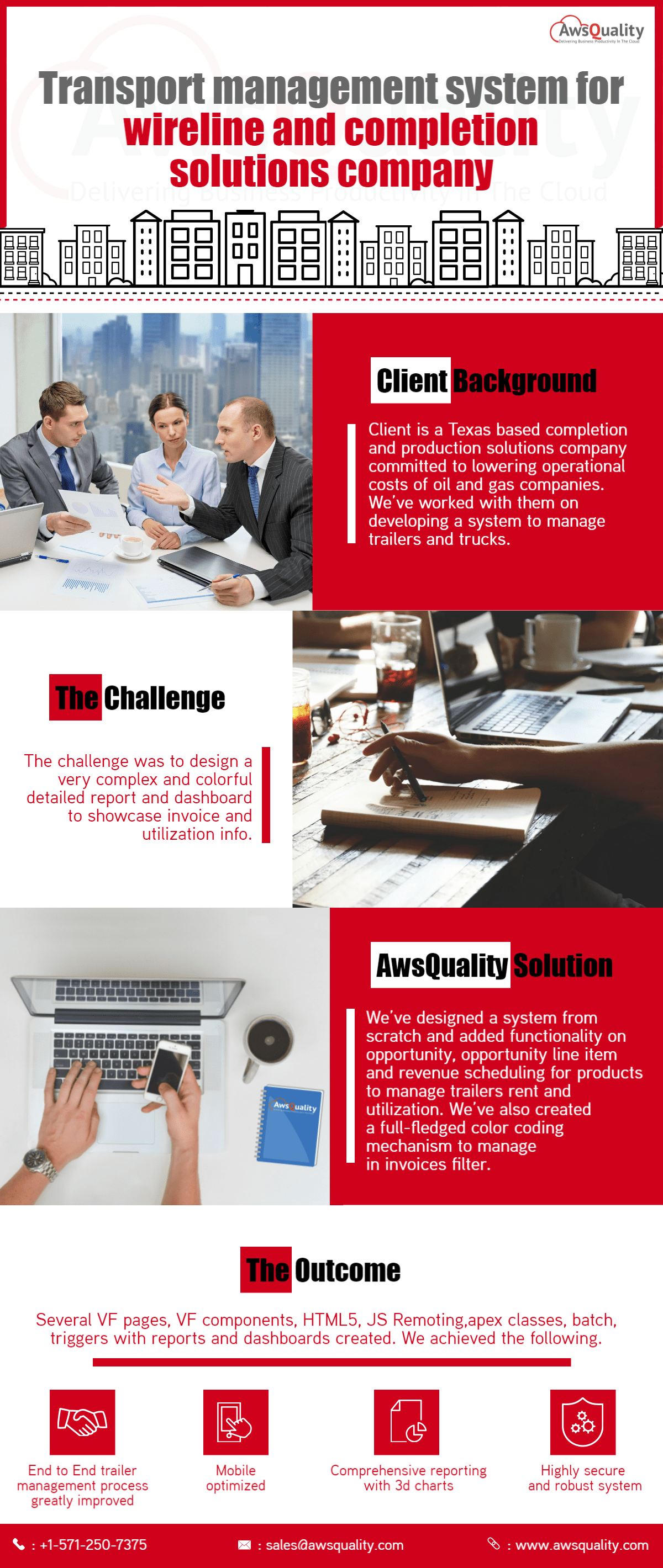 Manufacturing Salesforce Solutions for Transport Management Company Client Background Client is a Texas based completion and production solutions company committed to lowering operational costs of… Read case study