Cloud computing transformed how organizations build, deploy, and scale applications. Yet despite significant investments in cloud technologies, many businesses still struggle with slow software delivery, operational bottlenecks, inconsistent environments, rising cloud costs, and developer productivity challenges.
For years, traditional cloud delivery models have relied heavily on centralized operations teams managing infrastructure, deployments, security, and governance. While this approach worked during the early stages of cloud adoption, it is increasingly becoming a barrier to speed and innovation.
This is why many leading organizations are embracing Platform Engineering.
Platform Engineering is rapidly emerging as the next evolution of cloud operations, helping organizations improve developer productivity, standardize infrastructure, accelerate software delivery, and create scalable cloud environments.
In this article, we’ll explore what Platform Engineering is, how it differs from traditional cloud delivery, and why it is becoming a strategic priority for modern enterprises.
What is Platform Engineering?
Platform Engineering is the discipline of designing and building internal developer platforms (IDPs) that provide self-service infrastructure, tools, workflows, and environments for software development teams.
Instead of requiring developers to navigate complex infrastructure configurations, platform engineering creates a streamlined experience where teams can access everything they need through standardized platforms and automated workflows.
Think of Platform Engineering as creating a product for developers.
The platform team builds reusable capabilities that allow development teams to focus on delivering business value rather than managing infrastructure.
A modern internal platform may include:
- Self-service infrastructure provisioning
- CI/CD pipelines
- Kubernetes management
- Security controls
- Monitoring and observability
- Cloud governance
- Infrastructure as Code (IaC)
- Developer portals
- Cost management tools
The goal is to reduce complexity while increasing speed, consistency, and reliability.
Read: How to Build Secure AI Systems on Cloud Platforms (Complete Guide)
Understanding Traditional Cloud Delivery
Traditional cloud delivery models typically involve separate teams managing infrastructure, operations, security, networking, and development.
In this approach:
- Developers submit requests for cloud resources.
- Operations teams review and provision environments.
- Security teams perform compliance checks.
- Infrastructure changes require multiple approvals.
Deployments often depend on manual processes and cross-functional coordination.
While this model provides control, it frequently introduces delays and operational inefficiencies.
Common challenges include:
- Slow environment provisioning
- Ticket-driven workflows
- Limited scalability
- Inconsistent configurations
- Cloud sprawl
- Developer frustration
- Increased operational overhead
As organizations scale cloud adoption, these challenges become increasingly difficult to manage.
Why Traditional Cloud Delivery Is Reaching Its Limits
The demand for faster software delivery continues to grow.
Businesses now expect:
- Continuous innovation
- Frequent product releases
- Faster customer response times
- Improved developer productivity
- Better cloud cost management
Traditional cloud delivery struggles to support these expectations because infrastructure and operational processes often become bottlenecks.
Developers spend valuable time waiting for environments, troubleshooting infrastructure issues, or navigating complex approval processes.
As cloud environments become more sophisticated, these inefficiencies compound.
This is where Platform Engineering offers a better approach.
Also read: Zero Trust Security Model for Cloud and AI Applications
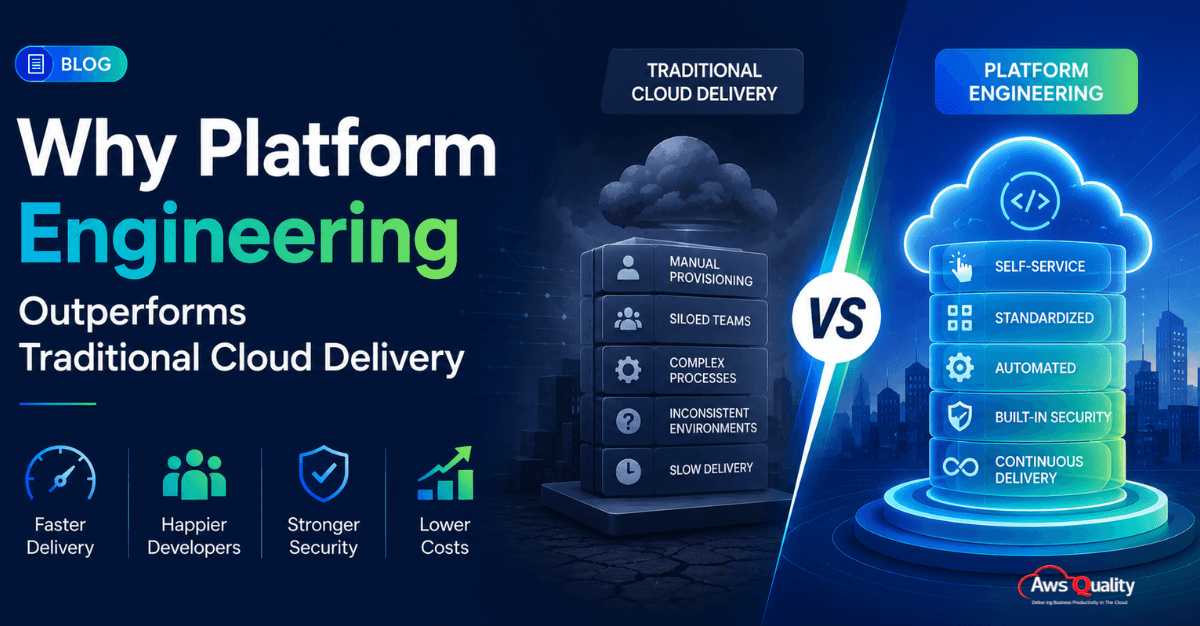
Platform Engineering vs Traditional Cloud Delivery
The fundamental difference lies in how infrastructure and operational services are delivered.
Traditional cloud delivery focuses on managing infrastructure.
Platform Engineering focuses on enabling developers.
Instead of infrastructure teams manually fulfilling requests, platform teams build reusable services that developers can access independently.
Traditional Cloud Delivery
- Ticket-based infrastructure requests
- Manual provisioning processes
- Centralized operational control
- Limited self-service capabilities
- Slower deployment cycles
- High operational overhead
Platform Engineering
- Self-service developer experience
- Automated infrastructure provisioning
- Standardized environments
- Integrated security and governance
- Faster deployment cycles
- Improved scalability
The result is a more efficient operating model that aligns with modern software delivery requirements.
How Platform Engineering Improves Developer Productivity
One of the biggest advantages of Platform Engineering is its impact on developer productivity.
Research consistently shows that developers spend significant time on activities unrelated to writing software.
These include:
- Infrastructure configuration
- Environment management
- Deployment troubleshooting
- Security compliance tasks
- Operational support
Platform Engineering reduces these distractions by providing pre-approved, automated workflows.
Developers gain access to ready-to-use environments and infrastructure resources without waiting for manual intervention.
This allows engineering teams to focus more time on building products and less time managing operational complexity.
Check out: How AI + Cloud Drives Business Growth and Efficiency
Accelerating Software Delivery
Speed is a competitive advantage.
Organizations that deliver software faster can respond more effectively to market opportunities, customer feedback, and business requirements.
Platform Engineering accelerates delivery through automation and standardization.
Teams can:
- Provision environments in minutes instead of days
- Deploy applications faster
- Reduce release risks
- Improve deployment consistency
- Increase development velocity
When developers can move quickly without sacrificing quality or security, organizations gain a significant competitive advantage.
Built-In Security and Compliance
Security often becomes a bottleneck in traditional cloud environments.
Teams must navigate security reviews, compliance approvals, and governance processes before deploying changes.
Platform Engineering shifts security earlier in the development lifecycle.
Security controls are embedded directly into the platform.
Examples include:
- Automated compliance checks
- Identity and access controls
- Infrastructure policies
- Security scanning
- Audit logging
This approach, often called “secure-by-design,” improves both security and delivery speed.
Developers can innovate while remaining compliant with organizational requirements.
Better Cloud Cost Optimization
Cloud costs continue to rise for many organizations.
Traditional delivery models often lack visibility and governance, leading to:
- Overprovisioned resources
- Idle infrastructure
- Duplicate environments
- Inefficient workloads
Platform Engineering introduces standardized resource management and governance controls.
Organizations gain:
- Improved cost visibility
- Better resource utilization
- Automated optimization
- Cost accountability
This helps reduce cloud waste while improving operational efficiency.
Also check: Cloud Migration Guide – From Legacy Systems to Cloud
The Role of Internal Developer Platforms (IDPs)
At the center of Platform Engineering is the Internal Developer Platform.
An IDP acts as a centralized layer that abstracts infrastructure complexity from developers.
Instead of interacting directly with multiple cloud services, developers access a unified platform that provides:
- Infrastructure templates
- Deployment automation
- Service catalogs
- Monitoring dashboards
- Security policies
This significantly improves the developer experience while maintaining organizational standards.
Platform Engineering and Kubernetes
Kubernetes has become a key driver of Platform Engineering adoption.
While Kubernetes offers powerful orchestration capabilities, it also introduces complexity.
Many developers do not want to become Kubernetes experts.
Platform Engineering simplifies Kubernetes adoption by providing:
- Standardized deployment workflows
- Managed cluster access
- Automated scaling
- Built-in monitoring
- Security controls
This allows teams to leverage Kubernetes without managing its underlying complexity.
Why Enterprises are Investing in Platform Engineering
Organizations adopting Platform Engineering report several business benefits:
Faster Time-to-Market
Automation reduces delays and accelerates software delivery.
Improved Developer Experience
Developers spend more time creating value and less time managing infrastructure.
Increased Operational Efficiency
Reusable platforms reduce duplication and manual effort.
Better Governance
Security, compliance, and cloud policies become standardized.
Higher Scalability
Organizations can support larger development teams without proportional increases in operational resources.
These advantages make Platform Engineering increasingly attractive for enterprises pursuing digital transformation initiatives.
Check: Accelerating Digital Transformation in IT with Salesforce DevOps Center and MuleSoft
Is Platform Engineering Right for Every Organization?
Not necessarily.
Smaller organizations with limited infrastructure complexity may not require a dedicated platform engineering function.
However, Platform Engineering becomes highly valuable when organizations:
- Operate multiple development teams
- Manage complex cloud environments
- Deploy software frequently
- Use Kubernetes extensively
- Need stronger governance and standardization
- Struggle with developer productivity
The larger and more complex the organization becomes, the greater the potential benefits.
The Future of Cloud Operations
Platform Engineering represents a significant shift in how organizations approach cloud operations.
Rather than treating infrastructure as a service managed by operations teams, organizations are increasingly treating platforms as products designed for developers.
This shift aligns with broader trends including:
- Developer experience (DevEx)
- Platform-as-a-Product
- Infrastructure as Code
- Cloud-native development
- AI-assisted operations
- Self-service engineering
As software delivery continues to accelerate, Platform Engineering is expected to become a foundational component of modern cloud strategies.
Ready to unlock the full value of cloud computing? Discover how AwsQuality’s Cloud Solutions can help you migrate, optimize, and scale with confidence.
Final Thoughts
Traditional cloud delivery helped organizations begin their cloud transformation journeys, but today’s business environment demands greater speed, scalability, and efficiency.
Platform Engineering addresses these challenges by creating self-service platforms that simplify infrastructure management, improve developer productivity, strengthen governance, and accelerate software delivery.
Organizations that invest in Platform Engineering are not simply modernizing cloud operations—they are creating a foundation for faster innovation, better developer experiences, and long-term business growth.
As cloud environments continue to evolve, Platform Engineering is quickly becoming the preferred model for organizations seeking to maximize the value of their cloud investments.
 Bio
Bio