The UAE has quietly become one of the most digitally ambitious business environments in the world. From the free zones of Dubai to the industrial corridors of Abu Dhabi, companies here are investing in technology at a pace that outstrips most comparable markets globally. Salesforce sits at the centre of many of those investments — and for good reason. As a CRM platform, it manages customer relationships, sales pipelines, service operations, and marketing campaigns with a depth that few competitors can match.
But Salesforce on its own is only part of the story. The real transformation happens when Salesforce is connected to the other systems a business runs on — its ERP, its finance platform, its e-commerce engine, its marketing tools, its logistics software. Integration is what turns Salesforce from a standalone CRM into the central nervous system of your entire operation.
For UAE businesses specifically, integration carries additional weight. Many companies here operate across multiple entities, currencies, and regulatory environments. They manage relationships with government bodies, logistics partners, and international clients simultaneously. Their systems often reflect that complexity — a mix of global platforms and regionally specific tools that need to work together seamlessly. Getting integration right isn't a technical luxury; it's a business necessity.
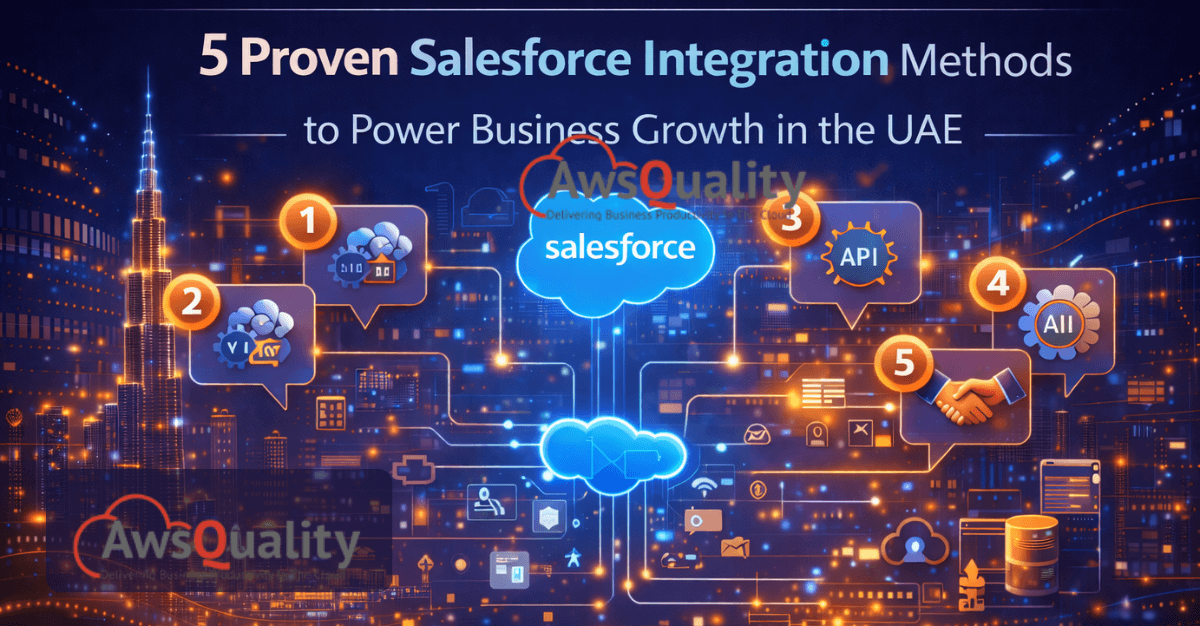
This article covers the five most proven Salesforce integration methods being used by growth-focused businesses in the UAE today, what each one involves, and how to decide which approach is right for your situation.
Why Integration Is Non-Negotiable for UAE Businesses
Before diving into the methods, it's worth being direct about what happens when integration is absent. Without it, your teams work in silos. Your sales team closes a deal in Salesforce but finance is still working from a separate system and doesn't know about it until someone sends an email. Your customer service team can't see a client's purchase history because it lives in a different platform. Your marketing team sends a campaign to customers who already churned because the data hasn't synced.
In the UAE's fast-moving commercial environment — where customer expectations are high, competition is intense, and business relationships are built on responsiveness — these gaps are expensive. Integration eliminates them by ensuring that data flows automatically between systems, teams have a single source of truth, and processes that span multiple platforms happen without manual intervention.
The UAE's Vision 2031 digital transformation agenda has also accelerated enterprise technology investment across the private and public sectors alike. Businesses that integrate their platforms effectively are better positioned to scale, to meet compliance requirements, and to deliver the kind of seamless customer experience that the market increasingly demands.
Read: 5 Ways- Salesforce Can Improve Your Customer Experience
Method 1: API-Led Connectivity
API-led connectivity is the gold standard of Salesforce integration — flexible, scalable, and built for long-term growth. An API, or Application Programming Interface, is essentially a set of rules that allows two software systems to communicate with each other in real time. When you connect Salesforce to another platform via API, data flows between them instantly and automatically, without any manual export or import.
For UAE businesses, API-led connectivity is particularly powerful because it scales gracefully. Whether you're connecting Salesforce to a single system today or building a network of ten integrated platforms over the next three years, APIs handle that complexity without requiring a fundamental rethink of your architecture.
MuleSoft, which is owned by Salesforce, is the leading platform for API-led integration in the enterprise space and has a strong presence among large UAE organisations. It allows businesses to build reusable APIs — meaning an API built to connect Salesforce with your ERP can be repurposed to connect Salesforce with your logistics platform, dramatically reducing development time and cost over the long run.
Practical applications in the UAE context include real-time synchronisation of customer data between Salesforce and government portals, live inventory updates flowing from warehouse management systems into Salesforce sales records, and automatic currency conversion and multi-entity financial data syncing across regional operations.
The investment required for API-led connectivity is higher than simpler integration methods, but for businesses with complex, multi-system environments — which describes a significant proportion of UAE enterprises — it is almost always the right long-term choice.
Also read: Salesforce Integration Guide for Businesses and Developers
Method 2: ERP Integration
For many UAE businesses, the most impactful Salesforce integration is the one that connects it to their ERP system — SAP, Oracle, Microsoft Dynamics, or one of the regional ERP platforms commonly used across the GCC. ERP systems are where the operational and financial backbone of a business lives: inventory, procurement, invoicing, payroll, and financial reporting. Salesforce is where customer relationships and revenue generation live. Connecting them creates a unified view of the business that neither system can provide alone.
Without ERP integration, the handoff between sales and operations is almost always manual and error-prone. A sales rep closes a deal in Salesforce. Someone then manually creates a purchase order or invoice in the ERP. Data entry errors creep in. Timing gaps cause customer service issues. Finance reports don't match sales reports. These are familiar problems for businesses of all sizes across the UAE, and ERP integration solves them at the root.
With a properly configured ERP integration, a closed Salesforce opportunity can automatically trigger invoice generation, inventory allocation, and delivery scheduling in the ERP — with no human intervention required. Customer credit limits and payment histories from the ERP become visible to sales reps inside Salesforce, allowing them to have more informed conversations. Finance and sales leadership see the same numbers in real time.
For UAE companies specifically, ERP integration also supports the multi-currency and multi-entity complexity that is common in this market. Businesses operating across Dubai, Abu Dhabi, and international free zones — or managing separate legal entities for different business lines — can use ERP integration to ensure that Salesforce reflects the financial reality of each entity accurately and automatically.
Check out: SAP and Salesforce Integration Guide
Method 3: Marketing Automation Integration
Salesforce's native CRM capabilities are built around managing existing relationships and active pipeline. But the journey that brings a prospect into that pipeline — awareness, interest, consideration — typically happens through marketing channels that live outside Salesforce. Connecting your marketing automation platform to Salesforce closes that gap and gives your revenue team visibility into the full customer journey from first touch to closed deal.
The most common integration in this category is between Salesforce and Marketing Cloud or Pardot (now Salesforce Marketing Cloud Account Engagement), both of which are native Salesforce products. But many UAE businesses also use HubSpot, Mailchimp, or regional marketing platforms, all of which can be connected to Salesforce through pre-built connectors or custom API integrations.
When this integration is working correctly, a lead generated by a LinkedIn campaign in Dubai automatically appears in Salesforce the moment they fill out a form, complete with their campaign source, content interactions, and lead score. Sales reps receive a notification and can see exactly what content that lead engaged with before reaching out. Closed-won deals feed back into the marketing platform so campaigns can be optimised based on what actually converts, not just what generates clicks.
For UAE businesses investing in digital marketing — and the numbers here are significant, with the UAE consistently ranking among the highest per-capita digital ad spend markets in the world — this integration ensures that marketing budgets are informed by sales outcomes and that the gap between marketing and sales teams is closed operationally, not just in strategy presentations.
Also check: The Role of Salesforce Marketing Cloud in Automating Customer Engagement
Method 4: E-Commerce and Payments Integration
The UAE's e-commerce market has grown at a remarkable pace, accelerated by changing consumer behaviour and a retail landscape that has embraced digital channels faster than almost any comparable market. For businesses that sell through both direct sales teams and digital storefronts, integrating their e-commerce platform with Salesforce is essential for maintaining a coherent view of the customer.
Without this integration, a customer who purchases online and then contacts your sales team for an upgrade or an add-on is treated as a stranger — the sales rep has no visibility into what they've already bought, when they bought it, or what their relationship with the brand looks like. With integration, that history is immediately visible in Salesforce, enabling more personalised and effective conversations.
Common integrations in this category connect Salesforce with platforms like Shopify, Magento, WooCommerce, and regional e-commerce solutions widely used across the GCC. Payment gateway integration — connecting platforms like Network International, Telr, or PayTabs (all prominent in the UAE payments landscape) — adds another layer, giving sales and finance teams real-time visibility into transaction statuses, payment failures, and revenue data directly within Salesforce.
For B2B businesses in the UAE using Salesforce to manage complex account relationships, e-commerce integration also enables self-service portals where clients can place orders, check delivery status, and manage their accounts — reducing the administrative burden on sales teams while improving the customer experience.
Check out: How Salesforce Commerce Cloud Can Help You Change Your E-Commerce Approach
Method 5: Third-Party App Integration via AppExchange
Not every integration requires custom development. Salesforce's AppExchange marketplace hosts thousands of pre-built applications and integration connectors, many of which are designed specifically for common business needs and regional requirements. For UAE businesses looking to extend Salesforce's capabilities without the time and cost of bespoke development, AppExchange is often the fastest and most cost-effective starting point.
Relevant categories for UAE businesses include document management and e-signature tools compliant with UAE electronic transactions law, WhatsApp Business integration (critically important in a market where WhatsApp is the dominant business communication channel), Arabic language support packages, VAT compliance tools built for the UAE's Federal Tax Authority requirements, and logistics and last-mile delivery integrations with regional carriers.
The advantage of AppExchange integrations is speed. Most can be installed and configured in days rather than weeks, with predictable costs and clear support structures. The trade-off is flexibility — pre-built connectors work well when your requirements match what the app was designed for, but they can become limiting if your processes are highly customised or your data model is complex.
A practical approach for many UAE businesses is to start with AppExchange for straightforward integrations and use custom API development for the connections that truly drive competitive differentiation. This balances speed and cost against the depth of integration that complex business processes require.
Choosing the Right Integration Approach for Your Business
The right integration strategy depends on three things: the complexity of your existing systems, the pace at which your business is growing, and the specific processes you need to connect. There is no universal answer, but there are some useful principles.
Start with the integrations that eliminate the most painful manual processes or data gaps in your current operation. For most UAE businesses, that means either ERP integration or marketing automation — the two connections that most directly affect revenue visibility and operational efficiency. Build from there in a sequence that reflects business priority, not technical convenience.
Invest in integration architecture early. Businesses that take a structured, API-led approach from the beginning avoid the technical debt that accumulates when integrations are built reactively, one at a time, without a coherent design. In a market growing as quickly as the UAE, that foundation pays dividends faster than most businesses expect.
And work with consultants who understand both Salesforce and the UAE's specific business environment. Regional compliance requirements, local platform preferences, Arabic language support, and the multi-entity complexity common among UAE businesses are all factors that a purely global perspective can miss.
Also check: 5 Compelling Reasons to Hire Salesforce Development Service in UAE
Frequently Asked Questions
Q1: Do I need all five integration methods, or just some of them?
You don't need all five. Start with the one or two integrations that eliminate your biggest data gaps — usually ERP or marketing automation — and build from there as your business grows.
Q2: How long does a Salesforce integration project typically take in the UAE?
AppExchange integrations can go live in days. Custom API integrations typically take six to twelve weeks. Large MuleSoft implementations for enterprise organisations can run three to six months depending on complexity.
Q3: Is Salesforce integration expensive for small and mid-sized businesses in the UAE?
Not necessarily. AppExchange connectors are affordable and require minimal development. Even a single well-executed integration — connecting Salesforce to your accounting software — often pays for itself within months through time saved and errors eliminated.
Q4: How does VAT compliance in the UAE affect Salesforce integration?
Any integration involving invoicing or financial data must be configured to capture and report UAE VAT correctly. Several AppExchange apps are built specifically for FTA compliance. Always have someone familiar with UAE VAT requirements review the data flows before go-live.
Q5: Can Salesforce integrate with WhatsApp for UAE business communication?
Yes. Salesforce supports native WhatsApp integration through its Messaging feature, and several AppExchange apps offer more advanced functionality including automated messages, chatbots, and conversation history logged directly against Salesforce records.
Q6: What is the difference between Salesforce integration and Salesforce customisation?
Integration connects Salesforce to external systems so data flows between them. Customisation changes how Salesforce itself is configured — its fields, layouts, and automation. Most businesses need both working together.
Q7: Do UAE businesses need a local Salesforce partner for integration projects?
Not always, but it helps. A local partner brings familiarity with UAE-specific requirements — Arabic language support, VAT compliance, regional ERP platforms, and local payment gateways — that a purely global partner may overlook.
Q8: How do I know if my current Salesforce integration is working correctly?
Watch for data syncing on schedule, consistent record counts across systems, and no duplicate records. If your teams are regularly correcting data that should be syncing automatically, your integration needs attention.
 Bio
Bio