Why AI is no longer optional for customer service
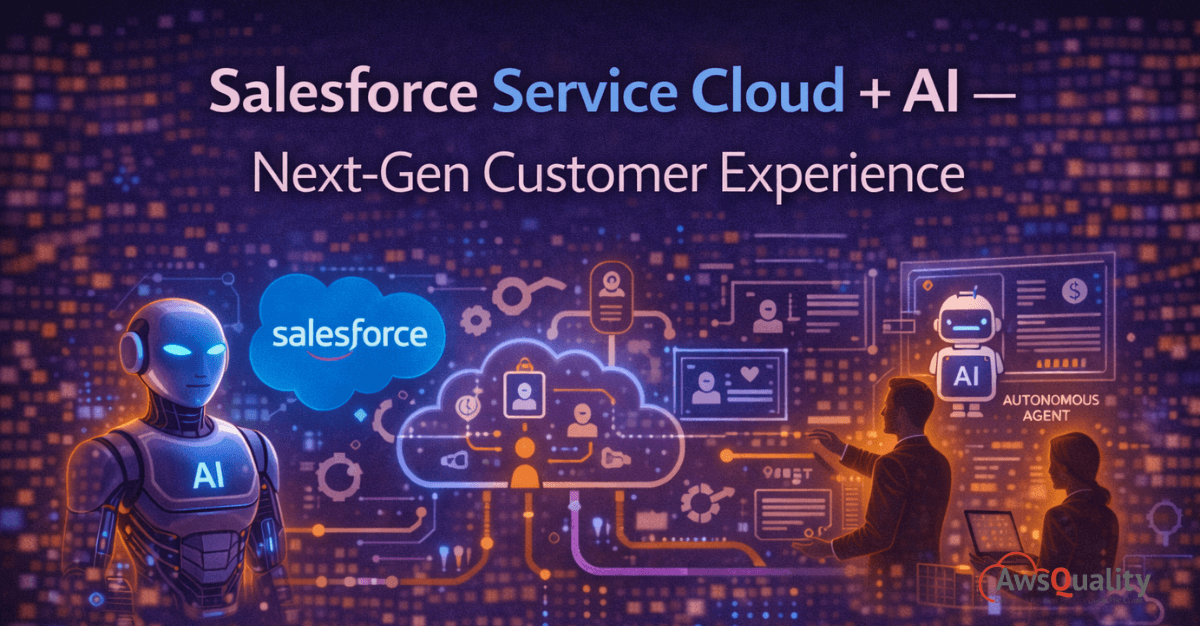
AI in service is no longer a ?nice to have.? Businesses are using generative AI, predictive models, and autonomous agents to reduce handle time, resolve repetitive tickets, and deliver tailored experiences at scale. Built-in AI features let support teams pull context from unified customer profiles, generate suggested replies or next actions, and automate routine follow-ups?freeing human agents for high-complexity work. Recent product releases show the platform evolution toward autonomous service agents that act on behalf of teams, not just suggest text.
What ?Service Cloud + AI? actually delivers (concrete capabilities)
Modern Service Cloud AI stacks typically combine these layers:
- Generative assistants for agents and customers ? produce draft replies, create knowledge articles, and summarize long case histories to speed resolution.
- Autonomous AI agents ? end-to-end agents that can triage, resolve standard cases, and perform follow-ups without human prompts.
- Unified customer data (Data Cloud) ? a single, real-time customer profile that powers personalization and keeps AI grounded in trusted data. Recent growth numbers and innovations underline Data Cloud?s role as the ?activation layer? for AI.
- Cross-system integrations and secure LLM access ? partnerships and integrations with leading LLM providers enable better models while preserving compliance and data control.
High-impact use cases you can offer clients
When selling or building Service Cloud + AI solutions, emphasize clear ROI use cases:
- Automated billing and returns handling ? generative AI drafts responses and autonomous agents execute routine refunds or status checks.
- Proactive issue detection & outreach ? combine real-time data streams with predictive scoring to identify at-risk customers and trigger outreach before they complain.
- Agent augmentation ? AI suggests next best actions, surfaces relevant KB articles, or prepares personalized responses, improving agent productivity and CSAT.
- Employee (HR) service ? extend the same agent model to internal service scenarios (onboarding, benefits), reducing HR ticket load and improving experience.
Read: The Ultimate Guide to AgentForce – Features, Benefits and Industry Use Cases
Risks and governance ? what leaders ask first
AI brings big benefits but also risk. Clients will want answers to questions about:
- Data privacy & residency ? how customer data is used by LLMs and whether it leaves controlled environments.
- Hallucinations & accuracy ? steps for grounding generative responses with trusted Data Cloud records and human-in-the-loop verification.
- Compliance in regulated industries ? using specialized model providers and stricter guardrails for finance, healthcare, and legal.
Frame these as features you deliver: secure zero-copy integrations, auditable prompts, and explainability reporting.
Implementation blueprint ? 6 practical steps
Make your blog actionable with a pragmatic rollout plan clients can follow:
- Audit for AI readiness ? inventory data sources, KB health, common ticket types, and SLAs. This reveals quick wins and risky areas.
- Create a trusted data layer ? implement Data Cloud (or equivalent) to centralize identity resolution and real-time signals; this is the foundation for personalization.
- Start with agent augmentation ? deploy generative assistance for agents (suggested replies, summaries) before full automation?measure accuracy and agent satisfaction.
- Pilot autonomous agents for low-risk tasks ? pick high-volume, low-complexity workflows (order status, password resets) and apply strict rollback and human-verify rules.
- Integrate observability & governance ? logging, prompt auditing, and feedback loops to tune models and prevent drift.
- Scale by vertical ? once pilots prove value, expand to industry-specific scenarios (finance, healthcare) using specialized models and tighter compliance chains.
Measuring success ? the right KPIs to track
Track metrics that tie directly to business outcomes:
- First contact resolution (FCR) and average handle time (AHT) ? show operational efficiency.
- Agent productivity / cases per agent ? quantify augmentation impact.
- CSAT & NPS ? ensure automation improves customer sentiment.
- Cost per ticket ? critical for executive buy-in.
- Model accuracy / hallucination rate ? technical health for AI features.
Also read: Salesforce Sales Cloud vs Service Cloud – Key Differences & Benefits
Pricing and packaging ideas for your services business
When you sell Service Cloud + AI implementations, consider tiered packages:
- Assess & Ready ? audit, data readiness, and governance playbook.
- Augment ? agent assist, knowledge automation, training.
- Automate ? autonomous agent pilots, process automation, integration.
- Optimize ? observability, continuous improvement, vertical customization.
Offer performance-based pricing (e.g., share of ticket cost savings) for customers who need low upfront risk.
Final thoughts ? where this is headed
AI is moving from assistant features to autonomous agents that can take action across systems. Platforms are increasingly offering secure, integrated data layers and partnerships with major LLM providers to support regulated workloads and higher accuracy. For service teams, that means faster resolutions, smarter automation, and a new balance of human + AI work. Recent platform updates and partner announcements show this direction clearly?and clients will expect vendors who can deliver both the tech and the governance.
Frequently asked questions
- What is Service Cloud AI?
Service Cloud AI combines Salesforce Service Cloud with generative and predictive AI capabilities to automate support tasks, assist agents, and deliver personalized customer experiences. - How does generative AI improve customer service?
Generative AI can draft responses, summarize case histories, suggest next actions, and create knowledge articles, helping support teams resolve issues faster and more accurately. - What are autonomous AI agents in customer service?
Autonomous AI agents are AI-powered systems that can automatically triage support requests, resolve common issues, and perform follow-ups without requiring manual intervention. - How does Data Cloud enhance Service Cloud AI?
Data Cloud creates a unified, real-time customer profile by combining data from multiple systems. This helps AI deliver personalized recommendations and more accurate responses. - What are the main benefits of using Service Cloud with AI?
Key benefits include faster response times, reduced ticket volumes, improved agent productivity, personalized customer interactions, and lower support costs. - Which customer service processes can be automated using AI?
Common use cases include order status inquiries, billing questions, password resets, returns processing, and automated follow-ups after support interactions. - How can companies ensure AI-generated responses are accurate?
Organizations can reduce errors by grounding AI responses in trusted data sources, implementing human review workflows, and continuously monitoring AI performance. - What are the biggest risks of implementing AI in customer service?
The main risks include data privacy concerns, inaccurate AI responses (hallucinations), and compliance challenges in regulated industries. - How should businesses start implementing Service Cloud AI?
Companies should begin with an AI readiness assessment, create a unified data layer, introduce AI assistance for agents, and then gradually pilot autonomous automation. - What KPIs should businesses track when using AI in customer support?
Important metrics include first contact resolution (FCR), average handle time (AHT), customer satisfaction (CSAT), cost per ticket, and agent productivity.
 Bio
Bio