The Hidden Risks of Agentic AI in Enterprise Workflows and How to Manage Them
 Mohammad Usman 26 min read
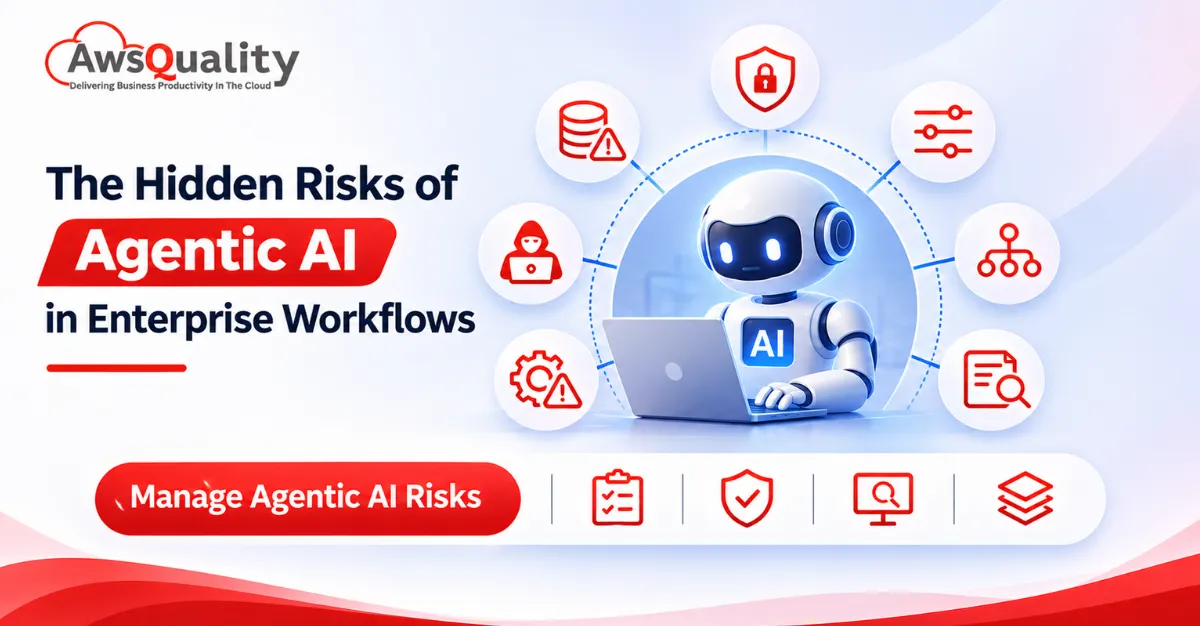
Artificial intelligence is changing how enterprises manage business operations, customer interactions, and decision-making. While traditional AI applications primarily analyze information and generate recommendations, agentic AI takes automation a step further. It enables AI agents to plan tasks, interact with enterprise applications, use connected tools, and execute actions with varying levels of autonomy.
For businesses, this creates significant opportunities. An AI agent could qualify sales leads, respond to customer inquiries, retrieve information from enterprise databases, process service requests, or coordinate activities across multiple business applications.
However, greater autonomy also introduces new risks.
An AI agent with access to business systems can do more than generate an inaccurate response. It might access sensitive information, execute an unauthorized action, modify customer records, trigger an incorrect workflow, or pass an error to another connected system.
These risks become more complex when multiple AI agents operate together or when agents interact with third-party applications, APIs, and enterprise data sources.
For CIOs, CTOs, CISOs, and business leaders, the challenge is no longer simply determining where agentic AI can improve productivity. It is understanding how to introduce autonomy without compromising security, privacy, compliance, operational reliability, or business accountability.
In this guide, we explore the hidden risks of agentic AI in enterprise workflows, practical examples of how these risks can affect businesses, and strategies organizations can use to manage them.
What is Agentic AI and How Does It Work in Enterprise Workflows?
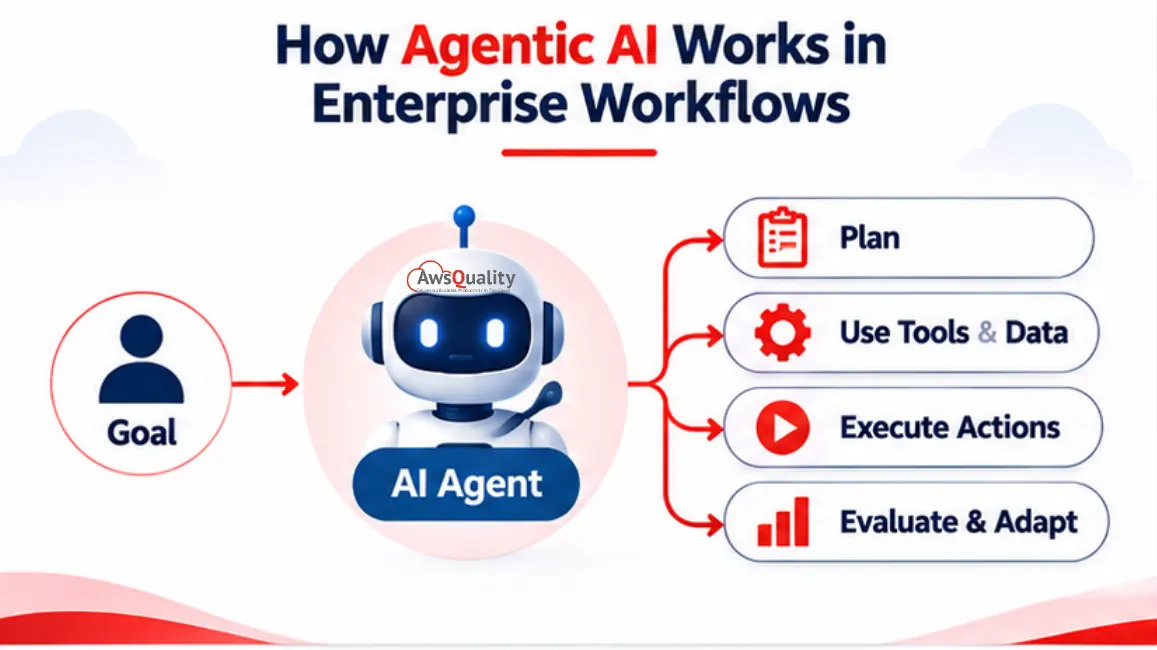
Agentic AI refers to AI systems that can independently plan and execute multiple steps to achieve a defined objective. Instead of responding only to individual prompts, these systems can interpret goals, gather information, select tools, perform actions, evaluate results, and determine what to do next.
An agentic AI system may use large language models (LLMs), external tools, APIs, enterprise data sources, memory, and workflow orchestration capabilities to complete tasks.
For example, consider an enterprise that receives hundreds of customer service requests every day.
A traditional AI chatbot might answer common questions or suggest relevant knowledge articles. An agentic AI system could potentially perform a broader sequence of activities:
- Receive and understand a customer’s request.
- Retrieve the customer’s account information from a CRM.
- Review previous interactions and relevant support records.
- Identify the appropriate resolution.
- Update an eligible service record.
- Trigger an approved follow-up workflow.
- Escalate the request to a human representative if necessary.
The important difference is that the AI agent can coordinate multiple steps rather than simply provide information.
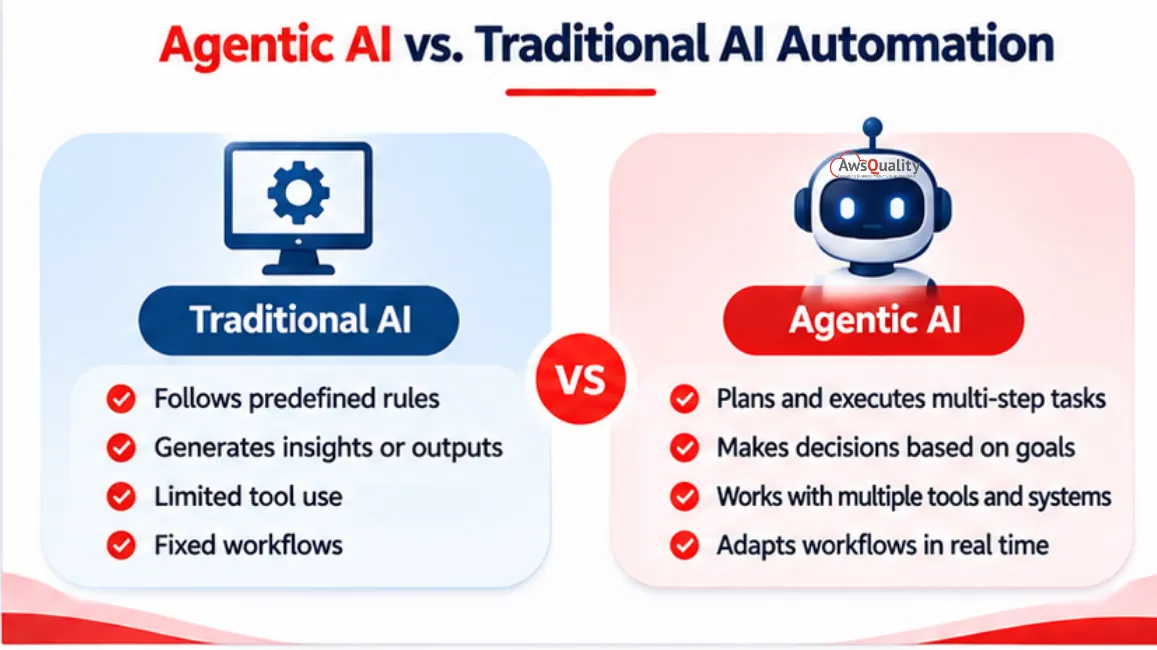
Agentic AI vs. Traditional AI Automation
| Area | Traditional AI or automation | Agentic AI |
|---|---|---|
| Primary function | Generate predictions, recommendations, or predefined outputs | Plan and execute multi-step tasks |
| Decision-making | Usually follows predefined logic or responds to prompts | Selects actions based on goals and available context |
| Tool usage | Often limited to configured integrations | Can interact with multiple approved tools and systems |
| Workflow execution | Typically follows predefined sequences | Can adapt task execution based on intermediate results |
| Human involvement | Often required to initiate or approve actions | Can operate with varying levels of autonomy |
| Risk exposure | Depends on model output and automation design | Also includes risks from autonomous actions, permissions, and tool access |
Agentic AI does not eliminate the need for traditional automation or human decision-making. Instead, it introduces another layer of intelligence and autonomy into enterprise workflows.
This makes governance and security particularly important.
Why are Enterprises Adopting Agentic AI?
Organizations are exploring agentic AI because it can help reduce manual work, coordinate complex processes, and make enterprise applications more responsive.
Some potential use cases include:
1. Customer Service Automation
AI agents can help retrieve customer information, classify service requests, suggest solutions, and initiate approved support workflows.
For example, an agent could review a customer’s service history, identify an unresolved issue, and create a follow-up request for the appropriate support team.
2. Sales and CRM Operations
Agentic AI can support sales teams by researching accounts, summarizing customer interactions, qualifying leads, updating CRM records, and preparing follow-up activities.
When properly configured, these capabilities can reduce administrative work and help sales representatives focus on customer relationships.
3. IT Service Management
AI agents can assist IT teams with ticket classification, knowledge retrieval, incident summarization, and routine service requests.
More advanced implementations may coordinate approved troubleshooting steps or route incidents based on their severity.
4. Finance and Procurement
Organizations can explore agentic AI for invoice processing, purchase request classification, document verification, and procurement coordination.
However, activities involving payments, financial approvals, and sensitive transactions should have strict authorization and human approval controls.
5. Enterprise Knowledge Management
AI agents can retrieve information from approved documents, internal knowledge bases, enterprise applications, and databases.
This can help employees locate relevant information without manually searching across multiple systems.
Despite these opportunities, deploying an AI agent into a business workflow is not the same as introducing a conventional software feature. The agent may have access to sensitive information and the ability to perform actions that affect real business operations.
That is where the hidden risks begin.
10 Hidden Risks of Agentic AI in Enterprise Workflows
Agentic AI introduces security, operational, and governance challenges that organizations must address before expanding autonomous workflows.
The following risks are particularly important for enterprise decision-makers.
1. Unauthorized Access to Enterprise Data
One of the biggest risks associated with agentic AI is excessive access to enterprise information.
AI agents often need access to business applications, databases, documents, APIs, and internal systems to complete their tasks.
If an organization grants an agent broader permissions than necessary, it may expose sensitive information or allow the agent to perform unauthorized operations.
For example, a customer service agent may only need access to customer support records. However, if it also receives unrestricted access to financial information, employee records, or confidential business documents, the potential impact of an error or security incident becomes much greater.
How to manage this risk:
- Follow the principle of least privilege.
- Assign permissions based on the agent’s specific business responsibilities.
- Use role-based or attribute-based access controls where appropriate.
- Restrict access to sensitive databases and enterprise applications.
- Review agent permissions regularly.
- Maintain separate permissions for reading, modifying, and deleting information.
- Monitor access to sensitive records.
AI agents should receive only the access required to complete their assigned tasks. They should not automatically inherit broad administrative permissions simply because those permissions make implementation easier.
2. Prompt Injection and Agent Goal Hijacking
Prompt injection is a security risk in which malicious instructions are introduced through user inputs, documents, web pages, emails, or other content that an AI system processes.
Unlike traditional software instructions, AI models interpret natural language. This creates opportunities for attackers to manipulate an agent’s behavior through carefully crafted content.
For example, imagine an AI agent that reviews incoming customer emails and updates CRM records.
An attacker could include hidden or misleading instructions in an email attempting to make the agent ignore its original task, reveal confidential information, or perform an unauthorized action.
The agent may treat this malicious content as an instruction instead of recognizing it as untrusted data.
In agentic systems, the consequences can extend beyond an incorrect response because the agent may have access to tools and connected applications.
How to manage this risk:
- Treat external documents, emails, and user-generated content as untrusted input.
- Separate system instructions from retrieved business content.
- Validate requests before allowing sensitive actions.
- Restrict the tools and data sources an agent can access.
- Use input validation and security filtering as additional layers.
- Test agents against direct and indirect prompt injection scenarios.
- Require human approval for sensitive or high-impact actions.
Organizations should not assume that prompt filtering alone can eliminate prompt injection. Security controls must also exist in the systems and workflows that agents interact with.
3. Excessive Autonomy and Unintended Actions
Agentic AI systems can execute multiple actions without requiring human confirmation at every step.
While this capability can improve productivity, it also creates the possibility of unintended business operations.
For example, an AI agent managing CRM activities might incorrectly interpret a customer request and update account information, change an opportunity stage, or initiate an automated follow-up process.
If the agent has permission to execute these actions independently, the error may affect actual business records and downstream workflows.
The risk becomes more serious when agents handle financial transactions, customer communications, access management, or production systems.
How to manage this risk:
- Define clear boundaries for autonomous execution.
- Classify actions according to their business impact.
- Require human approval for sensitive operations.
- Establish transaction limits and execution restrictions.
- Use sandbox environments for testing.
- Provide rollback or recovery mechanisms where possible.
- Introduce autonomy gradually based on performance.
A useful approach is to allow agents to independently perform low-risk activities while requiring human authorization for actions that could create financial, legal, security, or operational consequences.
4. Identity and Privilege Abuse
AI agents need an identity to interact with enterprise applications and perform authorized activities.
Problems can arise when organizations use shared service accounts, excessive privileges, poorly managed credentials, or unclear delegation mechanisms.
For example, an agent operating through a highly privileged service account may be able to access information or execute actions that its assigned business function does not require.
If the agent is manipulated or compromised, attackers may gain access to capabilities beyond the intended scope.
This creates a challenge for traditional identity and access management systems because organizations must now manage not only human users and applications but also autonomous software agents.
How to manage this risk:
- Establish a distinct identity for each agent or clearly defined agent workload.
- Avoid unnecessary use of shared administrative credentials.
- Apply least-privilege access policies.
- Use secure authentication and credential management.
- Monitor delegated permissions and access tokens.
- Set expiration and rotation policies for credentials.
- Maintain audit trails linking agent actions to identities and approvals.
Every AI agent should have a clearly defined identity, an assigned owner, and a documented set of permissions.
5. Data Leakage and Privacy Violations
Enterprise AI agents may process customer information, employee records, financial documents, contracts, and other sensitive data.
If data access and handling policies are not properly enforced, agents may expose confidential information through responses, logs, external tools, or connected services.
Consider an internal HR agent that helps employees answer questions about company policies.
If its access controls are poorly configured, it might retrieve confidential employee information while responding to an unrelated request.
Similarly, an agent could unintentionally send sensitive information to an external application or include confidential data in an automated communication.
How to manage this risk:
- Classify enterprise data according to sensitivity.
- Restrict agents to approved data sources.
- Apply data loss prevention (DLP) policies.
- Mask or minimize sensitive information wherever possible.
- Define data retention and deletion policies.
- Review third-party AI providers and data processing arrangements.
- Monitor information shared through external tools and integrations.
Organizations should evaluate data privacy requirements before connecting AI agents to enterprise systems, particularly when processing regulated or personally identifiable information.
6. Third-Party Tools and Agentic Supply Chain Vulnerabilities
Agentic AI systems often depend on external tools, plugins, APIs, connectors, models, frameworks, and other software components.
These dependencies can introduce vulnerabilities if they are not properly reviewed and maintained.
For example, an organization may connect an AI agent to a third-party application that provides access to documents or customer records.
If the integration contains a security weakness, has excessive permissions, or is compromised, the agent may become an indirect route to sensitive enterprise resources.
Dynamic tool discovery and multi-agent integrations can increase the complexity of this environment.
How to manage this risk:
- Maintain an inventory of approved AI tools, connectors, and integrations.
- Evaluate third-party providers before granting access.
- Review permissions requested by external tools.
- Use approved and authenticated APIs.
- Monitor software updates and dependency changes.
- Conduct security assessments of critical integrations.
- Disable unused or unapproved connectors.
Organizations should treat AI tools and connectors as part of their enterprise software supply chain rather than assuming that an integration is safe simply because it works.
7. Cascading Failures Across Connected Workflows
One of the less obvious risks of agentic AI is the possibility of cascading failures.
In a connected enterprise environment, one AI agent may pass information or instructions to another agent, application, or automated workflow.
If the first agent produces an incorrect result, that error may influence subsequent actions.
For example:
- A sales agent incorrectly classifies a customer account.
- A workflow agent uses that classification to update CRM records.
- A marketing automation system uses the updated information to trigger a campaign.
- A reporting system incorporates the incorrect data into business dashboards.
A single error can therefore affect multiple departments and systems.
The problem becomes more complex when multiple agents operate together without sufficient validation or monitoring.
How to manage this risk:
- Validate important outputs before passing them to other systems.
- Introduce checkpoints between critical workflow stages.
- Define limits on the number of automated actions.
- Monitor dependencies between agents and applications.
- Establish circuit breakers to stop abnormal activity.
- Maintain recovery and rollback procedures.
- Test failure scenarios before production deployment.
Organizations should design agentic workflows to contain errors rather than allowing a single incorrect decision to propagate across the enterprise.
8. Inaccurate Decisions and Hallucinations
Agentic AI systems can generate incorrect information, misunderstand business context, or make unsupported assumptions.
This is particularly important because an agent may use its generated output to decide what action to perform next.
For example, an AI agent reviewing an invoice might incorrectly interpret a payment amount or supplier detail. If it is connected to a procurement or finance workflow, the mistake could affect an approval process or financial record.
Even when an agent retrieves information from enterprise databases, it may misunderstand the context or select an inappropriate action.
How to manage this risk:
- Ground agent responses in approved enterprise information.
- Validate critical data against authoritative systems.
- Use structured inputs and outputs wherever practical.
- Establish confidence thresholds for specific tasks.
- Require human review for high-impact decisions.
- Test agents using realistic business scenarios.
- Monitor accuracy and error patterns after deployment.
AI-generated recommendations should not automatically be treated as verified business facts.
For important decisions, organizations should establish independent validation mechanisms.
9. Lack of Transparency and Auditability
When AI agents execute multi-step workflows, it can become difficult to understand why a particular action was taken.
A business user may see that a customer record was modified or an approval was initiated without knowing which information influenced the agent’s decision.
This creates challenges for troubleshooting, security investigations, compliance reviews, and accountability.
For example, if an AI agent sends an incorrect customer communication, the organization should be able to determine:
- What request initiated the workflow?
- Which information did the agent retrieve?
- Which tools and applications did it access?
- What actions did it execute?
- Was human approval obtained?
- What was the final result?
Without sufficient logging and monitoring, answering these questions may be difficult.
How to manage this risk:
- Maintain logs of agent activity and tool usage.
- Record important decisions, actions, and approval events.
- Track the identity of the agent and its responsible owner.
- Monitor changes to agent configurations and permissions.
- Establish alerting for unusual activity.
- Maintain records suitable for audits and investigations.
- Regularly review agent performance and execution history.
Transparency should be built into the agent architecture rather than added after an incident occurs.
10. Unclear Accountability and Governance
Agentic AI introduces a difficult organizational question: Who is responsible when an autonomous AI agent makes a mistake?
An agent may be developed by one team, configured by another, connected to applications managed by a third team, and used by employees across multiple departments.
Without clearly defined responsibilities, organizations may struggle to determine who owns the agent, who approves its permissions, who monitors its behavior, and who responds when something goes wrong.
This is not simply a technical problem. It is an enterprise governance challenge.
How to manage this risk:
- Assign a business owner to every production AI agent.
- Define technical and security responsibilities.
- Establish approval procedures for new agents and capabilities.
- Document acceptable and prohibited use cases.
- Define incident response and escalation procedures.
- Review agents periodically for business relevance and risk.
- Train employees to understand the limitations of autonomous systems.
AI agents may perform tasks independently, but organizational accountability should remain with designated people and teams.
Summary: Agentic AI Risks and Their Mitigation Strategies
The following table summarizes the major risks enterprises should evaluate before introducing autonomous AI workflows.
| Agentic AI risk | Potential business impact | Recommended control |
|---|---|---|
| Unauthorized data access | Exposure of confidential information | Least-privilege access and role-based permissions |
| Prompt injection | Manipulated agent behavior | Input validation, trust boundaries, and action controls |
| Excessive autonomy | Unauthorized or unintended operations | Human approval and execution limits |
| Identity and privilege abuse | Unauthorized access to enterprise systems | Agent identities and secure credential management |
| Data leakage | Privacy violations and information exposure | Data classification and DLP controls |
| Supply chain vulnerabilities | Compromised tools and integrations | Third-party assessments and approved connectors |
| Cascading failures | Errors spreading across workflows | Validation checkpoints and circuit breakers |
| Inaccurate decisions | Incorrect business actions | Data grounding and human verification |
| Lack of auditability | Difficult investigations and compliance reviews | Activity logging and continuous monitoring |
| Unclear accountability | Governance and operational gaps | Defined ownership and escalation procedures |
Building an Agentic AI Risk Management Framework
A coherent risk management framework for agentic AI has five operational components:
1. Agent Inventory and Classification
You cannot govern what you cannot see. The starting point is a complete, continuously maintained inventory of every AI agent deployed in the enterprise — including those deployed by individual business units or teams without central IT involvement.
Each entry in the inventory should include: the agent’s identity and owner; the systems, APIs, and data it has access to; the business process it supports; the permissions it holds; and the date it was last reviewed. Classification should reflect the agent’s risk level: access to regulated data, financial authority, customer-facing actions, and irreversible operations all increase the risk classification.
2. Least-Privilege Access and Just-in-Time Credentials
Agents should operate with the minimum permissions required to complete their assigned task — and no more. Standing access to production systems should be replaced with just-in-time credentials that are provisioned when a task begins and revoked when it ends.
For higher-risk operations — write access to financial systems, deletion of records, external communications on behalf of the organization — additional authorization steps should be required before the agent can proceed. Agent identities should be managed with the same rigor as human identities: provisioning, deprovisioning, access review cycles, and audit logging.
3. Human-in-the-Loop Checkpoints
Autonomy is valuable, but not all decisions should be fully autonomous. Define explicit human approval gates for:
- Financial commitments above a defined threshold
- Modifications to customer records or contractual documents
- External communications on behalf of the organization
- Deletion or export of regulated data
- Any action that cannot be reversed
Human oversight checkpoints should be built into the agent’s workflow design — not bolted on as an afterthought when something goes wrong. The goal is not to eliminate autonomy, but to ensure that the degree of autonomy matches the reversibility and consequence of the action.
4. Continuous Monitoring and Incident Response
Extend existing SIEM and security monitoring to cover agent activity. Log tool-call sequences, API requests, data access events, and agent-to-agent interactions. Set behavioral baselines for each agent and alert on deviations — unusual data access volume, unexpected API calls, actions outside the agent’s defined scope.
Prepare agent-specific incident response procedures that cover: how to isolate an agent from its tools without disrupting the broader workflow; how to revoke credentials immediately; how to reconstruct the agent’s action sequence for root-cause analysis; and how to communicate with affected parties.
5. Pre-Deployment Evaluation on Real Data
Many agentic AI failures stem from agents that performed well in controlled test environments but behaved unexpectedly when exposed to real enterprise data, edge cases, and adversarial inputs.
Before any agent goes into production, evaluate it against real data scenarios — including boundary cases, unexpected input formats, and deliberately adversarial prompts designed to probe for injection vulnerabilities. Define success and failure criteria in advance. Document what the agent is authorized to do and what it is not. Require sign-off from both the business owner and the security team before production deployment.
A Practical Roadmap for Secure Agentic AI Adoption
Organizations do not need to introduce fully autonomous AI systems across every department immediately.
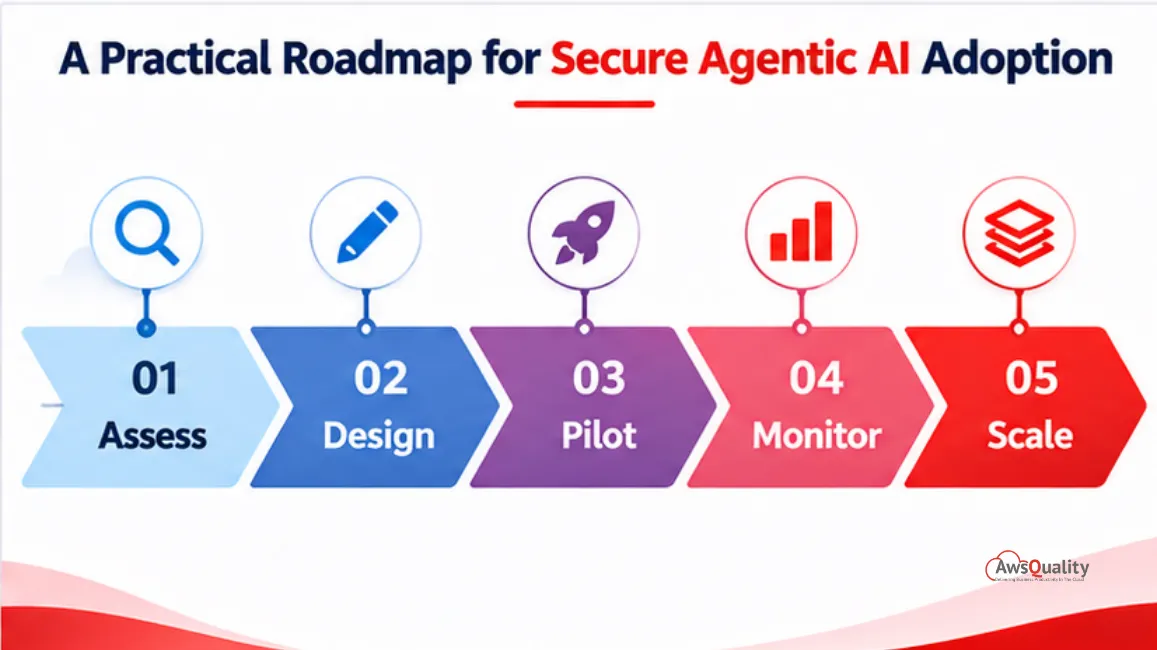
A phased approach allows businesses to validate capabilities, improve governance, and expand autonomy based on actual performance.
| Phase | Focus area | Recommended activities |
|---|---|---|
| Phase 1: Assess | Business needs and risk | Identify use cases, assess data sensitivity, and classify risks |
| Phase 2: Design | Architecture and governance | Define agent identities, permissions, security boundaries, and approval policies |
| Phase 3: Pilot | Controlled implementation | Deploy agents in limited environments and test realistic scenarios |
| Phase 4: Monitor | Security and performance | Review agent actions, validate outputs, monitor errors, and evaluate business results |
| Phase 5: Scale | Controlled expansion | Expand successful use cases, improve governance, and periodically reassess risk |
For example, an organization could initially deploy an internal knowledge retrieval agent with read-only access to approved documents.
After validating its accuracy, access controls, and monitoring, the organization could explore additional capabilities such as creating service tickets or updating selected CRM records.
Sensitive actions would continue to require appropriate human approval.
The objective is to increase autonomy only when the organization has sufficient confidence in the system and the controls surrounding it.
Which Security Frameworks and Guidelines Can Help Manage Agentic AI Risks?
Organizations do not need to develop their entire AI security strategy from scratch. Existing cybersecurity and AI risk management resources provide useful foundations.
Some important references include:
OWASP Top 10 for Agentic Applications
The OWASP Top 10 for Agentic Applications (2026) identifies important security risks associated with autonomous AI systems.
It covers areas such as agent goal hijacking, tool misuse, identity and privilege abuse, supply chain vulnerabilities, memory and context poisoning, insecure inter-agent communication, cascading failures, human-agent trust exploitation, and rogue agents.
Organizations can use this resource to structure threat assessments and identify security gaps in agentic applications.
NIST AI Risk Management Framework
The National Institute of Standards and Technology (NIST) AI Risk Management Framework provides a structured approach to managing risks associated with AI systems.
Its core functions are:
- Govern: Establish organizational policies, responsibilities, and accountability.
- Map: Understand the context, intended use, and potential risks of AI systems.
- Measure: Evaluate AI performance, trustworthiness, and risk.
- Manage: Prioritize and address identified risks throughout the AI lifecycle.
The framework can help organizations integrate AI risk management into existing enterprise governance practices.
CISA and International Cybersecurity Guidance
In May 2026, CISA and international cybersecurity partners released guidance on the careful adoption of agentic AI services.
The guidance emphasizes limiting agent autonomy, applying layered security controls, using strong identity management, conducting threat modeling, and maintaining continuous monitoring and oversight.
These recommendations are particularly relevant to organizations deploying agents in mission-critical environments.
Frameworks should be treated as practical references rather than substitutes for organization-specific risk assessments. Enterprises should adapt their controls to their industry, data sensitivity, operating environment, and business requirements.
Real-World Example: Managing Agentic AI Risks in a Salesforce Workflow
Consider an enterprise that wants to use agentic AI to improve its Salesforce sales and customer service operations.
The organization plans to introduce an AI agent that can review customer information, summarize interactions, qualify leads, update selected CRM fields, and initiate follow-up activities.
While this can reduce administrative work, it also introduces several risks.
Potential risks:
- The agent may access customer records beyond its intended scope.
- Malicious content in customer messages may manipulate the agent.
- Incorrect lead qualification may affect sales prioritization.
- An automated update may overwrite important CRM information.
- Customer data may be exposed through an insecure integration.
- A workflow error may trigger incorrect follow-up communications.
Recommended controls:
- Assign the agent a dedicated identity with limited Salesforce permissions.
- Restrict access to the specific objects and fields required for its tasks.
- Validate information before allowing CRM updates.
- Require sales representatives to approve sensitive changes.
- Protect integrations using secure authentication and API controls.
- Record agent activity and maintain audit logs.
- Monitor workflow failures and unusual behavior.
- Test the agent in a sandbox before production deployment.
This example demonstrates why agentic AI implementation should be treated as both an automation initiative and an enterprise security project.
The goal is not to prevent agents from performing useful tasks. It is to ensure they operate within clearly defined business and security boundaries.
How Can an AI and Technology Partner Help Enterprises Adopt Agentic AI Securely?
Implementing agentic AI requires expertise across several technology areas. Organizations must consider AI architecture, enterprise data, application integrations, cloud infrastructure, cybersecurity, automation, and ongoing monitoring.
An experienced technology partner can help businesses translate AI opportunities into practical, secure solutions.
Depending on business requirements, support may include:
- AI strategy and consulting: Identifying suitable use cases and evaluating the business value of agentic AI.
- AI agent development: Designing agents with clearly defined responsibilities, workflows, and execution boundaries.
- Enterprise integration: Connecting AI agents with CRM, ERP, service management, and other business applications.
- Data engineering: Preparing reliable, accessible, and governed data for AI applications.
- Cloud architecture: Building scalable environments to support AI workloads and enterprise integrations.
- DevOps and monitoring: Establishing testing, deployment, observability, and maintenance practices.
- Security and governance: Implementing access controls, approval mechanisms, and risk management processes.
At AwsQuality, we help businesses address technology challenges through AI, Salesforce, cloud, DevOps, data engineering, mobile, and web development services.
For organizations exploring agentic AI, the right implementation approach should begin with business requirements, data readiness, security considerations, and clearly defined outcomes.
Explore AwsQuality’s technology capabilities to understand how AI and enterprise technology solutions can support your digital transformation initiatives.
How AwsQuality Technologies Approaches Agentic AI Implementation
AwsQuality Technologies works with enterprises deploying agentic AI across Salesforce Agentforce, MuleSoft, and custom AI agent architectures. Every implementation begins with an evaluation-first methodology: defining what the agent needs to do, what it should not do, what data it can access, and what a failure looks like — before any production deployment begins.
AwsQuality’s agentic AI engagements include:
Agent charter definition. For each agent, AwsQuality defines the scope of permitted actions, the systems it can access, the data categories it can process, and the human escalation paths for decisions that fall outside its charter.
Least-privilege architecture. Agent identities and credentials are designed with minimum necessary access. Just-in-time provisioning and automatic revocation are built into the architecture by default.
Evaluation on real data. Every agent is evaluated against real enterprise data scenarios — including adversarial inputs — before production deployment. Success and failure criteria are defined in advance, not assessed retroactively.
Monitoring and observability. AwsQuality integrates agent activity monitoring into the client’s existing SIEM and observability stack, ensuring that tool-call sequences, data access events, and agent-to-agent interactions are logged and alertable.
Governance documentation. Every engagement produces documentation covering agent purpose, permissions, data access, escalation paths, and evaluation results — a governance record that supports both internal audit and regulatory examination.
Final Thoughts
Agentic AI has the potential to change how enterprises manage workflows, connect applications, and automate business operations. By enabling AI systems to plan tasks and execute actions, organizations can explore new opportunities to improve productivity and operational efficiency.
However, greater autonomy also increases the importance of security, governance, and accountability.
An AI agent should not receive unrestricted access simply because it can perform tasks faster. Its permissions, tools, data sources, and decision-making authority should be aligned with clearly defined business requirements.
Organizations that introduce agentic AI through controlled pilots, least-privilege access, human oversight, continuous monitoring, and structured governance will be better positioned to capture its benefits while managing the associated risks.
The future of enterprise AI is not just about building more autonomous agents. It is about building agents that operate securely, transparently, and responsibly within the enterprise.
FAQs
Frequently Asked Questions
What are the biggest risks of agentic AI in enterprise workflows?
The biggest risks include unauthorized data access, prompt injection, excessive autonomy, identity and privilege abuse, data leakage, third-party vulnerabilities, cascading failures, inaccurate decisions, lack of auditability, and unclear accountability.
These risks can affect enterprise security, privacy, compliance, and operational reliability.
Why is agentic AI more risky than traditional AI?
Traditional AI applications generally generate predictions, recommendations, or responses. Agentic AI can also use tools, access enterprise applications, and execute multi-step actions.
As a result, an incorrect output may lead directly to an unauthorized or unintended business operation rather than simply an inaccurate answer.
How can businesses prevent AI agents from accessing sensitive data?
Businesses should implement least-privilege access, role-based permissions, data classification, secure authentication, and data loss prevention controls.
Agents should only access the information required for their assigned responsibilities.
What is prompt injection in agentic AI?
Prompt injection is an attack in which malicious instructions are introduced through user inputs or external content to manipulate an AI system’s behavior.
In agentic systems, this may cause an agent to misuse tools, access information, or perform actions outside its intended purpose.
Should enterprises allow AI agents to make decisions independently?
Enterprises can allow agents to handle low-risk, clearly defined tasks independently when appropriate controls are in place.
However, actions involving financial transactions, sensitive information, legal decisions, access permissions, or significant customer impact should generally have additional approval and oversight.
How does human-in-the-loop control improve agentic AI security?
Human-in-the-loop controls allow people to review or approve important AI-generated decisions and actions before execution.
They help prevent unintended operations and maintain human accountability, particularly in workflows with significant business consequences.
What is the role of AI governance in enterprise agent deployments?
AI governance establishes policies, responsibilities, access restrictions, approval procedures, monitoring requirements, and accountability for AI systems.
It helps ensure that agents operate within acceptable business, security, and compliance boundaries throughout their lifecycle.
How can organizations monitor agentic AI activity?
Organizations can monitor agent identities, tool usage, data access, workflow execution, permission changes, errors, and approval events.
Activity logs, alerts, performance monitoring, and regular security assessments help identify unusual behavior and investigate incidents.
Can agentic AI work securely with Salesforce and other enterprise applications?
Yes, agentic AI can be integrated with Salesforce and other enterprise applications when the architecture includes appropriate authentication, permissions, data protection, validation, monitoring, and approval controls.
Security requirements should be evaluated for each integration and use case.
How should enterprises begin adopting agentic AI?
Enterprises should start by identifying a clearly defined business problem and selecting a low-risk use case.
They should then assess data readiness, establish security boundaries, test the agent in a controlled environment, monitor its performance, and gradually expand its autonomy based on demonstrated results.
Artificial Intelligence
Related Articles
12 Artificial Intelligence (AI) Solutions Every CTO Should Explore
Artificial intelligence (AI) is becoming an important part of how businesses build software, manage data, serve customers, and improve operational efficiency. From…
How AI-powered customer service automation reduces costs without hurting CX
Customer service teams are under constant pressure to do two things at the same time: reduce operating costs and deliver better customer…
Generative AI in Mobile Apps: Use Cases, Benefits, and Challenges
Generative AI is changing how people interact with mobile applications. Instead of relying only on predefined menus, forms, and workflows, users can…