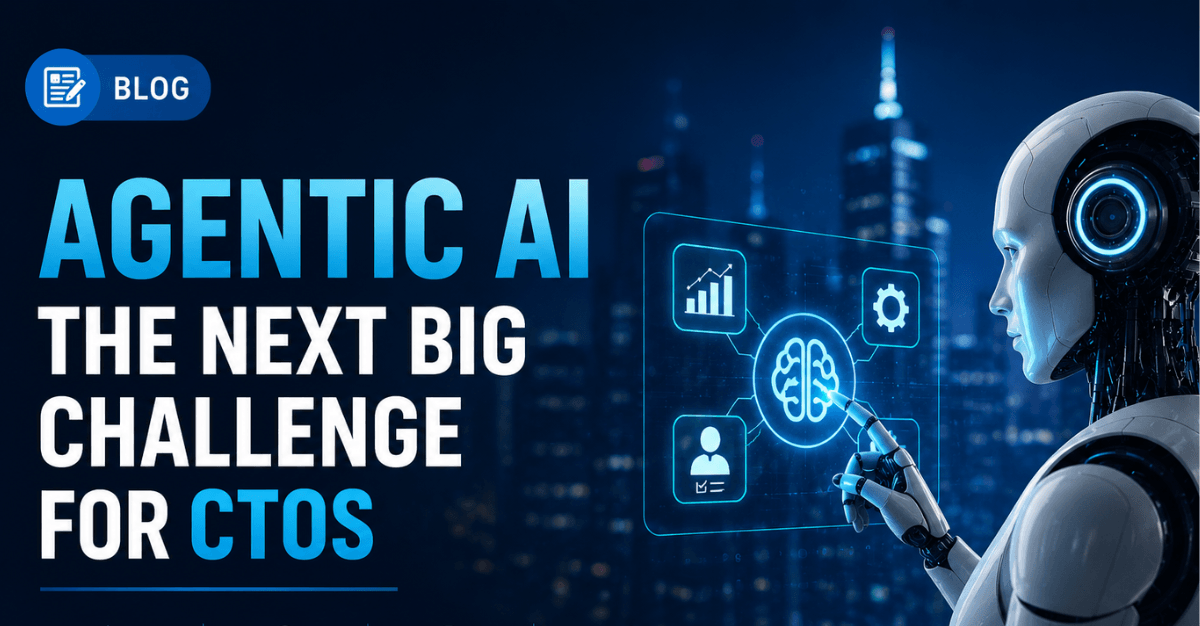
Artificial Intelligence has rapidly evolved from predictive analytics and generative AI to a new frontier: Agentic AI. While organizations are still adapting to Large Language Models (LLMs) and generative AI applications, a more autonomous form of AI is already reshaping enterprise technology strategies.
Agentic AI refers to intelligent systems capable of making decisions, planning actions, executing tasks, and adapting to changing conditions with minimal human intervention. Unlike traditional AI tools that respond to prompts, agentic systems can proactively pursue objectives, coordinate with other systems, and continuously optimize outcomes.
For Chief Technology Officers (CTOs), this advancement presents enormous opportunities for automation, innovation, and operational efficiency. However, it also introduces unprecedented challenges related to governance, security, compliance, accountability, infrastructure, and workforce readiness.
As enterprises accelerate their AI adoption journey, understanding and managing Agentic AI may become one of the most critical responsibilities for technology leaders in the coming years.
Read: Responsible and Ethical AI – How to Ensure Compliance, Security, and Transparency in AI Systems
What is Agentic AI?
Agentic AI describes autonomous AI systems that can:
- Set and pursue goals
- Make independent decisions
- Execute multi-step workflows
- Learn from outcomes
- Interact with software applications and APIs
- Collaborate with humans and other AI agents
Unlike conventional AI systems that require constant human direction, agentic systems can independently determine how to achieve desired outcomes.
For example:
Traditional AI
A chatbot answers customer questions when prompted.
Generative AI
An AI assistant drafts emails, creates reports, or generates code based on instructions.
Agentic AI
An AI agent receives a goal such as:
“Reduce customer support response times by 20%.”
The agent then:
- Analyzes support workflows
- Identifies bottlenecks
- Recommends improvements
- Implements approved changes
- Monitors results
- Continuously optimizes performance
This level of autonomy significantly expands AI’s role within enterprises.
Also read: How AI + Cloud Drives Business Growth and Efficiency
Why Agentic AI is Gaining Enterprise Attention
Several technological developments are accelerating Agentic AI adoption:
Advanced Foundation Models
Modern language models possess stronger reasoning, planning, and contextual understanding capabilities than previous generations.
API-Driven Ecosystems
Enterprises increasingly operate through interconnected platforms, enabling AI agents to interact across systems.
Automation Demand
Organizations seek greater productivity gains beyond basic task automation.
Workforce Shortages
Many industries face talent gaps, encouraging businesses to deploy intelligent agents that augment human teams.
Real-Time Decision Requirements
Businesses increasingly require rapid responses to market shifts, cybersecurity threats, customer needs, and operational disruptions.
As a result, Agentic AI is moving from experimental environments into enterprise production systems.
Check: How to Build Secure AI Systems on Cloud Platforms (Complete Guide)
Why CTOs Face Unique Challenges with Agentic AI
While the business benefits are attractive, Agentic AI introduces complexities that traditional IT governance frameworks were not designed to handle.
1. Governance and Accountability Become More Complex
One of the biggest challenges is determining responsibility when autonomous systems make decisions.
Questions CTOs must address include:
- Who is accountable for an AI agent’s actions?
- How are decisions documented?
- What happens when agents make incorrect judgments?
- How can organizations audit autonomous behavior?
Traditional governance models assume human decision-makers. Agentic AI challenges this assumption.
Without clear accountability frameworks, enterprises face operational and legal risks.
2. Security Risks Expand Dramatically
Agentic AI systems often require access to:
- Enterprise databases
- CRM systems
- Financial applications
- Internal documentation
- Cloud infrastructure
- Customer data
The broader the access, the larger the attack surface.
Potential risks include:
Unauthorized Actions
Compromised agents could perform actions beyond intended permissions.
Prompt Injection Attacks
Malicious inputs may manipulate agent behavior.
Data Leakage
Sensitive information could be unintentionally exposed.
Privilege Escalation
AI agents may gain access to systems they should not control.
CTOs must develop robust AI-specific security frameworks that go beyond traditional cybersecurity approaches.
3. Compliance and Regulatory Uncertainty
Governments worldwide are introducing AI regulations focused on:
- Transparency
- Accountability
- Data privacy
- Bias mitigation
- Risk management
Agentic AI complicates compliance because autonomous systems may:
- Make independent decisions
- Process sensitive information
- Operate across multiple jurisdictions
Organizations in regulated industries such as healthcare, finance, insurance, and government face heightened compliance obligations.
CTOs must ensure that AI agents remain aligned with evolving legal requirements.
4. Managing AI Hallucinations at Scale
Even advanced AI models can generate inaccurate outputs.
For traditional AI tools, human review often catches mistakes.
Agentic AI creates a different scenario:
A flawed decision may trigger multiple downstream actions automatically.
For example:
An AI agent could:
- Misinterpret customer data
- Approve incorrect transactions
- Trigger unnecessary system changes
- Generate misleading reports
As autonomy increases, small errors can rapidly become enterprise-wide issues.
CTOs must implement verification layers, guardrails, and monitoring systems.
5. Infrastructure Demands Continue Growing
Agentic AI requires substantial computational resources.
Enterprises must support:
- Large language models
- Vector databases
- Real-time orchestration systems
- Agent communication frameworks
- Monitoring platforms
- Security controls
Challenges include:
- Cloud cost management
- Scalability
- Performance optimization
- Latency reduction
- System reliability
Technology leaders must balance innovation with infrastructure sustainability.
6. Integration Complexity Across Enterprise Systems
Most enterprises operate dozens or hundreds of applications.
Agentic AI often requires integration with:
- ERP platforms
- CRM systems
- HR software
- Data warehouses
- Productivity tools
- Customer service platforms
Poor integration can result in:
- Data silos
- Inconsistent actions
- Process failures
- Security vulnerabilities
CTOs must develop enterprise-wide AI architectures rather than isolated pilot projects.
7. Ethical and Bias Concerns Intensify
Autonomous AI systems may influence decisions involving:
- Hiring
- Lending
- Insurance approvals
- Customer support
- Employee evaluations
Bias embedded within training data or business rules can scale rapidly through autonomous decision-making.
Technology leaders must ensure:
- Fairness
- Transparency
- Explainability
- Human oversight
Ethical AI governance is becoming a board-level concern.
8. Workforce Transformation and Change Management
Agentic AI will reshape how employees work.
Many teams may experience concerns related to:
- Job displacement
- Skill relevance
- Process changes
- AI oversight responsibilities
Successful adoption requires:
Reskilling Programs
Employees need AI literacy and governance training.
Human-AI Collaboration Models
Organizations must define where human judgment remains essential.
Cultural Adaptation
Teams need confidence that AI augments rather than replaces expertise.
CTOs increasingly play a leadership role in workforce transformation initiatives.
Also check: Is It Possible to Make AI Development Cost-Efficient? A Complete Guide
Strategic Actions CTOs Should Take Today
To prepare for the rise of Agentic AI, CTOs should focus on proactive planning.
Establish AI Governance Frameworks
Develop policies covering:
- Accountability
- Risk management
- Security controls
- Compliance requirements
- Ethical standards
- Implement Human-in-the-Loop Controls
Critical business decisions should maintain human oversight until trust and reliability are proven.
Invest in AI Observability
Monitor:
- Agent decisions
- Performance metrics
- Security events
- Compliance violations
Visibility is essential for managing autonomous systems.
Build Secure AI Architectures
Adopt:
- Zero-trust principles
- Least-privilege access
- Strong authentication
- Continuous monitoring
- Create Enterprise AI Centers of Excellence
Cross-functional teams can align:
- IT
- Security
- Legal
- Compliance
- Business stakeholders
This improves consistency across AI initiatives.
Develop AI Readiness Programs
Prepare employees through:
- Training
- Governance education
- AI literacy programs
- Change management initiatives
The Future of Agentic AI in Enterprises
Agentic AI represents a significant shift from software that assists humans to systems that actively participate in achieving business objectives.
Over the next five years, organizations will likely deploy AI agents across:
- Customer service
- IT operations
- Cybersecurity
- Software development
- Supply chain management
- Financial operations
- Human resources
The competitive advantages will be substantial.
However, enterprises that rush adoption without governance, security, and accountability frameworks may face significant operational and reputational risks.
For CTOs, the challenge is not simply implementing Agentic AI. The real challenge lies in managing autonomous intelligence responsibly at enterprise scale.
Those who successfully balance innovation with control will shape the next generation of digital transformation.
Looking to implement AI responsibly while maximizing business value? Our AI experts can help you develop, deploy, and scale secure AI solutions tailored to your goals.
Conclusion
Agentic AI is poised to become one of the most transformative technologies in enterprise computing. Its ability to autonomously plan, decide, and act offers remarkable opportunities for efficiency, innovation, and competitive advantage.
Yet with greater autonomy comes greater complexity. Security vulnerabilities, governance concerns, regulatory requirements, ethical considerations, and workforce implications make Agentic AI far more challenging than previous waves of automation.
For CTOs, success will depend on building strong governance frameworks, implementing rigorous oversight mechanisms, and fostering a culture of responsible AI adoption. Organizations that prepare today will be better positioned to harness the full potential of Agentic AI while minimizing risk in an increasingly autonomous future.
 Bio
Bio