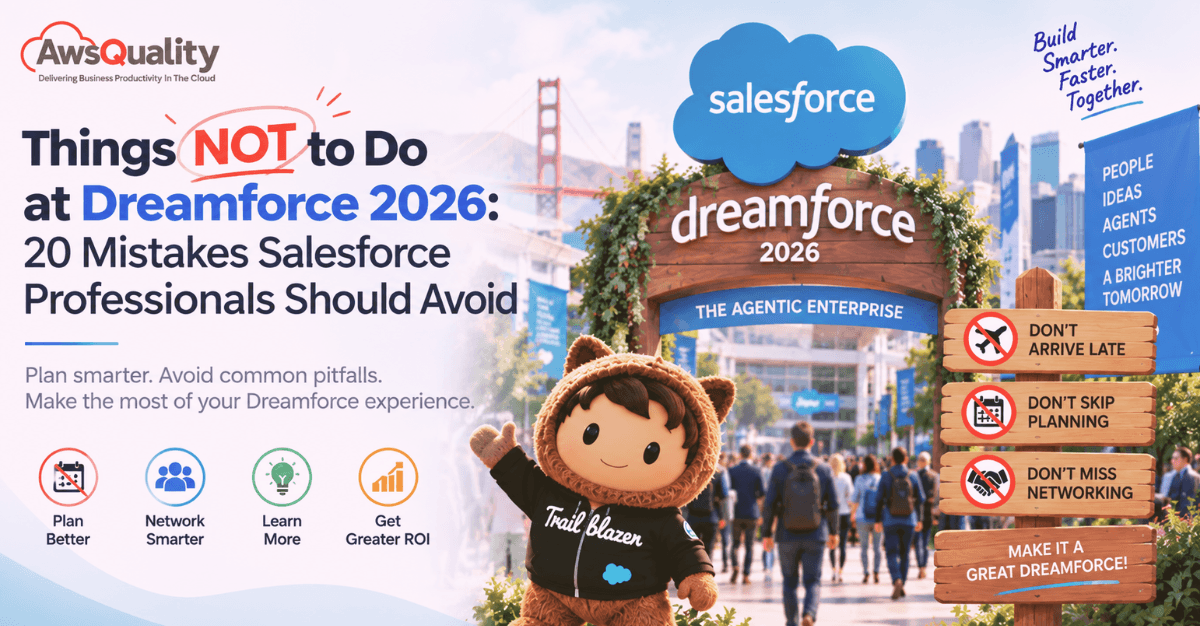
Dreamforce 2026 is five days away.
September 15–17 at Moscone Center in San Francisco. The Agentic Enterprise as the theme. More than 40,000 attendees in person, 1,600-plus sessions, 50-plus keynotes, 150-plus hands-on trainings, and the Dreamfest concert that has featured Red Hot Chili Peppers, Foo Fighters, and Metallica in previous years — this year raising funds for UCSF Benioff Children’s Hospitals.
If this is your first Dreamforce, you are about to discover that it is as overwhelming as everyone said and as rewarding as everyone promised — if you make the right decisions. If this is your fifth, you already know which decisions those are. And if you are attending the first one in a while, 2026 is different enough from prior years — the Claudeforce announcement, the Agentforce momentum, the agentic enterprise focus — that even veterans should read the session landscape with fresh eyes.
The mistakes that turn a Dreamforce from career-changing to conference-fatigue-inducing are almost always the same ones, repeated by the same personas, at the same points in the three days. This guide names them directly.
Before You Leave Home
1. Don’t Show Up Without a Prioritized Session List
The Salesforce Events App has an Agenda Builder. Use it before you travel. Popular sessions — Agentforce product announcements, keynote overflow sessions, hands-on training labs — fill weeks before the conference, not during it.
The attendees who arrive in San Francisco without a session priority list spend their first morning discovering that the sessions they need are at capacity. Then they spend the rest of Dreamforce improvising, which produces a fine experience but rarely the targeted learning or the specific question answered that justified the trip budget.
The process: identify your top three learning objectives before opening the app. Map sessions to those objectives. Reserve the essential ones and leave room for discovery sessions — the ones you did not plan for that turn out to be the most relevant conversations. 1,600 sessions are available; the discipline is knowing which ones to not miss, not which ones to fill the calendar with.
2. Don’t Arrive Tuesday Morning
Monday, September 14 is the day most Dreamforce veterans already know: the real conference begins before the conference officially begins.
Many unofficial Dreamforce parties start on Monday, September 14, before the conference officially begins. Monday is a particularly good night for community kickoffs because attendees have arrived in San Francisco but the main conference agenda has not yet taken over their calendars.
The people most worth talking to at Dreamforce — decision-makers, senior architects, executives, community leaders — are also the people whose Tuesday, Wednesday, and Thursday are the most packed. Monday evening is when their schedules are open and the environment is relaxed. The attendee who arrives Monday and shows up to the partner receptions and community meetups on Monday night often gets a better Dreamforce than the one who squeezes into the Tuesday morning keynote overflow room.
Book the flight that lands Monday. It is the simplest Dreamforce ROI improvement available.
3. Don’t Book Your Hotel at Conference Rates, Day-Of
If you are reading this with no accommodation booked, understand the pricing reality before checking availability.
Hotel prices near Moscone spike 87% during Dreamforce week, with the median nightly rate jumping from $305 to $569. Travelers who book two or more months early pay $483 versus $587 for last-minute bookings.
The options for the attendee without accommodation six days out: book farther from Moscone (BART makes this workable), consider Oakland or the East Bay (accessible via BART from Embarcadero or Montgomery), or accept the premium with the understanding that the alternative — daily ridesharing into SoMa from a distant location — costs more in time than the nightly rate difference.
For future reference: the single highest-leverage Dreamforce logistics decision is booking accommodation before the wave of pricing hits. Everything else is recoverable. A hotel booked in October for the following September’s Dreamforce pays for itself in both dollars and stress.
4. Don’t Pack a Suitcase Full of Paper Business Cards
Digital business cards make it seamless to share your details via QR code or link — no stacks of paper required.
40,000 attendees over three days. Paper cards get lost, get soggy, and require the manual data entry that ensures they never make it into the CRM. Digital card options — HiHello, Wave Connect, KADO — share contact information via QR code, link directly to LinkedIn and Trailhead profiles, and generate contact records that can be imported directly into Salesforce.
If paper feels necessary, bring fewer and give them to fewer people more intentionally. But a phone held out with a QR code is faster than a card shuffle, and the contact actually lands where it needs to go.
Getting Around San Francisco
5. Don’t Wear New Shoes
Prioritize broken-in walking shoes for the concrete floors.
Dreamforce spreads across Moscone’s North, South, and West buildings — a complex that requires walking between them continuously across three days. The Howard Street outdoor area (Salesforce builds Dreamforce National Park over the closed street) adds outdoor walking across varying terrain. Hotels across SoMa and Union Square add morning and evening transit. San Francisco’s hills add everything else.
The attendee who wears dress shoes on Day 1 is the one sitting out sessions on Day 3. Smart casual with genuinely worn-in shoes is both the dress code guidance and the practical advice.
6. Don’t Fight the Rideshare Surge
Public transit options include BART, Muni, and ridesharing.
During keynotes, during session breaks, and especially at conference end each evening, rideshare surge pricing around Moscone is significant. 40,000-plus people all making the same request at the same time from the same location produces exactly what anyone who has studied supply and demand would predict.
BART’s Powell Street and Montgomery Street stations are both accessible from Moscone and provide reliable, predictable transit to most of the SF accommodation zones. Muni connects to neighborhoods not on BART lines. The attendee who learns the BART map before arriving in San Francisco moves faster and cheaper than the one waiting for a surge-priced ride outside the conference exit.
7. Don’t Wait Until After the Last Session to Pick Up Your Bags
Moscone Center offers bag checks on-site. The lines at Moscone bag checks become long immediately after the final sessions on September 17.
Plan an extra 20–30 minutes into your airport transfer timeline.
If you have a flight on the evening of September 17, plan the itinerary accordingly. Thursday evening flights out of SFO that do not account for conference-end bag check queues and rideshare surge will be missed. Build the buffer before the conference, not after the closing keynote.
Session Strategy
8. Don’t Overbook Your Schedule
Don’t overbook — leave space for surprise sessions and networking opportunities.
The instinct at a 1,600-session conference is to fill every time slot. The people who do this report a consistent experience: they attend sessions efficiently, absorb approximately 30% of what each session covers because their attention is fragmented by the next-session anxiety, and they miss the hallway conversations that every Dreamforce veteran identifies as the most valuable part.
Leave white space in the agenda. Two unscheduled hours per day, at minimum. These are not wasted hours — they are the hours that produce the conversation with the exact person who has already solved the problem you are trying to solve, the walk to a session you passed on the agenda that turns out to be the most relevant one, and the chance encounter with a former colleague who now works at the company you are trying to understand.
Full agendas produce full schedules. Open agendas produce better outcomes.
9. Don’t Skip the Hands-On Training Labs
150-plus hands-on training sessions are available at Dreamforce 2026, and they are consistently the most underutilized sessions at the conference.
The keynote sessions generate the content and the announcements. The product showcase sessions generate the demos. The hands-on labs generate the competence — the actual ability to return to the office and implement what was shown in the keynote, because the attendee has worked through it in a guided environment with Salesforce instructors available.
For Salesforce developers and administrators, a focused morning in the hands-on labs is often more practically valuable than four keynote sessions. Register for these early — capacity is limited and they fill faster than their lower profile might suggest.
10. Don’t Miss the Agentforce and Claudeforce Sessions This Year
Every Dreamforce has a dominant technology theme. In 2024, it was Agentforce’s introduction. In 2026, the theme is The Agentic Enterprise — and the specific context is that Salesforce announced the Claudeforce partnership with Anthropic on August 26, just three weeks ago, with the Salesforce in Claude plugin entering open beta targeted for September 2026.
Dreamforce is the expected venue for the open beta launch and the full product briefing on what the Claudeforce architecture means for Agentforce implementations. Sessions covering Agentforce 3.0 capabilities, the AIforce MCP architecture, the Atlas Reasoning Engine’s expanded Claude integration, and the Data Cloud connection layer for agentic workflows are the sessions where the most consequential announcements will occur.
Whatever else is on the agenda: prioritize Agentforce and AI sessions this year. The technology is moving fast enough that missing the Dreamforce briefing on its current state means working from outdated information for the next 12 months.
11. Don’t Ignore the Well-Architected Program Consultations
Salesforce relaunched its Well-Architected Program at the previous Dreamforce, offering updated evaluation criteria, frameworks, and expert consultations for enterprise architects, developers, and technical leads to build scalable, secure Salesforce solutions.
Dreamforce 2026 is expected to continue and expand these consultations. For organizations with complex Salesforce implementations — multi-cloud deployments, large data volumes, integration-heavy architectures — a Well-Architected consultation is a direct line to Salesforce’s internal architecture expertise that is difficult to access at any other point in the year.
These are not general Q&A sessions. They are structured reviews with specific deliverables. Identify the architectural questions that have been on the backlog, and bring them prepared.
Networking Mistakes
12. Don’t Only Talk to People You Already Know
The biggest networking mistake at Dreamforce is the most common one: a conference filled with strangers becomes a company offsite, and the attendee returns to the office having had excellent conversations with people they already knew.
Dreamforce is a community gathering first and a vendor conference second. That distinction matters for how you approach networking. The Ohana culture means people are genuinely open to meeting strangers, swapping stories, and helping each other — which is rare at most tech conferences.
The person at the adjacent seat in a session has the same Salesforce ecosystem involvement and often a perspective or implementation experience that is directly relevant. Ask what they are working on. Dreamforce’s culture makes this comfortable in ways that most professional contexts do not.
13. Don’t Neglect the Hallway Track
The “hallway track” — conversations between sessions — is where real connections happen at Dreamforce.
The attendee focused entirely on sessions attends Dreamforce as a content consumption event. The attendee who treats the transitions between sessions as conversation opportunities attends it as a community event. Both approaches are valid; the community approach produces different and often more durable outcomes.
Slow down between sessions. Let conversations run a few minutes over if they are interesting. The session recording will be on Salesforce+ — the conversation with the senior architect who implemented the exact Agentforce pattern you are trying to understand will not.
14. Don’t Pitch at Every Opportunity
Dreamforce’s Ohana culture creates genuine open access to conversations with people at all levels of the ecosystem. It is a culture that can be spent, and the attendee who treats every conversation as a sales opportunity discovers that Dreamforce’s openness has a limit.
The vendor who asks, within 90 seconds, what the target’s current implementation looks like and who the budget holder is will have shorter Dreamforce conversations than the one who asks what the target is trying to solve and why it matters to their business.
The relationship that eventually turns into the business conversation is built at the human level first. Dreamforce provides more opportunities for that than any other event in the Salesforce calendar — but only to those who use them as intended.
15. Don’t Skip Dreamfest
Dreamfest is not a reward for the end of conference day three. It is the single largest organized networking event of Dreamforce — 40,000-plus attendees in one venue, the structure of an event that makes approaching strangers natural, and the kind of shared experience that produces the “I was talking to someone at Dreamfest who mentioned you” conversations for months after.
Past headliners have included Red Hot Chili Peppers, Foo Fighters, Metallica, and Benson Boone, with proceeds supporting UCSF Benioff Children’s Hospitals. The production value is exceptional. The social access is exceptional. Skip it only if the return flight cannot wait.
16. Don’t Wait More Than 48 Hours to Follow Up
Follow up within 48 hours — reference specific sessions or conversations, not generic “nice meeting you” messages.
The Dreamforce follow-up message sent Thursday evening or Friday morning gets read. The one sent the following Tuesday, after the recipient’s inbox has refilled with non-Dreamforce reality, gets the same treatment as any other cold outreach.
Reference something specific — the session you both attended, the specific implementation challenge they described, the vendor conversation you both had opinions about. Generic follow-ups produce generic outcomes. Specific follow-ups produce meetings.
AI and Content Mistakes
17. Don’t Ignore Salesforce+ Even While You’re There In Person
Salesforce+ streams 400-plus sessions for free, September 15–18, available globally. For in-person attendees, this creates an opportunity that most do not use: watching sessions in a different track that ran concurrently with a session they attended in person.
Popular sessions that fill beyond physical capacity also sometimes have Salesforce+ companion coverage that reaches more people than the room holds. If the Agentforce keynote overflow is standing-room-only, Salesforce+ provides access from the conference café with full audio and slides — which, for content retention, may be superior to standing at the back of an overcrowded room anyway.
18. Don’t Return From Dreamforce Without an Action Plan
This is perhaps the biggest mistake of all.
The conference doesn’t create value by itself.
Implementation creates value.
Within a few days of returning, review your notes and create a simple action plan.
| Dreamforce Takeaway | Business Problem | Potential Value | Complexity | Next Step |
|---|---|---|---|---|
| Agentforce capability | Service automation | High | Medium | Evaluate |
| Data 360 capability | Data fragmentation | High | High | Architecture review |
| Headless 360 | Application integration | High | High | Technical assessment |
| AI development tools | Developer productivity | Medium | Medium | Pilot |
| Governance capability | AI risk | High | Medium | Define framework |
Then assign:
- An owner
- A timeline
- A budget estimate
- Required resources
- Success metrics
- A decision date
That is how you turn Dreamforce into business value.
What CIOs and CTOs Should Not Do at Dreamforce 2026
Technology executives should approach Dreamforce differently from someone simply looking for product education.
Don’t let Salesforce’s roadmap become your technology roadmap
Salesforce’s priorities and your organization’s priorities aren’t necessarily identical.
Your strategy should start with business needs.
Don’t approve AI initiatives without an operating model
AI agents create questions around:
- Ownership
- Governance
- Monitoring
- Security
- Accountability
- Human oversight
Don’t overlook technical debt
New technology doesn’t automatically solve old architecture problems.
Don’t ignore total cost of ownership
Consider:
- Licensing
- Implementation
- Integration
- Training
- Data
- Governance
- Monitoring
- Support
- Ongoing optimization
Don’t let pilots multiply without a scaling strategy
A successful proof of concept doesn’t automatically mean you have a production operating model.
What Salesforce Architects Should Not Do at Dreamforce 2026
Architects should avoid architecture by demonstration.
Don’t assume:
- Every workflow should become an AI agent.
- Every integration needs to be redesigned.
- Every application belongs inside Salesforce.
- Every business process should be automated.
- Every new API requires immediate architectural change.
Instead, evaluate:
Business requirement → System boundary → Data flow → Integration → Identity → Security → Governance → Observability → Scalability
Dreamforce’s 2026 architecture sessions explicitly cover topics including Headless 360, Agent Fabric, governance, AI architecture, and security.
The question should be:
What is the simplest architecture that delivers the required outcome while remaining secure, governable, maintainable, and scalable?
What Salesforce Developers Should Not Do at Dreamforce 2026
Developers shouldn’t focus only on AI-assisted coding.
The bigger question is how AI changes the entire software development lifecycle.
Dreamforce 2026 includes sessions on agentic delivery pipelines covering planning, implementation, code review, testing, deployment, governance, and quality gates.
Therefore, don’t ask only:
“Can AI write Salesforce code?”
Also ask:
- How is AI-generated code reviewed?
- How is it tested?
- How is it secured?
- How is it deployed?
- How is it monitored?
- How does it fit our existing SDLC?
- What quality gates are required?
- What responsibilities remain with developers?
The bigger opportunity is not simply writing code faster.
It is improving the entire development lifecycle.
What Salesforce Administrators Should Not Do at Dreamforce 2026
AI doesn’t eliminate the fundamentals of Salesforce administration.
Don’t overlook:
- Data quality
- Permissions
- Security
- User adoption
- Org health
- Automation
- Governance
- Technical debt
Dreamforce’s 2026 programming includes sessions connecting security, adoption, org health, governance, and AI readiness.
AI may make these fundamentals more important, not less.
Don’t Confuse Innovation With Adoption
This may be the most important principle in this entire article.
Dreamforce exists to show what’s possible.
Your organization has to determine what’s practical.
A technology can be:
- Innovative
- Powerful
- Exciting
- Strategically important
and still not be right for your company today.
The right question is not:
“What is everyone talking about?”
It’s:
“What should we do differently because of what we learned?”
A Better Dreamforce 2026 Framework
Instead of asking:
“What can I see at Dreamforce?”
Ask:
“What do I need to learn?”
Before the event, define your top five questions.
For example:
- How should we approach Agentforce?
- Is our data foundation ready for AI?
- How could Headless 360 affect our architecture?
- How should we govern AI agents?
- How can AI improve Salesforce development productivity?
Then build your agenda around answering those questions.
The 5-Question Framework for Every Dreamforce Announcement
For every major announcement, ask:
1. What changed?
Understand the actual product or platform change.
2. Why does it matter?
Identify its technical and business significance.
3. Who should care?
Is it relevant to:
- CIOs?
- CTOs?
- Architects?
- Developers?
- Administrators?
- Sales teams?
- Service teams?
- Data teams?
4. What would adoption require?
Consider:
- Data
- Integration
- Architecture
- Security
- Skills
- Governance
- Budget
5. What should we do next?
Choose:
Adopt → Evaluate → Pilot → Watch → Ignore
This prevents information overload from becoming technology-roadmap overload.
How AwsQuality Can Help After Dreamforce 2026
Dreamforce can introduce organizations to new possibilities across:
- Salesforce
- Agentforce
- AI
- Data
- Integration
- Application development
- Automation
- DevOps
But understanding an announcement is only the beginning.
The harder question is:
How do you turn that capability into a secure, scalable, production-ready solution?
AwsQuality can help organizations evaluate and implement Salesforce and related technologies based on their specific business and technical requirements.
Our capabilities span areas such as:
- Salesforce consulting
- Salesforce implementation
- Salesforce customization
- Salesforce integration
- Salesforce development
- Agentforce and AI solutions
- Data engineering
- Cloud solutions
- DevOps
- Application development
- Quality engineering
- Digital transformation
The objective isn’t to help organizations adopt everything announced at Dreamforce.
It’s to help them identify the technologies that can create measurable business value—and implement them responsibly.
Final Thoughts: The Best Dreamforce Strategy Is Knowing What to Ignore
Dreamforce 2026 will generate an enormous amount of information.
That’s one of its greatest strengths.
It’s also one of its biggest challenges.
With 1,600+ breakout sessions, 150+ hands-on trainings and demos, 50+ keynotes, and 240+ roundtables, no attendee can consume everything.
And they shouldn’t try.
The real value of Dreamforce comes from selectivity.
Don’t chase every announcement.
Don’t adopt every AI capability.
Don’t treat demonstrations as implementation plans.
Don’t ignore data.
Don’t overlook architecture.
Don’t postpone security and governance.
Don’t spend every minute in sessions.
Don’t collect ideas without prioritizing them.
And most importantly, don’t return home without a plan.
Instead:
Learn → Question → Validate → Prioritize → Act
The most valuable thing you bring home from Dreamforce may not be a new Salesforce feature.
It may be a clearer understanding of where your organization should invest, where it should wait, and what it should avoid altogether.
The goal of Dreamforce isn’t to see everything. It’s to understand what matters, determine what is practical, and turn the right ideas into measurable business outcomes.
Frequently Asked Questions
What should I not do at Dreamforce 2026?
Don’t try to attend every session, chase every AI announcement, treat product demos as production solutions, ignore governance, overlook data quality, or return without a prioritized action plan.
How should I plan my Dreamforce 2026 agenda?
Start with your organization’s business and technology priorities. Identify the questions you need Dreamforce to answer and then prioritize sessions, workshops, customer stories, keynotes, and roundtables accordingly.
Should I attend every Agentforce session?
No. Choose sessions based on your role and objectives. If you’re evaluating Agentforce, include content covering architecture, data, governance, security, testing, implementation, and customer outcomes rather than focusing only on demonstrations.
Should companies adopt every new Salesforce technology announced at Dreamforce?
No. Evaluate each technology against business value, technical fit, maturity, data readiness, security, governance, implementation complexity, cost, and organizational readiness.
What should Salesforce architects focus on at Dreamforce 2026?
Architects should look beyond individual features and evaluate system architecture, integration, data, identity, security, governance, APIs, MCP, AI agents, observability, and scalability.
Why are data and governance important for Agentforce?
AI agents require access to relevant enterprise information and may perform actions on behalf of users or organizations. That makes data quality, permissions, governance, security, testing, and auditability critical to responsible deployment.
Are Dreamforce sessions guaranteed if I add them to my agenda?
Not necessarily. Salesforce’s session catalog identifies some sessions as first come, first seated and others as reserved seating. Attendees should check individual session details and plan accordingly.
What should I do after Dreamforce 2026?
Review your notes and classify ideas as Act Now, Investigate, Pilot, Watch, or Ignore. Assign owners, timelines, success metrics, and next steps to the initiatives worth pursuing.
 Bio
Bio