Investing in Salesforce is a strategic decision for any business aiming to improve customer relationships, streamline operations, and drive growth. However, the real value of Salesforce doesn’t come from the platform alone—it comes from how effectively it is implemented, customized, and integrated into your business processes.
This is where Salesforce consulting companies play a critical role.
But here’s the challenge: how do you find the right consulting partner without exceeding your budget?
Many organizations either overspend on premium consulting firms or compromise quality by choosing the cheapest option. Both approaches can lead to poor outcomes—either financially or operationally.
The key is not to find the cheapest partner, but the right partner that aligns with your budget and delivers real value.
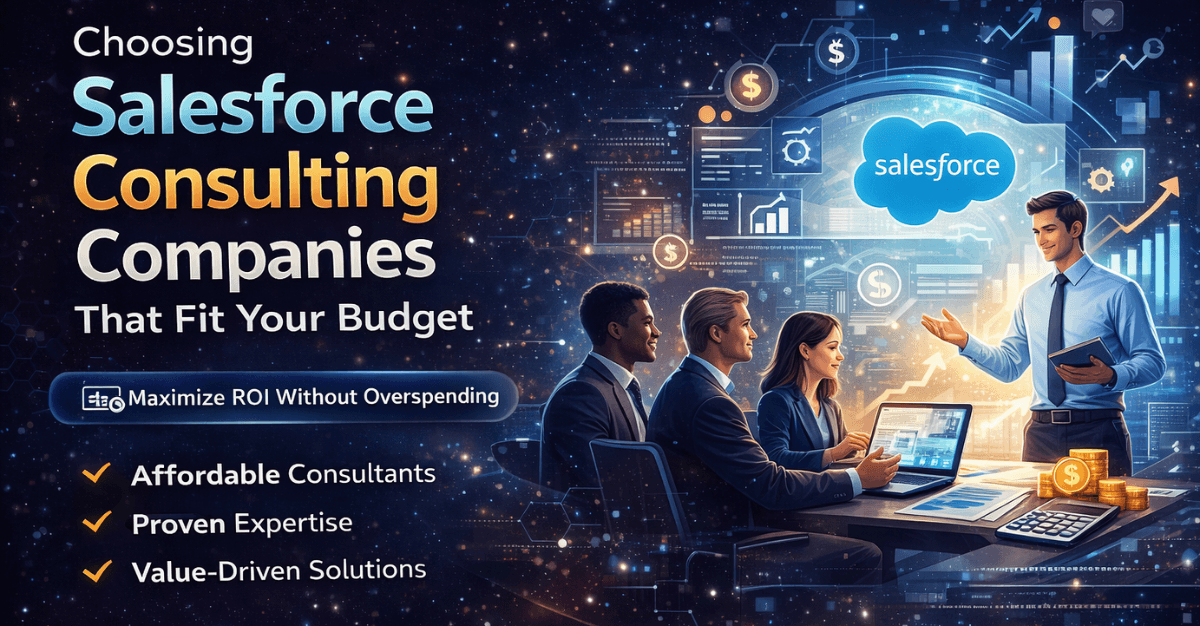
This article will guide you through how to choose Salesforce consulting companies that fit your budget—without sacrificing quality, scalability, or long-term success.
Why Budget Matters in Salesforce Consulting
Before diving into selection criteria, it’s important to understand why budgeting is so critical.
Salesforce consulting costs can vary significantly depending on:
- Project complexity
- Consultant experience
- Geographic location
- Scope of customization and integrations
For example, Salesforce consultants may charge anywhere from $30/hour for freelancers to $250+/hour for top-tier firms.
Without proper planning, costs can quickly spiral out of control.
Step 1: Define Your Business Goals First
The biggest mistake businesses make is starting with vendor selection instead of defining their own needs.
Before reaching out to consulting companies, ask yourself:
- What do we want to achieve with Salesforce?
- Are we implementing, optimizing, or integrating?
- Which teams will use it (sales, service, marketing)?
Clearly defined goals help you:
- Avoid unnecessary features
- Prevent over-customization
- Choose a partner that fits your scope
A strong understanding of your requirements ensures you only pay for what you truly need—not what vendors try to sell.
Step 2: Understand the Full Cost Structure
Budgeting for Salesforce consulting is not just about implementation costs.
You need to consider the total cost of ownership, which includes:
- Licensing fees
- Implementation and customization
- Data migration
- Integration with other systems
- Training and onboarding
- Ongoing support and maintenance
Experts recommend planning for both initial and long-term costs, as ongoing support and upgrades can significantly impact your budget .
Read: Salesforce Consulting Partners vs. Salesforce Implementation Partners - What You Should Know?
Step 3: Choose the Right Pricing Model
Salesforce consulting companies typically offer three pricing models:
1. Hourly Pricing
- Best for small or evolving projects
- Flexible but can become unpredictable
2. Fixed Pricing
- Suitable for well-defined projects
- Offers cost certainty
3. Retainer Model
- Ideal for ongoing support and optimization
- Ensures long-term partnership
Understanding these models helps you select a structure that aligns with your financial planning and project scope.
Step 4: Don’t Always Go for the Biggest Brand
It’s a common misconception that large consulting firms deliver better results.
In reality:
- Large firms often come with higher overhead costs
- Smaller or boutique firms can offer more flexibility and cost-efficiency
In many cases, smaller consulting companies deliver similar quality at a more affordable rate, especially for mid-sized projects .
The focus should be on:
- Expertise
- Relevance to your industry
- Ability to deliver within budget
—not just brand name.
Also read: How to Transform Your Sales Team Performance with a Salesforce Consulting Partner?
Step 5: Evaluate Experience vs Cost
Budget constraints often tempt businesses to choose the cheapest option.
But cheaper is not always better.
A low-cost consultant may:
- Lack experience
- Deliver poor-quality solutions
- Require costly fixes later
On the other hand, highly experienced consultants:
- Charge more upfront
- Reduce long-term risks
- Deliver scalable solutions
The goal is to find the right balance between cost and expertise.
Step 6: Ask for Detailed, Transparent Quotes
A reliable Salesforce consulting company will provide a clear and detailed breakdown of costs.
Your quote should include:
- Scope of work
- Timeline
- Deliverables
- Cost per phase
- Post-launch support
Experts recommend requesting multiple quotes to compare pricing and services transparently .
Avoid vendors that:
- Provide vague estimates
- Hide costs
- Add unexpected charges later
Transparency is a strong indicator of trustworthiness.
Step 7: Plan for Scalability, Not Just Current Needs
Many businesses focus only on immediate requirements to reduce costs.
But this often leads to:
- Rework
- Additional customization later
- Higher long-term expenses
Instead, choose a consulting partner that:
- Designs scalable solutions
- Plans for future growth
- Supports integrations and expansions
A slightly higher upfront investment can save significant costs in the long run.
Step 8: Prioritize ROI Over Cost
Budget is important—but ROI (Return on Investment) is even more critical.
Ask yourself:
- Will this partner help increase efficiency?
- Can they improve sales performance or customer experience?
- Will they reduce manual work and errors?
A good consulting partner ensures that your Salesforce investment delivers measurable business outcomes—not just technical implementation.
Check out: Salesforce Integration - Managing Hidden Costs and Maximising ROI
Step 9: Evaluate Their Approach to Cost Control
A strong Salesforce consulting partner doesn’t just execute—they help you manage costs effectively.
Look for partners who:
- Break projects into phases
- Prioritize essential features first
- Avoid unnecessary customization
- Use pre-built solutions where possible
This approach helps prevent scope creep, which is one of the biggest reasons projects exceed budgets.
Step 10: Consider Long-Term Support and Maintenance
Many businesses overlook post-implementation costs.
But Salesforce is not a one-time project—it’s an evolving system.
Your consulting partner should offer:
- Ongoing support
- Performance optimization
- Feature updates
- User training
Failing to plan for this can result in:
- System inefficiencies
- Poor user adoption
- Increased operational costs
Common Budgeting Mistakes to Avoid
When choosing a Salesforce consulting company, avoid these common pitfalls:
1. Choosing Based on Price Alone
Low-cost solutions often lead to higher long-term expenses.
2. Ignoring Hidden Costs
Training, integrations, and maintenance can add up quickly.
3. Not Defining Scope Clearly
Unclear requirements lead to budget overruns.
4. Skipping Vendor Comparison
Not comparing multiple vendors limits your options.
5. Over-Customization
Custom features increase complexity and cost unnecessarily.
Smart Strategies for Budget-Conscious Buyers
Getting great Salesforce consulting without overspending requires some deliberate strategy on your part.
Also check: 7 Powerful Ways a Salesforce Certified Consultant Adds Value to Your Business
Red Flags to Watch For
Not every consulting firm that presents a polished proposal is the right fit. Be alert to these warning signs.
A proposal that lacks detail or skips the discovery process is a serious concern. Reputable consultants will ask thorough questions about your business before quoting a price. If a firm gives you a fast quote without understanding your needs, they are either underscoping the project (setting you up for change orders) or lack the expertise to know what's involved.
Promises of unusually fast timelines should be treated with skepticism. Proper Salesforce implementations take time to do well. A firm that claims it can deliver a complex implementation in half the time of other vendors may be cutting corners.
High staff turnover on project teams is another risk, especially with larger firms. If your project manager or lead consultant changes mid-engagement, you lose valuable context and continuity. Ask about their team stability and retention rates.
Finally, watch for firms that push you toward unnecessary Salesforce licenses or add-on products. A good consultant recommends what you need, not what earns them the highest commission.
How to Find the Right Fit
To summarize, the right Salesforce consulting company should:
- Align with your budget and goals
- Offer transparent pricing
- Provide relevant experience
- Deliver scalable solutions
- Support long-term growth
Choosing the right partner is less about finding the cheapest option and more about finding the best value for your investment.
Final Thoughts
Salesforce is a powerful platform—but its success depends heavily on the consulting partner you choose.
A well-chosen partner can:
- Optimize your processes
- Improve team productivity
- Deliver measurable business outcomes
A poor choice, on the other hand, can:
- Drain your budget
- Delay implementation
- Create long-term inefficiencies
The key is to approach the decision strategically.
Define your goals, understand your budget, evaluate your options carefully, and prioritize long-term value over short-term savings.
Because in the end, the right Salesforce consulting company doesn’t just fit your budget—it maximizes your investment.
Frequently Asked Questions
1. How do I choose a Salesforce consulting company within my budget?
Start by defining your business goals, comparing multiple vendors, and evaluating their pricing models, experience, and transparency to ensure value for money.
2. What factors affect Salesforce consulting costs?
Costs depend on project complexity, customization needs, integrations, consultant expertise, geographic location, and support requirements.
3. Is it better to choose a cheaper Salesforce consultant?
Not always. Cheaper consultants may lack experience, leading to poor implementation and higher long-term costs. Focus on value rather than just price.
4. What pricing models do Salesforce consulting companies offer?
Common models include hourly rates, fixed pricing, and retainer-based engagement depending on project scope and duration.
5. How can I reduce Salesforce implementation costs?
You can reduce costs by clearly defining scope, avoiding unnecessary customization, using pre-built solutions, and choosing scalable architecture.
6. Why is ROI important when selecting a Salesforce partner?
ROI ensures that your investment delivers measurable business benefits like improved efficiency, better customer experience, and increased revenue.
 Bio
Bio