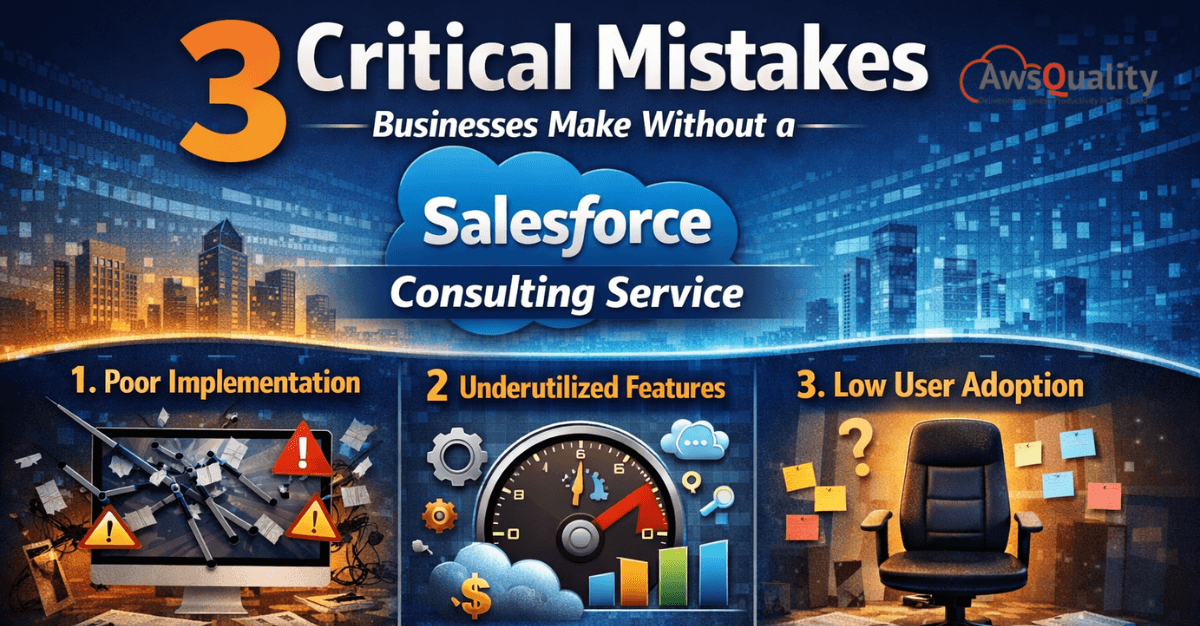
1. Poor Implementation That Creates More Problems Than It Solves
Salesforce is not a plug-and-play tool. It’s a highly customizable ecosystem with thousands of configuration options, workflow automations, integration possibilities, and data architecture decisions. Without a certified Salesforce consultant guiding the process, businesses frequently rush through implementation ? only to end up with a system that is confusing, unreliable, and barely functional.
The most common symptoms of a bad implementation include duplicated data across accounts, broken automation workflows, sales pipelines that don’t reflect reality, and reporting dashboards that produce meaningless numbers. Teams quickly lose faith in the system and resort to spreadsheets and sticky notes ? the very problem Salesforce was meant to solve.
What makes this especially damaging is that fixing a poorly implemented Salesforce org is significantly harder and more expensive than doing it right from the start. You’re not just rebuilding ? you’re also cleaning up months or years of bad data and undoing entrenched habits.
? How to Avoid It:
Engage a Salesforce consulting partner before you begin ? not after things break. A consultant will map your business processes first, then configure Salesforce to mirror them. This “process-first, platform-second” approach prevents costly rework and sets your team up with a system they actually trust.
2. Underutilizing Features ? Paying for a Ferrari but Driving It in First Gear
Most businesses only scratch the surface of what Salesforce can actually do. They use it as an expensive digital rolodex ? storing contacts and logging calls ? while leaving powerful features like Sales Cloud automation, Einstein Analytics, Marketing Cloud journeys, AppExchange integrations, and custom reporting completely untouched.
This isn’t laziness. It’s a knowledge gap. Salesforce is an evolving platform with three major updates per year. Without a dedicated consulting service keeping pace with new features and best practices, businesses are perpetually stuck using yesterday’s version of the tool.
The financial impact is staggering. Consider that the average Salesforce license costs anywhere from $25 to $300+ per user per month. A team of 20 users on a mid-tier plan could be spending $50,000 to $70,000 annually on a tool they are using at 20% of its capacity. That’s not a software problem ? that’s a strategy problem.
- Automation: Salesforce Flow can eliminate hours of manual data entry every week.
- AI-Powered Insights: Einstein Lead Scoring helps your sales team focus on the right prospects.
- Integrated Reporting: Real-time dashboards give leadership the visibility to make faster decisions.
- AppExchange: Hundreds of pre-built integrations connect Salesforce to your entire tech stack.
? How to Avoid It:
A Salesforce consulting service conducts regular platform audits to identify underutilized features relevant to your business goals. They don’t just configure the tool ? they continuously optimize it as your business grows and as Salesforce releases new capabilities.
Read: External Services in Salesforce – Connect Any REST API Without Writing a Line of Apex
3. Neglecting User Adoption ? Technology Without People Is Just Expensive Software
Here’s a hard truth: even a perfectly configured Salesforce instance will fail if your team doesn’t use it. And user adoption is arguably the most overlooked aspect of any CRM deployment. Businesses spend months on technical setup and zero time on the human side ? and then wonder why their sales reps are logging activity inconsistently, managers are pulling numbers manually, and everyone seems to have a different version of the truth.
Poor adoption typically stems from three root causes. First, the system wasn’t built with the end user in mind ? it’s technically correct but practically clunky. Second, there was no formal training, just a “here’s your login” moment. Third, there’s no internal Salesforce champion to reinforce good habits and answer daily questions.
When adoption fails, you lose more than productivity. You lose data integrity. Every activity not logged, every deal not updated, every note not recorded is a gap in your business intelligence. Over time, your Salesforce becomes a graveyard of incomplete information ? making it useless for forecasting, analysis, or strategy.
? How to Avoid It:
Salesforce consultants take a user-centered design approach, ensuring the system is built around how your team actually works ? not the other way around. They also deliver role-specific training, create adoption metrics to track engagement, and help you develop internal Salesforce champions who keep the culture of consistent usage alive long after go-live.
Also read: Apex vs Lightning Web Components – Choosing the Right Salesforce Development Approach
The Bigger Picture: What You’re Really Paying For
When businesses hear “Salesforce consulting service,” they often think about cost. But the better question is: what does it cost not to have one? Failed implementations can cost tens of thousands to repair. Feature underutilization means you’re bleeding subscription fees every month. Poor adoption means your sales data is untrustworthy ? and decisions made on bad data are the most expensive decisions of all.
A qualified Salesforce consulting partner brings certified expertise, cross-industry experience, and a deep understanding of the platform’s evolving capabilities. They act as an extension of your team ? not just for the initial rollout, but for ongoing optimization, training, and strategic guidance as your business scales.
Whether you’re implementing Salesforce for the first time, rescuing a struggling deployment, or simply trying to get more value from a tool you’re already paying for, professional consulting isn’t an optional add-on. For most businesses, it’s the difference between an ROI success story and an expensive cautionary tale.
Final Thoughts
Salesforce has the power to transform how your business acquires customers, manages relationships, and drives revenue ? but only when it’s implemented thoughtfully, used fully, and embraced by your entire team. The three mistakes outlined above ? poor implementation, feature underutilization, and low adoption ? are entirely preventable. They share a single common solution: the right expertise, at the right time.
Don’t wait for things to break before you call for help. The businesses seeing the greatest returns from Salesforce aren’t the ones with the biggest budgets ? they’re the ones with the smartest strategy. And that strategy starts with the right consulting partner by their side.
Ready to Get More From Salesforce?
Stop leaving value on the table. A certified Salesforce consulting service can audit your current setup, close the gaps, and build a roadmap that aligns your CRM with your real business goals.
Frequently Asked Questions
Q1: What does a Salesforce consulting service actually do?
A Salesforce consulting service helps businesses plan, implement, customize, and optimize their Salesforce CRM. Consultants assess your existing business processes, configure Salesforce to match them, train your team, and provide ongoing support to ensure you’re getting maximum value from the platform.
Q2: How do I know if my Salesforce implementation has gone wrong?
Common warning signs include duplicate or missing data, automations that don’t trigger correctly, sales pipelines that don’t reflect real deals, low user login rates, and reports that produce inconsistent numbers. If your team is still relying on spreadsheets alongside Salesforce, that’s a strong red flag.
Q3: Is Salesforce consulting only for large enterprises?
Not at all. Small and mid-sized businesses often benefit the most from consulting services because they have fewer internal resources to manage a complex platform. Many consulting partners offer scalable engagement models ? from one-time audits to ongoing retainers ? that fit a range of budgets.
Q4: How long does a typical Salesforce implementation take with a consultant?
Timelines vary based on business complexity, but a standard implementation with a consulting partner typically takes 6 to 16 weeks. This includes discovery, configuration, data migration, testing, training, and go-live. Rushing this process without expert guidance is one of the leading causes of failed deployments.
Q5: What is the ROI of hiring a Salesforce consulting service?
The ROI varies by business, but companies that work with certified Salesforce consultants typically see higher user adoption rates, faster sales cycles, improved data accuracy, and better utilization of features they’re already paying for. In many cases, the efficiency gains and recovered license value far outweigh the consulting fee within the first year.
Q6: Can a consultant help if we’ve already implemented Salesforce poorly?
Absolutely ? this is actually one of the most common reasons businesses bring in a consultant. A Salesforce rescue or remediation engagement involves auditing your existing org, identifying misconfigurations, cleaning up data, rebuilding broken workflows, and retraining your team. It’s never too late to course-correct.
Q7: How do we improve Salesforce user adoption across our team?
Improving adoption starts with making sure the system is built around how your team actually works. Beyond that, role-specific training, clear internal guidelines on data entry standards, appointing internal Salesforce champions, and tracking adoption metrics (like login frequency and record update rates) all make a measurable difference.
Q8: How do I choose the right Salesforce consulting partner?
Look for a partner with verified Salesforce certifications (such as Salesforce Certified Administrator or Consultant credentials), proven experience in your industry, strong client references, and a discovery-first approach ? meaning they take time to understand your business before jumping into configuration. Avoid any partner who offers a one-size-fits-all solution without understanding your specific needs.
 Bio
Bio