Modern employees depend on technology for almost every part of their work. Email, cloud applications, collaboration platforms, CRM systems, cybersecurity tools, data platforms, and business applications all play a role in day-to-day operations.
When these systems work smoothly, employees can focus on their jobs. When they don’t, productivity quickly suffers.
Slow computers, recurring network problems, application downtime, security incidents, access issues, and delayed IT support may appear to be technical problems, but their impact is fundamentally a business productivity problem.
This is where managed IT providers can make a significant difference.
By proactively managing technology infrastructure, providing ongoing IT support, strengthening cybersecurity, and automating repetitive IT processes, managed IT providers help organizations create a more reliable digital workplace where employees can work efficiently.
The Hidden Productivity Cost Most Businesses Overlook
Every hour an employee spends waiting for a password reset, troubleshooting a slow network connection, or rebooting a system after an unexpected crash is an hour not spent on the work they were hired to do. Multiply that across an organization of 50 or 500 people, and the cumulative productivity loss from IT friction becomes one of the most significant — and most consistently underestimated — drains on business performance.
The numbers are compelling. Organizations that partner with managed IT providers can increase productivity by 15% to 25% through improved efficiency and reduced downtime, according to Research and Markets’ “Market Share Analysis, Industry Trends and Statistics, Growth Forecasts (2025–2030).” The same research shows IT cost reductions of 20% to 30%. CompTIA’s Managed Services Survey documents 25% to 30% increases in productivity attributable to proactive monitoring alone. Aberdeen Group has quantified the total return on investment of managed IT engagement at up to 188%, accounting for the combined effect of downtime reduction, security improvement, and operational efficiency.
The global managed services market exceeded $400 billion in 2025 and continues to grow at a double-digit pace. 94% of small and medium-sized business organizations now use a managed service provider (MSP), according to the State of SMB Cybersecurity 2024 report. The rapid adoption reflects what these organizations are experiencing directly: IT problems that previously consumed internal resources and disrupted employee workflows are being resolved faster, prevented more reliably, and managed more efficiently by specialist providers who do nothing but this.
This guide examines exactly how managed IT providers deliver those productivity gains — the specific mechanisms, the measurable outcomes, and the 10 distinct ways that the right managed IT partnership translates into more productive employees and more competitive businesses.
Read: IT vendor consolidation – when fewer technology partners means better business outcomes
What is a Managed IT Provider?
A managed IT provider — also called a Managed Service Provider (MSP) — is an external company that assumes responsibility for an organization’s IT infrastructure and technology services under a defined service level agreement. Rather than reacting to IT problems after they occur, an MSP proactively monitors, manages, and maintains the organization’s systems, networks, devices, and applications on an ongoing basis.
The scope of services varies by provider and by the organization’s specific needs, but a comprehensive managed IT engagement typically covers:
- Proactive monitoring and maintenance — continuous monitoring of systems, networks, and endpoints with automated alerting and remediation before problems affect users
- Help desk and end-user support — 24/7 technical support for employees encountering IT issues, reducing wait time and resolution time for common problems
- Cybersecurity management — threat monitoring, patch management, endpoint protection, firewall management, and incident response
- Cloud services management — cloud migration, infrastructure optimization, license management, and multi-cloud governance
- Backup and disaster recovery — automated backup, tested recovery processes, and business continuity planning
- Network management — network monitoring, performance optimization, and connectivity management
- Software and license management — patch deployment, software updates, license compliance, and application management
- Vendor management — managing relationships with technology vendors and service providers on the organization’s behalf
The defining characteristic of a managed IT provider is the shift from reactive to proactive IT management — from fixing problems after employees report them to preventing those problems from occurring in the first place.
10 Ways Managed IT Providers Improve Employee Productivity
1. Proactive Monitoring Prevents Downtime Before It Disrupts Work
The single most impactful thing a managed IT provider does for employee productivity is prevent the IT problems that would otherwise interrupt work from occurring in the first place.
Proactive monitoring means that the MSP’s management platform is watching every server, network device, endpoint, and application in real time — tracking performance metrics, capacity utilization, error rates, and security signals. When a metric deviates from its normal baseline — a server’s disk utilization approaching capacity, a network device showing packet loss, an endpoint exhibiting behavior consistent with malware infection — the MSP identifies and addresses the issue before it becomes a disruption visible to employees.
CompTIA’s Managed Services Survey documents 25% to 30% increases in productivity attributable to this proactive monitoring approach alone. The mechanism is straightforward: problems that used to affect employees for hours while internal IT diagnosed and resolved them are now prevented entirely or resolved in minutes while employees are still working normally.
For businesses that have transitioned from reactive to proactive IT management, the most consistent feedback from employees is the same: “Things just work now.” That experience — of technology that works reliably without requiring employee attention — is the foundation of productive work.
2. Faster Help Desk Resolution Reduces Employee Wait Time
When IT issues do occur, the speed with which they are resolved has a direct impact on employee productivity. An employee who waits 45 minutes for a password reset or a software installation is not just losing 45 minutes of work — they are experiencing frustration that affects their engagement and concentration for the remainder of the day.
AI-enabled managed IT providers in 2026 are resolving tickets significantly faster than traditional reactive models. Omdia’s 2026 MSP Trends and Predictions found that among leading MSPs, AI has been credited with 40% to 70% reduction in ticket resolution times. This reduction translates directly into less employee time spent waiting for IT support and more employee time spent doing productive work.
The availability dimension matters equally. A managed IT provider’s help desk is typically available 24/7/365 — providing support to employees who encounter IT issues outside business hours, during remote work sessions, or in international locations where the internal IT team is unavailable. For organizations with remote teams, distributed workforces, or global operations, this continuous availability eliminates the productivity gap that occurs when employees cannot get IT support during non-standard hours.
Ready to deploy WhatsApp in Salesforce? Explore WhatsForce Connect.
3. Employees Focus on Core Work Instead of IT Tasks
One of the most significant but least quantified productivity gains from managed IT engagement is the elimination of technology-related tasks from employees’ daily workflows.
In organizations without adequate IT support, employees at every level spend time on tasks that should not require their attention: troubleshooting software that is not working correctly, updating applications and security software, managing their own backup processes, researching solutions to technical problems, and communicating with vendors and software providers. These tasks consume time that could be spent on the work the employee was hired to do.
A managed IT provider assumes responsibility for all of these tasks. Updates are pushed automatically. Backups run without employee action. Vendor relationships are managed by the MSP. And when a technical problem occurs, the employee reports it and returns to work while the MSP resolves it — rather than spending their own time attempting a diagnosis.
This refocusing is particularly significant for leadership. When internal IT teams are consumed by daily support requests and infrastructure management, they cannot apply their expertise to technology initiatives that drive business growth: system modernization, digital transformation, cloud optimization, and technology-enabled competitive differentiation. A managed IT provider handles the operational layer, freeing internal technology staff — where they exist — for higher-value strategic work.
4. Cybersecurity Protection Prevents Productivity-Destroying Breaches
A cyberattack is not just a security event. It is one of the most significant productivity disruptions any organization can experience. The investigation, remediation, recovery, and regulatory response to a data breach or ransomware attack consumes hundreds of hours of employee time across multiple departments — IT, legal, finance, communications, and executive leadership — at the moment when that time is most needed for operational recovery.
95% of cyberattacks are caused by human error, and managed IT providers reduce the risk of cyberattacks by up to 50%, according to JumpCloud’s MSP statistics analysis. This reduction is delivered through multiple complementary mechanisms: continuous security monitoring that detects threats before they become breaches; endpoint protection that blocks known and behavioral threat patterns; patch management that ensures vulnerabilities are closed before they can be exploited; phishing simulation and security awareness training that reduces the human error rate; and multi-factor authentication enforcement that prevents credential-based attacks.
The productivity benefit of avoiding a security incident is not just the direct employee time saved. It is the avoidance of the reputational damage, customer trust loss, regulatory fines, and operational disruption that security incidents consistently produce at a scale that far exceeds the cost of the preventive security investment.
5. Cloud Management Enables Seamless Remote and Hybrid Work
51% of businesses are planning hybrid work models, according to 2026 MSP industry trends data. Hybrid and remote work are not optional for competitive employers — they are the expectation of the workforce. And the productivity of remote work is entirely dependent on the quality of the technology that enables it.
Managed IT providers configure, manage, and optimize the cloud infrastructure that remote work requires: cloud-hosted applications that perform reliably from any location; virtual desktop infrastructure (VDI) that gives remote employees a consistent, secure desktop environment regardless of the device they connect from; VPN and zero-trust network access configurations that provide secure connectivity without the performance degradation that poorly configured remote access creates; Microsoft 365 and Google Workspace management that ensures email, collaboration, and communication tools work seamlessly across locations; and cloud storage management that gives employees reliable access to files and documents from any device.
For organizations that have not managed their cloud environments systematically, the symptoms are visible in employee productivity metrics: slow application response times when accessing cloud tools from remote locations; inconsistent VPN performance that makes remote work feel like a second-class experience; and file synchronization issues that cause version conflicts and lost work.
An MSP eliminates these friction points by managing the cloud environment to the performance standards that productive remote work requires.
6. Automated Patch Management Eliminates Interruption and Vulnerability
Software updates and security patches are essential for both security and application performance, but in unmanaged environments, they become a source of employee disruption. Updates that run at inconvenient times, require reboots during working hours, or break application compatibility create visible productivity disruptions — and updates that are not applied at all create security vulnerabilities that expose the organization to breaches.
Managed IT providers handle patch management systematically: scheduling updates and reboots outside business hours, testing patches in staging environments before deployment to prevent compatibility issues, and maintaining comprehensive patch status visibility across all managed endpoints to ensure no device falls behind.
For organizations that have measured the impact of unmanaged patch management, the productivity recovery from systematic patch scheduling is consistently notable. Employees no longer experience update reboots during video calls, application compatibility errors after Windows updates, or performance degradation from accumulated deferred maintenance.
Also check: Generative AI in business – where it creates real value and where it falls short
7. Technology Standardization Reduces Training Time and Support Overhead
Organizations that allow technology sprawl — employees using different software, applications, and devices without a standardized configuration — spend significantly more on IT support than those with standardized environments. Every unique configuration is a unique support scenario. Every unsanctioned application is an unknown security risk. Every incompatible tool creates integration friction that reduces the productivity of team collaboration.
Managed IT providers bring standardization to the technology environment: defining a supported hardware and software baseline, managing device enrollment and configuration through mobile device management (MDM), ensuring that every employee’s system meets a consistent performance and security standard, and enforcing license compliance across the software estate.
This standardization directly benefits employee productivity through two mechanisms. First, the standard environment works better because it has been designed and configured for the organization’s specific needs — not accumulated organically as each employee chose their preferred tools. Second, support is faster because support teams understand the environment completely and have documented solutions for every common scenario, rather than diagnosing unique configurations from scratch.
8. Business Continuity Planning Protects Productivity During Disruptions
Not every IT disruption is preventable. Hardware fails. Natural disasters affect data centers. Software vendors experience outages. When these disruptions occur, the difference between an organization that recovers in hours and one that struggles for days is almost entirely determined by the quality of its business continuity planning and backup infrastructure.
Managed IT providers implement and test backup and disaster recovery systems that enable rapid restoration of systems and data after any disruption. This includes automated, tested data backups with defined recovery time objectives (RTO) and recovery point objectives (RPO); documented business continuity procedures that define exactly what steps are taken in each disruption scenario; regular testing of recovery processes to confirm that backups are actually restorable and that recovery procedures work as documented; and failover capabilities that switch critical workloads to backup systems automatically when primary systems fail.
Studies show that companies with effective disaster recovery strategies are significantly more likely to resume operations quickly after an incident — protecting the employee productivity and customer relationships that extended downtime would otherwise damage. Organizations that have worked with MSPs to implement proper business continuity report 60% less annual downtime compared to their pre-MSP experience.
Read: The Future of AI-Powered Customer Support – How Salesforce Service Cloud Leads the Way
9. AI-Driven IT Operations Accelerate Support and Reduce Friction
The 2026 generation of managed IT providers is using artificial intelligence to deliver levels of IT operational efficiency that traditional MSP models could not achieve. AI is changing MSP delivery in ways that directly benefit the end users that MSPs support.
AI-powered monitoring platforms predict failures before they occur by identifying performance degradation patterns that precede actual failures — triggering proactive intervention that prevents the user-visible disruption. AI-driven help desk tools classify and route tickets automatically, match incoming issues with documented solutions from similar past cases, and in some scenarios resolve common issues without any human technician involvement. The result is faster resolution for employees and more efficient use of MSP technician time on issues that genuinely require human expertise.
Omdia’s 2026 MSP Trends and Predictions found that among leading MSPs, AI has been credited with 15% to 25% improvement in technician productivity and 40% to 70% reduction in ticket resolution times. For the employees those MSPs support, this AI-driven efficiency means IT issues are resolved faster and with less friction than at any previous point in the managed services market’s history.
10. Vendor Management Removes Technology Headaches From Internal Teams
Most organizations interact with dozens of technology vendors: hardware suppliers, software vendors, telecom providers, cloud platform providers, security vendors, and application specialists. Managing those relationships — handling procurement, licensing renewals, support escalations, contract negotiations, and service performance reviews — consumes significant time from internal teams who would be more productively employed on their core responsibilities.
Managed IT providers take on this vendor management role as part of their service scope. When an employee’s cloud application is performing poorly, the MSP contacts the vendor, diagnoses whether the issue is on the vendor’s side or the organization’s infrastructure, and manages the resolution — without requiring any employee involvement beyond reporting the original issue. When a software license is due for renewal, the MSP manages the renewal and optimizes the license count based on actual usage. When new hardware is needed, the MSP handles procurement from the specifications stage through delivery and configuration.
This vendor management capability removes a category of overhead that internal teams in understaffed IT environments consistently find time-consuming and distracting from their primary technical responsibilities.
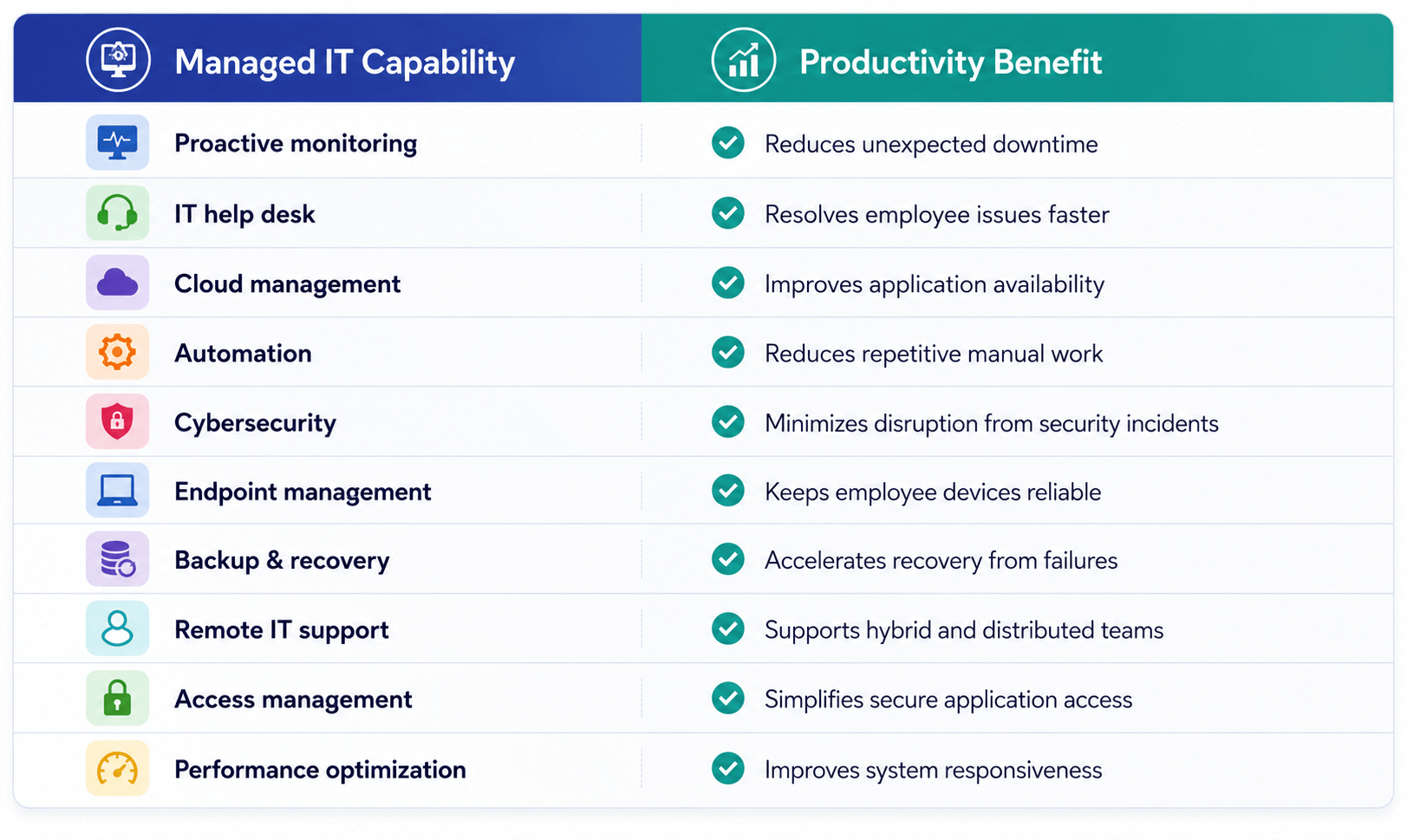
Managed IT Services and Employee Productivity at a Glance
The Financial Case: MSP ROI on Employee Productivity
The productivity improvements delivered by managed IT providers are measurable in financial terms that make the business case for MSP engagement concrete.
Downtime cost reduction: If an organization experiences 10 significant IT incidents per year, each affecting 20 employees for an average of 2 hours, and employee productivity is valued at $50 per hour, the annual downtime cost is $20,000. A 60% reduction in downtime — the improvement documented by organizations with MSP partnerships — eliminates $12,000 of that cost annually, before accounting for the revenue impact of customer-facing service disruptions.
IT cost savings: Organizations using MSPs reduce overall IT costs by 20% to 30%. For an organization spending $200,000 annually on IT — including an in-house IT technician whose total annual cost including salary, benefits, training, and tools reaches $65,000 or more — a 25% cost reduction represents $50,000 in annual savings.
Cybersecurity incident avoidance: The average cost of a data breach in 2025 approached $4.9 million globally. A 50% reduction in cyberattack risk from MSP security management represents substantial financial risk reduction that, while not a recurring cash saving, represents enormous expected value.
Total ROI: Aberdeen Group has quantified the combined return on investment from managed IT engagement at up to 188%, accounting for the integrated effect of downtime reduction, security improvement, and operational efficiency gains across the full service scope.
Also read: Why Platform Engineering Outperforms Traditional Cloud Delivery
The Role of AI in Managed IT Services
AI is making managed IT operations increasingly proactive.
Traditional IT support often follows a reactive model:
Problem occurs → Employee reports it → IT investigates → Problem is resolved
AI-enabled IT operations can move toward:
System monitored → Anomaly detected → Potential issue predicted → Automated or proactive response
AI can support managed IT teams with:
- Anomaly detection
- Ticket classification
- Intelligent routing
- Automated troubleshooting
- Infrastructure monitoring
- Predictive maintenance
- Knowledge recommendations
- Security threat detection
AI-powered automation can also help employees resolve straightforward issues through self-service while escalating more complex problems to human specialists.
The result is not simply fewer IT tickets—it can mean less employee time lost to IT problems.
Which Businesses Benefit Most from Managed IT Providers?
While any business with IT infrastructure and employees benefits from managed IT services, the productivity impact is most significant for specific organizational profiles:
Small and medium-sized businesses without dedicated IT staff.
For a business of 20 to 100 employees with no internal IT team, the employees who encounter IT problems are also the people trying to solve them — consuming time that should be spent on their actual role. An MSP provides enterprise-grade IT management at a cost that no SMB could afford to replicate internally.
Professional services firms where billable time is the core asset.
For law firms, accounting practices, consulting organizations, and similar businesses where employee time billed to clients is the primary revenue driver, any time consumed by IT problems directly reduces revenue. An MSP that reduces IT friction by 20% to 30% increases the billable time available for the same staff.
Organizations with distributed or remote workforces.
The more geographically dispersed an organization’s employees are, the more critical reliable, remotely managed IT infrastructure becomes. MSPs provide the continuous monitoring, cloud management, and remote support capability that distributed work requires.
Organizations in regulated industries.
Healthcare, financial services, legal, and other regulated organizations face compliance requirements that demand documented security controls, audit trails, and data protection standards. Managed IT providers with compliance expertise deliver these requirements systematically, reducing the internal overhead of compliance management.
Businesses experiencing growth.
As organizations add employees, locations, applications, and infrastructure, the complexity of the IT environment grows faster than many internal IT teams can manage. MSPs scale their service delivery with the organization without requiring corresponding increases in internal IT headcount.
How to Measure the Productivity Impact of Managed IT Services
Organizations should measure outcomes rather than simply counting support tickets.
Useful KPIs can include:
Mean Time to Resolution (MTTR)
How quickly are employee IT problems resolved?
System Uptime
How consistently are critical systems available?
First-Contact Resolution Rate
How many support issues are resolved during the initial interaction?
Ticket Volume per Employee
Are recurring technology problems decreasing?
Employee Satisfaction
Are employees satisfied with the quality and speed of IT support?
Time to Provision New Employees
How quickly can a new hire become fully operational?
Recurring Incident Rate
Are the same problems repeatedly disrupting employees?
Automation Rate
How many routine IT activities are completed automatically?
These metrics connect IT performance more directly with employee experience and operational productivity.
Managed IT Provider vs. In-House IT: Which Is Better for Productivity?
It doesn’t always need to be one or the other.
For many organizations, a co-managed IT model can be effective.
Internal IT teams retain responsibility for business-specific technology strategy and high-value projects, while a managed IT provider handles selected operational functions such as monitoring, help desk, infrastructure management, security, or cloud operations.
This approach can provide access to specialized expertise without requiring organizations to build every capability internally.
How to Choose the Right Managed IT Provider
The managed IT provider market includes hundreds of options ranging from local boutique firms to national managed services platforms. The selection criteria that consistently differentiate high-performing MSP partnerships from disappointing ones:
Proactive vs. reactive orientation. The most important question to ask any MSP is: how do you measure your success? An MSP focused on proactive outcomes measures itself by uptime percentages, mean time to detection, patch compliance rates, and security posture scores. An MSP focused on reactive delivery measures itself by ticket volume and resolution time. Proactive orientation produces productivity improvement; reactive orientation produces faster recovery from disruptions that proactive management would have prevented.
Service level agreement specificity. The SLA defines what the MSP commits to delivering. Specific, measurable commitments — response times by severity level, uptime guarantees with financial penalties for violations, defined escalation procedures — indicate an MSP confident in its delivery capability. Vague commitments indicate uncertainty about what can actually be delivered.
Industry and technology stack experience. An MSP that has served organizations in your industry understands the specific compliance requirements, application landscapes, and operational patterns that characterize your business. Ask specifically for references from organizations of similar size in your industry.
Security posture and certifications. The MSP will have access to your organization’s most sensitive systems and data. Evaluate their own security posture: what certifications do they hold (SOC 2, ISO 27001)? How do they manage privileged access? What is their incident response procedure?
Technology platform and tooling. The MSP’s Remote Monitoring and Management (RMM) and Professional Services Automation (PSA) platform determines the quality and efficiency of the service delivery. Modern platforms with AI-driven monitoring, automated remediation, and integrated ticketing indicate an MSP investing in delivery quality. Outdated or fragmented tooling indicates operational constraints that will affect service quality.
How AwsQuality Can Help
Technology should enable employees—not become an obstacle to getting work done.
At AwsQuality, we help businesses create reliable, scalable, and secure technology environments through managed IT and technology services.
Depending on organizational requirements, this can include areas such as:
- IT infrastructure management
- Cloud services
- Application support
- DevOps
- Cybersecurity
- Automation
- Data engineering
- AI solutions
- Digital transformation consulting
By combining technology expertise with a business-focused approach, organizations can reduce operational complexity and create an IT environment that supports employee productivity and long-term growth.
Frequently Asked Questions
How do managed IT services improve productivity?
Managed IT services improve productivity by reducing downtime, resolving technical problems faster, automating routine IT activities, improving system performance, and providing employees with reliable access to business applications.
Can managed IT providers support remote employees?
Yes. Managed IT providers can support remote and hybrid teams through cloud infrastructure, secure connectivity, endpoint management, identity management, collaboration tools, and remote technical support.
Can managed IT services reduce downtime?
Proactive monitoring, preventive maintenance, patching, backup, and infrastructure management can reduce the likelihood and impact of avoidable downtime.
Do managed IT providers replace internal IT teams?
Not necessarily. Many businesses use a co-managed model in which an MSP handles routine or specialized IT functions while internal teams focus on business strategy and transformation initiatives.
How does AI improve managed IT services?
AI can assist with anomaly detection, ticket classification, predictive monitoring, automated troubleshooting, cybersecurity, and self-service support, enabling IT teams to identify and resolve certain issues more efficiently.
Conclusion
Employee productivity is increasingly dependent on the quality of the technology environment surrounding employees.
When systems are unreliable, applications are slow, support takes too long, or employees repeatedly troubleshoot technical problems themselves, valuable working time disappears.
Managed IT providers address this challenge by shifting IT from a primarily reactive function toward a proactive, automated, and service-driven model.
Through proactive monitoring, faster technical support, cloud management, cybersecurity, automation, reliable remote access, and ongoing optimization, managed IT providers can reduce technology friction and allow employees to focus on the work that creates business value.
Ultimately, the value of managed IT services shouldn’t be measured only by the number of servers maintained or tickets closed. The more important question is:
How much easier does your technology make it for your employees to do their best work?
 Bio
Bio