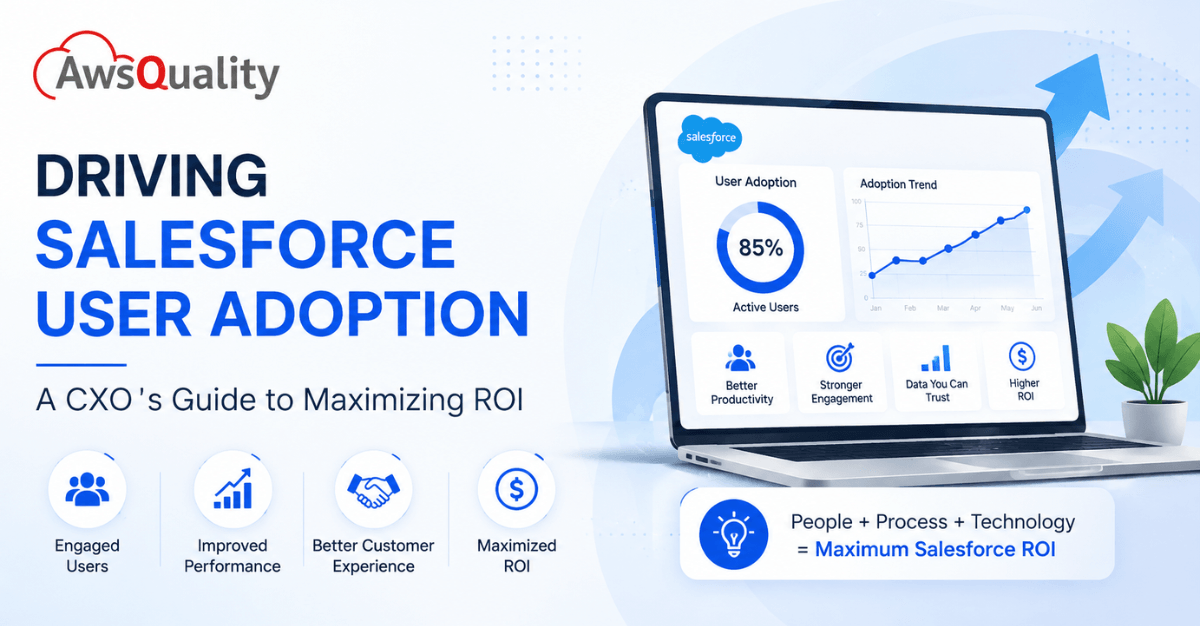
Implementing Salesforce is only half the journey. The real business value comes when your people actually use it.
Organizations invest millions in Salesforce implementation to streamline sales, improve customer experiences, automate workflows, and gain actionable insights. Yet many executives find themselves asking the same question months after deployment:
“Why aren’t we seeing the ROI we expected?”
The answer often isn’t the technology—it’s user adoption.
According to industry research, organizations with high Salesforce adoption consistently achieve better productivity, more accurate forecasting, stronger customer relationships, and higher returns on their CRM investments.
For CXOs, driving Salesforce user adoption isn’t simply an IT initiative. It’s a strategic business priority that directly impacts revenue growth, operational efficiency, and digital transformation success.
In this guide, we’ll explore why Salesforce adoption matters, the biggest barriers organizations face, and practical strategies leaders can implement to maximize ROI.
Read: Top Salesforce Integrations Every Growing Business Needs
Why Salesforce User Adoption Matters
Salesforce is one of the world’s most powerful CRM platforms, but its value depends entirely on how consistently employees use it.
Poor adoption often leads to:
- Incomplete customer data
- Inaccurate sales forecasts
- Low productivity
- Manual workarounds
- Poor customer experiences
- Reduced executive visibility
- Lower return on investment
Conversely, organizations with strong adoption benefit from:
- Better sales performance
- Faster decision-making
- Improved collaboration
- Higher customer satisfaction
- Greater operational efficiency
Technology delivers value only when people embrace it.
Discover WhatsForce Connect, a ready-to-install WhatsApp solution for Salesforce. Learn more.
Why Salesforce Adoption Fails: The Root Causes
Understanding the causes helps leaders build more effective adoption strategies.
Lack of Executive Sponsorship
Employees are far more likely to adopt Salesforce when senior leadership actively supports and uses the platform.
If executives treat Salesforce as “just another IT project,” employees often do the same.
Poor Change Management
Technology implementations frequently focus on configuration while overlooking people.
Without communication, training, and support, resistance is inevitable.
Overly Complex User Experience
Too many fields, unnecessary approvals, and complicated workflows discourage daily usage.
Users want Salesforce to simplify work—not create more work.
Inadequate Training
One-time training sessions rarely create long-term adoption.
Employees need ongoing learning tailored to their specific roles.
Lack of Business Context
Users should understand how Salesforce benefits them—not just the organization.
When employees see personal productivity gains, adoption increases naturally.
Also read: The Ultimate Guide to Salesforce Implementation – Steps, Benefits and Best Practices
The Hidden Cost of Low Salesforce Adoption
Low adoption affects more than CRM usage—it impacts the entire business.
Common consequences include:
Poor Data Quality
If sales teams fail to update opportunities or customer records, leadership loses confidence in reports and dashboards.
Reduced Productivity
Employees revert to spreadsheets, emails, and manual processes instead of leveraging Salesforce automation.
Lower Customer Satisfaction
Incomplete customer information makes it difficult to deliver personalized and timely service.
Slower Decision-Making
Executives rely on outdated or inaccurate data when making strategic decisions.
Lost Revenue Opportunities
Missed follow-ups, inconsistent pipeline management, and poor visibility often result in lower conversion rates.
Check out: 12 Powerful Salesforce Facts and Strategies – Attract and Retain More Clients
Six Strategies CXOs Must Implement to Drive Salesforce Adoption
1. Define Adoption as a Business Outcome — Not a Technology Metric
The first and most fundamental strategic shift required to drive Salesforce adoption is redefining what success means.
Technology adoption metrics — login rates, records created, fields completed — are useful leading indicators but they are not the business outcome. They tell an organisation how much its people are using Salesforce. They do not tell it what Salesforce is doing for the business.
The business outcomes that Salesforce adoption should be measured against are:
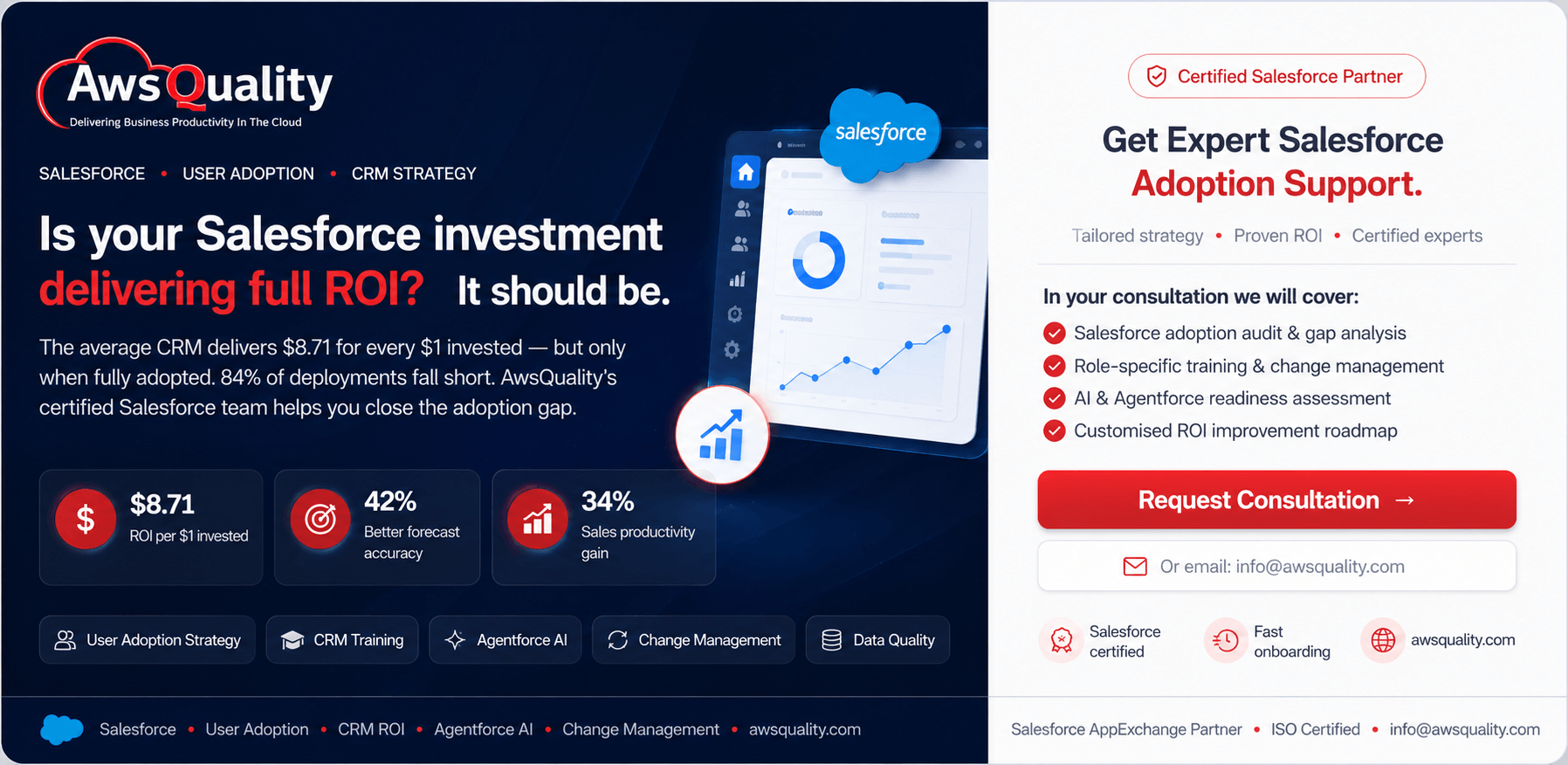
Forecast accuracy: Is the pipeline in Salesforce accurate and complete enough that revenue forecasts derived from it are reliable? Organisations with strong Salesforce adoption improve forecast accuracy by 42%. When forecasts are still built from sales manager conversations and manually assembled spreadsheets rather than from Salesforce pipeline data, adoption has not yet delivered one of its core financial benefits.
Data quality: Are the records in Salesforce complete, accurate, and current? Data quality is the currency of Salesforce ROI. Every downstream capability — AI scoring, automated workflows, marketing segmentation, customer service context — depends on the quality of the data that human adoption creates and maintains. Poor data quality is simultaneously a symptom of insufficient adoption and a cause of it: users who encounter inaccurate data lose confidence in the system and contribute less to it over time.
Feature utilisation: The average organisation uses approximately 50% of its Salesforce capabilities. The ROI lives substantially in the other 50% — in opportunity management, forecast categories, activity logging, automation, case management, Agentforce AI agents, dashboards, and Einstein analytics. Tracking which features are used by which roles, and building targeted adoption campaigns for underutilised high-value capabilities, is a strategic discipline that consistently improves financial return from the platform.
Time-to-productivity for new hires: Organisations that have genuinely adopted Salesforce as a working environment — not just a data repository — accelerate new hire ramp-to-productivity significantly. Improving time-to-productivity by 20 days across a cohort of new hires, at $150 in pipeline value per day per hire, produces a financial impact that is easy to quantify and even easier to justify.
CXOs who define Salesforce adoption success in these business terms — and who review adoption performance at the same level of rigor they apply to any other business performance metric — consistently achieve higher adoption rates than those who treat adoption as an IT project deliverable.
2. Make Salesforce the System of Record — Without Exception
The most reliable signal that Salesforce adoption is being taken seriously at the leadership level is what happens in meetings.
When pipeline reviews are conducted from Salesforce dashboards — and deals that are not in Salesforce are not discussed — every sales professional in the organisation receives a clear and unambiguous message: Salesforce accuracy is a business requirement, not an administrative preference.
When executive decisions about resource allocation, territory planning, and customer prioritisation are made using Salesforce data — pulled directly from reports and dashboards, not from manually prepared presentations — the case for maintaining accurate Salesforce records becomes self-evident to every user.
When all customer interactions are logged in Salesforce within a defined service level — and that expectation is reinforced consistently, not occasionally — the institutional knowledge that currently lives in individual inboxes and personal notes migrates into a shared system of record that compounds in value over time.
Making Salesforce the system of record is not primarily a configuration task. It is a governance decision and a cultural commitment. The organisations that achieve it successfully share a common discipline: parallel systems are not tolerated. If the data is not in Salesforce, it does not exist for business planning purposes.
The transition period — during which teams are required to change ingrained data management habits — involves genuine friction. The compound benefit of a system of record that actually records everything, at enterprise scale, over a multi-year period, is a competitive asset that is genuinely difficult for competitors to replicate.
3. Invest in Role-Specific, Continuous Training
The standard Salesforce training model — a scheduled onboarding session, access to Trailhead, and periodic refreshers — produces predictable adoption outcomes: initial engagement followed by gradual decline as the training becomes disconnected from daily workflow demands.
The training model that produces sustained, high-quality adoption is structurally different in three important ways.
It is role-specific. A sales development representative, an account executive, a customer success manager, a service agent, and a marketing operations manager all use Salesforce differently. They work with different objects, different workflows, different dashboards, and different metrics. Generic platform training that covers “how Salesforce works” in the abstract fails to connect platform capability to the daily decisions each role is trying to make. Role-specific training that walks each function through their specific workflows, their specific dashboards, and their specific contribution to the data quality that the whole organisation depends on produces dramatically higher retention and application.
It is continuous. Salesforce releases major platform updates three times per year. Each release introduces new capabilities, changes to existing features, and enhancements to AI and automation tools. Organisations that treat training as a one-time event at deployment are, within 12 months, running an outdated training model against an evolving platform. Continuous learning — through regular feature adoption campaigns, in-app contextual guidance embedded in the Salesforce interface, peer-learning programmes, and structured refresher training aligned to the release cycle — keeps the user base current with the platform’s expanding capability.
It is outcome-measured. Training completion rates are inputs. Adoption metric improvements are outcomes. Every training investment should be evaluated against a specific adoption metric it is designed to move — and if that metric has not improved within a defined measurement period, the training approach should be revised. This outcome orientation separates organisations that spend on training from organisations that invest in adoption.
4. Build the Right Incentive Architecture
People focus on what gets measured, recognised, and rewarded. Salesforce adoption is no different from any other organisational priority in this respect: if it is not embedded in the incentive structures that govern professional performance and recognition, it will not be consistently prioritised — regardless of how many training programmes, communication campaigns, or executive mandates accompany the rollout.
The organisations achieving the strongest Salesforce adoption have typically built an incentive architecture with three reinforcing layers.
Formal performance accountability: Sales managers whose performance reviews include pipeline data quality, activity logging rates, and forecast accuracy — all derived from Salesforce — have intrinsic motivation to maintain accurate records. When a manager cannot explain poor data quality to their own leadership, it becomes a professional priority in a way that an IT request never could.
Recognition and visibility: Publicly recognising the individuals, teams, or regions that achieve exceptional data quality, highest feature adoption, or most innovative use of Salesforce capabilities creates a cultural signal that platform excellence is valued by leadership. This recognition does not require financial investment — it requires the leadership attention that makes it meaningful.
Gamification: Structured competitiveness around adoption metrics — monthly leaderboards for data completeness, team challenges around forecast accuracy, certification achievement tracking — creates positive peer pressure toward adoption behaviours. Organisations that have implemented gamification in their Salesforce adoption programmes report meaningful and sustained improvements in the metrics targeted, particularly among sales teams whose competitive orientation makes gamification a natural fit.
The common principle across all three layers: adoption behaviours must have visible consequences — positive and negative — that are proportionate to their strategic importance. When Salesforce adoption is treated as an IT compliance requirement, it generates compliance behaviour. When it is treated as a strategic business performance priority, with corresponding measurement, recognition, and accountability, it generates strategic behaviour.
5. Simplify Before You Scale
One of the most counterproductive patterns in Salesforce deployment is the impulse to configure the platform comprehensively before launch — adding every conceivable field, automation, validation rule, and integration that might add value at some future point — and then presenting users with a system of considerable complexity on day one.
The relationship between configuration complexity and adoption rate is inverse. Every unnecessary field is friction. Every validation rule that blocks a save creates resistance. Every workflow that requires understanding before it can be navigated correctly generates support requests, workarounds, and erosion of user confidence. The more complex the initial Salesforce environment, the more cognitive burden is placed on users at the moment they most need simplicity: when they are trying to form new habits around an unfamiliar tool.
The organisations consistently achieving the highest adoption rates share a counterintuitive discipline: they keep Salesforce simple, particularly in the early phases of deployment. They configure the capabilities that deliver the most value for the most users most of the time. They phase complexity in gradually — once core adoption of simpler workflows is established and users are confident in the system — rather than front-loading the full scope of configuration.
The governing principle for Salesforce configuration in the context of adoption is straightforward: every field that cannot be justified by a specific business decision it enables should be removed from user-facing layouts. Every validation rule should be evaluated against the question of whether the data quality improvement it produces is worth the friction it creates for every user who encounters it. Salesforce should function as a tool that makes the user’s job easier — not as a compliance process they must navigate before they can move on to their actual work.
6. Leverage AI to Compound the Return on Adoption
Nowadays, Salesforce adoption strategy has a dimension that represents a genuinely new category of ROI: the AI capabilities that are activated by, and that further reinforce, strong human adoption.
65% of businesses now use CRM systems with generative AI features — and organisations using AI within their CRM are 83% more likely to exceed their sales goals. Agentforce, Salesforce’s autonomous AI agent platform, has reached 29,000 paid deals and is generating documented returns across customer service, sales, and operations. Wiley, a global publishing company, achieved a 213% ROI and $230,000 in documented savings in its first Agentforce deployment. Salesforce’s own internal help portal handles over one million conversations annually with a 75% containment rate — without human escalation.
The strategic implication for CXOs is important and often underestimated. AI features in Salesforce do not simply improve adoption by making the platform more capable — they fundamentally change the ROI equation for the adoption investment. When Agentforce agents are autonomously handling tier-1 service cases, qualifying inbound leads, generating draft proposals, or managing renewal workflows, the value generated by the Salesforce platform extends beyond what human usage rates alone can produce.
This creates a compounding dynamic: strong human adoption builds the data quality and completeness that AI models require to perform effectively. Effective AI performance reinforces the case for human adoption by demonstrating, tangibly and continuously, what the platform is capable of. The two dimensions are not sequential — they are complementary and mutually reinforcing.
CXOs who are generating the strongest Salesforce ROI in 2026 are investing in both simultaneously: building the human adoption disciplines that create the data foundation AI requires, and activating the AI capabilities that deliver value at a scale and speed that human adoption alone cannot achieve.
Also check: Low Salesforce Adoption? Try These 7 Fixes That Work
The Role of AI in Salesforce Adoption
AI is transforming how employees interact with Salesforce.
Capabilities such as predictive insights, automated recommendations, intelligent search, and generative AI reduce manual effort and improve productivity.
By embedding AI into everyday workflows, organizations make Salesforce more valuable for end users while increasing adoption.
Best Practices for Long-Term Adoption
Successful organizations treat Salesforce adoption as an ongoing journey.
Key best practices include:
- Continuous user training
- Regular feedback sessions
- Quarterly system optimization
- Executive sponsorship
- Gamification and recognition
- Process simplification
- Ongoing change management
Adoption should evolve alongside business needs.
Common Mistakes CXOs Should Avoid
Avoid these common pitfalls:
- Treating implementation as the finish line
- Measuring success only by deployment
- Ignoring user feedback
- Over-customizing Salesforce
- Failing to communicate business value
- Delaying optimization after launch
Long-term ROI depends on continuous improvement.
The Metrics That Matter: Measuring Salesforce Adoption at the CXO Level
Establishing the right measurement framework is essential to sustaining Salesforce adoption over time. The following metrics provide CXOs with a comprehensive view of adoption health and ROI trajectory.
Login frequency and active usage: The baseline adoption metric. Track not just whether users are logging in but how frequently, for how long, and across which features. Distinguish between passive logins — where users access Salesforce to retrieve data — and active usage, where they create and update records, work opportunities, log activities, and engage with dashboards.
Record completeness rate: The percentage of key fields completed across Contact, Account, Lead, and Opportunity records. This metric is a direct proxy for data quality — and data quality is the direct determinant of every downstream Salesforce capability. An organisation with 95% field completion rates on Opportunity records has fundamentally different forecasting and AI capability than one with 60%.
Opportunity pipeline coverage: The ratio of pipeline value in Salesforce to the revenue forecast period. Organisations with strong adoption maintain pipeline coverage ratios that provide reliable visibility into future revenue. Organisations with poor adoption consistently struggle to forecast accurately because their pipeline is incomplete.
Activity logging rate: The percentage of sales and service interactions — calls, emails, meetings, proposals — that are logged in Salesforce within the defined SLA. This metric directly reflects whether Salesforce is functioning as the system of record for customer interactions, and whether the institutional knowledge of the organisation is being captured in a shared system or remaining in individual inboxes.
Report and dashboard adoption: The percentage of users actively consuming Salesforce reports and dashboards, and the frequency with which those assets are accessed. Users who reference dashboards are users for whom Salesforce is a decision-making tool — the highest and most valuable form of adoption.
A successful Salesforce implementation doesn’t end at deployment—it depends on long-term adoption, optimization, and continuous improvement.
At AwsQuality, we help organizations maximize the value of their Salesforce investment through:
- Salesforce Consulting Services
- Salesforce Implementation Services
- Salesforce Development Services
- Salesforce Integration Services
- Salesforce Managed Services
- Salesforce Support & Maintenance
- Salesforce Service Cloud Solutions
- AI-Powered Salesforce Automation
Our certified Salesforce experts work closely with your teams to improve adoption, optimize workflows, and ensure Salesforce delivers measurable business outcomes.
Final Thoughts
Salesforce adoption isn’t simply a user training challenge.
It’s a leadership challenge.
Organizations that prioritize executive sponsorship, simplify user experiences, invest in continuous learning, and align Salesforce with business objectives consistently achieve higher returns on their CRM investments.
For CXOs, the goal isn’t just implementing Salesforce.
It’s building an organization where Salesforce becomes an essential part of how teams collaborate, serve customers, and drive growth.
Because the greatest ROI doesn’t come from purchasing better technology.
It comes from helping people use it effectively.
Frequently Asked Questions
Q. Why is Salesforce user adoption important?
High Salesforce adoption improves data quality, productivity, customer experience, forecasting accuracy, and overall return on investment.
Q. What causes poor Salesforce adoption?
Common causes include inadequate training, poor change management, complex workflows, lack of executive support, and unclear business value.
Q. How can executives improve Salesforce adoption?
CXOs should provide executive sponsorship, simplify Salesforce, invest in ongoing training, automate repetitive tasks, and continuously measure adoption metrics.
Q. How do you measure Salesforce adoption?
Key metrics include active users, login frequency, opportunity updates, workflow usage, dashboard engagement, and data quality.
Q. How does AI improve Salesforce adoption?
AI reduces manual work through automation, predictive insights, intelligent recommendations, and personalized user experiences, making Salesforce easier and more valuable to use.
 Bio
Bio