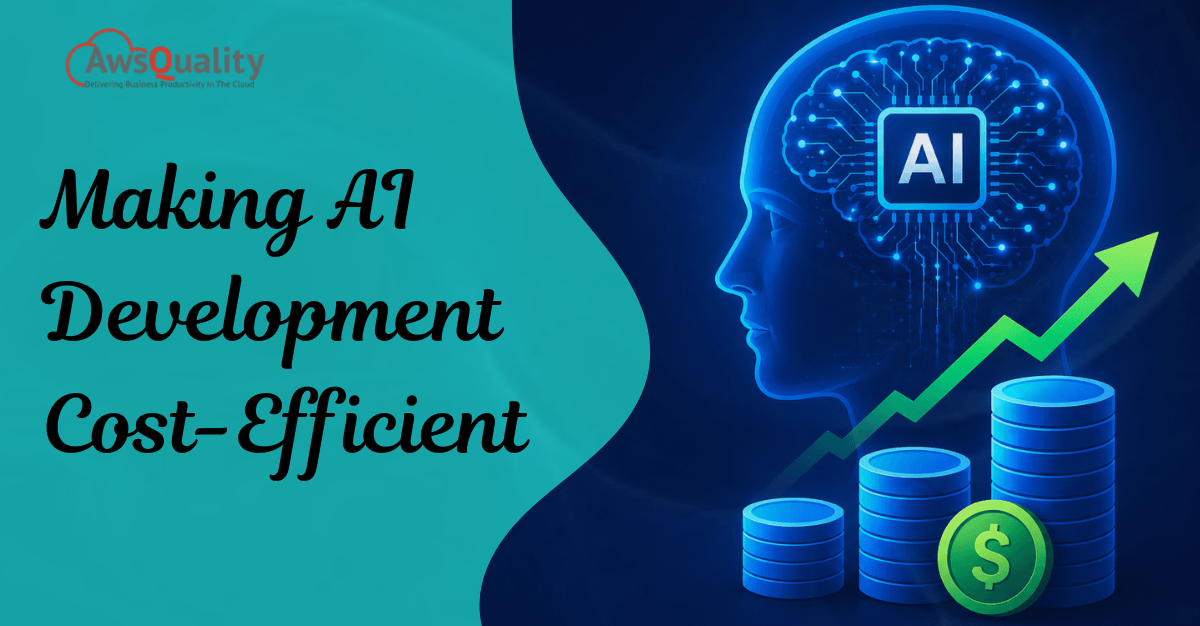
Artificial intelligence is no longer a luxury reserved for tech giants. Startups, mid-sized enterprises, and even non-profits are racing to integrate AI into their products and workflows. But there’s a persistent concern that stops many decision-makers in their tracks: AI development is expensive.
And they’re not wrong — at first glance. Training large language models, hiring specialized talent, licensing proprietary datasets, and maintaining AI infrastructure can cost anywhere from tens of thousands to hundreds of millions of dollars.
So the question becomes: Is it possible to make AI development cost-efficient?
The short answer is yes — but it requires strategic planning, smart tooling choices, and a disciplined approach to resource management. This guide breaks down exactly how organizations of all sizes are making AI development affordable without compromising on performance or scalability.
Read: How to Build Secure AI Systems on Cloud Platforms (Complete Guide)
What Makes AI Development Expensive?
Before exploring cost-saving strategies, it’s important to understand why AI development can be so costly. The major cost drivers include:
- Compute resources: Training and inference on GPUs or TPUs, especially for large models, can incur massive cloud bills.
- Data acquisition and labeling: High-quality labeled datasets are either expensive to license or time-consuming to create manually.
- Talent costs: AI/ML engineers, data scientists, and MLOps specialists command some of the highest salaries in tech.
- Iterative experimentation: AI projects require multiple rounds of testing, fine-tuning, and re-training before reaching production quality.
- Infrastructure and tooling: Building and maintaining model serving pipelines, monitoring dashboards, and CI/CD for ML is non-trivial.
- Compliance and security: Especially in regulated industries (healthcare, finance), meeting data governance requirements adds overhead.
Understanding these cost centers is the first step to controlling them.
Is Cost-Efficient AI Development Really Possible?
Yes — AI development can absolutely be cost-efficient.
Modern technologies, cloud platforms, open-source frameworks, and low-code AI tools have dramatically reduced the barriers to AI adoption. Businesses can now build scalable AI solutions without investing heavily in infrastructure or large in-house AI teams.
The key lies in:
- Choosing the right AI use case
- Starting with smaller implementations
- Leveraging cloud-based AI services
- Using pre-trained models
- Focusing on ROI-driven development
Organizations that approach AI strategically often achieve better outcomes at significantly lower costs.
Also read: How to Build AI-Powered Workflows in Salesforce?
9 proven strategies to make AI development cost-efficient
1. Start with Pre-Trained Models Instead of Training from Scratch
One of the most impactful decisions a team can make is avoiding training large models from scratch. This single choice can save millions of dollars and months of development time.
Pre-trained foundation models — such as open-source LLMs like Meta’s LLaMA 3, Mistral, or Falcon — provide a powerful baseline that can be adapted to specific use cases through fine-tuning or prompt engineering.
Cost Impact:
- Training a GPT-3-scale model from scratch can cost upwards of $4–12 million in compute alone.
- Fine-tuning an existing open-source model on domain-specific data typically costs $500 to $50,000 depending on model size and dataset volume.
Actionable Steps:
- Evaluate whether your use case truly requires a custom model or if an existing model can be adapted.
- Use parameter-efficient fine-tuning (PEFT) techniques such as LoRA (Low-Rank Adaptation) and QLoRA to reduce memory and compute requirements during fine-tuning.
- Leverage Hugging Face Hub to access thousands of pre-trained models across NLP, vision, audio, and multimodal tasks.
2. Optimize Cloud Compute Costs
Cloud computing is both the enabler and one of the biggest budget drains in AI development. Unoptimized cloud usage — idle GPU instances, over-provisioned resources, or missing spot instance strategies — can inflate bills dramatically.
Strategies to Reduce Cloud Spend:
a) Use Spot/Preemptible Instances
Cloud providers (AWS, GCP, Azure) offer preemptible or spot instances at 60–90% discounts compared to on-demand pricing. These are ideal for training jobs that can be checkpointed and resumed.
b) Right-Size Your Resources
Don’t provision a 8xA100 cluster for a task that a single T4 GPU can handle. Profile your workloads first, then provision accordingly.
c) Leverage Reserved Instances
For long-running inference infrastructure, reserved instances (1–3 year commitments) offer significant savings compared to on-demand pricing.
d) Use Serverless Inference
For variable or low-traffic inference workloads, serverless options (like AWS Lambda with ONNX runtime, or Hugging Face Inference Endpoints) eliminate idle compute costs.
e) Choose the Right Cloud Provider
Different providers have different pricing for GPU compute. Lambda Labs, CoreWeave, and Vast.ai often offer significantly cheaper GPU access than hyperscalers for training workloads.
3. Embrace MLOps to Eliminate Waste
Poor process management is one of the most overlooked sources of AI cost waste. Teams that lack proper MLOps (Machine Learning Operations) practices often repeat experiments unnecessarily, fail to reuse existing artifacts, and push broken models to production that require expensive rollbacks.
How MLOps Reduces Costs:
- Experiment tracking (using tools like MLflow, Weights & Biases, or Neptune) ensures that every training run is logged, preventing duplicate work.
- Model registries allow teams to version and reuse previously trained models instead of retraining from scratch.
- Automated pipelines (via Kubeflow, ZenML, or Prefect) reduce manual intervention and human error in the training-to-deployment workflow.
- Continuous monitoring catches model drift early, preventing costly re-training cycles caused by undetected degradation.
A mature MLOps culture can reduce overall AI development costs by 20–40% according to industry benchmarks, primarily by reducing redundant compute and shortening deployment cycles.
4. Build Efficient Data Pipelines
Data is the fuel of AI — but it doesn’t have to be an unlimited expense. Inefficient data handling is a silent cost multiplier: storing redundant copies, processing data multiple times, or paying for data that isn’t even used in training.
Cost-Efficient Data Strategies:/h4< a) Data Minimalism
More data is not always better. Techniques like active learning identify the most informative data points for labeling, reducing the volume of labeled data needed by up to 70%.
b) Synthetic Data Generation
When real-world data is scarce or expensive, synthetic data generated by tools like Gretel.ai, Mostly AI, or even generative models can supplement or replace costly data collection.
c) Data Versioning
Tools like DVC (Data Version Control) ensure your team doesn’t re-process or re-download datasets unnecessarily.
d) Efficient Storage
Use tiered storage strategies — hot storage for frequently accessed training data, cold storage for archival datasets — to reduce storage costs significantly.
e) Leverage Public Datasets
Before purchasing proprietary datasets, explore high-quality public repositories like Hugging Face Datasets, Kaggle, Google Dataset Search, or UCI Machine Learning Repository.
5. Choose the Right Team Structure
Talent is often the single largest line item in an AI budget. The instinct to hire a large, in-house AI team isn’t always the most cost-effective approach — especially for early-stage or mid-market companies.
Smart Team Models:
a) Hybrid Teams
Maintain a small core AI team internally (for institutional knowledge and IP protection) while augmenting with specialist contractors or agencies for specific project phases.
b) Leverage AI Product APIs First
For many use cases, using an API like OpenAI, Anthropic Claude, or Google Gemini is vastly cheaper than building a custom model. A general-purpose AI feature that costs $200/month via API might cost $500,000+ to replicate internally.
c) Offshore and Nearshore Talent
High-quality ML engineering talent is available in Eastern Europe, Latin America, and Southeast Asia at 40–70% of US/UK equivalent rates, without significant quality trade-offs.
d) Use AI to Build AI
Ironically, AI coding assistants (GitHub Copilot, Cursor, Claude) can significantly accelerate ML engineering productivity, reducing the developer hours required per feature.
6. Adopt Efficient Model Architectures
Not every AI problem requires a 70-billion-parameter model. Smaller, specialized models often outperform general-purpose large models on specific tasks — and at a fraction of the inference cost.
Techniques for Model Efficiency:
- Quantization: Reducing the numerical precision of model weights (e.g., from float32 to int8) shrinks model size and speeds up inference by 2–4x with minimal accuracy loss. Tools like GPTQ and bitsandbytes make this accessible.
- Pruning: Removing redundant neurons or attention heads from a trained model reduces its computational footprint without significant performance degradation.
- Knowledge Distillation: Training a smaller “student” model to replicate the behavior of a larger “teacher” model. DistilBERT, for instance, retains 97% of BERT’s language understanding capability at 40% of the size.
- Model Caching and Batching: For inference, caching repeated queries and batching multiple requests together dramatically reduces per-query costs.
7. Define Clear Success Metrics Before You Build
One of the most expensive mistakes in AI development is building the wrong thing. Without clearly defined success metrics upfront, teams spend months iterating toward a vague goal — burning compute, engineer hours, and runway.
Framework for Cost-Efficient AI Planning:
- Define the business problem precisely — not “improve customer experience” but “reduce support ticket resolution time by 30%.”
- Set a performance baseline — what does the current non-AI solution achieve?
- Establish a minimum viable accuracy threshold — what level of model performance is “good enough” to ship?
- Set a compute budget per experiment — cap individual training runs to prevent runaway GPU bills.
- Run a proof-of-concept (PoC) before full development — validate feasibility on a small scale before committing full resources.
This planning discipline alone can eliminate 30–50% of wasted spend that typically occurs in undisciplined AI projects.
8. Monitor and Optimize Continuously in Production
Cost efficiency doesn’t end at deployment. Production AI systems can become expensive fast if left unmonitored — through model drift, traffic spikes, or inefficient serving configurations.
Production Cost Optimization Tactics:
- Auto-scaling: Configure your inference infrastructure to scale down during low-traffic periods. Don’t pay for idle capacity.
- Model caching: Cache responses for common or repeated queries (especially effective in chatbot/RAG applications).
- Tiered routing: Route simple queries to smaller, cheaper models; escalate complex queries to more capable (and expensive) models. This hybrid approach can reduce inference costs by 40–60%.
- Monitoring dashboards: Set cost alerts on cloud spending to catch anomalies before they become budget disasters.
- Regular model audits: Periodically re-evaluate whether your current model is still optimal — a newer, more efficient architecture may deliver the same performance at lower cost.
9. Use Open-Source Tooling Strategically
The open-source AI ecosystem has matured dramatically. For most components of an AI stack, there are production-grade open-source alternatives to expensive proprietary solutions.
| Function | Proprietary Option | Open-Source Alternative |
|---|---|---|
| Model training | Azure ML, SageMaker | PyTorch, JAX, Lightning |
| Experiment tracking | Comet ML | MLflow, Weights & Biases (free tier) |
| Vector database | Pinecone | Qdrant, Weaviate, Chroma |
| LLM serving | OpenAI API | vLLM, Ollama, LM Studio |
| Data labeling | Scale AI | Label Studio, Argilla |
| Orchestration | Databricks | Apache Airflow, Prefect |
Strategic adoption of open-source tools can reduce tooling costs by $50,000–$500,000 annually for mid-to-large AI teams.
Check out: How AI + Cloud Drives Business Growth and Efficiency
Common Mistakes That Increase AI Costs
Overengineering Solutions
Many businesses build overly complex AI systems when simpler automation tools would suffice.
Lack of Data Strategy
Poor data management leads to delays and higher costs.
Ignoring Scalability
Short-term architecture decisions often create expensive technical debt.
Choosing the Wrong Use Cases
AI projects without measurable business value waste resources.
Inadequate Planning
Poor project management increases development timelines and expenses.
Benefits of Cost-Efficient AI Development
Organizations that optimize AI development costs gain several advantages:
Faster Time-to-Market
Cost-efficient approaches accelerate deployment.
Higher ROI
Lower development costs improve profitability.
Better Scalability
Businesses can expand AI initiatives gradually.
Reduced Financial Risk
Smaller investments reduce project uncertainty.
Competitive Advantage
Affordable AI adoption helps businesses innovate faster.
Also check: Responsible and Ethical AI – How to Ensure Compliance, Security, and Transparency in AI Systems
Real-World Examples of Cost-Efficient AI Development
Example 1: Startups Using API-First Approaches
Many successful AI startups (Notion AI, Perplexity, Harvey) built their initial products entirely on top of existing foundation model APIs. This allowed them to ship quickly, gather real user feedback, and optimize spend — without the overhead of training custom models.
Example 2: Fine-Tuning Instead of Building
Companies like BloombergGPT demonstrate a middle path: taking an existing open-source model and fine-tuning it on domain-specific data (in Bloomberg’s case, financial text). The result outperformed general-purpose models on finance tasks at a fraction of the cost of full pre-training.
Example 3: Efficient Inference at Scale
Mistral AI demonstrated that a 7B-parameter model with superior architecture and training data curation could match or outperform much larger models in many benchmarks — proving that thoughtful engineering beats brute-force scale.
Common Myths About AI Development Costs
Myth 1: “You need massive data to build a good AI model.”
Reality: Techniques like few-shot learning, transfer learning, and active learning mean even modest datasets (thousands, not millions, of examples) can yield highly capable specialized models.
Myth 2: “AI development always requires a large team.”
Reality: Small teams with strong MLOps discipline and the right tooling can build and deploy production AI systems that would have required 10x the headcount five years ago.
Myth 3: “Cloud is always cheaper than on-premise for AI.”
Reality: For sustained, high-volume inference workloads, on-premise or co-location hardware can be significantly cheaper than cloud over a 3–5 year horizon.
Myth 4: “Bigger models always mean better results.”
Reality: Smaller, well-trained models consistently beat larger, poorly-trained models on specific tasks. Model quality, data quality, and alignment matter more than raw parameter count.
Frequently Asked Questions
Q.How much does AI development typically cost?
AI development can range from $10,000 for simple solutions to millions for advanced enterprise systems, depending on complexity and infrastructure.
Q. What is the cheapest way to build an AI application?
Using AI APIs like GPT or Gemini with prompt engineering is the most affordable approach since it avoids model training costs.
Q. Can small businesses afford AI development?
Yes. Small businesses can build AI-powered solutions using APIs, no-code tools, and open-source platforms with relatively low budgets.
Q. How can AI inference costs be reduced?
Costs can be reduced using smaller models, caching, batching requests, and auto-scaling cloud infrastructure.
Q. Is open-source AI development cost-effective?
Yes. Open-source AI reduces licensing costs but requires technical expertise to manage infrastructure and deployment.
Looking to leverage AI for smarter automation and business growth? Explore our AI solutions to build intelligent, scalable, and future-ready digital experiences.
Conclusion
Making AI development cost-efficient is not just possible — it’s increasingly essential as AI becomes a competitive necessity across industries. The organizations that will win the AI race aren’t necessarily those with the largest budgets; they’re those that make the smartest architectural decisions, build disciplined development processes, and relentlessly optimize at every layer of the stack.
The key principles to remember:
- Leverage pre-trained models instead of building from scratch.
- Optimize cloud compute with spot instances, right-sizing, and reserved capacity.
- Adopt MLOps to eliminate waste and accelerate iteration.
- Build efficient data pipelines using active learning and synthetic data.
- Structure your team strategically — hybrid, API-first, or augmented with AI tools.
- Choose efficient model architectures through quantization, distillation, and pruning.
- Plan precisely before spending a dollar on compute.
- Monitor continuously in production to prevent cost creep.
- Embrace open-source where it makes engineering sense.
The era of cost-efficient AI development is here. The question isn’t whether you can afford to invest in AI — it’s whether you can afford the strategic and competitive cost of not investing wisely.
 Bio
Bio