Modern businesses face a growing challenge: selling products and services has become more complex than ever. Organizations must manage subscriptions, usage-based pricing, recurring billing, contracts, renewals, revenue recognition, and customer expectations across multiple channels.
Unfortunately, many companies still rely on disconnected systems for sales, finance, billing, and operations. The result is slow quote approvals, billing errors, revenue leakage, compliance risks, and poor customer experiences.
This is where Salesforce Revenue Cloud comes in.
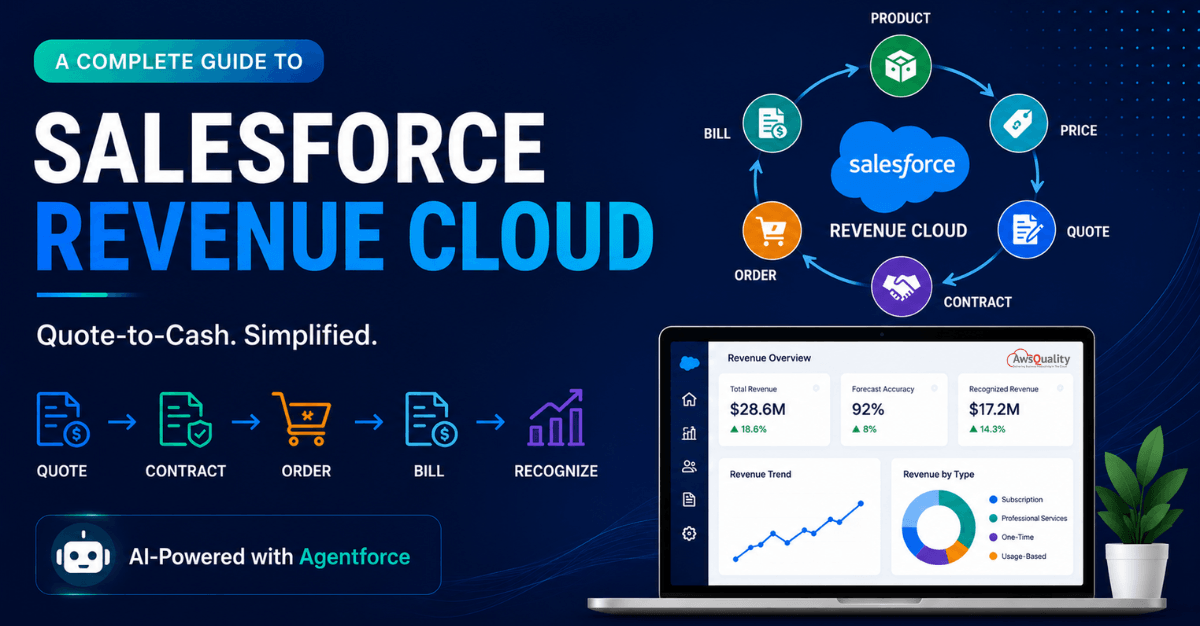
Salesforce Revenue Cloud is designed to unify the entire quote-to-cash process on a single platform. It enables businesses to manage pricing, quoting, contracts, orders, billing, revenue recognition, and renewals from one connected ecosystem.
As Salesforce continues to expand its AI capabilities through Agentforce, Revenue Cloud is becoming one of the most powerful revenue management platforms available to modern enterprises.
What is Salesforce Revenue Cloud?
Salesforce Revenue Cloud is an AI-powered revenue lifecycle management platform built natively on Salesforce. It helps organizations manage every stage of the revenue process—from product configuration and pricing to invoicing and payment collection.
Instead of using separate tools for sales, contracts, billing, and finance, Revenue Cloud brings everything together into a unified system.
The platform is designed to support:
- Subscription businesses
- SaaS companies
- Manufacturing organizations
- Professional services firms
- Telecommunications providers
- Usage-based businesses
- Hybrid revenue models
Whether a company sells one-time products, recurring subscriptions, or consumption-based services, Revenue Cloud helps maintain consistency and accuracy throughout the customer lifecycle.
The Evolution of Revenue Cloud
| Version | When | What Changed |
|---|---|---|
| Salesforce CPQ + Billing | Pre-2023 | Separate products, partial integration |
| Revenue Lifecycle Management | Spring ’24 | Unified platform, new data model |
| Revenue Cloud | 2024–2025 | Full lifecycle, composable architecture |
| Agentforce Revenue Management | Dreamforce 2025 | AI agents embedded throughout revenue process |
Read: Salesforce Sales Cloud vs Service Cloud: Key Differences & Benefits
What Does Quote-to-Cash Mean?
Quote-to-Cash (Q2C) refers to the complete business process that begins when a customer requests a quote and ends when payment is collected.
A typical quote-to-cash process includes:
- Product configuration
- Pricing
- Quote generation
- Contract creation
- Order management
- Billing and invoicing
- Payment collection
- Revenue recognition
- Renewals and expansions
Many businesses struggle because these steps are managed across different systems.
Revenue Cloud eliminates those silos by providing a single source of truth for the entire revenue lifecycle.
The Business Problem Revenue Cloud Solves
Before examining capabilities, it is worth being specific about what Revenue Cloud is solving. The pain points it addresses are concrete and measurable.
Pain Point 1: Manual Quote Creation That Takes Hours and Produces Errors
Manual quote creation takes hours and produces pricing errors. Sales and finance use disconnected systems with duplicate data entry. Approval workflows stall deals for days while waiting on email responses.
When a sales rep must manually configure a complex product bundle, pull pricing from a separate tool, generate a document in Word or PDF, route it via email for approval, and then re-enter the data when the deal closes — every step creates delay and every step creates risk.
Pain Point 2: Revenue Leakage from Missed Renewals, Billing Errors, and Pricing Drift
Subscription businesses lose 3–9% of revenue to leakage depending on billing model — from failed payment gaps, invoicing errors, pricing drift, contract leakage, discount abuse, and revenue recognition gaps.
Pricing drift alone drives roughly 38% of total leakage value. When pricing is managed in spreadsheets or disconnected systems, the price a customer was quoted, the price in the contract, and the price on the invoice frequently diverge. Each divergence is either unrecognized revenue loss or a dispute that damages the customer relationship.
Pain Point 3: Finance and Sales Working from Different Versions of Reality
When CRM, CPQ, order management, and billing systems don’t integrate, teams are forced to manually re-enter data at every stage. This leads to inconsistent customer records, mismatched contract terms, and errors that ripple from quoting through invoicing. Without a single source of truth, sales, operations, and finance operate on different versions of reality, slowing execution and increasing risk.
Pain Point 4: Compliance Risk in Revenue Recognition
For organizations subject to ASC 606 (US GAAP) or IFRS 15 (international), revenue recognition is not optional and not manual. Getting it wrong carries audit risk, restatement risk, and regulatory exposure. Manual revenue recognition processes in spreadsheets are the most common source of these errors.
Revenue Cloud solves all four problems from within a single platform — the same one where deals are already being managed.
Also read: 12 Cloud Tool Strategies from Top Salesforce Consulting Companies
Core Capabilities: What Revenue Cloud Does
1. Product Catalog Management
Define products once — including attributes, bundles, and configuration rules — then deploy them across every sales channel and revenue model. This means a subscription product, a usage-based service, and a one-time professional services engagement can all live in the same catalog, with the appropriate configuration rules enforced automatically at the point of quoting.
The practical benefit: when product information changes — a new pricing tier, a revised bundle, a discontinued SKU — it changes once and propagates everywhere. Sales reps cannot quote products that no longer exist or at prices that are no longer valid.
2. Price Management
Revenue Cloud’s flexible pricing engine supports fixed, tiered, volume, matrix, and attribute-based pricing. It enables discount schedules, approval workflows, and real-time price calculation across all channels.
This is the capability that directly addresses pricing drift — one of the largest single contributors to revenue leakage. When pricing rules are enforced by the system rather than remembered by individuals, the price on the quote matches the price in the contract matches the price on the invoice. Every time.
3. CPQ — Configure, Price, Quote
Guided selling and automated quoting allow sales reps to configure complex products, apply the right pricing, and generate accurate proposals in minutes. Revenue Cloud CPQ supports bundles, dependencies, exclusions, and optional items — all with configuration rules that prevent incompatible combinations from ever reaching a quote.
Organizations typically see 15–25% cycle time reduction and 10–15% revenue improvement after implementing automated quote-to-cash platforms. For sales teams spending hours per quote on manual configuration, this is a direct productivity multiplier — more quotes, faster, with fewer errors requiring rework.
4. Contract Lifecycle Management
Create, negotiate, approve, amend, and renew contracts within a single platform. Revenue Cloud enforces consistent contract terms, automates renewals, and provides a full audit trail for legal and finance teams.
The renewal automation capability alone addresses one of the most common and most preventable forms of revenue leakage: contracts that expire without renewal because nobody was tracking the date. When renewal workflows are automated — triggered a defined number of days before contract expiry, with the appropriate stakeholders notified and the renewal quote pre-generated — missed renewals become a structural impossibility rather than an operational risk.
5. Order Management
Automates order creation and fulfilment workflows from an accepted quote, reducing manual handoffs between sales and operations teams. When a deal closes, the order is created automatically from the quote data — not manually re-entered by someone who was not in the deal conversation.
6. Billing and Invoicing
Revenue Cloud’s native billing engine handles one-time, recurring, and consumption-based charges. It automates invoice generation, payment collection, and dunning management.
For organizations with subscription or usage-based revenue models, this is the capability that most directly replaces a disconnected billing system. Rather than exporting data from Salesforce into a separate billing platform — with all the reconciliation overhead that creates — billing runs natively on the same data model as the quote and the contract.
7. Revenue Recognition
Supports ASC 606 / IFRS 15 compliance through automated revenue schedules and real-time recognition aligned with contract performance obligations. This is the capability that converts Revenue Cloud from a sales execution tool into a finance-grade revenue management platform — and the one that most directly reduces audit risk for organizations with complex multi-element arrangements.
8. Dynamic Revenue Orchestration
API-first architecture orchestrates revenue processes across direct, indirect (partner), and self-service digital channels through a unified data model. This means the same product catalog, pricing engine, and revenue rules apply whether a customer is buying through a direct sales rep, a channel partner, or a digital self-service storefront.
9. Agentforce AI Integration
Built-in AI agents let reps describe what they need in natural language and instantly generate compliant quotes — automatically enforcing configuration rules and pulling correct products, pricing, and terms.
This is the capability that most clearly signals where Revenue Cloud is heading. Rather than a sales rep navigating configuration rules and pricing tables, they describe the deal in natural language and the AI agent generates a compliant quote. The configuration expertise is embedded in the agent — not dependent on the rep’s memory or the accuracy of their manual inputs.
Agentforce and Data 360 combined ARR hit nearly $1.4 billion by Q3 FY26, up 114% year-over-year. The pace of AI adoption inside the Salesforce ecosystem signals that AI-native revenue management is not a future state — it is the current direction of the platform.
10. Analytics and Reporting
Real-time dashboards and reports covering revenue trends, forecast accuracy, sales performance, and contract health — all native to Salesforce with no external BI tool required. When revenue data lives in the same system as pipeline data and contract data, the reporting connects these views without the reconciliation overhead that multi-system environments require.
Check out: The Role of Salesforce Marketing Cloud in Automating Customer Engagement
Key Benefits of Salesforce Revenue Cloud
Unified Revenue Operations
Sales, finance, legal, and operations teams work from the same platform.
This eliminates data silos and reduces reconciliation challenges.
Faster Sales Cycles
Automated quoting and approval workflows help sales teams close deals faster.
Improved Revenue Accuracy
Automation reduces pricing errors, billing issues, and revenue leakage.
Better Customer Experiences
Customers receive faster quotes, accurate invoices, and smoother renewals.
Scalability
Revenue Cloud supports growing businesses with complex revenue models and evolving customer needs.
AI-Driven Productivity
Agentforce AI helps automate repetitive tasks and improve decision-making.
Revenue Cloud Editions: Growth vs. Advanced
Revenue Cloud is available in two editions designed to match different organizational starting points.
Revenue Cloud Growth
Best for: Organisations focused on standard quoting, pricing, and order management.
Includes:
- Product Catalog Management
- Price Management
- Configure, Price, Quote (CPQ)
- Order Management
- Basic Analytics & Reporting
Revenue Cloud Growth is the right starting point for organizations currently managing quotes in spreadsheets or a disconnected CPQ tool, and whose primary pain is quote accuracy, speed, and pricing consistency. It delivers immediate value without requiring the organization to transform its entire billing architecture simultaneously.
Revenue Cloud Advanced
Best for: Subscription, consumption, or hybrid billing with AI and automation.
Includes everything in Growth, plus:
- Contract Lifecycle Management
- Billing & Revenue Recognition
- Dynamic Revenue Orchestration
- Agentforce AI Agents
- Advanced Analytics & Forecasting
Revenue Cloud Advanced is designed for organizations with subscription or usage-based revenue models, multi-channel selling, complex contract structures, or compliance requirements around revenue recognition. It is the full platform — connecting every step from product catalog through to recognized revenue.
Choosing Between Editions
The composable architecture means the choice is not permanent. Start with Growth, validate the value, and expand to Advanced when the business is ready. Complexity that once required heavy customization can now be handled more natively within the platform.
Also check: Salesforce CPQ v/s. Standard Quoting
Industries That Benefit from Revenue Cloud
Revenue Cloud delivers value across multiple industries, including:
SaaS and Technology
Manage subscriptions, renewals, and usage-based pricing.
Manufacturing
Handle complex product configurations and multi-channel sales.
Telecommunications
Support recurring billing and dynamic pricing models.
Professional Services
Manage contracts, project billing, and revenue recognition.
Healthcare
Improve contract management and compliance workflows.
Why Salesforce Revenue Cloud Matters in the AI Era
The future of revenue operations is not just automation.
It is intelligent automation.
Businesses need systems that can:
- Recommend actions
- Predict outcomes
- Automate decisions
- Improve accuracy
Agentforce AI transforms Revenue Cloud from a traditional revenue management solution into an intelligent revenue platform capable of supporting modern business growth.
Revenue Cloud vs. Salesforce CPQ: What’s the Difference?
This is one of the most common questions for Salesforce customers evaluating their options.
| Dimension | Salesforce CPQ (Legacy) | Revenue Cloud |
|---|---|---|
| Scope | Configuration, pricing, quoting | Full quote-to-cash lifecycle |
| Billing | Separate Salesforce Billing product | Native, fully integrated |
| Contract management | Basic | Full CLM built in |
| Revenue recognition | Not included | Native ASC 606 / IFRS 15 |
| AI integration | Limited | Agentforce agents built in |
| Data model | Older architecture | New unified Revenue Cloud data model |
| Roadmap | Legacy — being superseded | Primary investment platform |
Revenue Cloud focused primarily on sales execution. Agentforce Revenue Management connects sales operations with finance processes more tightly. Finance teams gain clearer forecasting based on structured revenue models and better insight into contract changes affecting revenue timing. Sales teams gain structured pricing guardrails without slowing deal velocity.
For organizations currently on Salesforce CPQ, migration to Revenue Cloud is the strategic direction. The new platform’s capabilities — particularly AI integration, contract lifecycle management, and native billing — address gaps that CPQ alone cannot close.
Why Partner with AwsQuality for Salesforce Revenue Cloud
AwsQuality is a certified Salesforce Consulting Partner with deep expertise in Revenue Cloud implementations. We help organisations across the UK, US, Asia, South America, and Australia design, deploy, and optimise Salesforce solutions that drive measurable growth.
Certified Salesforce Expertise
Our team holds multiple Salesforce certifications with specialisation in CPQ, Billing, and Revenue Cloud — the technical disciplines that determine implementation quality.
End-to-End Implementation Ownership
From discovery and design through to deployment, training, and post-go-live support. We do not hand you a configured system and leave — we stay through the first live deals to ensure the implementation works in practice, not just in testing.
Agile Delivery
Rapid, iterative delivery that minimises risk and gets you to value faster. We phase implementations to deliver business value incrementally — the CPQ working and generating ROI before the billing phase begins.
Global Reach, Local Expertise
Offices in Noida, India with clients globally — delivering Salesforce implementation quality at competitive cost for organisations in the UK, US, and international markets.
Ready to discuss your Revenue Cloud implementation? Contact AwsQuality Technologies at https://www.awsquality.com/contact-us/
Final Thoughts
Salesforce Revenue Cloud is more than a CPQ or billing solution.
It is a complete quote-to-cash platform that unifies product management, pricing, contracts, orders, billing, revenue recognition, and AI-powered automation within a single ecosystem.
As businesses continue to adopt subscription models, AI-driven workflows, and digital revenue operations, Revenue Cloud is becoming a critical platform for organizations seeking greater efficiency, accuracy, and scalability.
For companies looking to modernize their quote-to-cash process in 2026, Salesforce Revenue Cloud provides a powerful foundation for sustainable growth and revenue excellence.
Frequently Asked Questions
Q: What revenue recognition standards does Revenue Cloud support?
Revenue Cloud supports ASC 606 (US GAAP) and IFRS 15 (international) compliance through automated revenue schedules and real-time recognition aligned with contract performance obligations, reducing audit risk and manual accounting effort.
Q: How long does a Revenue Cloud implementation take?
Revenue Cloud Growth implementations typically take 12–18 weeks. Revenue Cloud Advanced implementations typically take 20–30 weeks, depending on the complexity of existing product catalog, pricing rules, contract structures, and billing requirements.
Q: Does Revenue Cloud work with existing ERP systems?
Yes. Revenue Cloud’s API-first composable architecture integrates cleanly with existing ERP and financial systems. It is designed to be the revenue management layer that connects to your ERP, not a replacement for it.
Q: What is Agentforce Revenue Management?
Agentforce Revenue Management is the current branding for Salesforce Revenue Cloud, introduced at Dreamforce 2025. It reflects the deeper integration of Agentforce AI agents throughout the revenue lifecycle — allowing sales reps to generate compliant quotes by describing deal requirements in natural language, with the AI automatically enforcing configuration rules and applying correct pricing and terms.
 Bio
Bio