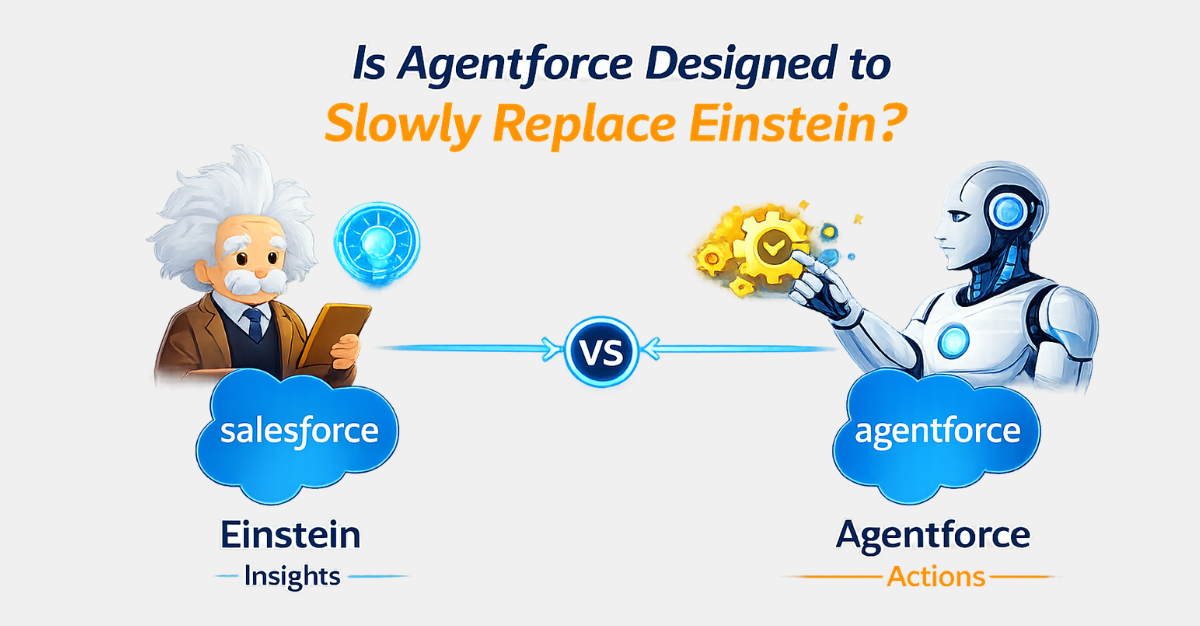
The rapid evolution of artificial intelligence in enterprise software has sparked an important question among Salesforce users and decision-makers:
Is Agentforce replacing Einstein—or are they meant to coexist?
At first glance, it’s easy to assume that Agentforce is simply the “next version” of Einstein. After all, both are part of the same AI ecosystem, both are developed by Salesforce, and both aim to make businesses smarter and more efficient.
But the reality is more nuanced.
This article explores the relationship between Agentforce and Einstein, how they differ, and whether Agentforce is truly designed to replace Einstein—or represent something entirely new.
Read: Unlocking Business Transformation with Salesforce Artificial Intelligence and Salesforce Einstein AI
Understanding the Foundation: What Is Einstein?
To understand the shift, we need to start with Salesforce Einstein.
Einstein, launched in 2016, was Salesforce’s first major step into AI. It introduced capabilities like:
- Predictive analytics
- Lead scoring
- Automated insights
- AI-powered recommendations
Rather than being a single product, Einstein is actually an umbrella of AI features embedded across Salesforce products.
Think of Einstein as:
👉 The intelligence layer inside Salesforce
It analyzes data, identifies patterns, and suggests actions—but typically requires human input to act on those insights.
Enter Agentforce: The Shift to Autonomous AI
Fast forward to 2024–2025, Salesforce introduced Agentforce, marking a significant evolution in its AI strategy.
Salsforce Agentforce is an agentic AI platform—meaning it doesn’t just analyze or recommend actions. It can:
- Execute tasks autonomously
- Interact with systems and users
- Make decisions based on context
In simple terms:
👉 Einstein = “Here’s what you should do”
👉 Agentforce = “I’ll do it for you”
Agentforce enables businesses to deploy AI agents that can handle:
- Customer service interactions
- Sales processes
- Marketing workflows
- Internal operations
This represents a major shift from predictive AI → autonomous AI.
Also read: Salesforce Service Cloud + AI ? Next-Gen Customer Experience
Key Differences Between Agentforce and Einstein
Let’s break it down clearly:
1. Level of Autonomy
- Einstein: Provides insights and recommendations
- Agentforce: Executes tasks independently
Agentforce is designed to operate with minimal human intervention, unlike Einstein.
2. Role in the Workflow
- Einstein: Analyst
- Agentforce: Operator
Einstein helps you understand what’s happening.
Agentforce helps you act on it instantly.
3. Scope of Capabilities
- Einstein is embedded in specific Salesforce clouds
- Agentforce operates across the entire Salesforce ecosystem
This makes Agentforce more flexible and scalable.
4. AI Philosophy
- Einstein → Predictive AI
- Agentforce → Agentic AI
This shift is often described as the third wave of AI in enterprise systems.
Check out: Salesforce AI Agents – The Future of Enterprise Automation
So, Is Agentforce Replacing Einstein?
The Short Answer: No—but it is evolving beyond it.
Agentforce is not a direct replacement for Einstein. Instead, it represents the next layer of AI capability built on top of Einstein.
Here’s why:
1. Einstein Is Still the Foundation
Einstein continues to:
- Power data insights
- Drive predictions
- Feed intelligence into workflows
Even Agentforce relies on data and insights generated by Einstein.
2. Agentforce Builds on Einstein’s Capabilities
Rather than replacing Einstein, Agentforce:
- Extends it
- Enhances it
- Automates its outputs
👉 You can think of Einstein as the “brain”
👉 And Agentforce as the “hands”
3. Salesforce Itself Positions Them as Complementary
Salesforce has clearly indicated that:
- Einstein is the AI intelligence layer
- Agentforce is the execution layer
Both can work together to create a complete AI ecosystem .
Also check: Salesforce Integration Strategy for Modern Enterprises
A Real-World Analogy
To simplify:
Imagine a business team:
- Einstein = Analyst
→ Provides insights, forecasts, and recommendations - Agentforce = Operations Manager
→ Executes tasks, manages workflows, and drives outcomes
You wouldn’t replace the analyst—you’d empower the manager with better insights.
Why Salesforce Introduced Agentforce
The introduction of Agentforce is not about replacing Einstein—it’s about solving a major limitation of traditional AI:
👉 Insight without action
For years, businesses faced a gap:
- AI could predict outcomes
- But humans still had to act
This created:
- Delays
- Inefficiencies
- Missed opportunities
Agentforce closes this gap by:
- Turning insights into action automatically
- Reducing dependency on manual intervention
The Bigger Shift: From Tools to Digital Workforce
Agentforce represents something bigger than just a new feature.
It signals a shift toward:
“AI as a Workforce”
Instead of just assisting humans, AI is now:
- Acting independently
- Handling workflows
- Making operational decisions
In fact, Salesforce has stated that AI now performs 30–50% of internal work across functions like support, engineering, and marketing .
Can Agentforce and Einstein Work Together?
Absolutely—and that’s where the real power lies.
Combined Workflow Example:
- Einstein analyzes customer data
- Identifies high-risk churn customers
- Agentforce automatically:
- Sends personalized offers
- Assigns follow-ups
- Triggers retention workflows
👉 Result: Faster action, better outcomes
Where Einstein Still Matters
Even with Agentforce, Einstein remains critical in areas like:
- Predictive analytics
- Data modeling
- AI insights and reporting
- Recommendation engines
Agentforce depends on accurate intelligence—and that’s Einstein’s role.
Where Agentforce Takes Over
Agentforce shines in:
- Automation of complex workflows
- Real-time decision execution
- AI-driven customer interactions
- End-to-end process handling
It’s especially powerful in:
- Customer service
- Sales automation
- Marketing operations
Check out: How to Transform Your Sales Team Performance with a Salesforce Consulting Partner?
Challenges and Considerations
While Agentforce is powerful, it’s not without challenges:
1. Complexity
Some organizations find Agentforce:
- Complex to implement
- Resource-intensive
2. ROI Uncertainty
Not all AI agent deployments deliver immediate ROI
(as seen in broader AI agent adoption trends)
3. Governance and Control
Autonomous systems require:
- Strong governance
- Clear rules
- Risk management
The Future: Coexistence, Not Replacement
Looking ahead, the future is not about:
❌ Einstein vs Agentforce
It’s about:
✅ Einstein + Agentforce
This combination enables:
- Intelligent insights (Einstein)
- Autonomous execution (Agentforce)
Together, they form a complete AI-driven business platform.
Strategic Implications for Businesses
If you’re using Salesforce, here’s what this means:
1. Don’t Abandon Einstein
Einstein remains essential for:
- Data intelligence
- Predictive capabilities
2. Start Exploring Agentforce
Especially if you want:
- Automation at scale
- Faster execution
- Reduced manual work
3. Build an AI Roadmap
Focus on:
- Where AI can assist
- Where AI can act
- How both layers work together
Final Thoughts
So, is Agentforce designed to replace Einstein?
👉 No—it’s designed to evolve beyond it.
Einstein laid the foundation for AI in Salesforce by making data intelligent.
Agentforce builds on that foundation by making systems autonomous and action-driven.
This is not a replacement—it’s a progression.
The real transformation happens when:
- Insights (Einstein)
- And execution (Agentforce)
…work together seamlessly.
Because the future of enterprise AI is not just about knowing what to do—
👉 it’s about doing it automatically, intelligently, and at scale.
Frequently Asked Questions
1. Is Agentforce replacing Salesforce Einstein?
No, Agentforce is not replacing Einstein. It builds on Einstein’s capabilities by adding autonomous execution, while Einstein continues to provide AI insights and predictions.
2. What is the difference between Agentforce and Einstein?
Einstein focuses on predictive analytics and recommendations, while Agentforce executes tasks autonomously using those insights, making it more action-oriented.
3. Can Agentforce and Einstein work together?
Yes, they are designed to complement each other. Einstein provides data insights, and Agentforce uses those insights to automate workflows and actions.
4. What are the benefits of Agentforce in Salesforce?
Agentforce enables automation of workflows, faster decision-making, reduced manual effort, and improved efficiency across sales, service, and marketing processes.
5. Do businesses still need Einstein if they use Agentforce?
Yes, Einstein is essential for generating accurate predictions and insights, which Agentforce relies on to perform automated actions effectively.
6. What is agentic AI in Salesforce?
Agentic AI refers to AI systems like Agentforce that can independently make decisions and execute tasks, rather than just providing recommendations.
7. When should businesses adopt Agentforce?
Businesses should adopt Agentforce when they want to scale automation, reduce manual processes, and improve operational efficiency using AI-driven workflows.
8. Is Agentforce suitable for all Salesforce users?
Agentforce is best suited for organizations looking to implement advanced automation and AI-driven processes, especially those with complex workflows.
 Bio
Bio