
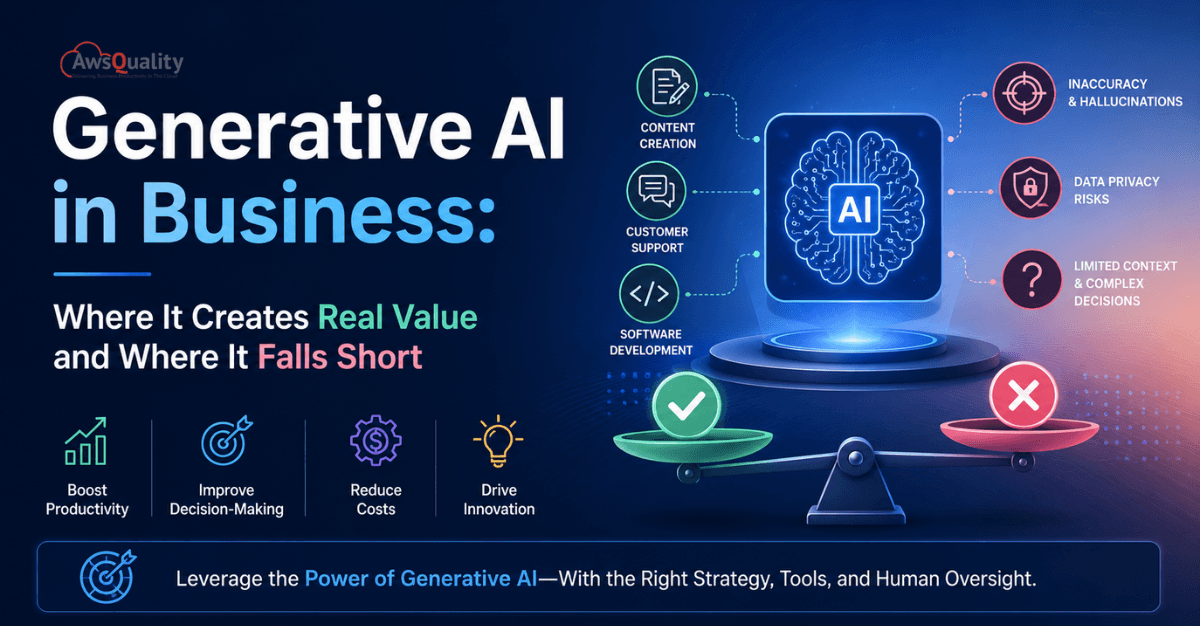
Generative AI has quickly become one of the most talked-about technologies in business.
From content creation and customer service to software development and business analytics, organizations are exploring how tools powered by large language models (LLMs) can improve productivity, reduce costs, and accelerate innovation.
Yet amid the excitement, many businesses struggle to answer a critical question:
Where does generative AI actually create measurable value—and where does it fall short?
The reality is that generative AI is neither a magic solution nor a passing trend. It is a powerful technology with clear strengths, important limitations, and specific use cases where it delivers the highest return on investment.
This article cuts through the hype to give you an honest, grounded view of where generative AI actually delivers for businesses, where it consistently underperforms, and how to think about implementation in a way that protects your investment and your reputation.
What generative AI actually is — and what it isn’t
Before evaluating where generative AI creates value, it helps to be precise about what it is.
Generative AI refers to machine learning models — most notably large language models (LLMs) like GPT-4, Claude, and Gemini, as well as image generators like Midjourney and Stable Diffusion — that are trained on vast datasets and can produce new content: text, code, images, audio, video, and structured data.
What generative AI is not:
- It is not a database. It does not retrieve stored facts reliably — it predicts what text is likely to come next based on patterns learned during training.
- It is not a reasoning engine in the classical sense. It can simulate reasoning convincingly, but its outputs are probabilistic, not logical.
- It is not autonomous. Current generative AI systems require human oversight, prompt design, and output validation to be reliably useful.
- It is not a replacement for domain expertise. It augments experts — it does not substitute for them.
Understanding these boundaries is the starting point for every sound generative AI business decision.
Where generative AI creates genuine, measurable business value
1. Content creation and knowledge work acceleration
This is the clearest, most validated use case for generative AI in business today. Knowledge workers — marketers, sales teams, legal teams, HR departments, engineers — spend enormous amounts of time producing first drafts: emails, reports, proposals, documentation, summaries, presentations, job descriptions, product descriptions, blog articles.
Generative AI dramatically compresses the time from blank page to usable first draft. Studies across industries consistently show productivity gains of 30–50% for writing-heavy tasks when generative AI is used effectively.
The key word is “first draft.” Generative AI produces material that still requires human review, editing, and judgment — but removing the blank-page problem is itself enormously valuable for most organizations.
Real business applications that work well:
- Marketing content: campaign copy, social media posts, email sequences, ad variations
- Sales enablement: proposal drafts, RFP responses, follow-up email templates
- Internal documentation: SOPs, policy documents, onboarding materials
- Customer communications: FAQ content, support article drafts, product descriptions
- HR: job descriptions, performance review frameworks, training material outlines
2. Customer service and support automation
Generative AI has meaningfully changed what is possible in customer service. Traditional chatbots were rigid — they followed decision trees and failed the moment a customer asked something outside the script. Generative AI-powered support agents can understand natural language, handle novel queries, synthesize information from multiple sources, and produce coherent, contextually appropriate responses.
For businesses with high support volume and relatively well-documented products or services, AI-powered support can:
- Handle tier-1 inquiries without human intervention — reducing cost per contact by 40–60% in documented deployments
- Provide 24/7 coverage without staffing costs
- Maintain consistent tone and accuracy across thousands of simultaneous conversations
- Escalate to human agents with full conversation context, reducing handle time
The caveats are real: AI support agents require careful prompt engineering, guardrails to prevent hallucination, integration with your actual knowledge base, and ongoing monitoring. But the value is proven and replicable at scale.
3. Software development acceleration
For engineering teams, generative AI — particularly coding-focused tools like GitHub Copilot, Cursor, and Claude — has become one of the most impactful productivity tools in years. Research from GitHub found that developers using Copilot completed tasks up to 55% faster than those who did not.
Where coding AI genuinely helps:
- Boilerplate and repetitive code generation
- Writing unit tests (historically one of the most time-consuming and neglected tasks)
- Code explanation and documentation
- Debugging assistance — explaining error messages, suggesting fixes
- Converting code between languages or frameworks
- Drafting API integration code from documentation
Senior engineers particularly benefit: they can offload mechanical work and focus cognitive energy on architecture decisions, complex problem-solving, and code review.
4. Data analysis and insight extraction
Generative AI has made data more accessible to non-technical business users. Natural language interfaces layered over databases and analytics tools allow business users to ask questions in plain English and receive structured analysis, summaries, and visualizations — without writing SQL or waiting for a data analyst.
This democratization of data access has real value for:
- Executive reporting: summarizing large datasets into narrative insights
- Sales analysis: identifying patterns in CRM data without analyst involvement
- Operational reporting: flagging anomalies and generating explanations
- Research synthesis: summarizing long documents, reports, or research papers
5. Personalization at scale
Generative AI enables a level of personalization that was previously only achievable with large content teams. E-commerce, SaaS, and financial services businesses are using it to:
- Generate personalized product recommendations with natural language explanations
- Tailor email campaigns to individual customer segments dynamically
- Create personalized onboarding experiences based on user profile and behavior
- Produce localized content across multiple markets simultaneously
6. Internal knowledge management
Many large organizations have vast amounts of institutional knowledge trapped in documents, emails, wikis, and the heads of long-tenured employees. Generative AI — specifically retrieval-augmented generation (RAG) architectures, where an LLM is connected to your internal document store — can make this knowledge searchable and conversational.
Employees can ask natural language questions and receive accurate, source-cited answers drawn from internal documentation. This is particularly valuable for:
- Legal and compliance teams navigating complex policy documents
- Sales teams needing quick access to product specifications and pricing
- HR teams answering policy questions
- Customer-facing teams needing real-time access to technical documentation
Where generative AI consistently falls short
1. Tasks requiring verified factual accuracy
Generative AI hallucinates. This is not a bug that will be patched in the next release — it is a fundamental characteristic of how large language models work. They predict the most plausible next token based on training patterns, which means they can produce confident, fluent, entirely fabricated information.
This makes generative AI dangerous — not merely imperfect — for any task where factual accuracy is non-negotiable without human verification:
- Legal documents and contracts
- Medical advice and clinical decision support
- Financial calculations and regulatory filings
- Scientific research and citations
- News reporting and factual journalism
Businesses that deploy generative AI in these domains without robust human review processes are not innovating — they are creating liability.
2. Complex, multi-step reasoning and judgment
Generative AI can simulate reasoning impressively in isolated tasks. It struggles significantly with tasks that require sustained, multi-step logical reasoning over complex, interdependent variables — particularly when those variables involve real-world constraints, edge cases, and domain-specific nuance that was not well-represented in training data.
This means it is poorly suited, without extensive human oversight, for:
- Complex financial modeling and scenario analysis
- Legal strategy and case assessment
- Medical diagnosis and treatment planning
- Engineering design decisions with significant safety implications
- Strategic business decisions involving ambiguous, high-stakes trade-offs
3. Real-time and proprietary data tasks — without integration
Out-of-the-box generative AI models have a training cutoff — they do not know what happened last week, last month, or in your business specifically. Without integration to live data sources (via RAG, APIs, or tool use), a generative AI system cannot answer questions about your current inventory, your latest sales figures, your live customer data, or recent industry developments.
This is solvable — but it requires engineering investment. Businesses that expect generative AI to be plug-and-play for data-dependent tasks without that investment will be disappointed.
4. High-stakes, irreversible decisions
Generative AI is excellent at generating options, drafting content, and synthesizing information. It is poorly suited to making high-stakes, irreversible decisions — not because it always produces the wrong answer, but because its outputs cannot be trusted without verification, and the cost of an unverified wrong answer in these contexts is too high.
Any process where an error cannot easily be undone — financial transactions, legal commitments, medical interventions, public communications — requires human decision authority. Generative AI can inform the decision; it should not make it autonomously.
5. Consistent brand voice and nuanced cultural judgment
Generative AI produces fluent, grammatically correct text — but it often lacks the specific voice, tone, and cultural sensibility that defines a brand. Without significant prompt engineering, fine-tuning, and editorial oversight, AI-generated content tends toward a recognizable sameness: competent, inoffensive, and somewhat generic.
For brands where distinctive voice is a competitive differentiator — premium consumer brands, professional services firms, media companies — generative AI is a productivity tool for their writers, not a replacement for them.
6. Tasks requiring genuine creativity and originality
Generative AI is extraordinarily good at recombining, remixing, and interpolating from its training data. It is not genuinely creative in the sense of producing ideas that are truly novel, counter-intuitive, or culturally ahead of the curve. Its outputs reflect the distribution of its training data — which means it is excellent at producing competent, conventional work and significantly worse at producing genuinely original thinking.
For innovation-dependent work — breakthrough product strategy, avant-garde creative direction, genuinely novel research — generative AI is a tool, not a collaborator.
Common Business Mistakes When Implementing Generative AI
Chasing Hype Instead of Business Value
Many organizations adopt AI because competitors are doing it.
Successful companies focus on measurable outcomes.
Automating Everything Too Quickly
Not every process should be AI-driven.
Identify areas where AI creates genuine value.
Ignoring Governance
Without clear policies, AI adoption can introduce unnecessary risk.
Neglecting Human Oversight
AI works best when humans remain involved.
Expecting Immediate ROI
AI maturity takes time.
Pilot programs and gradual implementation often deliver better results.
The hidden risks businesses frequently underestimate
Data privacy and confidentiality
When employees use public generative AI tools — ChatGPT, Claude.ai, Gemini — and paste in proprietary data, customer information, or confidential business content, that data may be used for model training or exposed to the vendor. This is a significant risk that many organizations have not adequately governed.
Enterprise AI deployments require data processing agreements, private model instances, or careful policy enforcement around what data can and cannot be submitted to AI tools.
Over-reliance and skill atrophy
When generative AI handles first drafts, code, and analysis automatically, the human muscles that produced that work can atrophy. Junior employees who never learn to write, think analytically, or code from first principles may eventually lack the judgment to evaluate AI outputs effectively. This is a long-term organizational risk that is easy to ignore in the short term.
Regulatory and compliance exposure
The regulatory landscape around generative AI is moving quickly. The EU AI Act, sector-specific guidance from financial regulators, and emerging data protection rulings are creating a compliance surface that businesses deploying AI need to actively manage. Organizations that move fast and ignore governance are accumulating regulatory risk alongside technical debt.
Model dependency
Building critical business processes on top of a specific third-party AI model creates dependency. Models change, APIs deprecate, pricing shifts, vendors get acquired. Businesses that have deeply embedded a specific model without architectural flexibility may face costly migration challenges.
Best Practices for Using Generative AI in Business
Start with High-Impact Use Cases
Focus on:
- Customer service
- Content creation
- Knowledge management
- Sales productivity
Keep Humans in the Loop
Human review remains essential for:
- Accuracy
- Compliance
- Quality control
Establish AI Governance
Define:
- Data handling policies
- Security standards
- Approval processes
- Responsible AI guidelines
Measure Results
Track metrics such as:
- Productivity gains
- Time savings
- Cost reductions
- Customer satisfaction
- Revenue impact
Invest in Training
Employees need guidance on:
- Prompt engineering
- AI limitations
- Validation practices
- Responsible usage
A practical framework for evaluating generative AI use cases
Before deploying generative AI in any business process, evaluate it against these five questions:
1. What is the cost of a wrong output?
If an error in this process is easily caught and corrected, AI is lower risk. If an error could cause financial, legal, reputational, or safety harm, the human oversight requirements are higher.
2. Can the output be verified efficiently?
AI is most valuable when a human can review and validate its output faster than they could produce it from scratch. If verification takes as long as original production, the productivity case weakens significantly.
3. Does the task require current or proprietary data?
If yes, plan for the integration work required to connect the AI to live, accurate data sources — or reconsider the use case.
4. Is this a high-volume, repeatable task?
Generative AI delivers the greatest ROI on tasks that are performed frequently, are relatively well-defined, and currently consume significant human time. One-off, highly specialized, or highly variable tasks are harder to automate effectively.
5. What governance and oversight do you have in place?
AI deployment without governance is not innovation — it is risk-taking. Define who reviews AI outputs, how errors are caught and corrected, how data privacy is protected, and how compliance is maintained before you deploy.
The Future of Generative AI in Business
Over the next few years, generative AI will become increasingly integrated into everyday business workflows.
Key trends include:
AI Agents
Autonomous agents capable of executing multi-step tasks.
Hyper-Personalization
More personalized customer experiences at scale.
AI-Powered Enterprise Search
Knowledge retrieval will become conversational.
Intelligent Process Automation
Combining AI with workflow automation platforms.
Industry-Specific AI Models
Organizations will increasingly use specialized AI trained for specific domains.
Frequently Asked Questions
Is generative AI worth investing in for businesses?
Yes, when applied to the right use cases. Content creation, customer service, software development, and knowledge management often deliver strong ROI.
Can generative AI replace employees?
Generally, no. Generative AI is best used to augment employees rather than replace them entirely.
What are the biggest risks of generative AI?
The primary risks include hallucinations, data privacy concerns, compliance issues, bias, and overreliance on AI-generated outputs.
Which industries benefit most from generative AI?
Healthcare, finance, retail, manufacturing, technology, education, and professional services are all finding valuable applications for generative AI.
Final Thoughts
Generative AI is a genuinely transformative technology. It is also a technology that is being deployed with more speed than judgment in many organizations — leading to productivity gains in some areas, wasted investment in others, and accumulated risk in too many.
The businesses that will win with generative AI over the next five years are not the ones that adopted it fastest. They are the ones that adopted it most thoughtfully — identifying the use cases where it genuinely moves the needle, governing it rigorously, integrating it deeply with their data and workflows, and maintaining the human expertise to validate, guide, and improve its outputs over time.
Technology should solve real business problems. Generative AI can — when it is applied to the right problems, in the right way, with the right oversight.
 Bio
Bio